When I was growing up in the 80s and early 90s, a lot of people called me a gym rat. My dad was a high school basketball coach by profession, so most of those years you could find me hanging out in the gym practicing basketball, watching basketball, just doing anything I could related to the game. I guess you could also have called me a video store rat, because if I wasn’t at the gym, I wanted to be browsing the inventory of our local video stores looking for that perfect movie to rent and take home. I remember often seeing the VHS box for MONKEY SHINES: An Experiment in Fear on those shelves, but I never had the nerve to rent it. You see, I wasn’t big on horror movies back in those days so a movie might intrigue me, but if it looked kind of scary I’d usually pass. This year’s Horror-Thon has been all about watching horror movies and thrillers for the first time. When I recently saw the title MONKEY SHINES on one of my streaming services, I knew it was finally the right time to check it out!
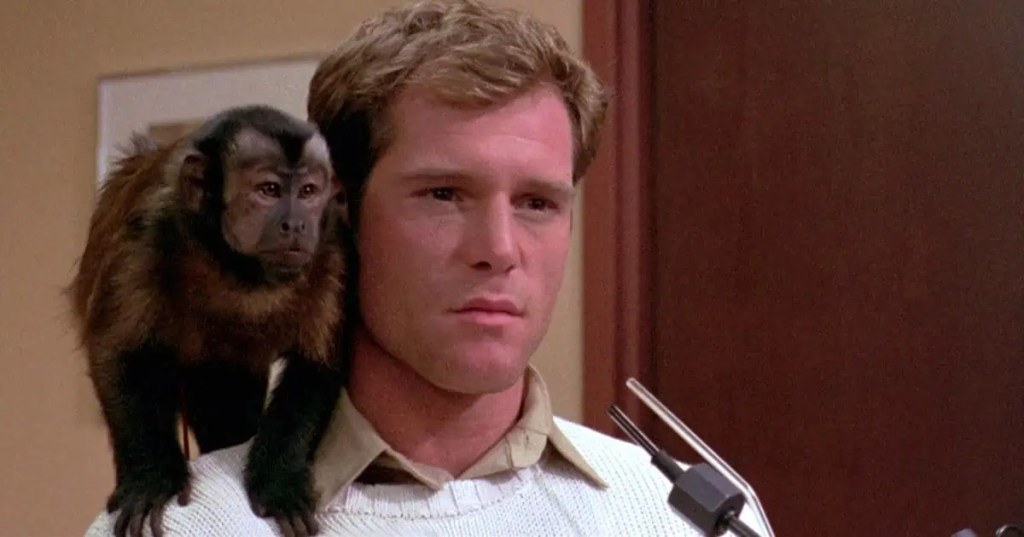
The film stars Jason Beghe as Allan Mann, a young man who’s hit by a truck while he’s out jogging one morning. This accident leaves him paralyzed from the neck down, and he finds himself having to depend on other people for just about everything. Understandably, he doesn’t handle this new life very well emotionally, even going so far as trying to kill himself. Enter Ella, a cute little monkey trained to assist people with disabilities. At first, Ella is a tremendous help with Allan’s attitude improving as she helps him gain a little independence. But unknown to Allan, Ella has been the subject of experiments involving human brain tissue, and their connection becomes something more than anyone could have anticipated. Soon, when Allan has bad thoughts about someone, something bad happens to them. When Allan gets too close to someone, something bad happens to them. With this, the little monkey who was making Allan’s life so much better begins turning it into a living hell.
MONKEY SHINES was written and directed by George A. Romero. Considering his place in horror history, I was certainly interested in seeing what he had come up with here. I do have to admit though, that I haven’t watched much of his work before. Looking at his filmography, I think I’ve only seen NIGHT OF THE LIVING DEAD, CREEPSHOW, and THE DARK HALF, which I saw at the theater and didn’t even like. But still, the man is a legend, and I knew this would be another good chance to appreciate his work while expanding my own vast film watching history.
One of the things I appreciated about the film is that Romero really takes his time establishing the characters and situation before jumping into the horror elements. Allan seems like a good guy with such a promising future, only to have it all changed so suddenly. We understand why he’s struggling so much, and we’re also happy for him as we see his spirits lifted through Ella, as well as her beautiful trainer Melanie Parker (Kate McNeil).
We get to see how Allan’s accident affects the people that knew him before the accident, like his best friend Geoffrey (John Pankow) and girlfriend Linda (Janine Turner). We also meet the brand new people in his life, like Melanie and his live-in nurse, Maryanne (Christine Forrest). In essence the film has taken its time establishing the people who have treated Allan well, and those who haven’t, which adds to the emotional stakes once the horror finally starts kicking in. It might be fair to criticize Romero for taking too long to get to the action, but for me, a little patience pays off with this one.
I think Jason Beghe does a good job as Allan. His character has a lot of highs and lows throughout the film, and he seems to navigate the emotions well enough that I was still pulling for him, even if he did act like a jerk at times. I don’t watch a lot of TV, but Beghe’s career is still going strong to this day as he plays the lead in the hit series CHICAGO PD. And then there’s Ella, the cute little capuchin monkey played by Boo, who gets an “introducing” credit in the film. I laughed and smiled with Allan as she came into his life and made things so much better at first. One of the more effective things about the movie is the sense of dread that comes from knowing that joy cannot last.
As far as the supporting cast, I think I most appreciated John Pankow’s performance as the best friend. He’s one of those guys who loves his buddy, but he’s morally compromised and has so many self-medicating vices that he ends up screwing up other people’s lives while taking himself down. One of the things I love about watching 80s movies is seeing who pops up in the more minor roles. Here we get Stanley Tucci as a sleazily arrogant doctor and Stephen Root as the cruel head of an animal research lab.
I’d say if the movie does falter, it would be in its ending. Rather than following through on the more grounded, psychological story it had been telling, it seems to push things in a direction that’s pretty far over-the-top. I wanted the ending to feel like a natural progression of everything that had come before, but instead, it felt like the movie was going for more crowd-pleasing theatrics. With that said, it was still very effective when Allan, with all his physical limitations and vulnerability, was truly forced to defend himself. I’ve read that the studio got involved with the ending, interfering with Romero’s original vision, but I can only judge the finished product. It didn’t ruin the film by any stretch, but the change in tone is very noticeable.
My final verdict on MONKEY SHINES is that it’s an effectively dramatic horror film with an interesting premise, a good central performance, and a talented director who knows how to tell a story while building up a sense of dread, even if its ending didn’t land perfectly. Looking back now, I’m glad this video store rat finally took that box off the shelf.


