Review: Tropic Thunder (dir. by Ben Stiller)


“A nutless monkey can do your job.” — Les Grossman

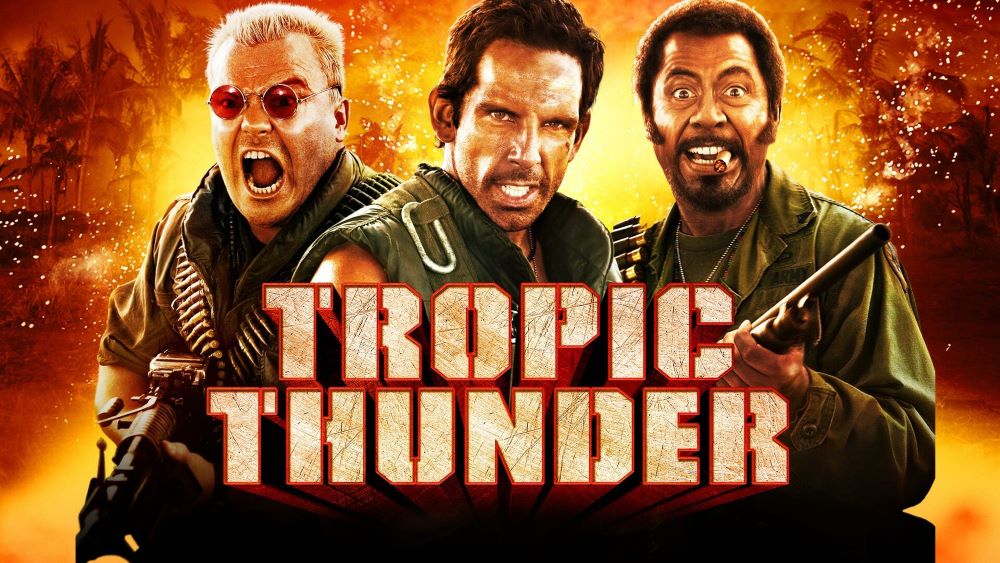
Ben Stiller’s Tropic Thunder is a bold, chaotic comedy that dives headfirst into the wild world of Hollywood satire. The film, which Stiller directed, co-wrote, and starred in, feels like a high-energy roast of the movie industry itself, blending action, parody, and sharp commentary into one explosive package. The cast is stacked with familiar faces like Robert Downey Jr., Jack Black, Jay Baruchel, Brandon T. Jackson, and even Tom Cruise in a shockingly hilarious cameo, all committed to the film’s madcap, anything-goes spirit.

A distinctive touch that shows Tropic Thunder’s deep commitment to Hollywood satire is how it begins—not with a typical studio logo or title sequence—but with a series of fake movie trailers. These trailers parody different film genres and Hollywood clichés, setting an irreverent tone before the actual film even starts. The highlight is undoubtedly the “Oscar-bait” trailer for Satan’s Alley, a pitch-perfect send-up of self-serious, emotionally heavy dramas designed for awards season attention. By embedding these faux trailers, the film immerses viewers in its meta commentary and signals from the outset that it’s willing to mock and take apart the film industry at all levels.

This movie-within-a-movie begins with a group of egotistical actors trying to make a serious war film based on the fictional memoir of a Vietnam veteran. Their attempt at gritty realism falters under the weight of their own vanity and cluelessness, turning the set into a feverish comedy of errors. When the director dies and the actors are abandoned in a real jungle with actual dangers, the film blurs the lines between fantasy and reality, leading to a relentless cascade of absurd situations and insider jokes about Hollywood machinery.

Robert Downey Jr.’s portrayal of Kirk Lazarus, a method actor who undergoes extreme skin pigmentation surgery to play a Black character, is both provocative and hilarious. His performance skewers Hollywood’s past mistakes with race and casting, while his tense exchanges with Brandon T. Jackson’s Alpa Chino, who plays a genuinely Black rapper, provide sharp moments that balance discomfort with comedy. Downey Jr.’s “blackface” was a conscious satire of method acting and Hollywood egos, an attempt to ridicule extreme lengths actors go for acclaim rather than an endorsement of offensive practices. However, even at its release in 2008, it sparked conversations about the boundaries of comedy and racial sensitivity—an issue that would be even more controversial in 2025’s cultural climate.

Similarly, the film’s handling of ableist humor through the subplot of Simple Jack, a fictional movie starring Ben Stiller’s character as a person with intellectual disabilities, drew mixed reactions. While intended as a biting critique of Hollywood’s exploitation of disability for sympathy and awards, the portrayal nonetheless walked a tightrope that made some audience members uncomfortable. This nuanced but risky satire highlights how Tropic Thunder throws a wide net in exposing Hollywood’s many blind spots, yet its fearless approach also invites legitimate questions about respect and representation.

Jack Black delivers wild physical comedy as Jeff Portnoy, a drug-addled comedian losing control, offering a blend of slapstick and oddly sincere moments. Meanwhile, Tom Cruise steals the film with his iconic turn as Les Grossman, the balding, foul-mouthed studio exec whose explosive rants and dance moves have reached legendary status. Industry insiders often note that Grossman’s tempestuous persona seems inspired by real-life producer Scott Rudin, known for a similarly volatile temperament.

Much of the film’s humor targets Hollywood’s obsession with awards and ego, skewering Oscar-bait films, blockbuster excess, and ridiculous celebrity antics. The fake trailers highlight these themes, and Lazarus’s infamous line “Never go full retard, man!” takes aim at acting extremes motivated by prestige rather than authenticity. Stiller’s direction embraces loud, over-the-top action sequences that mimic classic Vietnam War movies but infuse them with cartoonish chaos, while the lush jungle serves as a satirical arena for exposing the actors’ incompetence.

While Tropic Thunder is gleefully offensive and hilarious, its treatment of race and disability sparked debate about where satire crosses lines. The film’s biting self-awareness and sharp commentary doesn’t always prevent discomfort, but it highlights the difficulty of balancing edgy humor with social consciousness in comedy. The film’s reception reveals how comedy evolves with cultural awareness; what passed as biting satire in 2008 would face even fiercer scrutiny in today’s more sensitive and politically aware environment.

From an entertainment standpoint, the movie delivers nonstop laughs, with rapid-fire jokes, strong chemistry among the cast, and sharp Hollywood references that keep fans engaged. Downey Jr.’s method acting antics, Black’s physical comedy, and Cruise’s outrageous studio boss combine into a relentless comedic assault. It’s not a film for those who prefer safe or sanitized humor, but for those who appreciate biting satire with reckless energy, it’s a must-watch.

Looking back, Tropic Thunder stands as a snapshot of a moment before social media and instantaneous backlash reshaped Hollywood comedy. Its controversial content might not get greenlit today, much like the boundary-pushers Blazing Saddles and Airplane! before it. Yet, as history shows, comedy will always find new ways to challenge sensibilities and push limits. Only time will tell what the next film is that dares to cross such lines again.

If you haven’t experienced Tropic Thunder, prepare for a relentlessly funny, sharply satirical comedy that skewers everything from celebrity egos to studio politics with savage wit and over-the-top energy.
Review: Saving Private Ryan (dir. by Steven Spielberg)


“Someday we might look back on this and decide that Saving Private Ryan was the one decent thing we were able to pull out of this whole godawful, shitty mess.” — Sergeant Horvath

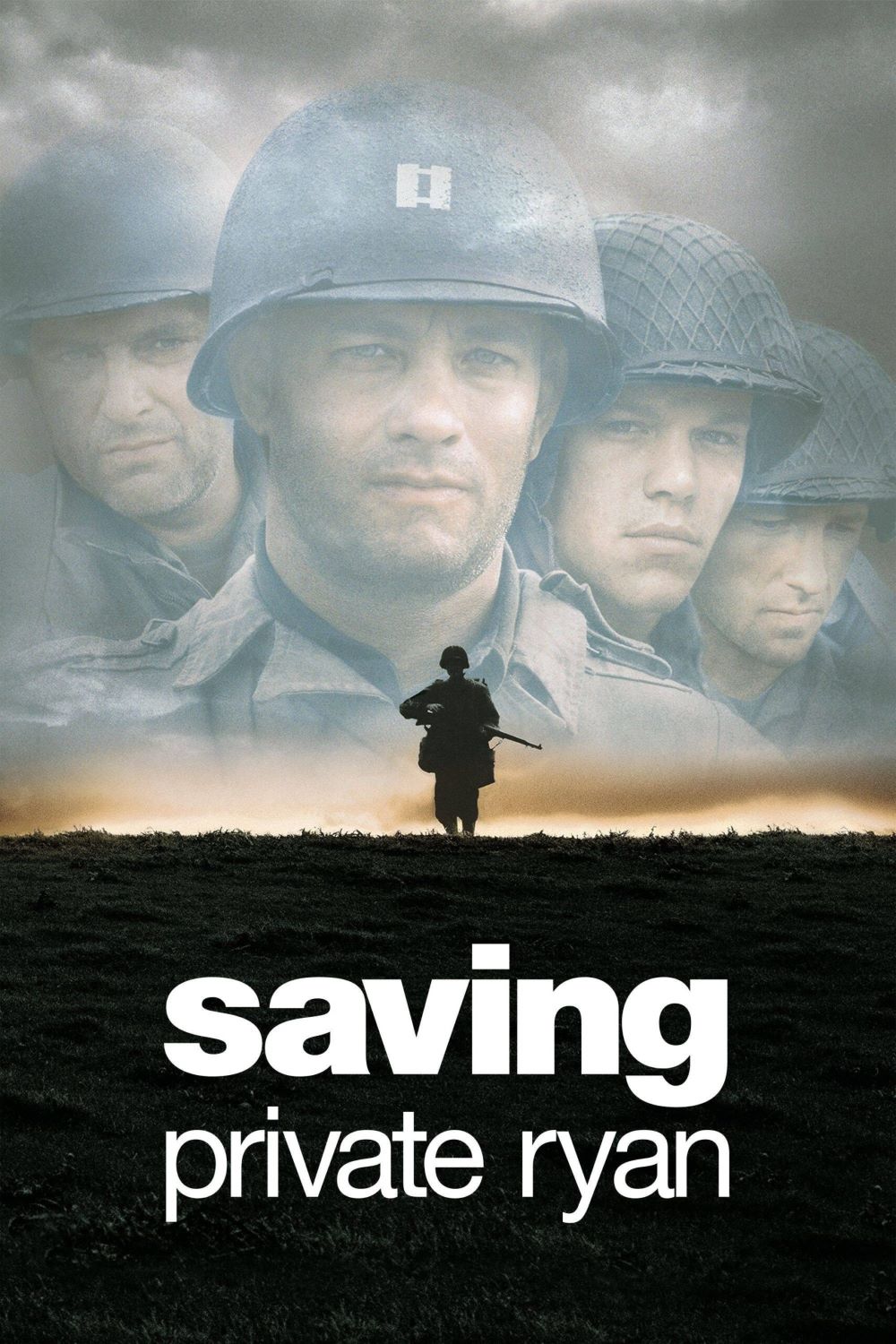
Saving Private Ryan stands as a landmark achievement in war cinema, intricately weaving immersive battle scenes, rich character dynamics, and profound moral themes into a nearly three-hour exploration of World War II’s human cost. One of its most remarkable features is the opening Omaha Beach landing sequence, a meticulously crafted, over 24-minute depiction of warfare’s brutal reality. Spielberg deploys a cinema verité style with handheld cameras capturing disorientation and chaos through the soldiers’ eyes. The sound design envelops the viewer in a sensory onslaught—gunfire, shouting, explosions—creating a visceral experience that immerses audiences directly in the terror and confusion of D-Day.

The filming process drew heavily on historical accuracy, with the production shot on the coast of County Wexford, Ireland, employing amputee actors and practical effects over computer graphics to simulate violent injuries and battlefield horrors. Muted tones evoke wartime photographs, and rapid, shaky editing conveys the disorganized, frantic environment soldiers endured. Consulting WWII veterans and historians, Spielberg created a sequence that reshaped cinematic portrayals of war, influencing how future films would approach the genre’s raw immediacy and emotional weight.

The film’s narrative follows a squad led by Captain Miller on a mission to locate and bring home Private James Ryan, whose three brothers have been killed in combat. The mission is steeped in the real-life tragedy of the five Sullivan brothers who died together aboard the USS Juneau in the Pacific, prompting military policies to prevent similar familial devastation. This historical context frames the story’s ethical heart: risking several men’s lives to save one, raising enduring questions about the value of individual sacrifice within the broader war.

In Saving Private Ryan, sacrifice is portrayed ambiguously—not as the sacrifice of a single hero but as the collective cost borne by the men tasked with rescuing one individual under perilous conditions. As the squad journeys through the war-torn French countryside, the deaths, injuries, and tensions they face underscore war’s randomness and the difficulty of weighing one life against many. The narrative refuses to romanticize or simplify, instead confronting the audience with the tragic truth that countless soldiers lose their lives without recognition or purpose, while some survive against staggering odds.

Duty and camaraderie thread throughout the film, portrayed through the soldiers’ evolving relationships and personal struggles. Each grapples with loyalty not only to their mission but to their fellow men and their own moral codes.

Integral to the film’s power is Tom Hanks’s layered performance as Captain John Miller. Hanks breathes life and emotional depth into Miller, portraying him as a man shaped by civilian life—revealed poignantly when he discloses his pre-war profession as a schoolteacher—now transformed by the relentless demands of war. He embodies an officer who is both composed and vulnerable, carrying the heavy burden of leadership with quiet dignity. Hanks’s portrayal reveals the internal struggles beneath Miller’s stoic exterior: moments of doubt, moral conflict, and fatigue subtly expressed through a trembling hand or a weary gaze. This humanity makes Miller relatable, as a man trying to maintain order and purpose amid chaos.

Hanks skillfully balances Miller’s authoritative presence with warmth and empathy, particularly evident in his paternal interactions with younger soldiers, reinforcing Miller’s role as both a leader and protector. His nuanced acting delivers the complexity of a man constantly negotiating duty and compassion. In scenes of high tension or moral quandaries, Hanks conveys the weight of command while allowing glimpses into Miller’s psychological strain, deepening the film’s emotional resonance.

Following Hanks’s Miller, a standout amongst the supporting cast is Tom Sizemore’s portrayal of Technical Sergeant Mike Horvath, Miller’s steady second-in-command. Sizemore embodies the pragmatic, battle-hardened soldier whose loyalty and experience provide emotional grounding for the squad. Sizemore portrays Horvath’s weariness and quiet commitment, adding layers of realism that deepen the exploration of how war reshapes individuals. The chemistry and shared history between Miller and Horvath are palpable, illustrating the bonds that sustain soldiers through hardship and lending emotional weight to the narrative.

The film wrestles with intense moral ambiguity throughout. The mission’s premise—to risk many lives to save one—compels both characters and viewers to confront complex questions about justice, value, and the cost of war. Scenes presenting difficult choices, such as the decision to spare or execute prisoners, dramatize these ethical dilemmas and highlight the emotional burdens borne by soldiers.

Technically, the film excels, with Janusz Kaminski’s dynamic cinematography capturing both the chaos of battle and intimate moments with evocative clarity. The immersive sound design reinforces the brutal reality, stripping warfare of glamor and confronting audiences with its daunting human costs.

Despite the overwhelming destruction and loss, Saving Private Ryan offers moments of humanity and hope. The rescue mission serves as a fragile symbol of compassion in the midst of devastation, while the film’s closing reflections on memory and legacy emphasize the lasting significance of sacrifice and survival.

Saving Private Ryan stands as a monumental achievement in the war genre, combining visceral combat realism, compelling characters, and moral complexity. Through Hanks’s deeply human Captain Miller and the nuanced supporting performances, especially Sizemore’s grounded Horvath, the film explores themes of sacrifice, duty, and brotherhood with unflinching honesty. Its enduring legacy lies in its unvarnished yet empathetic portrayal of war’s cost and the profound sacrifices made by those who lived it.

The Cold War Relived Through Bridge of Spies


BridgeofSpies

Lisa Marie is not the only history nerd in this here place. I don’t think it was a coincidence that TSL’s co-founders ended up being both history nerds. We both love films the depict historical events. Some of them turn out to be great while some end up on the trash heap.

One filmmaker who has made a career late in his life of making historical films is Steven Spielberg. The same one who gave us great blockbusters in the scifi, thriller and fantasy genres has also given us some excellent historical films such as Saving Private Ryan, Schindler’s List, Munich and Lincoln.

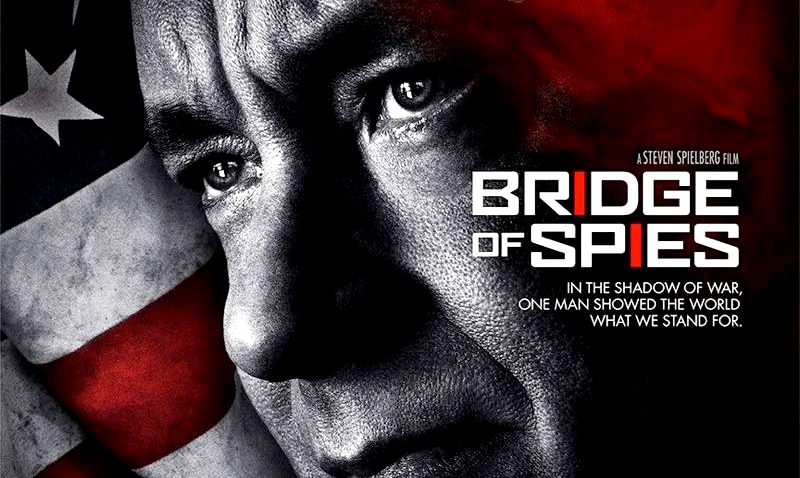
We have the first trailer for Spielberg’s latest film which is based on the real-life events surrounding the 1960 U-2 spy plane incident where American pilot Francis Gary Powers was shot down while on a mission over the Soviet Union and was subsequently swapped back into US custody for a Soviet spy that the Americans were holding.

Bridge of Spies showcases the events which led to that swap and how contentious the negotiations had been before it finally came about. Everyone knows the Cuban Missile Crisis put the world very close to nuclear annihilation, but what many don’t know is how the Gary Powers Incident also pushed the two nuclear powers very close to the brink.

Bridge of Spies is set for an OCt. 16, 2015 release date…just in time for the start of Lisa Marie’s favorite film season: Awards Season.

Trailer: Lincoln (dir. by Steven Spielberg)


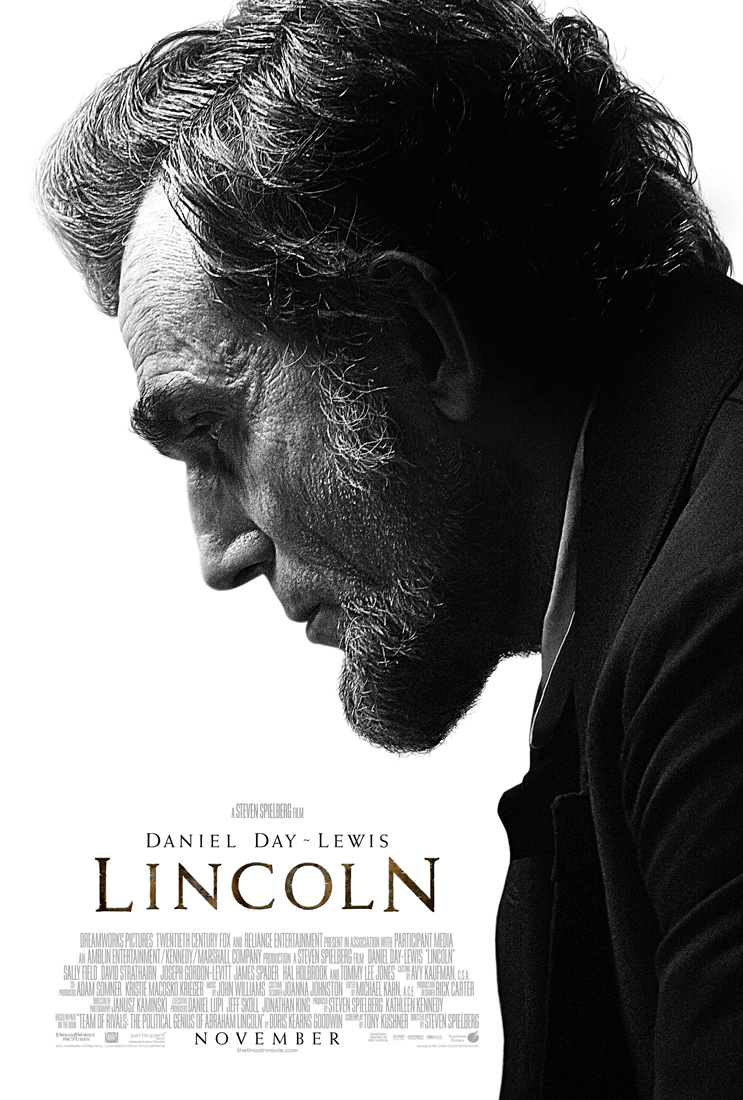
One of the films for 2012 that’s seen by many as a major player in the end of the year Awards season. Steven Spielberg’s long-delayed and gestating historical drama about Abraham Lincoln will finally make it onto the big-screen this early November. Spielberg had initially chosen Liam Neeson to play the 16th President of these United States but as the project continued to get delayed he backed out and in comes Daniel Day-Lewis to take on a very difficult role.

Lincolnis based off of Doris Kearns Goodwin’s biography of the 16th President, Team of Rivals: The Political Genius of Abraham Lincoln. With Tony Kushner tasked with finally hashing out a final draft of the screenplay the film finally went into production in 2009. The cast is an ensemble led by Day-Lewis that includes several past Academy Award and Emmy winners like Tommy Lee Jones, Sally Field and Hal Holbrook with other acting luminaries like Joseph Gordon-Levitt, Walton Goggins, David Straithairn, Jared Harris and Jackie Earle Haley.

The first trailer finally arrived today, September 13, 2012, during a Google+ hangout with Spielberg and Gordon-Levitt and reaction to the trailer seems to range from “give Daniel Day-Lewis the Oscar already” to “an Oscar-bait if there was ever one”. No matter where one sat in their reaction to this trailer it will be interesting to see if Spielberg will come out with a film that doesn’t come off as maudlin and manipulative, but deliver a film that explores and tries to explain why Lincoln became such a beloved President in his time despite making so many unpopular decisions and sitting through the worst era of American history (Civil War) and decades since his death.

Here’s to hoping that the film is less like Amistad and more like Schindler’s List in terms of tone and narrative. We know why Lincoln is seen as the greatest President we ever had. What we want to know is the why’s.

Lincoln arrives in the theaters this November 9, 2012.

Trailer: Real Steel


I’ve been hearing about this film called Real Steel for some time now and a trailer had even come out a couple months earlier, but it’s only with today’s release of the latest trailer that I’ve stopped to actually check it out.

From what I can see in the trailer this looks like a live-action, big-budget adaptation of that classic toy called “Rock’em, Sock’em Robots”. This being Dreamworks who have already turned one classic toy franchise into a major blockbuster film franchise then why not another toy. It stars Hugh Jackman who looks much slimmer and not as bulky as his former Wolverine self. Real Steel looks to be a father-son story that has been done so many times before, but this time with big giant boxing robots.

Further research on this film had me discovering that it’s actually based on a Richard Matheson short story called “Steel”. That story was actually a much darker, colder dystopia tale. Script changes since the screenplay and project was bought by Dreamworks in 2003 has toned down the dystopia and instead the project going more for a form of Americana nostalgia. I’m not sure if those changes were necessary. In fact, I wouldn’t have minded seeing this film go the original Matheson route.

I have feeling that despite my doubts about this film it will do quite well in the box-office. It’s a heartwarming tale with fighting robots and fathers will be taking their young sons to see this in droves. Well, except those fathers who happen to also be on-line film bloggers who may think this film not the kind of drivel and tripe to be showing to their young boys.

Real Steel is set for an October 7, 2011 release date.

Trailer: Transformers: Dark of the Moon (Official Theatrical)


OK, this latest trailer for Michael Bay’s third entry in the Transformers film franchise looks to try and ask forgiveness from it’s fans about what had transpired with Transformers: Revenge of the Fallen (cough, cough…Twins). This latest trailer looks to mine the current alien invasion trend happening in Hollywood for the last year or two.

I’m not going to say that Transformers: Dark of the Moon will be in the running for Best Picture, Best Screenplay or even Best Acting awards come awards season, but I do get a feeling from this trailer that this third entry will be darker and infinitely more fun and watchable than the second film. I actually think that Dark of the Moon is the true first sequel to the first film and that Revenge of the Fallen never occurred.

The look of Shockwave (one red-eye) is pretty awesome as are the look of the invading Decepticons (or are they another faction). I remember talk of Unicron (the giant planet transformer) was to appear in this film but I’m not sure if Unicron will appear as a planet or that giant snake-like transformer that was giving that Chicago high-rise a major case of the hugs.

Transformers: Dark of the Moon is set for a July 1, 2011 release date.

Cowboys & Aliens: Trailer 2


Last night saw the release of the latest (most likely the final) trailer for Jon Favreau’s sci-fi and western mash-up called Cowboys & Aliens.

There’s some new scenes shown in this latest trailer some of which were first shown earlier this month at WonderCon 2011. There’s less of the comedic aspect shown in the past trailers. The usage of Audioslave’s “Show Me How To Live” was a nice touch.

There’s not much else to say other than the film sold me fully at WonderCon 2011 so this latest trailer is just icing on the cake. With three more months to go before it finally sees it’s release there’s going to be a lot of hype surrounding this film and it better live up to it.

Cowboys & Aliens is still set for a July 29, 2011 release.

Transformers: Dark of the Moon (Super Bowl TV Spot)


I think most everyone will admit that Transformers: Revenge of the Fallen wasn’t very good and to some people it was just one piece of turd. Even Michael Bay himself has admitted that the first sequel just tried to do too much without any sort of plan on how to pull it off.

Now, we have the third film and what looks like, at least from the trailer, may be a tad better. There seems to be more focus on the transformers themselves and the two sides fighting it out with lots of human collateral damage.

I sure hope this third film is not going to be like the second and more like the first but this time with invasion to make it more epic. The film comes out on July 1, 2011.


Cowboys & Aliens (Super Bowl TV Spot)


Super Bowl XLV hasn’t even started and the very first summer blockbuster tv spot has already been released by its producers. While it still hasn’t premiered on tv it has already aired on the internet as Jon Favreau and crew continues to build up the hype the film got from its panel at 2010’s San Diego Comic-Con.

The tv spot that will air during the game is only half a minute long, but during that small time frame we see a lot more action with clear glimpses of the alien machines/spacecrafts that will be doing some abducting and probing in the Old West.

If this film end ups being as fun as the original Men In Black then I’m there. But part of me fears that it could turn out to be something like Wild, Wild West which would definitely make it a major fail. Here’s to hoping it’s more like the former and not the latter when it comes out on July 29, 2011.

Transformers: Dark of the Moon (Teaser Trailer)


Well, what is there to say about the Transformers franchise other than it is what it is. A special-effects heavy flick about a Hasbro toyline from the 80’s that has become a sensation (a good first film with a sub-par follow-up) that’s made millions worldwide. The fact that Michael Bay (who I tend to believe as only a step above Uwe Boll in his talent as a filmmaker) is the filmmaker in charge of the franchise almost guarantees that each film will be a hit no matter what critics say.

Now we have the third film in the series with the very Pink Floyd-ish title which I am sure Pink Floyd fans are none to happy about. The film is deep into its film schedule and the fact that there’s now a teaser trailer with still 7 months to go before its July 1, 2011 release tells me that pre-production on this project began either as soon as the second film premiered or while it was finishing post.

Gone in this third and, as Michael Bay announced earlier, final film in the series is Megan Fox thus Shia LeBouf’s character Sam Witwicky will have a new love interest in English model Rosie Huntington-Whiteley. Most of the cast from both previous films will return and so do most of the primary Transformers on both sides. With the Fallen having fallen in the second film this third entry will bring in one of the more popular Decepticons in Shockwave to act as the main villain. How they’ll work this part of the script into having Shockwave being the main heavy despite Megatron still appearing in the film will be interesting to see.

In the end, the film will have great special-effects courtesy of ILM with chaos and destruction as seen through the mad-eyes of Bay. The wild card is whether Bay has learned how to work the 3-D cameras used to film the project from beginning to end. Because no matter what people may think of James Cameron he seems to be the only one who has figured out how to properly create an immersive 3-D film and not lose out on the action end.

Will Bay’s hyper-kinetic and MTV-style editing be able to work well with 3-D or will this third film just end up making its entire audience nauseous and I don’t mean from the film’s plot. We’ll soon find out this coming July.