At the height of World War II, Commander Casey Abbott (Ronald Reagan) breaks up with nurse Helen Blair (Nancy Davis, the future first lady) and takes command of a submarine that has been tasked with mapping out Japanese mine fields. Abbott struggles at first with commanding his submarine. After a popular diver — and Helen’s new boyfriend — is killed during a mission, much of the crew holds Abbott responsible. While Abbott is able to win back the respect of the crew, he still struggles with his second-in-command, Don Landon (Arthur Franz). Landon wants to command his own submarine but when Abbott gives him a negative recommendation, Landon is forced to consider his past actions. Landon eventually discovers just how difficult it is to be in charge.
Full of stock footage and chintzy special effects, Hellcats of the Navy was the movie that Ronald Reagan considered to be so bad that it led to him retiring from feature films and devoting himself to mastering the emerging medium of television. Gene Hackman had his Welcome To Mooseport. Ronald Reagan had his Hellcats of the Navy. It’s definitely on the cheap and predictable side but, when I watched it earlier today, I discovered it wasn’t as bad as I had heard. Reagan actually gives a pretty good performance as Abbott and the film does show that even a good commander will make mistakes. The main problem is that it’s just not a very exciting film and a good deal of the undersea footage was clumsily lifted from other movies.
Hellcats of the Navy was the one movie that co-starred both Ronnie and Nancy and it’s worth watching for curiosity’s sake. Nancy isn’t in much of the movie and it’s really a role that anyone could have played. There’s not a lot of romantic chemistry between Ronnie and Nancy, they’re both too reserved for that. This film still shows the likability and the natural authority that led to Ronald Reagan launching a second career in politics.
Just think, if Hellcats of the Navy had been a better movie, the past 45 years might have been very different.
Welcome to Late Night Retro Television Reviews, a feature where we review some of our favorite and least favorite shows of the past! On Thursdays, I will be reviewing Highway to Heaven, which aired on NBC from 1984 to 1989. The entire show is currently streaming on Freevee and several other services!
This episode features a very good boy.
Episode 3.3 “For the Love of Larry”
(Dir by Michael Landon, originally aired on October 8th, 1986)
At the start of this episode, we find Jonathan and Mark on a dangerous assignment. They’re in the city and apparently, they’re working as undercover cops and trying to catch a local drug dealer. At least, I assume that the people working with Jonathan and Mark were supposed to be cops. None of them were in uniform so I guess they have just as easily been a neighborhood vigilante group. As Jonathan and Mark prepare to confront the dealer, Jonathan says that the scourge of drugs is the greatest threat that American will ever face.
It’s a heavy assignment but it doesn’t really seem like a Highway to Heaven sort of assignment. Usually, Mark and Jonathan are specifically assigned to help someone. This time, though, it appears that they’ve just been assigned to help the cops do their job. Jonathan and Mark don’t really do anything that any other cop couldn’t have done. Mark gets excited when the dealer tries to shoot him because he’s convinced that God is causing the bullets to miss him. Only after the dealer is captured does Jonathan reveal that God didn’t do Mark any favors. Mark just got lucky.
Mark’s earned a break! He and Jonathan drive off to another one of those small towns that always seem to show up on this show. They rent a cabin for a few days. However, Mark’s attempts at relaxation are continually interrupted by a dog. First, the dog runs in front of the car. Then, the dog somehow shows up at the cabin. Even though Mark took the dog to a shelter, the dog somehow managed to get out and track Mark down.
Eventually, Mark and Jonathan figure out that they need to follow the dog. The dog leads off the main road, to an overturned car that is hidden away in the woods. A father and a son, both badly injured but still alive, are in the car. Jonathan and Mark are able to rescue them but then they notice that the dog is in the back seat and was apparently killed in the crash.
The camera pans up to the sky and gets lost in the clouds. Suddenly, the dog’s ghostly form appears and seems to actually wink at the audience, letting us know that the dog may have died but his spirit stayed on Earth long enough to rescue his owners. (The Larry of the title is the son of the dog’s owner.)
Did this episode make me cry? You better believe this episode made me cry! I’m not even a dog person and I was still sobbing at the end of this episode. As I’ve mentioned before, there’s an earnest sincerity at the heart of this show that makes it effective even when it should be silly. Having the dog appear in the clouds is the type of thing that a lot of shows probably would have screwed up. In lesser hands, it would have been too heavy-handed and overly sentimental to work. But, on this show, it does work. It helps that the dog was cute.
This was a simple episode but sometimes, it’s the simple episodes that work the best.
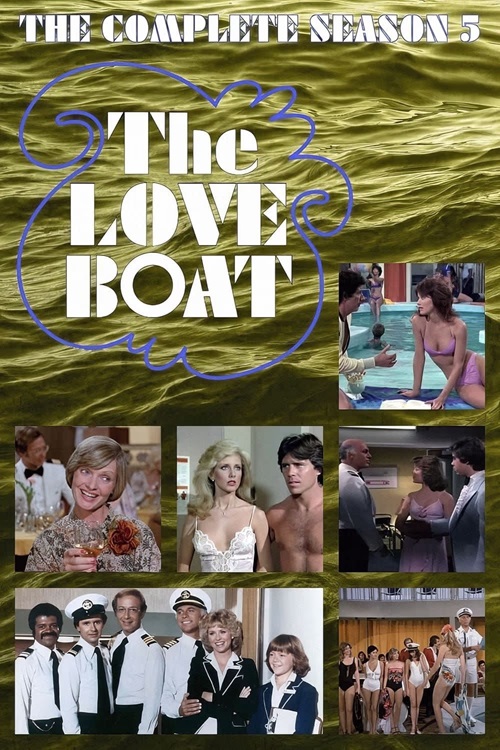
Welcome to Retro Television Reviews, a feature where we review some of our favorite and least favorite shows of the past! On Wednesdays, I will be reviewing the original Love Boat, which aired on ABC from 1977 to 1986! The series can be streamed on Paramount Plus!
This week, The Love Boat hosts a special event!
Episode 5.3 “Two Grapes On The Vine/Aunt Sylvia/Deductible Divorce”
(Dir by Bob Sweeney, originally aired on October 17th, 1981)
This week, the Love Boat is hosting a wine tasting competition!
Basically, the contestants sit in the ballroom. They take a sip of wine. They then write down what type of wine they think they just tasted. All of the members of the crew and the majority of the passengers watch them. Seriously, it looks like the most boring thing ever. I mean, I get why the competitors are into it. The winner gets a lot of money. But why would you want to watch people drink? I mean, if you’re crazy into wine, it seems like you’d want to drink it yourself. What fun is there in watching other people drink something? I’ll just say that, if I was on a cruise, I would want to do other things. I would want lay out by the pool or look at the ocean or maybe solve a murder. What I would not want to do would be to spend hours watching other people drink and then spit.
Also, I have to wonder about the wisdom of hosting a wine tasting competition on a ship that’s captained by a recovering alcoholic. Did the show forget this key part of the captain’s character? Merrill Stubing is a recovering alcoholic and he lives his life with the rigorous discipline of someone who is trying to avoid falling back into old habits. It would seem like Captain Stubing would at least mention his alcoholic past in this episode, especially after Vicki says that she wishes she could take part in the contest. Wouldn’t this be a good time for Stubing to explain that an addictive personality can be hereditary?
I know, I know. I’m overthinking. It’s just because I found this episode to be remarkably dull. I mean, I love The Love Boat but this episode was just boring. The whole wine tasting thing just put me to sleep.
It didn’t help that the three stories weren’t particularly interesting.
Robert Guillaume and Leslie Uggams played the two finalists in the wine tasting competition. They each lied to the other about why they needed the money. Then they fell in love and they each threw the competition so the other could win the money. But since they both got the last wine wrong, no one won and no money was awarded. Wow, wine tasting is a harsh sport!
Tanya Tucker and Michael Goodwin played a married couple who got divorced every year so that they could get a tax break. This time, they sailed to Mexico for a quickie divorce. Tucker’s ex-boyfriend, Robert Walden, was on the cruise and Tucker was tempted to stay divorced. However, she and Goodwin eventually decided to get married a sixth time and to never get divorced again. I liked this story solely because it was about screwing over the IRS.
Finally, Betty White wanted to marry Douglas Fairbanks, Jr. but he instead fell for Betty White’s friend, Carol Channing. No worries though! Fairbanks gave Betty White a job so that she would no longer have to marry for money.
It was all pretty boring. As I said, I love this show but this episode tasted as flat as a French wine from 1178.
Welcome to Retro Television Reviews, a feature where we review some of our favorite and least favorite shows of the past! On Sundays, I will be reviewing the made-for-television movies that used to be a primetime mainstay. Today’s film is 1973’s The Bait! It can be viewed on YouTube!
Tracey Fleming (Donna Mills) is the widow of a cop and an undercover detective herself. Unfortunately, her superior, Captain Maryk (Michael Constantine), is not convinced that Tracey has what it takes to be in a dangerous situation and, as a result, Tracey spends most of her time riding the bus and busting perverts and low-level drug dealers. When four woman are raped and murdered by the same serial killer, Tracey writes up a report on what she thinks is motivating the killer. Captain Maryk is, at first, skeptical about Tracey’s claim that the killer is fueled by a puritanical rage but, when it turns out that the killer has been wiping off his victims’s lipstick (just as Tracey speculated that he was), Maryk starts to think that Tracey might have something to offer the investigation.
Tracey becomes the bait in an operation to lure out the killer. Leaving behind her son and her mother, Tracey moves into an apartment in the neighborhood that is believed to be the center of the killer’s activities. Tracey is given a job as a survey taker and soon, she’s walking around the neighborhood and asking random men for their opinions on current events and women’s liberation. A local waitress (Arlene Golonka) recognizes Tracey as a detective but Tracey lies and say that she’s no longer with the force. When the killer makes the waitress his next victim, Tracey becomes even more determined to capture him but will she able to get Marsyk and the rest of the force to give her the room to investigate the murders?
This may sound like an intriguing whodunit but, for some reason, The Bait reveals early on that the murderer is a bus driver named Earl Stokely (played, in a very early performance, by William Devane). There’s really nothing to be gained by revealing the killer’s identity as early as the film does. Perhaps if the film was split between scenes of Tracey investigating the neighborhood and Earl stalking Tracey, that would have generated some sort of suspense but, with the exception of one bus ride, Tracey and Earl barely even interact before he comes after her at the film’s end. Devane does give a good performance as a homicidal lunatic but, when viewed today, it’s impossible to watch him in this film without spending most of the time thinking, “Hey, that’s the usually Kennedyesque William Devane, playing a killer bus driver!”
I was not surprised to learn that The Bait was intended to be a pilot for a weekly television series that would have followed the future investigations of Tracey Fleming. Donna Mills was likable in the lead role and she had a good chemistry with the other actors playing her colleagues so it’s easy to imagine a series in which Tracey solved a new case every week while Marsyk continually underestimated her. Ultimately, though, that series never happened and The Bait would be the sole televised adventure of Detective Tracey Fleming.
What’s an Insomnia File? You know how some times you just can’t get any sleep and, at about three in the morning, you’ll find yourself watching whatever you can find on cable? This feature is all about those insomnia-inspired discoveries!
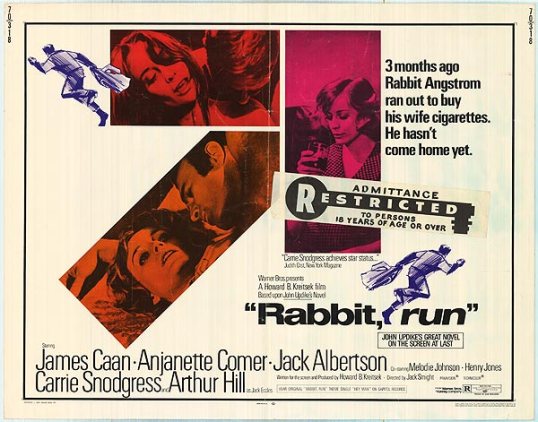
If, at one in the morning on Wednesday, you were suffering from insomnia, you could have turned over to TCM and watched the 1970 film, Rabbit Run. That’s what I did.
Rabbit Run is the epitome of a dumb lug film. In a dumb lug film, a male character finds himself living an unfulfilling life but he can’t figure out the reason. Why can’t he figure it out? Because he’s a dumb lug, with the emphasis on dumb. Usually, the viewer is supposed to sympathize with the dumb lug because he doesn’t mean to hurt anyone and everyone else in his world is somehow even more annoying than he is. Typically, the dumb lug will have an emotionally distant wife who refuses to have sex with him and who is usually portrayed as being somehow at fault for everything bad that has happened in the dumb lug’s face. (Want to see a more recent dumb lug film than Rabbit Run?American Beauty.) Ever since the silent era, there have been dumb lug films. In particular, male filmmakers and critics seem to love dumb lug films because they allow them to pat themselves on the back for admitting to being dumb while, at the same time, assuring them that everything is the fault of the wife or the girlfriend or the mother or the mother-in-law.
In Rabbit Run, the dumb lug is named Harry Angstrom (James Caan), though most people still remember him as Rabbit, the high school basketball star. Harry’s life peaked in high school. Now, he’s 28 and he can’t hold down a job. He’s married to Janice (Carrie Snodgress), who spends all of her time drinking and watching TV. He has a son and another baby is on the way. One day, when the pregnant Janice asks him to go out and get her a pack of cigarettes, Harry responds by getting in his car and driving all the way from Pennsylvania to Virginia.
When he returns to Pennsylvania, Rabbit doesn’t go back to his wife. Instead, he drops in on his former basketball coach (Jack Albertson) and begs for advice on what he should do. The coach, it turns out, is more than little creepy. He also has absolutely no practical advise to give. He does introduce Rabbit to a part-time prostitute named Ruth (Anjanette Comer). Rabbit quickly decides that he’s in love with Ruth and soon, he’s moved in with her.
Meanwhile, there’s all sorts of little things going on. Rabbit gets a job working as a gardener. Rabbit befriends the local Episcopal minister (Arthur Hill), even while the minister’s cynical wife (Melodie Johnson) tries to tempt Rabbit away from both his wife and his mistress. Rabbit both resents and envies the sexual freedom of the counter culture, as represented by his younger sister. And, of course, Janice is pregnant…
Rabbit Run is based on a highly acclaimed novel by John Updike. I haven’t read the novel so I can’t compare it to the film, beyond pointing out that many great works of literature have been turned into mediocre movies, largely because the director never found a way to visually translate whatever it was that made the book so memorable in the first place. Rabbit Run was directed by Jack Smight, who takes a rather frantic approach to the material. Since Rabbit Run is primarily a character study, it needed a director who would be willing to get out of the way and let the actors dominate the film. Instead, Smight overdirects, as if he was desperately trying to prove that he could keep up with all the other trendy filmmakers. The whole movie is full of extreme close-ups, abrupt jump cuts, intrusive music, and delusions of ennui. You find yourself wishing that someone had been willing to grab Smight and shout, “Calm down!”
(On the plus side, as far as the films of 1970 are concerned, Smight’s direction of Rabbit Run still isn’t as bad as Richard Rush’s direction of Gettting Straight.)
James Caan actually gives a likable performance as Rabbit, which is good because Rabbit would be totally unbearable if not played by an actor with at least a little genuine charisma. There’s nothing subtle about Caan’s performance but he makes it work. You never like Rabbit but, at the same time, you don’t hate him.
Unfortunately, there’s nothing subtle about the rest of the cast either. Something rather tragic happens about 80 minutes into the film and, as much as I knew I shouldn’t, I still found myself giggling because Carrie Snodgress’s performance was so bad that it was impossible for me to take any of it seriously. Even worse is Arthur Hill, as the minister who won’t stop trying to help Rabbit out. I eventually reached the point where, every time that sanctimonious character started to open his mouth, I found myself hoping someone would hit him over the head and knock him out. Among the major supporting players, only Anjanette Comer is allowed a chance to be something more than just a sterotype. Like Caan, she does the best that she can but ultimately. this is James Caan’s movie.
It’s a disappointing movie but it did not put me to sleep. Give credit for that to James Caan, who is the only reason to see Rabbit Run.
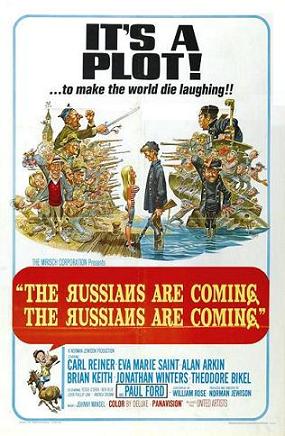
Earlier tonight, I watched a 1966 film called The Russians Are Coming, The Russians Are Coming.
It’s a cheerful comedy about what happens when the captain (played by Theodore Bikel) of a Russian submarine decides that he wants to take a look at the United States. Though he was only planning to look at America through a periscope, he accidentally runs the submarine into a sandbar sitting near Gloucester Island, which itself sits off the coast of Massachusetts. The captain sends a nine man landing party, led by Lt. Yuri Rozanov (a youngish Alan Arkin, making his film debut and receiving an Oscar nomination for his efforts), to the island. Their orders are simple. Yuri and his men are too either borrow or steal a boat that can be used to push the submarine off the sandbar. If they run into any locals, they are to claim to be Norwegian fisherman.
Needless to say, things that don’t quite go as planned. The first Americans that Yuri and his men meet are the family of Walt Whitaker (Carl Reiner), a vacationing playwright. Walt’s youngest son immediately identifies the Norwegian fisherman as being “Russians with submachine guns.” When Walt laughingly asks Yuri if he’s a “Russian with a submachine gun,” Yuri produces a submachine gun and promptly takes Walt, his wife (Eva Marie Saint), and his children hostage.
Yuri may be a Russian. He may officially be an enemy of America. But he’s actually a pretty nice guy. All he wants to do is find a boat, keep his men safe, and leave the island with as little drama as possible. However, the inhabitants of the island have other plans. As rumors spread that the Russians have landed, the eccentric and largely elderly population of Gloucester Island prepares for war. Even as Police Chief Mattocks (Brian Keith) and his bumbling assistant, Norman Jonas (Jonathan Winters), attempt to keep everyone calm, Fendall Hawkins (Paul Ford) is organizing a militia and trying to contact the U.S. Air Force.
Meanwhile, Walt’s babysitter, Allison (Andrea Dromm) finds herself falling in love with one of the Russians, the gentle Alexei Kolchin (John Phillip Law).
As I said at the start of this review, The Russians Are Coming, The Russians Are Coming is a cheerful comedy, one with a rather gentle political subtext, suggesting that the majority of international conflicts could be avoided if people got to know each other as people as opposed to judging them based on nationality or ideology. There’s a rather old-fashioned liberalism to it that probably seemed quite daring in 1966 but which feels rather quaint today. Sometimes, the comedy gets a bit broad and there were a few times that I found myself surprised that the film didn’t come with a laugh track. But overall, this is a well-acted and likable little movie.
As I watched The Russians Are Coming, The Russians Are Coming (and, as someone who is contractually obligated to use a certain number of words per review, allow me to say how much I enjoyed the length of that title), I found myself considering that the film would have seemed dated in 2013 but, with all the talk of Russian hacking in the election and everything else, it now feels a little bit more relevant. Not a day goes by when I don’t see someone on twitter announcing that the Russians are coming. Of course, if the film were released today, its optimistic ending would probably be denounced as an unacceptable compromise. Peaceful co-existence is no longer as trendy as it once was.
Another interesting thing to note about The Russians Are Coming, The Russians are Coming: though the film was written by William Rose (who also wrote another example of mild 1960s feelgood liberalism, Guess Who’s Coming To Dinner), it was based on a novel by Nathaniel Benchley. Benchley was the father of Peter Benchley, the author of Jaws. It’s easy to see the eccentrics of Gloucester Island as distant cousins of the inhabitants of Amity Island.
As previously stated, The Russians Are Coming, The Russians Are Coming was nominated for best picture but it lost to the far more weighty A Man For All Seasons.
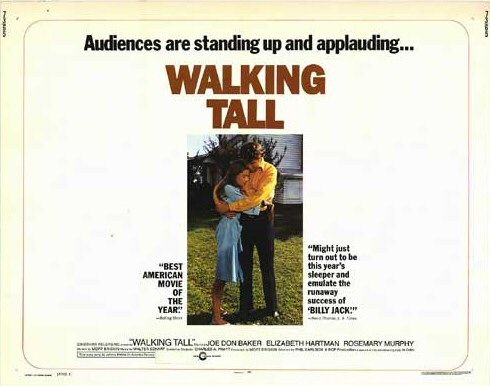
About 50 minutes into the 1973 film Walking Tall (not to be confused with the 2005 version that starred Dwayne Johnson), there’s a scene in which newly elected sheriff Buford Pusser (Joe Don Baker) gives a speech to his deputies. As the deputies stand at attention and as Pusser announces that he’s not going to tolerate any of his men taking bribes from the Dixie Mafia, the observant viewer will notice something out-of-place about the scene.
Hovering directly above Baker’s head is a big, black, almost phallic boom mic. It stays up there throughout the entire scene, a sudden and unexpected reminder that — though the film opens with a message that we’re about to see the true story of “an American hero” and though it was filmed on location in rural Tennessee — Walking Tall is ultimately a movie.
And yet, somehow, that phallic boom mic feels oddly appropriate. First off, Walking Tall is an almost deliberately messy film. That boom mic tells us that Walking Tall was not a slick studio production. Instead, much like Phil Karlson’s previous The Phenix City Story, it was a low-budget and violent film that was filmed on location in the south, miles away from the corrupting influence of mainstream, yankee-dominated Hollywood. Secondly, the phallic implications of the boom mic erases any doubt that Walking Tall is a film about men doing manly things, like shooting each other and beating people up. Buford does have a wife (Elizabeth Hartman) who begs him to avoid violence and set a good example of his children. However, she eventually gets shot in the back of the head, which frees Buford up to kill.
As I said earlier, Walking Tall opens with a message telling us that we’re about to watch a true story. Buford Pusser is a former football player and professional wrestler who, after retiring, returns to his hometown in Tennessee. He quickly discovers that his town is controlled by criminals and moonshiners. When he goes to a local bar called The Lucky Spot, he is unlucky enough to discover that the bar’s patrons cheat at cards. Buford is nearly beaten to death and dumped on the side of the road. As Buford begs for help, several motorists slow down to stare at him before then driving on.
Obviously, if anyone’s going to change this town, it’s going to have to be Buford Pusser.
Once he recovers from his beating, Buford makes himself a wooden club and then goes back to the Lucky Spot. After beating everyone up with his club, Buford takes back the money that he lost while playing cards and $50.00 to cover his medical bills. When Buford is put on trial for armed robbery, he takes the stand, rips off his shirt, and shows the jury his scars. Buford is acquitted.
Over his wife’s objections, Buford decides to run for sheriff. The old sheriff, not appreciating the competition, attempts to assassinate Buford but, instead, ends up dying himself. Buford is charged with murder. Buford is acquitted. Buford is elected sheriff. Buford sets out to clean up his little section of Tennessee. Violence follows…
On the one hand, it’s easy to be snarky about a film like Walking Tall. This is one of those films that operates on a strictly black-and-white world view. Anyone who supports Buford is good. Anyone who opposes Buford is totally evil. Buford is a redneck saint. It’s a film fueled by testosterone and it’s not at all subtle…
But dangit, I liked Walking Tall. It’s a bit like a right-wing version of Billy Jack, in that it’s so sincere that you can forgive the film’s technical faults and frequent lapses in logic. Walking Tall was filmed on location in Tennessee and director Phil Karlson makes good use of the rural locations. And, most importantly, Joe Don Baker was the perfect actor to play Buford Pusser. As played by Baker, Pusser is something of renaissance redneck. He’s a smart family man who knows how to kick ass and how to make his own weapons. What more could you ask for out of a small town sheriff?
In real life, Buford Pusser died in a mysterious car accident shortly after the release of Walking Tall. Cinematically, the character of Buford Pusser went on to star in two more films.
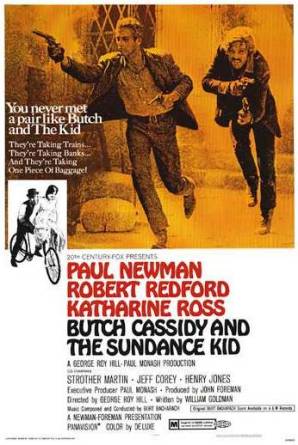
Should I start this post by ticking everyone off or should I start out by reviewing the 1969 best picture nominee Butch Cassidy and The Sundance Kid?
Let’s do the review first. I recently watched Butch Cassidy and the Sundance Kid when it aired as a part of TCM’s 31 Days of Oscar. This was actually my third time to see the film on TCM. And, as I watched Butch Cassidy and the Sundance Kid for the third time, I was shocked to discover how much I had forgotten about the film.
Don’t get me wrong. I remembered that it was a western and that it starred Paul Newman and Robert Redford as real-life outlaws Butch Cassidy and the Sundance Kid. I remembered that it opened and ended with sepia-toned sequences that suggested that Butch and Sundance represented the last gasp of the old west. I remembered that Butch won a fight by kicking a man in the balls. I also remembered that they robbed the same train twice and, the second time, they accidentally used too much dynamite. I remembered that, for some reason, Butch spent a lot of time riding around on a bicycle. I remembered that Butch and Sundance ended up getting chased by a mysterious posse. I remembered that Sundance could not swim. And I remembered that the film eventually ended on a tragic note in South America…
And I know what you’re saying. You’re saying, “It sounds like you remembered the whole movie, Lisa!”
No, actually I did not. The thing with Butch Cassidy and the Sundance Kid is that the scenes that work are so memorable that it’s easy to forget that there’s also a lot of scenes that aren’t as memorable. These are the scenes where the film drags and you’re thankful that Paul Newman and Robert Redford were cast as Butch and Sundance, because their charisma helps you overlook a lot of scenes that are either too heavy-handed or which drag on for too long. You’re especially thankful for Newman, who plays every scene with a twinkle in his wonderful blue eyes and who is such a lively presence that it makes up for the fact that Redford’s performance occasionally crosses over from being stoic to wooden. It can be argued that there’s no logical reason for a western to feature an outlaw riding around on a bicycle while Raindrops Keep Fallin’ On My Head plays on the soundtrack but Paul Newman’s so much fun to watch that you can forgive the film.
Newman and Redford both have so much chemistry that they’re always a joy to watch. And really, that’s the whole appeal of Butch Cassidy and the Sundance Kid, the chance to watch two iconic actors have fun playing opposite each other. Even though Katharine Ross appears as their shared romantic interest, the film’s love story is ultimately between Butch and Sundance (and, by extension, Newman and Redford). You can find countless reviews that will give all the credit for the film’s appeal to William Goldman’s screenplay. (You can also find countless self-satisfied essays by William Goldman where he does the exact same thing.) But, honestly, the film’s screenplay is nothing special. This film works because of good, old-fashioned star power.
Now, for the part that’ll probably tick everyone off (heh heh), I think that Butch Cassidy and the Sundance Kid is actually a pretty good pick for a future remake. All you have to do is pick the right actors for Butch and Sundance. I’m thinking Chris Pratt as Butch and Chris Evans as Sundance…
Don’t think bad thoughts or Anthony Freemont will turn you into a giant jack in the box!
That’s lesson to be learned from tonight’s example of televised horror. In this classic episode of The Twilight Zone, the citizens of Peaksville always have to be happy or else they’ll be punished by the cruel monster that lives among them. The big twist, of course, is that the monster is just a little boy and sometimes, it’s difficult to predict what exactly is going to upset him.
It’s A Good Life was originally broadcast on November 3rd, 1961.
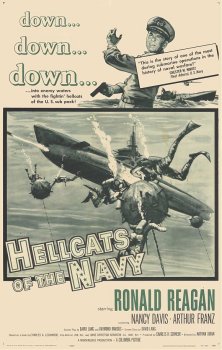 At the height of World War II, Commander Casey Abbott (Ronald Reagan) breaks up with nurse Helen Blair (Nancy Davis, the future first lady) and takes command of a submarine that has been tasked with mapping out Japanese mine fields. Abbott struggles at first with commanding his submarine. After a popular diver — and Helen’s new boyfriend — is killed during a mission, much of the crew holds Abbott responsible. While Abbott is able to win back the respect of the crew, he still struggles with his second-in-command, Don Landon (Arthur Franz). Landon wants to command his own submarine but when Abbott gives him a negative recommendation, Landon is forced to consider his past actions. Landon eventually discovers just how difficult it is to be in charge.


 Through the Shattered Lens