Film Review: Public Enemies (dir by Michael Mann)


2009’s Public Enemies is a portrait of the battle for the soul and imagination of America.

The films take place during the Great Depression.  With Americans struggling to pay their bills and many citizens out-of-work and feeling desperate, a new breed of folk hero has emerged.  Men like my distant relative Pretty Boy Floyd (Channing Tatum) and Alvin Karpis (Giovanni Ribisi) may be criminals who make their living by robbing banks but, to a nation of angry people who feel like they’ve been forgotten by the government and betrayed by the wealthy, they’re rebels who are challenging the system.  They are viewed as being modern-day Robin Hoods, even though very few of them actually bother to give the money that they steal back to the poor.

John Dillinger (Johnny Depp) is perhaps the most famous of the criminals who have been declared a “public enemy” by the FBI.  The handsome and charismatic Dillinger becomes almost a living legend, the man who cannot be captured by law enforcement.  He becomes a folk hero but with the twist that his own death seems inevitable.  Dillinger lives by his own set of rules and the press loves him even as they hungrily anticipate his violent end.

Pursuing Dillinger and the other so-called public enemies is a young FBI agent named Melvin Purvis (Christian Bale).  Purvis’s job is not only to capture or eliminate men like Dillinger.  It’s also to somehow figure out a way to replace them in the public’s imagination.  Through the use of what was then-considered to be revolutionary techniques (like fingerprinting and phone taps), Purvis tracks down one public enemy after another and soon, he’s becoming as much of a folk hero as the people that he’s pursuing.  If Dillinger and his cohorts represent the ultimate rebellion against an ineffectual system, Purvis and his success suggest that maybe the system actually can get something accomplished.  Unfortunately, for Purvis, he not only has to deal with the challenge of capturing Dillinger but also with the growing jealousy of his publicity-hungry boss, J. Edgar Hoover (Billy Crudup).  As is typical of the heroes of Michael Mann’s film, Dillinger and Purvis may be on different sides of the law but they have more in common than they realize.  Neither one can trust the people that they’re working with.

I remember that I was really excited about Public Enemies when it was first released in 2009.  I’m fascinated by the Depression-era outlaws and Dillinger’s story is certainly an interesting one.  (I’ve always enjoyed the theory that Dillinger faked his death, even though I don’t believe it for a second.)  Michael Mann seemed like the perfect director for the material and Johnny Depp seemed like ideal casting.  I have to admit that I was a little bit disappointed in the film itself, which was poorly paced and stuck so closely to the facts of the case that it led me to realize that Dillinger will always be more interesting as a legend than an actual person.  (I’ll concede that was probably the film’s point.)  There were moments of brilliance in the film.  The scene where Dillinger escaped from custody was wonderfully done.  Stephen Graham’s unhinged performance as Baby Face Nelson was excellent.  Johnny Depp had the right look for Dillinger but I have to admit that I found myself a little bit bored with Christian Bale’s Melvin Purvis.

Looking back today, though, the film feels almost prophetic.  That may seem like an odd thing to say about a film set in the past but Public Enemies portrait of an America caught between celebrating the rule of law and the excitement of rebellion feels very relevant to what’s happening today.  In retrospect, Public Enemies is a portrait of the contradiction at the heart of America, a country with a culture of both rebellion and loyal patriotism.  Public Enemies portrays a battle the continues to this day.
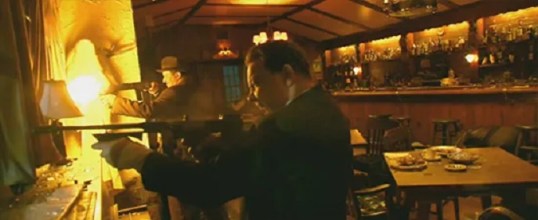
Public Enemies (2009, dir by Michael Mann, DP: Dante Spinotti)
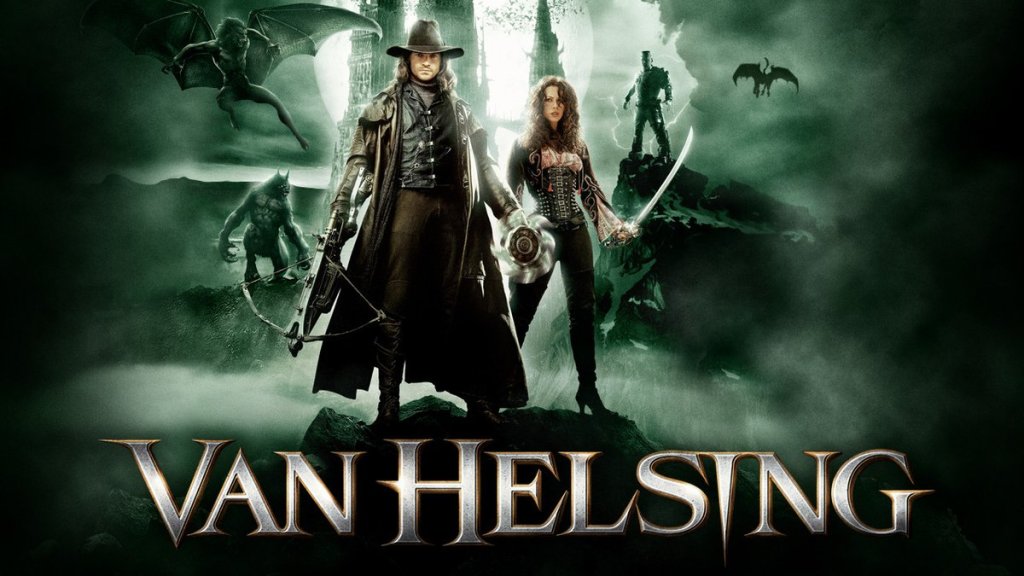
Guilty Pleasure No. 74: Van Helsing (dir by Stephen Sommers)


What can I say about this 2004 action horror film that can do it justice at just how it perfectly represent what I call a “guilty pleasure”.

Van Helsing by Stephen Sommers (him being at his most Stephen Sommersist) was suppose to be a new action franchise with Hugh Jackman as it’s lead. One must remember that in 2004, Hugh Jackman was still at the height of his popularity as an action star with roles as Wolverine in the X-Men film franchise and, in another guilty pleasure of mine, Swordfish.

This film was suppose to catapult him to the stratosphere and taking the action star role from aging ones such as Arnold Schwarzenneger, Sylvester Stallone and Bruce Willis. Instead Stephen Sommers reached for that brass ring and failed, but did so with a mish-mash of horror properties blended haphazardly to give us a film that tried to be too much yet also not enough.

Hugh Jackman in the title role was more than game to try and prop up the film’s convoluted plot. Kate Beckinsale was stunning as usual and hamming it up in what I could only guess is here version of a Transylvanian accent. Even Richard Roxbrough in the role of Dracula, miscast as he seem to be in the role, gave a campy and scenery-chewing performance that his performance went past bad and circled back to being entertaining.

Yet, for all its flaws, I actually enjoy Van Helsing for what it was and that was a modern version of those Abbott and Costello mash-up with the Universal horror characters of the 40’s and 50’s. One cannot mistake this film on the same level as Nosferatu (Murnau, Herzog and Eggers versions) and Sommers definitely cannot be mistake for the three auteurs who had their own take on the abovementioned film. But Sommers does make thrilling, though some would say repetitive, action films.

Did I turn my brain off watching Van Helsing?

I sure did, but it still didn’t stop me from being entertained…and I cannot ever sat anything bad about a film with Kate Beckinsale in a tight black-red leather corset. It’s against some sort of law to do so.

Previous Guilty Pleasures

  1. Half-Baked
  2. Save The Last Dance
  3. Every Rose Has Its Thorns
  4. The Jeremy Kyle Show
  5. Invasion USA
  6. The Golden Child
  7. Final Destination 2
  8. Paparazzi
  9. The Principal
  10. The Substitute
  11. Terror In The Family
  12. Pandorum
  13. Lambada
  14. Fear
  15. Cocktail
  16. Keep Off The Grass
  17. Girls, Girls, Girls
  18. Class
  19. Tart
  20. King Kong vs. Godzilla
  21. Hawk the Slayer
  22. Battle Beyond the Stars
  23. Meridian
  24. Walk of Shame
  25. From Justin To Kelly
  26. Project Greenlight
  27. Sex Decoy: Love Stings
  28. Swimfan
  29. On the Line
  30. Wolfen
  31. Hail Caesar!
  32. It’s So Cold In The D
  33. In the Mix
  34. Healed By Grace
  35. Valley of the Dolls
  36. The Legend of Billie Jean
  37. Death Wish
  38. Shipping Wars
  39. Ghost Whisperer
  40. Parking Wars
  41. The Dead Are After Me
  42. Harper’s Island
  43. The Resurrection of Gavin Stone
  44. Paranormal State
  45. Utopia
  46. Bar Rescue
  47. The Powers of Matthew Star
  48. Spiker
  49. Heavenly Bodies
  50. Maid in Manhattan
  51. Rage and Honor
  52. Saved By The Bell 3. 21 “No Hope With Dope”
  53. Happy Gilmore
  54. Solarbabies
  55. The Dawn of Correction
  56. Once You Understand
  57. The Voyeurs 
  58. Robot Jox
  59. Teen Wolf
  60. The Running Man
  61. Double Dragon
  62. Backtrack
  63. Julie and Jack
  64. Karate Warrior
  65. Invaders From Mars
  66. Cloverfield
  67. Aerobicide 
  68. Blood Harvest
  69. Shocking Dark
  70. Face The Truth
  71. Submerged
  72. The Canyons
  73. Days of Thunder

THE CHILDREN OF HUANG SHI (2008, directed by Roger Spottiswoode) – The incredible story of English adventurer George Hogg!


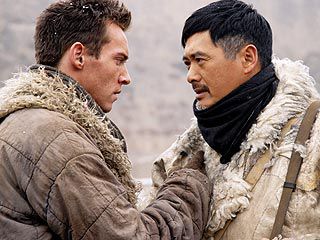
My wife and I love to watch movies based on true stories and real people. I had never heard of English adventurer George Hogg prior to 2008, which was the year that I found out that Chow Yun-Fat would be co-starring in a film based on Hogg’s life. Chow Yun-Fat is my favorite living actor, so I make it a point to watch every film he’s in. I even watched the horrendous DRAGONBALL EVOLUTION, even worse, at the theater!! As I looked into the film a little closer all those years ago, I thought Hogg’s real-life story had major dramatic potential. I thought the cast was interesting as well. At the time, Jonathan Rhys Meyers was starring in a popular series called THE TUDORS, where he played King Henry VIII. He seemed ready for the role of real-life hero George Hogg. Radha Mitchell had somewhat recently starred in the Denzel Washington action film, MAN ON FIRE, which I’m very fond of. And coolest of all, outside of Chow Yun-Fat of course, was the casting of Michelle Yeoh, another favorite of mine from her years in Hong Kong films. She and Chow Yun-Fat were captivating together in CROUCHING TIGER HIDDEN DRAGON. And finally, I saw that Roger Spottiswoode would be directing the film. The veteran filmmaker has had a hand in some of my favorite films, from editing HARD TIMES with Charles Bronson, to writing 48 HRS. with Nick Nolte and Eddie Murphy, and even directing the excellent action film SHOOT TO KILL, with Sidney Poitier and Tom Berenger. I was expecting a good, solid film!

The story opens in 1937 with British reporter George Hogg (Jonathan Rhys Meyers) worming his way into Nanjing, China, to cover the Japanese occupation of the city. While there, he sees and photographs horrific violence against the Chinese people. Discovered by the Japanese authorities with his camera, it appears he’s headed for execution. But luckily for Hogg, just prior to having his head lopped off, he’s saved by Chinese resistance fighter Chen Hansheng (Chow Yun-Fat). Injured while escaping, Hogg awakens under the care of Nurse Lee Pearson (Radha Mitchell), who is also taking care of Chen. Needing time to recover from his wounds, Hogg is sent to a boy’s orphanage in Huang Shi by Chen and Nurse Pearson. Initially reluctant to get involved with the 60 or so orphans, Hogg eventually begins to try to improve their living conditions. He begins teaching the boys, and he comes up with a way to guarantee needed food and supplies in town when he strikes a deal with the local merchant, Mrs. Wang (Michelle Yeoh). Over the next few years, it seems like everything is going pretty well. But when the Chinese nationalist military camps outside of the orphanage, and some of their leaders come to the orphanage and threaten to take some of the boys into their army by force, Hogg makes the decision that they should leave the area. Thus begins an incredible journey over mountains and through deserts to the city of Shandan, which is approximately 700 miles away, but in an area that Hogg believes will be safe. Will they be able to survive the journey and start all over again with a better life in Shandan?

With THE CHILDREN OF HUANG SHI, Director Roger Spottiswoode delivers a solid, but certainly not spectacular, movie. Even if writers James MacManus and Jane Hawksley take some liberties with the actual events for dramatic effect, the basic story about George Hogg working to improve the lives of these orphaned boys and then leading them to safety across hundreds of miles of treacherous terrain and away from war, is good stuff. I’m glad I watched it, and at times it managed to stir up my emotions. With that said, there still seemed to be something missing. I don’t think the movie as executed ever moved me as far emotionally as I hoped it would. Thinking back on the performances, I found Jonathan Rhys Meyers only adequate as George Hogg. He delivers some good moments, but I didn’t leave the film really thinking that much about him. I’d say that Radha Mitchell did better with her role as the nurse who saves Hogg, and who eventually falls in love with him. Her character had some complexity, and I felt myself more drawn to Mitchell’s performance. Chow Yun-Fat and Michelle Yeoh are in true supporting roles. Chow has so much natural charisma, that you can’t help but like his character, and anytime he’s on-screen things pick up. He’s actually quite fun as resistance fighter “Jack” Chen. The problem is that there are large chunks of the film’s 125-minute running time that he’s nowhere to be seen. Much of the same can be said of Michelle Yeoh. She’s very effective when she’s on the screen, but it seems she has even less screen time than Chow. It’s hinted at that her character has hidden layers of depth, but there just isn’t enough time to really develop anything. She is so beautiful, and I did enjoy every time she appeared. Thanks to cinematographer Xiaoding Zhao (THE CURSE OF THE GOLDEN FLOWER), there are many times that the movie itself is just so beautiful to look at. It appears that some of the most beautiful places on earth were captured for this film.

THE CHILDREN OF HUANG SHI has an awesome ace up its sleeve at the very end of the film, and by the end I mean the credits. As the credits begin to roll, some of the actual boys who lived through these harrowing experiences, now older men, appear on screen and provide some of their memories of the journey and of Hogg. That kind of stuff always gets to me and it did here as well. It was a strong ending to a decent film.

Film Review: Elvis (dir by Baz Luhrmann)


Elvis the movie has much in common with Elvis the entertainer.

Both the movie and the entertainer (who is played, in the film, by Austin Butler) start strong, fall apart at the end, and leave you with a tear in one of your eyes once it’s all over.

Both the movie and the entertainer are big and unapologetically excessive yet also undeniably earnest as well.  Considering the amount of music that appears in the film (from both Elvis Presley and others), it’s significant that the final song played is In The Ghetto, which features Elvis at both his most naïve, his most sincere, and at what some of his critics would call his most offensive.

Both the movie and the entertainer are occasionally shallow but both of them want to be about more than just screaming fans, libidinal desires, and radio-friendly songs.  While Elvis (played by Austin Butler) watches the funeral of Martin Luther King, Jr. and the assassination of Bobby Kennedy and wonders how he should respond, the movie tries to make sense of and find a deeper meaning in the world’s fascination with kitschy Americana.  The movie suggests that Elvis spent much of the 60s on the outside looking in and the same could be said of Australian director Baz Luhrmann and his attempts to observe and capture the contradictions inherent in American culture.  Luhrmann’s kinetic style, which is one of those things that viewers will either love or hate, serves not just to capture the frantic energy of the late 50s and the 60s but it also allows him to remain detached from the world that he’s recreating.  It’s his way of reminding us that, though the story may be about a real person and a real moment in time, it’s still just a movie and, even during the film’s most intimate moments, the audience is still on the outside looking in.  We are the outsiders peeping in on the insiders, watching through a locked window that allows us to observe but not to interact.  This is history as a fever dream.

Finally, both Elvis the movie and Elvis the entertainer face the same dilemma.  What to do about Colonel Tom Parker?  Tom Parker was the former sideshow carny-turned-promoter who took credit for discovering Elvis and who managed his career.  Of course, he wasn’t really a colonel.  His name wasn’t Tom Parker.  And despite his claims to the contrary, he wasn’t born in West Virginia.  No one, not even the film’s version of Elvis, seemed to be sure who Col. Parker really was.  Parker is typically cast as the villain in the story of Elvis’s self-destruction.  He made a lot of money off of Elvis but he also put Elvis is bad movies and trapped him in a Las Vegas residency.  He made sure that Elvis got the pills that he needed to keep performing.

In the film, Parker narrates the story from his deathbed and angrily denounces anyone who would say that he was responsible for Elvis’s death.  When he talks about the gamble he took on Elvis, Parker’s seen staggering through a casino while still wearing a hospital gown.  Parker is played by Tom Hanks, who wears a prosthetic nose and speaks in an almost unintelligible accent.  My first reaction to Hanks’s performance was to think, “Could they not have gotten Christoph Waltz for this role?”  There’s nothing subtle about Hanks’s performance but then again, there’s never been anything subtle about Luhrmann as a filmmaker.  As the film progressed, I started to better appreciate what Luhrmann was doing with the character and I think I even came to understand his motives for casting Hanks.  If Austin Butler’s Elvis is meant to represent the optimism and the hope of America then it makes sense that he would be shadowed by the dark side of kitsch and there’s nothing more kitschy then casting an actor like Tom Hanks as the Devil.  As an actor, Hanks is often casts in roles where he epitomizes old-fashioned integrity.  By casting him as Col. Parker, Luhrmann challenges our expectations of who Tom Hanks can be in much the same way that Elvis challenged expectations of how music could be performed.  This is a film that is fully aware of the irony of Elvis coming to symbolize America while his career was being managed and his image carefully constructed by a man who entered the country illegally and who couldn’t reveal his real name or his real biography.  If Tom Hanks sometimes seems lost in the role of Col. Parker, it helps to remind us that Parker himself was often lost in America.  If Tom Hanks is usually cast as the epitome of American exceptionalism, his casting here reminds us that Col. Parker was a man who achieved the American dream and who came to represent the American nightmare.

In the end, it’s Austin Butler’s performance as Elvis that keeps the movie from spinning out of control.  Even while surrounded by Luhrmann’s stylistic touches and Tom Hanks’s bizarre performance, Austin Butler keeps the film grounded in reality by turning Elvis into a human being, a talented singer who loves his success but who also fears that he’ll never truly be worthy of it.  Butler gives a performance that is full of sexual swagger but which also finds room for the small moments in which Elvis reverts back to being a lost child who feels like he needs someone to look after him.  Interestingly enough, there aren’t many scenes in the film in which Elvis and Col. Parker show much affection toward each other.  Instead, each feels like he needs the other to survive and, to a certain extent, they each resent the other because of that dependence.  Austin Butler’s Elvis is the king when he’s on stage but, when he’s off-stage, he’s just another outsider looking in.  Elvis becomes a symbol of America but the American establishment is only willing to fully accept him after he’s gone.  If nothing else, this role should make a star out of Austin Butler.  Before he played Elvis, Butler was best known for playing murderer Tex Watson is another fever dream of history, Tarantino’s Once Upon A Time In Hollywood.  In Elvis, the title character retreats into his hotel room after reading about the murders that Tex Watson, under the direction of Charles Manson, took part in.  As both a film and a character, Elvis understands that society is just as quick to destroy its celebrities as it is to idolize them.

Elvis is a flawed film, make no mistake.  How the viewer reacts to it will largely depend on how much tolerance that viewer has for Luhrmann’s flamboyant style.  At 2 hours and 38 minutes, it feels a bit overlong and, despite all of Luhrmann’s stylistic flourishes, the final fourth of the film is a conventional “rock star in decline” story.  (In one way or another, these flaws are present in almost all of Luhrmann’s films, allowing one to wonder when a flaw ceases to become a flaw and instead becomes a directorial trademark.)  Elvis is undeniably a Baz Luhrmann film but, fortunately, it’s also an Austin Butler film.  It’s a big, sprawling, overwhelming, sometimes annoying and often very moving piece of cultural history.  It’s a work of pure, unapologetic showmanship.  Elvis probably would have lost interest after the first hour but Col. Parker would have loved it.

Iron Fist Gives A Glimpse of The Living Weapon


iron-fist

Netflix and Marvel has had quite a couple years. It began in 2015 with the premiere of the first season of the Daredevil series. It was then followed up by the Jessica Jones series.

Here we are in 2016 and we get the second season of Daredevil to start the year and ending it with the just released Luke Cage series. What do Marvel and MCU fans have to look forward to in 2017.

Well, we have the upcoming Iron First series coming out this March 2017 to look forward to with Daredevil, Jessica Jones, Luke Cage and Iron Fist teaming up to become the Defenders to end the year.

We finally get the first trailer for Iron Fist and it dropped during New York Comic-Con for attendees first, but it didn’t take Marvel and Netflix to release the trailer on-line for all the bear witness to the Living Weapon.

6 Late Film Reviews: 300: Rise of Empire, About Last Night, Adult World, Jersey Boys, Ride Along, and Trust Me


Well, the year is coming to a close and I’ve got close to 50 films that I still need to review before I get around to making out my “Best of 2014” list.  (That’s not even counting the films that I still have left to see.  December is going to be a busy month.)  With that in mind, here are late reviews of 6 films that I saw earlier this year and had yet to get around to reviewing.

300_Rise_of_an_Empire

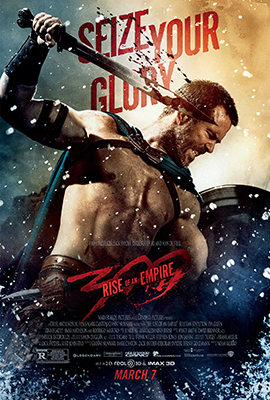
1) 300: Rise of an Empire (dir by Noam Munro)

Last night, I watched 300: Rise of an Empire for the second time and I still couldn’t figure out what exactly is going on for most of the film.  I know that there’s a lot of fighting and a lot of bare-chested men yelling and, whenever anyone swings a sword, they suddenly start moving in slow motion and dark blood spurts across the screen like Jackson Pollock decorating a previously blank canvas.  The style of 300 has been co-opted by so many other films that 300: Rise of an Empire feels more like an imitation than a continuation.

At the same time, I’m resisting the temptation to be too critical of 300: Rise of the Empire for two reasons.  First off, this movie wasn’t really made to appeal to me.  Instead, this is a total guy film and, much as I have every right to love Winter’s Tale, guys have every right to love their 300 movies.  Secondly, 300: Rise of an Empire features Eva Green as a warrior and she totally kicks ass.

About_Last_Night_One_Sheet

2) About Last Night (dir by Steve Pink)

Obviously, I made a big mistake this Valentine’s Day by insisting that my boyfriend take me to see Endless Love.  (I still stand by my desire to see Winter’s Tale.)  I say this because I recently watched this year’s other big Valentine’s Day release, About Last Night, and I discovered that it’s a funny and, in its way, rather sweet romantic comedy.

About Last Night tells the story of two couples, Danny (Michael Ealy) and Debbie (Joy Bryant) and Bernie (Kevin Hart) and Joan (Regina Hall).  All four of the actors have a very real chemistry, with Hart and Hall bringing the laughs and Ealy and Bryant bringing the tears.  The film itself is ultimately predictable but very likable.

Adult_World

3) Adult World (dir by Scott Coffey)

In Adult World, Emma Roberts plays Amy Anderson, an aspiring author and recent college graduate.  Despite her own overwhelming faith in her own abilities, Amy struggles to find a job outside of college.  She is finally reduced to working at Adult World, a small adult bookstore.  Working at the store, she befriends the far more down-to-earth Alex (Evan Peters) and eventually discovers that one of her customers is also her idol, poet Rat Billings (John Cusack).  Amy proceeds to force her way into Rat’s life, volunteering to work as his assistant and declaring herself to be his protegé.  However, it turns out that Rat is far less altruistic than Amy originally thought (and with a name like Rat, are you surprised?).

Adult World is a flawed film but I still really enjoyed it.  The story has a few problems and the film never really takes full narrative advantage of Adult World as a setting but the entire film is so well-acted that you’re willing to forgive its flaws.  Cusack gives a surprisingly playful performance while Evan Peters is adorable in a Jesse Eisenberg-type of way.  Emma Roberts shows a lot of courage, playing a character who is both infuriating and relatable.

Jersey_Boys_Poster

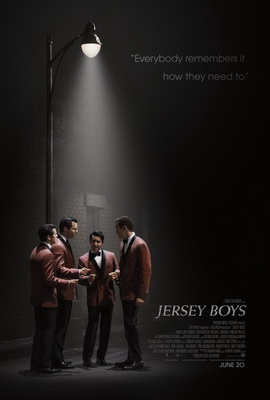
4) Jersey Boys (dir by Clint Eastwood)

Clint Eastwood’s upcoming American Sniper has been getting so much attention as a potential Oscar contender that it’s easy to forget that, at the beginning of the year, everyone was expecting Jersey Boys to be Eastwood’s Oscar contender.  In fact, it’s easy to forget about Jersey Boys all together.  It’s just one of those films that, despite its best efforts, fails to make much of an impression.

Jersey Boys is based on one of the Broadway musicals that tourists always brag about seeing.  It tells the true story of how four kids from the “neighborhood” became the Four Seasons and recorded songs that have since gone on to appear on thousands of film soundtracks.  The period detail is a lot of fun, Christopher Walken, who has a small role as a local gangster, is always entertaining to watch, and the music sounds great but Eastwood’s direction is so old-fashioned and dramatically inert that you don’t really take much away from it.

Hopefully, American Sniper will be the work of the Eastwood who made Mystic River and not the Eastwood who did Jersey Boys.

Ride_Along_poster

5) Ride Along (dir by Tim Story)

School security guard Ben Barber (Kevin Hart) wants to marry Angela (Tiki Sumpter) but Angela’s tough cop brother James (Ice Cube) doesn’t approve.  In order to prove himself worth, Ben goes on a ride along with James and the results are just as generic as you might expect.  Probably the only really funny part of the film was the way that Hart delivered the line, “You’re white!  You don’t fight!” but we all saw that in the commercial so who cares?

On the plus side, Ice Cube has a lot of screen presence and is well-cast as James.  As for Kevin Hart — well, he should probably be thankful that About Last Night came out a month after Ride Along.

Trust Me

6) Trust Me (dir by Clark Gregg)

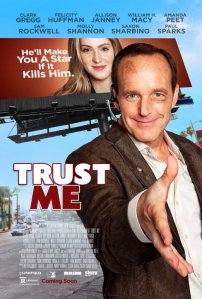
In Trust Me, Clark Gregg both directs and stars.  He plays Howard, a fast-talking but ultimately kind-hearted talent agent who mostly represents children.  After losing some of his most popular clients to rival agent Aldo (a hilariously sleazy Sam Rockwell), Howard meets Lydia (Saxon Sharbino), a 13 year-old actress.  Soon, Howard is representing Lydia and trying to land her a starring role in a major production.  Howard also finds the time to tentatively date his next door neighbor (Amanda Peet).  However, there’s more to Howard than meets the eye.  He is haunted by the death of one of his previous clients and his guilt leads him to become especially protective of Lydia.  When Howard concludes that Lydia is being sexually abused by her crude father (Paul Sparks), he attempts to protect her from both him and the Hollywood system that’s threatening to corrupt her.  It all leads to an oddly tragic conclusion…

I say “oddly tragic” because Trust Me is, in many ways, an odd film.  As a director, Gregg gets good performances from his cast but he never manages to find a consistent tone.  The film starts as a Hollywood satire and then it becomes a romantic comedy and then it turns into a legal drama before then becoming an all-0ut attack on the way the entertainment industry treats child actors and then finally, it settles on being a tragedy.  As a result, Trust Me is undeniably a bit of a mess.

And yet, it’s a compelling mess and the film itself is so heart-felt that you can’t help but forgive its flaws.  If nothing else, it proves that Clark Gregg is capable of more than just being Marvel’s Agent Coulson.

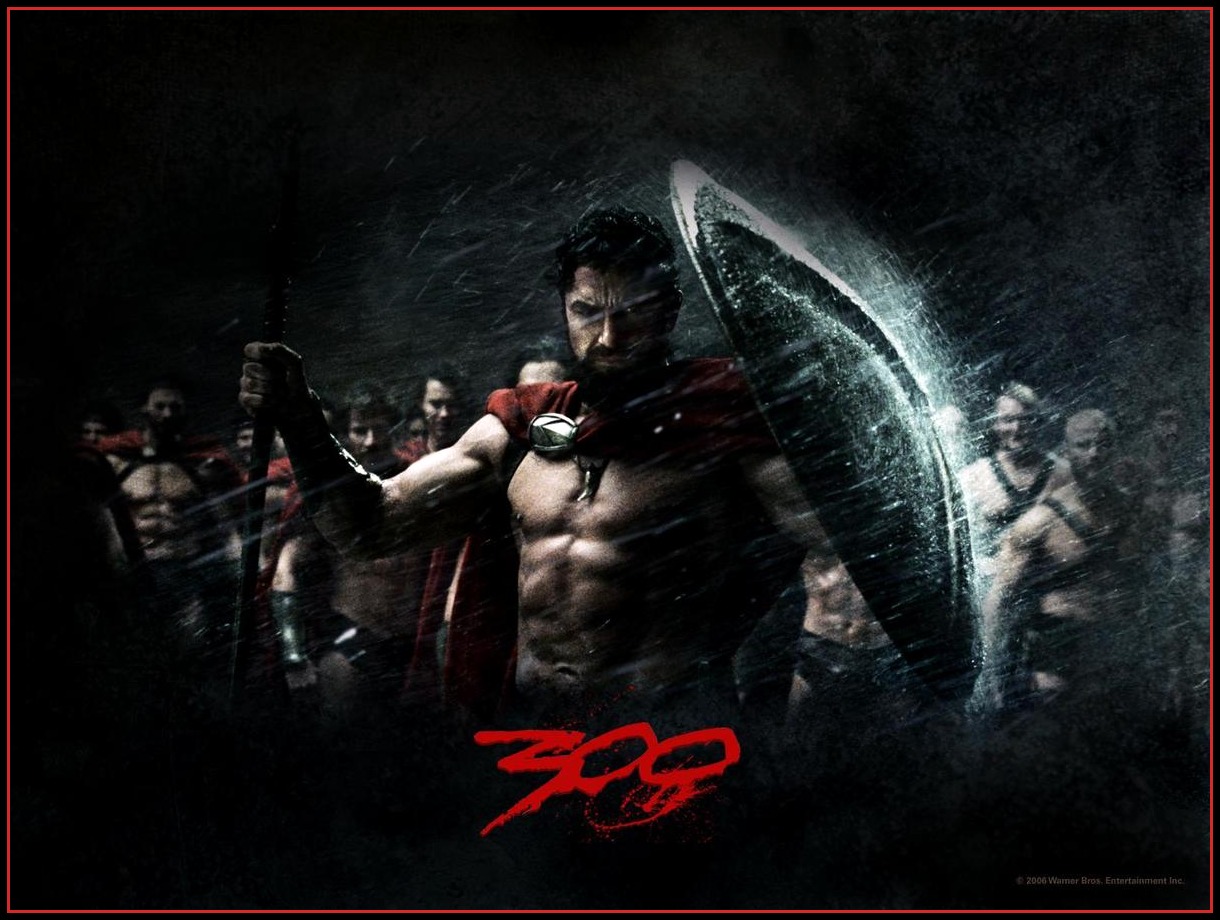
Review: 300 (dir. by Zack Snyder)


I will get it out of the way and say that this was not and was not meant to be a historically accurate depiction of Ancient Greece. It was never meant to be even when it was still just an Eisner-Award winning graphic novel from the mind of iconic graphic novelist and artist Frank Miller. With that out of the way I was able to watch and enjoy Zack Snyder’s film adaptation on its own terms without the criticism of historical accuracies looming dangerously over my head. 300 deserves the label of being an event film. From start to finish, Snyder’s film practically screams blockbuster and popcorn and I wouldn’t have it any other way.

Frank Miller’s 300 was at its time an interesting depiction of one of history’s greatest military last stands. Miller already known for hyperstylizing the look and feel of the noir genre with his Sin City graphic novels, takes the same approach with his depiction of King Leonidas and his 300 Spartans taking a final last stand against Persian God-King Xerxes at a narrow mountain pass called Thermopylae (literally meaning Hot Gates in Greek). Zack Snyder took this graphic novel and painstakingly stayed true to the visuals Miller and his colorist wife, Lynn Varley put on paper. Looking back at my memory of some of the panels and images from the graphic novel. Snyder and his crew of art directors, cinematographers and CGI-artists were successful in translating almost every page of the graphic novel onto the screen.

Like Robert Rodriguez’s adaptation of Miller’s Sin City, Zack Snyder’s 300 pretty much brings the graphic novel to moving life. This means he stuck to the source material quite literally which limits his own take on the graphic novel. Like Rodriguez, Snyder doesn’t really put his own signature stamp as a director to the film. It’s not too much of criticis since he does a great job of translating Miller’s work onto film, but one wonders what sort of personal touches he could’ve added to the finished look that wasn’t lifted from Miller’s style and whether it would’ve changed the overlook look and feel of the film.

The story is quite simple and just takes the basic summary of the historical event itself. Spartan King Leonidas (played with visceral gusto and machismo by Scottish thespian Gerard Butler) makes a decision to go to war and confront the encroaching and fast approaching massive Persian Army led by Xerxes (Rodrigo Santoro) intent on conquering the Hellenic city-states of the Greek Peninsula. Persian ambassadors ride forth to demand oaths of fealty from those city-states ahead of the army’s path. Sparta is one such city-state, but different from the rest of its Hellenic brethrens. Sparta has gone down in history as a word synonymous with unbending dedication to a strict, ascetic warrior code. Warfare and battle were what Spartans were born and trained to do from an early age. Weakness and physical imperfections weeded out from the time of birth (the film explains just what happens to male newborns with physical imperfections and deformities). The answer Leonidas gives the Persian delegation could be seen as somewhat extreme, but not contrary to his nation’s warrior-culture of never surrendering and seeing death in battle the greatest glory for a Spartan to achieve. From this sequence right up to the end of the film we get to see just how much of a warrior culture the Spartans were in extreme detail.

It’s during the prolonged battle scenes between Leonidas’ Spartans and Xerxes army which will have everyone chomping at the bit. If you have to see this film for any particular reason outside of watching superbly-trained underdogs slaughtering and endless supply of enemy troops then you will most likely be disappointed by the slower scenes away from Thermopylae. Indeed, this film an its original source material would’ve worked even better without the extra filler Snyder and his writers added to give the film more depth. I’m all for more emotional depth and characterization in my films but when a movie is all about a bloody and heroic last stand of a few against the many, scenes which slow the story down does more to break the rhythm and tone of a film than add to it. Othe than a deeper understanding of the kind of partnership Leonidas had with Gorgo, his Spartan Queen, most of the subplots added by Snyder and his writers could easily have been left out and still ge a kick ass action epic.

It’s the action scenes which reall stand out visually. Some people might see the style tricks of speed ramping certain action sequences then slowing it down considerably to show the minute detail of the battle scene as being to gimmicky, but I would disagree and say it actually gives the movie a mythical quality in its storytelling. One thing I have to say about Zack Snyder as a director (his remake of George A. Romero’s Dawn of the Dead better than what detractors have made it out to be) is that he knows how to film action and with special mention to bloody and gory action. He makes these scenes of dismemberments, decapitations, and disembowlments look like a piece of performance art.

These scenes of carnage would be considered extremely gratuitious if it didn’t look so made up good. Even the way the blood flows, spurts and splashes look like something Jackson Pollock would take interest in. The speed up and slow down of the sequences also gives the fight scenes a certain rhythm that once an audience picks up on will follow it through to the end. This is why the scenes back in Sparta with a duplicitous politician and his powerplay to assume control and power seem such a downer instead of enhancing the sacrifice of Leonidas and his men. Those scenes just feel tacked on and completely superfluous. Luckily, there’s not enough of them to slow down the frantic pace developed by the battle itself.

The performances by all actors involved really doesn’t require too much criticism or reflection over. Gerard Butler does a great and convincing job as the Spartan King and his conviction in confronting Xerxes and his army with so few seem very believable. It’s not a star-making performance but it does show that Butler can add a bit of gravitas to a character and role so basic in characterization. Lena Hedley is radiant as his partner and Queen. Despite the weird sounding name of Gorgo, Hedley plays the strong-minded and equally influential wife to Butler’s Leonidas. It’s only her scenes back in Sparta as she tries to rally her people to support their king which keeps these slower sequences from fully pulling down the film. The performances were good enough to keep the acting in the film from becoming too campy or too serious. It’s an action film and with enough action going on in the movie I could forgive the writers (both Miller and the screenwriters) from scrimping on character build up.

All in all, Zack Snyder’s film adaptation of Frank Miller’s 300 succeeds in bringing the book to moving life. Throughout the run of the film it was hard not to get lost in the beautiful visuals. Whether it was the muted color pallette which puts most of the scenes in an almost sepia-tone look to over-emphasizing certain colors to set a certain mood. From oversaturation of reds in one sequence to one where everything seem to be tinted with the many shades of blues at night. This is what 300 will be best remembered for. It’s technical use of CGI to paint the environment in unrealistic but beautiful ways which gives the scenes a lyrical and mythical look to them once the actors were superimposed over them. The film really was a painting come to life and it shows once again how computer and digital filmmaking technology have now afforded directors in making what used to be impossible technically to something that could be done with the limit being the artist’s imagination.

This film will not win many acting, directing and even screenwriting awards (which it didn’t once award season rolled around), but it doesn’t have to for people to enjoy it. It will entertain and pull its audience into a living and modern retelling of a legend. Whether all that happened on the screen was exactly as it happened in 480 B.C. doesn’t matter. What it does show is that through retelling down the years even all the embellishments added to the story of Leonidas and his men doesn’t diminish the fact that what they did and accomplished was how legendary heroes were made and remembered.

Review: The Proposition (dir. by John Hillcoat)


When I first saw John Hillcoat’s film The Proposition I was literally shocked and dumbstruck with what I had just witnessed. As a long-time aficionado of the horror genre I could say that part of me has become desensitized to onscreen violence and nothing really shocks me. Even though I’ve seen films with more violence throughout its running time, The Proposition just had a heavy sense of despair, moral ambiguity, and a Miltonian feel throughout. The film felt like how it would be if one accepted an offer from one of the damned to stroll down to the Nine Circles of Hell. As much as I didn’t want to accept that offer the curiosity of what I might see won out. That’s how I was able to sit through the entirety of Hillcoat’s ultra-violent and nihilistic tale of lawless and amoral individuals in the untamed wilderness of 1880’s Australian Outback.

I must agree with several critics who have said The Proposition seemed to mirror another dark and violent tale. Hillcoat’s film shares so much the same themes and tone as Cormac McCarthy’s brutal novel, Blood Meridian, that one almost wondered if the film was adapted from McCarthy’s great novel. But similarities aside, Hillcoat and Nick Cave’s (director and writer respectively) film can clearly stand on its own two bloody legs.

The film begins with a bloody siege and shootout and we’re soon introduced to two of the three Burns’ brothers. We soon find out that both brothers, Charlie (played by Guy Pearce) and Mikey (played by Richard Wilson), are outlaws wanted for a multitude of heinous crimes with a recent one the senseless rape and murder of the Hopkins family. One Capt. Stanley (Ray Winstone) who acts as law in this particular area of the Outback also happens to be friends of the unfortunate Hopkins clan. When he finally apprehends the two brothers after the siege gives older brother Charlie a proposition. He’ll spare the younger brother’s life from the hangman’s noose if Charlie finds their older brother Arthur (played with Kurtz-like menace by Danny Huston) and kills the outlaw leader. The quest is set as Charlie accepts and sets out to find his elder brother. Whether Charlie will go through with killing his older brother Arthur is one thing the audience won’t find out until the final minutes of the film. Even though there’s no love-lost between Charlie and Arthur, there’s still the traditional bond of family that makes Charlie’s quest a complex one.

We realize early on that Charlie is very protective of his simpler, younger brother Mikey and would do anything to save his life. Guy Pearce does a great performance as the conflicted and brooding Charlie Burns. There’s a quiet intensity in Pearce’s performance. He’s pretty quiet through most of the film, but one could feel the palpable rage just roiling beneath his brooding countenance. Pearce’s Charlie is one who is only a trigger away from exploding into outright violence. Charlie is definitely a child and creation of the lawless Outback the film is set in.

Arthur Burns on the other hand comes in introduced as an almost warrior-poet (though in this story it would be more like a charismatic-sociopath) who would watch the sun set and spout poetry as easily as gun down an innocent or slice a man’s throat without missing beat. Danny Huston does a bravura performance as the charismatic and wholly amoral Arthur. His performance easily matches that of Pearce’s scene for scene. Another performance that I must point out as being very strong in the film is Ray Winstone as Capt. Stanley, the Ahab of the tale with his obsession to bring civilization to the lawless Outback and to bring Arthur Burns to ultimate justice even if it means dealing with the lesser evil that is Charlie Burns.

The Proposition will be talked about alot for its unflinching look at violence onscreen. Though there’s been films that have more violence per hour than Hillcoat’s film, but the extreme brutality of the killings, maimings and rape in The Proposition has such an air of realism to it that one cringes at every gunshot wound and knife slashing. Like Aronofsky’s Requiem for a Dream, this film’s scenes of violence makes one want to rush into the shower and cleanse off the dirt, grime and stink of the film. It’s in this unflinching and realistic portrayal of death and violence that the film shares alot with McCarthy’s Blood Meridian. The images are difficult to watch, but our curiosity makes us look through squinted eyes to see the full breadth of the violence. In time, just through the audiences acceptance of the oncreen violence do we soon become complicit in whats going on the screen.

It is a shame that The Proposition had such a limited release in the US. Even since it’s release on video it’s a film that still seems to be underappreciated. I think this film would’ve done as well as Eastwood’s Unforgiven in giving the audience a different, darker side of the Old West mythology (though its really the Australian Old West). John Hillcoat has crafted himself a brutal and nihilistic film that’s very hard to watch but also difficult to ignore. The Proposition is a film I highly recommend as it is the type of film that helps redefine a whole genre.