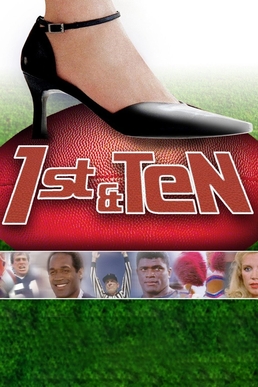
Welcome to Late Night Retro Television Reviews, a feature where we review some of our favorite and least favorite shows of the past! On Wednesdays, I will be reviewing 1st and Ten, which aired in syndication from 1984 to 1991. The entire series is streaming on Tubi.
This week, an injury leads to the promise of sex …. or does it?
Episode 1.5 “Play Me Or Trade Me”
(Dir by Bruce Seth Green, originally aired on December 23rd, 1984)
Carl Whitherspoon, the star running back who is always demanding more money, is injured while filming a commercial for a rental car company. (“Call OJ,” the commercial’s director says when it becomes obvious that Carl won’t be able to jump over any more luggage.) The Bulls are struggling and Coach Denardo wants a championship but his star player is out for four weeks!
It’s time to trade! Unfortunately, the only way that the Bulls are going to be able to get the running back they want is by trading their aging quarterback, Bob Dorsey. Dana is upset about losing Bob but then she realizes she can finally have sex with him if he’s no longer a Bull and she decides that she’s okay with the trade.
But then the running back that the Bulls were hoping to trade for is injured so the trade is called off. So, Dana can’t have sex with Bob. But Bob still leads the team to victory. Actually, the team wins because Bubba (Prince Hughes) blocks a field goal with his oversized ass. (That’s not me being rude. Bubba’s weight and the size of his ass is a running theme on this show.) The Bulls are now 5-3 and I guess they don’t need a running back after all.
The main theme of this episode seemed to be that Dana needs to get laid. I liked the chemistry between Delta Burke and Geoffrey Scott. And the scene where Carl injured himself made me laugh just because of Sam Scarber’s over-the-top facial expressions as he crashed into a table. Otherwise, this episode was pretty forgettable.
Though the Academy of Motion Picture Arts and Sciences claim that the Oscars honor the best of the year, we all know that there are always worthy films and performances that end up getting overlooked. Sometimes, it’s because the competition too fierce. Sometimes, it’s because the film itself was too controversial. Often, it’s just a case of a film’s quality not being fully recognized until years after its initial released. This series of reviews takes a look at the films and performances that should have been nominated but were, for whatever reason, overlooked. These are the Unnominated.
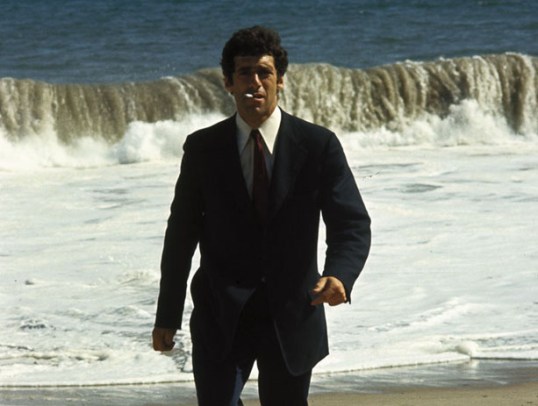
Elliott Gould is Phillip Marlowe!
If I had to pick one sentence to describe the plot of 1973’s The Long Goodbye, that would be it. Robert Altman’s adaptation of the Raymond Chandler detective novel loosely follows Chandler’s original plot, though Altman did definitely make a few important changes. Altman moved the story from the 50s to the then-modern 70s, replacing Chandler’s hard-boiled Los Angeles with a satirical portrait of a self-obsessed California, populated by gurus and hippies. And Altman did change the ending of the book, taking what one could argue is a firmer stand than Chandler did in the novel. In the end, though, the film really is about the idea of Chandler’s tough detective being reimagined as Elliott Gould.
Rumpled, mumbling, and with a permanent five o’clock shadow, Gould plays Marlowe as being an outsider. He lives in a shabby apartment. His only companion is a cat who randomly abandons him (as cats tend to do). With his wardrobe that seems to consist of only one dark suit, Marlowe seems out-of-place in the California of the 70s. When Marlowe’s friend, Terry Lennox (Jim Bouton), asks Marlowe to drive him to Mexico, one gets the feeling that Lennox isn’t just asking because Marlowe’s a friend. He’s asking because he suspects Marlowe would never be a good enough detective to figure out what he’s actually doing.
After Terry’s wife is murdered, Marlowe is informed that 1) Terry has committed suicide and 2) Marlowe is now a suspect. Convinced that Terry would have never killed himself, Marlowe investigates on his own. He meets Marty Augustine (Mark Rydell), a gangster who demands that Marlowe recover some money that he claims Terry stole. Marty seems like an almost reasonable criminal until he smashes a coke bottle across his girlfriend’s face. (One of Marty’s bodyguards is played by a silent Arnold Schwarzenegger.) Meanwhile, Terry’s neighbors include an alcoholic writer named Roger Wade (Sterling Hayden) and his wife, Eileen (Nina van Pallandt). Like Marlowe, Roger is a man out-of-time, a Hemingwayesque writer who has found himself in a world that he is not capable of understanding. Henry Gibson, who would later memorably play Haven Hamilton in Altman’s Nashville, appears as Wade’s “doctor.”
Marlowe, with his shabby suits and a cigarette perpetually dangling from his mouth, gets next to no respect throughout the film. No one takes him seriously but Marlowe proves himself to be far more clever than anyone realizes. Elliott Gould gives one of his best performances as Marlowe, playing him as a man whose befuddled exterior hides a clear sense of right and wrong. Gould convinces us that Marlowe is a man who can solve the most complex of mysteries, even if he can’t figure out where his cat goes to in the middle of the night. His code makes him a hero but it also makes him an outsider in what was then the modern world. The film asks if there’s still a place for a man like Phillip Marlowe in a changing world and it leaves it to us to determine the answer.
Frequently funny but ultimately very serious, The Long Goodbye is one of the best detective films ever made. Just as Altman did with McCabe & Mrs. Miller, he uses the past to comment on what was then the present. And, just as with McCabe & Mrs. Miller, The Long Goodbye is a film that was initially released to mixed reviews, though it would later be acclaimed by future viewers and critics. Whereas McCabe & Mrs. Miller received an Oscar nomination for Julie Christie’s performance as Mrs. Miller, The Long Goodbye was thoroughly snubbed by the Academy. Altman, Gould, Hayden, and the film itself were all worthy of consideration but none received a nomination. Instead, that year, the Oscar for Best Picture went to The Sting, a far less cynical homage to the crime films of the past.
The Long Goodbye (1973, directed by Robert Altman)
What’s an Insomnia File? You know how some times you just can’t get any sleep and, at about three in the morning, you’ll find yourself watching whatever you can find on cable or streaming? This feature is all about those insomnia-inspired discoveries!
If you’re having trouble getting to sleep tonight, you can always go over to either YouTube or Tubi and pull up Why, an obscure film from 1973 that has a semi-interesting cast.
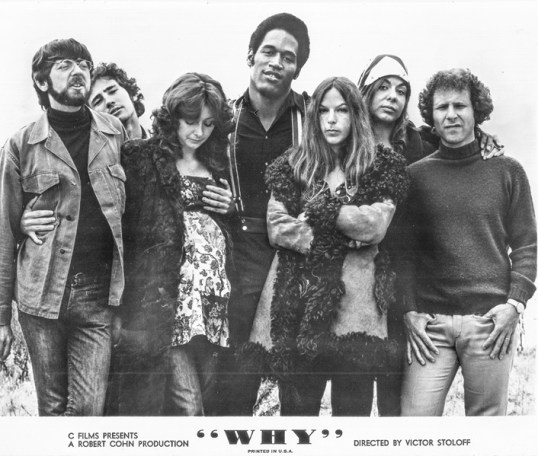
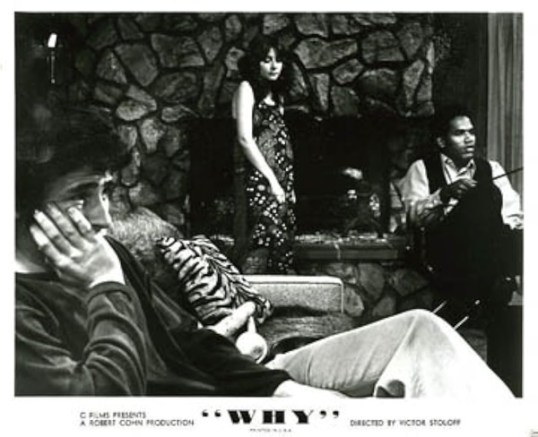
The plot of Why is simple. Six people gather at their psychiatrist’s mansion for group therapy. Dr. Peter Carlson (played by Herb Goldberg, an actual psychiatrist) asks the members of the group questions and asks them to do things like try to imagine a moment that made them truly happy. The members of the group discuss their problems and …. well, that’s pretty much it.
Who is in the group? Jeannie Berlin plays Gail, a single mother who has been rejected by her family because she had an out-of-wedlock child with a black man. Cathy Bleich plays Jennifer, who claims to be a teacher but who is also a pathological liar. Linda Gillen is Christine, a rich teenager who is two-months pregnant and who is implied to be addicted to heroin. Danny Goldman plays Bill, a suicidal gay man. Musician Tim Buckley plays musician Glenn, who can’t get over his band breaking up. And, playing a professional athlete named Bud, is O.J. Simpson. “I smoke dope,” Bud says at one point before going on to explain why he thinks its important to be a good role model.
Why is an odd film. It starts out with a lengthy animated sequence (complete with a hippie-style song) and then settles into being a stagey film that feels more like an extended acting exercise than an actual narrative. It’s a talky film and some of the monologues work while others fall flat. The best performances are given by Danny Goldman, Tim Buckley, and Linda Gillen but I imagine most people who watch this film will be giving most of their attention to O.J. Simpson, who talks about resenting the pressure to always be perfect. In the end, there are no real break-throughs and one could argue that makes this the most realistic depiction of therapy ever filmed.
Reportedly, the film start out as a short film starring O.J. Simpson and Tim Buckley that was commissioned by Technicolor to see if video could be transferred to film. The decision was made to expand the short into a feature. The actors improvised during rehearsal and those improvs served as the basis for the script. Again, this will probably be most interesting to people looking for hints into what it was like inside of O.J. Simpson’s head. (O.J.’s character comes across as being friendly but guarded and quick to get angry about women in general.)
Again, it’s a talky film. At times, it’s a rather boring film. Many of the monologues start out strong but they tend to go on and on. Why might cure you of your insomnia. That said, the film is interesting from a historical point of view. It’s all very 70s, revealing a group of people trying to navigate a world that was still trying to figure out where they stood in the years immediately following the turmoil of 60s. The characters have a brand new world ahead of them and none of them know if that’s a good thing or a bad thing. Some things never change.
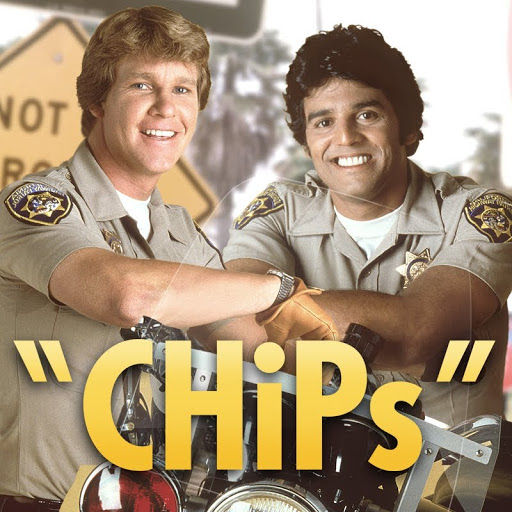
Welcome to Late Night Retro Television Reviews, a feature where we review some of our favorite and least favorite shows of the past! On Mondays, I will be reviewing CHiPs, which ran on NBC from 1977 to 1983. The entire show is currently streaming on Freevee!
This week, things get a little dull.
Episode 2.20 “Quarantine”
(Dir by Harvey S. Laidman, originally aired on February 24th, 1979)
When a Korean teenager tries to stow away in the backseat of a car being driven by two women who freak out when they discover that he’s back there, it’s Ponch and Baker to the rescue. They take the teenager back to the station. Unfortunately, the teen, who does not appear to speak English, turns out to be extremely ill. He’s rushed to a hospital and the station is put under quarantine.
That means that Baker, Sindy, Grossman, and Getraer are all stuck with each other. (Ponch was lucky enough to get out of the station before the quarantine was declared.) There are also two prisoners at the station, a man (Tom Poston) with multiple personalities and a young but witty criminal (Jody St. Michael) who wears a leather jacket and who is always looking for an excuse to crawl around in the air ducts. Eventually, Harlan enters the station and ends up getting quarantined as well. Oddly enough, the doctor who tells them that they’re quarantined is allow to enter and leave the station, despite not wearing any sort of protective gear. For that matter, the two women who were in the car with the teenager are also allowed to leave. This really isn’t much of a quarantine!
It’s also not much of an episode of CHiPs. I know that I’ve spent a lot of time complaining about how, during its second season, CHiPs essentially became the Ponch show but I may have to stop doing that. Ponch is barely in this episode and the end result is definitely the most boring episode of this show so far. This is an episode that could have actually used Erik Estrada’s tendency to overact every single minute that he’s onscreen. Larry Wilcox was definitely a better actor than Estrada but he’s so low-key that Baker’s just not that interesting when he’s left to his own devices. One gets the feeling that Estrada would have totally gone totally overboard in portraying Ponch’s desire to leave the station but that would still have been more interesting than what we ended up with.
CHiPs is ultimately a show that’s about the joy of the California scenery and the excitement of driving a motorcycle down the highway. It’s a show that works best when everyone is outside and on or in some sort of of vehicle. With the exception of the opening scenes, this episode takes place almost entirely inside the station. (And the station, it must be said, it not a particularly intriguing location.) This episode fails because it goes against everything that makes CHiPs an entertaining show. Fortunately, in the end, it turns out that the kid only had the flu and quarantine comes to an end. Baker and everyone else is set free so that they can ride again.
Welcome to Late Night Retro Television Reviews, a feature where we review some of our favorite and least favorite shows of the past! On Mondays, I will be reviewing CHiPs, which ran on NBC from 1977 to 1983. The entire show is currently streaming on Freevee!
This week, Ponch rides with Getraer!
Episode 1.21 “Crack-Up”
(Dir by Phil Bondelli, originally aired on March 9th, 1978)
After causing an accident that lands Officer Baker in the hospital, street racer and tow truck drive Niles (Joey Aresco) has a psychotic break and decides that he wants to put as many police officers in the hospital as possible. He starts driving recklessly in his tow truck, all the better to get the attention of highway patrol officers. Soon, Officer Grossman has joined Baker in the hospital.
Meanwhile, with his partner laid up, Ponch faces his greatest nightmare. His temporary partner is none other than Sgt. Getraer! Getraer tells Ponch that he expects Ponch to do everything by the book. He expects Ponch to follow orders and observe official procedure. Ponch, however, is more concerned with saving lives and getting results than following the book. Ponch is a rebel!
And that’s fine, except for the fact that there’s never been anything about Erik Estrada’s performance that has ever made Ponch seem like he’s actually the rebel who everyone claims he is. Estrada plays Ponch as someone who is quick to smile and quick to brag on himself and quick to get annoyed if a motorist doesn’t pull over for him. In short, Estrada has always been convincing when he plays Ponch as being a jackass but far less convincing when it comes to convincing us that Ponch is a cop who deliberately breaks the rules for the greater good.
While Getraer and Ponch get on each other’s nerves, Baker lies in bed and insists that he’s ready to get back on his bike. Wanda (Phyllis Diller), who is visiting her husband in the hospital, frequently stops by to tell jokes. When I saw this episode was going to be co-starring Phyllis Diller, I cringed because CHiPs seems like the type of show that would screw something like that up. But actually, Diller gives a really good performance as Wanda and her scenes were the best in the episode. She told a lot of jokes but, as she admitted to Baker, she was only joking to distract herself from worrying about her husband.
In the end, things work out. Baker gets back on his bike. Getraer and Ponch come to respect each other. And, eventually, Niles the mad mechanic is captured. To be honest, it’s kind of weird that it took so long to capture Niles. After Baker was injured, Niles called the police to say that someone has stolen his car an hour or so before. He also got another mechanic, Ray (Gary Sandy), to lie and provide him with an alibi. But then, Niles went driving around in his tow truck and that’s what he was driving when he injured Grossman. So, really, a smart cop would have said, “Hey, that stolen car belonged to a tow truck driver and now, another office has been injured by someone driving a tow truck! Maybe we should go talk to that guy again….”
This episode was better than I was expecting, largely due to Phyllis Diller and the comedic interplay between Officers Grossman and Baker. As always, the California scenery was the real star of the show and the state looked lovely.
Welcome to Retro Television Reviews, a feature where we review some of our favorite and least favorite shows of the past! On Sundays, I will be reviewing the made-for-television movies that used to be a primetime mainstay. Today’s film is 1975’s The Secret Night Caller! It can be viewed on YouTube!
Though the show pretty much guaranteed that he would forever be a part of the American pop cultural landscape, Robert Reed was not a fan of The Brady Bunch. Onscreen, Reed played Mike Brady, the stern patriarch who always knew the right thing to do and who, as a result, was named father of the year by the local chamber of commerce. (Of course, even though she was responsible for him getting the reward, Mike still grounded Marcia for sneaking out to mail in his nomination forms.) Offscreen, Reed was notoriously difficult, complaining that the scripts for the show were juvenile and shallow. Reed was correct and it should be noted that all of the actors who played the Brady kids have said that Reed never took out his frustration on the cast and actually became a bit of a surrogate father to all of them. Still, you have to wonder what Reed was expecting when he signed up for a show that was created by the man responsible for Gilligan’s Island.
The Brady Bunch was cancelled in 1974, temporarily setting Robert Reed free from the burden of playing Mike Brady. (Of course, he would later return to the role in The Brady Bunch Hour and we all know how that turned out.) One of the first post-Brady movies that Reed starred in was The Secret Night Caller.
In this film, Reed plays a seemingly mild-mannered IRS (booo!) agent named Freddy Durant. Freddy has a good career and a nice home but he’s deeply unsatisfied. He barely communicates with his wife, Pat (Hope Lange). He freaks out over his teenage daughter, Jan (Robin Mattson), wearing a bikini. He fantasies about hitting on almost every woman that he sees. He hangs out at a strip club and, when he’s really feeling unsatisfied, he makes obscene phone calls! Because this is a made-for-TV movie from the 70s, we never actually get to hear what Freddy says on the phone but he manages to disgust and/or horrify everyone who has the misfortune to answer his call. He even calls a woman who works in his office, scaring Charlotte (Arlene Golonka) so much that she subsequently has an auto accident. Unfortunately, for Freddy, one of his victims, a stripper named Chloe (Elaine Giftos), recognizes his voice and tries to blackmail him. Freddy’s life is falling apart. Can his psychiatrist (played by Michael Constantine) help him put it all back together again?
Freddy Durant is obviously meant to come across as being the exact opposite of Mike Brady. (Of course, many of us who have seen The Brady Bunch have our suspicions about what Mike was actually doing in his office….) Whereas Mike Brady was the perfect father, Freddy is cold, distant, and repressed. Reed is convincingly uptight as Freddy and he’s surrounded by a fine supporting cast, including Sylvia Sidney as his disapproving mother-in-law. That said, it’s still impossible to watch this show without thinking to yourself, “There’s Mike Brady making an obscene phone call.” That’s the difficulty of typecasting unfortunately. For all of his efforts to escape the shadow of the Brady Bunch, it’s impossible not to associate Robert Reed with the show, even when he’s talking dirty on the phone.
After Tom Logan (Jack Nicholson) and his gang of rustlers (played by Randy Quaid, Frederic Forrest, and Harry Dean Stanton) rob a train, Logan uses the money to buy a small ranch. Their new neighbor is Braxton (John McLiam), a haughty land baron who considers himself to be an ambassador of culture to the west but who is not above hanging rustlers and hiring gunmen. One such gunman is the eccentric Robert E. Lee Clayton (Marlon Brando), a “regulator” who speaks in a possibly fake Irish brogue, is a master of disguise, and uses a variety of hand-made weapons. Braxton hires Clayton to kill Logan and his men, despite the fact that his daughter (Kathleen Lloyd) has fallen in love with Logan.
A flop that was so notorious that it would be five years before Arthur Penn got a chance to direct another film, The Missouri Breaks is best remembered for Marlon Brando’s bizarre performance. Brando reportedly showed up on the set late and insisted on largely improvising his part, which meant speaking in a comical Irish accent, singing an impromptu love song to his horse, and disguising himself as an old woman for one key scene. (According to Patrick McGilligan’s Jack’s Life: A Biography of Jack Nicholson, co-star Harry Dean Stanton grew so incensed at Brando’s behavior that he actually tried to rip the dress off of Brando, saying that he simply would not be “killed’ by a man wearing a dress.) Brando’s later reputation for being a disastrously weird performer largely started with the stories of his behavior on the set of The Missouri Breaks.
I had heard so many bad things about Brando and The Missouri Breaks that I was surprised when I finally watched it and discovered that it is actually a pretty good movie. For all of his notoriety, Brando does not enter this leisurely paced and elegiac western until after half a hour. The majority of the movie is just about Jack Nicholson and his gang, with Nicholson giving a low-key and surprisingly humorous performance that contrasts well with Brando’s more flamboyant work. While Arthur Penn may not have been able to control Brando, he still deftly combines moments of comedy with moments of drama and he gets good performances from most of the supporting cast. Quaid, Stanton, Forrest, and Nicholson are all just fun to watch and the rambling storyline provides plenty of time to get to know them. Whenever Brando pushes the movie too close to self-parody, Nicholson pulls it back. The Missouri Breaks may have been a flop when it was released but it has aged well.


 After Tom Logan (Jack Nicholson) and his gang of rustlers (played by Randy Quaid, Frederic Forrest, and Harry Dean Stanton) rob a train, Logan uses the money to buy a small ranch. Their new neighbor is Braxton (John McLiam), a haughty land baron who considers himself to be an ambassador of culture to the west but who is not above hanging rustlers and hiring gunmen. One such gunman is the eccentric Robert E. Lee Clayton (Marlon Brando), a “regulator” who speaks in a possibly fake Irish brogue, is a master of disguise, and uses a variety of hand-made weapons. Braxton hires Clayton to kill Logan and his men, despite the fact that his daughter (Kathleen Lloyd) has fallen in love with Logan.
 Through the Shattered Lens