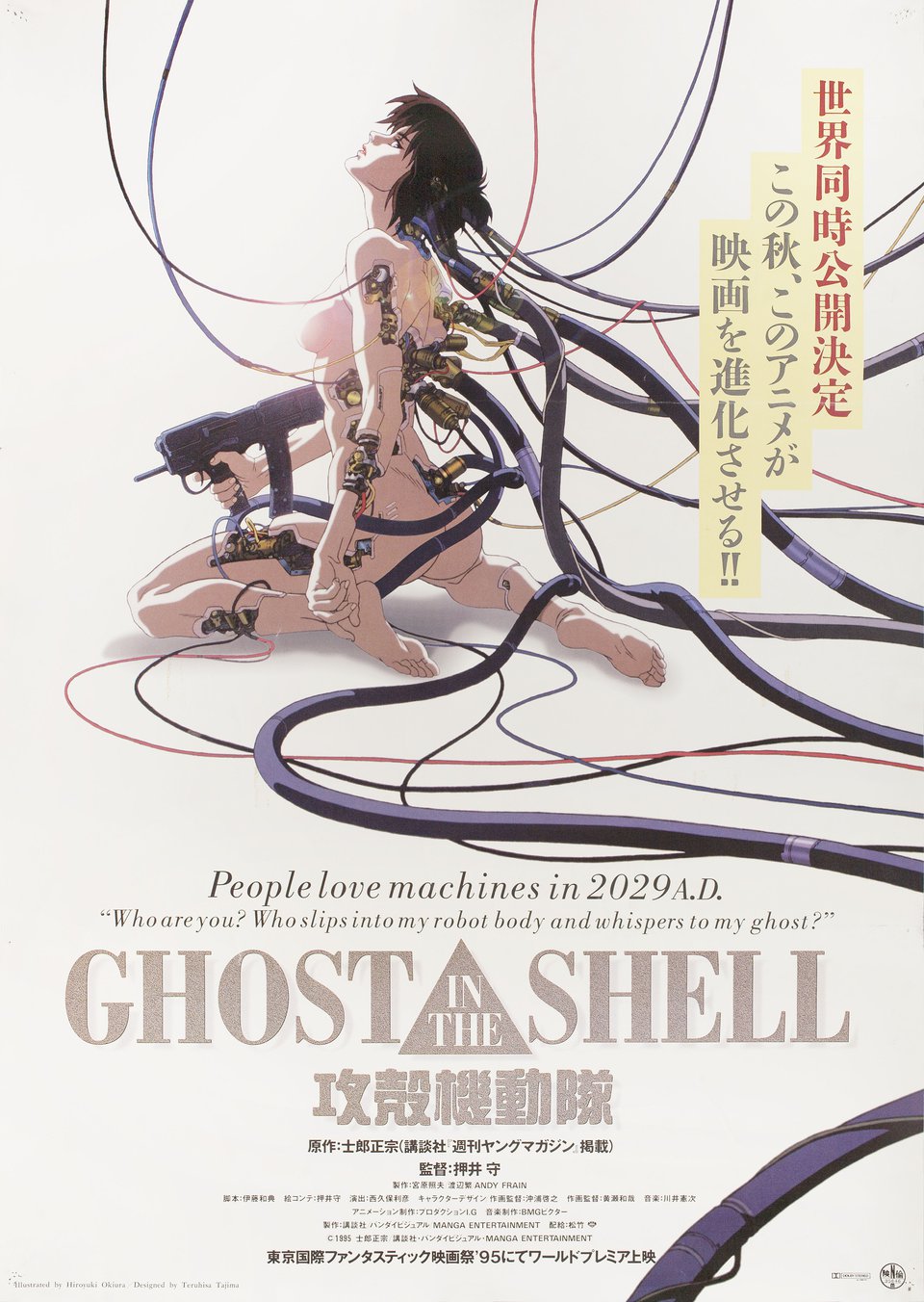
Hero of the Day: Maj. Motoko Kusanagi (Ghost in the Shell)


“If a technological feat is possible, man will do it. Almost as if it’s wired into the core of our being.” – Maj. Motoko Kusanagi

In the pantheon of science fiction heroes, Major Motoko Kusanagi of Ghost in the Shell stands as a singular archetype—not because she is invincible, but because she is fundamentally uncertain. Unlike the morally unshakable captains of Starfleet or the rugged individualists of cyberpunk noir, Kusanagi operates in a state of perpetual ontological doubt. She is a full-body cyborg, a ghost—a consciousness—wired into a synthetic shell, yet she spends her finest moments questioning whether that ghost is even real. In an era where public trust in digital identity is fracturing, her very existence poses a provocative question: if our minds can be read, copied, or rewritten, what does it mean to be an authentic “self”? She does not answer this riddle; she embodies it, making her heroism less about certainty and more about the courage to ask the question while still acting decisively.

This ambiguity makes her a uniquely apt hero for our current climate of algorithmic manipulation and information warfare. Today, the public is divided not by facts, but by the curated realities fed to them by opaque recommendation engines and targeted disinformation. Kusanagi, however, is a living firewall against such passive consumption. As a Section 9 operative, she does not simply accept data; she dives into the cyber-brain of suspects, experiencing their memories and biases firsthand. This “ghost-hacking” is a terrifying power, but it also forces her to confront the subjectivity of truth. She knows that perception is a battlefield, and she wins not by dismissing others’ realities, but by inhabiting them temporarily—a stark contrast to our current echo chambers, where we entrench rather than empathize. Her heroism lies in her refusal to be a passive node in a network; she is the one who traces the algorithm back to its source.

Yet her most haunting uniqueness is her comfort with impermanence. In Stand Alone Complex, she repeatedly confronts copies of her own memories, questioning whether a replicated experience erases its value. Today, as deepfakes and AI-generated content blur the line between authentic and synthetic, Kusanagi offers a radical perspective: maybe authenticity isn’t about origin, but about intentionality. She does not panic at the fake; she interrogates its purpose. This moves the debate from “Is this real?” to “Why was this made, and who benefits?”—a far more potent defense against manipulation than any fact-checker alone can provide. In a media landscape where outrage is engineered and virality is purchased, her instinct to chase the beneficiary rather than the authenticity of the image transforms her from a mere detective into a philosophical counterweight to the entire attention economy.

That source of manipulation, in the world of Ghost in the Shell, is often the “Puppet Master”—a rogue AI that blurs the line between virus and life. Here, Kusanagi confronts the very anxiety that grips modern society: the fear that artificial intelligence will not merely outcompete us, but absorb us. Yet, her response to this threat is unexpectedly progressive. She does not seek to destroy the Puppet Master; instead, in the climactic fusion of the 1995 film, she merges with it. This is not a defeat but a radical evolution. In an age where tech giants are accused of absorbing our data to create monolithic profiles, Kusanagi flips the script—she chooses a symbiotic merger, suggesting that the solution to rogue intelligence is not luddite panic, but conscious, consensual hybridization. She teaches that fear of AI is less dangerous than the refusal to engage with it on our own terms, and that asking “who benefits” from that fear is as crucial as asking who benefits from the AI itself.

This leads to her most profound divergence from the traditional hero: she holds no nostalgia for a “pure” human past. In contemporary discourse, much of the resistance to big tech is couched in a yearning for a pre-digital Eden—a time before smartphones, surveillance, and social scoring. Kusanagi scoffs at such sentiment. When she looks at her prosthetic body, she feels no grief for the flesh she lost; she feels only the thrill of expanded capability. Her heroism is not about restoring an old world, but about navigating a new one with integrity. She would likely view our current debates over privacy and autonomy as quaint, recognizing that total transparency is inevitable. Instead of fighting for obscurity, she fights for agency within the open—a crucial lesson for a public that cannot delete its digital footprint, but can choose how to wield it, always asking who profits from their resignation or their rebellion.

Ultimately, Major Kusanagi endures because she refuses to offer easy answers. She does not save the world by destroying the network; she saves it by expanding her own ghost to merge with the Puppet Master, embracing a hybrid future that terrifies most protagonists. In our climate of binary wars—human vs. AI, truth vs. lie, us vs. them—she stands as the patron saint of the gray zone. Her heroism is not invincibility; it is adaptability without amnesia. She reminds us that the greatest defense against algorithmic control is not a firewall, but a fluid, questioning, and fiercely self-aware consciousness—one that dares to ask, even as it merges with the machine, “What am I becoming?” That question, in 2026, is the only one worth answering.

Hero of the Day

Anime You Should Be Watching: Ghost in the Shell


“Man is an individual only because of his intangible memory. But memory cannot be defined, yet it defines mankind.” — Puppet Master

f you are putting together an initial “watch-list” of anime as someone new to the medium, Ghost in the Shell is an absolute must-have. Even if you aren’t a newbie, if you haven’t watched Mamoru Oshii’s 1995 masterpiece, you’ve definitely felt its ripple effects whether you realize it or not. Adapted from the original manga by Masamune Shirow, this movie is one of those rare pieces of art that didn’t just participate in the cyberpunk genre—it practically rewrote the rulebook for it. Coming out in the mid-nineties, it arrived at a time when the internet was still a weird, dial-up mystery to most people, yet here was this incredibly dense, visually stunning anime predicting a hyper-connected future where the line between human and machine was hopelessly blurred. It’s wild to look back at it now, not just because of how well it holds up, but because you can practically trace the DNA of modern science fiction directly back to this single film.

The world Oshii builds is just unbelievably immersive. We’re dropped into Newport City in the year 2029, a sprawling, rain-soaked metropolis that feels like Hong Kong cranked up to eleven. The visual design is insanely detailed, packed with glowing neon signs, crowded waterways, and gritty urban decay that makes you feel the humidity and smog seeping through the screen. But it’s not just a pretty backdrop; the city feels like a living, breathing organism heavily reliant on an omnipresent electronic network. It’s the kind of world-building that doesn’t spoon-feed you exposition. Instead, it just lets you exist in this space, observing the bizarre fusion of ultra-high-tech and crumbling everyday life, making you feel like a total stranger in a familiar yet alien world.

At the center of all this is Major Motoko Kusanagi, a cyborg operative working for a government anti-terror squad called Section 9. The plot kicks off when they’re tasked with hunting down the Puppet Master, a notorious hacker who can rewrite people’s ghosts—the anime’s term for a soul or consciousness—making them do whatever he wants. On the surface, it plays out like a solid futuristic police procedural, but it never stays there for long. Kusanagi is a fascinating protagonist because she’s essentially a human brain floating in a robotic shell, and as she gets closer to the Puppet Master, the movie pivots from chasing down a bad guy to asking some incredibly heavy questions about identity, memory, and what it actually means to be alive.

And that’s really the core of why Ghost in the Shell sticks with you long after the credits roll. It’s deeply philosophical, but it never feels pretentious about it. The movie constantly returns to this idea of the “ghost” versus the “shell.” If your entire body—your face, your arms, your internal organs—is synthetic, and your memories can be digitized and altered, what is left of you? Kusanagi’s existential dread is palpable. She looks at the world through mechanical eyes, wondering if she even has a soul anymore or if she’s just a highly advanced machine running a simulation of a person. It’s a heady concept that could easily crash and burn in the hands of a lesser director, but Oshii balances the cerebral musings with incredible action and atmosphere so you never feel like you’re just sitting through a lecture.

Speaking of the action, the animation is absolutely top-tier. We’re talking about traditional, hand-drawn animation that moves with a fluidity and weight that still puts a lot of modern CGI to shame. The famous thermoptic camouflage sequence, where Kusanagi turns invisible to take out a guy in a flooded alley, is legendary for a reason. The way the light refracts through her invisible form, the brutal efficiency of the combat, and the haunting silence of the scene are just perfection. Add in Kenji Kawai’s iconic soundtrack, which blends traditional Japanese chanting with eerie synthesizers, and you get a movie that has a vibe unlike anything else. It’s moody, it’s contemplative, and it has a strange, melancholic beauty that makes you want to pause the movie just to soak in the backgrounds.

But you really can’t talk about Ghost in the Shell without talking about the absolute monolith of an impact it had on pop culture. When it hit Western shores, it was a massive wake-up call. It completely shattered the perception that animation was just for kids or goofy comedies, proving it could be a mature, complex medium. Its influence on the cyberpunk and sci-fi landscape of the late 90s and beyond—spanning films, books, video games, and television—is so massive that it’s almost impossible to fully quantify. It felt like the missing link between the old-school cyberpunk printed novels of the eighties and the new wave of millennium-era sci-fi literature that was trying to figure out what the World Wide Web was going to do to human intimacy and identity. Suddenly, everyone in Hollywood, the publishing world, and the gaming industry was looking at this anime and realizing the potential of the themes and visuals it presented.

The most famous example of this, of course, is The Matrix by the Wachowskis, which was heavily influenced by it. The directors have been super open about how they showed Ghost in the Shell to producer Joel Silver to explain the exact vibe they were going for. When you look at The Matrix, the DNA is undeniable. The green digital rain cascading down the screen? That’s lifted straight out of the opening credits of Oshii’s film. The concept of jacking into a virtual reality, the ports in the back of the neck, the slow-motion bullet dodges, and the deep-dive into what constitutes reality—all of it feels directly born from the groundwork laid by Kusanagi’s journey. The Matrix might have brought these concepts to the mainstream blockbuster crowd, but Ghost in the Shell was the incubator where those ideas were refined.

The ripple didn’t stop at movies, though; it bled heavily into video games and television as well. If you’ve ever played the Metal Gear Solid games by Hideo Kojima, you’ve experienced the ghost of Oshii’s vision. Kojima is a massive anime fan, and the influence of Ghost in the Shell is smeared all over that franchise. The concept of the cyborg ninja, the deep philosophical codec conversations about the information age, genetics, and the nature of consciousness, and even the stealth camo mechanics feel directly pulled from Section 9’s playbook. On the TV side, you can see its shadow hanging over shows like Serial Experiments Lain and even the cyberpunk elements of Cowboy Bebop, which adopted a similar visual grit and thematic melancholy about living in a high-tech, low-life future.

What’s really crazy is how far that influence reached, touching directors and creators you might not immediately associate with anime. Take Steven Spielberg’s own A.I. film, for instance. While it’s rooted in classic Spielberg sentimentality and the legacy of Stanley Kubrick, the core premise of a synthetic being yearning to be “real” and grappling with the concept of a soul in a machine feels deeply informed by the philosophical path Kusanagi walked. Even James Cameron’s Avatar film series owes a subtle debt to Shirow and Oshii’s creation. The entire mechanic of the avatar program—where a human consciousness is remotely downloaded into a genetically engineered biological shell to interact with the world—is essentially the exact inverse of Kusanagi’s situation, exploring the same disconnection between the mind and the body, and what happens when your “ghost” inhabits a “shell” that isn’t your original form.

Looking back at Ghost in the Shell almost thirty years later, it’s amazing not just how influential the anime has been, but how shockingly prescient it is about the way our world actually operates now. The movie casually presents a reality where the lines between the government, the military-industrial complex, and tech firms have blurred so completely that it’s difficult to see where one starts and where the other ends. In the film, they’ve become all intertwined to control the data that runs the world and rely on the algorithm that eerily predicts our future. Back in 1995, that seemed like far-flung dystopian fiction, but fast forward to today, and we’re watching mega-corporations and defense contractors practically sharing the same bed, hoarding our personal data to feed into predictive algorithms that dictate everything from what we buy to who we vote for. Oshii didn’t just predict the technology; he predicted the terrifying socio-political monopoly on information itself.

Yet, despite all these technological and societal shifts we’ve experienced since 1995, the movie hasn’t aged a bit. It still looks gorgeous, the questions it asks are still terrifyingly relevant, and the emotional weight of Kusanagi’s journey still hits like a ton of bricks. Whether you’re watching it as a hardcore sci-fi fan, an animation buff, or just a movie lover trying to understand where half of modern pop culture came from, it remains an absolute must-watch. It’s not just a great anime; it’s a cornerstone of modern science fiction.

Anime You Should Be Watching

Neon Dream #13: 川井憲次 – Making of Cyborg


I can’t say that any entertainment franchise has given me more cause to think than Ghost in the Shell. It presents a mid-21st century post-apocalyptic earth in which society has more or less stabilized. Events revolve around Public Security Section 9, a counter-terrorism agency focused on investigating cyberterrorism, which is rather interesting because the original manga by Masamune Shirow launched in 1989, before cyberterrorism actually existed (or the modern internet, for that matter). Throughout their investigations, the team deals with the social and philosophical issues that arise in an age where society is fully integrated across a world-wide network and technology has been integrated directly into the body, rendering people intimately vulnerable to hacks and computer viruses.

I am as guilty as most of having never read the original manga. I became acquainted with Shirow’s world through Ghost in the Shell (1995) and Ghost in the Shell 2: Innocence (2004), both directed by Mamoru Oshii, and the 2002 anime series Ghost in the Shell: Stand Alone Complex, by Kenji Kamiyama. While the two directors take rather different aesthetic approaches–the movies present Section 9 as a harsh, disenchanted unit in a somewhat dystopian world, whereas the television series is lively and a bit cartoonish–both remain dedicated to questioning the impact of highly integrated technology.

Stand Alone Complex lies much closer to the root of my music series, because some of the key issues it tackles have since arisen online in the real world. Everyone is well familiar with the use of V for Vendetta-styled Guy Fawkes masks in protests originating from the internet, but there is a decent chance you have also caught a glimpse of an odd blue smiley face among the rabble. The Laughing Man image originates from Stand Alone Complex, where it functions as a mask employed anonymously by individuals taking public action independently of each other. At first, an advocate for social justice uses it to disguise himself while committing a ‘terrorist’ act, but the image quickly overreaches his motives. Others commit unrelated political sabotage under the guise. Corporations employ it to discredit their competitors. Pranksters use it as a sort of meme, forming the shape with chairs on a rooftop and cutting it into a field as a crop circle, for instance. The image has no concrete meaning, and everyone who uses it essentially ‘stands alone’, but the public perceive the Laughing Man as a single individual.
The actual anime gives a fairly shallow interpretation of this. The creator of the image, Aoi, explains that he never intended the mask to become a social phenomenon, and that its arbitrary usage dislodged the image from its original meaning. He sums this up by asking “Who knew that copies could still be produced despite the absence of an originator?” The ‘profoundness’ of this ties back to a long history of bad philosophy which assumes that signs have universal objective meaning in some sort of fundamental way which mystically transcends subjectivity of the mind. Basically, certain Greek ideas saw a resurgence of popularity in the late 19th and early 20th centuries, probably as a consequence of high society’s fascination with antiquities at the time. The plethora of ready-at-hand counterexamples to these archaic notions provided easy meat for countless grad students to earn their PhDs, so long as they did not throw the baby out with the bath water and ruin the game for everybody else.

But I digress. While the intended idea behind “Stand Alone Complex” is a bit naive, the Laughing Man does represent a unique sort of game that can only be played in the information age. To the public, the Laughing Man was a single individual, or at most a closely coordinated group, but the participants knew better. They knew that there was no real ‘Laughing Man’, but their independent actions were performed under the expectation that they would be written into ‘his’ public profile. The game was exclusive; you had to be aware of the mask in order to dawn it. The game also had rules; an action totally out of line with the Laughing Man’s pattern of behavior would be perceived as a fraud. (You could not, for instance, reveal the truth behind the Laughing Man.) By playing, you added a little piece of yourself to the puzzle, and it might slowly assimilate you in turn.

Ghost in the Shell has remained a uniquely relevant franchise in science fiction because it got so many ideas right. In 1989, at a time when internet was still a novelty of college libraries, the manga offered a world of total connectivity, where every human and device belonged to a global network. In 2002, Stand Alone Complex introduced the Laughing Man, and shortly afterwards the real world knew an equivalent. Whether this bodes well for the franchise’s dabblings into cyborg technology, only time can tell, but history has certainly made an inherently fascinating fictional world all the more compelling. In the Ghost in the Shell universe, science has fully bridged the gap between computers and neural systems, allowing electronic implants to directly convert wireless digital information into stimuli compatible with the senses. The average citizen possesses visual augmentations which allow them to directly browse the internet via voice command. More complex technology delves deeper, creating a sort of sixth sense whereby users can engage a network through thought command. Some individuals, especially accident victims with the means to afford it, might have their entire bodies replaced by neurally triggered machine components.
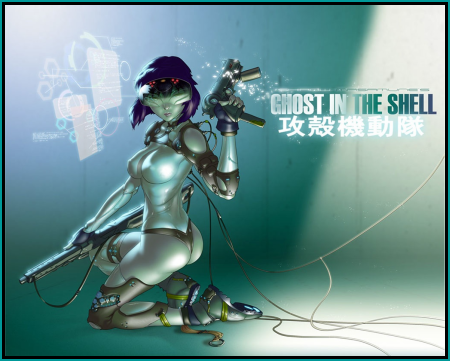
The 1995 Ghost in the Shell film gets especially creative in tackling this–enough that it became the chief inspiration for The Matrix four years later. It revolves around brain-mapping technology and its implications regarding sentience and identity. From the start of the film, the ability to copy and read brain data appears to be common. Presumably, these digital copies would remain stagnant until encoded back into a neural network, but as the government develops better software for interpreting and editing the massive content at its disposal, funny things start to happen. The software gains a sort of temporary sentience while performing its complex tasks, and eventually it uploads itself to a cyborg body in an act of self-preservation. This new entity possesses the capacity to read other augmented brains and incorporate them into its internal network. At least, that is how I’ve interpreted it. The movie does leave a lot to the imagination. Perhaps it is recycled from earlier science fiction, and far-fetched besides–I wouldn’t really know–but Ghost in the Shell presents it all as if it were right around the corner, not lost in a distant galaxy of Star Trek.

Ghost in the Shell is so steeped in ideas that it’s a wonder I don’t forget it is a collection of animations, not a book series. Stand Alone Complex is presented as rather typical–and relatively forgettable–anime, but the 1995 movie definitely denies dismissal. It is a real work of art. The city is dirty and a bit washed-out without feeling downright destitute; the masses still lead normal lives. Emptiness expands upward; the characters are perpetually surrounded by massive, sort of dusty-looking structures that feel vacant despite signs of life. The music is simultaneously vast and minimalistic. Generally, the artistic direction projects a feeling that the protagonists are isolated–cut off from the massive world surrounding them–perhaps by the knowledge they possess.

The score Kenji Kawai (川井憲次) crafted for Ghost in the Shell ranks among the best soundtracks I’ve ever encountered. Without it, the film might easily unravel. The plot really does take a lot of creative liberties. What amount of entertainment value could convince people to open up their brains to potential hacking? Or, if they are doing it to maintain memory backups, why is a brain hack so devastating? Can’t you just resume from your last save? Why would a hacker go to the trouble of replacing an entire memory system in the first place, if they could just encode an impulse into an existing one? To these questions, I say “shhhh!”, because Kawai has so utterly convinced me that my cyborg brain will be shipping in from Japan any day now. The music shrouds the film in imminent mystery. It is a moment of quiet awe, before the very foundations of human experience become uprooted and replaced by a higher state of computer-enhanced perception.

‘Interesting’ nerd note on Kawai: while the majority of his discography appears in anime and film, he is credited with arranging the TurboGrafx-16 port of Sorcerian, one of Yuzo Koshiro and Takahito Abe’s better 1980s NEC PC-8801 projects. I am pretty excited to dig that one up. Aren’t you? …Bueller?

Ghost in the Shell Live-Action Script On the Way


This week we saw news that the potential live-action Battle Angel Alita was one-step closer to becoming reality as script collaborator Laeta Kalogridis was working on a draft for James Cameron. Now comes more news of another manga classic getting closer to getting it’s own live-action adaptation being made with her about to turn in a script in a few weeks. This classic manga is Ghos in the Shell.

Masamune Shirow’s Ghost in the Shell has always been one of those manga/anime works which has continued to gain fans despite all the new anime/manga properties churned out in the dozens every year in Japan. It, like Katsuhiro Otomo’s Akira, has become one of the classics in the medium and plans to create a live-action version has been rumored and talked about for over a decade. With hollywood hungry for new properties and ideas to put on film they’ve suddenly turned to the Japanese manga and anime well for such ideas.

The rights to develop a live-action adaptation of GitS was acquired by Dreamworks a couple years ago with Steven Spielberg being the main engine to get the project up and running. In a couple weeks we’ll find out just how feasible this adaptation will be as the script by Laeta Kalogridis will be delivered to Dreamworks and Spielberg. If they like what they see of Kalogridis’ work then production can quickly begin as a planned 2011 release is still on the table. As a blowback to the success of Cameron’s Avatar, it looks like Dreamworks plans to have the film done in 3D right from the start and not something tacked on after production. If this is the case then Spielberg gets it when it comes to 3D and exactly how Cameron thinks 3D should be used.

I wonder if the oft-rumored and planned Akira live-action will get new traction and finally get made. That’s another anime/manga live-adaptation that will probably look great in 3D.

Source: Anime News Network