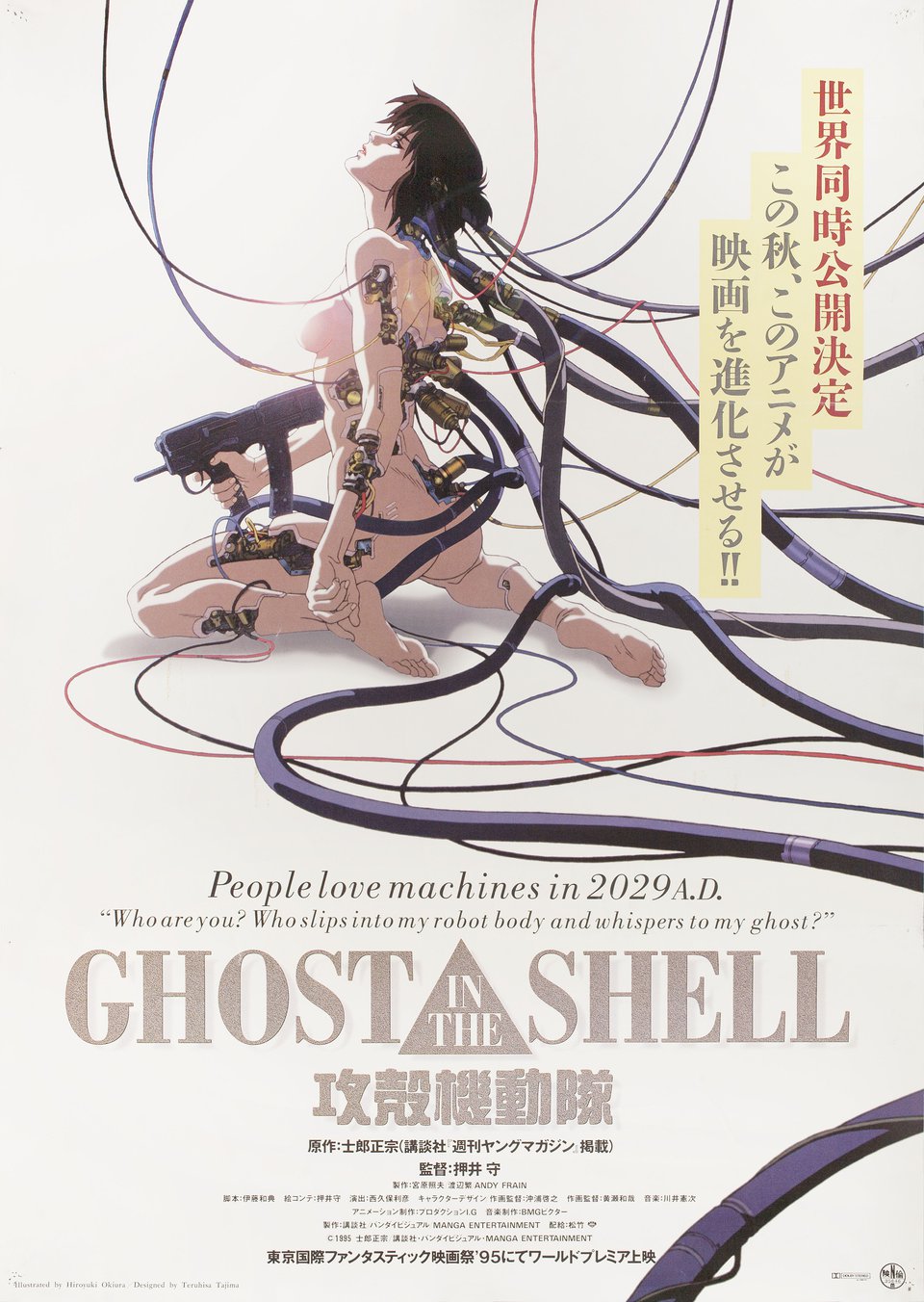
“Man is an individual only because of his intangible memory. But memory cannot be defined, yet it defines mankind.” — Puppet Master
f you are putting together an initial “watch-list” of anime as someone new to the medium, Ghost in the Shell is an absolute must-have. Even if you aren’t a newbie, if you haven’t watched Mamoru Oshii’s 1995 masterpiece, you’ve definitely felt its ripple effects whether you realize it or not. Adapted from the original manga by Masamune Shirow, this movie is one of those rare pieces of art that didn’t just participate in the cyberpunk genre—it practically rewrote the rulebook for it. Coming out in the mid-nineties, it arrived at a time when the internet was still a weird, dial-up mystery to most people, yet here was this incredibly dense, visually stunning anime predicting a hyper-connected future where the line between human and machine was hopelessly blurred. It’s wild to look back at it now, not just because of how well it holds up, but because you can practically trace the DNA of modern science fiction directly back to this single film.
The world Oshii builds is just unbelievably immersive. We’re dropped into Newport City in the year 2029, a sprawling, rain-soaked metropolis that feels like Hong Kong cranked up to eleven. The visual design is insanely detailed, packed with glowing neon signs, crowded waterways, and gritty urban decay that makes you feel the humidity and smog seeping through the screen. But it’s not just a pretty backdrop; the city feels like a living, breathing organism heavily reliant on an omnipresent electronic network. It’s the kind of world-building that doesn’t spoon-feed you exposition. Instead, it just lets you exist in this space, observing the bizarre fusion of ultra-high-tech and crumbling everyday life, making you feel like a total stranger in a familiar yet alien world.
At the center of all this is Major Motoko Kusanagi, a cyborg operative working for a government anti-terror squad called Section 9. The plot kicks off when they’re tasked with hunting down the Puppet Master, a notorious hacker who can rewrite people’s ghosts—the anime’s term for a soul or consciousness—making them do whatever he wants. On the surface, it plays out like a solid futuristic police procedural, but it never stays there for long. Kusanagi is a fascinating protagonist because she’s essentially a human brain floating in a robotic shell, and as she gets closer to the Puppet Master, the movie pivots from chasing down a bad guy to asking some incredibly heavy questions about identity, memory, and what it actually means to be alive.
And that’s really the core of why Ghost in the Shell sticks with you long after the credits roll. It’s deeply philosophical, but it never feels pretentious about it. The movie constantly returns to this idea of the “ghost” versus the “shell.” If your entire body—your face, your arms, your internal organs—is synthetic, and your memories can be digitized and altered, what is left of you? Kusanagi’s existential dread is palpable. She looks at the world through mechanical eyes, wondering if she even has a soul anymore or if she’s just a highly advanced machine running a simulation of a person. It’s a heady concept that could easily crash and burn in the hands of a lesser director, but Oshii balances the cerebral musings with incredible action and atmosphere so you never feel like you’re just sitting through a lecture.
Speaking of the action, the animation is absolutely top-tier. We’re talking about traditional, hand-drawn animation that moves with a fluidity and weight that still puts a lot of modern CGI to shame. The famous thermoptic camouflage sequence, where Kusanagi turns invisible to take out a guy in a flooded alley, is legendary for a reason. The way the light refracts through her invisible form, the brutal efficiency of the combat, and the haunting silence of the scene are just perfection. Add in Kenji Kawai’s iconic soundtrack, which blends traditional Japanese chanting with eerie synthesizers, and you get a movie that has a vibe unlike anything else. It’s moody, it’s contemplative, and it has a strange, melancholic beauty that makes you want to pause the movie just to soak in the backgrounds.
But you really can’t talk about Ghost in the Shell without talking about the absolute monolith of an impact it had on pop culture. When it hit Western shores, it was a massive wake-up call. It completely shattered the perception that animation was just for kids or goofy comedies, proving it could be a mature, complex medium. Its influence on the cyberpunk and sci-fi landscape of the late 90s and beyond—spanning films, books, video games, and television—is so massive that it’s almost impossible to fully quantify. It felt like the missing link between the old-school cyberpunk printed novels of the eighties and the new wave of millennium-era sci-fi literature that was trying to figure out what the World Wide Web was going to do to human intimacy and identity. Suddenly, everyone in Hollywood, the publishing world, and the gaming industry was looking at this anime and realizing the potential of the themes and visuals it presented.
The most famous example of this, of course, is The Matrix by the Wachowskis, which was heavily influenced by it. The directors have been super open about how they showed Ghost in the Shell to producer Joel Silver to explain the exact vibe they were going for. When you look at The Matrix, the DNA is undeniable. The green digital rain cascading down the screen? That’s lifted straight out of the opening credits of Oshii’s film. The concept of jacking into a virtual reality, the ports in the back of the neck, the slow-motion bullet dodges, and the deep-dive into what constitutes reality—all of it feels directly born from the groundwork laid by Kusanagi’s journey. The Matrix might have brought these concepts to the mainstream blockbuster crowd, but Ghost in the Shell was the incubator where those ideas were refined.
The ripple didn’t stop at movies, though; it bled heavily into video games and television as well. If you’ve ever played the Metal Gear Solid games by Hideo Kojima, you’ve experienced the ghost of Oshii’s vision. Kojima is a massive anime fan, and the influence of Ghost in the Shell is smeared all over that franchise. The concept of the cyborg ninja, the deep philosophical codec conversations about the information age, genetics, and the nature of consciousness, and even the stealth camo mechanics feel directly pulled from Section 9’s playbook. On the TV side, you can see its shadow hanging over shows like Serial Experiments Lain and even the cyberpunk elements of Cowboy Bebop, which adopted a similar visual grit and thematic melancholy about living in a high-tech, low-life future.
What’s really crazy is how far that influence reached, touching directors and creators you might not immediately associate with anime. Take Steven Spielberg’s own A.I. film, for instance. While it’s rooted in classic Spielberg sentimentality and the legacy of Stanley Kubrick, the core premise of a synthetic being yearning to be “real” and grappling with the concept of a soul in a machine feels deeply informed by the philosophical path Kusanagi walked. Even James Cameron’s Avatar film series owes a subtle debt to Shirow and Oshii’s creation. The entire mechanic of the avatar program—where a human consciousness is remotely downloaded into a genetically engineered biological shell to interact with the world—is essentially the exact inverse of Kusanagi’s situation, exploring the same disconnection between the mind and the body, and what happens when your “ghost” inhabits a “shell” that isn’t your original form.
Looking back at Ghost in the Shell almost thirty years later, it’s amazing not just how influential the anime has been, but how shockingly prescient it is about the way our world actually operates now. The movie casually presents a reality where the lines between the government, the military-industrial complex, and tech firms have blurred so completely that it’s difficult to see where one starts and where the other ends. In the film, they’ve become all intertwined to control the data that runs the world and rely on the algorithm that eerily predicts our future. Back in 1995, that seemed like far-flung dystopian fiction, but fast forward to today, and we’re watching mega-corporations and defense contractors practically sharing the same bed, hoarding our personal data to feed into predictive algorithms that dictate everything from what we buy to who we vote for. Oshii didn’t just predict the technology; he predicted the terrifying socio-political monopoly on information itself.
Yet, despite all these technological and societal shifts we’ve experienced since 1995, the movie hasn’t aged a bit. It still looks gorgeous, the questions it asks are still terrifyingly relevant, and the emotional weight of Kusanagi’s journey still hits like a ton of bricks. Whether you’re watching it as a hardcore sci-fi fan, an animation buff, or just a movie lover trying to understand where half of modern pop culture came from, it remains an absolute must-watch. It’s not just a great anime; it’s a cornerstone of modern science fiction.
Anime You Should Be Watching
- Gakuen Utopia Manabi Straight
- Chōjin Densetsu Urotsukidōji
- School Days
- Higurashi no Naku Koro ni
- Toradora!
- Aria
- Azumanga Daioh
- Bible Black
- Puella Magi Madoka Magica
- Black Lagoon
- Ika Musume
- High School DxD
- Bakemonogatari
- Sailor Moon
- Princess Tutu
- Another
- Hellsing Ultimate
- Sword Art Online
- Wolf Children Ame and Yuki
- Toaru Kagaku no Railgun
- Nichijō
- Redline
- Gakkou Gurashi (School Live)
- Gate: Thus the Japanese Self-Defense Force Fought in Their Land
- Hinamatsuri
- Asobi Asobase
- Zombie Land Saga
- Monster
- Farming Life In Another World (Isekai Nonbiri Nouka)
- Perfect Blue
- Shiki
- Angel of Darkness (Injū Kyōshi)
- Blood: The Last Vampire
- Akira
- Space Battleship Yamato (Uchū Senkan Yamato)
- Macross Plus
- Ninja Scroll (Jūbē Ninpūchō)
- Tokyo Godfathers (Tōkyō Goddofāzāzu)
- Memories
- That Time I Got Reincarnated as a Slime (Tensei Shitara Suraimu Datta Ken)
- Spy x Family
- Record Of Lodoss War (Rōdosu-tō Senki)
- Berserk (Kenpū Denki Berserk)
- Jin-Roh
- Made In Abyss (Meido in Abisu)
- Legend of the Galactic Heroes (Ginga Eiyū Densetsu)
- Nausicaä of the Valley of the Wind
- May I Ask for One Final Thing? (Saigo ni Hitotsu dake Onegai Shitemo Yoroshī Deshō ka)
- Initial D (Inisharu Dī)
- Vinland Saga (Vinrando Saga)
- Grave of the Fireflies (Hotaru no Haka)
- How a Realist Hero Rebuilt the Kingdom (Genjitsu Shugi Yūsha no Ōkoku Saikenki)
 Stand Alone Complex lies much closer to the root of my music series, because some of the key issues it tackles have since arisen online in the real world. Everyone is well familiar with the use of V for Vendetta-styled Guy Fawkes masks in protests originating from the internet, but there is a decent chance you have also caught a glimpse of an odd blue smiley face among the rabble. The Laughing Man image originates from Stand Alone Complex, where it functions as a mask employed anonymously by individuals taking public action independently of each other. At first, an advocate for social justice uses it to disguise himself while committing a ‘terrorist’ act, but the image quickly overreaches his motives. Others commit unrelated political sabotage under the guise. Corporations employ it to discredit their competitors. Pranksters use it as a sort of meme, forming the shape with chairs on a rooftop and cutting it into a field as a crop circle, for instance. The image has no concrete meaning, and everyone who uses it essentially ‘stands alone’, but the public perceive the Laughing Man as a single individual.
 Ghost in the Shell has remained a uniquely relevant franchise in science fiction because it got so many ideas right. In 1989, at a time when internet was still a novelty of college libraries, the manga offered a world of total connectivity, where every human and device belonged to a global network. In 2002, Stand Alone Complex introduced the Laughing Man, and shortly afterwards the real world knew an equivalent. Whether this bodes well for the franchise’s dabblings into cyborg technology, only time can tell, but history has certainly made an inherently fascinating fictional world all the more compelling. In the Ghost in the Shell universe, science has fully bridged the gap between computers and neural systems, allowing electronic implants to directly convert wireless digital information into stimuli compatible with the senses. The average citizen possesses visual augmentations which allow them to directly browse the internet via voice command. More complex technology delves deeper, creating a sort of sixth sense whereby users can engage a network through thought command. Some individuals, especially accident victims with the means to afford it, might have their entire bodies replaced by neurally triggered machine components.
