Well, here we are. The year is more than halfway over. The fall movie season is approaching. And yet, not a single true Oscar front-runner has yet to emerge. Could this be the year that a true populist hit, like Mad Max: Fury Road, or an unexpected art house wonder, like Ex Machina, manages to secure a spot?
Well, probably not. But still, it’s fun to speculate!
(Are Oscar pundits being too quick to dismiss Straight Outta Compton? I have not seen it yet but look at those reviews and look at that box office. It’s an interesting question.)
Anyway, here are my prediction for August! To see how my thinking has evolved over the year, check out my predictions of January, February, March,April, May, June, and July!
It’s shaping up to be a strange Oscar race. Here we are halfway through the year and, yet, there are no front-runners. Some very acclaimed films have been released this year and yet, few of them seem to be getting the type of buzz that usually accompanies a surprise Oscar nomination. Last year at this time, there was cautious buzz for Grand Budapest Hotel while almost everyone felt pretty safe assuming that Sundance favorites like Boyhoodand Whiplash would be players in the Oscar race and many of us were highly anticipating the release of films like Birdman and The Imitation Game. (For that matter, a lot of people were also still convinced that Unbroken would win best picture. The buzz is not always correct but still, the buzz was still there.)
This year, some people are hoping that Mad Max: Fury Road will somehow break through the Academy’s aversion to “genre” filmmaking. (And seriously, the Doof Warrior deserves some sort of award, don’t you think?) Quite a few are hoping that Ex Machina will not be forgotten. Personally, I have high hopes for Inside Out.The buzz around Bridge of Spies is respectful, largely because it seems like the type of film that usually would be be nominated. (That said, this film also seems like it could bring out the worst impulses of both Steven Spielberg and Tom Hanks, leading to a movie that will have more in common with The Terminal than with War Horse.) Carol was beloved at Cannes.
So there are definitely possibilities out there. When I made my Oscar predictions for this month, I didn’t quite have to blindly guess as much as I did way back in January. But still, it cannot be denied that — as of right now — this race is wide open and there’s a lot of room for surprise.
Below, you’ll find my Oscar predictions for July. You can also check out my previous Oscar predictions for January, February, March,April, May, and June!
It’s time for our monthly edition of Lisa’s Too Early Oscar predictions!
This is our first entry since the Cannes Film Festival. As a result of Cannes, former contenders like The Sea of Trees have been dropped from the predictions. Meanwhile, new contenders like Michael Caine and Sicario have emerged. I have also added Pixar’s Inside Out to my list of predictions because a 98% rating on Rotten Tomatoes demands the consideration.
(Unfortunately, adding Inside Out meant dropping The Good Dinosaur. Though it could happen, I find it hard to imagine two animated films receiving best picture nominations.)
If you want to see how my feelings on the race have developed, be sure to check out my predictions for January, February, March, April, and May!
And without further ado, here are Lisa’s Too Early Oscar Predictions for June!
2010 will always be considered, by many of us, to be the year that Oscar journalism first jumped the shark. That was the year that a group of self-styled award divas (which Awards Daily’s Sasha Stone being the most obnoxious culprit) went batshit crazy over a film called The Social Network.
From the minute that David Fincher-directed film premiered, the Sasha Stones in the world not only declared it to be the greatest film ever made but also insinuated that anyone who disagreed had to be stupid, crazy, and evil. It actually got rather silly after a while. That is until The Social Network lost best picture to The King’s Speech. Suddenly, what was once merely enthusiastic advocacy transformed into fascistic fanaticism. Suddenly, these people started to view the 2010 Oscar race (and each subsequent Oscar race) as a rather tedious battle between good and evil. For these people, David Fincher represented the forces of good. And Tom Hooper, the director of The King’s Speech, represented all that was evil. They took this to such an absurd extreme that they not only subsequently heaped undeserved praise on Fincher’s bastardization of The Girl With The Dragon Tattoo but also unnecessary scorn on Hooper’s Les Miserables.
Of course, what was forgotten in all of that drama was that — before Hooper and The King’s Speech came along, the 2010 Oscar race was predicted be some to be a rematch between Fincher and Danny Boyle (whose 2010 film, 127 Hours, was indeed nominated for best picture, alongside The Social Network, King’s Speech, and Black Swan). When Fincher and Boyle previously competed during the 2008 Oscar race, Danny Boyle’s Slumdog Millionaire defeated Fincher’s The Curious Case of Benjamin Button.
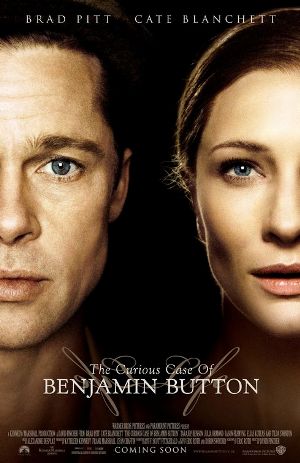
And indeed, the case of Benjamin Button was curious one!
Loosely based on a short story by F. Scott Fitzgerald, The Curious Case of Benjamin Button told the story of a man who aged in reverse. When Benjamin is a baby, he has the wrinkled face of an elderly man. When he’s a teenager, he’s walking with a cane. When he’s middle-aged, he looks like Brad Pitt in Legends of the Fall.(In that regard, it helps that Benjamin is played by Brad Pitt.) And when he’s an old man, he’s a baby. Though the film, wisely, refrains from offering up a definite reason why Benjamin ages in reverse, it hints that it could have something to do with a clock that was built to run backwards as an anti-war statement.
Benjamin is born in New Orleans in 1918 and raised in a nursing home by Queenie (Oscar nominee and future Empire star Taraji P. Henson). The love of Benjamin’s life is Daisy Fuller (Elle Fanning when young, Cate Blanchett as an adult), a dancer who also loves Benjamin but who, unlike him, is not aging in reverse. For this reason, Benjamin and Daisy cannot be together. That’s the way tragic love works.
The film itself features a framing device. Daisy, now an elderly woman, is dying and gives her estranged daughter, Caroline (Julia Ormond), the diary of Benjamin Button. As Caroline reads, Hurricane Katrina rages outside. I’ve never really been comfortable with the way that the film uses Katrina as a plot point, for much the same reason that it bothered me when Hereafter used the real-life Thailand typhoon and London terrorist bombings to tell its story. The real-life tragedy of Katrina feels out-of-place in a story about Brad Pitt aging backwards.
As for the rest of the film, The Curious Case of Benjamin Button is … well, it’s a curious film. Visually, it’s definitely a David Fincher film but, at the same time, there’s something curiously impersonal about it. You almost get the feeling that this was Fincher’s attempt to show that he was capable of making a standard big budget Hollywood film without getting too Fincheresque about it. Brad Pitt and Cate Blanchett have chemistry and they look good together but Fincher has never been a sentimental director and his heart never truly seems to be in their love story. (Ben Affleck and Rosamund Pike in Gone Girl feel more like a natural couple than Brad Pitt and Cate Blanchett do in this film.) There’s only a few scenes, mostly dealing with the more morbid aspects of Benjamin’s odd condition, towards which Fincher really seems to feel any commitment.
As a result, The Curious Case of Benjamin Button becomes a curious misfire. It’s a film that struggles with the big picture but is occasionally redeemed by some of its smaller moments. (The scenes with the elderly Benjamin as a dementia-stricken baby are haunting and unforgettable.) Ultimately, The Curious Case of Benjamin Button is probably the weakest of the five 2008 films nominated for best picture but it’s still an interesting film to watch.
— Queen Elizabeth I (Cate Blanchett) in Elizabeth (1998)
I have to admit that I always feel guilty about the fact that I love movies about British royal history. After all, I have roots in Northern Ireland and I was raised Catholic. If anything, I should refuse to watch films about British royalty on general principle. I should be writing more reviews of films like Bloody Sunday.
But I can’t help myself. Whether it’s because I enjoy looking at all of the costumes or I just have a thing for movies set in drafty old castles, I have a weakness for films about British royalty. (And I will also admit that I sat through the entire royal wedding and I have a bit of a girlcrush on both Pippa and Kate Middleton. As I said, I just can’t help myself.)
Of course, some of it definitely has to do with the fact that I’m an unapologetic history nerd. I am fascinated with how people lived in the past. And, of course, anyone who shares my obsession understands that, when it comes to history, there’s both the official story and the truth. The official story is something that’s passed down over the centuries. It’s what we learn in school. The truth, however, is always far more obscure. The truth is what historians piece together from what little gossipy evidence has managed to survive the passage of time.
We all know that the official story of Queen Elizabeth I is that she was England’s greatest Queen, she defeated the Spanish Armada, and she never married. She was the “Virgin Queen,” forsaking love to serve her nation. That’s the official story but is it the truth?
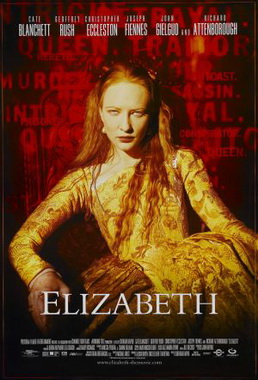
That’s the question at the heart of the 1998 Best Picture nominee Elizabeth. Now, don’t get me wrong. I’m not arguing that Elizabeth represents the truth. Historically, the film is messy and full of speculation that is less based on evidence and more on the desire to keep things cinematic. But still, Elizabeth is an interesting film specifically because it takes a historical figure and dares to suggest that she may have been human before she became an icon.
Cate Blanchett gives a great performance in the role of Elizabeth. When we first meet her, she’s a somewhat silly girl who is less concerned with politics and religion and more concerned with her boyfriend, Robert Dudley (Joseph Fiennes). Elizabeth is also the protestant half-sister of Catholic Queen Mary (Kathy Burke). Mary is planning on ordering Elizabeth’s execution but dies of stomach cancer before she gets around to singing the order.
Suddenly, Elizabeth is Queen of England. Young and insecure, she is, at first, manipulated by advisors like William Cecil (Richard Attenbrough), who pressures her to marry the cross-dressing Henry III (Vincent Cassel) of France. Meanwhile, the Pope (John Gielgud) signs an order calling for Elizabeth’s death. Catholic nobleman Thomas Howard (Christopher Eccleston) and mysterious priest John Ballard (Daniel Craig) conspire to assassinate Elizabeth. With even Robert Dudley giving her reason to distrust him, Elizabeth discovers that her only ally is the enigmatic and ruthless “spymaster,” Francis Walsingham (Geoffrey Rush). It all ultimately ends in a sequence that basically transports the finale of The Godfather to the Elizabethan era.
I really should not like Elizabeth. It’s undoubtedly an anti-Catholic film, though it’s nothing compared to the histrionic anti-Catholicism of its sequel, Elizabeth: The Golden Age. But I can’t help myself, I enjoyed Elizabeth. It was impossible for me not to relate to Cate Blanchett’s passionate performance. (And there was just something so incredibly hot about the way Joseph Fiennes, with his intense eyes, would stare at her.) When you ignore the film’s protestant bias and just concentrate on the performances and the gorgeous production design, you can’t help but love Elizabeth.
My #Cannes predix: Palme d'Or – Son of Saul Director — Denis Villeneueve Actress — Cate Blanchett Actor — Tim Roth
— Lisa Marie Bowman (@LisaMarieBowman) May 24, 2015
Well, that shows you how much I know.
The 68th Annual Cannes Film Festival came to a close earlier today. If you’ve been following news from the festival over the past two weeks then you’ve heard that Gus Van Sant’s Sea of Trees is no longer considered to be an Oscar contender. (That’s putting it gently.) You’ve heard a lot of acclaim given to Todd Haynes’s Carol. You have also seen Denis Villeneuve’s Sicario and the Hungarian film Son of Saul emerge as a potential Oscar contenders. Michael Caine’s performance in Youth was acclaimed, as was the work of Tim Roth in Chronic and Marion Cotillard in MacBeth.
One film that you probably did not hear about was Jacques Audiard’s Dheepan. As far as coverage of Cannes over here in the states is concerned, Dheepan was ignored. And yet — once again proving that nobody can predict Cannes — Dheepan is the film that ended up winning the Palme d’Or. The acting prizes also went to actors who have been under the radar, with the possible exception of Rooney Mara.
As far as what the past two weeks have meant for the upcoming Oscar race: Well, I think it’s safe to say that we can forget about Sea of Trees. As for my insistence that Sea of Trees would be nominated … well, we’ll all have a good laugh about it someday. Carol appears to have emerged as an early front-runner and I think that Sicario could come on strong as well, especially if one of the nominal front runners — like Bridge of Spies, for instance — doesn’t live up to expectations. It wouldn’t surprise me to see Caine and Cotillard nominated as well. Everyone loves Michael Caine and, as he gets older, we are more and more aware that a day is going to come that he won’t be around to appear in any more movies. As for Cotillard, she is everything that Meryl Streep is supposed to be and more.
Anyway, here are the winners!
68th Cannes Film Festival top awards:
Palme D’Or: Dheepan
Grand Prix: Son of Saul
Jury Prize: The Lobster
Best Director: Hou Hsiao-hsien for The Assassin
Best Actor: Vincent Lindon for The Measure of a Man
Best Actress: Rooney Mara for Carol and Emmanuelle Bercot for My King
Best Screenplay: Michel Franco (Chronic)
Camera d’Or (Best first feature): La Tierra Y la Sombra
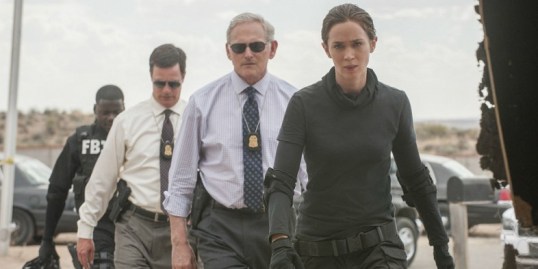
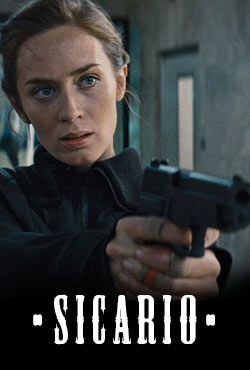
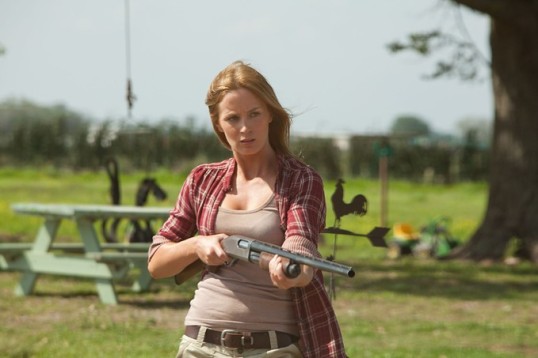
Emily Blunt in Sicario (No, actually, that is Emily Blunt in Looper. My mistake…)
Well, here we are! The year is nearly halfway over and the Oscar picture … well, it’s really not that clear yet. The Cannes Film Festival just opened and maybe that will help clear up the picture a bit. Or maybe not.
Anyway, here are my early Oscar for predictions for May. (In previous months, my Oscar predictions were “way too early.” But now that we’re 5 months into 2015, the “way” can be dropped. They’re just “too early” now.) As is usual for any predictions made at this time of the year, these are mostly guesses, some random and some educated. Be sure to check my predictions for January, February, March, and April as well!
(I know that rumor has it that the Academy is going to go back to only nominating five films this year. However, I’m going to continue to make ten predictions because that’s more fun for an obsessive list maker like me.)
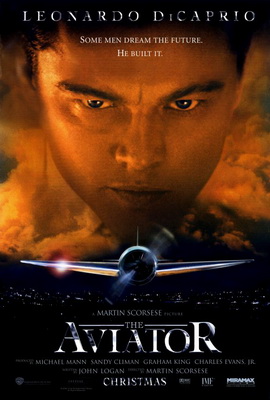
“The way of the future.” — Howard Hughes (Leonardo DiCaprio) in The Aviator (2004)
As I recently rewatched the 2004 best picture nominee, The Aviator, I realized that, in the film’s scheme of things, Ava Gardner was far more important than Katharine Hepburn. (Or, perhaps it would be more appropriate to say that Kate Beckinsale’s Ava Gardner was far more important than Cate Blanchett’s Katharine Hepburn.)
Over the course of the film, both Hepburn and Gardner are involved with billionaire-turned aviator-turned film director Howard Hughes (Leonardo DiCaprio). Throughout the film, Katherine is portrayed as being flighty, pretentious, and overdramatic. There’s a lot of dark humor to the scene where Katherine breaks up with Howard, largely because Katharine is incapable of not acting as if she’s making a film. Her every word is so carefully rehearsed that you have to agree when Howard says that she’s incapable of not giving a performance. Ava, on the other hand, is always direct. She has a sense of humor. She has no trouble telling Howard off. Whereas Katharine put on airs of being an incurable romantic, Ava tells Howard flat out that she doesn’t love him and is only using him to forward her career.
But, while Katharine Hepburn gets more screen time, it’s Ava Gardner who actually saves Howard’s business. Towards the end of the film, after Howard has had a nervous breakdown and has locked himself in a hotel room, it’s Ava who suddenly shows up, cleans him, and dresses him. She’s the one who gives Howard the strength to leave his room and to face down the corrupt senator (Alan Alda) who is investigating his business.
Of course, Howard Hughes is best known for once being the world’s richest recluse. In the 1960s, Howard locked himself away in a hotel room in Las Vegas and spent the next decade laying naked in bed and watching television. The Aviator doesn’t deal with this period of Howard’s life but it’s full of scenes where we catch glimpses of Howard’s future. Throughout the film, we watch as Howard obsessively washes his hands. We watch as he gives precise instructions on how even the simplest of tasks are to be accomplished. We watch as he grows increasingly paranoid about the germ-filled outside world. The film suggests that Howard’s obsessive compulsive disorder both served to make him a great engineer and a great filmmaker while, at the same time, ultimately destroying him.
The Aviator was the second film that DiCaprio made with Scorsese. And, as bad as DiCaprio may have been in Gangs of New York, he’s absolutely brilliant in The Aviator. As a character, Howard Hughes has so many quirks and tics that it would have been easy for DiCaprio to go overboard. Instead, he gives a surprisingly subtle performance. And, even more importantly as far as I’m concerned, he actually sounds authentically Texan when he speaks.
In many ways, much of The Aviator reminds me of Gangs of New York. Both films are gorgeously produced period epics that try to cover a lot of material. Both films are absolute cat nip for history nerds like me. But, whereas Gangs of New York leaves one feeling vaguely dissatisfied, The Aviator actually improves with subsequent viewings. Whereas the action in Gangs had no center, The Aviator revolves around Howard and the actor playing him.
While the Aviator starts off with Howard making movies and romancing Katharine Hepburn, it’s at its best when Howard appears before a committee chaired by Sen. Owen Brewster (Alan Alda) and passionately defends both himself as an engineer and a businessman and the right of innovators everywhere to freely pursue their passion. The film suggests that Brewster was bribed by Howard’s main business rival, Juan Trippe (Alec Baldwin, in unapologetic villain mode), and it’s hard not to applaud when Howard stands up for himself.
Speaking of which, it’s odd, so soon after reviewing Alan Alda in The Seduction of Joe Tynan, to see Alda playing a far less ethical politician in The Aviator. That said, Alda’s corrupt performance in The Aviator is a hundred times better than his cutesy work in Joe Tynan. If anything, Alda gives a performance here that will remind everyone of why they don’t care much for their congressman.
The Aviator was nominated for best picture but it lost to the far more low-key Million Dollar Baby. Scorsese would have to wait until the release of The Departedfor one of his films to finally win best picture.
It seems kind of weird to do a quick review for a 144 minutes film that not only serves as the end of one epic trilogy but also as a prequel for yet another epic trilogy.
Well, so be it. I hate to admit it but I really don’t have that much to say about The Hobbit: The Battle of the Five Armies beyond the fact that I saw it on the day after Christmas, I enjoyed it, and I thought Aidan Turner was really hot. It’s not a perfect film but then again, The Hobbit has never been a perfect trilogy. As opposed to the Lord of the Ring films, The Hobbit told a story that could have easily been told in two films. As a result, whenever you watch one of The Hobbit films, you’re aware of all of the filler that was included just to justify doing three films.
But so what? The Hobbit films are fun. Despite the cynical economic reasons behind turning The Hobbit into a trilogy, director Peter Jackson’s love for the material always came through. In the title role, Martin Freeman was always likable. Ian McKellan and Christopher Lee made for properly enigmatic wizards. Though apparently his inclusion caused some controversy among purists, it was nice to Orlando Bloom as Legolas. I also liked Evangeline Lilly’s elf character, even if everyone else seemed to dislike her and her love story with Aidan Turner. And then there was Benedict Cumberbatch providing a perfectly evil and self-satisfied voice for Smaug.
I have to admit that, with the exception of Aidan Turner, I was never a big fan of the dwarves. They were all so surly and bad-tempered and it didn’t take me too long to get tired of Richard Armitage showing up as Thorin and acting like a jerk. However, in the final part of the trilogy, Armitage’s surly performance started to make sense. As Thorin grew more and more paranoid, I saw that The Hobbit was actually using both the character and Armitage’s performance to make a much larger point. Power corrupts and most conflicts are ultimately all about money and property. It was a good message.
When the Battle of the Five Armies started, I was shocked to discover how little I remembered about the previous two Hobbit films. It took me a while to get caught up on who everyone was and why they were all fighting over that mountain. As opposed to the LoTR films, it’s not always easy to get emotionally invested in The Hobbit films. But, Jackson is a good director and he’s a good storyteller and, even though it took me a while to get caught up, I was still often enthralled with what I was watching on screen. The images were so stunning and the battle scenes were so spectacularly done that I could handle being occasionally confused.
Battle of the Five Armies is a fitting end for the Hobbit trilogy. It’s not a perfect film but it is exciting and fun and that’s really all that matters. At the end of it, the audience in the theater applauded, not just for the film but in recognition of everything that Peter Jackson has given us over the past 14 years.
It was a good way to spend the day after Christmas.
Ah, Berk. That fictional far away land where Dragons once plagued humans, until a young boy made friends with a Night Fury and changed everything.
How I’ve missed this place.
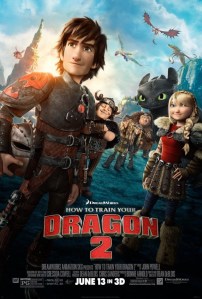
Fox & Dreamworks’ How to Train Your Dragon 2 brings us back to its dragon riding fun, taking place 5 years after the events of the first film. While the story doesn’t have the same level of depth as say, Kung Fu Panda 2, it still manages to be an enjoyable thrill ride when the dragons are taking flight.
Since this is an animated feature, let’s do visuals first. The animation is roughly the same as the original, with a bit of aging here and there for the main characters, but both the colors and the depth of field are a major standout. Cinematographer Roger Deakins (Skyfall) was brought back on board as a consultant for the lighting, focus and color tones and it definitely shows. If at all possible, this film should be seen in its 3D format. The flight sequences are a joy to behold and when they’re not flying, you shouldn’t find yourself squinting and pinching your nose too much. Chris Sanders wasn’t on hand this time for the writing and directing, although you can still see his designs all over the film.
Additionally, there were a number of technical changes that improved the process. Just as Pixar did with Renderman, Dreamworks ended up creating their own software, Apollo. Apollo uses two tools – Premo, which allowed the animators better control of characters through the use of Wacom tablets. Even more magical is Torch, a lighting system developed with Deakins’ assistance that allowed for more natural setups in animation. One of the best uses of this is when Hiccup is surrounded in a dark room and needs to use his sword to illuminate the area. It’ll be interesting to see how it’s used in other Dreamworks projects.
All of the familiar characters are back – Jay Baruchel’s Hiccup is a little older, and much wiser than in the original, with he and Toothless mapping the lands around Berk during their flights. Hiccup’s flair for gadgetry hasn’t left him, as in this film, the character is introduced almost as a medieval Batman. Between he, his father Stoic (Gerald Butler) and his girlfriend / Dragon Racing Champion Astrid (America Ferrera), they get the bulk of the screen time. His friends, played by Jonah Hill, Christopher Mintz-Plasse, and Kristen Wiig, felt more like cameos than anything else here. Then again, they really didn’t have that great a part in the first film. Toothless, the Unholy Offspring of fire and darkness itself, is still as cuddly and emotive as ever, despite not being able to actually speak. Through the film, both Toothless and Hiccup find themselves growing up in different ways and their relationship is at the heart of everything here. Hiccup and Stoic still have family issues, this time centering around Hiccup preparation for becoming Chief of the town after Stoic steps down.
When Astrid and Hiccup discover dragon hunters (Lead by Game of Thrones’ Kit Harrington, whose character here still knows nothing), they find a new evil on the horizon in the form of Drago (Guardians of the Galaxy and Blood Diamond’s Djimon Hounsou), who is building a dragon army to do some harm.
Where the movie may stumble is in its last act. It felt abbreviated to me, but as this is meant for children, I suppose it’s not meant to be that long of a film. Clocking in at 102 minutes, it moves fast. For a kid’s film, Dragon 2 rises to some interesting heights that even adults would appreciate. The film doesn’t assume you need to be retold everything you may have missed in the first film, though it does reference some elements of it. The themes of the story are coexistence (between humans & dragons), leadership, friendship and family, and they’re done well.






 Through the Shattered Lens