Well, no, actually it’s not. It’s a very serious film that has a few comedic moments. Matt Damon makes a few jokes but that’s largely because he’s trying not to lose his mind and commit suicide. However, The Martian was submitted to the Golden Globes as a comedy. Why? Probably because the producers realized that it would be easier for them to win if their film was the only big-budget drama nominated in the comedy category. It’s dishonest, it’s unethical, and it totally worked. This morning, when the Golden Globe nominations were announced, The Martian was nominated for Best Picture, Comedy or Musical.
I was not a particularly huge fan of The Martian to begin with. The fact that it has now been nominated for Best Comedy while Inside Out was not does not help matters.
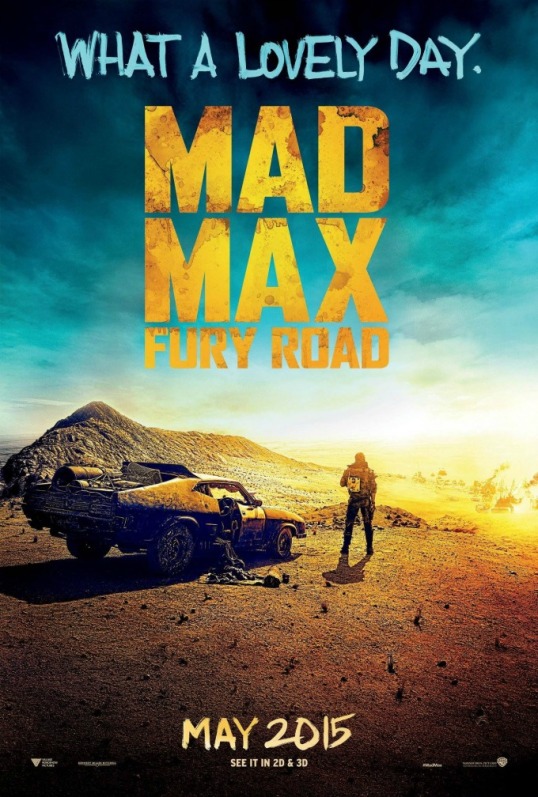
Anyway, as for the rest of the Golden Globe nominations … actually, I like a lot of them. Mad Max: Fury Road was nominated for Best Picture, Drama and that should help it regain whatever momentum it may have lost after not being nominated by the SAG. The Big Short was also nominated for Best Picture, Comedy so I guess I really will have to see it, despite having no desire to do so. Trumbo was not nominated for Best Picture but it did pick up nominations for Bryan Cranston and Helen Mirren. Spotlight was naturally nominated for best picture but received no acting nominations, which means that either all the actors are splitting the votes among themselves or maybe Spotlight, while remaining the front-runner, is not as universally loved as some are thinking. It’s impossible for me to say because I haven’t seen Spotlight yet but I have noticed that a lot of critics seem to be more respectful than enthusiastic about it.
(At the same time, my friend, the sportswriter Jason Tarwater, was quite enthusiastic after seeing Spotlight and I usually trust his opinion on these things.)
Anyway, here are the Golden Globe Film nominations!
Boston and New York were not the only critics to vote today! The Los Angeles Film Critics Association announced their picks for the best of 2015 as well! Mad Max: Fury Road won best director but Spotlight won best picture with Fury Road as the runner-up. In other words, the LAFCA liked Fury Road but decided to play it safe. Let’s not forget that this is the same group of people who once named The Descendantsbest picture with The Tree of Lifeas the runner-up.
(Dear award-giving groups: Just so you know, playing it safe is really freaking boring.)
“Harry Potter is about confronting fears, finding inner strength and doing what is right in the face of adversity. Twilight is about how important it is to have a boyfriend.” – Stephen King
I have a problem with the notion that says you have to have someone in your life in order for your life to be considered perfect or grand. I’m of the mind that you step into the world alone and leave it the same same way. Even if you are surrounded by your nearest and dearest friends when you pass, you’re still the only one making that trip. And while I love the notion of Romance, I don’t believe it needs to translate to “Omigod, if you’re not near me, I’m going to jump off this building, I swear it because I can’t talk about you without stammering.” or the other obsessive notions that Twilight seems to bring up. This doesn’t mean I outright hate everything that Twilight is, but I’m not totally fond of the overall message it conveys. Perhaps I’m just emotionally cold that way.
And yet, I may know more about Twilight than any other guy in the known universe. It’s an enigma, I know.
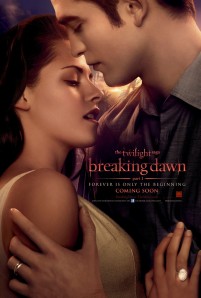
A little background on why I, a guy, am writing a review for The Twilight Saga: Breaking Dawn, which is pretty much geared for girls. Note that I’ll refer to the film just as Breaking Dawn, because I really don’t see Twilight as a Saga by any means.
In the early 90’s, I hit a “Vampire Phase”. Between playing games of Vampire: The Masquerade and reading every Vampire Chronicle novel that Anne Rice wrote up until Tale of the Body Thief, I was pretty involved. I grew up with Vampires that were monsters to be feared (and sometimes admired), and dodged the sun more or less. I even owned two vampire encyclopedias. Somewhere between Mark Danielewski’s “House of Leaves” (a book I still haven’t finished) and Andrew Davidson’s “The Gargoyle”, I picked up a hardcover copy of Stephenie Meyer’s “Twilight” from Barnes & Noble. I didn’t think much of the books, save that they were quick reads. Meyer and her vampires were far from Rice and her universe lacked the erotic flair of Laurell K. Hamilton’s earlier books in the Anita Blake series. They were more or less books for teens, but they had vampires in them, so I pretty much inhaled all four books (Twilight, New Moon, Eclipse, and Breaking Dawn) twice in Hardcover. I even went so far to read Meyer’s “The Host” and have seen all of the other Twilight films in the theatre. While they all seem to be really close to the source material, there’s something strange in the translation. What made sense on paper really didn’t on screen (Sparkling Vampires jump to mind), but I guess that’s for an Editorial.
So, when it came to reviewing Breaking Dawn, we at the Shattered Lens drew straws. While we hold to the tenet that any movie can be reviewed by anyone even if the movie was previously reviewed by anyone else (for alternate viewpoints), this was a film that was pretty much off our collective radars. I think we all secretly wanted Lisa or Erin to take it, but both Lisa and my cousin gave the argument that I could probably give a different perspective on the film than all of the girls who planned to see it, most of whom would sprout something like the following:
“I love Edward so much, and that he took his time with Bella was just so heartfelt that I wanted to cry. I felt so bad for Jacob that he could haven’t have her. He deserves better than that!! If anyone doesn’t like what I’m saying, then I will come to their houses and stab them with rusty blades in their beds because no one – I mean no one – gets in the way of my Twilight Love!! You haters could suck it! Team Edward/Jacob Forever!!!!”
So, here I am, writing this. Let’s see what becomes of it, shall we?
For those of you who managed to avoid the Twilight books and movies like they were Sutter Cane novels, here’s everything you’ll ever need to know.
Twilight is the story of Isabella Swan (Kristen Stewart) who moves from Arizona (where Meyer lives) to Forks, Washington to live with her Sheriff father, Charlie (Billy Burke). While in school, she meets an interesting but strange fellow in Edward Cullen (Robert Pattinson). After being saved from a near fatal car crash in an impossible fashion by Edward, Bella becomes intrigued with who and what he may be. A little big of Googling and book buying leads her to discover that Edward is in fact, a Vampire. He explains he’s dangerous. She doesn’t care. He states he’s a killing machine. She loves the danger. He steps into the sunlight to show he doesn’t burn, he just sparkles. She’s just mesmerized.
The original Twilight was Bella’s introduction to The Cullens (who are more or less Vegetarians in that they don’t go after humans, but animals instead):
Carlyle (Peter Facinelli) – Father figure and Doctor. He recruited the rest of the family.
Esmee (Elizabeth Reaser) – Carlyle’s Wife and Mother Figure.
Emmett (Kellan Lutz) – The Muscle of the Family and companion to Rosalie.
Rosalie (Nikki Reed) – Emmett’s Companion and is pretty much opposed to Bella up until Breaking Dawn, for reasons she explains in Eclipse.
Alice (Ashley Greene) – Companion to Jasper and has the ability to see the decisions that others make before they make them.
Jasper (Jackson Rathbone) -The newest vampire of the group and companion to Alice. Has the ability to manipulate the emotional tides of others.
In Twilight, Bella and the Family run into a trio of vampires, one of which decides he has to hunt down and kill Bella (because she’s food). The family is able to kill the vampire and get on with their undead lives, not before a final parting shot showing the vampire’s girlfriend and her desire to kill Bella in return. Bella decides it’s in her best interests to become a vampire and tries to persuade Edward to change her, but he refuses, citing she has many years ahead of her worth living.
In New Moon, Edward decides to celebrate Bella’s birthday at his place. After an accident occurs that leaves her bleeding, Jasper loses it and attacks her. The family is able to save her, but this convinces Edward that it just won’t work out and the entire family leaves town. Left on her own, Bella spends the next four months crying and screaming in her sleep over Edward until her father convinces her to hang out with her friends. She ends up spending more time with Jacob Black (Taylor Lautner), a friend who lives on a nearby reservation that clued her into what the Cullens really were. They get closer as friends and eventually, she discovers that Jacob and his family are actually Werewolves. While cool, she also learns that the Werewolves don’t get along with Vampires and despise the Cullens. They haven’t killed the vampires because of a Treaty that was enacted long ago. Werewolves stay on their side, Cullens on the other and no humans get hurt. Victoria (the girlfriend of that dead vampire in Twilight) returns to town to kill Bella, but she’s protected by the Wolves. She ends up doing a little cliff diving, which catches Alice’s attention and she manages to reunite with the family, though learns that Edward plans to kill himself. Edward believes she died when she jumped off the cliff, volunteering himself to death by the Vampire Congress known as the Volturri.
Alice and Bella fly to Italy and intercede, rescuing Edward from his fate and meeting the Volturri. As Bella knows too much, the Volturri leader demands that within a year she has to becomes a vampire. This of course, excites Bella and annoys Edward, who throws in a “Let’s get Married First” clause into the works. The idea of this is to help give closure to all the humans in Bella’s life. She reluctantly agrees to it. Jacob catches wind of this and spends the next book & film, Eclipse, trying to convince Bella that she should live and that he’s the better choice of a love interest.
Okay, Eclipse. Victoria knows that she can’t get to Bella on her own without dealing with both the Werewolves and the Vampires. She finds a resident of Forks in Seattle named Riley Biers and changes him to a Vampire, convincing him that the Cullens are bad and killed her friend. He builds an army and they attack the Cullens en masse, but somewhere along the line, Victoria forgot to mention there may be giant dogs in the area. The Cullens and Werewolves join forces and defeat the newborns with ease. In the process, Bella learns more about the Wolves and their ability to “Imprint”, meaning they basically obsess over one person for the rest of their lives (much like whales, I suppose). Luckily, Jacob hasn’t Imprinted on Bella yet. Edward eventually dispatches Riley and Victoria, leaving the romance to continue. In Eclipse, the Cullens explain to Bella how they came to be, partially to help her what she has to look forward to, positive or negative.
And all that brings us to Breaking Dawn, Part I.
Of the Twilight movies, I still feel Eclipse was the strongest one. Breaking Dawn covers everything the 1st half of the book does and manages to do it without stepping past the PG-13 bounds it created. The film starts off with Edward and Bella’s Wedding, with different reactions from everyone. Jacob hates it, wolfs out and runs to Canada. The Cullens are ecstatic. Charlie manages to deal with it. The wedding ceremony is done well, and gives some screen time to all of the high school friends (who we won’t be seeing after the wedding). Stephenie Meyer herself even has a cameo here (and eerily looks like my mother). Even the honeymoon is done better than I thought it would. Anyone expecting Bella and Edward’s honeymoon to look like something out of a late night Cinemax series may be disappointed, but the romance is nice to see and there were some laughs in the audience. Again, it’s Twilight. I’m not expecting Jane Eyre or Sense & Sensibility romance levels. At least, that’s what the snoring mother sitting next to me who brought her kids felt, I think.
After the married couple’s wild honeymoon, Bella discovers she’s miraculously pregnant and even worse, the unborn child is sucking the very life from her. The wolves find out about this and feel that she needs to be eliminated, along with the rest of the Cullens, as it breaks the Treaty. Bella is rushed home while the Cullens try to find a way to save both the baby and the mother. Will Bella make it? Will the Wolves pounce on the vampires? Those are some of the questions brought to the table.
Jacob finds himself taking sides with the Cullens, which causes him to recall his Alpha Status in his wolf pack and stand alone (or nearly alone) against his family. In the book, this was done pretty well, but translated to the screen the scene with wolves telepathically yelling at one another seemed a little cartoonish. Just change back to people and talk it over. I guess it was done that way to show how animals have the whole Alpha / Omega relationship, and remains one embarrassing moment in a sea of scenes that were okay.
Visually, Eclipse was a serious step up from both Twilight and New Moon. Breaking Dawn seemingly returns to the look and feel of the original Twilight, right down to Carter Burwell’s score. With the exception of the Bella’s Lullaby theme (which worked incredibly well, especially at the last two minutes of the film), the music felt a little weak to me. I actually preferred Howard Shore’s score to Eclipse. Don’t get me wrong, the movie goes where it’s supposed to, but you’d expect things to look a little better as it goes along. It would be nice if they improved on that.
One other thing I’ll give this (and that’s all of the Twilight mess) is the audience. I live for seeing audiences react to what they’re seeing on the screen, and I can’t remember a more reactive audience set since Captain America. Some of the girls who go to see this really go wild over it, and some of the guys grumble loudly. My theatre was packed, right down to the front seats where you have to crane your neck up to see everything. It’s the closest to a Midnight Movie experience you could have at a Matinee.
The big problem Breaking Dawn Part II will have will be trying to be exciting, because there isn’t a lot that occurs in the second half of the story that’s worthy of stretching it out to nearly two hours. It’ll be interesting to see what they do with that.
Overall, Breaking Dawn doesn’t really break any new ground in Vampire myths or anything like that. For anyone unfamiliar with the Twilight movies or books, it may feel slow and even a little boring at times. For it’s target audience (readers of the book), it gives them just about everything they wanted.
True Grit is probably the most straight-forward film that has ever come from the irony-laced imaginations of Joel and Ethan Coen. Perhaps that’s appropriate since the movie is essentially an homage to that most All-American of all movie genres, the western.
Taking place in 1878, True Grit tells the story of Mattie Ross, a 14 year-old girl (Hailee Stienfeld) whose father is killed by a drifter named Tom Chaney (Josh Brolin). Tom flees into Oklahoma so Mattie goes to Ft. Smith, Arkansas and hires alcoholic, one-eyed U.S. Marshal Rooster Cogburn (Jeff Bridges) to track Chaney down. Cogburn agrees and teams up with a Texas ranger named LeBouef (Matt Damon) who is also looking to capture Chaney for an unrelated crime (and to pick an equally unrelated reward). The three of them form an unlikely and uneasy alliance as they search the harsh wilderness for Chaney, who has hooked up with outlaw Ned Pepper (Barry Pepper). Along the way, reality proves itself to be far less prosaic and ideal and justice turns out to be far less straight forward than Mattie had originally assumed.
As you might expect from a Coen Brothers film, there’s a lot of moral ambiguity on display. Cogburn is a former outlaw who is mainly motivated by his own greed while LeBouef is an arrogant blowhard. Meanwhile, the nominal villains often show more humanity than our “heroes.” Even Tom Chaney appears to be more overwhelmed than evil. This is a western where the “good guys” ambush their enemies and shoot them in the back. Throughout the film, the Coens contrast the beautiful cinematography of Roger Deakins and Carter Burwell’s traditional score with the brutality and violence on-screen.
True Grit is a remake of a 1969 film and Jeff Bridges is getting a lot of attention for taking on a role that was originally played by John Wayne. I haven’t seen the original film so I can’t say if Bridges gives a better performance than Wayne. However, to be honest, Bridges probably gives the least interesting performance in the entire film. I know that a lot of people are raving about his work here but I think those raves are more about the actor and less about the performance itself. When people look back on this movie, they won’t remember Rooster Cogburn as much as they’ll remember Jeff Bridges wearing an eyepatch and slurring his words like your alcoholic cousin on the 4th of July. Bridges gives a good enough performance but there’s nothing here that couldn’t have been done just as well (or better) by either Tommy Lee Jones or Joe Don Baker.
If anything, the movie belongs to Steinfeld who gives a wonderfully focused performance as Mattie and who serves as the perfect audience surrogate. As the two main villains, Brolin and Pepper both give excellent performances and the fact that both of them are almost likable only serves to make them all the more effective as “bad” guys.
True Grit is a good movie because the Coen Brothers aren’t capable of doing any less. Technically, it’s probably one of the best films of 2010. Still, the movie left me vaguely disappointed. For what it is — a straight genre piece — it’s a superior work of craftsmanship. However, from the Coens, I’ve come to expect a bit more.

 Through the Shattered Lens