44 Days of Paranoia #12: Burn After Reading (dir by Joel and Ethan Coen)


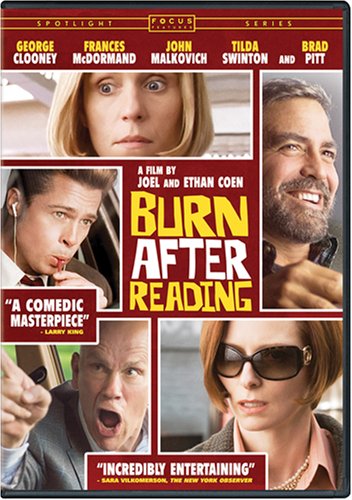
For today’s entry in the Days of Paranoia, let’s take a look at Joel and Ethan Coen’s wonderfully satiric look at espionage, greed, lust, and stupidity, 2008’s Burn After Reading.

Like most Coen Brothers films, Burn After Reading tells the dark story of a group of obsessives who all think that they’re far more clever than they actually are.  Osborne Cox (John Malkovich) is a CIA analyst who, because of his alcoholism and generally sour personality, is demoted.  Cox angrily quits his job and then starts working on his memoirs.  Meanwhile, Cox’s wife Katie (played by Tilda Swinton) is having an affair with the handsome but idiotic Mark (George Clooney).  On the advice of her divorce lawyer, Katie secretly downloads copies of all of Osborne’s records, including his memoirs.  Katie gives the disc to her lawyer’s secretary.  The secretary then proceeds to accidentally leave the disc at Hardbodies Gym.

This is where things, in typical Coen Brothers fashion, start to get complicated.  Two trainers at the gym — Linda (Frances McDormand) and her fitness obsessed friend Chad (a hilarious Brad Pitt) — find the disc and mistake Osborne’s very mundane files for national security secrets.  Linda, who is obsessed with raising enough money to get a boob job, convinces Chad that they should blackmail Osborne and demand that he pay them before they return his disc.  Osborne, who has no idea that Katie copied his records, refuses to pay so Linda takes the disc to the Russians.  This leads to a series of misunderstandings that eventually lead to several murders, all of which have to be covered up by the CIA, despite the fact that both the director of the CIA and his assistant agree that there’s no way to understand how any of this happened and that, in the end, neither one of them has learned anything from the experience.

Perhaps because it was released between the Oscar-winning No Country For Old Men and the Oscar-nominated A Serious Man, many critics tend to dismiss Burn After Reading as just being an enjoyable lark and nothing more.  While it’s true that there’s not a lot going on underneath the surface of Burn After Reading, the surface itself is so fun, vivid, and vibrant that it seems rather petty to complain.  Burn After Reading finds the Coen Brothers at their most playful and snarky.

The Coen Brothers have made films in several different genres and styles but all of their work has one thing in common.  The Coens tell stories about obsessive characters who aren’t anywhere close to being as smart as they think they are.  When critics complain that the Coens tend to view their characters with a rather condescending attitude, they’re usually talking about films like Burn After Reading.  Fortunately, in the case of Burn After Reading, the Coens assembled one of their strongest casts.  From the insanely focused Frances McDormand to the perpetually smiling Brad Pitt to cynical John Malkovich, everyone does such a great job that you can overlook the fact that they’re all essentially playing idiots.  Perhaps the film’s best performance comes from George Clooney who, in the role of Harry, proves himself to be a very good sport by satirizing both his own reputation as a womanizer and his career as an old school movie star.  In one of the film’s best moments, Harry, gun drawn, dramatically leaps and then rolls into an empty bedroom.  Like almost all of the characters in Burn After Reading, Harry is just a big kid playing action hero and Clooney’s performance here is perfect.

As for Burn After Reading, it may not be perfect but it’s certainly a lot of fun.

51CW76jX8fL

Other entries in the 44 Days Of Paranoia:

  1. Clonus
  2. Executive Action
  3. Winter Kills
  4. Interview With The Assassin
  5. The Trial of Lee Harvey Oswald
  6. JFK
  7. Beyond The Doors
  8. Three Days of the Condor
  9. They Saved Hitler’s Brain
  10. The Intruder
  11. Police, Adjective

Defending the Counselor


The_Counselor_Poster

(Spoilers Below)

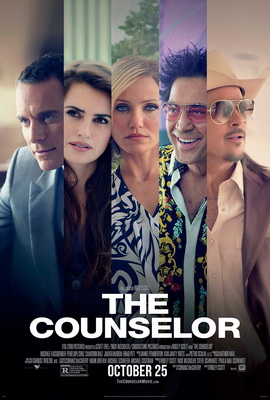
The Counselor was one of the most anticipated films of 2013.  After all, it was based on a screenplay by the Pulitzer-prize winning novelist Cormac McCarthy and it was directed by Ridley Scott.  Its cast included such stars as Michael Fassbender, Javier Bardem, and Brad Pitt.  The film’s two trailers promised a return to the thematic territory that the Coen Brothers explored in their Oscar-winning adaptation of McCarthy’s No Country For Old Men.

And yet, when The Counselor was released in October, the reviews were scathing and audience response was reportedly terrible.  Writing for Salon, film “critic” Andrew O’Hehir suggested that The Counselor was not only the worst film of 2013 but the worst film of all time.

And you know what?

For not the first time, Andrew O’Hehir was wrong.  The Counselor is not the worst film of 2013.  Instead, it’s one of the best.  It’s a film that will be studied long after more acclaimed films have been forgotten.

Why is The Counselor so hated?

It’s not an easy film to love.  In fact, the film is rather brave about alienating its audience and refusing to allow for the crowd-pleasing moments that viewers have come to expect from even the most prestigious of films.

In order to truly defend the Counselor, it’s necessary to know the plot of The Counselor.  Needless to say, everything that follows constitutes a huge spoiler so, if you’re one of those types, feel free to stop reading now.
Brad-Pitt-Michael-Fassbender-Counselor

Okay, still here?  Here’s a condensed version of what happens in The Counselor:

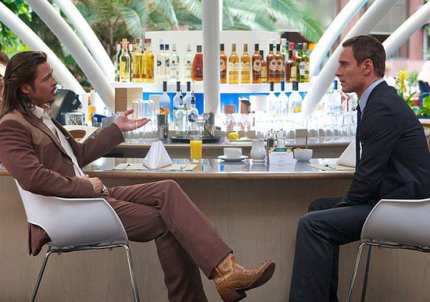
The Counselor (Michael Fassbender) is an honest lawyer in El Paso who has never broken the law and is engaged to marry the beautiful and saintly Laura (Penelope Cruz).  For reasons that are never explicitly stated (but, as I’ll explain below, are obvious to anyone who is willing to look for the clues), The Counselor agrees to help his clients Westray (Brad Pitt) and Reiner (Javier Bardem) smuggle a huge shipment of cocaine into the U.S. from Mexico.  However, Reiner’s girlfriend Malkina (Cameron Diaz) steals the drugs and frames the Counselor for the theft.  As a result, Reiner ends up getting executed by the Mexican cartel, Westray is beheaded on the streets of London, and the Counselor ends up hiding out in Juarez, Mexico, sobbing as he looks at a DVD copy of a cartel-produced snuff film that features Laura being murdered.  The end.

Yeah, it’s not exactly a happy film.  And yet, it’s a film that sticks with you, a portrait of a shadowy underworld that is fueled solely by greed, paranoia, and masculine posturing.  Ridley Scott makes good use of the South Texas landscape and the talented cast creates a memorable gallery of rouges.

And yet, The Counselor is getting some of the worst reviews of the year.  What’s especially interesting is that the things that so many critic cite as flaws are actually the film’s greatest strengths.
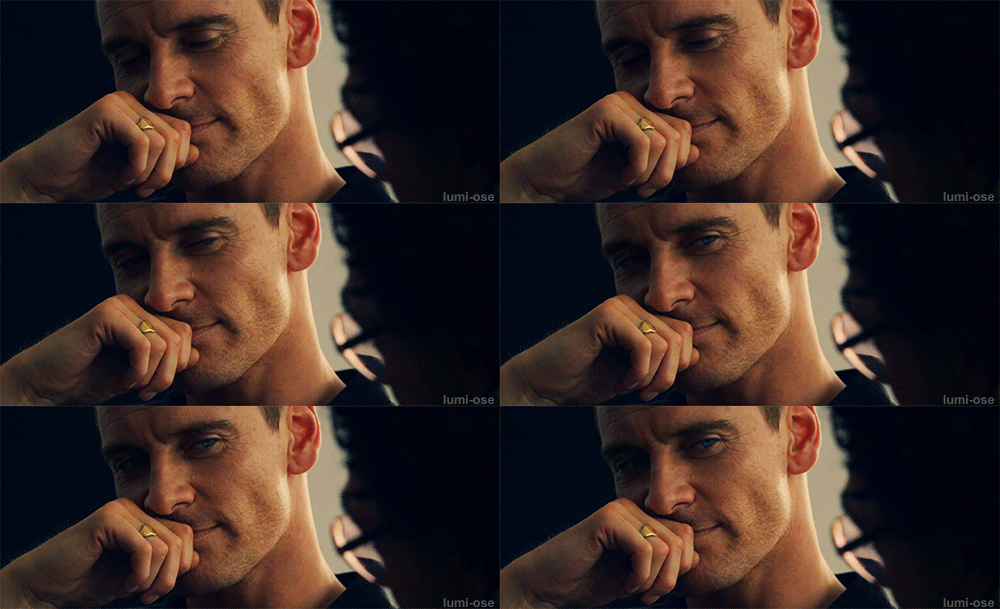
The Counselor

Consider the following common criticisms:

1) The film features some of the most overly articulate drug deals of all time.

This is the most frequent complaint that I’ve come across concerning The Counselor and there is some validity to it.  The Counselor is a very talky film.  The film’s first hour is pretty much made up of The Counselor having three conversations, all about the same thing and all reaching the same conclusion.  Cormac McCarthy’s dialogue is, perhaps not surprisingly, rather portentous and florid.  The Counselor does ask the audience to accept a world where even the head of Mexico’s most powerful cartel is given to going off on long philosophical digressions.  The Counselor is one of those films where nearly every line seems to have a double meaning.

That said, I think that those who attacking the film’s dialogue are missing the point.  This is not meant to be a naturalistic film.  Instead, it’s a heavily stylized B-film that uses its sordid story as a metaphor for dealing with deeper issues of greed, masculinity, and the changing mores of American culture.  Much as every line of dialogue has a deeper meaning, so does every pulpy plot twist.  It takes a while to adjust to McCarthy’s dialogue but, ultimately, that dialogue serves to remind us that the film has a lot more on its mind than just telling the story about a drug deal gone bad.  The combination of overly articulate dialogue with primitive violence and desires encourages us to look under the film’s surface.

2) The film’s plot is predictable.

This may be true but I think that’s actually McCarthy’s point.  From the start of the film, the Counselor is continually warned that things could potentially go very wrong.  Despite these warnings, the Counselor still gets involved in Reiner’s drug and, through a combination of hubris and fate, he loses everything that he loved.

The Counselor’s downfall is not meant to be a surprise.  Instead, McCarthy’s point is that the consequences of our actions are usually obvious but we, as human beings, chose to live in denial about just how little control we actually have over our own fate.

TheCounselor-Diaz-Cheetah-Tat

3) Ridley Scott’s direction is stylish but ultimately empty.

This argument goes that, while Scott manages to capture some gorgeous images of the Texas/Mexico border, those images ultimately don’t add up to much.  The idea goes back to a charge that is frequently leveled against Ridley Scott as a director, that he’s all style and technique with little substance.  (Interestingly enough, this is the same charge that is often made against the Coen Brothers.)

In the past, I’ve been critical of Ridley Scott.  (For proof, check out my reviews of Robin Hood and Gladiator.)  However, that being said, I think that, with The Counselor, Scott does a good job of visually interpreting the concepts at the heart of McCarthy’s script.  My mom was from South Texas and I’ve spent enough time down there to understand just how perfectly Ridley Scott manages to capture the combination of beauty and harshness that one finds along the border between Texas and Mexico.  In Scott’s hands, the emptiness of the Texas landscape serves as a perfect parallel for the emptiness of the lives of the majority of the film’s characters.

Speaking of which…

4) The motivations of the Counselor remain a mystery.

Why does the Counselor get involved in the drug deal in the first place?  Many of the film’s critics have complained that the Counselor’s motivations remains a mystery and therefore make it impossible for audiences to sympathize with the character.

Nothing could be further from the truth.

What these critics are failing to realize is that the Counselor’s motives are obvious every time that he appears on-screen.  The audience has to be willing to look for them.  The audience has to be willing to think and that, of course, is asking quite a bit of some viewers.
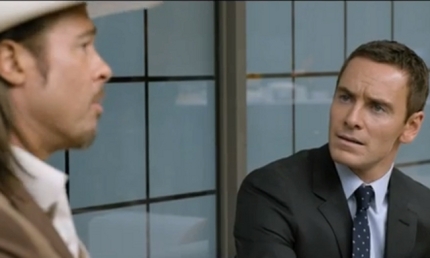
The-Counselor

While the Counselor hints that his reason for getting involved with the drug deal is so that he can make enough money to provide a good life for Laura, his actual motivations are far more selfish.  One need only see the Counselor in his perfectly pressed suits or in his sleek but sterile home to understand exactly who the Counselor is.  He is a character who has made his living by defending those who break the law but who has never had the courage to actually flaunt the rules himself.   He is a man who lives in a self-constructed prison of ennui and associating with Reiner and Westray gives him a chance to escape from his conventional existence.   He is a character who spends his day profiting from the crimes of others but, because he can go home to his beautiful home and his beautiful fiancee, assumes that he’s somehow detached from the consequences of the actions of his associates.

The Counselor starts the film as an unemotional, blank-faced cipher, a man whose entire identity is based on his job title.  (Indeed, we never learn once learn or hear the character’s actual name.)  The only time that he shows even a hint of human depth or emotion is when he’s with Laura.  He’s a man who, in many ways, is dead on the inside.  It’s only after he gets involved with Reiner and Westray that the Counselor starts to show any signs of life until, by the end of the film, he literally cannot control his emotions.   The Counselor frees himself from his stifling and conventional existence at the cost of everything and everybody that he loves.  In his pursuit of freedom, he simply moves from one self-imposed prison to another.

5) Particularly in its portrayal of Malkina, there is a strong streak of misogyny running through the film.

This is a point that I’ve seen made by several critics and it’s one that bothers me as both a feminist and as a female who happens to love genre films.  Just because a film features a misogynistic character does that therefore make the film itself misogynistic?

The majority of those who claim that The Counselor is anti-female often point to the character of Malkina.  As played by Cameron Diaz, Malkina is a hyper sexual sociopath who manipulates and destroys everyone else in the film.  Even though he’s obsessed with her, Reiner also claims to fear her and he has several conversations with the Counselor in which he cites her as proof that women cannot be trusted.

However, just because Reiner says this, that doesn’t necessarily mean that the film agrees.  In fact, as should be obvious to anyone who is actually willing to pay attention to the film, Reiner is portrayed as being a fool who, ultimately, is just as delusional as the Counselor.  Reiner, Wainstray, and the Counselor all exist in a hyper masculine environment.  For all of their posturing and macho talk, it’s also obvious that none of them are capable of truly dealing with women.  Wainstray can only bring himself to acknowledge them as potential sexual partners while the Counselor both idealizes Laura and uses her happiness as an excuse to pursue his own criminal enterprises.  Reiner, meanwhile, is both attracted to and terrified of Malkina.
the-counselor-ferrari-diaz

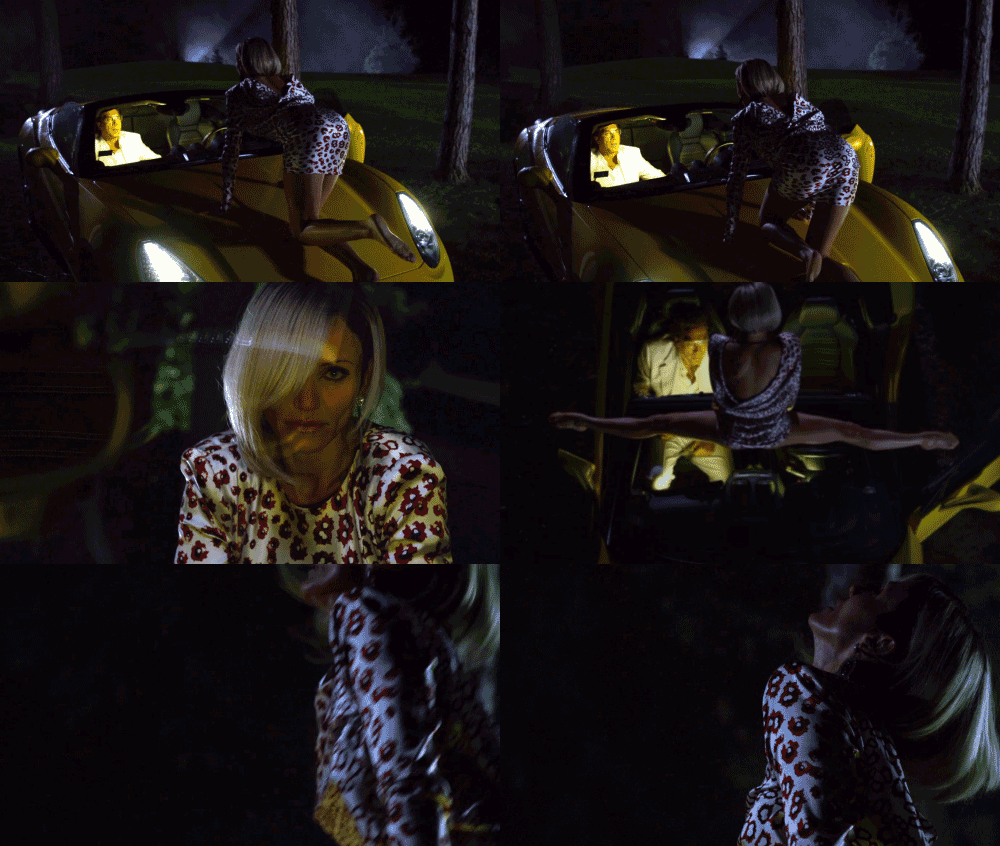
In perhaps the film’s most infamous scene, Malkina removes her panties and then grinds against the windshield of a Ferrari while Reiner watches from inside the car.  Some have argued that, with this scene, the filmmakers are equating Malkina’s sexuality with evil.  I, however, would argue that this scene shows that Malkina — alone of all the film’s major characters — understands the fact that all of the men in her life are essentially boys who are either incapable of or unwilling to grow up.  Malkina uses her sexuality not because she’s evil but because she’s intelligent enough to use every weapon at her disposal to make sure that she will be one of the few characters to survive to the movie’s conclusion.  By the end of the film, it’s obvious that Malkina is both the strongest and the most intelligent character in the film.

There’s an interesting scene towards the end of the film in which the Counselor, who is hiding out in Juarez, stumbles across a group of protesters who are holding pictures of young women who have either been killed on or vanished from the streets of Juarez.  Since 1993, over 4000 women have been murdered in Juarez.  The majority of those murders are still unsolved, with many blaming the Spanish tradition of machismo.  The feeling of many is that “good” girls stay home while “bad” girls get jobs in the city and are often  murdered as a result.  And, since the victims shouldn’t have been pursuing a life outside of domestic servitude in the first place, why waste the time trying to win them any sort of justice?  For the past decade, brave activists have put themselves in danger by daring to demand justice for the dead of Juarez.  When the Counselor stumbles across their rally, it’s a brief moment in which the real world and the cinematic landscape come together.

It’s also a scene that serves to remind us that the film’s characters are living in a hyper masculine world, one that embraces the concept of machismo without understanding or caring about the consequences of that destructive  culture.  The Counselor’s horrified reaction to the rally is the reaction of a man who has finally been forced to confront the evil of which he is now a permanent part.

6) The film’s ending is depressing.

Complaining about Cormac McCarthy writing a depressing ending is a bit like getting upset at a cat for purring.  It’s what McCarthy does and anyone with any knowledge of his work has no right to be shocked that the film ends on a note of hopelessness.  Much as with No Country For Old Men, The Counselor ends the only way that it can.  It may not be a happy ending but it is, at least, an honest ending.

The Counselor may not be an easy film to like but it’s definitely a film that deserves better than to be dismissed as the worst of 2013.
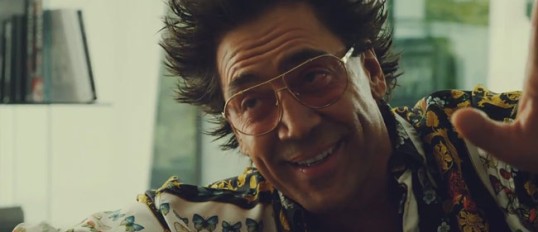
Counselor-Bardem2

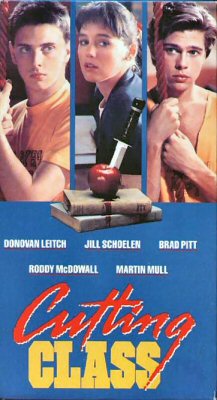
Horror On The Lens: Cutting Class (dir by Rospo Pallenberg)


Cutting_Class_film_poster

it’s been said that, early in the career of every Oscar nominee, there’s a film or two that he probably wishes would be forgotten.  Today’s movie is one of those films, 1989’s Cutting Class.

Cutting Class is, in many ways, a fairly standard 1980s slasher comedy hybrid.  It features a stronger heroine than most and it does a bit of a better job than expected at making you guess who the killer is but, for the most part, Cutting Class is mostly memorable for being one of Brad Pitt’s first major roles.

The bad news is that the character he’s playing here is kind of an asshole and not even the fact that he looks like Brad Pitt can make him likable.

The good news is that Brad Pitt has always been hot.

And here’s the proof…

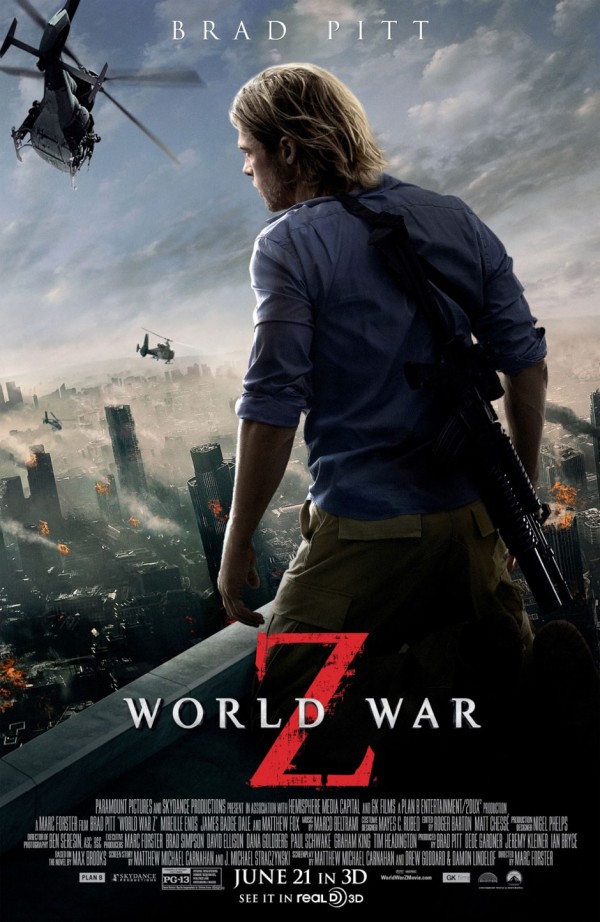
Trash Film Guru Vs. The Summer Blockbusters : “World War Z”


World-War-Z-2013-Movie-Poster3-600x922


Okay, I get it — fans of Max Brooks’ best-selling “zombie apocalypse” novel World War Z are pissed off about director Marc (Monster’s BallQuantum Of Solace) Forster’s big-budget, big-screen “adaptation” of it because the finished product bears essentially no recognizable similarity to its printed-page predecessor. Heck, some are even going so far as to say that they actually like the film, they just feel that it should be called something else.

On the other hand, it seems that more or less everyone who hasn’t read the book loves the movie.

Much as I’d enjoy picking a side in this, the latest great “genre geek debate,”  I honestly can’t, simply because I don’t really fit into either of the “warring” camps, seeing as how I neither read the novel nor loved the film with the kind of awestruck wonder its most fervent partisans seem to be brimming over with.

Oh, sure, it was pleasantly entertaining enough — United Nations bad-ass-for-hire Gerry Lane (Brad Pitt — who, let’s face it, is probably contractually obligated to always play somebody at least a little bit cooler than the Average Joe) races against the clock, and around the globe, to keep his wife, Karin (Mireille Enos of TV’s The Killing) and their kids safe from a massive viral plague that essentially mashes together elements of the scenarios George Romero laid out in both The Crazies and his seminal “Living Dead” flicks, only with a much larger budget that enables the filmmakers to give us a more international perspective on the goings-on. Governments are strained to breaking point and/or collapse entirely, WHO and the world’s various military forces struggle to get a handle on things, no area is left unaffected, no one is safe —you get the picture.

The script went through four sets of hands — Babylon 5 creator and frequent comics scribe J. Michael Straczynski gave way to former Lost head honcho and occasional comics scribe Damon Lindelof who in turn gave way to Drew Goddard who in turn gave way to Matthew Michael Carnahan — and, as you can imagine, is something of a mess as a result. Fortunately, it never slows down long enough for you to fully realize that fact, and instead keeps you on the edge of your seat with its PG-13-level action and semi-violence (notice I don’t say anything about gore — sorry, die-hard zombie-holics) from the time it clocks in to the time it knocks off and heads for the bar around the corner.

The end result is something of a hustle — it’ll slowly dawn on you as you make your way home from the theater that what you just saw really wasn’t anything too special, but what the hell — you were too busy having fun to notice.

And that was probably the whole point, really. I don’t think Forster and his literal army of screenwriters set out to reinvent the wheel here or overturn the sacred “Romero Rules” permanently. They were just the guys brought in to make something of a damn popular book that Paramount bid a fortune to obtain the rights to and if, at the end of the day, all that survived of World War Z as most folks knew it was the title, well — that’s pretty much all they were paying for, anyway. Beyond that the only edicts from the studio “suits” were probably to land a huge star, load up on the CGI, and deliver a product that the average summertime movie-goer would find to be a reasonable enough investment of ten bucks and (roughly) two hours.

Judging it on that scorecard, you’d have to say they can all pat themselves on the back, say “mission accomplished,” and go home. Those hoping for a movie that would revolutionize the genre on celluloid the same way the book did in print are bound to be left feeling a bit disappointed, as is anyone who bothers to actually think about what they’re seeing while they’re seeing it, but for anyone and everyone else, hey — it’s a decent enough little thrill ride. Grab some popcorn, sit back, and please don’t struggle against your inner 12-year-old.

Now, as to the other raging debate splitting the internet about whether or not this is actually a horror movie or just a “thriller” with some genre trappings —

Forget it. I’m sooooo not going there. One nerd-controversy per review is my limit.

Review: World War Z (dir. by Marc Forster)


WorldWarZ

I’ll get this out of the way and just say it: World War Z the film pretty much has nothing in common with the acclaimed novel of the same name by author Max Brooks (reviewed almost at the very beginning of the site). Ok, now that we have that out of the way it’s time to get to the important part and that’s how did the film version turn out on it’s own merits.

World War Z was a film that took the long, winding and rough road to finally get to the big-screen. Whether it was the five different writers brought in to work on the script (J. Michael Straczynski of Babylon 5 fame came onboard first with Christopher McQuarrie coming unofficially to help tighten a few scenes in the end) to the massive changes made to the original source material that was bound to anger the fans of the novel, the film by Marc Forster had an uphill climb to accomplish even before the final product even came to market.

I was as surprised as man others were that the finished product was better than I had anticipated. Some had very low expectations about World War Z coming in due to the rumors and news reports coming in about the problems during production, but it doesn’t change the fact that the unmitigated disaster predicted by every film blogger and critic beforehand never came to fruition.

World War Z might not have been what fans of the novel had wanted it to be, but when seen on it’s own merit the film was both exciting and tension-filled despite some flaws in the final script and use of well-worn horror tropes.

The film begins with a visual montage interspersing scenes of nature (particularly the swarming, hive-like behavior of certain animals like birds, fish, and insects), alarmist news media reporting and the mindless celebrity-driven entertainment media that’s so big around the world. From there we’re introduced to the main protagonist of the film in one Gerry Lane (played by Brad Pitt) and his family. We see that the Lane family definitely love and care for each other with his wife Karin (Mireille Enos in the supportive wife role) and their two young daughters, Rachel and Constance. The film could easily have spent a lot of time establishing this family and their relationship towards each other, but we move towards the film’s first major sequence pretty much right after the opening. It’s this choice to not linger on the characters too long that becomes both a strength and a weakness to the film’s narrative throughout.

WorldWarZPhilly

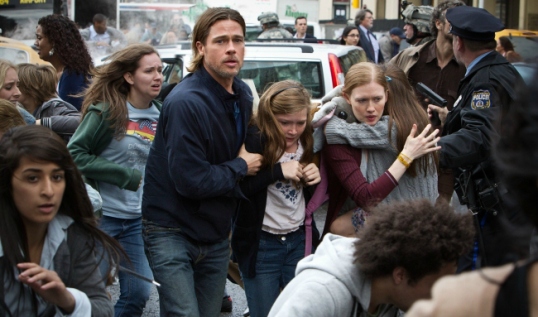
World War Z finally shows why it’s not your typical zombie film with it’s first major sequence in the center of downtown Philadelphia as Gerry and his family sees themselves in bumper-to-bumper traffic. As they wait there are some subtle hints that something might just be somewhat awry ahead of them as we see more and more police racing towards some sort of emergency ahead of the family and more and more helicopters flying overhead. There’s a brief lull in the scene before all hell breaks loose and the film’s zombie apocalypse aspect goes from 0 straight to 11 in a split second.

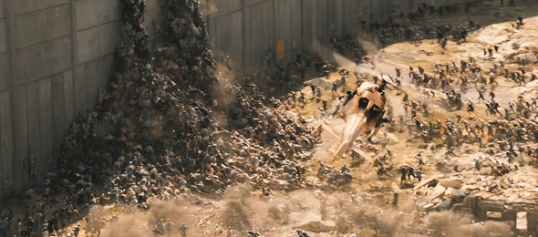
It’s this sequence of all-encompassing chaos overtaking a major metropolitan city seen both on the ground through the eyes of Gerry Lane and then on flying overhead wide shots of the city that gives World War Z it’s epic scope that other zombie films (both great and awful) could never truly capture. It’s also in this opening action sequence that we find the film’s unique take on the tried-and-true zombie. While not the slow, shambling kind that was described in the novel, these fast-movers (owes a lot more on the Rage-infected from 28 Days Later) bring something new to the zomgie genre table by acting like a cross between a swarm of birds or insects with the rapidly infectious nature of a virus.

These zombies do not stop to have a meal of it’s victims once they’ve bitten one but instead rapidly moves onto the next healthy human in order to spread the contagion it carries. We even get an idea of how quickly a bitten victim dies and then turns into one of “Zekes” as a soldier has ended up nicknaming them. It’s this new wrinkle in the zombie canon that adds to the film’s apocalyptic nature as we can see just how the speed of the infection and the swarm-like behavior of the zombies could easily take down the emergency services of not just a city and state but of entire nations.

WorldWarZJerusalem

World War Z works best when it doesn’t linger too long between action sequences. Trying to inject some of the themes and ideas that made the novel such a joy to read only comes off as an uncomfortable attempt to try and placate fans of the novel. When we get scenes like Philadelphia in settings like Jerusalem and, in smaller scales but no less tense, like in South Korea and on a plane, the film works as a nice piece of summer action fare. This works in the first two thirds of the film but a sudden shift in the final third in Cardiff, Wales could be too jarring of a tonal shift in storytelling for some.

While the change from epic and apocalyptic to intimate and contained in the final third was such a sudden change this sequence works, but also shows just how bad the original final third of the film was to make this sudden change. It proves to be somewhat anticlimactic when compared to the epic nature of the first two-thirds of the film. We get a final third that’s more your traditional horror film. In fact, one could easily see World War Z as two different films vying for control and, in the end, the two halves having to try to co-exist and make sense.

World War Z doesn’t bring much of the sort of societal commentaries and themes that we get from the very best of zombie stories, but it does bring the sort of action that we rarely get from zombie films. The film actually doesn’t come off as your traditional zombie film, but more like a disaster story that just happened to have zombies as the root cause instead of solar flares, sudden ice age or alien invasion.

So, while World War Z only shares the title with the source novel it was adapting and pretty much not much else, the film wasn’t the unmitigated disaster that had been predicted for months leading up to it’s release. It’s a fun, rollercoaster ride of film that actually manages to leave an audience wanting to know more instead of being bombarded with so much action that one becomes desensitized and bored by it. There’s no question that a better film, probably even a great one, lurks behind the fun mess that’s the World War Z we’ve received, but on it’s own the film more than delivers on the promise that most films during the summer fails to achieve and that’s to entertain.

Trailer: World War Z (2nd Official)


WorldWarZ

We see the release of a new trailer for this summer’s epic zombie film based on the equally epic novel of the same name by Max Brooks.

World War Z is already the most expensive zombie film ever made with a budget rumored to be between 125-200 million dollars. Some of this has been due to the delays in filming and most of it seems to stem from a massive rewrite of the third act. Damon Lindelof was first hired to rewrite but due to prior commitments the job went to Drew Goddard. Such a rewrite also meant reshoots had to be done which took another seven weeks of shooting.

All in all, World War Z is one troubled film before it even gets to the general public.

Yet, it is also one of the more anticipated films for this summer. Some from fans of the genre who just can’t get enough of zombie films. Some from people wanting to see just what sort of zombie film ends up with a budget around 200 million dollars. From the trailer we’ve seen some of that money seem to have gone on some massive special effects sequences which includes swarming zombies of the Rage-infected kind. Then again we don’t really see the zombies close-up which tend to make them look like swarming ants from afar. Maybe the look of the zombies themselves have been saved for the release of the film.

This latest trailer actually gives a bit more of the plot of the film which puts Brad Pitt’s UN employee character to travel the world in search for the cause of the worldwide zombie pandemic. The speed by which things happen seems to have compressed all the events in the novel into a film of two hours. This, I’m sure will be a major contention with fans of the novel, but it looks like a decision by filmmaker to try and create a single narrative from a novel that was mostly single-hand accounts of the zombie war from survivors who have no connection with each other whatsoever.

We’ll find out in just under 3 months if this film will be a major flop or succeed despite all the stumbling blocks and problems throughout its production.

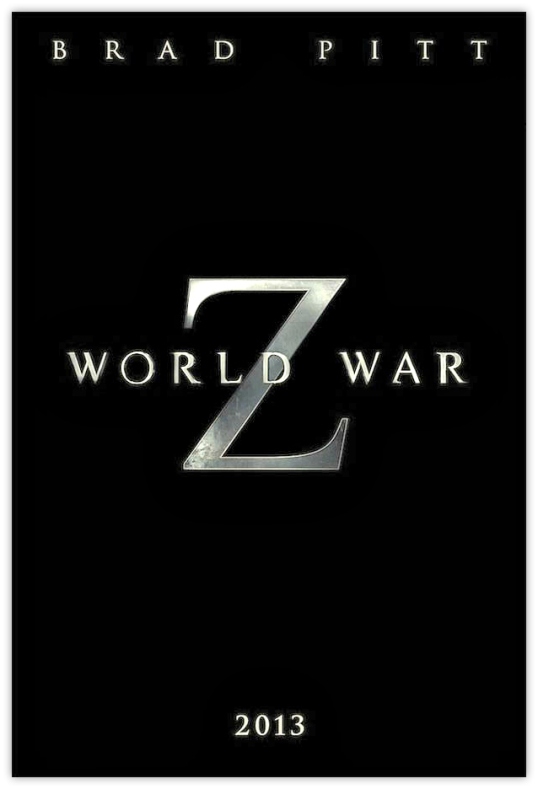
World War Z is set for a June 21, 2013 release date.

Trailer: World War Z (Super Bowl Exclusive)


One of the films that was to have it’s day in the Super Bowl ad campaign rush was Paramount Pictures’ troubled epic zombie apocalypse film, World War Z.

Starring Brad Pitt and directed by Marc Forster, the film is an adaptation (very loosely adapted from the novel) of the novel of the same name written by Max Brooks. Anyone who is even remotely interested in the topic of zombie fiction (or that they’re real like certain awesome people) have read this novel and have been highly anticipating the film. When the first trailer was released several months ago the reaction to the changes made from book to film was a resounding “Huh” to “WTF?!” from fans.

Time will not be changing some of these reactions, but from the sudden release of the Super Bowl ad TV spot that the film will show during Sunday’s Big Game it looks like the film will take the basic premise of the novel and go it’s own way. The zombies being CGI when seen from a distance and moving like ravenous army ants (siafu as the Japanese call them which is also what the zombies were called in the novel).

The film seems to want to see the zombie apocalypse first-hand as it occurs and sped things up to bring more action to the proceedings. This is not a bad thing if the film had been titled other than World War Z, but since it needed to use that name the complaints by fans of the novel will continue. Just based on the trailer and this teaser spot alone it looks like there’s something interesting going on in this film that people will either love or hate. I’m hoping I’ll be of the former than the latter.

World War Z is set for a June 21, 2013 release date.

WorldWarZ

Film Review: Killing Them Softly (dir. by Andrew Dominik)


Killing Them Softly is perhaps the most unpleasant film of 2012.

Taking place in 2008, Killing Them Softly tells the story of how a poker game got robbed in New Orleans and how that robbery led to a lot of people getting killed.  The poker game is run by Markie (Ray Liotta), a likable and well-meaning gangster who made a big mistake in the past.  A few years  previously, Markie arranged for one of his poker games to get robbed.  Though everyone knew that Markie was guilty, nobody could prove it and Markie continued to claim his innocence even while being tortured by a legendary hitman named Dillon (Sam Shepard).  So, years later, three small-time crooks figure that if they rob another one of Markie’s games, the Mafia will automatically blame Markie and hold him responsible.

Unfortunately, one of the crooks (played by Ben Mendelsohn, who was so good in Animal Kingdom) is also a heroin addict and something of an idiot.  He talks to the wrong people and soon the Mafia knows who was actually responsible.  Since Dillon is in the hospital, his protegé Jackie (Brad Pitt) is sent down to New Orleans to take care of the situation.  As Jackie explains to the mob’s representative (played by Richard Jenkins who gives a very Richard Jenkinsy performance here), not only do the three criminals have to die but Markie has to die as well.  It’s all strictly business.

Speaking of business, this entire story plays out against the backdrop of the 2008 elections.  For some reason, all of these sleazy criminals seem to be obsessed with watching CNN.  As a result, nearly every scene features either George W. Bush or Barack Obama speaking in the background.  At one point, Jackie says, “This is America,” just in case you couldn’t figure out that the film’s plot is supposed to be allegorical.

Killing Them Softly is an odd film, a well-made film that never quite convinces us that its story needs to be told.  Brad Pitt is miscast as Jackie and James Gandolfini has a truly annoying cameo as an alcoholic killer but otherwise, the film is perfectly cast.  Mendelsohn and Scoot McNairy are believable as two of the stupidest criminals to ever appear on-screen and Ray Liotta is likable and sympathetic as the tragic Markie.  Director Andrew Dominik makes good use of the New Orleans locations and the film has a few genuinely suspenseful moments.  That said, the film’s graphic and brutal violence quickly goes from being shocking to just being tedious.

If for no other reason, I did appreciate the fact that Killing Them Softly was brave enough to lump Barack Obama in with every other politician whose words are used to punctuate the film’s action.  Here in America, filmmakers tend to be very hypocritical when it comes to criticizing the government, going to almost ridiculous lengths to excuse Obama for following the same policies that they previously spent eight years attacking George W. Bush for instituting.  Instead of attempting to promote any partisan position, Killing Them Softly argues that the business of America will remains the same regardless of who is in charge.  Normally, that would seem to be a pretty obvious point but, in today’s cult-like political climate, it’s practically revolutionary.

Critics have been mixed on Killing Them Softly but, judging on both the film’s anemic box office and a lot of the comments that have been left online, audiences seem to absolutely loathe this film.  This isn’t particularly surprising because Killing Them Softly, with its constant emphasis on everything that’s ugly and dirty about life, seems to be a film that was specifically made to annoy audiences.  Even the film’s strengths ultimately serve to alienate the viewer.  I suspect that was Andrew Dominik’s ultimate goal and, on that count, he definitely succeeded.

Ultimately, I guess that’s why I ended up developing a strange sort of respect for Killing Them Softly, even though I found it impossible to enjoy the film itself and I would rather visit my gynecologist than ever have to sit through it again.  This is a film that stays true to itself, even at the risk of becoming unwatchable as a result.

Trailer: World War Z (Official)


It’s not hyperbole to say that one of the best horror novels to come out in the past 20 years was written by Mel Brook’s son. A son who wrote comedy scripts for Saturday Night Live. Max Brooks before 2003 was relatively unknown to genre fans. This changed post-2003 with the release of his tongue-in-cheek how-to book, The Zombie Survival Guide. It was a book that was slow to succeed in terms of sales but grew in popularity as more and more fans of the zombie genre heard about it and recommended it to like-minded friends. Just like the subject matter Brooks worte about this guide spread in a geometric pattern and more and more people began to know.

In 2006, Brooks released the companion piece to his best-selling guide with the fictional oral history account of the aftermath of a zombie apocalyptic war and how humanity fought back from the brink of extinction. This novel was World War Z and even before one could say “this book could be made into a film…” the film rights to the book became a hot commodity in Hollywood. In the end, Brad Pitt’s Plan B production company won the right to adapt the novel into a feature-length film.

After several years of trying to create a screenplay from the documentary-style and sprawling narrative of the novel the film finally went into production in mid-2011 with a screenplay that took some of the important events from the novel and set the film during the war itself as it unfolded instead of flashbacks as recounted by those who survived. This change has angered fans of the book and their anger and frustration went up another notch when some leaked on-the-set footage showing the zombies as more of the running-style zombies than the slower ones in the novel.

Another stumbling block pushed the film from a holiday 2012 release date to a summer 2013 release as Paramount looked to having World War Z as part of their 2013 summer blockbuster slate of films. This film has had so much issues and problems that it took to Brad Pitt finally agreeing to headline the cast to get the film finally made. So, instead of a film the chronicles the stories of the war’s survivors a decade after the war ended we now have a film that skews more towards a film that’s heavy on action set-pieces and globe-trotting. Someone on IGN.com has called World War Z (after seeing the attached official trailer) as 2012 with zombies. The first official trailer does seem to make it look like that.

As a fan of the novel I’m saddened by the changes, but I will say that the trailer does make this film look very epic. I’m more than willing to watch this film (who am I kidding I will watch this film and probably more than once or twice.) and look at it as the filmmakers’ own take on the novel. I mean if it turns out to be great on it’s own then hooray. If it sucks then I still have my novel to go back to. Plus, this is the first zombie film that will show the pandemic in global settings and proportions. This will be the first time we get to see this on film and not just on the written page.

My own review of the novel gives an idea just how different the film will be from the source material.

Trailer source: Joblo Movie Network