At the start of 2012’s She Made Them Do It, Sarah Jo Pender (Jenna Dewan) is a student at Purdue University who has a good-for-nothing boyfriend named Rick (Greyston Holt) and two roommates who think nothing using her tuition money to buy drugs. At first, Sarah seems to be frustrated with the losers around her but, after smoking some weed and doing some coke, she’s soon dancing and making out with another woman while Rick plays a video game. (Who among us hasn’t?)
Sarah leaves to get some cigarettes and, when she comes back, she discovers that her roommates have been executed by a shotgun. A shaken Rick explains that an argument over money led to him retrieving the shotgun (one that Sarah bought for him because Rick’s criminal record made it illegal for him to buy a gun) and killing everyone else in the house. At least, that’s what Sarah claims Rick told her. When the police eventually arrest Rick and Sarah, Rick claims that Sarah was the mastermind behind the killings. The prosecution describes Sarah as being a “female Charles Manson” and she’s sentenced to 110 years in prison.
Yikes! That’s a long time! Luckily, the prison is a pretty nice place. Sure, some of the inmates are a little rough and everyone is initially jealous of Sarah’s combination of brains and beauty. But the prison also hosts courtyard dance parties and eventually, Sarah proves herself as a jailhouse lawyer. Much like Hester Prynne, Sarah show herself to be able and hard-working. That said, prison is still prison and soon, Sarah is plotting her escape. Luckily, there’s a smitten prison guard (Nels Lennarson) who is willing to help her out.
The title She Made Them Do It has, of course, a double meaning. During her trial, the prosecution claims that Sarah Jo Pender made Rick murder her roommates. Rick even produces a letter that he claims Sarah wrote to him in which she confessed to being responsible. Even though the letter is itself dismissed as being a forgery, the courts still rule that there is more than enough evidence to argue that Sarah was involved with the murders. However, the title also refers to the fact that everyone in prison seems to be determined to help Sarah. Nearly everyone who she meets after she escapes tries to provide Sarah with some sort of aid. In the end, everyone claims that she made them do it. A few regret helping her but the majority do not.
Because the controversy over Sarah Jo Pender’s conviction is still ongoing, the film tries to play it both ways as far as the question of her guilt is concerned. We see her version of the murder. We see Rick’s version of the murder. In prison, we see her helping the other prisoners. Outside of prison, we watch as she clearly manipulates everyone that she meets. There’s nothing wrong with a little ambiguity but this film takes it so far that Sarah often seems to be a totally different character from scene to scene. Jenna Dewan tries her best and the film’s early scenes definitely capture the sordid atmosphere of trailer park drama but the film’s refusal to take a definite stand on Sarah’s guilt or innocence ultimately makes the story feel shallow. It’s one thing for the prisoners and the guards to feel as if they don’t know what’s going on in Sarah Jo Pender’s head. It’s another thing for the audience to feel that way.
As for the real Sarah Jo Pender, she is still in prison and she still claims to be innocent. She had a lot of supporters. I wouldn’t consider myself to be one of them. I doubt she ‘s a female Charles Manson but I also have a hard time buying her claim that every piece of evidence against her was just a coincidence or a case of bad luck. Unfortunately, some activists are so eager to turn every conviction into a miscarriage of justice that they ignore anything that doesn’t support their preferred narrative. (Call it the Mumia Abu-Jamal effect.) Sarah Jo Pender’s earliest possible relate date is 2054, when she will be 75 years old.
He didn’t make a title card; so, I don’t have to either! Take that, Ethan! This is your run of the mill interstellar space craft crashes on an unknown alien planet and they wander around and get eaten.
Have none of these people ever gone hiking? There is dangerous stuff right here on planet Earth that should make you wary!
If you are ever on a space craft that crashes and you see bizarre abandoned stuff everywhere, don’t investigate like you’re in an 80s horror movie.
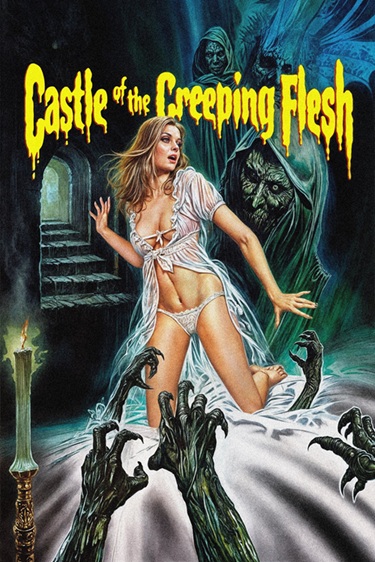
In 1968’s Castle of the Creeping Flesh, a group of wastrel aristocrats stumble upon a castle inhabited by Graf Saxon (Howard Vernon). It is explained to Baron Brack (Michel Lemoine) and his drunken friends that Saxon’s daughter died just an hour earlier. Everyone is sorry to hear that, but they still want to spend the night at the castle for… reasons, I guess.
Actually, their reasons aren’t that obscure. Night is falling. It’s stormy. There’s a bear on the loose. The Baron and his friends have their reasons for not wanting to travel at night, but that doesn’t change the fact that our film’s “heroes” are demanding that a grieving father not only put them up for the night but also serve them dinner. Saxon would be totally justified in kicking them all out and allowing the bear to have its way with them, but one of the Baron’s friends (Claudia Butenuth) looks just like Saxon’s dead daughter.
Scenes of Saxon looking depressed are mixed with scenes of the Baron’s friends all trying to seduce each other. Meanwhile, a group of surgeons in the castle’s basement are performing open-heart surgery. Every few moments the film cuts to documentary footage of an actual operation, and it’s pretty icky to watch. The heart is an amazing organ, but it’s not really something you want to spend a lot of time staring at. Saxon is trying either to save his daughter or to bring her back to life; the film is never really clear which.
Watching this German film, I was reminded of the work of Jess Franco, and I was not shocked to discover that Franco himself was credited with the incoherent story. The credited director is Adrian Hoven, but it would not shock me if Franco had a hand in the direction as well. Everything about the film—from the meandering storyline to the perpetually horny characters to the scenes of aristocratic decadence—brought Franco to mind. Like many of his films, Castle of the Creeping Flesh is atmospheric and totally incoherent.
Also leading me to suspect Franco contributed more than an outline is the casting of his favorite leading man, Howard Vernon, as Saxon. Vernon plays essentially the same character he did in the Dr. Orloff films. Unlike his co-stars, he is at least consistently entertaining. Outside of Udo Kier, no actor captured wasted European decadence the way Howard Vernon did. If any actor was born to play an early Bond villain, it was Vernon. (When I read Fleming’s originals I pictured him every time Blofeld appeared.) Here he gives a better performance than the material deserved. That was usually how it went with Howard Vernon.
Castle of the Creeping Flesh is a slow, incoherent film, but it has occasional moments strange enough to be entertaining. One woman sensually licks a chicken bone as part of her seduction ritual. Another character runs into that bear mentioned earlier. And of course no one seems to notice there is open-heart surgery happening a few doors down. It’s weird the way any film with Jess Franco’s fingerprints usually is.
That said, Howard Vernon is the main reason to watch. He did his best.
“It does not surprise me that the Devil is an Irishman. Though I thought perhaps he might be a bit taller.” — Friend
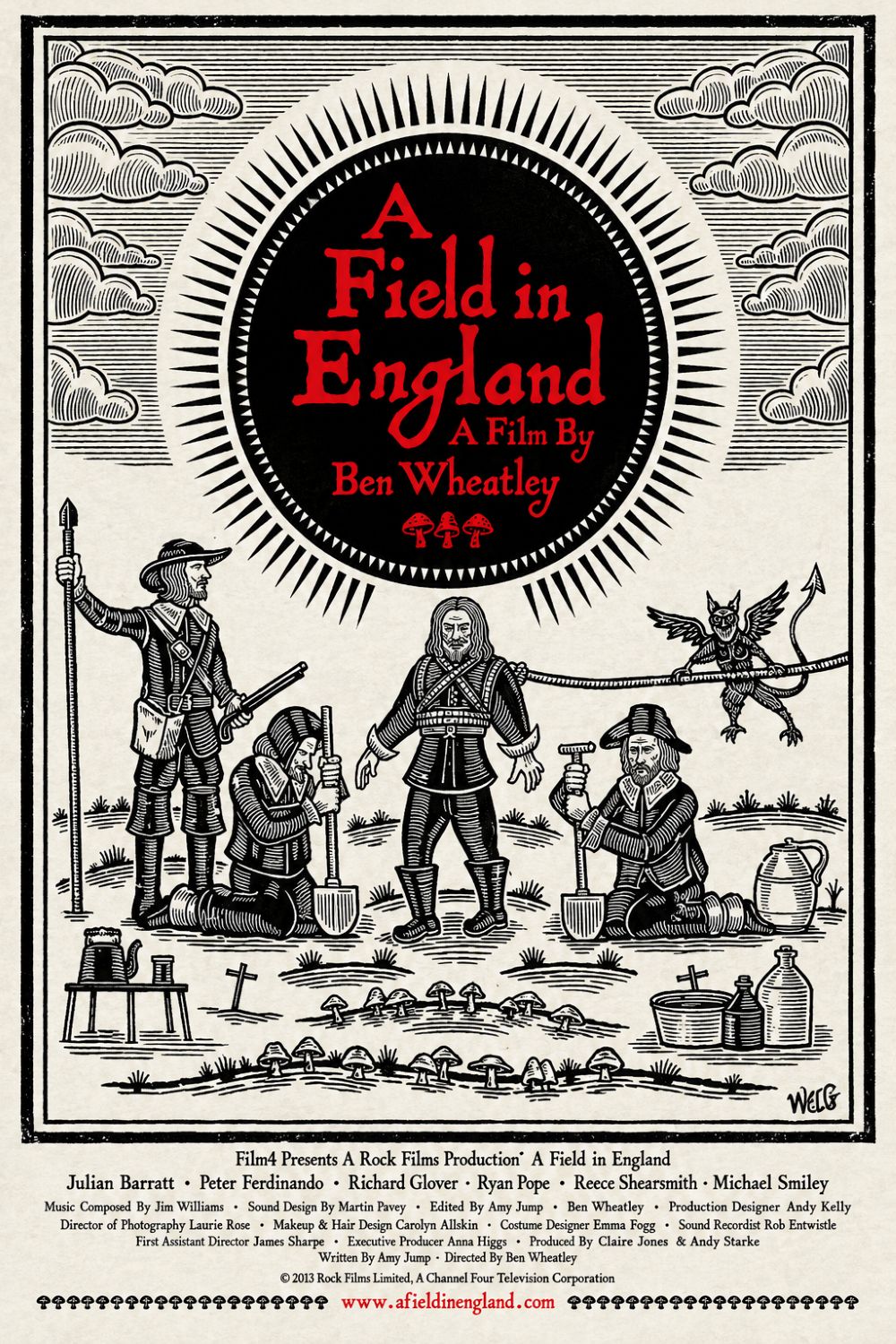
There is something deeply unsettling about a horror film that takes place almost entirely in broad daylight, and A Field in England uses that unease to devastating effect. Ben Wheatley’s 2014 release is a black-and-white nightmare about deserters, mushrooms, occult power, buried treasure, and men slowly losing whatever grip they had on reality. It is cryptic, abrasive, occasionally funny, deliberately repetitive, and sometimes so visually and sonically intense that it feels less like watching a film than being trapped inside a bad trip with several deeply unpleasant Englishmen.
Set during the English Civil War, A Field in England begins with Whitehead, played by Reece Shearsmith, fleeing an unseen battle. He is an educated man and an apprentice to an alchemist, although he is not particularly brave, heroic, or prepared for the chaos around him. Whitehead soon falls in with a small group of deserters: the blunt Cutler, the nervous Friend, and the worldly Trower. Their immediate goal is basic survival. They want food, ale, somewhere safe to rest, and preferably no more involvement in the war. Naturally, things do not work out that way.
The group crosses an enormous field and encounters O’Neill, played with unnerving authority by Michael Smiley. O’Neill is an alchemist, a manipulator, and possibly something more supernatural. He claims there is treasure buried in the field and forces the men into helping him dig for it. From there, the story gets progressively stranger, particularly after the men consume mushrooms that may or may not be supernatural in origin. The film’s central question is never simply whether the characters are hallucinating. Wheatley keeps pushing the viewer toward a more uncomfortable possibility: what if the hallucinations are revealing something real?
That ambiguity is the movie’s greatest strength and its biggest obstacle. A Field in England gives the audience fragments rather than firm answers. There are references to stolen papers, alchemical knowledge, magical control, a rival master, buried riches, and rituals that may have been going on long before these men stumbled into the field. But Wheatley and screenwriter Amy Jump never stop to explain the rules. The field seems both ordinary and impossible. It is a place where history, warfare, class resentment, religious anxiety, superstition, and psychedelic terror all collapse into one ugly patch of grass.
The setting is especially impressive because it is so limited. Much of the film takes place in one open field, but Wheatley makes that restriction feel like a trap rather than a budgetary compromise. The wide, empty landscape should offer freedom, yet it becomes increasingly claustrophobic. There is nowhere to hide, no landmark to guide anyone out, and no real sense that walking away would accomplish anything. The field becomes a purgatory, a prison, and an altered state of mind all at once. The characters are technically outdoors the whole time, but they might as well be locked in a dungeon.
Laurie Rose’s black-and-white cinematography is essential to that effect. The movie is beautiful in a harsh, unfriendly way. The high-contrast images turn grass, clouds, trees, faces, and dirt into something almost mythic. Instead of giving the Civil War setting a polished historical-drama look, the monochrome photography makes it feel ancient and unstable, like a series of damaged photographs or illustrations pulled from a cursed old book. The lack of color also helps detach the film from realism. Blood, mud, sweat, and the field itself lose their normal visual identity, making everything feel one step removed from the world the audience recognizes.
The film’s most famous stylistic choices arrive during its hallucinatory stretches. Wheatley uses strobing images, freeze frames, abrupt flashes, distorted sound, overlapping dialogue, and violently fractured editing to turn the characters’ mushroom-induced breakdowns into sensory assaults. These sequences are not designed to be pleasant or even easily readable. At times, they are exhausting. That is clearly the point. The men are losing control of time, memory, language, and physical space, and the film wants the viewer to feel that disorientation rather than observe it safely from a distance.
This can make A Field in England a demanding watch. There are stretches where the characters repeat themselves, argue in circles, dig holes, pull ropes, or speak in riddles that do not immediately add up. Some viewers will probably find this fascinating, while others will feel that Wheatley is testing their patience for the sake of being weird. Both reactions are fair. The film occasionally comes close to mistaking opacity for depth. Not every bizarre image carries the same force, and the narrative sometimes feels like it is daring the audience to keep watching rather than drawing them in naturally.
Still, the performances keep the movie from floating completely away into abstraction. Shearsmith is especially good as Whitehead, whose intelligence does not save him from terror or humiliation. He plays the character as someone who desperately wants to understand the occult forces surrounding him but may be too frightened and compromised to confront them. There is something deeply sad about Whitehead’s weakness. He is not a clean-cut innocent, but he is also clearly outmatched by O’Neill.
Michael Smiley, meanwhile, is fantastic as O’Neill. He does not play the role as a standard screaming madman. That would be too easy. Instead, he is controlled, smug, and almost conversational, which makes him much more threatening. O’Neill treats cruelty like an intellectual exercise. He speaks as though he is always several steps ahead, and his certainty becomes frightening because nobody else in the film can confidently say whether he is a fraud, a sorcerer, or a man who has simply learned how to exploit frightened people. Smiley gives the character the exact kind of ugly charisma needed for a villain who may be entirely human but feels almost demonic.
The supporting cast also deserves credit. Peter Ferdinando, Richard Glover, and Ryan Pope give the film its rougher, more grounded energy. Their banter provides an odd kind of dark humor, especially early on, before the nightmare fully takes over. Wheatley has always had a talent for making people sound casually vicious and absurd at the same time, and A Field in England contains that familiar bite. These are not noble historical figures delivering grand speeches. They are exhausted, hungry, crude men trying to survive a war they barely understand.
What makes the movie linger is how it turns that survival instinct into something ugly. The field strips away the characters’ supposed identities. Religion, social rank, education, loyalty, and military allegiance all become flimsy protections. Whitehead may be literate and knowledgeable; O’Neill may possess real occult power; Cutler may be physically capable; Trower may seem more practical than the others. None of it guarantees safety. Everyone is vulnerable to fear, manipulation, and the possibility that they have walked into a place where ordinary rules no longer apply.
As horror, A Field in England is less interested in jump scares than spiritual contamination. It is about the horror of not knowing whether you are seeing reality, madness, divine punishment, or the Devil at work. Wheatley uses the English countryside not as a comforting pastoral image, but as something ancient, indifferent, and possibly hostile. The movie shares some DNA with folk horror, but it is rougher and less traditionally structured than something like The Wicker Man. It also has the psychedelic aggression of a 1960s or 1970s experimental film, filtered through Wheatley’s mean streak and dark sense of humor.
Ultimately, A Field in England is not an easy movie to love, but it is difficult to dismiss. It is too committed to its mood, too visually striking, and too full of uneasy ideas to be written off as empty weirdness. Wheatley makes the viewer work, and sometimes he pushes that demand to the point of frustration. But when the film locks into its nightmare rhythm, it is genuinely haunting. The sound design rattles around in your head, the images feel burned into your memory, and the field itself starts to seem like the kind of place you would never want to wander into alone.
For viewers who want a straightforward historical horror movie, A Field in England may feel like a punishing experience. For anyone willing to follow Ben Wheatley into a muddy, surreal, pitch-black vision of war, magic, and madness, it is one of the strangest British horror films of its era. It does not explain itself, it does not comfort the audience, and it definitely does not care whether everyone comes out of it satisfied. That stubbornness is exactly what makes it memorable.
“I have come here to chew bubble gum and kick ass. And I’m all out of bubble gum.”
— John Nada (Roddy Piper)
Roddy Piper improvised the most famous line in 1988’s They Live.
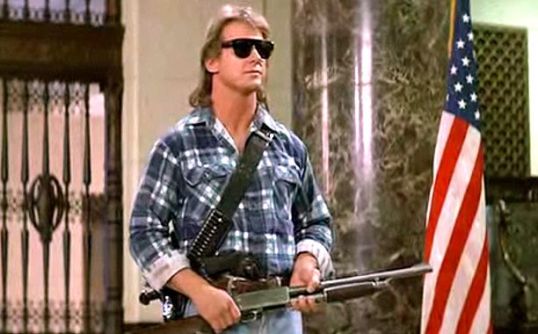
When John Carpenter was casting They Live, he specifically sought someone who was not a film star to play John Nada. The character was meant to be a drifter, an often-homeless man who lived on the fringes of society and did what he had to do to survive. Carpenter viewed John as the epitome of “the forgotten man,” and he knew that casting a big star would sabotage what he was going for. Ultimately, Carpenter cast professional wrestler Roddy Piper as Nada, and history, as they say, was made. Piper showed up on set with a notebook full of one-liners he had jotted down but hadn’t gotten a chance to use while wrestling. The famous line was not in the script. Piper came up with it on his own and spontaneously used it in the bank scene. Carpenter kept it in the film.
The line worked because of its combination of unhinged humor and genuine bravado. It was a line that would have worked before a wrestling match but, even more importantly, a line that perfectly captured John Nada’s worldview after he put on the dark glasses and saw the reality of the world around him. The line was pure John Nada.
John Nada. John Nothing. It was the perfect name for a man with no home, no family, and, until he meets Keith David’s Frank Armitage, no real friends. He’s the 1980s version of Clint Eastwood’s Man with No Name. John has nothing, and once he puts on those glasses, that becomes his greatest strength. John has nothing to lose, and therefore the aliens who have convinced everyone else to “Obey” have nothing to offer him. Because society has given him nothing, he’s far less susceptible to being manipulated. He’s too angry to be controlled, and once he sees the truth, he becomes determined to share it with everyone. When he and Frank fight in the alley, it’s not just a fight scene. It’s John committing to opening his friend’s eyes, no matter how much pain it may cause. John, who lives on the fringes, who has no home, and who would probably get the police called on him if he ever showed up in the suburbs, sacrifices his life for humanity. He still manages to give the finger to the aliens before he goes, and somehow that feels like the character’s greatest triumph. He remains defiant to the end. No one brainwashes John Nada.
They Live works because of John Nada, and John Nada works as a character because he’s vulnerable throughout. If he were played by a traditional star, we would have no doubt about his ability to defeat the aliens. But with Piper in the role, we’re not quite sure. John Nada doesn’t set out to be a hero, but by the end of They Live, he definitely is one.
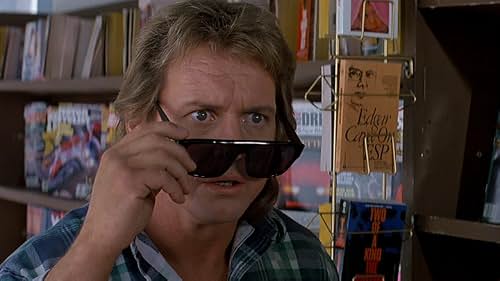
When it comes to John Carpenter’s 1988 masterpiece, They Live, everyone remembers the moment that a drifter named Nada (Roddy Piper) first puts on the dark glasses.
They remember him putting them on and suddenly seeing that the city of Los Angeles is stark black-and-white. They remember the mix of humans and skeletal-looking aliens that surrounded Nada and they remember how the aliens were the ones who went out of their way to be rude. What they especially remember are the billboards and the magazine covers reduced to simple orders like “OBEY,” “CONFORM/STAY ASLEEP,” “CONSUME,” “DO NOT QUESTION AUTHORITY,” and “NO INDEPENDENT THOUGHT.”
What is often forgotten is that it takes a while for the film to get to that point. Carpenter starts the film with a rather lengthy first act, in which Nada arrives in Los Angeles, tries to find work, tries to stay fed, and ends up camping out at a shanty town. Nada is one of America’s forgotten people, a drifter with no real home, no past, and it would appear no future. Nada hears a blind street preacher (Raymond St. Jacques) talking about how the rich and the powerful have been recruited to control humanity and he agrees, even before he puts on the glasses. It’s not until the shanty town has been destroyed in a police raid and Nada has put on the glasses that he sees just who exactly has been doing the recruiting.
After he puts on the glasses and sees the way the world really looks (it’s even suggested that what we perceive as color is something artificial that the aliens are using to distract us), Nada hardly ever takes them off. Some of that is for self-preservation. Wearing the glasses allows him to see who is an alien and who is not. But even more importantly, it’s a sign that having now seen the truth, Nada cannot return to the lie. Instead, Nada tries to win his freedom and expose the aliens. It’s not easy. It takes a lengthy and deservedly famous fight in an alley for him to convince his friend Frank (Keith David) to wear the glasses as well. Once Frank does put them on, he automatically understands what is happening. Wearing the glasses doesn’t leave one confused. Instead, wearing them makes everything suddenly make sense.
If this is not a traditional film review, that’s because They Live is one of those films that everyone seems to already know. Even those who have not watched the entire film know what happens when Nada puts on the glasses. For a film that was not a box office hit and which was initially dismissed by many critics, They Live has become very much a part of our shared culture. Today, everyone knows the messages that are being sent through media. Unlike Nada, most people don’t try to rebel. They don’t announce that they’re all out of gum. We’ve become used to it all.
They Live is often described as being an anti-capitalist film, though John Carpenter has said that it’s not. Carpenter has also been quick to say that it’s not meant to be a Marxist film either, regardless of what the film professors may say. Indeed, the messages of “NO INDEPENDENT THOUGHT” and “CONFORM” are about as Marxist as you can get. (Wearing the glasses can be compared to taking the red pill in The Matrix, except of course leaving The Matrix means becoming a part of Zion, a community whose slogan might as well be “DO NOT QUESTION AUTHORITY.”) They Live is a film that celebrates rebellion against the establishment, regardless of how that establishment might disguise itself. In They Live, the right and the left are different sides of the same manipulative coin. The aliens and their human allies thrive regardless of who might technically be in charge. It’s not really a surprise that my more Libertarian-minded friends tend to view They Live as being a sacred text.
It should be noted that there’s a savage humor running through They Live. It’s present in the first time that Nada puts on the glasses. It’s there in his one-liners. But it’s also present at unexpected moments. I love that this movie gives George “Buck” Flower an actual character to play and, when he shows up during the third act in a suit, I can’t help but smile. The aliens, when they are gathered together, still speak in the language of sales and stockholder meetings. They’re in business and business is good.
They Live is one of those films that feels even more relevant today than when it was first released. Anyone who lived through the COVID era will be able to relate to the media telling them to obey authority and to conform with everyone else. It’s easy to imagine that, if one put on the glasses today, they would see a lot of aliens. The sad truth is that there are no aliens to blame things on. The actions of the past few years were done without any help. Carpenter ended They Live with humanity waking up. Escape from L.A. ended with Kurt Russell shutting down the country. One can only imagine how things would end today.
Aliens are trying to conquer Earth. It’s a pretty good thing that we’ve got a giant, fire-breathing turtle to protect us!
In Japan, this film was released as Gamera vs Viras. In 1969, when it aired on American television, the Japanese actors were dubbed and the title was changed to Destroy All Planets, presumably to try to capitalize on the success of Destroy All Monsters. As any true kaiju fan can tell you, Gamera and Godzilla exist in different cinematic universes but that’s not something that the average American was worried about, especially in 1969! Myself, I love both Gamera and Godzilla. That said, my favorite remains Jet Jaguar. Whatever happened to that robot?
Here, for your viewing pleasure, is today’s Horror on the Lens! Enjoy Destroy All Planets!
Today would have been the 103rd birthday of actor Charlton Heston.
This scene that I love comes from one of the few horror films in which Heston appeared. An adaptation of Richard Matheson’s I Am Legend, 1971’s The Omega Man featured Charlton Heston as Robert Neville. By night, Neville protects his house against the mutant horde. By day, he tracks those sleeping mutants down and watches Woodstock over and over again.
“They don’t make them like that anymore,” Neville says.
This scene gets a lot of attention because of the contrast between the conservative Heston and the hippies in the film. To me, the reason that it works is because Woodstock is a documentary. Neville isn’t watching an actor pretending to be a character in a film. He’s watching an actual human being who went to the Woodstock music festival and who is presumably either now a mutant or dead. Imagine being the hippie interviewed by this scene and seeing yourself in The Omega Man and knowing you didn’t survive the apocalypse. For that matter, we also have to assume that all of the Woodstock performers have been turned into mutants as well. Write a song about that, Country Joe.
(I choose to believe that Arlo Guthrie made it to safety. Sha Na Na, though? Doomed.)
Neville’s right. They don’t make them like this anymore.
4 Or More Shots From 4 Or More Films is just what it says it is, 4 shots from 4 of our favorite films. As opposed to the reviews and recaps that we usually post, 4 Shots From 4 Films lets the visuals do the talking!
Today would have been the 86th birthday of author Anne Rice. It’s time for….
4 Shots From 4 Anne Rice Adaptations
Interview With A Vampire (1994, dir by Neil Jordan, DP: Phillippe Rousselot)
Exit to Eden (1994, dir by Garry Marshall, DP: Theo van de Sande)
Queen of the Damned (2002, dir by Michael Rymer, DP: Ian Baker)
The Young Messiah (2016, dir by Cyrus Nowrasteh, DP: Joel Ransom)