Retro Television Review: Saved By The Bell: The New Class 2.11 “Tommy The Tenor”


Welcome to Retro Television Reviews, a feature where we review some of our favorite and least favorite shows of the past!  On Tuesdays, I will be reviewing Saved By The Bell: The New Class, which ran on NBC from 1993 to 2o00.  The show is currently on Prime.

Oh no!  The Glee Club is in trouble!

Episode 2.11 “Tommy the Tenor”

(Dir by Don Barnhart, originally aired on October 15th, 1994)

During the second season, Saved By The Bell: The New Class aired twice on Saturday morning.  The first episode would feature the Gang at Bayside, dealing with high school stuff.  The second episode would feature the Gang outside of school, working a summer job or visiting relatives in another state.  This often wrecked havoc with the show’s already fragile continuity.  Episodes in which Rachel and Brian were dating while working at the Palisades Country Club would air beside episodes set at Bayside, in which Brian was still pining for Rachel and Rachel, for her part, barely seemed to notice that Brian was even around.

In this Bayside-set episode, Brian joins the Glee Club because he wants to be near Rachel. (Rachel, meanwhile, joins the Glee Club because the teacher is hot.  That’s also why Lindsay and Megan join as well.)  The only problem is that Brian can’t carry a tune.  So, he arranges for Tommy stand outside the classroom and sing through an open window while Brian lip-synchs.  Tommy has a wonderful voice but he’s afraid that his cool, leather jacket-wearing image will be ruined if he joins the Glee Club.  And the teacher apparently is too stupid to notice that Brian can only sing when he’s standing near an open window.

(Speaking of continuity, Lindsay doesn’t realize that Tommy is the one singing for Brian, even though she’s been dating Tommy forever and should presumably know what his voice sounds like.  In this episode, Lindsay and Tommy barely speak.  It’s as if everyone involved forgot that Tommy and Lindsay were supposed to be the school’s power couple.  How lazy were the writers this season?)

Uh-oh, the school board is thinking cutting funding for the Glee Club!  Mr. Belding invites the school board’s Mr. McKenzie (Eddie Allen) to hear the Glee Club perform but, unfortunately, Rachel, Megan, and Lindsay are too busy fighting over the teacher to sing (and that all get hiccups due to — God help me — hiccup spray that Rachel buys to sabotage the other girls) and Tommy isn’t available to provide a voice for Brian.  The Glee Club is doomed!

Oh well.  Who needs a Glee Club?

Apparently, Bayside does.  Belding arrange for yet another performance and, this time, Tommy walks out on stage and does his best Tony Bennett impersonation.  Tommy D is willing to risk his cool to save the Glee Club.  What a loser.

The best thing about this episode is that Screech was not present.  Bobby mentions that Screech is in Alaska, visiting his grandmother.  For some reason, this is presented as a laugh line.  I mean, surely, there are grandmothers who live in Alaska, right?  And people do visit them.  It’s not like Screech went to Manitoba to visit her.  Now, that would have been funny!

Otherwise, this was a dumb episode.  The lip-synching was dumb.  The assembly was dumb.  Why was the school board funding the Glee Club?  Why couldn’t the Glee Club just do a fundraiser on their own?  When I was in high school, I stood outside of Richardson Square Mall in short shorts and a crop top and yelled, “Car Wash!” and raised enough money to fund the Drama Club through 2035.  It’s not that difficult!

Seriously, this episode barely even tried.  No wonder Screech went to Alaska.

Late Night Retro Television Review: CHiPs 6.1 “Meet The New Guy”


Welcome to Late Night Retro Television Reviews, a feature where we review some of our favorite and least favorite shows of the past!  On Mondays, I will be reviewing CHiPs, which ran on NBC from 1977 to 1983.  The entire show is currently streaming on Prime!

This week, we start the sixth and final season of CHiPs.

Episode 6.1 “Meet the New Guy”

(Dir by John Astin, originally aired on October 10th, 1982)

The sixth season of CHiPs opens up with some changes.  Bonnie, Bear, and Turner are all gone.  They’ve been replaced by Kathy (Tina Gayle) and Officer Webster (Clarence Gilyard, Jr.)  Grossman (Paul Linke) is still providing comedic relief.  Harlan (Lou Wagner) is still running the garage.  Getraer (Robert Pine) is still the sarge.  And Ponch (Erik Estrada) is still riding his motorcycle and flashing his grin.

However, this episode finds Ponch riding solo.  Officer Baker is no longer his partner.  This was because Larry Wilcox declined to return for another season, specifically because he felt that the producers only cared about keeping Estrada happy.  On the show, it’s mentioned that Baker has relocated to Wyoming and he is now working on his father’s ranch.  Ponch, however, is not without a partner for long.  At the start of the episode, he meets Baker’s replacement.  Bobby Nelson (Tom Reilly) is blonde and kind of spacey and he’s nicknamed “hot dog” because he likes to take risks.  Ponch has been assigned to work as Nelson’s partner throughout Nelson’s probationary period.  Getraer explains that Nelson reminds him of Ponch.

And really, that’s the problem.  Ponch is a flamboyant motorcycle cop who smiles a lot and likes to take risks.  Bobby is another flamboyant motorcycle cop who smiles a lot and likes to take risks.  There’s not much difference between them.  Even though Larry Wilcox and Erik Estrada didn’t get along behind the scenes, Baker and Ponch worked as a team because Baker was the opposite of Ponch.  Baker was serious and by-the-book and he didn’t take unnecessary risks.  Bobby, on the other hand, is pretty much just a blonde version of Ponch.

There is another problem as far as Bobby Nelson is concerned.  Judging from this episode, Tom Reilly doesn’t appear to have been much of an actor.  Larry Wilcox may not have had the most expansive emotional range but he was totally believable as a cop.  Reilly, meanwhile, spends the entire episode looking somewhat spaced out.  He delivers his lines in a flat monotone.  From the start, there’s very little chemistry between him and Estrada.  When Ponch complains about getting a new partner, one gets the feeling that he was expressing Estrada’s own feelings.

That said, this episode isn’t all bad.  It opens with one of the most spectacular crashes in the show’s history.  The tragic Dominique Dunne gives a strong performance as a teenage mother who sells her baby to a couple but then decides that she wants him back.  This episode even manages to work quicksand into its finale.  How can you not appreciate a show that makes use of quicksand?

Finally, this episode has one extended sequence that is so ludicrous that you just can’t help but smile while watching it.  Two thieves have been robbing health clubs.  They just happen to rob the one where Ponch is a member.  (Fitness guru Richard Simmons plays Ponch’s teacher.)  Ponch, clad only in a pair of black shorts and a motorcycle helmet, jumps on his motorcycle and chases after the robbers.  The site of a half-naked Erik Estrada riding his motorcycle down the streets of Los Angeles is the perfect combination of silly and stupid.

This episode had its moments but I’m not really sold on Tom Reilly as a replacement for Larry Wilcox.  We’ll see what happens!

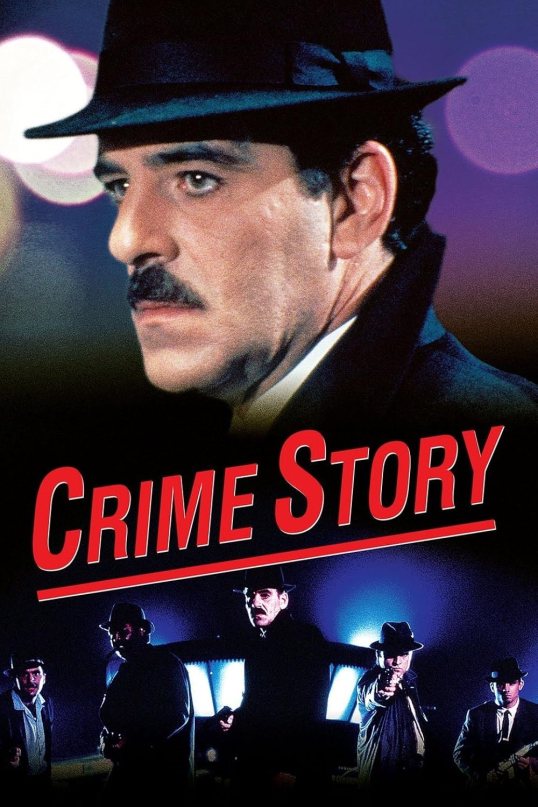
Retro Television Review: Crime Story 1.12 “Hide and Go Thief”


Welcome to Retro Television Reviews, a feature where we review some of our favorite and least favorite shows of the past!  On Mondays, I will be reviewing Crime Story, which ran on NBC from 1986 to 1988.  The entire show can be found on Tubi!

This week, Torello finally tracks down Homan.

Episode 1.12 “Hide and Go Thief”

(Dir by Francis Delia, originally aired on December 12th, 1986)

In Chicago, an unnamed gunman (Paul Guilfoyle) has taken a woman (Lorraine Bracco) hostage and has barricaded himself in a hotel room.  He wants to get on television and he figures that holding a hostage and firing a machine gun out the window is the best way to do it.  The members of the Major Crimes Unit are in the street, ducking behind squad cars whenever the gunman starts firing on them.

It’s definitely a major situation but Torello is more interested in going to Gary, Indiana than exchanging gunfire in Chicago.  Frank Homan (Ted Levine), a former member of Luca’s crew, has been discovered  working as a cook in a Gary diner.  Everyone in Gary knows Frank as “Mike Torello.”  The real Torello is determined to arrest Frank and hopefully use him to take down Luca.  Torello abandons the hostage situation, drives down to Gary, and captures Homan at work.

Finally, some good news for the real Mike Torello, right?  Well, not quite.  After Homan is arrested, U.S. Attorney Harry Brietel (Ray Sharkey) takes custody of him.  Brietel has political ambitions and taking down gangster Manny Weisbord would be a good way for him to make a name for himself.  When Homan is interrogated by Brietel, Homan lies.  He says that he’s never heard of Manny Weisbord.  But, Homan says, he has information that will take down Luca, Phil Bartoli, and a crooked cop.  In exchange for a light sentence and entry into the witness protection program, Homan is willing to testify that Mike Torello is on the take.  Brietel is intrigued.  Fighting police corruption is guaranteed to generate even better press than taking down an actual mobster.

Meanwhile, back in Chicago, Torello rejoins the MCU at the hostage situation.  (Apparently, the gunman has been awake and firing out of his hotel window for two and a half days straight.  One gets the feeling that perhaps it’s wise not to give too much thought to the logistics of this episode’s timeline.)  In a well-shot, slow-motion scene, Torello and his men storm the hotel room and shoot the gunman dead.  The hostage survives.

Significantly, neither the gunman nor the hostage are given names in this episode.  Indeed, Paul Guilfoyle is credited as playing “Deranged Gunman.”  That’s because the gunman and the hostage are really only there to show just how obsessed Torello has become with Luca.  When it comes to destroying Luca and his fledgling criminal empire, all else can wait, even saving an innocent woman from an armed lunatic.

I usually don’t enjoy watching anything that involves a hostage situation because it always seems to lead to the same predictable narrative beats.  Fortunately, this episode avoided most of the usual cliches by making the gunman a total nutcase who never stopped firing his weapon.  The scene where Torello and his men storm the hotel room was stylish enough to verge on being surreal.  As for the Homan plotline, both Ted Levine and Ray Sharkey provided strong performances and I’m looking forward to seeing how Luca and Torello react to being betrayed by the same guy.

All in all, this was a good episode.

Retro Television Review: Homicide: Life On The Street 5.18 “Double Blind”


Welcome to Retro Television Reviews, a feature where we review some of our favorite and least favorite shows of the past!  On Sundays, I will be reviewing Homicide: Life On The Street, which aired from 1993 to 1999, on NBC!  It  can be viewed on Peacock.

This week, Bayliss and Pembleton are partners again and again, they find themselves on two different sides of the same case.

Episode 5.18 “Double Blind”

(Dir by Uli Edel, originally aired on April 11th, 1997)

Where do I put my hate? Tim Bayliss asks his Uncle George (Robert Bornarth) at the end of this week’s episode.

Uncle George is the man who abused Bayliss when he was younger.  The final few minutes of this episode features Bayliss tracking down George to the decrepit house that George calls home.  Stepping aside, Bayliss sees that George is now an old man with a persistent cough.  The messy house is full of empty liquor bottles.  George is a pathetic, frightened old man and it’s obvious that he doesn’t have much longer to live.

Bayliss has just finished investigating the case of a chef who was found shot to death in his home.  It quickly became obvious that the chef was abusive and that he was shot and killed by his teenage daughter (Monica Keena).  Pembleton sees it as justifiable homicide but Bayliss says that it doesn’t matter that the victim was a terrible person.  The fact that he was shot three times (twice after he was already on the ground) proves that it was a deliberate execution.  For once, Bayliss is the one saying that the law is the law while Pembleton is the one worried about the human cost of their investigation.  It’s such a reversal in their usual pattern that Pembleton has to laugh.  And yet, it works.  Having found his previously lost faith, Pembleton now believes that there is more to existence than the letter of the law.  Pembleton also realizes that Bayliss wants to call it a murder because, deep down, he wishes he had done the same thing to his uncle.  The victim’s daughter did what Bayliss could never bring himself to do.

It’s an interesting storyline, featuring great work from Andre Braugher and especially Kyle Secor.  Unfortunately, this episode had a few other plotlines that weren’t quite as interesting.  Kellerman and Cox continued their tentative, emotionally-damaged romance, with Kellerman finally confessing that he was suicidal when Cox last visited him on his boat.  Meanwhile, Lewis supported former patrolman Chris Thormann (Lee Tergesen) when the man who blinded him came up for parole.  The Lewis storyline was a sequel to a first season episode and I appreciated that the show made an effort to maintain continuity.  That said, it just wasn’t that interesting of a story.

Still, that final scene with Bayliss and his uncle was undeniably powerful.  Seriously, what is Bayliss going to do with all of his hate?  There are no easy answers.

Late Night Retro Television Review: Saved By The Bell 2.11 “1-800-Crushed”


Welcome to Late Night Retro Television Reviews, a feature where we review some of our favorite and least favorite shows of the past!  On Saturdays, I will be reviewing Saved By The Bell, which ran on NBC from 1989 to 1993.  The entire show is currently streaming on Tubi!

This week, Zack becomes Nitro!

Episode 2.11 “1-800 Crushed”

(Dir by Don Barnhart, originally aired on November 17th, 1990)

“Hello, mate.  It’s me, Nitro!”

Uhmm …. hi, Nitro.  Why do you sound like Zack Morris?

Because Zack is Nitro!

In this episode, Zack decides that the best way to become a millionaire would be to wait for his parents to die so he can inherit their money…. no, actually, he decides to start a teen advice line and charge everyone $2.00 per call.  He recruits Lisa to provide advice and Screech to …. hang out.  I don’t know what Screech is doing there, to be honest.

Lisa takes most of the calls but, whenever she gets wrapped up (“Not now, Zack, I’m talking to a girl who hates shopping!”), Zack mans the lines.  Because he doesn’t want anyone to know that he came up with the stupid idea of starting the Teenline, he calls himself Nitro and speaks with what I guess is meant to be an Australian accent.

Unfortunately, Lisa solves everyone’s problems and the phones strop ringing.  Zack fires her and then he and Screech proceed to give everyone bad advice.  Soon, the entire school is on edge.  Even worse, Zack tells Kelly’s never-before seen little sister Nikki (Laura Mooney-Hubbert) that she should do whatever it takes to win the man of her dreams.

“Mrs. Zack Morris,” Nikki dreamingly responds.

Later, when both Kelly and Nikki call the Teenline at the same time, Zack gets confused as to who is on which line and he tells Kelly to dump her boyfriend and he tells Nikki that she’s the only girl for him.

Bayside is in chaos and only Mr. Belding can fix things.  After an art class descends into chaos, Belding tells Zack, “My school will be a happy school or else.”  Bye bye, Teenline!

But what about Nikki?  Zack dresses up like a nerd and meets her at the Max.  He says that he likes insects.  Nikki likes them too!  Finally, Zack confesses that he likes Kelly.  Nikki tells Zack that he’s a loser for not being honest to begin with and she has a point.  Kelly, wearing a blonde wig, overhears the whole conversation and takes Zack back.  Nothing’s more romantic than dating a pathological liar, I guess.

This episode …. actually, I like this episode.  It’s a good example of what Saved By The Bell occasionally got right.  It’s a silly story that focuses on the chemistry between Zack & Kelly and Slater & Jessie and it does so without getting too preachy.  This episode is lightweight and cheerfully shallow and exactly what you want from Saved By The Bell.

Lisa Marie’s Week In Television: 7/19/26 — 7/25/26


Big Brother (24/7, CBS, Paramount+, Pluto TV)

I’ve been sharing my thoughts on Big Brother here.

Homicide: Life On The Street (Peacock TV)

My review will drop tomorrow.

The Larry Sanders Show (HBOMax)

Rip Torn could make any line funny.

Saved By The Bell (Tubi)

My review will drop in an hour.

Survivor (CBS, Wednesday Night)

CBS is reshowing Survivor 50 this season.  I missed it when it originally aired but I’m having trouble getting into the reruns.  The 90-minute runtime is a problem for me.  Survivor is the perfect 60-minute show.  At 90 minutes, there’s way too much filler.

TMZ Investigates: The Reiner Murders (Tubi)

TMZ takes a shallow look at the murders Rob and Michele Reiner.  This special offered up no new insights but it did serve as a reminder of what a loser Nick Reiner was (and is).

Watched and Reviews:

  1. 1st & Ten,
  2. Baywatch,
  3. CHiPs,
  4. Crime Story,
  5. Decoy,
  6. Freddy’s Nightmares,
  7. Hunter,
  8. The Love Boat,
  9. Pacific Blue,
  10. Saved By The Bell: The New Class,
  11. St. Elsewhere

Retro Television Review: Baywatch 2.12 “Reunion”


Welcome to Retro Television Reviews, a feature where we review some of our favorite and least favorite shows of the past!  On Saturdays, I will be reviewing Baywatch, which ran on NBC and then in syndication from 1989 to 2001.  The entire show can be viewed on Tubi.

This week, Mitch goes to his high school reunion!

Episode 2.12 “Reunion”

(Dir by Gus Trikonis, originally aired on January 27th, 1992)

Mitch gets laid.

That’s pretty much the plot of this incredibly simple episode.

It’s time for Mitch’s 20-year high school reunion but he doesn’t want to go because he’s worried about seeing his ex-wife, Gayle (Wendie Malick).  However, at the last moment, Mitch suddenly does decide to go.  He meets up with Gayle, who is wearing a blue dress that is simply to die for.  With Gayle’s help, Mitch also rescues the class bully (Tim Rossovich) after two former high school outcasts (Tom Villard and Glenn Morshower) bury him in the sand just as the tide starts to come in.  And then Mitch and Gayle go back to the Buchanan house and do it like it’s prom night.

Fortunately, Hobie is gone for the weekend.  (It’s kind of funny how Hobie is always off with relatives or friends whenever Mitch needs the house to himself.)  I will say that, as a child of divorce, there’s nothing more painful than thinking your parents are going to get back together just because one of them was still in the house when you woke up in the morning.  Hobie is spared the trauma of Mitch and Gaye’s post-reunion hook-up.

Mitch, however, is disappointed to learn that Gayle has a boyfriend and that she’s going to be marrying him.  The only reason Gayle went to the reunion was to work out her feelings about Mitch.  Hasselhoff handles the revelation with his trademark emotional earnestness.  Left unmentioned is the fact that having sex with Mitch apparently convinced Gayle that she should marry the other guy.

Finally, someone left a baby in Eddie’s lifeguard station.  Eddie and Shauni looked after it for the weekend.  This led to a lot of, “Wow, sometimes babies smell bad,” humor.  In the end, the baby’s father shows up to get the baby but it turns out that he doesn’t actually have custody and that his ex-wife left the baby at the lifeguard station specifically to keep her safe from him.  Obviously, this couple has issues that will not be resolved by a high school reunion hook-up.

Even by the standards of Baywatch, this was a remarkably empty episode.  Between Mitch quickly getting over the fact that Gayle is getting remarried and Eddie and Shauni taking care of a random baby, it was hard to escape the feeling that nothing really matters on this show.  There are no real consequences to anyone’s actions.  No one has any sort of emotional conflict that can’t be solved with a musical montage.  Eddie and Shauni end the episode thinking about what it would like to be parents.  They’ll be over it in a week.

Baywatch was a show where nothing really mattered and that’s probably why it was so popular.


Late Night Retro Television Review: Freddy’s Nightmares 2.20 “Dust to Dust”


Welcome to Late Night Retro Television Reviews, a feature where we review some of our favorite and least favorite shows of the past! On Fridays, I will be reviewing Freddy’s Nightmares, a horror anthology show which ran in syndication from 1988 to 1990. The entire series can be found on Tubi!

The cannibals are back!

Episode 2.20 “Dust to Dust”

(Dir by Bill Froehlich, originally aired on February 25th, 1990)

Tony Dow, Amy Lyndon, and Sandahl Bergman, the three cannibals from Prime Cut, are back!  They are now all living together and are members of Cannibals Anonymous.  For months, they have resisted the urge to taste human flesh.  But, when an escaped prisoner breaks into their home, they give into temptation and have a good meal.

Uh-oh, it turns out that escaped prisoner was actually an astronaut who returned to Earth infected with a space virus that eventually reduces its victims to dust.  And now, the cannibals all have the virus!  The government abducts them and takes them to an underground lab where a group of scientists dispassionately watch as they become hypersexual before going insane and turning into dust.  One scientist (Tim Russ) sympathizes with the cannibals and soon, the entire lab  is infected.

This episode had potential but it ultimately failed because it couldn’t decide whether it wanted to be funny or scary.  There’s a lot of terror to found in the idea of being held prisoner until your transformed into blue dust.  At the same time, the symptoms of the space virus were so over-the-top and the actors went so overboard in performing those symptoms that it was hard to really care about any of it.  Having the victims quote a movie before turning into dust probably seemed like a good idea but it doesn’t work in execution.  The whole thing ultimately felt like a community theater production of The Andromeda Syndrome.

Not even Freddy appeared to be that interested in this episode.

Only two more episodes to go!

Retro Television Review: St. Elsewhere 4.3 “Haunted”


Welcome to Retro Television Reviews, a feature where we review some of our favorite and least favorite shows of the past! On Fridays, I will be reviewing St. Elsewhere, a medical show which ran on NBC from 1982 to 1988.  The show can be found on Daily Motion.

I apologize for the delay in posting this review.  I was feeling under the weather last week.  This week, I feel well enough to share this review of one of the most emotional hours of television that I’ve ever watched.

Episode 4.3 “Haunted”

(Dir by Mark Tinker, originally aired on October 23rd, 1985)

This episode begins where the previous one ended.  After crashing his car, Stephen Craig and his wife, Yvonne, are rushed to the Emergency Room.  Despite the best efforts of Drs. Chandler and Axelrod, Stephen dies in the ER.  Yvonne goes into labor, eventually giving birth to Dr. Craig’s granddaughter.  Dr. Mark Craig and Ellen show up shortly after Stephen has been pronounced dead.  While Ellen immediately slips into denial (“That’s not Stephen!”), Dr. Craig calmly tells Chandler that he knows Chandler did everything that he could.

Throughout the episode, Ellen struggles with her grief while Mark holds back his emotions.  He suspects that Stephen was once again using drugs and he even goes to the autopsy to see for himself.  While Stephen’s organs are being weighed, Dr. Craig starts to talk about how he was never close to his son but how, when Stephen was young, they used to read Dr. Seuss together.  “Thank you Sam I Am,” Dr. Craig recites under his breath, right before hearing that Stephen had used cocaine shortly before dying.

For Dr. Craig, Stephen’s renewed drug use is an excuse to refuse to mourn for him.  For Ellen, Stephen’s drug use is proof that his father was too critical and pushed him too hard.  Ellen tells Mark that he never cared about Stephen except for when Stephen said he wanted to be a doctor.  As the episode ends, Dr. Craig sits in his office and thinks about the words of Dr. Seuss and finally, he starts to cry.

I cried too.  I cried a lot while watching this episode.  This was the most emotional episode of St. Elsewhere that I’ve watched so far.  Both William Daniels and Bonnie Bartlett were heartbreaking as a couple who each dealt with their grief in their own way.  It was hard to watch Ellen fall apart in the Emergency Room but it was even harder to watch Dr. Craig fall apart as he realized that his wife was right.  When Stephen was young, the only time they were close was when they read that Dr. Seuss book.  And now, that memory is all Dr. Craig has left.

There were other things that happened in this episode, of course.  One thing about St. Elsewhere is that there are always several stories going on at once.  Elliot worried about his weight, even after discovering that his girlfriend liked the fact that he wasn’t thin.  Dr. Caldwell spent the weekend at a recently purchased house in Cape Cod and Fiscus showed up unannounced.  Dr. Morrison encouraged the other male residents to donate sperm.  Dr. Westphall continued to try to push through his efforts to make St. Eligius a community-centered hospital.  But none of the other stories could match the power of Mark and Ellen Craig losing their son.  In fact, I found myself resenting being taken away from the Craigs.  “Who cares about Cape Cod!?” I said, “The Craigs have lost their son!”

This was not an easy episode to watch but, in the end, it was powerful, it was touching, and it made me cry.


Villain of the Day: Kai Proctor (Banshee)


“At some point, in the very near future, you’ll be made to understand how badly you misjudged me today. And when that time comes and you’re begging me for mercy, I want you to remember this moment because this is the moment you’ve sealed your fate.” — Kai Proctor

Banshee’s Kai Proctor, played with quiet menace by Ulrich Thomsen, distinguishes himself from the familiar lineup of television crime bosses precisely because his authority is defined by contradiction. On the surface, he fits the archetype: a man who controls Banshee’s underworld through legitimate fronts, compromised law enforcement, and an unflinching readiness for brutality. Yet what makes Proctor compelling isn’t the structure of his empire—it’s the tension beneath it, the sense that every assertion of control doubles as a form of self-justification for a man who has never truly stopped answering to the community he claims to have left behind.

That tension is rooted in his Amish upbringing. Proctor’s departure from that world was not a clean break but something closer to an amputation. He retains its language, discipline, and moral rigidity even as he has constructed a life in direct opposition to its teachings. He speaks Pennsylvania Dutch, invokes scripture, and adheres to a personal code of order and restraint that feels almost monastic against the backdrop of his violence.

At the same time, that code should not be mistaken for conventional morality. Proctor is, first and foremost, a brutal crime lord. He traffics in narcotics, prostitution, and murder—violence he is fully willing to carry out with his own hands—and sustains his power through a network of entrenched criminal enterprises. His discipline does not temper his cruelty; it organizes it.

This contradiction becomes even more pronounced in the alliances he chooses to make. The same man who carries remnants of Amish restraint will readily conduct business with Colombian drug cartels or neo-Nazi gangs if it strengthens his control over Banshee and the surrounding counties. His worldview is not governed by external ethics but by an internal logic that allows him to reconcile seemingly irreconcilable acts in service of power and order.

What further complicates Proctor is the way that same internal logic extends beyond self-interest. Time and again, he protects the Amish community that excommunicated him, intervening against outside threats on behalf of people who refuse even to acknowledge him. He does this without expectation of gratitude or reconciliation, suggesting that what drives these actions is not redemption but something more instinctive—an inherited sense of duty he cannot discard. In effect, he continues to guard a flock that has already cast him out.

By the series’ end, Proctor remains a man without a true home—too violent for the Amish world, yet too disciplined and burdened by it to fully belong to the criminal one. His arc does not resolve these contradictions so much as deepen them, and that unresolved tension is precisely what makes him endure. He is not simply a crime boss or a villain, but a figure defined by the uneasy coexistence of brutality and belief, control and longing—someone whose humanity, however obscured, keeps him from ever becoming reducible to a monster.

Villain of the Day