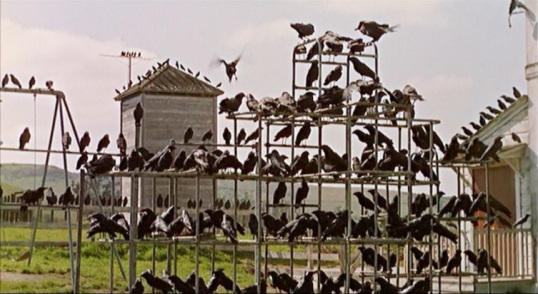
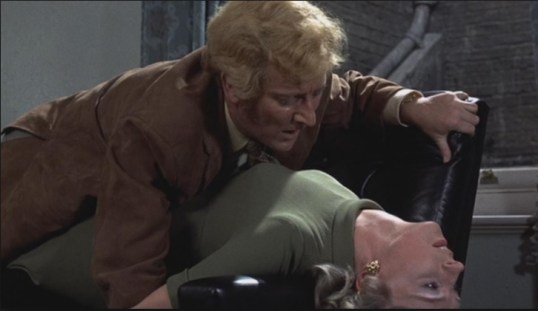
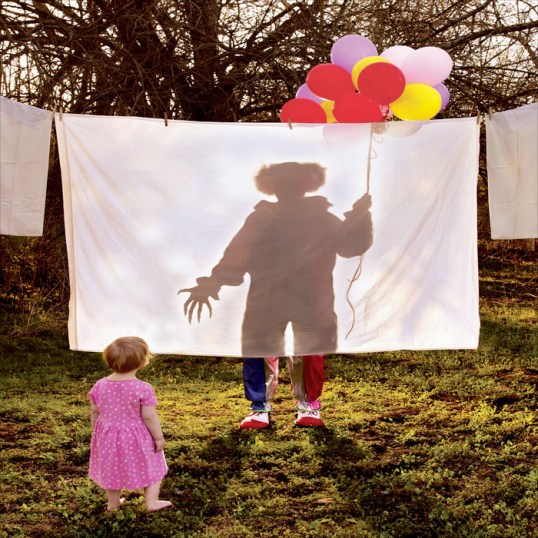
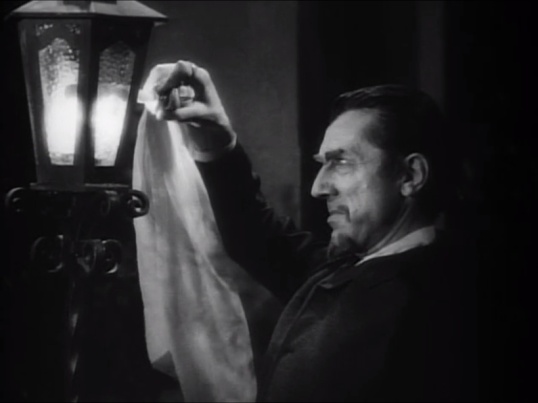
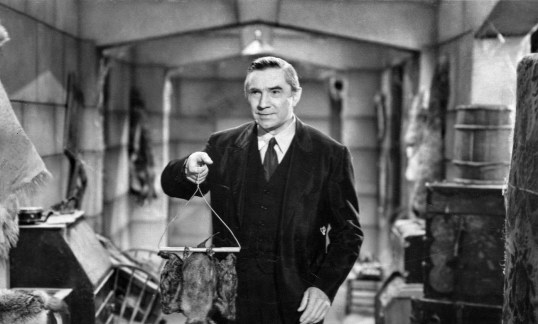
4 Shots From 4 Films is just what it says it is, 4 shots from 4 of our favorite films. As opposed to the reviews and recaps we usually post, 4Shots From 4 Films is all about letting the visuals do the talking. Today is the 135th anniversary of the birth of one of horror’s most iconic stars, the great Bela Lugosi! In his honor, here’s a special Halloween tribute to everyone’s favorite Hungarian actor!
4 Shots From 4 Films is just what it says it is, 4 shots from 4 of our favorite films. As opposed to the reviews and recaps that we usually post, 4 Shots From 4 Films is all about letting the visuals do the talking.
This October, I am going to be using our 4 Shots From 4 Films feature to pay tribute to some of my favorite horror directors, in alphabetical order! That’s right, we’re going from Argento to Zombie in one month!
For tonight’s televised horror, here’s another episode the Boris Karoloff-hosted anthology series, Thriller!
This episode, Well of Doom, shows what happens when two demons kidnap two men on their way to a bachelor party and force them to slog across the moors, to a mysterious castle. This episode is full of atmosphere and it also features great work from Henry Daniell and Richard Kiel as the two demons.
Michael Bower (Edward Furlong) is a 15 year-old loser who walks with a limp and still has nightmares about the night his mother was killed in a car wreck. Brainscan is the new PC game that Michael makes the mistake of playing. In the game, Michael is encouraged by The Trickster (T. Ryder Smith) to kill both his friends and complete strangers. When Michael starts finding body parts around his house, he realizes that whenever he kills someone in the game, he kills them in real life too.
Though it may be forgotten now, Brainscan was heavily promoted when it was first released. I think the producers were hoping to turn The Trickster into the new Freddy and get a new horror franchise out of it. Like most films from the 90s that dealt with computers and gamers, Brainscan is now as dated as dial-up internet. T. Ryder Smith does ok as the Trickster but it is difficult to take him seriously because he has a big red mohawk skullet and he dresses like the keyboard player in every new wave band that has ever synthesized. As for Furlong, he had apparently already entered the I-no-longer-give-a-shit phase of his career when he made Brainscan. Add to that one of the worst endings that I have ever seen in a horror movie and Brainscan is one film that is easy to forget.
It is easy to say what Brainscan is lacking: suspense, gore, and horror. It is less easy to say what would have made it better. Considering its suburban setting, I think Brainscan would have been improved by cameos from the stars of Shattered If Your Kid’s On Drugs.
With Burt Reynolds and Judd Nelson around to serve as mentors, Eddie Furlong never would have gotten addicted to playing video games in the first place.
4 Shots From 4 Films is just what it says it is, 4 shots from 4 of our favorite films. As opposed to the reviews and recaps that we usually post, 4 Shots From 4 Films is all about letting the visuals do the talking.
This October, I am going to be using our 4 Shots From 4 Films feature to pay tribute to some of my favorite horror directors, in alphabetical order! That’s right, we’re going from Argento to Zombie in one month!
Today’s director: the master of suspense, Alfred Hitchcock!
For today’s horror on the lens, we have 1973’s The Night Strangler.
This is the sequel to The Night Stalker and it features journalist Carl Kolchak (Darren McGavin) in Seattle. (After all the stuff that happened during the previous movie, Kolchak was kicked out of Las Vegas.) When Kolchak investigates yet another series of murders, he discovers that paranormal murders don’t just occur in Las Vegas and aren’t just committed by vampires.
I actually prefer this movie to The Night Stalker. The Night Strangler features a truly creepy villain, as well as a trip down to an “underground city.” It’s full of ominous atmosphere and, as always, Darren McGavin is a lot of fun to watch in the role in Kolchak.
What’s an Insomnia File? You know how some times you just can’t get any sleep and, at about three in the morning, you’ll find yourself watching whatever you can find on cable? This feature is all about those insomnia-inspired discoveries!
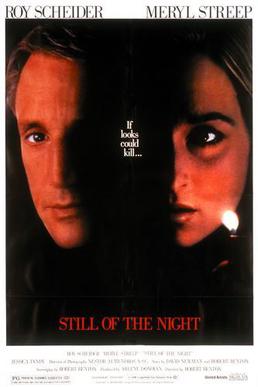
If last night, at 1:30 in the morning, you were having trouble getting to sleep, you could have turned on the TV, changed the channel to your local This TV station, and watched 1982’s Still Of The Night.
Still of the Night actually tells two stories. The first story deals with Dr. Sam Rice (Roy Scheider), a psychiatrist who is living a perfectly nice, mild-mannered, upper class existence in Manhattan. His patients are rich and powerful and his sessions with them provide him with a view of the secrets of high society.
One of Sam’s main patients is George Bynum (Josef Sommer), who owns an auction house and who is a compulsive cheater. George tells Sam that he’s haunted by strange nightmares and that he is also worried about a friend of his. George says that this friend has murdered in the past and George fears that it’s going to happen again. When George is murdered, Sam wonders if the murder was committed by that friend. He also wonders if that friend could possibly have been one of George’s mistresses, the icy Brooke Reynolds (Meryl Streep).
The second story that Still of the Night tells is about our endless fascination with the films of Alfred Hitchcock. Still of the Night is such an obvious homage to Hitchcock that it actually starts to get a little bit silly at times. Almost every scene in the film feels like it was lifted from a previous Hitchcock film. At one point, there’s even a bird attack! (Add to that, Scheider’s mother is played by Jessica Tandy, who previously played Rod Taylor’s mother in The Birds.) Meryl Streep is specifically costumed and made up to remind viewers of previous Hitchcock heroines, like Grace Kelly, Kim Novak, Eva Marie Saint, and Tippi Hedren.
Unfortunately, considering the talent involved, Still of the Night never really works as well as it should. Both Scheider and Streep seem to be miscast in the lead roles. If Still of the Night had been made in the 50s, one could easily imagine James Stewart and Grace Kelly playing Sam and Brooke and managing to make it all work through screen presence along. However, Scheider and Streep both act up a storm in the lead roles, attacking their parts with the type of Actor Studios-gusto that seems totally out-of-place in an homage to Hitchcock. Scheider is too aggressive an actor to play such a mild character. As for Streep, she’s miscast as a noir-style femme fatale. Streep’s acting technique is always too obviously calculated for her to be believable as an enigma.
That said, there were still some effective moments in Still of the Night. The majority of the dream sequences were surprisingly well-done and effectively visualized. I actually gasped with shock while watching one of the dreams, that’s how much I was drawn into those scenes.
According to Wikipedia, Meryl Streep has described Still of the Night as being her worst film. I think she’s being way too hard on the movie. It’s nothing special but it is an adequate way to kill some time. Certainly, I’d rather watch Still of the Night than sit through Florence Foster Jenkins.





 Michael Bower (Edward Furlong) is a 15 year-old loser who walks with a limp and still has nightmares about the night his mother was killed in a car wreck. Brainscan is the new PC game that Michael makes the mistake of playing. In the game, Michael is encouraged by The Trickster (T. Ryder Smith) to kill both his friends and complete strangers. When Michael starts finding body parts around his house, he realizes that whenever he kills someone in the game, he kills them in real life too.