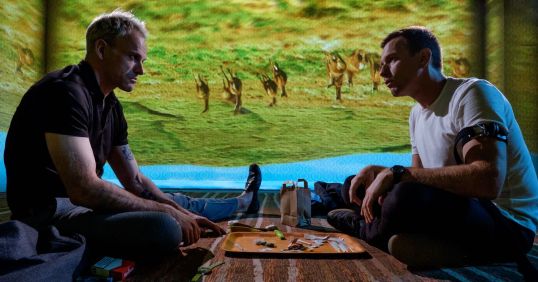
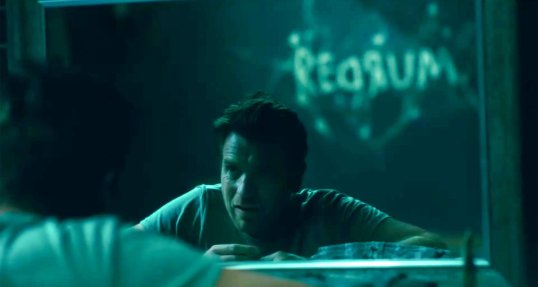
The International Lens: Polytechnique (dir by Denis Villeneuve)


On a snowy day in Montreal, a nameless young man (Maxim Gaudette) wanders about a cramped apartment.  He loads a rifle.  He drives to his mother’s house and leaves a note in her mailbox.  He goes to École Polytechnique, the engineering school where he’s a student.  Leaving the rifle in his car, he walks around the school.  He stares at the students in the cafeteria, observing them with a hatred that they might not notice but which we’ll never forget.  He goes back outside.  He sits in his car while the snow continues to fall.

As we watch him, we hear him reading the suicide note that he’s written  for the authorities.  He talks about his belief that the world has been destroyed by feminists.  He writes that he’s offended that he is expected to compete with women and that women have an unfair advantage in both the academic and the professional world.  He brags about the good grades that he gets, despite the fact that he rarely attends school.  He says that he’s never fit in with the world and that woman are to blame.  He complains about women competing at the Olympics, showing that he views everything through the filter of his own misogyny.  At one point, he apologizes for not being as eloquent as he believes he could be.  He explains that he only had 15 minutes to put down his thoughts.

Inside the school, another engineering student, Jean-Francois (Sébastien Huberdeau ) struggles to complete an assignment before his next class begin.  He sits in the cafeteria with open books scattered across the table in front of him.  Later, we’ll see Jean-Francois running through the hallways of the school, trying to warn the other students that something terrible is happening.  He’ll run to a security officer and ask him to call the police, just to be given a somewhat confused look in response.  Later still, we’ll see Jean-Francois outside of the school, visiting his family and haunted by guilt.

One of Jean-Francois’s classmates, Valerie (Karine Vanasse), goes to a job interview where the older male interviewer states that he’s shocked that Valerie wants to go into engineering after graduation.  Most women, he says, don’t do that.  It’s a profession that requires a lot of hard work and it’s not ideal for someone who wants to start a family.  Stunned, Valerie lies and says that she doesn’t have any desire to start a family.  Throughout the film, we watch as Valerie stop several times at her locker so that she can switch shoes.  When she has to deal with stuff like her job interview, she puts on high heels that are obviously very uncomfortable for her.  When she just wants to go to class, she has to stop and switch to shoes that she can actually walk in and, at that moment, I knew exactly what she was feeling.  Every woman watching will instantly know what she’s going through.  Later, she complains to her friend and roommate, Stephanie (Evelyn Brouchu), about how condescending the interview was.  Stephanie tells her not to obsess on it.

Outside, the snow continues to fall in the night, creating a bleakly cold landscape and making Montreal look like a barren and bombed-out wasteland.

Later, we’ll see Jean-Francois arriving late for a class.  Valerie and Stephanie are already in the class, listening to the lecture.  Not long after Jean-Francois claims his seat, the unnamed man steps into the room, carrying his rifle.  He orders the males to gather on one side of the room and the women on the other….

These are the moments and images that stick with you, long after the 2009 Canadian film, Polytechnique, concludes it’s brief 77-minute run time.  It’s a haunting film, definitely not one to watch if you’re already feeling depressed.  What makes it especially disturbing is that it’s based on a true story.  On December 8, 1989, an Algerian-Canadian student opened fire at École Polytechnique in Montreal.  (The film does not name the killer and I won’t either, because to name him without naming his victims does a disservice to their memory.  Those who really want to know his name are free to look it up on Wikipedia.)  As seen in the film, the gunman specifically targeted women and even ordered all of the males in the classroom to leave before he opened fire.  Also, as seen in the movie, the men did just that, with not a single one trying to stop the gunman or warn others until they were already out of the classroom.  The character of Jean-Francois stands in for all of the men who were haunted by their decision to leave.  As I watched the film, I had mixed feelings about the men who left that classroom.  Yes, the gunman was armed but there were enough men in that classroom that it’s hard to justify the fact that not a single one attempted to intervene.

Before shooting himself in the head, the gunman killed 14 women and wounded 10 women and 4 men.  It remains the deadliest mass shooting in Canada’s history.  When the police found his body, they also found a suicide note in his pocket, the same note that we hear read at the beginning of this film.  In memory of the lives lost, the anniversary of the massacre has been commemorated as the National Day of Remembrance and Action on Violence Against Women.

Poltytechnique, which is dedicated to those who died, was directed by Denis Villeneuve, long before he would come to America and make a name for himself with films like Sicario, Arrival, and Blade Runner 2049.  Polytechnique is filmed in harsh black-and-white and Villeneuve skips around in time, often showing us the consequences of the killer’s actions before showing us the actions themselves.  It’s an approach that reminds us that the Montreal Massacre and all other acts of violence are events that will forever haunt us.  The past will always cast a shadow over both the present and the future.

As I said, it’s not a happy film but perhaps not every film needs to happy.  With Polytechnique, Villeneuve mourns for the lives lost on that day in 1989 and he encourages us all to try to create a better world for the future.
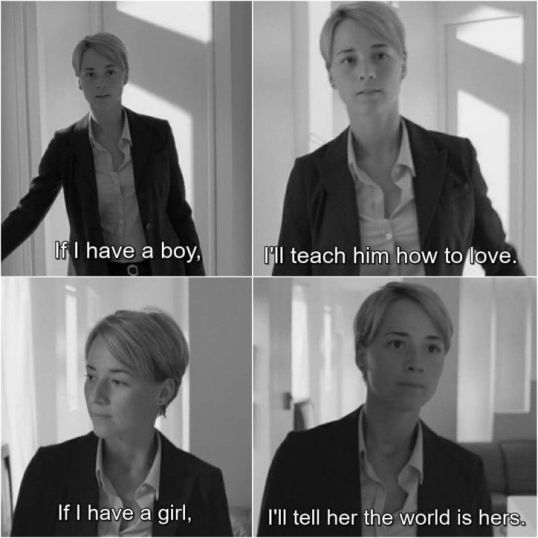
Zombies run amok in the Train to Busan Presents: Peninsula teaser!


Whoa!! It looks like we have a sequel to 2016’s smash hit, Train to Busan! Train to Busan Presents Peninsula takes place four years after the events of the original film. The zombies have taken over the land, and what’s left is more of a post-apocalyptic setting, with armored vehicles and cage matches. Director Yeon Sang-Ho returns for this update.

A Release Date hasn’t been set, though we’re told the film is coming soon. Until then, enjoy.

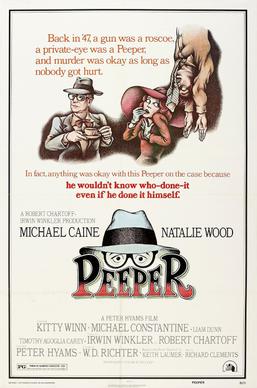
Peeper (1975, directed by Peter Hyams)


Peeper gets off to a good start, with a Humphrey Bogart look alike standing on a dark street corner and reading the opening credits in a reasonable approximation of Bogart’s unmistakable voice.  It all goes down hill from there.

Peeper stars Michael Caine as Leslie C. Tucker, a cockney private detective who is working in Los Angeles in the late 40s.  Tucker is hired by a shady businessman named Anglich (Michael Constantine).  Anglich explains that he knows that he has a daughter but he doesn’t know who or where she is.  He wants Tucker to track her down.  It doesn’t take much time for Tucker to conclude that Anglich’s daughter might be a member of the wealthy and quirky Pendergrast family.  In fact, Tucker thinks that Anglich’s daughter might be Ellen Pendergrast (Natalie Wood, who seems to be bored with the role).  It should be a simple enough case to solve but there are numerous complications along with two thugs (played by Timothy Carey and Don Calfa) who, for some reason, are out to get Anglich and Tucker.

It’s hard to know what to make of Peeper.  It’s meant to be an homage to the detective films of the 40s but it also tries to parody the genre.  Unfortunately, Peter Hyams has never been a director known for his light touch and, in this film, his idea of comedy is to have everyone shout their lines.  (Michael Constantine is the worst offender.)  Michael Caine is also miscast in the lead.  The film tries to get some comedic mileage out of Caine delivering Bogart-style dialogue in his cockney accent but it’s a joke that’s never as funny as the film seems to think.

Peeper was a critical and box office failure but fortunately, there were better things in store for both Michael Caine and Peter Hyams.  Hyams went on to direct Capricorn One while Michael Caine established himself as one of the most durable character actors around.

The International Lens: The Girl With A Bracelet (dir by Stéphane Demoustier)


If there’s anything that I’ve discovered over the years, it’s that cinema is truly a universal language.

I’ve lost track of the number of film fans with whom I’ve bonded with over social media.  Some of them live near me and some of them live very far away but the one thing that we all have in common is that we all love movies.  For instance, I have a friend in India who loves Sofia Coppola almost as much as I do.  Meanwhile, I’ve got friends in the UK who are as crazy about horror movies as I am and my friend Carlo in Italy shares my total disdain for Avatar.  In short, films bring us together.

This month, I want to celebrate that fact here on the Shatered Lens.  Along with my usual reviews, I’ll be taking a look at some films that were produced outside of the United States and far away from the Hollywood studios.  Some of these films will be great and some of them probably won’t.  Some of these films may be well-known and, again, some of them won’t be.  What they all have in common is that they’re out there for discriminating viewers who aren’t scared of having to read a subtitle or two.

I want to start things off by looking at a French film, La fille au bracelet (The Girl With A Bracelet).

This low-key but thought-provoking courtroom drama opens with a family enjoying a day at the beach.  We watch them from a distance and they seem almost like the perfect family unit.  And yet, that perfection puts us ill at ease.  We’ve seen enough movies to know that any family that appears to be perfect is going to be the exact opposite and, even more importantly, director Stéphane Demoustier knows this.  Therefore, we’re not surprised when the police suddenly show up.  We are perhaps a little bit more surprised when the police lead away not the mother or the father but instead, the teenage daughter, Lise (Melissa Guers).

The film jumps forward two years.  Lise has been under house arrest ever since that day at the beach and is required to wear an ankle bracelet, so that the authorities can keep track of her.  Lise has been charged with murdering her best friend, Floria.  While her father (Rosdchy Zem) insists that Lise is innocent and gets involved in her defense, Lise’s mother, Celine (Chiara Mastroianni), has thrown herself into her work and says that she probably won’t even be able to attend her daughter’s trial.

As for Lise, she refuses to show remorse for a crime that she says she didn’t commit and she refuses to apologize for a lifestyle for which she feels no shame.  As the proceedings begin, it becomes apparent that Lise is as much on trial for her perceived coldness and lack of conformity as for anything else.  Much of the evidence against Lise seems weak.  Lise and Flora had a fight shortly before the murder and Lise’s DNA was found on Flora’s body.  Lise claims that she and Flora made up on the same night that Flora was found dead.  While her parents listen, Lise’s sexual history is clinically dissected in the courtroom, suggesting that she is as much on trial for not conforming to society’s expectations as she is for any murder that she may have committed.  Is Lise on trial because of the evidence or because she’s a member of generation that has been vilified by its elders?  Is she on trial because she’s guilty or is she on trial because she’s a young woman who is not reacting the way that society expects women to react?

And yet, even though you want to be on Lise’s side, the film keeps you off-balance.  Is it true that Lise is simply mourning her friend in her own way or is it possible that Lise is actually a remorseless murderer?  At times, it seems like either one of the two could be true.  The film ends on a deliberately ambiguous note, one that may leave some frustrated but which will also leave you thinking.

The Girl With A Bracelet requires some patience.  The film plays out at a deliberate and methodical pace.  However, your patience will be rewarded with a fascinating mystery that will keep you thinking.  The cast is excellent, especially Anais Demoustier as the prosecutor.  (Given the film’s theme of generational conflict, it’s interesting that the prosecutor is closer, in age, to Lise’s generation while Lise’s defense attorney is from her parent’s generation.)  Melissa Guers makes her film debut in the role of Lise and gives an excellent and intriguing performance as an enigmatic character who always seems like she should be more sympathetic than she actually is.

I was fortunate enough to see The Girl With A Bracelet in Paris.  (Two weeks later, and four days after Jeff & I returned home to the U.S., the entire world shut down.   It’s strange to think about it now.)  It’s a film that’s stuck with me and hopefully it’ll make it’s way over to the States sometime soon.


Scenes That I Love: Lon Chaney Gets Unmasked in Phantom of the Opera


I know I’ve probably shared this scene in the past but I’m going to share it again because today is Lon Chaney’s birthday!  137 years ago, today, one of the greatest actors of all time was born in Colorado Springs, Colorado.  He was the man of a thousand faces and he brought a lot of life to silent cinema.

This scene is from the 1925 version of Phantom of the Opera!  That’s Lon as the phantom and Mary Philbin as Christine.  In honor of the anniversary of Lon Chaney’s birth, we invited you to enjoy a scene that I love…..

This scene, incidentally, was originally planned to be shot in color.  Unfortunately, the lights that were (back then) necessary to film in color were too hot and they caused Chaney’s makeup to melt.   So, those plans were scrapped and then scene was shot in black-and-white but, personally, I find the black-and-white to be more effective.  I’ve seen a colorized version of this film and it just wasn’t as effective.


4 Shots From 4 Films: Special Toshiro Mifune Edition


4 Shots From 4 Films is just what it says it is, 4 shots from 4 of our favorite films. As opposed to the reviews and recaps that we usually post, 4 Shots From 4 Films lets the visuals do the talking!

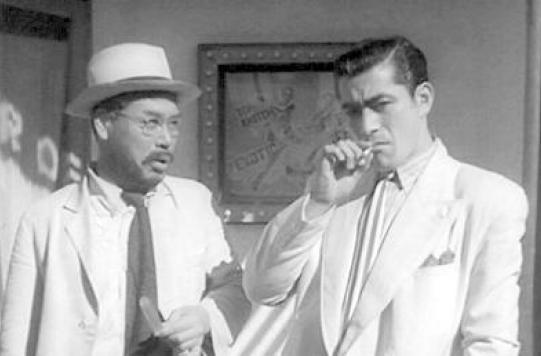
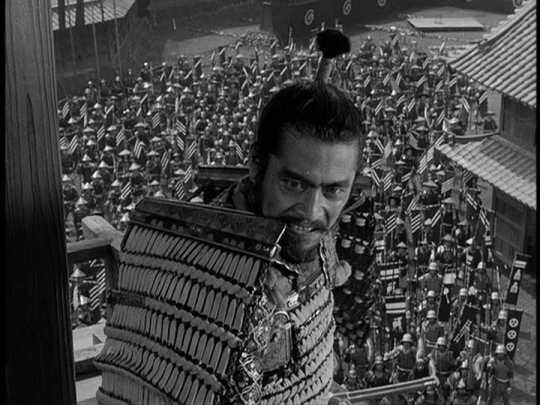
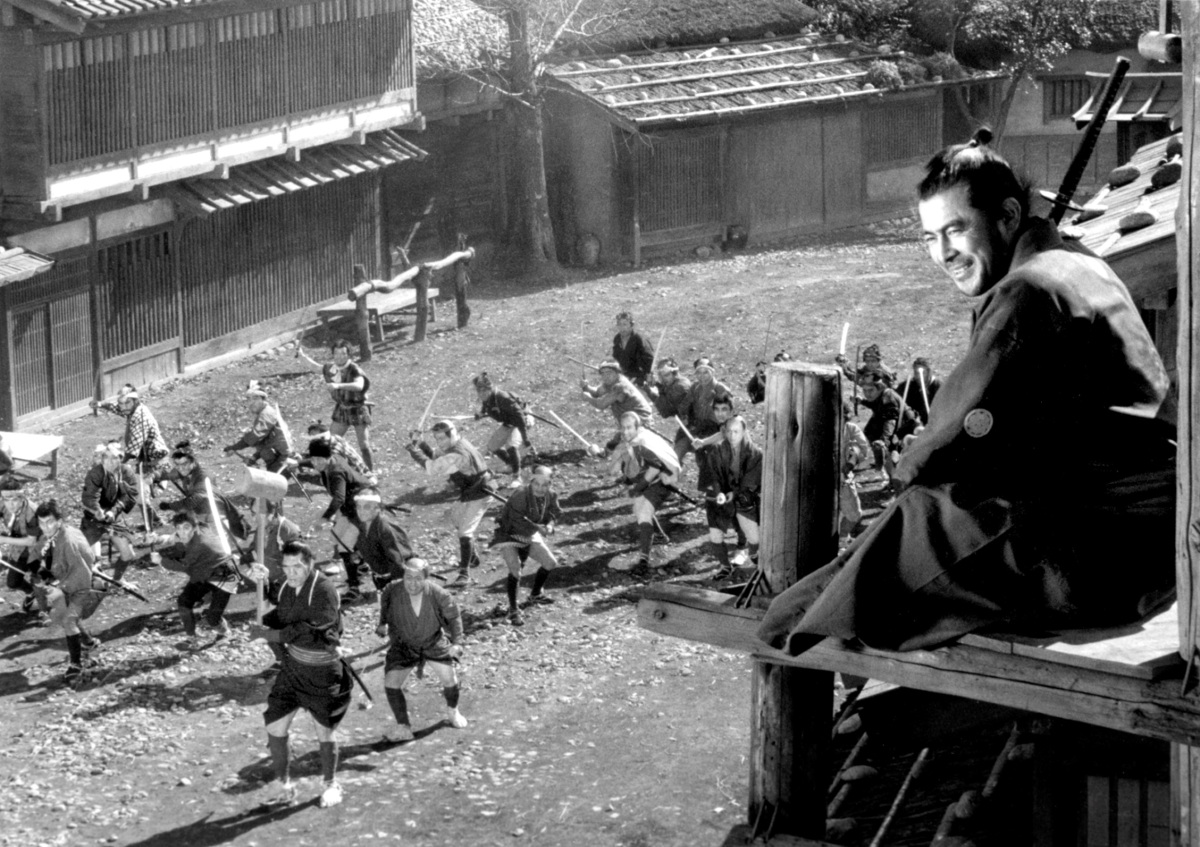
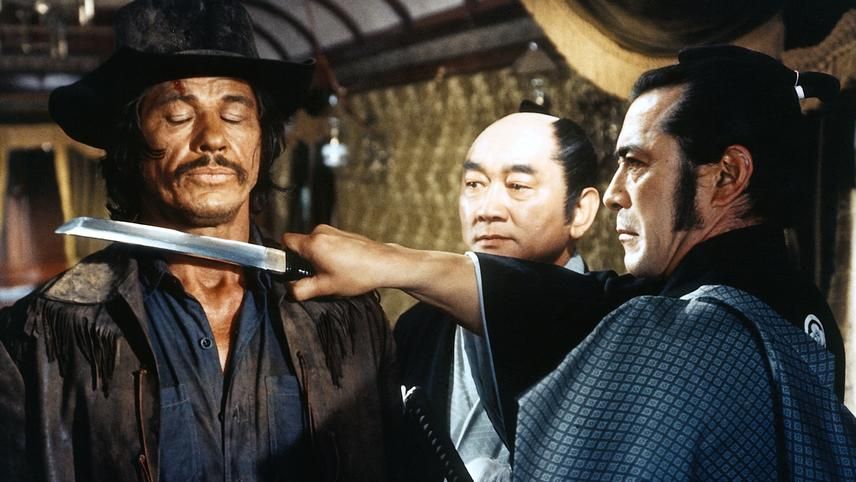
100 years ago today, the great Japanese actor Toshiro Mifune was born in Qingdao, Shandong, China, which was under Japanese occupation at the time.  After working as a photographer and as an assistant cameraman, Mifune made his acting debut in 1947, playing a bank robber in Snow Trail.

Mifune would go on to become an international superstar, appearing in hundreds of films before his death in 1997.  Sixteen of those films would be directed by Akira Kurosawa and Mifune’s performances in Kurosawa’s yakuza and samurai films would go on to inspire actors the world over.  When Sergio Leone adapted Yojimbo into A Fistful of Dollars, Clint Eastwood based his performance on Mifune’s performance in the original.  George Lucas would later create the character of Obi-Wan Kenobi with Mifune in mind.

In honor of the man and his career, here are

4 Shots From 4 Films

Drunken Angel (1948, directed by Akira Kurosawa)

Throne of Blood (1957, directed by Akira Kurosawa)

Yojimbo (1961, directed by Akira Kurosawa)

Red Sun (1971, directed by Terence Young)

Coach of the Year (1980, directed by Don Medford)


Jim Brandon (Robert Conrad) used to be a member of the Chicago Bears, until he was drafted and sent to Vietnam.  While Jim was serving his country, he was wounded in battle and when he returns to the United States, he’s now in a wheelchair.  With his playing days over, Jim still wants to put his athletic abilities to good use.  When the Bears front office tells him that they want to place him in the PR department as a glorified mascot, Jim tells them to forget about it and then starts to search for any opportunity to work as a coach.  Unfortunately, no one is willing to take a chance on a coach who can’t walk across the field.

While he looks for a job, Jim is living with his sister (Erin Gray) and her son, Andy (Ricky Paull Goldin).  When Andy gets caught (not for the first time) breaking the law, he is sent to the local reform school.  It’s while Jim is visiting his nephew that he notices that the students at the Illinois State Training School for Boys like to play football.  Jim suggests that the school needs an official team and that he would be the perfect person to coach them.

At first, the boys are rebellious and refuse to show Jim any respect but Jim slowly wins them over.  When a prep school’s football team visits the reform school and makes some snide remarks, Jim challenges them to a game.  If Jim’s team wins, it will not only prove that Jim can coach but it will also give the members of the team a needed boost of self-respect.  If Jim loses, he’ll get fired and his team will probably try to escape before boarding the bus back to reform school.

Coach of the Year was a TV movie and there’s nothing surprising about it.  It’s a typical example of an “inspiring” sports film, where an underdog team is led to victory by an underdog coach.  The two teams play each other twice in the movie and, just as surely as you’ll be able to guess who wins the first game, you’ll also be able to guess who manages to beat the odds and win the second game.  The film’s main selling point is that Robert Conrad gives a good performance as Jim Brandon.  Conrad is believable as both a coach, a former star athlete, and a man who is not yet prepared to surrender his pride.  Though Jim’s clearly the hero, the movie doesn’t idealize him.  Sometimes, Jim can be too stubborn for his own good.  Supposedly, in real life, Conrad was always the celebrity who ended up taking his appearances on Battle Of The Network Stars too seriously and that’s the way that Conrad plays Jim.  It doesn’t matter if his team is made up of a bunch of juvenile delinquents or that their games are just for exhibition.  Jim’s determined to win.

Coach of the Year is on Amazon Prime.  Unfortunately, Battle Of The Network Stars is not.


Lisa Marie’s Possibly Pointless Oscar Predictions For March


I’ve been going back and forth on whether or not I should even bother to continue my monthly Oscar predictions.  With the current Coronavirus pandemic, it’s not unreasonable to wonder if there will even be an Oscar ceremony next year.  Many completed films have been taken off the schedule so that they can be released at a time when people aren’t scared to leave their house.  Meanwhile, production on several other films — some of them expected to be Oscar contenders — has been suspended.  New films are continuing to premiere on the streaming services but the Academy has always insisted that films also play in a theater if they want to contend for an Oscar.  That’s going to be difficult with the majority of the country’s theaters currently being closed.

Unlike a lot of people, I’m not necessarily apocalyptic or even that pessimistic in my outlook.  I think that, one way or another, we will eventually be able to leave our homes again and that at least some of the movie theaters will reopen.  So, I think that we will be able to have some sort of Oscar ceremony.  For that reason, I’m going to make my predictions for March but, needless to say, take all of these with an even bigger grain of salt than usual.

If you’re curious to see what my Oscar thinking was in the months before the world went crazy, check out my predictions for January and February!

(I’ve tried to take the fact that the Coronavirus led to the suspension of many ongoing productions while making out my list below.  As far as I know, filming wrapped on all of the films listed below before the outbreak.)

Best Picture

Ammonite

Annette

Hillbilly Elegy

The Father

Minari

News of the World

Nomadland

On the Rocks

Tenet

West Side Story

Best Director

Isaac Lee Chung for Minari

Paul Greengrass for News of the World

Christopher Nolan for Tenet

Steven Spielberg for West Side Story

Florian Zeller for The Father

Best Actor

Tom Hanks in News of the World

Anthony Hopkins in The Father

Bill Murray in On the Rocks

Gary Oldman in Mank

Will Smith in King Richard

Best Actress

Amy Adams in Hillbilly Elegy

Clare Dunne in Herself

Jennifer Hudson in Respect

Frances McDormand in Nomadland

Kate Winslet in Ammonite

Best Supporting Actor

Tom Burke in Mank

Richard E. Grant in Everybody’s Talking About Jamie

Mark Rylance in The Trial of the Chicago 7

Forest Whitaker in Respect

Steve Yeun in Minari

Best Supporting Actress

Abigail Breslin in Stillwater

Glenn Close in Hillybilly Elegy

Vera Farmiga in The Many Saints of Newark

Saoirse Ronan in Ammonite

Helena Zengel in News of the World


18 Days of Paranoia #18: Nineteen Eighty-Four (dir by Rudolph Cartier)


Well, here we are at the end of both March and the 18 days of paranoia.  We started things off with a review of The Flight That Disappeared and now, we end things with a look at the 1954 BBC production of Nineteen Eighty-Four.

“Orewllian” is a term that gets tossed around a lot nowadays, largely by people who the real George Orwell probably would have viewed rather dismissively.  Ever since the election of Donald Trump, for instance, it’s become rather common for certain people of twitter to say that “Orwell was right” or that we’re living in an “Orwellian nightmare.”  I remember after Trump’s press secretary blatantly lied about the size of the crowd at the inauguration, there was even a commercial that featured Zachary Quinto giving a hilariously overwrought reading of the final passage of George Orwell’s 1984.  “He …. LOVED …. BIG …. BROTHER!” Quinto declared while staring grimly at the camera.

Interestingly enough, many of the same people who complain about Trump’s lies being Orwellian never used the term during the previous 8 years, when we were being constantly told that a permanent recession was actually a sign of a strong economy and that if people liked their doctor, they could keep them.  The fact of the matter is that, for a lot of people, “Orwellian” is just a term that they use whenever a politician from the other side does something that they dislike.  It makes you wonder how many of them have actually read 1984 because, if they had, they would surely know that — if we truly were living in the world depicted in Orwell’s novel — no one would be allowed to acknowledge it and, in fact, Orwell and his books would have vanished down the memory hole.  Just the act of saying that we’re living in 1984 without getting sent to a reeducation camp is proof that we’re not (or, at least, we’re not just yet).

That’s not to say that 1984 isn’t an important work of literature.  In fact, it’s probably one of the most important books ever written, which is why it does it such a disservice to glibly toss around the term Orwellian.  Even if we aren’t living in Orwell’s world right now, it’s probably easier than ever to imagine a scenario where we eventually could.  The Coronavirus pandemic, for example, is just the sort of thing that could lead to the people accepting the idea that the government is meant to be a Big Brother and that those who disagree deserve to be reported for the good of the people.  It’s easy to imagine a future where people believe that history started with the Coranavirus and that everything that happened before the pandemic was just a hazy rumor, like Europe before the Renaissance.  As such, even if the term Orwellian is overused, 1984 is still a book that needs to be read and understood.

There have been several film adaptations of 1984, some of which are better than others.  My personal favorite is the 1985 film, which was directed by Michael Radford and which starred John Hurt and Richard Burton.  Running a close second, however, would be the version that was made for the BBC in 1954.

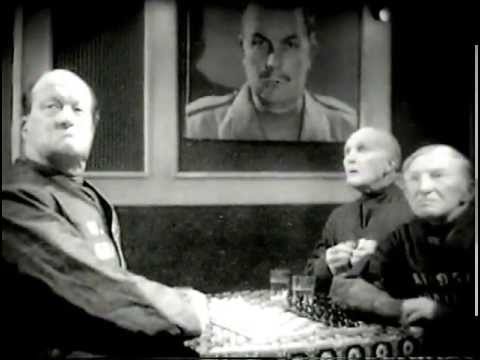
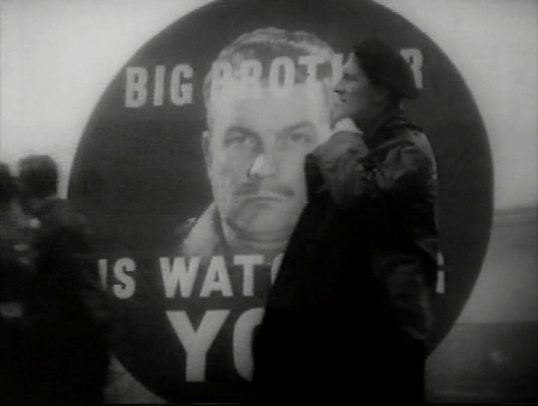
This version sticks closely to Orwell’s novel, though it downplays the book’s sexual themes.  (This is not surprising considering that this version was made for 1950s television.)  Though it condensed Orwell’s story, it hits all of the important points.  Winston Smith (Peter Cushing) is a member of the Outer Party who works at the Ministry of Truth and who lives a rather drab existence in London, “the chief city of Airstrip One.”  He is a citizen of Oceania, which has always been at war with Eurasia.  Winston lives under a system of government called Ingsoc and every day, he spends two minutes hating a mysterious figure named Goldstein.  All around him are posters of Big Brother, watching him and judging.

On the outside, Winston is a loyal party man but on the inside, he has questions and doubts.  How can he not when he works for the Ministry of Truth?  His job is to change history to reflect whatever the current version of it may be.  Some of his co-workers, like Symes (Donald Pleaseance), are openly cynical about what they do.  Others, like O’Brien (an imposing Andre Morell), seem as if they might be sympathetic to Winston’s doubts but Winston cannot be sure.  Meanwhile, Winston has found himself obsessed with Julia (Yvonne Mitchell), who is a member of the Anti-Sex League but who might have doubts of her own.  (Then again, she could also be a member of the Thought Police.)

When Winston is finally arrested for being a thoughtcriminal, it leads to a harrowing interrogation where he learns that truth doesn’t matter, the numbers add up to whatever the party says that they add up to, and that no one is strong enough to survive the ordeal of Room 101.

The BBC adaptation of Nineteen Eighty-Four was, for the most part, a live performance with a few filmed scenes inserted into the action.  Still, the fact that the majority of the actors were delivering their lines lives brings a certain immediacy to the film.  Everyone seem nervous and edgy.  In real life, that could have been due to the fear that they would miss a line but it also feels appropriate for people who spend every day of their life being watched and judged by Big Brother.  The entire production does an excellent job of creating a world where every minute is suffused in an atmosphere of dread and fear.  From the minute we first see him, Winston seems to know that he’s doomed.  The fact that Big Brother would rather torture and brainwash him rather than just make him disappear just makes things worse.

The production is full of actors — like Cushing, Morrell, and Pleasence — who would go on to become leading figures in the British horror industry and all of them do an excellent job bringing Orwell’s horror to life.  Peter Cushing, with his mix of intelligent features and neurotic screen presence, makes for the perfect Winston Smith and Andre Morrell is just as perfectly cast as the fearsome O’Brien.  The scene in which Winston is forced to confront Room 101 is still a harrowing one and this film perfectly nails the novel’s famous ending, doing so in a low-key manner that’s far more effective than the overwrought approach that other adaptations have brought to the final scene.

Nineteen Eighty-Four can currently be viewed on Prime.  The print is a bit grainy but that only adds to the film’s power.  It comes to us like a hazy vision of the future.

Other Entries In The 18 Days Of Paranoia:

  1. The Flight That Disappeared
  2. The Humanity Bureau
  3. The Private Files of J. Edgar Hoover
  4. The Falcon and the Snowman
  5. New World Order
  6. Scandal Sheet
  7. Cuban Rebel Girls
  8. The French Connection II
  9. Blunt: The Fourth Man 
  10. The Quiller Memorandum
  11. Betrayed
  12. Best Seller
  13. They Call Me Mister Tibbs
  14. The Organization
  15. Marie: A True Story
  16. Lost Girls
  17. Walk East On Beacon!

4 Shots From 4 Films: Special Ewan McGregor Edition


4 Shots From 4 Films is just what it says it is, 4 shots from 4 of our favorite films. As opposed to the reviews and recaps that we usually post, 4 Shots From 4 Films lets the visuals do the talking!

Today is not just Christoper Walken’s birthday!  It’s also the birthday of another one of my favorite actors, the only and only Ewan McGregor!  And you know what that means.  It’s time for….

4 Shots From 4 Ewan McGregor Films

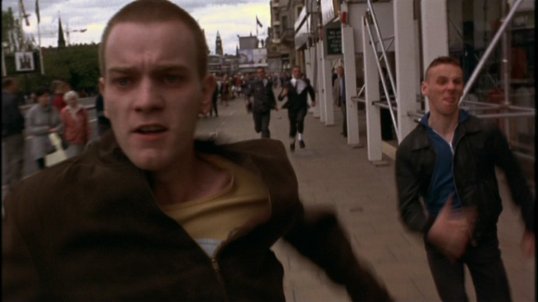
Trainspotting (1996, dir by Danny Boyle)

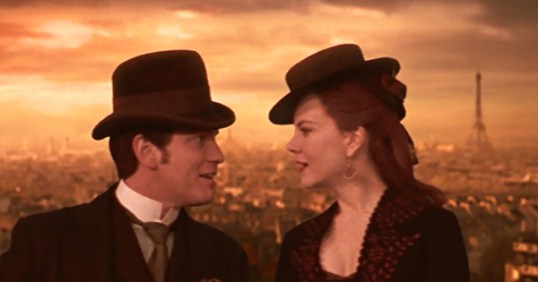
Moulin Rouge! (2001, dir by Baz Luhrmann)

T2: Trainspotting (2017, dir by Danny Boyle)

Doctor Sleep (2019, dir by Mike Flanagan)