Review: Hostage (dir. by Florent Siri)


The five years or so has seen the rise of several new directors from France who’ve made quite a splash with their Hollywood debuts. There’s Alejandro Aja with Haute Tension (or Switchblade Romance/High Tension) who brought back the late 70’s early 80’s sensibilities of what constitutes a good slasher, exploitation film. Then there’s Jean-Francois Richet whose 2005 remake of John Carpenter’s early classic, Assault on Precinct 13 surprised quite a bit in the industry. Neither film made too much in terms of box-office, but they did show that a new wave of genre directors may not be coming out of the US but from France of all places. Another name to add to this list is Florent Siri and his first major Hollywood project Hostage shows that he has the style and skills to make it in Hollywood.

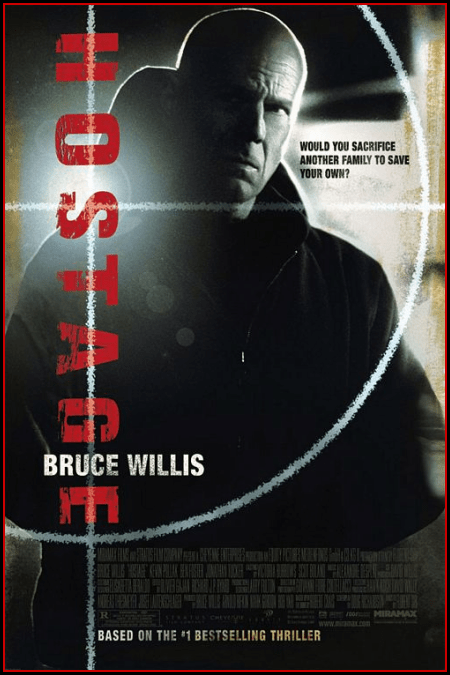
Hostage
is another Bruce Willis vehicle that was adapted by Doug Richardson (wrote the screenplay for Die Hard 2) from Robert Crais’ novel. Hostage is a very good thriller with a unique twist to the hostage-theme. Willis’ character is a burn-out ex-L.A. SWAT prime hostage negotiator whose last major case quickly ended up in the death of suspect and hostages. We next see him as chief of police of a small, Northern California community where low-crime is the norm. We soon find out that his peace of mind and guilt from his last case may have eased since taking this new job, but his family life has suffered as a consequence. All of the peace and tranquility is quickly shattered as a trio of local teen hoodlums break into the opulent home of one Walter Smith (played by Kevin Pollak). What is originally an attempt to steal one of the Smith’s expensive rides turn into a hostage situation as mistakes after mistakes are made by the teens.

From this moment on Hostage would’ve turned into a by-the-numbers hostage thriller, but Richardson’s screenplay ratchets things up by forcing Willis’ character back into the negotiator’s role as shadowy character who remain hooded and faceless throughout the film kidnap his wife and daughter. It would seem that these individuals want something from the Smith’s home and would kill Willis’ character’s family to achieve their goals. The situation does get a bit convoluted at times and the final reel of the film ends just too nicely after what everyone goes through the first two-third’s of the film.

The character development in the film were done well enough to give each individual a specific motivation and enough backstory to explain why they ended up in the situation they’ve gotten themselves into. Willis’ performance in Hostage was actually one of better ones in the last couple years. The weariness he gives off during the film was more due to his character’s state of mind rather than Willis phoning in his performance. I would dare say that his role as Chief of Police Jeff Talley was his best in the last five years or so. The other performance that stands out has to be Ben Foster as the teen sociopath Mars. Foster’s performance straddles the line between being comedic and over-the-top and could’ve landed on either side. What we get instead is one creepy individual who almost becomes the boogeyman of the film. In fact, the last twenty minutes of Hostage makes Mars into a slasher-film type character who can’t seem to die.

The real star of the film has to be Florent Siri’s direction and sense of style. From the very first frame all the way to the last, Siri gives Hostage the classic 70’s and 80’s Italian giallo look and feel. Siri’s use of bright primary colors in conjuction with the earthy, desaturated look of the film reminds me of some of the best work of Argento, Bava and Fulci. In particular, Siri’s film owes alot of its look to films such as Tenebrae, The Bird with the Crystal Plumage, and The Psychic. Certain scenes, especially the penultimate climax in the Smith home, take on an almost dreamlike quality. Siri’s homage to the classic gialli even gives Hostage some sequences that would comfortably fit in a 70’s slasher film.

Florent Siri’s Hostage is not a perfect film and at times its increasing tension without any form of release can be unbearable to some people, but it succeeds well enough as a thriller. It also shows that Siri knows his craft well and instead of mimicking and cloning scenes from the gialli he’s fond of, he emulates and adds his own brushstrokes. The film is not for everyone and some people may find the story convoluted if not dull at times, but for me the film works well overall. Siri is one director that people should keep an eye on.

Review: A Blade In The Dark (dir. by Lamberto Bava)


If you’re lucky, you remember your first time.  I know I do.  I was 17 years old and I was trying very hard to convince myself that I was an adult.  It had been less than a year since I was first diagnosed as being bipolar and I was still struggling to understand what that truly meant about me.  My days were spent wondering if I was crazy or if I was just misunderstood.  In the end, I just desperately wanted to be loved.  As for the event itself, I remember being more than a little anxious and, once things really got going, pleasantly surprised.  However, the main thing I remember is thinking to myself, “Wow, that’s a lot of blood.”

Yes, everyone should remember the experience of seeing their first giallo as clearly as I do.

Over the years, I’ve read a lot of different definitions of what a giallo is and none of them have really managed to capture what makes this genre of film so strangely compelling.  The simplest and quickest definition is that a giallo is an Italian thriller.  Typically (though not always), the film features a protagonist who witnesses and then proceeds to investigate a series of increasingly gory murders.  Often times, solving the murders means uncovering some dark and sordid sin of the past and, just as often, the film’s “hero” turns out to be as damaged a soul as the killer.  However, the plot is rarely the important in a giallo film.  What’s important is how the director chooses to tell the story.  When I watch the classic giallo films of the 60s and 70s, I get a sense of a small group of directors who were all competing to say who could come up with the most startling camera angle, who could pull off the bloodiest death scene, and who could pull off the most audacious tracking shot.  Giallo is a uniquely Italian genre of film, an unapologetic opera of mayhem and murder.  For the most part, the films seems to have a polarizing effect on viewers.  You either get them or you don’t.  (From my own personal experience, I think it helps if you come from a Catholic background but, again, that’s just my opinion.)

My first giallo was Lamberto Bava’s 1983 shocker, A Blade in the Dark.

The protagonist of A Blade in the Dark is Bruno, a popular young composer who has been hired to score a horror movie.  The film’s director has arranged for Bruno to stay in an isolated villa while he works.  Every night, Bruno sits in front of his piano and searches for the perfect note.  Occasionally, his actress girlfriend calls him from the other side of Italy and demands to know if he’s cheating on her.  He’s not despite the fact that he has two attractive neighbors who tend to come by at the most inconvenient of times and who make cryptic comments about the woman who lived at the villa before him.  Bruno would probably be even more frustrated if he knew that, on most night, he’s being watched by someone outside hiding outside the villa.  One night, Bruno listens to the movie’s soundtrack and hears a menacing voice whispering on the recording.  Meanwhile, the mysterious watcher begins to brutally murder anyone who has any contact with Bruno.

(Despite all these distractions, Bruno continues to vainly try to create the perfect score.  Much like Kubrick’s Shining, A Blade in the Dark is as much about the horrors of the artistic process as it is about anything else.)

As it typical of most giallo films, the plot of A Blade in the Dark makes less and less sense the more that you think about it.  However, this is a part of the genre’s charm.  One doesn’t watch a giallo for the story.  One watches to see how the story is told and that is where A Blade in the Dark triumphs.  Wisely, director Lamberto Bava keeps things simple.  Working with a small cast and one main set, Bava fills every scene with a palpable sense of dread and uneasiness.  As Bruno finds himself growing more and more paranoid, so does the audience.  Watching the movie, you feel that anyone on the screen could die at any moment and, for the most part, that turns out to be the case.

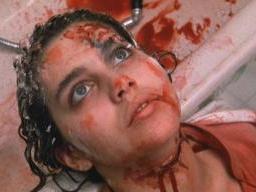
A Blade in the Dark is probably best known for the brutality of its violence.  Even after repeat viewings, the murders are still, at times, difficult to watch. In the most infamous of them, one of Bruno’s neighbors is killed while washing her hair over a sink.  The violence here is so sudden and so much blood is spilled (and spurted) that its easy to miss just how well-directed and effectively shocking this scene really is.  In this current age of generic cinematic mayhem, the violence of A Blade In The Dark still packs a powerful punch.

(The scene is so effective that, for quite some time after seeing it, I actually got uneasy whenever I found myself standing in front of a sink.  A Blade in the Dark does for the bathroom sink what Psycho did for showers.)

Bruno is played by Andrea Occhipinti, an actor whose non-threatening, Jonas Brotheresque handsome earnestness was used to great effect by Lucio Fulci in the earlier New York Ripper.  Since I’ve only seen the dubbed version, it’s difficult to judge his performance here.  He’s never quite believable as a great composer though you could easily imagine him writing whatever syrupy ballad that James Cameron chooses to play at the end of his next blockbuster.  However, Occhipinti does have a likable enough presence that you don’t want to see him killed and that’s all that the film really requires anyway.

A far more interesting presence in the cast is that of Michele Soavi.  Soavi plays Bruno’s landlord and, even with limited screen time and even with his dialogue dubbed into English, Soavi is such a charismatic presence that he dominates every scene that he’s in.  Before being cast, Soavi was already serving as Bava’s assistant director on Blade in the Dark and, of course, he later went on to have a significant directorial career of his own.  Soavi is perhaps best known for directing one of the greatest films of the 1990s, Dellamorte Dellamore.

While Soavi would go on to great acclaim, the same cannot be said of this movie’s director.  Among fans of Italian horror, it’s become somewhat fashionable to be dismissive of Lamberto Bava.  It’s often pointed out that the majority of his filmography is actually made up of cheap knock-offs that he made for Italian television (and, admittedly, A Blade in the Dark started life as a proposed miniseries).  Most of the credit for Bava’s most succesful film — Demons — is usually given to producer Dario Argento.  Perhaps the most common complaint made about Lamberto Bava is that he isn’t his father, Mario Bava.  With films like Blood and Black Lace, Lisa and the Devil, Black Sabbath, and Bay of Blood, Mario Bava developed a deserved reputation for being the father of Italian horror and Lamberto is often accused of simply trading in on his father’s reputation.

It’s true that Lamberto Bava is no Mario Bava but then again, who is?  Blade in the Dark was Lamberto’s second film (as a director) and its a tightly constructed, quickly paced thriller.  Bava makes good use of the vila and creates a truly claustrophobic atmosphere that keeps the viewer on edge throughout the entire film.  Even when viewed nearly three decades after they were filmed, the film’s murders are still shocking in both their violence and their intensity.  There’s a passion and attention-to-detail in Bava’s direction here that, sadly, is definitely lacking in his later films.  If most of Bava’s film seem to be the work of a disinterested craftsman, A Blade in the Dark is the  work of an artist.

Review: The Black Waters Of Echo’s Pond (dir. by Gabriel Bolongna)


I’m going to start this review with a disclaimer.  Yesterday, I nearly died trying to see this movie.  As I was driving to the theater, I nearly collided with another car.  One of us (okay, it me) wasn’t paying attention and ran a stop sign.  We handled the near accident with the usual mix of car horns and profanity and, my heart still racing, I drove on to the theater and saw The Black Waters of Echo’s Pond.

As a result of my near death experience, I sat through this movie with one thought in my head: was seeing it worth losing my life?  While there are some movies (Suspiria, Beyond the Darkness, Zombi 2, and the Living Dead Girl, for example) that I would happily sacrifice a few years in order to see on the big screen, Black Waters is not one of them.

The film actually starts out well with a 9-minute prologue.  An archeological expedition in Turkey discovers an ancient tomb.  Inside the tomb, they find a map that is somehow linked to the Greek God Pan.  For nine minutes, we’re treated to clunky exposition (“Why, it’s what we’ve been here looking for!”  “Professor, do you mean that it’s the ancient map of Pan’s Arcadia?”  “Yes, the same Pan who was the Greek God of fertility and…”) and it seems like this movie might actually turn out to be a fun, cheerfully stupid take on the old Mummy movies that Hammer Studios released in the late 60s.

No such luck.  All the members of the expedition are promptly killed off-screen.  We jump forward to the “present day” and the entire movie quickly goes downhill.

In the present day, nine college friends get together to spend a weekend in an isolated mansion on an even more isolated island.  Why they would want to do this is never really addressed nor do you ever believe that any of the characters have a shared history or would actually be friends if not for the fact that the film demands it.  While there are some talented actors in the cast, they have absolutely no chemistry when they’re on screen together.  Since the rest of the film is pretty much dependent upon us believing that these people are all old friends, this lack of chemistry pretty much dooms the entire movie. 

(Add to that, the men in this group all appear to be having the worst bad hair day in recorded history.)
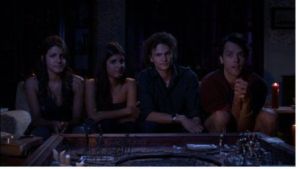
Once they’re in the mansion, the power promptly dies.  While attempting to find a fuse box, one of the friends instead discovers a board game.  Our group proceeds to play the game and soon, they’re seeing visions of murder, illicit sexual activity, and a big-horned demon.  However, none of them find this to be all that curious because they are 1) stoned and 2) incredibly stupid.

As I watched them play this cursed Jumanji death game, I found myself wondering if nobody in this film had ever seen a horror movie before.  Surely, if they had, they would realize that getting together in an isolated location, joking about sex, smoking weed, and then playing with the mysterious game that was previously walled up in the cellar is a good way to guarantee that you’re not going to be alive in the morning. 

To a certain extent, you have to be willing accept a lot of stupidity on the part of the characters in a horror film.  After all, we all know that our poor victims are always going to end up running up a flight of stairs in order to escape the killer (as opposed to going out the front door) and we forgive them for that because we know that if their actions were logical, then there would not be a movie.  However, the victims of the Black Waters of Echo’s Pond simply require us to forgive too much. 

Anyway, the game quickly starts to get weird as everyone draws cards that require them to answer increasingly personal questions.  Old resentments boil up to the surface.  One guy admits to wanting to have sex with both his girlfriend and her sister while the token responsible girl finds herself compelled to flirt with the token slut.  All of this goes on until finally, one member of the group snaps and, while everyone else is busy getting it on, proceeds to cut his best friend in half with a chainsaw.  (And no, nobody in the house hears the screams or the chainsaw because, as I mentioned earlier, they’re all incredibly stupid.)
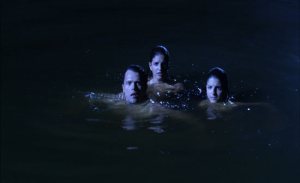
Once that first murder is committed, everyone is soon trying to kill everyone else.  In this regard the film is remarkably similar to Mario Bava’s classic Bay of Blood (a.k.a. Twitch of the Death Nerve).  However, the constant carnage in the Bava film worked because Bava made it clear that his many murderers were all working independently from each other with just their own greed to motivate them.  Whereas in Black Waters, it is made clear from the start that everyone has been possessed by Pan.  In short, the murders have nothing to do with the people being killed or those who do the killing.  And while the murders are nicely brutal and bloody (I hate bloodless horror films), they don’t have any meaning beyond the mechanics of the film.

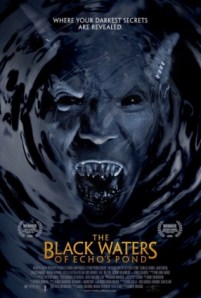
Pan (or at least I assume that its meant to Pan because it looks more like a Minotaur than anything else) shows up fairly early in the movie and he is an impressive creature with a goat’s head that features glowing eyes and long, dirty talons at the end of his fingers.  Still, I think it was a mistake on the part of the filmmaker’s to reveal him as early (and as often) as the film does.  Once Pan shows up, the movie loses all of its mystery.  We now know, for sure, that all the ensuing mayhem is the result of Pan’s supernatural malevolence.  By revealing Pan as early as it does, the film sacrifices whatever chance it may have had to be truly scary.  Instead Pan, just becomes another faceless killer and the movie, which has been advertised as a “psychological thriller,” loses its edge.

Outside of Pan, the cast is largely forgettable and they’re certainly not helped by how unlikable the majority of the characters are.  A few members of the cast do occasionally manage to offer up a few good (or, at least, memorable) moments but their efforts are sabotaged by some of the most leaden dialogue I’ve ever heard.  (It’s not a good sign that the film feels like it was dubbed into English even though it’s not.) 

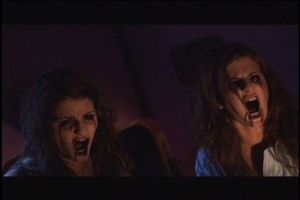
The Babysitter twins from the Planet Terror segment of Grindhouse show up for instance and, even though their characters are wildly inconsistent, they both bring a lot of energy to their roles.  Incidentally, one of them gets the worst the line of the dialogue in the entire film when she says, “Shakespeare is Shakespeare!  B-movies are porn!”
Robert Patrick plays Pete, the grizzled old-timer who gets to do the whole “Some people say the killer is still out there…” thing.  It’s not much of a role but Patrick has fun with it.

Speaking of horror film tropes, Mircea Monroe plays Veronique, the token slut.  From the minute she shows up on-screen, you know she’s doomed because she’s flirtatious, openly bisexual, and likes to show off her boobs.  (Come to think of it, if I ever find myself in a slasher film, I am fucked!)  It’s a thankless role but Monroe does her best with it and actually give Veronique a personality that goes beyond the puritan stereotype of the slasher film slut.  Her best scene is her last.  The look of mournful resignation on her face make her final fate rather sad and suggests the type of film that Black Waters could have been.

The two nominal leads are played Danielle Harris and James Duval and they both occasionally manage to transcend the shallowness of their roles.  Harris, of course, is a horror film veteran who could play her role in her sleep.  To her credit, she doesn’t.  James Duval is best known for playing Frank the Bunny in Donnie Darko.  Here, he plays ne’er-do-well Rick.  If for no other reason, the movie is worth seeing just for the way Duval delivers the line “Shit!  We’re fucked!”  It’s a line that he repeats several times and he says it with just the right combination of genuine frustration and stoner pathos.
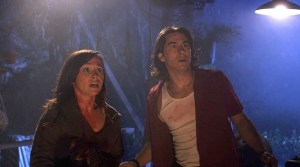
In many ways, Black Waters On Echo’s Pond feels a lot like one Lucio Fulci’s post-Manhattan Baby efforts.  You have no doubt that the movie was made by talented people and you keep wanting it to be better than it actually is.  You find yourself clinging onto the few isolated moments that are actually effective and hoping that maybe they’ll carry you to the light at the end of the tunnel.  Unfortunately, by the end of the movie, you realize that the light was actually the train that’s just bisected you because you were too stupid to jump off the tracks.

Ultimately, the main problem with The Black Waters of Echo’s Pond is that it just is not a scary movie.  I can usually forgive a lot from a horror movie as long as there’s a handful of shocking “jump” moments.  Unfortunately, Black Waters doesn’t feature a single one.  While the gore effects are occasionally impressive, it takes more than blood to make a horror movie.  All the material was there for this to be a fun little B-movie (and not a porno, regardless of what that Babysitter Twin claims) but it just doesn’t happen.

I recently posted some of my feelings about this film over on a message board.  I quickly received a reply from a gentleman who disagreed with me.  He informed me that not only did I not have the slightest idea how difficult it is to make a movie but by criticizing this film, I was failing to support “independent film.”  “Why don’t you just go spend more of your money on Avatar again?” he asked.  Well, for the record, I hated Avatar and I do support independent film.  Just because this movie was made outside of the studios, that doesn’t make it a good film.  If you want to see a good, independent horror and/or fantasy film, go track down Baghead or Primer.  Leave the Black Waters of Echo’s Pond undisturbed.
Review: Night of the Living Dead – 1968 (dir. George A. Romero)


I wasn’t born yet when George A. Romero’s Night of the Living Dead was first released in theaters, but I’ve wished many a night that I was old enough to have seen this classic horror film on the big screen. Night of the Living Dead simply changed the film industry forever and showed that horror was taking an uncharted road toward realism, brutality, and true terror. Before Romero’s film, horror often echoed the classic 1940s Universal style or the technicolor Hammer Films. Night of the Living Dead became the torchbearer of what would soon evolve into the splatter and exploitation films of the following decades. The influence this film has had on horror filmmakers is still ongoing.

Zombie films existed long before Night of the Living Dead, but they mostly depicted the traditional Haitian voodoo variety—with zombies as heavily drugged victims forced into slave labor for merciless masters. Romero changed all that in 1968. Made on a shoestring budget even by the standards of the time, Romero and his friends decided to make their own horror movie. The premise was simple: radiation from a returning Venus probe (though later films in the series abandoned that explanation for something more vague) somehow reanimated the recently deceased—though these zombies only had the most basic motor skills. That alone was terrifying enough. But Romero took it further by giving the zombies a new motivation: an unending hunger for the flesh of the living. With this, Night of the Living Dead marked the birth of horror at its most extreme.

The story was heavily influenced by Richard Matheson’s apocalyptic vampire novel I Am Legend, and Herschel Gordon Lewis’ Blood Freaks and Two Thousand Maniacs. Matheson’s novel contributed the idea of an encroaching horror besieging the survivors, while Lewis’ films provided an unflinching portrayal of exploitative violence and gore. Lewis didn’t shy away from gore, but Romero was the first to put a solid story behind the carnage.

The film opens simply enough, with a brother and sister heading to a rural cemetery to visit their dead mother. Right away, it takes on a disturbing tone, as both siblings come under attack from what seems to be a transient. Barbara, played by Judith O’Dea, flees for her life, with her brother Johnny already down. The tension of the opening sequence still makes my pulse pound every time I watch it. Soon, the story introduces the strongest character: Ben, played by Duane Jones in what became his signature performance. But even as strong-willed and level-headed as Ben is, he shares flaws that lead to critical mistakes later. The rest of the cast follows: Harry Cooper (Karl Hardman), his wife Helen (Marilyn Eastman), their injured daughter Karen (Kyra Schon), and the local couple Tom (Keith Wayne) and Judy (Judith Ridley). As the farmhouse becomes surrounded by a growing horde of undead, attracted by their noise, you’d expect the group to band together to survive the night until help arrives. But instead, misunderstandings and bitterness divide them, escalating into open conflict and self-preservation without concern for others.

The infighting and inability to cooperate is Night of the Living Dead’s strongest message—a bleak reflection of human nature in times of upheaval. The characters are fully realized, complex, and rare for horror films of that era. Their realistic portrayal makes their conflicts hit harder. After watching them fall apart, it’s easy to judge them as foolish, but realistically, many others faced with the same pressure might behave just as destructively. Romero’s harsh commentary on humanity’s failure to unite has led to conflict throughout history, and the film points this out in the bluntest, most brutal way possible.

The horror of Romero’s film is intensified by an economic choice. Color film was available in the 1960s but still expensive; only major studios or wealthy independents could afford it. Romero instead used black and white, helped by his background in documentary filmmaking, which made film stock easier to procure. This gave Night of the Living Dead its signature cinéma vérité look—grainy, raw, and immediate, like 8mm home movies of the era. Combined with Romero’s economical editing and minimalist, bass-heavy soundtrack, the film gains a life of its own. Its creeping dread was so tangible, I’m surprised more viewers didn’t walk out when it first played. The horror lingered long after watching.

There really isn’t much to complain about this film. Horror fans were given a movie that went well beyond exploitation. It also opened the door for a new generation of filmmakers who saw that movies could be more than entertainment—they could express social, political, and economic truths of their era. Night of the Living Dead had it all. It told audiences young and old that the era of silly, fantastical horror was over, and a new wave of realistic horror was about to descend. It didn’t shy away from violence. Flesh was ripped from limbs; intestines and organs were shown being handled and devoured. This “Vietnamization” of film violence launched a new era in what filmmakers could depict. But in 1968, this was the kind of violence usually reserved for drive-in exploitation fare—and initial audiences were unprepared. Not just adults, but 11- and 12-year-olds saw this as part of Saturday morning double features. One moment they were watching Flash Gordon or Buck Rogers, the next they faced flesh-eating ghouls and damning social themes bombarding their minds.

1968 is now seen as a turning point in filmmaking history. Night of the Living Dead influenced not just horror directors but filmmakers in all genres. It’s no surprise the film lives in the Smithsonian National Film Registry as a work that reshaped filmmaking art. Decades later, it still shocks first-time viewers and delights devoted fans. Night of the Living Dead didn’t just usher in a new era of horror and cinema; it announced the arrival of a genuine guerrilla auteur, a master of his craft.

Review: The Wild Geese (dir. by Andrew V. McLaglen)


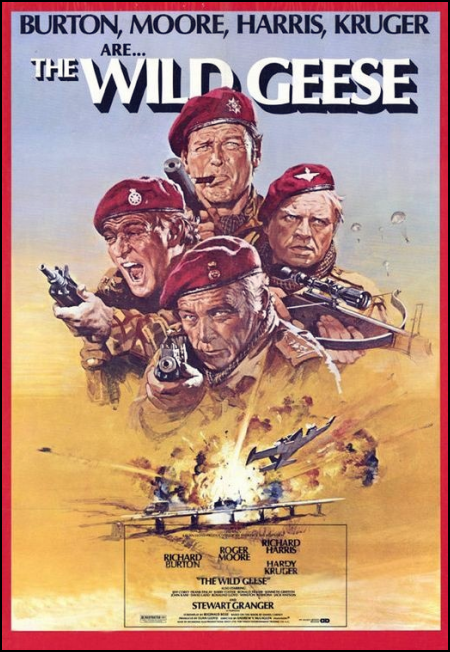
1978’s action war film The Wild Geese is an adaptation of Daniel Carney’s unpublished novel about a group of mercenaries on a mission during the turbulent revolutionary times that beset Central Africa during the 1960s and early 70s. The film features an all-star cast of British actors, a true who’s who of the era. Under the direction of Andrew V. McLaglen, The Wild Geese manages to be an action-packed and well-told film with memorable performances.

The character Colonel Allen Faulkner, played by Sir Richard Burton, is loosely based on the real-life mercenary legend Michael “Mad Mike” Hoare. Hoare not only inspired this central character but also served as the film’s military and technical advisor. Adding to the film’s authenticity, one of the actors portraying a mercenary, Ian Yule, had served with Hoare in his mercenary company. This infusion of real-life experience gives the film a vivid sense of art imitating life and lends credibility to its portrayal of mercenary warfare.

The story begins with a meeting between Faulkner and British banker Sir Edward Matheson about a rescue mission in the fictional Central African nation of Zembala. The first third follows Faulkner’s recruitment of a 50-man mercenary team, including his reluctant old friend Rafer Janders (Sir Richard Harris). The film portrays the mercenary company training and preparing for the mission before being inserted behind enemy lines. The second half details the rescue of their target: a deposed African leader about to be executed by the man who overthrew him.

During the second third of the film, the action intensifies. Though tame by today’s standards, the sequences were energetic and well-shot for their time. The mercenaries are shown not as idealized heroes but as pragmatic soldiers who use ruthless tactics—such as cyanide gas and poisoned crossbow bolts—that may shock modern audiences. This realism reflects Hoare’s influence and presents mercenaries as professionals doing a dangerous job for pay, blurring the moral lines of warfare. Betrayal during the mission tests their survival in enemy territory.

Burton and Harris deliver excellent performances as hardened war veterans, while a younger Sir Roger Moore adds roguish charm as the Irish pilot Shaun Fynn. Strong supporting roles include Hardy Kruger as Pieter Coetzee, an initially racist Afrikaner who gains new perspective on the continent’s upheaval, and Stewart Granger as the principled banker Matheson.

Though relatively small budgeted compared to other war epics of the era, The Wild Geese carries an epic feel and should have appealed more to American audiences. Unfortunately, financial difficulties with the production company affected its U.S. release. Over time, video and DVD releases built it a cult following among war and mercenary film fans, a subgenre often dominated by lesser films. McLaglen’s straightforward direction keeps the film’s pacing steady, and the story balances action with political and philosophical themes in its final act.

The Wild Geese stands as a rare gem in war cinema that delves into a little-known subgenre. With strong performances by knighted British actors, a former Hitler Youth, and real-life mercenaries as extras, the film distinguishes itself from the many flawed war movies flooding late-70s and early-80s cinema. Its roots in actual mercenary experiences, highlighted by Hoare’s real-life involvement and character inspiration, make it a compelling and underappreciated classic for aficionados of the genre.

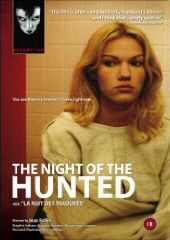
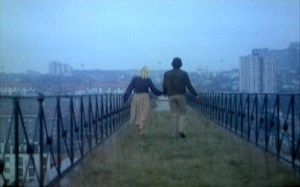
Review: Night of The Hunted (dir. by Jean Rollin)


When, at that age of 22, I first saw Jean Rollin’s Night of the Hunted, I cried as much as the first time I saw Titanic at the age of 12.  In both cases, the tears were inspired by a “doomed” love story.  The main difference between the two films is that I don’t cry over Titanic anymore.  But Night of Hunted still brings me to tears every time I see it.

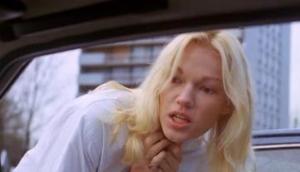
The film opens with the image of a terrified young woman (Brigitte Lahaie) running through a dark forest until she eventually reaches a highway.  She’s picked up by a young man (Vincent Gardere) who, being a guy, proceeds to take her back to his apartment in Paris.  She confesses that she can’t remember who she is, why she was running, or even being picked up by the young man in the first place.  Saying that she needs some sort of memory to fill the emptiness, she proceeds to make love to Gardere.  Gardere, being a guy, doesn’t object.

However, he does make the mistake of later leaving Lahaie alone in the apartment afterwards.  As soon as Gardere leaves, Lahaie forgets ever meeting him and why she’s even in the apartment in the first place.  Even as she tries to figure out what’s going on, the apartment is visited by a doctor who tells Lahaie that she is his patient and that she needs to go with him to a “clinic” where he can treat her.  No longer remembering her encounter with Gardere, Lahaie agrees.

Needless to say, the “clinic” turns out to be what Lahie was so desperately trying to escape just a few hours before.  We learn that Lahie is merely one of several hundred people who, months earlier, were exposed to a biological warfare experiment gone wrong.  Now, as a result, her brain is slowly dying one cell at a time.  The clinic is actually a government-run prison where she and her fellow victims have been sent to be forgotten about and to eventually die.  Lahie finds herself surrounded by men and women who, as they slowly lose everything that made them unique, revert back to their most primal instincts.  While Gardere tries to find her, Lahie struggles to survive just one final night in both the clinic and in the prison of her own fading mind.

Director Jean Rollin is best known for his sexually-themed vampire films but the Night of the Hunted is not as huge a departure for him as it may first seem.  One of Rollin’s reoccurring themes is the importance of our memories, no matter how idealized they may sometimes be and this theme is present in every frame of Night of the Hunted.

The lead role is played by Rollin’s frequent muse and collaborator, Brigitte Lahaie.  Because the majority of Lahaie’s career has been spent making adult films, she’s never gotten the due she deserves as an actress.  Playing a difficult role here, Lahaie is the movie’s greatest strength.  She brings a real sincerity and empathy to her role and its impossible to imagine this movie working without her.  If nothing else, this movie is a wonderful display of Lahaie’s often underrated talent. 

Rollin made the film for very little money and used a cast made up almost entirely of nonprofessionals and French adult film veterans.  So, yes the film does sometimes have a grainy look and the editing is definitely jagged.  When the characters shoot at each other, it is obvious that they’re firing toy cap guns.  To me, however, this works in the film’s favor.  The raw quality of the film perfectly mirrors that constant fear and confusion that Lahaie and her fellow prisoners live in.  No, the film is not technically perfect but a flawed masterpiece is preferable to uninspired technical perfection any day.

Despite working with a miniscule budget, Rollin captures some haunting images in this film.  Never has Paris looked as desolate as in this movie.  One of Rollin’s trademarks has always been his own fascination with architecture and, as a result, the cold skyscraper where Lahaie is held prisoner almost becomes a character itself.  I’ve always considered Jean Rollin to be horror cinema’s equivalent to Jean-Luc Godard and, with its images of a sterile city run by passionless autocrats, Night of the Hunted brings to mind Godard’s Alphaville.

 The film’s most haunting image comes at the end and it is this image that brings tears to my eyes every time.  Whatever flaws the film may have, Night of the Hunted has one of the best final shots in the history of cinema.  Even if everything preceeding it had been worthless, this movie would be worth sitting through just for the stark beauty of the final shot.  Night of the Hunted ends on a note that manages to be darkly sad and inspiringly romantic at the same time.  It’s an ending that makes Night of the Hunted one of the most romantic films of all time.

Night of the Hunted was released in 1980 and, like the majority of Rollin’s films, was never released in the States.  Redemption, however, has released it on DVD (which is how I first saw it in 2008.)   While the transfer is undeniably rough, that actually gives the movie a documentary-like quality that works in its favor.  The film is in French with English subtitles.   As is so often the case with subtitles, a lot of the film’s nuance is sacrificed in translation.  Fortunately, the combination of Rollin’s visual sense and Lahaie’s lead performance more than makes up for it.

Review: Welcome Home, Brother Charles (dir. by Jaama Fanaka)


Recently, I decided to try to track down and watch every single movie featured in Synapse’s 42nd Street Forever DVD collection.  Some of these movies have been unexpectedly brilliant and quite a few have been the exact opposite.  But none have been quite as wonderfully odd as a low-budget blaxploitation film entitled Welcome Home, Brother Charles.  If ever I have to explain who I am, I’ll do so by stating that I hated Avatar but I loved Welcome Home, Brother Charles.

The plot of Welcome Home, Brother Charles is almost simplicity itself.  Charles (played by Marlo Monte) is a small-time criminal who is struggling to get by in the Los Angeles ghetto.  At the start of the movie, Charles is arrested by two, white policemen.  While making the arrest, the more racist of the two cops attempts to castrate Charles (or as Charles later puts it, “damn near cuts off my manhood”).  Unfortunately, this is America in the 1970s and that can only mean that Charles is destined to go to prison while the racist cop is proclaimed a hero. 

After doing the “man’s time,” Charles is released from prison and finds himself back out on the mean streets of L.A.  However, things have changed.  His former best friend has now set himself up as the local godfather and is none too happy to see Charles wandering around.  Even worse, Charles discovers that the man who “damn near cut off (his) manhood” is still being proclaimed a hero.  Charles responds the way anyone would.  He seeks revenge against his enemies by 1) seducing their wives and 2) strangling those who have betrayed him with his penis.

Yes, that’s right.  Charles goes into prison as a small-time criminal but he comes out as some sort of X-rated super hero.  Not only can he seduce women simply by kissing them but he can now mentally turn his penis into a boa constrictor.  Add to this, director Jaama Fanaka doesn’t shy away from showing us Charles’ penis stretching across the screen and strangling his enemies.  When you consider that this feat was accomplished without CGI, you can only conclude that either Fanaka is a very talented director or that Marlo Monte was a very lucky man.

Whether it’s Charles constantly lamenting the fact that he nearly lost his “manhood” or then using that manhood to kill his enemies, Welcome Home Brother Charles is a penis-obsessed film. 

(Strangely enough, that word is never actually uttered in the film.  Nor do we hear any other of the common terms for the male organ.  Instead, we just hear the term “manhood” a few hundred times.) 

What was especially odd was that the film took an almost nonchalant attitude towards the scenes involving Charles and his magic penis.  At no point are we offered any explanation of just how exactly Charles acquired this power.  Nobody seems to be all that shocked by it.  You would think at least one of his victims would, at some point, say, “Oh, c’mon, you’re not seriously going to strangle me with your penis, are you?” 

I found myself wondering if perhaps this was actually a common thing, maybe one of those guy things that I, as a result of gender, simply do not know about.  After I watched the movie, I called up my friend Jeff and I asked him, “If you concentrate really hard, can you use your penis to pick things up and maybe strangle people?”

He was quiet for a few minutes before saying, “Uhmm…sure.” 

What’s even stranger than the sight of grown men being strangled by a gigantic penis is that director Fanaka appears to be taking this story very seriously.  There’s little deliberate humor in the movie and the actors all play their roles with an admirable seriousness.  In the lead role, Monte is probably as a convincing as anyone could be while using their penis to strangle another human being.

The thing about this movie is that when Welcome Home, Brother Charles works, it truly does work.  Charles’ time in prison is represented by a series of grim, black-and-white stills that roll over a soundtrack composed of horrific screams.  This montage is surprisingly disturbing and, in a manner of minutes, let’s us know the Hell that Charles goes through as a convict.  When, after being released from prison, Charles visits his old neighborhood, Fanaka gives us a much more joyful montage of Monte interacting with the people living there.  Directed in a cinema verite style, there’s a lively energy to these scenes that actually adds a rather tragic dimension to the rest of Charles’ story. 

These are the type of scenes (along, of course, with the sight of Charles strangling people with his penis) that would never appear in a mainstream film.  The prison scenes would have been filled with stereotypical predatory homosexuals and shanks-in-the-shower scenes that would have served as traditional crowd pleasers but would have carried absolutely no emotional impact.  As for the montage of Charles in his old neighborhood, forget about it.  That sequence would have hit the cutting room floor, sentenced to maybe show up as a DVD extra if that.  If nothing else, this movie shows why the grindhouses were necessary and how much we’ve lost with their decline.

Like many grindhouse films, Welcome Home, Brother Charles was released under several different titles.  It’s been released on DVD under the title Soul Vengeance.  If you’re the type of DVD snob who likes to show off by talking about “transfers,” the transfer here is a bit grainy but quite honestly, this is a movie that needs to be grainy.  For best viewing experience, invite several homeless drug addicts over to hang out as you watch the movie and turn your living room into your own private grindhouse.

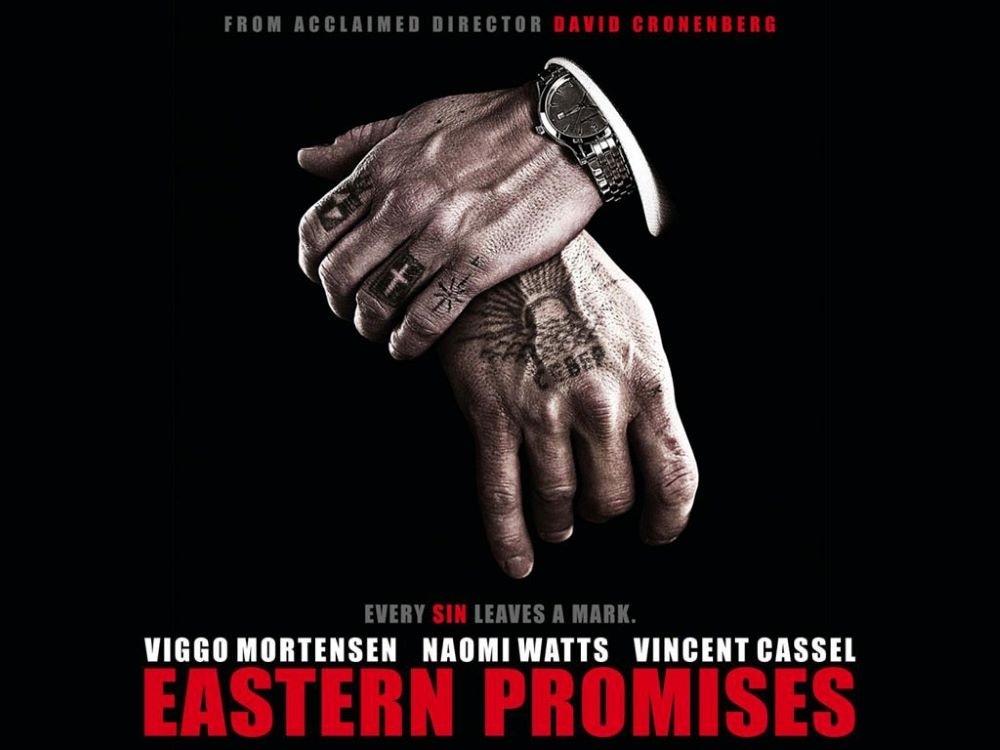
Review: Eastern Promises (dir. by David Cronenberg)


“You can’t always be in control.” — Nikolai Luzhin

In 2005 Canadian filmmaker David Cronenberg brought to the silver screen a film that was both a taut, smart crime-thriller and also a well-done film treatise on the nature of violence and how it changes not just witness’ perception of an individual but about themselves as well. The film also introduced what might be the newest creative pairing that could be on par as other pairings like Scorsese-DeNiro and Burton-Depp. The pairing I speak of is that of Cronenberg and his growing repertoire with actor Viggo Mortensen. They scored a critical hit with A History of Violence and in 2007 they collaborate in another crime-drama that more than lives up to their initial collaboration. Eastern Promises is a taut and meticulous drama which brings new eyes and a different approach to the mob film genre made famous by Coppola and Scorsese.

The film begins innocently enough with a very pregnant teenage Russian girl named Tatiana entering a neighborhood store. While Cronenberg chose to open up A History of Violence nary any musical cues and backgrounds to create a sense of naturalism and plant a seed of unease in the audience of what’s to come, he does the opposite with Eastern Promises by allowing long-time collaborator Howard Shore to score this opening scene with a haunting violin solo. Even right from the start Cronenberg’s propensity to use a sudden image of violence to shock the audience works well to set the tone for the film. It is not the usual filmgoing experience to see a young girl, looking lost and afraid of her surroundings, suddenly and bloodily starts to give birth in the middle of a store. It is from the diary entries of this young girl where we get glimpses of the true meaning of the film’s title and sets up the clues and tidbits that Cronenberg gradually fills in as the film progresses and the main characters investigate the girl’s death and the full contents of her diary.

We’re quickly introduced to Anna Khitrova (played with touching compassion and a certain naivete by Naomi Watts), midwife at the London hospital where Tatiana dies from bloodloss due to childbirth. Having had experienced her own personal tragedy regarding a past pregnancy Anna takes it upon herself to find the next of kin or, at the very least, close friends who might know Tatiana and thus claim the child and care for her. It was finding Tatiana’s diary and the business card tucked within amongst the young girl’s meager possessions which gives Anna a starting point for her investigation and search.

It is during this search into Tatiana’s life that Anna encounters Nikolai Luzhin (Viggo Mortensen at his most chameleonic), the personal driver of one Semyon (as played by Armin Mueller-Stahl). Semyon charms Anna with his old world grandfatherly persona yet both the audience and Anna feels something off, even sinister beneath the charm and twinkling eyes. Semyon is not just the owner of the Trans-Siberian, a Russian restaurant, but a boss in the vory v zakone also known as the Russian Mafia. It is through Nikolai that we see the underbelly of Tatiana’s life before her death.

It is during the second half of the film that the film takes a clear turn into Cronenberg territory. With all the players in play Eastern Promises starts to peel the layers on all the characters. Just like in A History of Violence every character in this unofficial follow-up to that film go on through the film living dual-lives. Even Anna’s seeming naivete, in regards to the danger she faces in Semyon and his unstable son Kirill, shows a modicum of world-weariness born out of personal tragedy and those she sees on a daily basis when working as a midwife in the hospital.

Cronenberg doesn’t just try to tell a crime drama about the mob and the subculture they live and die in but he adds his own personal stylistic and metaphorical touches on the mob film conventions. While in the past he has taken on the immutability of the body and the physical nature of man in his later years he has moved on to the amorphous nature of man’s very nature as both a civilized and reasoned animal to the primal being which lurks within each. Eastern Promises delves into this metaphysical topic by showing the natures of both Nikolai and Semyon. Both of whom, at first glance, inhabiting a particular stereotype but soon showing the opposite as the audience gets to know them. Even the twists in the story in the middle section and close to the end doesn’t seem like cheap plot tricks but a logical and almost mathematical conclusion to the very themes Cronenberg has been exploring right from the beginning.

The performances by the cast was top-notch from top to bottom. David Cronenberg’s always has had a reputation for being an actor’s director. His willingness to allow his actors to not just play the part but find ways to become their characters makes his films some of the more well-acted one’s of the last quarter-century. From Watts’ own touching performance as the moral center of the film in Anna to Cassel’s unstable and coward of a bully in Kirill the work put on by the actors adds a level of gravitas to a story that has it’s roots in pulp crime stories and not the high-brow tales prestige films like Eastern Promises has been compared to. But the two stand-out work comes from Viggo Mortensen as the enigmatic Nikolai and Armin Mueller-Stahl as Russian mob boss Semyon. Where Watt’s performance was subtle and Cassel’s literally scene-chewing both Mortensen and Mueller-Stahl bring forth nuanced performances full of life and complexities that makes both characters stand out above a cast already doing great work.

Mortensen’s work as Nikolai actually surpasses his previous Cronenberg-directed role in Tom Stalls of A History of Violence. Viggo has always been quite the Method actor and really loses himself in every role he takes on, but it took him being paired up with Cronenberg for critics and cineastes to finally realize how great an actor he really has become in the last decade. His Nikolai oozes a charisma from the moment he enters the film. He makes Nikolai not just a thug with a brain and a semblance of compassion beneath the rough surface. Mortensen literally becomes Nikolai right down to the very tattoos which tells his character’s criminal past in ink. One could not help but be mesmerized by Mortensen’s work in this film that it was easy to forget that he was playing a part and not actually living that life. To say that Mortensen may have found his creative soulmate in Cronenberg would be quite the understatement and with more projects in the future linking the two together it wouldn’t be a surprise if the two in conjuction finally get the critical awards that has eluded both.

While A History of Violence showed that Cronenberg could work beyond the genre and esoteric genres of his part works, it is with Eastern Promises that we see him move towards a more mainstream type of work. Yet despite a work more accessible than before he still was able to add his own style of storytelling and explore themes usually not seen in crime dramas and mob films. It is this ability to marry the violent pulp with the intellectual high-brow which makes Eastern Promises a delight for both the general filmgoer and the arthouse cineaste. Time will only tell if the successful streak by the duo of Cronenberg-Mortensen continues as the two continue to work together in the years to come.

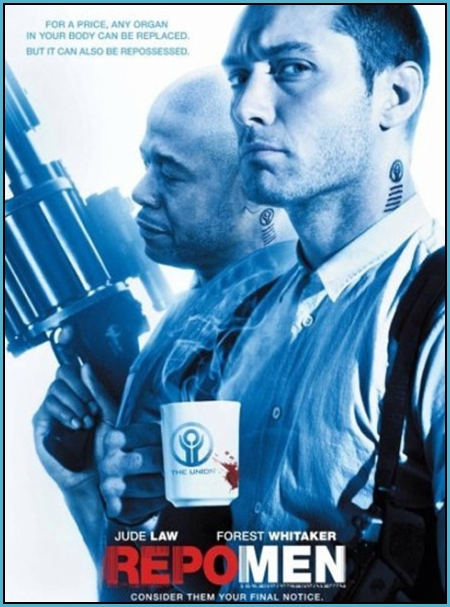
Review: Repo Men (dir. by Miguel Sapochnik)


In the beginning of 2010 a scifi-horror film arrived in the theaters to much internet hype. This film showed a future world where a massive societal change and the resulting health crisis following it was described in detail. It was a film which cleverly built a world so different from out very own yet still very similar in its foundation. This film was Daybreakers and for all the wonderful world-building it did to establish a foundation for the story being told the film couldn’t find it’s way to having the film’s plot match what the filmmakers’ established in the beginning. I say this because it is now late March 2010 and another film has done another wonderful job of establishing a future world so very different and yet so very similar in many ways. Where the Spierig Brothers failed in more ways than one to have the rest of Daybreakers live up to the world established in the beginning and a premise that was quite new, Miguel Sapochnik did a much better job — albeit still flawed — in allowing the plot for Repo Men live up to the world established in the opening minutes of the film.

In the near future of Repo Men medical science and technology has advance far enough that most organs and parts of the human body can be artificially replaced when they failed. While this detail of the film sounds like the makings of a future utopia it’s actually much closer to our own reality in that these organs, despite being mass-produced, are still only affordable to the rich. Artificial organs (artiforgs in this film’s vocabulary) sold to the rich like luxury items. Those not-so-rich, but desperate to try and find a way to change a fatal health situation, also offered these artiforgs on a monthly payment plan suitable to their current expense situation. It’s mostly these payment plan artiforg owners who experience the skill sets of the so-called “repo men.” These are individuals employed by the artiforg company called The Union who sell the products. When someone misses too many payments on their artiforgs and goes delinquent on their payment plan then the repo men will be knocking on their door to take back the synthetic organ. It’s similar to banks repossessing cars and homes when payments are not made.

The film’s told in the point of view of one of these repo men. Jude Law’s character Remy is one of The Union’s top repo men who we see enjoys his work despite the ultimate consequence of what he does to the people whose artiforgs he takes back. His partner is Jake (played with childish glee by Forest Whitaker). The two have been friends since grade school and both share a similar sense of sociopathy when it comes to violence. To say that they’re like brothers minus the shared genetics won’t be too far off. The first third of Repo Men shows the audience these two organ repossessors in their element as they hunt down those delinquent in their plan and those who have turned to the black market for their artiforgs. The film’s touches upon the current public hysteria of the two sides in the health care debate. While the film touches upon this current debate it does so without being too broad or preachy. It’s done subtly and without having it distract the audience from the film’s story.

The film does sing and move at an entertaining pace during the first third, but inevitably it does reach a point where the conflict of the story shows itself to add a dramatic ingredient to the film. It’s during what was to be Remy’s final repo mission before he heads over to a less paying, but safer job as sales in The Union that he goes from the repossesser to potential possessee. The switch in roles soon has Remy unable to do what he’s been so good at as cutting into someone delinquent on their artiforg when he himself now has one keeping him alive. It’s a common storytelling telling idea of the insider getting a taste of their own medicine and seeing how the other side lives. Avatar used it late last year and Daybreakers did it clumsily earlier this year.

This second third of the film has some character development flaws which could be attributed to some of the script’s weakness. While Remy’s sudden inability to do his job as a repo man after his own artiforg surgery makes sense the one-note characterization of his wife (played by the Black Book‘s Carice von Houten) who leaves him during this crisis of faith adds an unnecessary factor to his problems. In actuality the roles of the wife and Remy’s son could’ve easily been left off the film and just had the story be about Remy and his long-time friend and fellow repo man Jake. This would’ve been enough conflict and drama to power the rest of the film. This is where less would’ve definitely more and keep the story lean, mean and definitely more efficient. But even with this misstep in the film’s script it doesn’t sink the film. This could be attributed to some strong performances from Jude Law who manages to credibly transition from what amounts to be a paid serial killer to one having his eyes opened to the devastation he has wrought on individuals and families. Even the scene-chewing done by Whitaker as Jake doesn’t diminish Law’s performance and instead just shows that despite some of the horrible things Remy’s done he’s actually the sanest person in the film w/ everyone else close around him playing certain caricatures whose roles are to push him one way or another to picking a side on the issue of artiforgs and their repo issues.

It is in the beginning of the third act which may make or break the film for those who have stayed with it through the first acts. A particular even happens which transitions act to three which ramps up the action to it’s bloodiest and, at times, quite Cronenbergian level. It is this third act which pays homage to several great action-thrillers of the past decade. One scene in particular tries to emulate the classic hallway fight scene from Oldboy. This time around more weapons are used from knives, guns and all the way to a medical hacksaw. This scene leads up to another which pays homage to another Jude Law film of the past with a Cronenberg pedigree. While bloodier than similar scenes in eXistenZ there’s no denying that Sapochnik sure loves his Cronenberg. The climactic finish to the film before a sort of epilogue of a twist just builds and builds throughout the third act. For some the epilogue’s reveal may and will ruin the rest of the film as it seems like a cop-out of a plot twist, but I thought it was actually well done and gives a new meaning to the conventional Hollywood happy ending to an action-thriller.

As a first-time feature-film director Miguel Sapochnik has a deft and keen eye for visuals. The artistic design of the near-future world of Repo Men shows influences from the consumeristic dystopian future of Blade Runner up to the grounded in futurist science of Spielberg’s Minority Report. He’s quite adept at blocking and handling the many action setpieces which helped keep the film from being bogged down by flaws in the script and some uninspired characters. Sapochnik does need to get a better feel for how his cast interacts with each other. As stated earlier with the exception of Law’s Remy character and Liev Schrieber’s delicious turn as a gleefully amoral example of corporate evil at its best, the rest of the cast seem uninspired from von Houten’s role as Remy’s wife right up to Alice Braga’s performance as Beth, the artiforg addicted singer Remy hooks up with halfway through the film.

Repo Men could’ve easily gone highbrow in addition to keeping to it’s genre trappings the way the Spierig Brothers tried to do with Daybreakers. Fortunately, Sapochnik w/ writers Eric Garcia and Garrett Lerner kept things focused on Remy’s journey from hunter to prey to “savior” without trying to overly explain his motivations. While they weren’t subtle in all things they tried to tell with the story they gamely tried to stick to the rule of showing and not telling everything. For his directing debut Sapochnik does a good job despite he flaws and shows promise.

In the end, Repo Men is a very good scifi action-thriller which delivers on its title. Despite missteps in the writing and some uninspired characters the film still turned out to be quite entertaining. It was a fast-paced film with several bloody, gore-filled action setpieces timed to pick up the film when dialogue and exposition starts to drag it down. Miguel Sapochnik’s debut feature-film could easily have turned off the rails and went in so many different directions but he kept things on the straight and narrow. While for some the ending will infuriate and negate what fun they were having through most of the film it also would be seen by others as an inspired take on the Hollywood happy ending. Repo Men won’t be mistaken as the next Brazil and Sapochnik won’t be mistaken as the next Cronenberg or Park Chan-wook, but both filmmaker and film is better than it should be and wholly entertaining from start to finish.

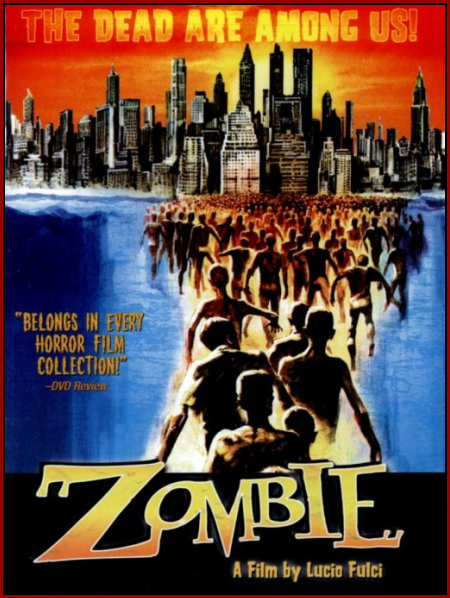
Review: Zombie (dir. by Lucio Fulci)


1979 saw the release of a film titled Zombi 2. It was suppose to be an unofficial sequel to Romero’s own Dawn of the Dead which was released in Italy under the title of Zombi. many thought this pseudo-sequel was a way to cash-in on the success of Romero’s film in Italy. This wasn’t true for the fact that it’s director and producers had already been working on their own zombie film as Romero started on Dawn of the Dead. It was by coincidence that both were released within the same year and in order to try and tie the two films together their titles reflected it.

Lucio Fulci’s Zombi 2 (or just plain Zombie in the US) has no connection whatsoever with Romero’s own Dawn of the Dead except for the zombies and the rules governing their destruction. This is not to say that Fulci’s Zombi 2 wasn’t good. In fact, I would say that Zombi 2 was, and still a great horror movie that’s been unfairly compared with Romero’s ultimate zombie classic. The two films tell different type of stories even when sharing similar plot devices and rules. Where Romero used the backdrop of the zombie epidemic as a damning visual commentary on the growing consumerism culture in the United States, Fulci’s film eschews any such social observations and goes for pure horror instead.

Zombi 2 helped begin the Italian cinema’s love of zombie movies and Fulci’s film still stands as the best of the lot. Starring Tisa Farrow as Ann, the daughter of a missing doctor working in the Carribean, and Ian McCulloch as reporter Peter West who helps Ann try to solve the mystery of her father’s disappearance in one of the Carribean Islands. The only clue they have being the mysterious reappearance of a boat belong to Ann’s father. A drifting yacht which, when inspected by NY Harbor Patrol, a disfigured, obese man violently attacks one of the patrolmen before falling overboard into the city harbor. From that moment on, Ann and Peter head off to her father’s last location on the Carribean island of Matool. Once on Matool, Ann and Peter discover that one of her father’s colleagues, a Dr. Manard, has been trying to solve the mysterious disease, or curse as the native islanders call it, which her father became afflicted with. A disease which seem to kill those it infects and then return them to life to attack the living.

These two are soon joined by a vacationing couple who seem to have arrived on Matool at the worst time. Ann and Peter soon enlist the aid of Brian and Susan, but before they could solve the island’s deadly mystery the island’s dead, both past and recent, rise up from their resting place and doom the remaining inhabitants. One sequence involving these zombies has gone down in horror history as one of the most cringe-inducing scenes on film. It involves the torturously slow sequence where a woman’s head is dragged forward toward a door splinter aimed directly at the woman’s eye. This gore-sequence in addition to the scenes of the zombies attacking and feeding on the visiting Westerners and the remaining living islanders were very well done and all due to make-up FX master Giannetto de Rossi. There’s even a spectacular sequence where a zombie tries to attack and feed on a live shark. Even to this day I still marvel at whichever stuntman volunteered for that action shot.

Zombi 2 has been called a dumbed down attempt to capitalize on Dawn of the Dead. I wholeheartedly disagree with this obeservation. Zombi 2 was never meant to be socially relevant, but one whose only goal was the scare, disgust and disturb its audience with scenes of extreme violence and gore. In this respect Fulci succeeded with the final cut of Zombi 2. The acting itself was very well done considering that half the cast spoke in English as their natural language while the other half were saying their lines in Italian. The dubbing of the Italian-spoken lines were done particularly well. A rarity when it comes to dubbed films.

The final few minutes of Zombi 2 where the Matool survivors make it back to New York through its harbor makes for a great ending. With a city radio station recounting the growing zombie crisis which seemed to have begun while Ann and Peter were on Matool, the final shot of zombies walking on the pedestrian level of the Brooklyn Bridge with cars below them seeming to be rushing out of the city to escape the crisis still makes for a haunting scene. Lucio Fulci’s Zombi 2 might not have been the iconic, cultural and societal masterpiece that was Romero’s Dawn of the Dead, but it more than holds its own when seen as a pure horror film.