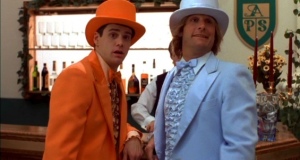
Last night, I turned on Comedy Central and I watched the 1994 comedy Dumb and Dumber.
Why Was I Watching It?
Last night was my first time to ever sit down and watch Dumb and Dumber from beginning to end. I had seen several clips on YouTube and I had been assured by many people that Dumb and Dumber was one of the funniest movies ever made. Last night, since SyFy was not showing an original movie, I decided to find out for myself.
What Was It About?
Harry (played by Jeff Daniels) is dumb and Lloyd (Jim Carrey) is dumber. Harry has messy hair and Lloyd has a chipped tooth. They end up getting kicked out of their depressing apartment and this somehow leads to them going on a road trip from Rhode Island to Colorado. They’re looking for Lloyd’s dream girl, Mary (Lauren Holly). Along the way, they’re pursued by a gangsters and engage in a lot of disgusting adventures. It’s a dumb movie about dumb people doing dumb things.
What Worked?
I laughed once while watching the film. It was a weary laugh that was largely the result of being slowly worn down by the film’s insistence that what I was watching was actually funny. It wasn’t a sincere laugh. It was a laugh of surrender but it was a laugh nonetheless.
Jeff Daniels is currently best known for playing Will McAvoy, the smug and condescending center of HBO’s The Newsroom. That show’s pilot famously started off with McAvoy declaring that the millenials are the “WORST. GENERATION. EVER.” As a member of the WORST. GENERATION. EVER, I have to say that there was something oddly satisfying about seeing Jeff Daniels getting continually humiliated (and, at one point, set on fire) in Dumb and Dumber.
What Did Not Work?
Just to judge by the reaction on twitter while Dumb and Dumber was playing, a lot of people are going to disagree with me on this but Dumb and Dumber sucks. Seriously. The film’s constant gross-out humor felt more lazy than clever and watching it quickly became as tedious as watching a commercial featuring a celebrity talking to their iPhone. As I watched Dumb and Dumber, I found myself constantly checking the time and wondering, “Is the film ever going to actually get funny?”
One of the keys to succesful film comedy is that you have to believe that the characters have an actual stake in the film’s plot, regardless of how ludicrous or over-the-top the plot may get. That stake is the difference between silly and funny. With Jeff Daniels looking extremely uncomfortable and Jim Carrey apparently acting in a separate movie from everyone else, Dumb and Dumber is silly without ever really being funny.
Maybe it was easier to make people laugh in 1994.
“Oh my God! Just like me!” Moments
For once, I’m glad to say that a movie featured absolutely no “Oh my God! Just like me!” moments.
Actually, I take that back. Both me and Lauren Holly have the same hair color. So, that was just like me.
But that is it!
Lessons Learned
Comedy, like beauty, is in the eye of the beholder.
If you’ve read my previous reviews here on the Shattered Lens, that’s not necessarily a major revelation. Still, before I talk about Steven Spielberg’s latest film, the sure-to-be Oscar nominated Lincoln, you should know where I’m coming from as a reviewer. Cinema may be my number one love but history, and especially political history, runs a close second. To me, there is nothing more fascinating than learning how those in the past both viewed and dealt with the issues that we still face in the present. Whereas some people take pride in being able to name every player that’s ever played for the Dallas Cowboys, I take pride in the fact that I can not only name every President and Vice President in order but I can also tell you exactly who they had to defeat in order to serve in those offices.
I love history and therefore, it was hard for me not to feel as if Lincoln was a film that was made specifically for me. Covering the final four months of the life of the 16th president, this film tells the story of Lincoln’s struggle to pass the 13th Amendment and to bring an end to the U.S. Civil War. The film also documents Lincoln’s troubled marriage to the unstable Mary and his son’s decision to enlist in the Union Army. Even though Spielberg and screenwriter Tony Kushner don’t include any vampires*, there’s still a lot going on in Lincoln and it is to their credit that the film remains compelling despite the fact that everyone already knows how the story is going to end.
Daniel Day-Lewis is getting a lot of critical acclaim for his performance in the title role and, for once, I actually have to agree with the critics. Abraham Lincoln is one of the most iconic figures in American history. He is such an icon that, at times, it’s hard to believe that this larger-than-life figure, with his stove-pipe hat and his homely face, was an actual human being who lived and breathed and died like any other human being. It’s easier to think of him in the same way that Jesus Christ used to be represented in films like Ben-Hur, as an inspiring character who is always standing just a little bit off-camera. The brilliance of Day-Lewis’s performance is that he makes us believe that this legendary figure could actually exist with all the rest of history’s mortals. For lack of a better term, Day-Lewis humanizes Lincoln. His performance contains all the bits of the Lincoln legend: the fatalistic melancholy, the steely resolve, the quick humor, and occasional flashes of self-doubt. The genius of the performance is the way that it takes all the legendary pieces and arranges them to create a portrait of a very believable man.
Though the film is dominated by Day-Lewis’s lead performance, the film’s supporting cast does a good job at bringing to life the people around Lincoln. Whenever one film can manage to find roles for Hal Holbrook, David Strathairn, Jared Harris, James Spader, John Hawkes, and Jackie Earle Haley, you’ve got good reason to be optimistic about what you’re about to see. Probably the film’s showiest supporting role goes to Tommy Lee Jones, who plays the firebrand abolitionist Thaddeus Stevens. Admittedly, Tommy Lee Jones gives a standard Tommy Lee Jones performance here but, especially when paired with Day-Lewis’s more internal acting style, the end result is still fun to watch. Also giving a good performance is Sally Field, who plays Lincoln’s mentally unstable wife. Historians have rarely been kind (or fair) to Mary Lincoln but Field makes her into a difficult but sympathetic figure. Finally, even though the role of Lincoln’s son is not a challenging one, I’m always happy whenever Joseph Gordon-Levitt shows up onscreen.
Ultimately, however, Lincoln is a Steven Spielberg film. Spielberg is a very good director but he’s also a very safe one. The same can be said of Lincoln as a film. The film’s cinematography, art design, and costume design are all brilliantly done and award-worthy but it’s still hard not to occasionally wish that Spielberg would have enough faith in his audience that he wouldn’t feel the need to have John Williams provide constant musical cues to let us know what we are supposed to be feeling about what we’re experiencing. If you’re looking for hints of moral ambiguity, an unflinching examination of the rivers of blood that flowed on the Civil War battlefield, or for an in-depth portrait of Lincoln’s personal demons (and most historians agree that he had a few), you might want to look elsewhere. This is not Martin Scorsese’s Lincoln. This is Steven Spielberg’s Lincoln. This is a film that is meant to be inspiring (as opposed to thought-provoking) and, for the most part, it succeeds.
I have to admit that I went into Lincoln expecting to be disappointed. Ever since the film first went into production in 2011, websites like Awards Daily have been hyping this film to death. Before many of them had even seen the completed film, online critics were announcing that both the film and Daniel Day-Lewis were the clear front-runners for the Oscars in 2013. As anyone who has read my previous reviews on this site knows, nothing turns me off more than the bandwagon mentality of the critical establishment. Often times, when a film is embraced as vehemently and as early as Lincoln has been, I feel almost honor-bound to be a hundred times more critical of it than I would be of a film like Step Up Revolution.
However, Lincoln is a rarity. It’s a film that, for the most part, actually lives up to all the hype.
—-
*I imagine that little joke will cause a lot of confusion to anyone who, ten years in the future, happens to stumble across this review. To you, future reader who has forgotten all about Abraham Lincoln: Vampire Hunter, I can only apologize.
I love watching the old educational films from the 1950s. Whether they are dealing with the threat of outside agitators, the need for families to eat dinner together, or the importance of obsessive grooming, these films often provide an interesting view into the past.
(Though, as far as I’m concerned, obsessive grooming is a theme that will never get old.)
Two weeks ago, I first came across The Snob on YouTube. In the days since I first saw it, this 13-minute educational film has become something of an obsession of mine. Some of this is because this film deals with a universal subject. Though I don’t think I’ve ever been a snob, I’ve certainly known a few. Even more importantly, everyone in this film is just so intense. If Edward Albee wrote an educational film, it would have been a lot like The Snob.
Also, is it just me or is the kitchen scene between Sarah and her father kind of creepy?
For almost a month, starting in mid-October and almost two weeks into November, we here at Through the Shattered Lens have watched and shared our reviews and thoughts on the 25 James Bond films (22 official EON productions with 3 non-official ones) which preceded this week’s release of the latest James Bond entry with Skyfall. We’ve shared which were our personal favorites of the series. Some preferred the Connery-era of the Bond franchise while some were in the Moore-era. What we here have all come to realize is just how timeless this franchise has become despite it having celebrated it’s 50th anniversary just last month.
The James Bond film franchise has gone beyond what Ian Fleming had imagined when he first came up with a literary character that would become a global pop icon and remain one of cinemas most successful franchises in history. There have been low points in the franchise (usually when the actor whohas been performing the role has outlived their stay) but then there have been some great highs. In the end, there’s always been one constant and that’s the character of James Bond — British secret agent 007 with a license to kill.
A franchise which began with on Sean Connery in the title role has now seen a return to prominence with the role now in the care of British actor Daniel Craig. The Craig-era began with the critically-acclaimed Casino Royalewhich also became popular with the mass audience. The sequel to this reboot would set the franchise back a step or two, but still became the second highest grossing Bond film in the franchise. We now come to the third Bond film in the Craig-era with 2012’s Skyfall and the question of whether the James Bond franchise can still remain relevant in this age of hyper-kinetic and ultra-violent action films remain to be answered.
Skyfall begins with Bond already in the middle of a mission to recover a computer hard-drive which stores the names of hundreds of NATO agents deep undercover within the many terrorist organizations around the world. Things are not going well for Bond and his fellow MI6 agents. He finds many of them already dead or dying and it’s up to him and another agent named Eve (played by Naomie Harris) to chase after the mercenary who has taken off with the hard-drive.
One thing we’ve come to expect with the more recent James Bond films (especially the Daniel Craig ones) are the action sequences which make up the opening section of the film. Even before we get to the recognizable Bond opening credit sequence this opening of the film using a very thrilling and elaborate action sequence tend to set the tone for the rest of the film. Skyfall was no different as Bond chases the mercenary Patrice through the rooftops of Istanbul’s Grand Bazaar right up to a one-on-one fight on top of a moving train. Through an unfortunate stroke of luck and a command decision by “M” back in MI6 headquarters in London we segue ito the always popular opening credits sequence with Bond having been shot by accident and left for dead.
The plot of Skyfall was somewhat similar to Goldeneye which saw Pierce Brosnan introduced as the new James Bond. James Bond finds himself racing against time and a former MI6 agent who feels betrayed not just by the country and organization he loyally served but by “M” herself. Raoul Silva (played with a sociopathic flair and panache by Javier Bardem) knows the in’s and out’s of MI6 and this allows him to penetrate both their physical and cyber defenses which puts the entire national security of Great Britain and the Commonwealth in extreme peril. It also puts “M” on the proverbial political hot seat as civilian oversight committees look to find a scapegoat for dead MI6 agents and Silva’s continuing assault on Britain’s intelligence apparatus.
To say anymore about the plot of Skyfall would ruin the biggest joy about this film. Mendes would’ve been one of the last people I saw being picked to direct a James Bond film, but he proves himself more than just capable, but also brings his own character-driven narrative sensibilities to raise the bar for future James Bond film. His handling of the quieter moments during the film shows that particular skill of his that has made him an Academy Award-winning filmmaker. It was on the action scenes that Mendes’ skill as a filmmaker would remain in doubt, but with the help of second unit director Alexander Witt, Skyfall manages to create action scenes that weren’t created for the sake of putting action on the screen but to move the story forward.
In the past, James Bond films rarely moved into introspection on it’s main character’s personal and professional motivations. This began to change when Daniel Craig was picked to help reboot the franchise. The first two films with Craig as Bond showed a much grittier and emotionally complex 007 than in years past. We also got a Bond who was still new to the role of being a 00-agent so we saw the character grow into the role. With Casino Royale and Quantum of Solace we got a Bond who moved from newly minted secret agent then to an agent going off the reservation and following his emotions to finish a mission (both official and personal). The one thing those two films didn’t do was give us a Bond that was fully capable and confident in his abilities to get the job done through the biggest odds. But before we finally get that Bond in Skyfall we see him go through personal doubts about whether he still has the skill to be 007 in a world that sees him and his kind of espionage a relic of the Cold War. By the time the film finishes to a close we find ourselves seeing this new modern, complex Bond finally meeting the old-school traditional Bond who delighted our parents and grandparents in the past.
There’s so much more to be said about this film which brings to the table the best of 50 years this franchise has been on the silver screen. The film pays homage to it’s cinematic history, but not so much that the film becomes a “Can you spot a past Bond reference” exercise. Each and every reference seemed to flow naturally into every scene it showed up in and some even got a nice ovation and reaction (classic Aston Martin DB for example). We even got to see the film poke a bit of cheeky fun at some of the franchises more over-the-top plot devices and all of it in good fun.
Then even with a strong story, great performances from the film’s principal cast members there’s still the question that always get asked whenever a new Bond film hits the screen. That question being how were the latest new Bond Girls.
While Naomie Harris’ Eve was a nice partner to Craig’s Bond their chemistry just didn’t flare up like most of the classic pairings in the franchise. That honor goes to Bond’s short, brief time with the character Severine (played by the ridiculously beautiful Bérénice Lim Marlohe). The scenes the two share in the Macau gambling house was one of the highlights of the film with Marlohe conveying both the femme fatale and damsel in distress in the same scene with the most subtle of acting touches. There’s a good chance that whenever “best of…” lists about Bond girls get made each and every year Marlohe as Severine would be on the top of most lists.
It took two films and six years of exploring, deconstructing and analyzing the character of James Bond through the performance of Daniel Craig. Through that time we’ve gotten to see a new side to James Bond without dismissing and forgetting about the character’s suave and deadly efficiency of past Bond films. While I still lean towards Sean Connery as the gold standard of all James Bond performances after seeing Craig as Bond for the third time in Skyfall the gap has shrunk considerably and I wouldn’t argue if some have Craig matching and/or surpassing Connery in the role. It’s a title that would be well-earned and with how the film ends a chance to see how Craig moves forward as Bond not just in the updated modern sense but the traditional that has made the character one of the most iconic figures in cinema history.
A last note, we get a return to old-school James Bond songs with Adele performing the film’s song which actually has the film’s title in it. The song also harkens back to the days of Shirley Bassey and If I had a choice in the matter I would just let Adele sing all future Bond songs for as long as she wants to.
Thus end Through the Shattered Lens’ retrospective on the James Bond franchise both past and present. It’s been a great ride and all thanks to the drive and organization of co-founder Lisa Marie Bowman who styles herself as the site’s resident Bond Girl.
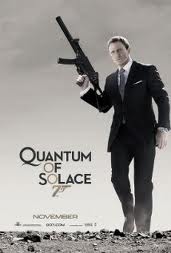
About 22 days ago, The Shattered Lens started a project to cover all of the Bond Films in order leading up to the release of the 23rd film, Skyfall. Spearheaded by Lisa Marie and Arleigh, It’s been a fun ride seeing everyone’s thoughts on James Bond over the movies and it’s cool to know that after 50 years, they still (well, most of them) hold their own. Today, we cover the second Daniel Craig film, Quantum of Solace.
Quantum of Solace reunites the same writing team from Casino Royale – Neal Purvis, Robert Wade and Paul Haggis (Academy Award Winner for 2006’s Crash), and brings on Monster’s Ball director Marc Foster for filming duties. As far as I can tell, it seems to be the first 007 film to start not far from the previous film ended. Literally, there could be a 20 minute difference between the end events of Casino Royale and the opening sequence here. The movie veers away from the classic gun barrel sequence and gets the audience right into the action with Bond avoiding villains in his Aston Martin DBS. The chase leads into a quarry, where he manages to get rid of his opponents. It’s only when he arrives in an unknown location within Siena, Italy that we find he’s had Mr. White in the trunk of his car the entire time. Mr. White was the individual that Bond wounded and introduced himself at the end of Casino Royale.
We basically find James Bond dealing with the loss of Vesper Lynd (Eva Green), and though she never makes any kind of appearance in the film, her presence (or lack thereof) is certainly felt. While Quantum of Solace has some remarkable scenes, for me it suffered from at least one major problem early on. Near the beginning of the film, after the credits, there is a chase between Bond and a villian, as always. At the same time, we’re given shots of a bullfight that’s occurring. While I understand that we’re supposed to see the similarities between both actions, I felt as if I was being pulled away from the story at hand. Foster does this a number of times, including one in the middle of an opera scene. That seemed really strange to me, though others may appreciate it.
Bond is told by M (Dame Judi Dench), after securing Mr. White that she has a lead on Vesper’s boyfriend, but also believes that he’s not quite dead. She asks Bond to leave it alone, but being someone who sees things through, he takes a copy of his photograph. It’s revealed that Mr. White is part of a larger group called Quantum, similar to SPECTRE in some respects. Although Bond loses Mr. White, he gets a clue that leads him to Haiti.
The Haiti sequences were done prior to the earthquake that happened there, and it makes Quantum of Solace one of the last films to show how that area looked before the devastation. 007 is able to find his suspect, but in the course of fighting, he kills him. This becomes something of a thread in Quantum of Solace. Just about anyone that Bond encounters is either killed by him or because of him and at some point, restraint needs to be made. At some point, it goes so far that it becomes something of a “Bond Goes Rogue” tale in the vein of License to Kill. There’s a slight reference to The Spy Who Loved Me with a rooftop fall that’s interesting, as well as a great one for the movie Goldfinger. The Craig Bond stories seem to want to make sure they remind us of all the films before it, though it’s hardly the first 007 story to do so.
The Bond Girls in Quantum of Solace are Olga Kurlyenko and Gemma Arterton. Kurlyenko’s Camille has a mission of her own, as she’s trying to avenge the death of her mother. Arterton’s character, Miss Fields (who’s first name I believe may be Strawberry, but don’t quote me on that) is send in by MI6 to bring Bond back in for debriefing (as he’s been avoiding M’s requests). The actual villain of the movie is played by Mathieu Amalric (Munich), who is more of a hands-off baddie with tons of henchmen at his side.
The problem I had with Quantum of Solace is that it seemed like the Vesper angle was a side note. Yes, we know Quantum is out there, and we learn there’s a plot to control the water of a small area, but outside of all that, it didn’t seem like much of a revenge story. This is unless, of course, it wasn’t meant to be. I’m not a big fan of Quantum of Solace overall. It’s not as bad as Die Another Day (which a number of people consider to be one of the worst) by a longshot, but after what we were given in Casino Royale, it almost seems like it builds on things in the wrong direction.
This weekend, Skyfall is out, and by the time the weekend is up, we’ll have a review for it. We leave you the theme song to Quantum of Solace, “Another Way to Die” by Jack White and Alicia Keys. The Instrumental version of this song is actually really good, though the actual song itself was just a little off.
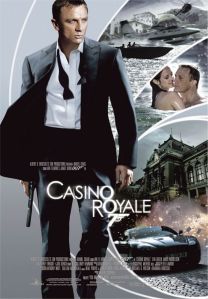
Welcome, one and all! Leading up to the North American release of the latest James Bond film, Skyfall, The Shattered Lens has taken on the task of reviewing each and every one of the twenty two James Bond films that precede it. Today’s is the penultimate review, Casino Royale, the first film of the series to star current-iteration Bond Daniel Craig. It serves as a reboot of the James Bond character, looking back to the beginning of his career, and entirely unconnected from all of the previous films in the series. The only returning actor is Dame Judi Dench, who reprises her role as M, in a more maternal overseer role looking out for a young Bond, despite his rash actions potentially causing trouble for MI6.
Our cold open this time has a black and white Bond confronting a crooked MI6 section chief – one who has been selling secrets to make money on the side. Bond kills both the section chief and his contact, which is enough to earn him his 00-status. The freshly minted 007 heads to Madagascar in pursuit of an international bomb maker. He attempts to find a way to apprehend the bomb maker alive, but is made, and is forced to pursue this man across the city. Bond eventually corners the bomb maker in an embassy building and kills him, blowing up part of the wall, and effecting his escape.
Back in England, M chides Bond for his itchy trigger finger, pointing out that while the world has one less small-time terrorist, they had hoped to get information which would let them fight international terrorism on the organisational level. Bond seems suitably chastened, but M goes further, asserting that she promoted Bond too early, that he is reckless, and a danger. Bond coldly replies that, since the 00-agent’s life is not typically a long one, she will not have to live with her mistake for long.
That’s the sort of Bond that we’re dealing with under the handling of Daniel Craig. While the character is still capable of being charming, he’s a very far cry from Sean Connery’s easy smile and one liners, or Pierce Brosnan’s especially terrible puns. This is sort of the crux of the movie; what controversy exists surrounding its qualities is heavily tied into how you respond to this new take on James Bond. Like all things 2000s, our hero is much grittier than before. Absent is all of Q’s high tech wizardry, and as I stated before, we are not even dealing with a seasoned killer in James Bond, but rather a freshly minted 00 agent. As a result of all these factors, this film has a distinctly different feel from every Bond produced before it. If you like the changes, everything is cool. If you don’t, you may still find yourself appreciating Casino Royale, which has a relatively simple plot, but spends quite a bit of effort on setting up and establishing its characters, including this new James Bond, for the audience.
The main plot of Casino Royale revolves around a high-stakes Texas Hold ‘Em tournament held at the titular casino, located in Montenegro. James Bond is assigned to win the tournament which is being staged by terrorist financier Le Chiffre (Mads Mikkelsen) to recoup the terrible losses he suffered when he used the money of his clients to short sell stock, predicting that a terrorist strike which he himself had planned would send prices into free fall. M hopes that by pushing Le Chiffre to the point of desperation, they can force him to cut a deal with MI6 – sanctuary in exchange for everything he knows about terrorists around the world. Bond is assisted in his goal by fellow MI6 agent Rene Mathis (Giancarlo Giannini) and Vesper Lynd (Eva Green), this iteration’s Bond girl, an agent from HM Treasury, who is assigned to manage Bond’s $10M buy-in, and to provide him with a $5M re-buy if she believes it would be a good investment. However, since a failure on Bond’s part would mean that Her Majesty’s Treasury was directly funding international terrorism, there is incentive to be cautious.
It takes us nearly an hour to begin to engage in the meat of the film, at the titular Casino Royale. Or, at least, this should be the meat of the film. However, the structure of Casino Royale is a little bit off. It feels like it has enough action, but it doesn’t feel properly paced, with the front half of the film (really just a series of subplots to get us to Montenegro) feels like classic “action Bond”. The scenes in the Casino could have been pulled (well, if Daniel Craig could smile, at any rate) from any other Bond film, as his history is littered with a rich litany of casino sequences. Before and after the casino sequences, however, are framing bits that involve idyllic locations, and if I may be so bold, it doesn’t exactly zoom along. The spacing between the casino sequences and the finale, in particular, made the final act feel very tacked on and a little out of place, even as deliberately intended setup for Quantum of Solace. This can also be off-putting, as it feels like there are two different movies going on here.
For the most part though, I think Casino Royale works. If you can live with a grimmer, grittier, low-talking James Bond, you may really appreciate this low-tech return to basics for our favourite 00-agent.
Tomorrow you’ll get a healthy dose of Quantum of Solace, but before I sign off, let me leave you with the theme from Casino Royale, one of the cooler James Bond themes in the franchise, performed by Chris Cornell.
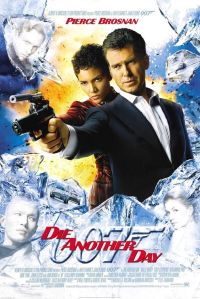
Leading up to the North American release of the latest James Bond feature film, Skyfall, The Shattered Lens is reviewing each and every James Bond film in the history of the franchise. Today’s film is the controversial Die Another Day, the twentieth film in the James Bond franchise, and the final such film to feature Pierce Brosnan in the titular role as 00-agent James Bond. Despite launching to mixed reviews – particularly overseas, where it generated significantly negative reaction in North and South Korea – it was at the time the highest grossing Bond film of all time.
Our cold open for this film has us in North Korea. There, 007 is assuming the identity of a diamond smuggler who is assisting a North Korean Colonel, Tan-Sun Moon, in laundering blood diamonds as part of an ongoing search for advanced military hardware. In order to bypass the landmines of the Korean Demilitarized Zone, the good Colonel has constructed an entire army of hover vehicles which can cross the region without triggering the mines, allowing for a land invasion of South Korea. Bond proceeds with the exchange, but is identified by Zao (Rick Yune), Colonel Moon’s right hand man. Bond triggers an explosion which badly disfigures Zao’s face, which becomes embedded with dozens of diamonds. Colonel Moon attempts to escape on a hovercraft, and Bond pursues him, eventually chasing the Colonel off the edge of a waterfall, apparently killing him. Afterward, Bond is captured by General Moon, the Colonel’s father, and is imprisoned.
After over a year of imprisonment and torture, Bond is traded during a prisoner exchange for Zao. Upon returning to MI6, M (Dame Judi Dench) tells Bond that his 00-status has been suspended. Both she and the Americans believe that Bond cracked under torture and revealed classified information, necessitating the prisoner exchange that brought him back. However, the release of Zao leaves both M and Bond extremely bitter. Determined to recapture Zao, Bond evades MI6’s security and disappears. He travels to Hong Kong, seeking a way back into North Korea, but his contact there informs him that Zao has attempted to disappear in Cuba and provides him with the necessaries to travel there instead.
After he arrives in Havana, Cuba, Bond investigates a clinic there which specializes in gene therapy that is virtually unknown in the first world. Bond’s local contact describes it as prolonging the lives of their leading citizens, and the richest folks in the West, but Bond also learns that the gene therapy would allow a person to totally restructure their appearance and assume a whole new identity. During his investigation, he meets a woman who introduces herself as Jinx (Halle Berry) who, initially unknown to Bond, is an NSA agent on a similar investigation, albeit one with presumably very different goals. Bond locates Zao inside the clinic, and a chase ensues. Although Zao ultimately manages to escape by helicopter (and Jinx in dramatic fashion by diving off the sea wall and boarding a waiting boat which drives her off), Bond recovers a pendant left behind by Zao. Upon unscrewing it, Bond discovers a cache of diamonds. Upon inspection, the diamonds are chemically identical to diamonds found in Sierra Leone, but they bear the identifying mark of a diamond mine owned by a British billionaire and thrill seeker, Gustav Graves (Toby Stephens). Bond is determined to investigate.
This forms the basis of the remaining plot. Our set pieces this time aren’t quite so varied, as much of the remaining story plays out in Iceland, where Graves’ diamond mine is situated, and where he has constructed a special ice hotel for the purpose of a technology convention. Eventually, we return to Korea, for a final showdown that seems somehow empty, despite the increasingly high stakes in terms of both explosions and technology.
The truth, ultimately, is that Die Another Day is a bit of a mess. It has a seemingly incessant procession of action sequences, but they raise the stakes primarily through CGI and improbable wizardry, in a way that threatens our suspend disbelief. I know that this is Bond, and that in 80s-early 00s Bond very much fell into the trap (who didn’t?) of ‘bigger and better’. However, this film takes things a bit too far in my estimation. Its villains aren’t quite as fun as the ones in the past two films (well, Mr. Stamper is kind of a drag I suppose), and don’t really fit the Bond mold. The story is pretty straightforward, but probably doesn’t receive quite the treatment that it deserves to get us established in it. The interactions between Bond and M are a bit too stiff, and I say that even keeping in mind tomorrow’s review piece, Casino Royale. There’s something about Die Another Day that made me think everyone involved was just going through the motions, like a sense of fatigue just hung over the proceedings. It was a bit of a bummer.
As for the women of Bond, Die Another Day actually has a lot to recommend. Breaking convention, this section is heavy with spoilers, but I’m going to risk it just this once. Don’t read on if you’re new to this film and planning to watch it!
Die Another Day continues to feature Dame Judi Dench as a pleasantly strong and uncompromising intelligence chief (I probably haven’t made enough of how much I enjoy her in the role of M in my reviews up to this point). In addition, we’re treated to Halle Berry as Jinx, an ass-kicking NSA agent who seems to do a lot of getting outmaneuvered and captured for being so adept. I didn’t care for Berry’s performance in this film, and I’d be lying if I said she stacked up well against Tomorrow Never Dies’ Michelle Yeoh as a Chinese intelligence agent. Still, compared to some of the other Bond girls, Berry is definitely a warrior. The other major female character, however, is Miranda Frost (Rosamund Pike), a frigid and beautiful MI6 agent… actually, a double agent, who betrayed Bond in the cold open. Pike’s character definitely gives off the edge of competence and deadliness that I, for one, am rooting for in female characters in any Bond movie, and she sells it well. Unfortunately, she’s not nearly as fun as Elektra King, as her motivations are completely unexplored and she just feels like an add-on to the existing plot surrounding some dangerous North Koreans.
Overall, this is probably not one of the better Bond films, though I’d argue that it doesn’t deserve the bad rap that some have given it either. It’s not a terrible film, just overwrought in a kind of Michael Bay way that undermines the characters and concepts. This is a common complaint of all four Pierce Brosnan films, especially, as well as some of the Roger Moore and Timothy Dalton efforts. However, this is the one that I most agree with that assessment of. This film really gets out of control with effects and gadgetry.
That’s it for today’s review. I leave you with the theme from Die Another Day, performed by Madonna. Tomorrow’s review will be of 2006’s Casino Royale.
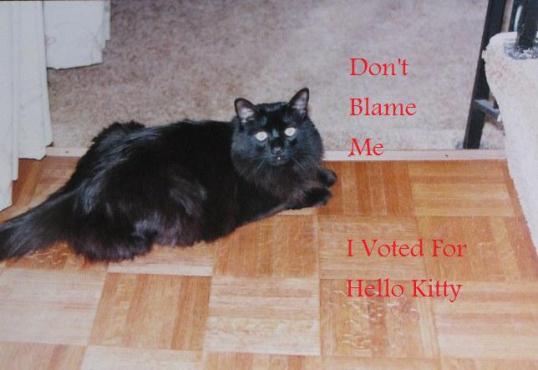
Hi everyone! Yesterday was election day here in the United States and what can I say other than that I’m taking my cute ass to Canada! That may sound extreme but earlier this month, I promised that if Hello Kitty and Tuxedo Sam did not win this election, I was heading up north.
And in honor of my future life in the land of Degrassi and Ryan Gosling, here’s another edition of Lisa Marie’s Favorite Grindhouse and Exploitation Film trailers. And guess what? This edition is dedicated to Canadian films!
1) Abraxas: Guardian of the Universe (1990)
This is less of a trailer and more of an advertisement designed to entice retailers to keep Abraxas in stock. But, what’s really important here is that it’s Canadian.
2) Expect No Mercy (1996)
With a title like Expect No Mercy, it has to be good! Plus, it was made in Canada.
3) Jesus Christ Vampire Hunter (2001)
Who needs Abraham Lincoln?
4) The Playgirl Killer (1966)
“The Playgirl Killer … in color!” I think the Playgirl Killer looks like he might be distantly related to Steve Buscemi.
5) Starship Invasions (1977)
I think this film might involved starships invading something. It’s hard to tell from the trailer.
6) Rolling Vengeance (1987)
It’s out for revenge! And it’s … rolling, apparently.
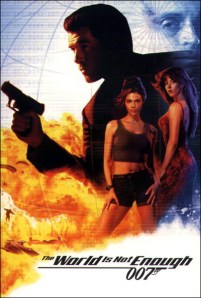
Hello everyone! As a prelude to the North American release of Skyfall, we here at The Shattered Lens have been reviewing each and every single James Bond film in the history of the franchise. Today we examine the nineteenth film in the James Bond franchise, and the third to feature Pierce Brosnan as the titular super spy, Ian Fleming’s James Bond. Its title? The unpretentious The World is Not Enough.
This time our cold open has Bond in negotiations with a Swiss banker for the return of a significant amount of money belonging to British Knight, Sir Robert King, who is a personal friend of M (Dame Judi Dench). Negotiations break down quickly, when Bond reveals that King was buying a report over which an MI6 agent was killed. The banker not only refuses to disclose information, but actually threatens Bond. Bond takes control of the situation in predictable fashion, offing the Banker’s underlings and capturing the man in question. However, before the banker can give up the name of the man who hired him, he is picked off by his own assistant – revealed to be a lovely young assassin (Maria Grazia Cucinotta), who disappears before Bond can do much in the way of response. With the police already on their way, Bond escapes out a window, and heads back to jolly old England.
When Bond returns to MI6 headquarters, Sir King takes possession of his money. However, Bond deduces seconds too late that the money has been trapped with a binary compound explosive that King inadvertently triggers, blowing up the suitcase of money, Robert King, the entire room he is present in, and a huge chunk of the wall of MI6 headquarters. Bond arrives just in time to see the same assassin outside in a speed boat, aiming a mounted gun his direction. Upon seeing Bond, she opens fire, but then quickly turns tail and flees the scene. Bond seizes a speed boat from Q and goes in pursuit. After a truly remarkable chase sequence (by sea, by land, and by air!) Bond catches up with the assassin, who commits suicide by firing into the tanks of her own hot air balloon rather than risk being taken alive. Bond falls and is heavily injured, and the assassin is killed.
Bond convalesces under the care of one Dr. Molly Warmflash (Serena Scott Thomas), but unwilling to actually wait for his wounds to heal, he “persuades” the good doctor into giving him a clean bill of health, the way only James Bond can. Medically cleared, he invites himself into a high level planning session with M where they trace the assassination of Robert King back to its likely perpetrator – a notorious Soviet terrorist, Renaud (Robert Carlyle). Recognizing the danger he represents, M sent 009 to kill Renaud. Although the agent got a shot in, and it struck Renaud in the head, the bullet miraculously failed to kill the terrorist right away. Instead, it slowly burrows through the matter of his brain, dampening and destroying his senses one by one. Dr. Warmflash speculates that while Renaud will eventually die from his wound, in the meantime he feels no pain, and is particularly dangerous as a result. Renaud had previously abducted and held hostage King’s beautiful daughter, Elektra (Sophie Marceau), for ransom. M believes that Renaud is attempting to strike against the King family again. Concerned with Elektra’s safety, she assigns 007 to personally see to her security.
Things ramble on quickly from there. Like Tomorrow Never Dies, there are no shortage of action pieces in The World is Not Enough. The film has a healthy dose of plot twists and is finely paced, never really descending into a lull. It has excellent set pieces, including a kind of cart racing down an oil pipeline, a battle in a caviar factory (which includes a notable cameo from our old friend Valentine, first introduced in Goldeneye [a fun role that is heartily embraced by actor Robbie Coltrane]), and even climactic showdown aboard a Soviet nuclear submarine Unfortunately, The World is Not Enough suffers from a couple of limitations that hold it back from being a truly great Bond film. Yes, that’s right folks, it’s time we talked about one of the more infamous Bond girls… Dr. Christmas Jones (Denise Richards).
Now, I don’t necessarily hate Denise Richards, but she’s not what I’d call a paragon of acting ability. She doesn’t bring a ton of range to a character that is already a bit on the weak side. Dr. Jones, a short-short short-dress short-skirt clad nuclear physicist, is not short on brains. She’s also athletic, and able to keep up with 007’s crazy antics for the most part. She’s also a patently unbelievable character, a stretch even for James Bond, even for latter-day Pierce Brosnan James Bond. She doesn’t ever really fit into this film, and while the movie’s plot ultimately deals with a nuclear threat (as always, I won’t spoil the film’s more important plot details!) and it seems like Dr. Jones’ expertise might be useful… mostly, she just offers some rather obvious exposition, and serves as a sexual object for one important sequence in the film’s final third. So, hooray? Compared to ass-kicking Chinese secret agent Wai Lan, the main thing that Denise Richards’ character brings to the James Bond franchise is cup size. And more easy puns on her name than you can shake a stick at.
This film is also notable for being the tragic final appearance of Desmond Llewelyn in his long time role as “Q”. Although the film … “humourously” … introduces John Cleese as Q’s successor early in the film, there were no official plans to cut Desmond Llewelyn from future Bond films, and he had not announced plans to retire. Unfortunately, Llewelyn was killed in a traffic collision shortly after the film’s premiere. R.I.P.
That having been said, I still very much like this movie. For reasons which are not entirely clear, I think I’ve seen it a dozen times or so (maybe it’s just on BBC a lot?) and nothing about it ever makes me want to turn the film off. In fact, vibrant performances by the film’s villains and an energetic Judi Dench as M (more active in this film than in … probably any other) kind of bring this one to life for me. Of course, this film definitely telegraphed a possible dive off the cliff’s edge… something which we may or may not journey through together in tomorrow’s film, the much-maligned Die Another Day.
In the meantime, let me leave you with my all-time favourite James Bond theme, presented by Garbage:
It’s election day! Today is the day that American citizens select the person that they’ll be angry with for the next four years. Have you voted yet? I did and, after I turned in my ballot, this guy at the polling place told me that I was the prettiest voter that he had seen all day. Awwwwww!
Today’s scene that I love is particularly appropriate for Election Day. In The Candidate (1972), Bill McKay (played by Robert Redford) runs for the U.S. Senate. Directed in a documentary fashion by Michael Ritchie, The Candidate features excellent supporting performances from Melvyn Douglas and Peter Boyle and it’s one of the best films ever made about the American political system.
The scene below takes place at the end of the film, after the votes have been counted. And, of course, the entire scene is a spoiler so don’t watch it if you haven’t seen The Candidate.