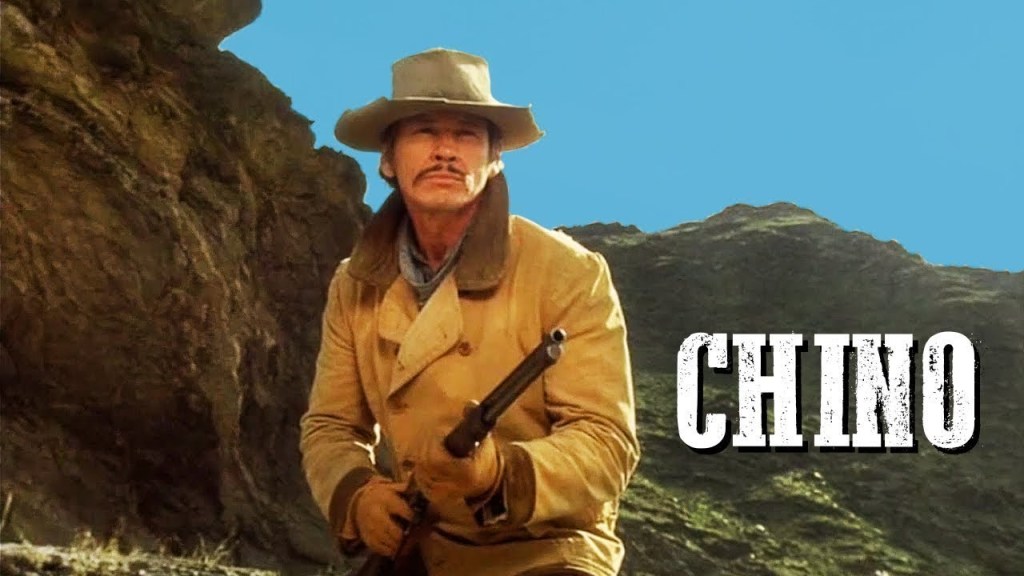
Brad revisits CHINO (1973), starring Charles Bronson, on Jill Ireland’s 90th Birthday!


I remember the first time I ever saw the Charles Bronson western, CHINO.  I was probably around 13 or 14 years old and already well known in my school for being obsessed with the actor Charles Bronson, who would have been roughly 65 years old at the time. There was this girl who I guess had a crush on me, so she invited my best friend Chad and I, along with her best friend, over to her house to watch a movie one Saturday. And the movie she chose… CHINO, AKA THE VALDEZ HORSES! I don’t think I watched the movie very close that day. CHINO was treated poorly on VHS in the 80’s, and I was more interested in the DEATH WISH 3s and MURPHY’S LAWs of the world at that time. I was also more interested in trying to make the girls laugh, which was always my main move because I was never good looking enough to smolder.

So, for many years, CHINO was nowhere near the top of my list of favorite Charles Bronson films.  I watched it a few times, but I always found it hard to take seriously due to the cheap quality of the video presentation.  Well in 2021, Kino Lorber released the film under THE VALDEZ HORSES title in a glorious Blu-ray. CHINO is a revelation with this new release, and I finally saw what I had been missing all these years. For the first time, I felt like I was able to watch it, and judge it, based on its own merits as a film.

CHINO opens on Jamie (15-year-old Vincent Van Patten) riding across the range as the title tune “Freedom Rainbow” plays over the credits. When he comes upon a ranch just as it’s getting dark, a tough-as-nails-looking Chino Valdez (Charles Bronson), emerges from the cabin and offers him a warm fire and a meal. Initially a little scared of Chino, Jamie is looking for work and Chino needs help, so the boy hangs around for a while. Things seem to be going well as the eager Jamie and Chino work the horses at his ranch, but soon issues start popping up. First, it’s the barbed wire that cattle baron Maral (Marcel Bozzuffi) puts up on the range that results in serious injuries for some of Chino’s wild horses.  Then, it’s the fact that every time Chino goes to town for supplies, he ends up drinking, brawling, and spending a little time in jail. But those things pale in comparison to the biggest issue… Chino falls in love with the beautiful Catherine (Jill Ireland), Maral’s sister, and Maral will have no part of her falling back in love with the half breed Chino! Maral threatens to kill Chino if he doesn’t quit seeing his sister, and he means it.

Based on the award-winning 1967 novel THE VALDEZ HORSES by female author Lee Hoffman, director John Sturges crafted a movie around a role that seems tailor made for Bronson. Chino Valdez is a loner who reluctantly takes on a fatherly role towards Jamie, and then even more reluctantly falls in love with Catherine. He seemed like the kind of man who would be perfectly fine working the ranch by himself forever until Jamie rides up. A loner in real life who valued his family over anything else, who also purchased his own horse ranch in Vermont the same year of CHINO’s release, it’s hard to know where the character of Chino begins and Charles Bronson ends. This is a particularly strong performance from Bronson, one of his very best.

And you really do need to savor the film for Bronson’s incredible presence, because the film doesn’t have as much action, nor does it lead to the typical showdown that we’ve come to expect in Bronson’s movies.  Chino gets into a scuffle when he goes into town, and he shoots some bad guys at the end, but this is first and foremost a character study.  As a matter of fact, the film that John Sturges delivered had even less action than what we see in the final product.  Disappointed in the surprising lack of action, producer Dino De Laurentiis hired director Duilio Coletti to shoot some additional action scenes for the film after Sturges had left the project. These scenes are incorporated very well into the final product, and I agree that they add value.

Without the typical Bronson action, we’re left with a perfectly cast Bronson interacting with the supporting characters in ways that are atypical for his filmography. Bronson and Vincent Van Patten work well off each other, and Van Patten is phenomenal as the teenage Jamie. I love that their relationship evolves into something meaningful as the movie progresses.  Chino learns that he can trust the boy who seems to emerge as a young man right before our eyes. And then there’s the relationship between Chino and Catherine, played by Bronson’s wife Jill Ireland. Not quite as effective as the Chino / Jamie relationship, it’s still character driven and unique. Chino shows a tenderness towards her in a couple of scenes that we’re not used to seeing presented onscreen, even if one of the moments is brought on by the admittedly odd inclusion of the two watching his stud mount a beautiful wild mare. Ireland is extremely beautiful, so it’s not completely surprising that the self-sufficient Chino would fall for her.  Unfortunately, while the Chino / Jamie relationship strengthens throughout the film, the Chino / Catherine relationship eventually goes the other way leading to the somewhat surprising, some might say disappointing, finale.      

After watching the restored Blu-ray presentation by Kino Lorber, I can confidently say that CHINO is a good Charles Bronson film that features one of his best performances. It’s still not in my personal Bronson top ten, but if you’re a fan of Charles Bronson the actor, then this a must-watch. It’s my opinion, after having read the book and watched the movie, that no other actor could have brought the character of Chino Valdez alive in a stronger way than Charles Bronson. It was the perfect combination of actor and character, and I’ll stand by that opinion to the end.  
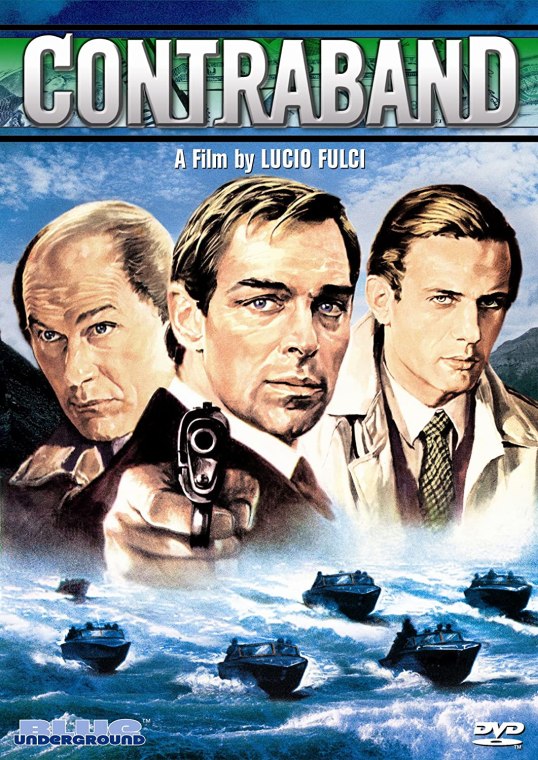
An Offer You Can’t Refuse #14: Contraband (dir by Lucio Fulci)


The 1980 film, Contraband, tells a story of the Neapolitan underworld.

Luca Ajello (Fabio Testi) and his older brother, Mickey, have a pretty nice operation going.  They pilot boats up and down the coast of Italy, smuggling cigarettes and booze into Naples.  It’s given both of them a pretty good life.  They own a racehorse.  Luca’s got a big house with a beautiful wife (Ivana Monti) and a precocious son.  The police are too incompetent to stop them and their disco-loving boss, Perlante (Saverio Marconi), keeps them safe from any interference from the other mob bosses working in Naples.

But then, one night, two men disguised as policeman pull Luca and Mickey over while they’re driving down an isolated road.  The fake cops proceed to fire what seems to be over a hundred bullets into Mickey.  Luca, having ducked down in his seat, is not spotted by the assassins.  Determined to find out who murdered his brother and why, Luca immediately suspects a rival mobster named Scherino but Scherino insists that Mickey’s murder was actually ordered by a mysterious French drug lord known as Il Marsigliese (Marcel Bozzuffi, who also played a French drug smuggler in The French Connection).  The French are trying to take over the rackets in Naples and a sudden surge in violence, one which sees nearly every mob boss in Naples murdered on the same day, suggests that Scherino is telling the truth.

Contraband is a brutal Italian crime film, one that is notable for being one of director Lucio Fulci’s final non-horror films.  (Contraband was released after Zombi 2 but before City of the Living Dead.)  Though the film might not feature any zombies or any talk of “the Beyond,” it’s still unmistakably a Fulci film and some of the film’s brutal violence remains shocking even when seen today.  The scene where a duplicitous drug smuggler gets her face melted with a blow torch is nightmarish and it’s followed by a scene where a rival gangster graphically gets the back of his head blown out.  (Fulci lingers on the hole in the man’s head, giving us an out-of-focus shot of the people standing behind him.)  A later gunfight leads to one gangster dying with a gaping hole in his throat while another has his face shot away, despite the fact that he’s already dead.  It’s graphic but it’s also appropriate for the story being told.  This is a movie about violent men and, as Fulci himself often pointed out whenever he was challenged about the graphic gore in his films, violence is not pretty.  Contraband is not a film that’s going to leave anyone wanting to become a gangster.

The plot is not always easy to follow but, as is typical with a good Fulci film, the striking visuals make up for any narrative incoherence.  Fulci’s camera rarely stops moving, creating a sense of unease and pervasive paranoia.  Much like the characters in the film, we find ourselves looking in every corner and shadow for a potential threat.  A meeting with an informant at a mist-shrouded sulfur pit ends with assassin literally emerging from the mist and stabbing the informant from behind.  A later gun battle on a narrow street seems to feature gunmen literally appearing out of thin air.  Fabio Testi is ruggedly sympathetic as Luca while Saverio Marconi does a great job as the decadent Perlante.  Meanwhile, Marcel Bozzuffi is legitimately frightening in his few scenes as the evil French gangster.  He’s a great villain, smug and willing to kill anyone.  You don’t have to support organized crime to support the idea of running the French out of Naples.

Contraband is a minor crime classic and proof that there was more to Fulci than just zombies and serial killers.  Today would have been Lucio Fulci’s 93rd birthday and it’s also a good day to track down Contraband, an offer that you can’t refuse.

Previous Offers You Can’t (or Can) Refuse:

  1. The Public Enemy
  2. Scarface
  3. The Purple Gang
  4. The Gang That Could’t Shoot Straight
  5. The Happening
  6. King of the Roaring Twenties: The Story of Arnold Rothstein 
  7. The Roaring Twenties
  8. Force of Evil
  9. Rob the Mob
  10. Gambling House
  11. Race Street
  12. Racket Girls
  13. Hoffa

Lisa Watches An Oscar Winner: The French Connection (dir by William Friedkin)


TheFrenchConnection

Earlier today, thanks to Netflix, I watched the 1971 best picture winner, The French Connection.

Based on a true incident, The French Connection is the story of two NYPD detectives, the reasonable and serious Buddy Russo (Roy Scheider) and his far more hyperactive partner, Popeye Doyle (Gene Hackman).  When we first see them, Doyle is dressed as Santa Claus and they’re both chasing a drug dealer through the streets of New York.  When they eventually catch up with the dealer, Russo plays good cop while Doyle plays batshit insane cop.  That’s a pattern that plays out repeatedly over the course of the film.  Russo suggests caution.  Doyle blindly fires his gun into the shadows.  Russo is sober.  Doyle is frequently drunk.  Russo is careful with his words.  Doyle is a casual racist who never seems to stop talking.  The one thing that Russo and Doyle seem to have in common is that they’re both obsessed with catching criminals.

The French Connection is also the story of Alain Charnier (Fernando Rey), a suave and always impeccably dressed French businessman.  Charnier has a plan to smuggle several millions of dollars of heroin into the United States by hiding it in a car that will be driven by an unsuspecting (and rather vacuous) French actor named Henri Devereaux (Frederic de Pasquale).  Working with Charnier is a low-level mafia associate named Sal Boca (Tony Lo Bianco) and a lawyer named Joel Weinstock (Harold Gray).

(Incidentally, Weinstock’s chemist is played by an actor named Patrick McDermott, who also played Susan Sarandon’s abusive hippie boyfriend in Joe.  The French Connection was McDermott’s third film and also his last.  I point this out because McDermott totally steals his one scene in The French Connection.  When one considers both his performance here and his work in Joe, it’s strange and unfortunate that McDermott’s cinematic career ended after just three films.  According to a comment left on the imdb, he later ran a health food store in Nebraska.)

When Doyle and Russo just happen to spy Sal hanging out with a group of mobsters at a local club, they decide (mostly on a whim) to investigate what Sal’s up to.  They notice that Sal drives a car that he shouldn’t be able to afford.  Will they discover how Sal is making his money and will they be able to stop Charnier from smuggling his heroin into the United States?

Well…let’s just say that The French Connection was made in 1971.  That’s right, this is one of those films where everything is ambiguous.  Neither Russo nor Doyle are traditional heroes.  Neither one of them is foolish enough to believe that their actions will make a difference.  Instead, they seem to view it all as a game, with Doyle and Russo as the win-at-any-cost good guys and the French as the bad guys.  And, indeed, it’s interesting to note that, when the police do make their move against Charnier, it’s the people who work for him who suffer the worst punishments.

I have to admit that, as a civil libertarian, Doyle is the type of cop who should make my skin crawl.  He’s an obsessive bigot, the type who runs into the shadows with his gun drawn and blindly firing.  When I watched The French Connection, a part of me wanted to get offended and say, “It’s none of your business why Sal has an expensive car!”  But I didn’t.  In fact, I was rooting for Doyle the whole time.  The French Connection is probably one of the best cast films of all time.  Hackman gives such a good performance that, while you can’t overlook Doyle’s flaws, you can accept them.  Meanwhile, Rey is so sleazy and smug in the role of Charnier that you really don’t care about his rights.  You just want to see him taken down.

(That said, if I ever got hold of a time machine and went back to New York in 1971, I’d rather be arrested by Russo than Doyle.  Doyle seems like he’d be the type to grope while frisking.)

Seen today, it’s a bit odd to think of The French Connection as being a best picture winner.  It has nothing to do with the film’s quality.  The film’s performances remain strong.  William Friedkin’s documentary-style direction is still compelling and he makes the decay of 1970s New York oddly beautiful.  Instead, it’s the fact that The French Connection essentially tells a very simple story that, when seen today, feels very familiar.  It’s a cop film and it includes every single cliché that we’ve come to associate with cop films.  (Russo and Doyle even have a supervisor who yells at them for not doing things by the book.)  But, what you have to realize is that the majority of those clichés were invented by The French Connection. If imitation is the sincerest form of flattery, then The French Connection is probably one of the most flattered film ever made.

And what better way to end this review than by sharing The French Connection‘s most influential scene?  In the scene below, Doyle chases a commuter train that happens to be carrying one of Charnier’s associates.

Apprecier le film!