Everything Is Awesome! The Lego Movie Is Still Great!


The_Lego_Movie_poster

Have you ever rewatched a film that you remembered as being pretty great just to then be totally shocked to discover that it really wasn’t even that good?

It’s happened to me more times than I care to count.  Often times, it seems like the films that have the most immediate impact on us are the same films that, in a matter of weeks, we often end up forgetting.  My personal theory is that these films are so designed to make an immediate impact that there’s often little room for the subtext that would be necessary for a movie to actually linger in the mind.  These are the type of films that we remember enjoying but it’s often a struggle for us to explain why we thought it was great.  (“Oh my God,” we say, “it was such a great movie!” and then we leave it at that.)  When we do get around to watching the film for a second time, we’re often left slightly disappointed.  Now that we know what’s coming, the film no longer has as much of an impact.

It happens all the time and I hate it.  That is why, often times, I find myself dreading the second viewing.  Will the film still work the second time or will it turn out that the film only truly works when viewed with virgin eyes?

That’s one reason why I was feeling a bit of trepidation about rewatching The Lego Movie when it showed up on HBO this month.  After all, I loved the Lego Movie when it was originally released earlier this year.  As soon as I got home from seeing it at the Alamo Drafthouse, I jumped on twitter and tweeted out, “EVERYTHING IS AWESOME!”  For the past few months, I’ve been telling everyone that the Lego Movie was great.

But was it really?

Of course, everyone knows what The Lego Movie was about.  President Business (Will Ferrell) is seen by the residents of the Lego Universe as being a benevolent ruler but actually, he’s an insecure control freak who enforces strict conformity and who is planning to use a mysterious weapon known as the Kragle to rob everyone of free will and imagination.  A group of rebels — known as the Master Builders and led by Vitruvius (Morgan Freeman) — hope to stop him.  According to Vitruvius, a chosen one will defeat President Business and, to everyone’s surprise, the Chosen One turns out to be a cheerfully ordinary construction worker named Emmett (Chris Pratt).

There were so many things that I remembered loving about the Lego Movie.

I loved the voice work done by the film’s talented cast.  Along with the perfectly selected Ferrell, Freeman, and Pratt, the cast also includes: Will Arnett as a hilariously pretentious Lego Batman, Elizabeth Banks as the rebellious Wyldstyle, Liam Neeson as Bad Cop, the always brilliant Nick Offerman as a pirate called Metal Beard, Charlie Day as a “space guy,” and Alison Brie as my favorite character, Unikitty (a unicorn/kitty hybrid, and who wouldn’t want to own one of those?).  And, of course, there were also cameos from Channing Tatum as Superman and Jonah Hill as a hilariously obsequious Green Lantern.  I remembered that all of these actors had done great work, bringing very vivid life to their characters.

And I remembered that all of the actors were aided by a script that was full of funny lines and clever bits of satire.  I remembered loving the enthusiastic way that Charlie Day talked about making a spaceship.  I loved Will Arnett’s pretentious hipster posturing.  I loved the way that Chris Pratt could deliver a line like, “I understand what you’re saying but could you repeat it again because I wasn’t listening?”  I loved Liam Neeson switching back and forth from being the ruthless Bad Cop and the painfully nice Good Cop.  And most of all, I loved Morgan Freeman.  Freeman, of course, is known for having the most God-like voice in the movies and, in this movie, he delivers even the most over-the-top dialogue with a calm and soothing authority.

And I loved the song Everything Is Awesome, an earworm if there ever was one!

And finally, I remembered that — as funny as The Lego Movie was — it also made me cry.  The theme of being yourself and going your own way is a common one but the Lego Movie expressed it with such sincerity that it was impossible for me not to be moved as if I was hearing it for the very first time.

So, as I lay down to rewatch the Lego Movie, I asked myself if the movie would live up to my memories.

Well, guess what?

EVERYTHING IS AWESOME!

The Lego Movie is just as good on subsequent viewings than on the first!  So, if you somehow haven’t watched it, then watch it now.  And if you have watched it, watch it again!
Film Review: Anna (dir by Jorge Dorado)


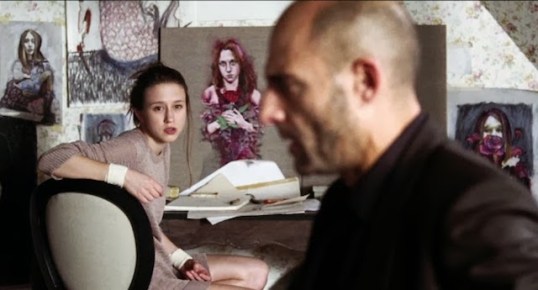
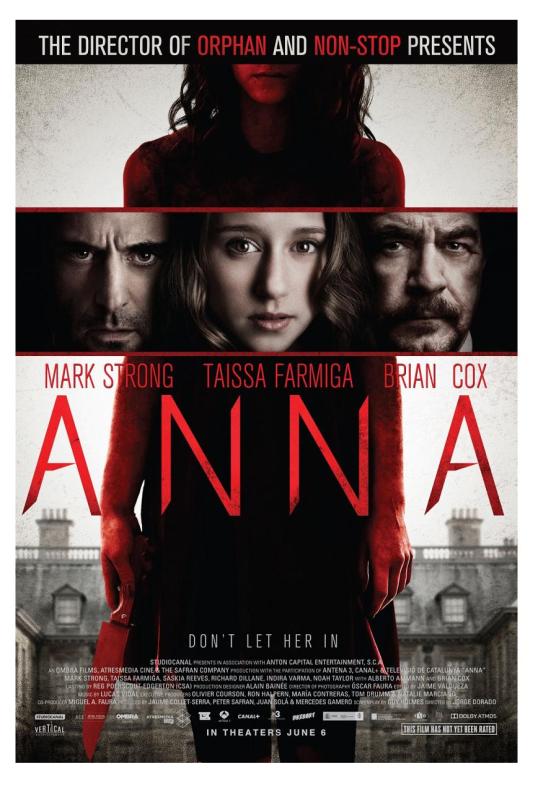
AnnaI just finished watching Anna, a Spanish thriller that was briefly given an American release way back in June.  Anna (which was produced under the title Mindscape) got fairly bad reviews, with many critics dismissing it as being a weak imitation of Inception.

Having now seen the film, I can say that, once again, the critics were wrong.

Oh, don’t get me wrong.  It’s obvious that without Inception, there never would have been an Anna.  But, as any fan of old school Italian horror can tell you, imitation is not necessarily a bad thing.  Anna may start out as a low-budget take on Inception but, by the end of the film, it has established its own unique identity.

Anna tells the story of John (Mark Strong), a “memory detective.”  John has the power to enter into people’s memories, where he can search for clues to help people deal with psychological trauma and to occasionally help the police solve crimes.  At the start of the film, John is recovering from a trauma of his own.  After their son dies, his wife — who is also a memory detective — retreats so deeply into her memories that she can’t come back.  (Yes, I know.  It’s exactly like Inception.  Just be patient…)  While exploring the memories of an assault victim, John’s own memories start to intrude on the victim’s memories, leading to John having a stroke.

After John recovers from the stroke, he finds himself both financially destitute and emotionally unstable.  His boss (Brian Cox) takes sympathy on John and assigns him to what should be an easy case.  16 year-old Anna (Taissa Farmiga) is refusing to eat and her extremely wealthy parents want to know why.

John meets Anna and discovers that she’s a sarcastic, intelligent, and withdrawn teenager.  When John enters into her mind, he discovers memories of neglect and abuse.  The night after John first enters Anna’s memories, her nurse is pushed down a flight of stairs.  The nurse claims that Anna pushed her while Anna swears that she’s being framed.  Anna’s parents, meanwhile, have signed papers to have her committed, giving John just a few days to determine what’s behind Anna’s behavior.

Convinced that she’s innocent, John enters into Anna’s memories and searches for clues that will answer the question of whether Anna is a victim or a sociopath.  As he does so, he finds more and more evidence that Anna was abused.  However, he also starts to discover hints that there may be more to Anna’s memories than he originally realized.

Anna is a good and entertaining mystery of a film, one that takes its time telling its multi-layered story.  Jorge Dorado makes his directorial debut with Anna and he wisely emphasizes characterization and atmosphere above all else.  There’s a dream-like sense of menace that fills every frame of the film, casting a palpable feeling of unease over both John and the audience.  As a result of his work here, I’m definitely looking forward to seeing what Dorado does in the future.

Mark Strong is a talented and intelligent actor who has gotten typecast as a villain.  As such, it’s nice to see him actually get a chance to be the star for once.  Strong gives a sympathetic performance while adding just enough instability that the audience is never totally at ease with John.  The same can also be said of Taissa Farmiga, who gives a wonderfully ambiguous performance that makes Anna both innocent and destructive at the same time.  Anna keeps both John and the audience guessing until the very end of the film.

Anna is currently making the rounds on cable.  I would recommend keeping an eye out for it.

strong


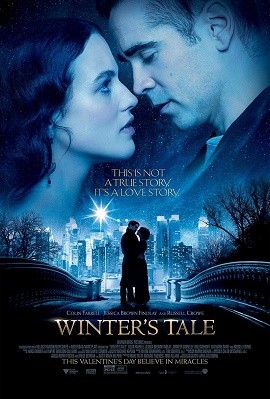
A Late Film Review: Winter’s Tale (dir by Akiva Goldsman)


Winter's_tale_(film)

I liked Winter’s Tale.

And I don’t care what anybody else says!

And that’s a good thing too because, critically, Winter’s Tale has been one of the most maligned movies of 2014.  It came out on Valentine’s Day, at the same time as Endless Love.  And the critics absolutely hated it!  For a while there, the online film community was taking bets on which one of the two Valentine’s Day releases would end up with the lowest score on Rotten Tomatoes.  And, though it was a close race, Winter’s Tale actually ended up with the lower score, coming in at 13% as opposed to Endless Love‘s 15%.

That’s right — according to most mainstream film critics, Winter’s Tale was actually worse than Endless Love.

Well, those critics were wrong.  That’s how I felt when I first saw Winter’s Tale and, after watching it a second time on HBO, that’s still how I feel.  Winter’s Tale is not a bad movie!

(Incidentally, Winter’s Tale has a 6.2 rating over at the imdb, which would seem to indicate that I’m not the only person who knows better than Peter Travers.)

Admittedly, the plot of Winter’s Tale does not make much logical sense but that’s kind of the point.  It’s a tale and tales are not about being realistic.  Tales are about emotion and the whole point of listening to or telling a tale is to inspire feelings. To truly appreciate Winter’s Tale, you have to understand that this is a fairy tale that happens to be set in the most mythical of American cities, New York.

Opening in 1895 and ending in 2014, Winter’s Tale tells the story of Peter Lake (Colin Farrell).  When Peter was an infant, his immigrant parents were refused entry into Manhattan because they both had tuberculosis.  So, they put Peter in a toy boat and dropped him into ocean and watched as the boat slowly floated towards America.

Jump forward 21 years and Peter has grown up to be a thief, working for a gangster named Pearly Soames (Russell Crowe).  What few people know is that Pearly is actually a demon who regularly visits his boss, Luicfer (played by Will “Yes, that Will Smith” Smith).  Pearly is immortal as long as he stays in New York City.

When Peter decides that he wants to leave Pearly’s gang, Pearly orders that Peter be killed.  However, while fleeing from the rest of the gang, Peter is rescued by a flying white horse.  While Peter’s first instinct is to fly the horse out of New York and spend the winter in Florida, he instead decides to rob one more mansion.  (It helps that the horse literally takes him to the mansion.)

While robbing the mansion, Peter meets Beverly Penn (Jessica Brown Findlay), a passionate and talented pianist who is dying of tuberculosis.  In what is literally a case of love at first sight, Peter forgets about robbing the mansion and instead has a cup of tea with Beverly.  They discuss their lives and Beverly tells Peter that everyone has a miracle inside of them and that everyone becomes a star after dying.

Soon, Peter and Beverly are a couple and Peter even manages to win over Beverly’s suspicious father, Isaac (William Hurt).  Peter and Beverly spend the winter at her family’s summer home.  Peter believes that his miracle is to save Beverly.  Meanwhile, an angry Pearly waits for his chance to get revenge…

Now, I will admit that there are some obvious flaws with Winter’s Tale.  Russell Crowe goes totally overboard, with his accent wildly going from Australian to New Yorkish to Scottish and back again.  Meanwhile, Will Smith is not necessarily a bad choice to play the devil and he actually gives a pretty good performance but it doesn’t chance the fact that, whenever he’s on screen, all you can think about is that he’s Will Smith and he’s playing the devil.

But, honestly, who cares?  This is an amazingly romantic film and Farrell and Findlay have a lot of chemistry.  When you see them together, you have no doubt that Peter and Beverly are meant to be together.  You care about them as a characters, even if you don’t always understand everything that’s happening around them.  Their love feels real and, when it comes to telling a love story, isn’t that the most important thing?

(Add to that, does any actor fall in love as convincingly as Colin Farrell?)

And the film itself is gorgeous!  From the costumes to the set design to Caleb Deschanel’s cinematography, the film is just beautiful to look at.  Undoubtedly, cynics would argue that the film is almost too glossy in its appearance but Winter’s Tale is not a film for cynics.  It’s a film for romantics.

So, yes,  I did like Winter’s Tale and I am not ashamed to admit it.

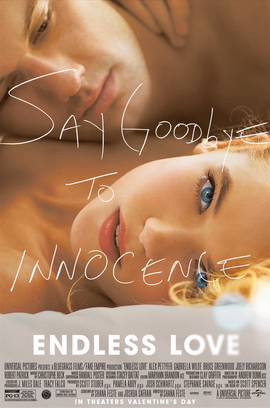
Film Review: Endless Love (dir by Shana Feste)


EDL_31_5_Promo_4C_2F.indd

Oh, what a disappointing film this turned out to be!

When the trailer for Endless Love came out way back in the closing days of 2013, both me and my BFF Evelyn were seriously excited about seeing it.  The trailer was great!  It featured Florence + The Machine!  The movie looked hot and sexy and fun and…

Well, let’s just rewatch the trailer, shall we?

Here’s the thing:  Sometimes, trailers lie.

I saw Endless Love when it was originally released in February but I didn’t review it.  I meant to review it but somehow I never got around to doing so.  And, unfortunately, the film itself was so bland and forgettable that I actually struggled to think of anything to say about it.  Some movies make you laugh.  Some movies make you cry.  Some movies make you mad.  And some movies are just there.

Endless Love is a just there type of movie.

That said, when I saw that Endless Love would be making its cable debut on Cinemax on Saturday night, I decided to give it a second chance.  “Who knows?” I thought to myself, “Maybe I just went into the film with unrealistic expectations.  Maybe I was just in a bitchy mood when I saw it.  Maybe, on a second viewing, I’ll discover that Endless Love works on a purely emotional level…”

No such luck!  Having watched Endless Love a second time, I can now actually remember enough about the film to finally get around to writing a review.  However, I have also now been reminded why I didn’t care much about the film the first time I saw it.

Endless Love is essentially a collection of generically pretty scenes that all feature pretty performers thinking about love, talking about, and making love.  Recent high school graduates David (Alex Pettyfer) and Jade (Gabriella Wilde) start going out.  Jade comes from a wealthy family.  David does not.  Jade’s overly protective father, Hugh (Bruce Greenwood), does not approve of the relationship because Jade has an ivy league future ahead of her while David has no plans to attend college at all.  Jade becomes more rebellious.  David lectures Hugh on the fact that nothing is more important than love.  Hugh takes out a restraining order against David.  Jade goes off to college.  David tries to secretly see her.  And, of course, there’s a fire.

(Though, unlike in the original Endless Love, the fire is not deliberately set.  This is Endless Love  reimagined as a Nicholas Sparks novel.)

And who really cares?

The problem with Endless Love is that we’re supposed to care about David and Jade and we’re supposed love how obsessed they are with each other but David and Jade are two of the most boring people ever so who cares?  Alex Pettyfer is nice to look at.  Gabriella Wilde is pretty.  But, as a couple, they have next to no chemistry.  Instead, they come across like one of those vapid couples that my boyfriend and I always worry we’re going to end up getting trapped in an endless conversation with.

(“How did you two meet?  Wait, before you start — let me tell you how we met… It’s a great story…you guys are going to love this…we were both attending kindergarten on a dance scholarship but the ballet kids all hated the ballroom kids.  Then they moved to Iceland and I asked my dad if we could move to Greenland and then…”)

And again, this just shows the power of a good trailer.  Watching the trailer, you would never guess how boring David and Jade truly are.  Incidentally, the best parts of the trailer are all taken from a “David and Jade dating” montage that occurs about halfway through the film.  As such, the scenes that made me want to see Endless Love pretty much just serve as filler in the actual film.

Also, Florence + The Machine are nowhere to be heard in the actual film.  And their haunting, atmospheric music would have been out of place anyway.  Florence + The Machine embraces the power of ambiguity and Endless Love takes place in a world where there is no ambiguity.

However, there is a lot of blue.

Seriously!  (And yes, I do realize that there’s a typo in my tweet but everyone is allowed to be illiterate on twitter so get off my back.)  This movie opens with a high school graduation where everyone is wearing a blue robe and the entire cast is so oppressively cheerful and overwhelmingly pleasant-looking that I briefly wondered if they were supposed to be a graduating class or a cult.  Later on, David works at a valet at a country club and, of course, he wears a blue shirt.  Everyone who belongs to the club also appears to be wearing a blue shirt, except that it’s a lighter shade of blue than David’s blue.  It’s just odd-looking and reinforces the feeling that Endless Love is less a movie and more a collection of commercial outtakes.

Endless Love, of course, is a remake of a film from the early 80s.  The first Endless Love isn’t very good but it’s at least a lot of unintentional fun!  And you can read my review of it (and even watch the film!) by clicking here.

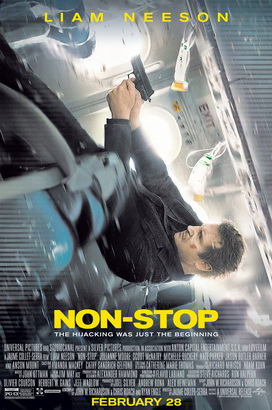
A Late Film Review: Non-Stop (dir by Jaume Collet-Serra)


NST_31_5_Promo_4C_4F.indd

With 2014 rapidly coming to a close, I am currently trying to get caught up on some of the movies that I either missed seeing or did not get a chance to review earlier this year.  After all, in just another month and a half, it’ll be time for me to make out my “Best Of the Year List” and I want to have as many options as possible.

With that in mind, I just finished watching Liam Neeson in Non-Stop, an action-suspense film that came out way back in February.

In Non-Stop, Liam Neeson plays Bill Marks.  It’s interesting to note that Bill Marks has the same initials as Bryan Mills, the very specifically trained CIA agent that Neeson plays in the Taken films.  And really, Bill Marks might as well Bryan Mills because Neeson pretty much gives the exact same performance in Non-Stop that he previously gave in Taken.  That’s not necessarily a criticism.  There’s a reason why Liam keeps getting cast in these type of roles.  He’s good at them.

In fact, I would say that Liam Neeson is one of the few action stars who I can imagine actually killing someone in real life (though only if he had to).  He has a rugged, world-weary cynicism about him.  You look into the eyes of a character played by Liam Neeson and you realize that he’s had to do things that you probably don’t want to know anything about.  At the same time, Neeson also projects a certain old-fashioned decency as well.  He’s the epitome of a decent man forced to use bad methods for the good of us all.

As for Non-Stop, I imagine it was probably pitched as being “Taken on a plane.”  Bill Marks is an air marshal who is on board a non-stop flight from New York to London.  Shortly after the plane takes off, he starts to receive mysterious text messages telling him that, unless he arranges for a 150 million dollar ransom to be paid into a specific bank account, someone on the plane will die every 20 minutes.  While Bill tries to discover who is sending him the text messages and various people on the plane die, the authorities on the ground are convinced that Bill is hijacking the plane.  Why?  Well, mostly because the bank account is in Bill’s name…

That’s right!  Somebody’s trying to frame Bill Marks!  Can Bill — with the help of a passenger played by Julianne Moore — figure out who is trying to frame him and why?  I have to admit that there was a part of me that was hoping that it would turn out that Bill really was the mastermind behind the whole scheme but instead, the movie offers up a solution that is even more ludicrous and illogical.  Naturally, there’s a twist.  The hijacking is not what it originally appears to be.  Perhaps if Non-Stop itself was more fun, the total implausibility of the twist wouldn’t bother me.

Director Juame Collet-Serra (who previously directed Neeson in Unknown) manages a few good action sequence but, ultimately, Non-Stop is really saved only be the presence of Liam Neeson.  Regardless of how implausible or silly the film may get, Neeson always brings a lot of authority to his role.  He’s never more convincing than when he’s walking up and down the aisles, glaring at the passengers and barking out orders.

It’s the type of performance that leaves us assured that the world will be safe as long as Liam Neeson is around to kill people.

Liam Neeson, about to kill someone

Liam Neeson, about to kill someone

Film Review: In the Blood (dir by John Stockwell)


in-the-blood-1

Do you remember Haywire?

Haywire was an action film that came out in 2011.  It briefly got a lot of attention because it starred MMA fighter Gina Carano in her feature film debut and it was directed by Steven Soderbergh.  I have to admit that I didn’t care much for Haywire.  Some of that is because Gina Carano herself didn’t seem to be a very good actress but my main issue with the film was with Steven Soderbergh.  Don’t get me wrong — I know that Soderbergh can be a genius.  However, he’s also a remarkably pretentious filmmaker.  Sometimes that pretension works, like with The Girlfriend Experience.  But, in the case of Haywire, all the pretension served to do was to make a thin story even more annoying.

John Stockwell, on the other hand, is a director who is the very opposite of pretentious.  Whereas Soderbergh often makes genre films that try too hard to be art, Stockwell makes genre films that are so unapologetic about being genre that they often become art despite themselves.  Stockwell may never be as acclaimed as Soderbergh but, on the whole, he’s a much more consistent filmmaker.

Take In The Blood for instance.  In the Blood came out earlier this year, got thoroughly mediocre reviews, and disappeared from theaters pretty quickly.  When I watched it last night, I had very low expectations.

But you know what?

In the Blood isn’t bad.

In fact, it’s a perfectly entertaining and, ultimately, rather empowering film.

In In The Blood, Gina Carano plays Ava.  Ava, we quickly learn, has led a difficult life.  Raised in extreme poverty by a father who taught her early how to fight and how to defend herself, Ava is a former drug addict.  When she goes to rehab, she meets and falls in love with fellow addict Derek (Cam Gigandet).  Once they’re both clean, Ava and Derek marry despite the concerns of Derek’s wealthy father (Treat Williams).

For their honeymoon, Derek and Ava go to the type of Caribbean island where bad things always happen in movies like In The Blood.  They meet Manny (Ismael Cruz Cordova), who agrees to be their guide on the island.  One night, Manny takes them out to a club where Ava ends up getting into a huge fight with literally everyone on the dance floor, including a local gangster played by Danny Trejo.  The next morning, Manny takes them zip lining but Derek ends up plunging from the zip line and crashing down to the ground below.  He’s rushed to the hospital where he promptly vanishes.

Despite being ordered to return to America by police chief Luis Guzman, Ava is determined to figure out what has happened to her husband and she’s willing to beat up the entire island to do it…

Obviously inspired (much like almost every other low-budget action film released over the past few years) by Taken, In The Blood is a familiar but enjoyable burst of pulp fiction.  As opposed to Soderbergh’s approach to Haywire, Stockwell doesn’t worry about trying to disguise the genre roots of In The Blood.  Instead, he simply tells the story and he tells it well.  In The Blood is a film that’s full of beautiful island scenery, villainous character actors, and enjoyable melodramatic dialogue.  The pace never falters and the action is exciting.  In a few years, the club fight scene will be remembered as a classic of action cinema.

And best of all, Gina Carano kicks ass!  In The Blood gives her a chance to show what she can actually do when she has a director who is willing to get out of her way.  As opposed to Haywire, where she often seemed to get lost amongst all of Soderbergh’s showy techniques, Gina Carano gives a confident and determined performance in In The Blood.  After having to sit through countless action films where every female character is either a victim or a pawn, there is something so wonderful about seeing a movie where a woman gets to do something more than whimper and beg.  Regardless of how predictable the film’s plot may be, the fact that it’s a woman — as opposed to a man — who is getting to kick ass (and look good while doing it!) serves to make In The Blood something of a minor masterpiece of the pulp imagination.

If nothing else, In The Blood shows that sometimes it’s best to keep things simple.

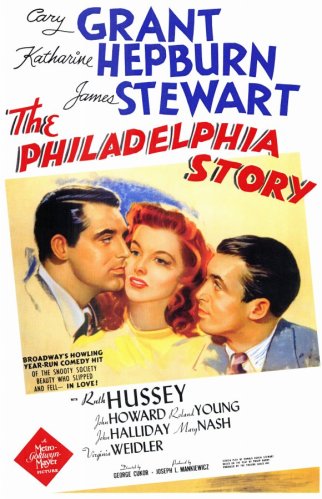
Lisa Reviews The Oscar Nominees: The Philadelphia Story (dir by George Cukor)


The-Philadelphia-Story-(1940)

There are a few reasons why The Philadelphia Story was one of those films that I had been meaning to watch for a while.  For one thing, The Philadelphia Story was nominated for best picture of 1940 (it lost to Alfred Hitchcock’s Rebecca) and my ultimate goal is to see and review every single film ever nominated for best picture.  The other reason is that Jimmy Stewart won an Oscar for his performance in The Philadelphia Story and anyone who doesn’t love Jimmy Stewart has obviously never seen Anatomy of a Murder (not to mention It’s a Wonderful Life!).

Well, The Philadelphia Story was on TCM last night and I finally got to see it and what can I say?  I absolutely loved it.  For a 74 year-old, black-and-white comedy, The Philadelphia Story is still a lot of fun.

The Philadelphia Story tells the story of Tracy Lord (Katharine Hepburn), a wealthy socialite who is engaged to marry George Kitteridge (John Howard), a self-described “man of the people,” who is widely respect for both his strong moral character and the fact that — unlike most of Tracy’s friends — he made his fortune as opposed to inheriting it.

It would be tempting to reach into the bag of simplistic blogging clichés and call the Lords a 1940s version of Khardashians but I’m not going to do that because the Lords have a lot more wit and class.  My favorite member of Tracy’s family was Dinah (Virginia Wiedler), her teenage sister who is sarcastic, cheerfully cynical, and has no problem demanding to be the center of attention.  My sister Erin claims that the reason I liked Dinah is because I saw a lot of myself in the character and that’s probably true.  However, I have to say that the great thing about both Tracy and Dinah is that they were both wittier, classier, and better dressers than all of the Khardashians and Jenners combined.

Anyway, the evil editor of Spy Magazine, Sidney Kidd (Henry Daniell), wants to get pictures of Tracy’s very exclusive and very private wedding so he sends two of his reporters in under cover.  Mike Connor (James Stewart) is a frustrated writer who hates having to lower himself to writing for a tabloid.  Photographer Liz (Ruth Hussey) is secretly in love with Mike.  Helping Mike and Liz pass themselves off as friends of the family is Tracy’s ex-husband, C.K. Dexter Haven (Cary Grant).

As quickly becomes obvious, Dexter is still in love with Tracy.  However, Tracy divorced Dexter because Dexter was an irresponsible alcoholic and, even though Dexter has changed his ways and she is still obviously attracted to him, Tracy is now engaged to the morally upright but boring and judgmental George.

However, Tracy is not just torn between George and Dexter.  She is attracted to Mike as well, to the extent that Tracy even takes the trouble to read some of Mike’s short stories.  For only the second time in her life, Tracy gets drunk and goes for a midnight swim with Mike.  This, of course, leads to the best scene in The Philadelphia Story: Jimmy Stewart singing Somewhere Over The Rainbow.

Seriously, the scene made my entire night.

The Philadelphia Story is based on a play and the film itself is rather stagey in that way that films from the 40s often appear to be to modern viewers.  But, once you get used to the fact that the movie was made in 1940 and not 2014, it’s a real delight.  The dialogue is funny and it’s delivered by one of the best casts ever.  Playing a role that was specifically written for her, Katherine Hepburn is brilliant as the strong-willed but unapologetically romantic Tracy and Cary Grant is just as charming as you would expect Cary Grant to be.  Best of all, you’ve got Jimmy Stewart singing Somewhere Over the Rainbow and seriously, how can you not love that?

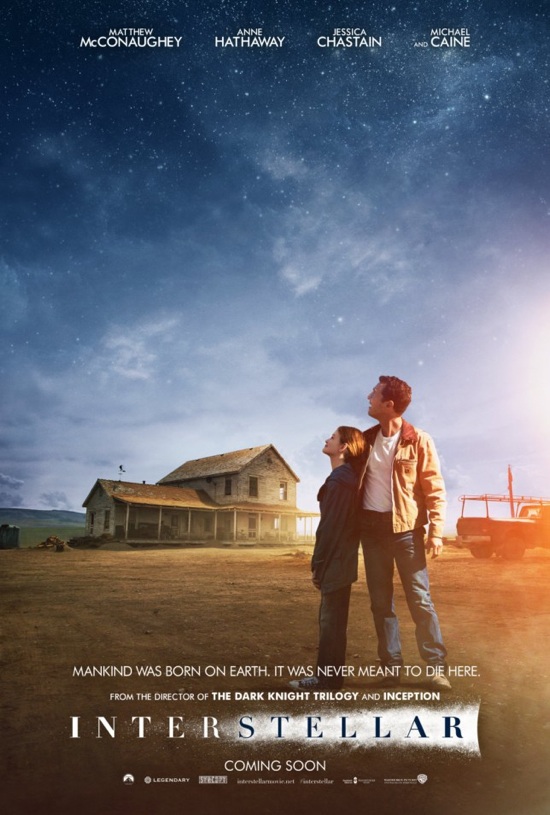
‘Interstellar’ Review (dir. Christopher Nolan)


interstellar2

It would be disingenuous of me to not start this review by saying that I went into ‘Interstellar’ with a clear and present bias. Not towards Nolan – though I think he is a wonderful director who has not yet made a truly bad film. But a bias towards the scientific theories and potential themes I expected – based on trailers and the concept of the film – that it would explore. I have always been very interested in astronomy and astrophysics – and have a soft spot for science fiction films with a strong emotional core (‘Close Encounters of the Third Kind’, ‘Contact’). So when I headed to the theater I knew I was walking a very fine line (one that many reviewers walk but won’t admit to). If the film met (even marginally) my high expectations then it would in no doubt lead to high praise that bordered on hyperbole – and if it didn’t – if it disappointed – then it would cause a reaction a lot more negative than it really needed to be.

Where did ‘Interstellar’ ultimately fall? Hyperbole…or disappointment? Well luckily for me it was the former…to a fairly strong degree. I’ll say it now – this is not just probably  my favorite film of the year so far, but like with ‘Gravity’ and ‘The Tree of Life’ (yes, more on that later) in recent years, this may  fall within my favorite films of all time. It is a dazzling, visually stunning, emotionally resonant and incredibly well made sci-fi space epic – one with the power to keep you on the edge of your seat one minute and in tears the next. It explores big ideas about the cosmos while also staying incredibly grounding with an intimate story about family, regret, sacrifice and love. Like I said…hyperbole.

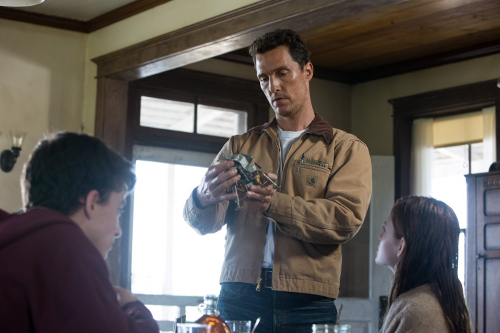
coop2

The film takes place in a not so distant future in which the world is becoming unlivable. After population growth, climate shifts and diseases ravishing crops, the world is struggling to produce enough of what little food sources they have left – which means a heavy reliance on corn farms. It is very bleak future where dust from dust storms covers everything, and the only focus of mankind is struggling to survive with what they know and have. Innovation, free thinking and exploration are at a standstill – and unless schools deem you smart enough to go on to a university, your only career prospective is farming.

Matthew McConaughey stars as Cooper, a widower and former pilot who now owns a farm where he lives with his two young children. He does his best to provide for his family but clearly wants more for them than what the current world can provide. After finding a mysterious message in his daughter Murph’s room, Cooper finds himself being recruited by what is left of NASA. They are secretly putting together a mission to journey through a wormhole that has appeared near Saturn. They do not know how it got there but they do know that beyond it is a solar system with some potentially habitable planets. They want Cooper to pilot an expedition through the wormhole to explore these planets and see if one is suitable to set up a new human colony. Cooper reluctantly agrees, even though it means leaving his children behind. He knows that the journey could kill him or – due to the laws of relatively – that by the time he does return his children may be much older than he is or already dead. But the fate of the human race – including his son and daughter – relies on finding a new home. So he sets out with a team of astronauts – and one pretty funny robot – on a journey that will take them farther than any humans have ever gone. The decision devastates his young daughter Murph – who he had a close relationship with – and it sets her out on a journey of her own to save humanity in a way she believes her father couldn’t.

To go into much more detail of the plot would ruin much of the experience. But I will say it becomes a fast paced and exciting journey. It does sometimes fall back on the usual genre tropes but there is never a dull moment; and it all builds up to an emotional and rewarding conclusion.

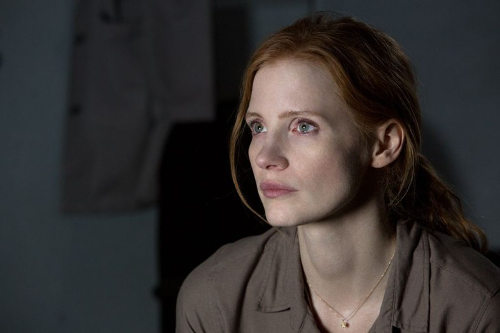
murph

The performances are truly superb. For all his technical mastery, Nolan is also an actors’ director and he gets the most out of his casts. McConaughey is at his best here – which is saying a lot considering his work in recent years. The emotion he brings is on a whole different level than anything he has done before. Jessica Chastain, who plays the adult Murph, also has a strong presence. Both actors wear the burden of their decisions and regrets on their shoulders, and you can see it in every scene. They are the heart and soul of the film. Hathaway also did a wonderful job – as did Wes Bently, Michael Caine, and David Gyasi.

The score from Hans Zimmer is loud and heart pounding. He always manages to perfectly convey the intensity of some truly exciting set pieces – while also slowing down to capture the emotions of the more intimate moments, and this score is no different.

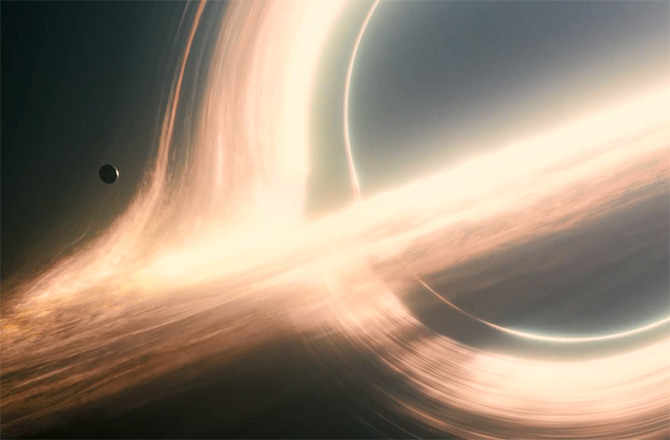
The visuals are absolutely stunning. The effects (most of them created through practical means) were influenced by physicist Kip Throne – who also oversaw a lot of the science in the film – and the result is dream-worthy space imagery. Interestingly, the depictions of the wormhole and black hole in ‘Interstellar’ are considered to be the most accurate ever created. The results are gorgeous, especially on a big screen – with one scene with Saturn making me all teary eyed.

tumblr_nel0c0Oncj1qd479ro1_1280

Below the spectacle and hard science is an emotionally resonant tale of exploration and human ambition that puts its faith not only in science but also the human soul.  Does it become heavy handed at times? Of course! This is a space opera – a science fiction epic – with a big budget, big ideas, big name actors, big visuals and so the emotions at times match that. The first 40 minutes or so do a fantastic job setting up the bond between Cooper and his daughter. It is a wonderful relationship – but a complex one filled with love, anger and regret. It is also the backbone of the story and Nolan builds the emotion from there.

Like with ‘The Tree of Life’ (I told you I was going here), the juxtaposition of dazzling space images and the exploration of the cosmos with this grounded and intimate family story about love and nature make for a challenging but truly rewarding experience. One that asks big questions about our relationship with each other and the universe we inhabit; and examines how the flow and clash of such things as love and instinct with nature can change and inspire us for better or worse. Nolan does seem to want to show how love has the ability to conquer and transcend even the harshest things nature and its laws can throw at us. It is almost fitting then that Chastain stars in each, and has a roll in both stories that could be almost viewed as similar – as the focal point of love that guides the main character and the audience. And like with ‘The Tree of Life’ I can totally understand why people would not like ‘Interstellar’. Neither are films for everyone. I believe most reviews I have seen are so mixed because ultimately ‘Interstellar’ relies so heavily on the emotions at the core of the story that it was inevitable that it wouldn’t connect with some people. You have to be open to some extreme sentimentalism, which just isn’t the case for everybody.

coop mur

I won’t go into much detail over the film’s final act, but I think it makes perfect sense within the logical and emotional progression of the story – though some critics disagree. They seem to think that Nolan’s often straight forward hard science approach is too stern and takes the wonder and ambiguity out of his stories and I found that to not be the case with ‘Interstellar’. Mainly because the ending does in fact have some level of ambiguity – but what it does explain adds a level of wonder and hope that would be lost had it been open ended. I will also say that I find it absolutely absurd that some critics who praise and accept the ending to’2001: A Space Odyssey’ have dismissed this one for being too convoluted or even nonsensical…as if those couldn’t also be said of the ending of Kubrick’s film.

But again maybe this is all just me. As I warned you, hyperbole was expected and I think this review lived up to that. I truly loved the film. It generated in me the same feeling of wonder, excitement and curiosity I got from the spectacle and emotions of ‘Close Encounters of the Third Kind’ and ‘Contact’ –the realism of ‘Gravity’ – and the complexity and mind bending theories of ‘2001: A Space Odyssey’. Throw in with that the connections I felt it had with such films as ‘The Tree of Life’ and there was no way I wasn’t going to love it. This is cinema at its finest. Whatever flaws it might have I can easily overlook due to not only how moving and entertaining of an experience it all is – but also because it is just so damn ambitious. Whether you see it on a large IMAX screen or not, you’ll be moved in one way or another.

tumblr_nejbrwgYQs1qanm80o3_500

Now, I don’t usually do this but I would like to end by quickly addressing the small group of people who have been crying sexism before the film even got its wide release. Apparently, because the lead is a scruffy male and the film is about the will power of mankind to journey off and explore the unknown, that it is somehow a male centric film that is about masculinity above all else. If the idea of human endeavor, innovation, the struggle to survive, and the pursuit of knowledge brings to your mind nothing but masculinity and male dominance then blame society – not the film – because it was clearly not its intentions  and really is just not even remotely the case here. You could easily replace McConaughey’s character with a female lead (like in ‘Contact’) and the narrative, emotional and thematic results would be EXACTLY the same. This all seems even more ridiculous given the fact that the female characters play a much more important role than any of the men. Their work, decisions and perspective essentially save the day. It isn’t until the men view the situations and universe through them that they are able to succeed.

I have also been thrown off by the complaints of Nolan’s reliance on “daddy issues” or the “dead wife/spouse” tropes, and fail to see how these (which I admit are often present in his films) should at all matter when they fit so well into the story and are so emotionally effective. Not to mention Cooper being a widower has nothing to do with any decision he makes; and the relationship Murph has with him is far more complex than simply being “daddy issues”. It is actually a wonderfully realized one, with Nolan drawing experience from the relationship he has with his own daughter.

But why are these even being brought up by people, so early and with such vigor? Do not get me wrong, I understand and appreciate the opinions of those who simply did not like it…but for the few who have criticized it for the aforementioned reasons I just cannot wrap my head around where they are coming from. Sexism is often an issue in cinema and film making as a whole and something that could clearly be worked on…but it just does not apply to ‘Interstellar’ in any way. And I say this as someone who isn’t a Nolan fan boy. Yes, I appreciate his work – he has made some truly great films – but I am not one of those who think he is the best director working right now. But it is hard to not be disappointed and confused by the fact that every time he releases a film there are tons of articles that pop up to critique what would otherwise be completely ignored in other films – or in some case they critique things they didn’t even care about in his other films. Maybe this is just the price a director like him faces. His work tends to be so popular that critics seem to try extra hard to make their voices heard – an attempt to quell the masses of fans excited to see it – by overreaching in their criticism. This is made all the more disheartening when you consider he is one of a very few filmmakers willing to take such big risks to make smart and ambitious films. But maybe I am wrong. Please, let me know your thoughts!

———

Twitter.

Lisa Reviews The Oscar Nominees: Nicholas and Alexandra (dir by Franklin J. Schaffner)


Nicholas_and_Alexandra-831476012-large

(Depending on how much you know about world history, the review below may contain spoilers.)

It was nearly four years ago that I decided that my goal in life was to watch and review every single film — no matter how obscure or potentially disappointing — that had ever been nominated for best picture.  Of course, that’s not my only goal.  If anything, I may have too many, often contradictory goals in my life.  But seeing all of the best picture nominees was definitely one of them and, all these years later, it’s a goal that I’m still trying to achieve.  With the help of TCM and their nonstop schedule of movies made long before I was born, it’s also a goal on which I am slowly but surely making progress.

Last night, as I scrolled through the guide, I noticed that TCM would be showing Nicholas and Alexandra, a three and a half hour film from 1971.  Now normally, I would be hesitant about watching a film that long, if just because I have ADHD and I doubt I’d be able to concentrate on it.  In a theater, watching the action unfold on a big screen, it wouldn’t be a big deal.  However, it’s totally different when you’re talking watching a movie on TV in a house that is full of potential distractions.  Add to that, Wednesday night is when I usually watch shows like Survivor, Hell’s Kitchen, and South Park.

But, here’s the thing.  The title Nicholas and Alexandra sounded familiar to me and not just because I’m an obsessive history nerd.  I did some checking and I discovered that, regardless of how obscure the film may be today, Nicholas and Alexandra was nominated for best picture.  It lost to The French Connection but it was nominated.

So, of course, I had to watch it.

And you know what?

NA

It’s not a terrible movie.  It’s certainly not great.  It has multiple flaws and it’s hard to imagine this film being nominated alongside films like The French Connection, Last Picture Show, and A Clockwork Orange.  Watching the movie, I got the feeling it was probably nominated because it was a big, expensive epic and not because it was one of the best of the year.  But, if you stick with the film (which, if we’re going to be honest here, is much easier said than done), it’s not quite as disappointing as you might expect it to be.

Nicholas and Alexandra tells the story of the last monarch of Russia, Tsar Nicholas II (Michael Jayston).  Struggling to escape the shadow of his father and incapable of understanding what life is like for those not born into royalty, Nicholas is portrayed as being well-meaning but autocratic and blind to the fact that the days of royalty are rapidly coming to an end.  His wife, Alexandra (Janet Susman) is also unpopular with both the Russian citizenry and the royal court on account of being German.

Alexandra spends most her time doting on her youngest son, Alexei, who suffers from hemophilia.  When a flamboyant Serbian monk named Rasputin (Tom Baker) claims that he has the power to heal Alexei, Alexandra immediately brings him into the court.  Soon, rumors are flying across Russia about Rasputin’s relationship with Alexandra.

Meanwhile, men with names like Lenin (Michael Bryant), Trotsky (Brian Cox), and Stalin (James Hazeldine) are plotting to lead a “worker’s revolution…”

If you know anything about history, it’s not really a spoiler to reveal what happens in the second half of Nicholas and Alexandra.  (And if you’re not into history, you probably would not have any interest in watching the movie in the first place.)   Archduke Franz Ferdinand is assassinated, plunging the entire world into war.  Russia declares war on Germany and the German-born Alexandra becomes even more unpopular than before.  The rest of the royal court, jealous over the mad monk’s influence, plots against Rasputin.  The Tsar is forced from the throne and Nicholas and his family spend their last days as captives of the people they once ruled.  Now a powerless prisoner, Nicholas finally starts to understand the world beyond his palace walls.  However, in the end, Nicholas, Alexandra, their children, and their loyal servants are taken into a small room and violently executed.  End of movie.

NA2

So, there are a lot of things wrong with Nicholas and Alexandra.  Not the least of the film’s problem is an unwieldy length and generally slow pace.  (The film was directed by Franklin J. Schaffner, who also directed the still-fun original Planet of the Apes.  Little of the flair he brought to Planet of the Apes is present here.)  This is one of those films that is full of incident with various characters popping up and discussing the intricacies of international politics with little concern as to whether or not any of this is the least bit cinematic or even compelling on a narrative level.  The film has a huge cast but very few memorable characters.

Even worse is that neither Nicholas nor Alexandra never come across as being all that interesting.  The film makes the case that Nicholas’s downfall was largely a result of him being unlucky enough to rule at a time when people across Europe and Asia were rejecting the old ways for the new ways of revolution and industrialization.  Nicholas is continually portrayed as being well-meaning but isolated and that has the potential to be interesting but, at times, the film feels almost as emotionally detached as its characters.

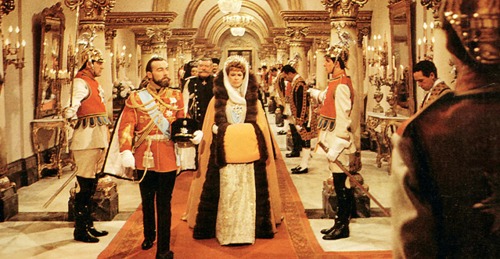
That said, Nicholas and Alexandra does work as a spectacle, as a showcase for beautiful clothing and ornate scenery.  As a character study, Nicholas and Alexandra largely fails but, as a fashion show, it’s actually a lot of fun.    Early on in the film, there’s a lengthy sequence in which Nicholas and Alexandra walk down the red-carpeted hallways of their palace.  It’s shot through Nicholas’s eyes and we see a collection of guards and noblemen and women standing to the side and bowing their heads as the Tsar and his wife walk past.  It’s a good scene and one that perfectly shows not only the life that Nicholas is used to but also why Nicholas doesn’t want to change that life.

baktna03

Perhaps not surprisingly, the first two hours of Nicholas and Alexandra work best when they focus on the flamboyant character of Rasputin.  Baker does a really go job as Rasputin, delivering all of his lines with a ferocious intensity while staring with obviously unhinged eyes.  When he’s with Alexandra, Rasputin is calculating and coldly conniving, providing just enough comfort to keep her under his control.  When he’s with Nicholas or any of the other male members of the court, he reveals himself to be an arrogant libertine, making profane jokes and bragging about his conquests.  It’s a really good performance but, as with so many other good performances in this film, it occasionally gets lost in the film’s dense production.

The best moments of Nicholas and Alexandra come towards the end, with the humbled Nicholas finally revealing his humanity and the Tsar’s family struggling to maintain their dignity even as their inevitable fate approaches.  At this point, the performers came to life.  The film suddenly had an emotional resonance.  It finally became about something!  For those final 20 or so minutes, Nicholas and Alexandra suddenly seemed worthy of being awarded.

In fact, based on those final 20 minutes, I would even be willing to see a sequel called Nicholas and Alexandra and Rasputin Makes Three.  

(Though I’m not sure how that sequel could ever be made.  As @Kev1Media pointed out when I suggested it on twitter, Adam Sandler would have to be somehow involved.)

As for Nicholas and Alexandra, it’s not a great film but if you’re into history or you’re an Oscar completist like me, the film has its occasional charms.  You just have to be willing to look for them.

Nicholas and Alexandra