The main reason that I enjoyed the 1997 Clint Eastwood film Absolute Power was because it features a murderer who also happens to be the President. As someone who dislike the idea of any one person having absolute power, I always get annoyed by the attitude that authority is something that has to be automatically respected. Instead, I’ve always felt that all authority should be distrusted and continually questioned.
Just take President Alan Richmond (Gene Hackman) for example. At the start of Absolute Power, he’s a popular President. He’s quick with a smile. He’s quick with a memorable line. I imagine that excerpts from his State of the Union speech would probably be very popular on YouTube. However, at the start of the film, elderly burglar Luther Whitney (Clint Eastwood) witnesses President Richmond getting violent with Jan Levinson-Gould. When Jan resists him, two Secret Service agents (Scott Glenn and Dennis Haysbert) run into the room and shoot her.
Okay, technically, the victim was not really The Office‘s Jan Levinson-Gould. (They both just happen to be played by Melora Hardin.) Instead, her name was Christy Sullivan and she was also the wife of one of Richmond’s top financial supporters, Walter Sullivan (E.G. Marshall). After the murder, President Richmond and his chief-of-staff, Gloria Russell (Judy Davis), attempt to frame Luther for the crime.
Absolute Power is pretty much your typical Clint Eastwood action picture. In the role of Luther, Eastwood snarls his way through the film and never dispatches a bad guy without providing a ruthless quip. (When one bad guy begs for mercy, Luther replies that he’s “fresh out.”) Luther has an estranged daughter, a lawyer named Kate (Laura Linney) and, despite the fact that she’s helping the homicide detective (Ed Harris) who is trying to capture him, Luther still pops up to look out for her. In the end, Luther’s not only try to prove that the President is a murderer but he’s trying to be a better father as well! Awwwwwww!
Again, it’s all pretty predictable but the film is worth seeing just for the chance to witness Gene Hackman play one of the most evil Presidents ever. As far as soulless chief executives are concerned, Alan Richmond makes Woodrow Wilson look like a humanitarian! And Hackman does a good job embodying the affable type of evil that could conceivably translate into an electoral landslide.
Absolute Power may not be a great film but it’s a good one to watch whenever you need an excuse to be cynical about the absolute power of the government.
Oddly enough, right after I watched City Hall, I watched yet another 1997 film about politics and police corruption in New York. And while Night Falls on Manhattan is definitely not one of Sidney Lumet’s best films, it’s still definitely an improvement on City Hall.
Night Falls on Manhattan tells the story of what happens when two veteran detectives — Liam Casey (Ian Holm) and Joey Allegreto (James Gandolfini) — attempt to arrest drug dealer Jordan Washington (Shiek Mahmud-Bey). Liam ends up getting shot multiple times before Jordan, disguised as a police officer, flees the scene. As the cops search for Jordan, they accidentally shoot and kill one of their own.
In short, Manhattan has gone crazy and only the prompt capture and conviction of Jordan Washington will set things right.
However, the police don’t have to spend too much time searching for Jordan because, the very next day, he turns himself in. He’s accompanied by a veteran radical lawyer named Sam Vigoda (Richard Dreyfuss). Vigoda announces that yes, Jordan is a drug dealer and yes, he did shoot Liam Casey. However, Vigoda claims that Jordan has been paying off the cops and that Liam and Joey weren’t actually trying to arrest him. Instead, they were specifically looking for an excuse to execute him.
Flamboyant District Attorney Morganstern (Ron Leibman) know that his office has to convict Jordan. And luckily, he has a secret weapon. Liam’s son, Sean (Andy Garcia), just happens to be a former cop and an assistant district attorney. He assigns Sean to handle Jordan’s prosecution.
Sean, it turns out, has political ambitions of his own and, by prosecuting Jordan, he not only gets revenge for the shooting of his father but he also furthers his own career. (He also gets a girlfriend, in this case an associate of Vigoda’s who is played by Lena Olin.) When Morganstern has a heart attack, Sean suddenly finds himself being mentioned as a candidate to replace him in the upcoming election.
However, even as Sean appears to be shoo-in to be the next district attorney, he also discovers that neither Liam nor Joey were as innocent as he originally assumed..
Night Falls In Manhattan is an occasionally diverting legal and political thriller. As a director, Sidney Lumet had an obvious feel for New York culture and, as a result, the film feels authentic even when the plot occasionally veers into melodrama. As opposed to City Hall, you never doubt the plausibility of Night Falls On Manhattan. Though Andy Garcia is a bit an odd choice to play an Irish-American (and it’s particularly difficult to imagine him being, in any way, related to Ian Holm), the rest of the film is well-cast. Fans of The Sopranos will enjoy a chance to see James Gandolfini playing someone who, because he’s on the “right” side o the law, is actually more dangerous than Tony Soprano and Rob Leibman is thoroughly believable as a bullying crusader against crime.
After I watched Night Falls on Manhattan, I did some checking online and I was surprised to discover that the film is apparently not better known than it is. While it definitely uneven, Night Falls On Manhattan is an interesting look at crime, ethics, and urban politics.
Interestingly enough, New York City may be the center of wealth and politics in the United States but being Mayor of New York rarely leads to any sort of greater office. Though the Americans Elect people tried to unsuccessfully recruit Michael Bloomberg in 2012 and there’s a few deluded souls who seem to think that Bill de Blasio could run and win in 2016, only three NYC mayors have taken the plunge and actually run for President. Of the three of them, DeWitt Clinton was the most successful. He not only won the Federalist nomination but he came close to beating James Madison in the election of 1812. However, both John V. Lindsay and Rudy Giuliani were forced to end their campaigns when their electoral success in New York failed to translate into votes outside of the Northeast.
And that’s the thing really. Everyone in America knows that New York is an important city, perhaps the most important city in the United States. And they resent the Hell out of it. It’s kinda like how the rest of country hates my home state of Texas because they need our oil more than we need … well, whatever the Hell it is that the rest of the country brings to the table.
I mean, let’s face it. There’s a lot of resentment out there. And that resentment will probably keep anyone from going from Gracie Mansion to the White House.
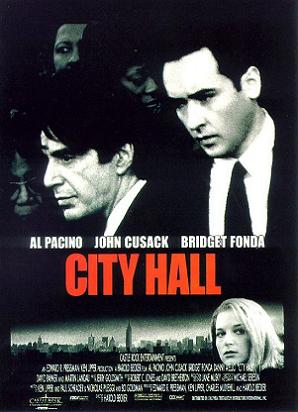
That’s one of the problems that I had with the 1996 film City Hall. In order for City Hall to work, you have to believe that Mayor John Pappas has a legitimate chance to not only be nominated for President but to win the election as well. At the start of the film, we’re informed by Deputy Mayor Kevin Calhoun (John Cusack, speaking in one of the worst attempts at a Louisiana accent that I’ve ever heard) that Pappas is the greatest mayor that New York City has ever had. I guess that might be true, even though we really don’t see any evidence of that fact. (Pappas does get to deliver a few monologues about how much he loves New York but if love is all it took, I’d be a really kick ass Prime Minister of Canada.) However, it’s because Mayor Pappas is such a product of New York City that he’d probably never be able to actually win a primary in Vermont and capture Iowa’s electoral votes. That’s one reason why it’s difficult to buy Mayor Pappas as a future President.
The other reason is that Mayor Pappas is played by Al Pacino. And we’re not talking about Godfatheror Dog Day Afternoon Al Pacino here. Instead, we’re talking about raspy voiced, constantly bellowing, thousand-yard state Al Pacino. As played by Al Pancino, it takes only one look at Mayor Pappas to imagine thousands a middle American voters running in terror away from the voting booths.
(One gets the feeling that if a large group of police officers ever turned their back on Mayor Pappas, he would immediately start jumping up and down while yelling, “YOU ARE TURNIN’ YOUR BACKS ON DA MAYOR HERE! WHAT DA FUCK IS GOIN’ ON WITH THIS SHIT HERE!?”)
That said, there’s another reason why Mayor Pappas may never be President. There’s been a shooting. An undercover cop and a drug dealer shot each other. A little boy was hit by a stray bullet. The little boy is black but, oddly enough, nobody in the film ever suggests that there was any sort of racial element involved. Instead, Mayor Pappas goes to the boy’s funeral and is enthusiastically applauded by the entirely African-American congregation.
It turns out that the drug dealer is the nephew of a mafia don. He should have been in prison at the time of the shooting but instead, he was given an early release by a seemingly incompetent judge (Martin Landau). As Calhoun and a lawyer named Marybeth Cogan (Bridget Fonda, giving a good performance in a generically written role) investigate how the dealer came to be released, they discover that local politician Frank Anselmo (Danny Aiello) may have had something to do with it. Calhoun also discovers that his idol, Mayor Pappas, may know more than he’s saying as well…
If you do happen to watch City Hall, be sure to compare Danny Aiello’s performance with Al Pacino’s. Both Aiello and Pacino are playing larger-than-life characters. And both Aiello and Pacino have a tendency to bellow and to play big. But, whereas Pacino’s performance feels forced and oddly empty, Aiello’s performance feels totally natural. You actually believe that Aiello could be elected to a citywide office whereas Pacino — or at least the version of Al Pacino that shows up for City Hall — seems like he’d have a hard time getting elected to a student council, much less Mayor of America’s largest city.
Anyway, City Hall is currently making the rounds on cable, which is how I saw it. It had the potential to be an interesting look at urban politics but, ultimately, it just doesn’t work. To a certain extent, I hate to be negative about any film that, like City Hall, has its heart in the right place but the movie just doesn’t work.
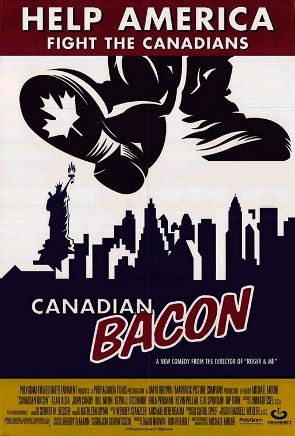
I have mixed feelings about the 1995 films Canadian Bacon.
On the one hand, Canadian Bacon is the only non-documentary to have been directed by Michael Moore. And I’m just going to admit right now that I don’t care much for Michael Moore. I think he’s fake. I think he’s the epitome of the type of limousine liberal who exclusively preaches to the converted and who, when all is said and done, does more harm to his causes than good. Just because he doesn’t shave, dresses like a slob, and apparently has never been to a gym, that doesn’t change the fact that he’s worth $50 million dollars. Just because he may claim to be for the workers, that doesn’t keep him from notoriously overworking and underpaying his own employees. Just because he may make films critical of capitalism, that certainly hasn’t stopped him from investing millions in the very same companies that he claims to oppose. And, quite frankly, it’s hard for me to take seriously a man who rails against income inequality when that man happens to own 9 mansions, none of which are exactly housing the homeless right now.
On the other hand, I love Canada! Canada has produced some of my favorite actors. It’s the country that created Degrassi. It’s the home of Lindsay Dianne and the Becoming A Bolder Being blog! Seriously, how can you not love Canada?
In fact, if a war ever broke out between American and Canada, I’m not sure who I’d support. Then again, hopefully Texas will have seceded from the U.S.A. before that happens. I’m keeping fingers crossed about that. Hopefully, once we have seceded, our first action will be to declare war on Vermont. (Not the rest of America, though. Just Vermont.)
The plot of Canadian Bacon is that the President of the United States (Alan Alda) is suffering from low approval ratings so he decides that America needs to find a new country to be enemies with. Mind you, the President doesn’t necessarily want to go to war. Instead, he just wants to have an enemy that he can always be on the verge of going to war with. After a riot breaks out at a hockey game, the President’s advisors realize that Canada would be the perfect enemy!
(And, while this is played for laughs, there actually is a historical precedent here. The War of 1812 was basically a result of America’s desire to conquer Canada.)
Anyway, American airwaves are soon full of anti-Canada propaganda and, since Michael Moore thinks everyone in America is an idiot except for him, gun-toting rednecks are soon preparing to do whatever it takes to defend America. A patriotic sheriff named Boomer (John Candy) decides to invade Canada on his own. Needless to say, things get even more complicated from there and soon a crazy weapons manufacturer (G.D. Spradlin) is plotting to launch a missile attack on Russia and … oh, who cares?
When Canadian Bacon tries to satirize politics and blind patriotism, it falls flat. Michael Moore has somehow earned a reputation for being a satirist but, if you actually look at his work, it quickly becomes apparent that he really doesn’t have much of a sense of humor. The humor in his documentaries is pretty much based on Moore saying, “Look how stupid everyone is except for me!” Since the people who watch Michael Moore documentaries are usually people who already agree with Michael Moore, they naturally find that to be hilarious because they already think anyone who disagrees with them is a joke. However, that doesn’t mean that Moore himself is a comic genius. He’s just a guy telling a joke to an audience that already knows the punchline.
Canadian Bacon is long on righteous indignation but it’s short on anything that would make you want to spend 90 minutes listening to the same point being made over and over again. Moore did make one good decision, in that he selected Rip Torn to play a crazed general. Rip Torn can deliver militaristic insults with the best of them.
The few times that Canadian Bacon actually works is when it gently (as opposed to indignantly) satirizes Canada’s reputation for being the most polite (and most hockey-obsessed) place on Earth. Dan Aykroyd has a great cameo as a Canadian police officer who pulls over Boomer’s truck and politely reprimands him for not including French translations for all of the anti-Canadian graffiti on the side of the vehicle.
Canadian Bacon could have used more scenes like that.
On Saturday night, I watched the latest Lifetime original movie, Beautiful & Twisted!
Why Was I Watching It?
Ever since I first saw the commercial during Whitney, I have been looking forward to seeing Beautiful & Twisted. Not only was it true crime (which is one of my favorite Lifetime movie genres) but it also featured Rob Lowe. Rob has appeared in a few Lifetime films and they always seem to bring out his best.
What Was It About?
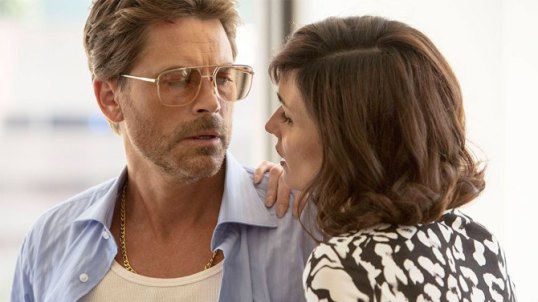
The film is narrated by Ben Novack (Rob Lowe), who starts things off by telling us that he’s dead. We see how Ben, the eccentric son of a millionaire hotelier, first met and subsequently married a stripper named Narcy (Paz Vega). Ben likes collecting Batman memorabilia. Narcy likes money. They both like kinky sex.
However, Ben is often unfaithful to Narcy and finds himself on the receiving end of her often violent tempter. When Narcy finds out that Ben is planning on leaving his fortune to his mother (Candice Bergen), Narcy has her murdered. And when she worries that Ben might like her daughter (played by Seychelle Gabriel) more than her, Narcy has Ben brutally murdered. Not only does she get her brother to beat him to death but she also demands that his eyes be gouged out of his head.
AGCK!
Amazingly enough, this is all based on a true story.
What Worked?
This is one of the best Lifetime films that I’ve seen in a while! It was stylish, it was melodramatic, it was occasionally funny, and it was over-the-top in the best way possible. The settings were opulent, the clothes were to die for, and the pace was relentless. Even the music was great! Seriously, if you’re going to make a movie about kinky sex and murder among the wealthy, you should at least have fun with it. And, despite all of the grisly murders, Beautiful & Twisted was definitely fun.
Rob Lowe was sympathetically weird as Ben while, in the role of Narcy, Paz Vega gave a performance worthy of an old school femme fatale.
All in all, Beautiful & Twisted is exactly the type of movie that we Lifetime viewers have been hoping for.
What Did Not Work?
It all worked. This one of the best Lifetime movies ever!
“Oh my God! Just like me” Moments
Well, I have to admit that I’ve never had anyone killed and I doubt that I ever will. I’m just not the murderous type, regardless of what you may have heard. However, much like Narcy, I’m not above using my cleavage to get what I want.
Lessons Learned
If there’s any lesson to be learned from watching any of these Lifetime true crime films, it’s that you shouldn’t murder anyone because, regardless of how cute or clever you may be, you will eventually end up getting caught. And then someone will make a movie about you and you’ll end up with a bunch of snarky people on twitter talking about how crazy you are. It’s better to just get a divorce.
Way back in October, around the same time that I first decided that I would do a series of reviews of political films and that I would call it Lisa Gets Preachy (subsequently changed to Shattered Politics), I noticed that the 1995 film The American President was scheduled to be shown on TVLand.
“Hey,” I said, “I’ve definitely got to watch and review that!”
So, I set the DVR and I recorded The American President.
And then, I just left it there.
You have to understand that it’s rare that I ever leave anything unwatched on my DVR. Usually, within an hour of recording a program, I’ll be watching it. I have even been known to go so far as to make out very long lists of everything that I have on the DVR, just so I can make check them off after I’ve watched. As a general rule, I am way too obsessive compulsive to just leave anything sitting around.
But, for whatever reason, I could never work up any enthusiasm for the prospect of actually watching The American President. I knew that, eventually, I would have to watch it so that I could review it. Unlike those folks criticizing American Sniper on the basis of the film’s trailer, I never criticize or praise a film unless I’ve actually watched it. But I just couldn’t get excited about The American President.
Can you guess why? I’ll give you a hint. It’s two words. The first starts with A. The second starts with S.
If you guessed Aaron Sorkin, then you are correct! Yes, I do know that Sorkin has a lot of admirers. And, even more importantly, I know that it’s dangerous to cross some of those admirers. (I can still remember Ryan Adams and Sasha Stone insanely blocking anyone who dared to criticize the underwritten female characters in Sorkin’s script for The Social Network.)
But what can I say? As a writer, Aaron Sorkin bothers me. And since Sorkin is such an overpraised and powerful voice, he’s that rare scriptwriter who can actually claim auteur status. The Social Network, for instance, was not a David Fincher film. It was an Aaron Sorkin film, through and through.
And, after having to deal with three seasons of the Newroom and countless Aaron Sorkin-penned op-eds about why nobody should be allowed to criticize Aaron Sorkin, I’ve reached the point where dealing with all of Aaron Sorkin’s signature quirks is a bit like listening to the drill while strapped into a dentist’s chair. I am weary of pompous and egotistical male heroes who answer every question with a sermon. I am tired to endless scenes of male bonding. I have had enough with the quippy, quickly-delivered dialogue, all recited as characters walk down an endless hallways. I have no more sympathy for Sorkin’s nostalgic idealism or his condescending, rich, white dude version of liberalism.
Most of all, I’m sick of people making excuses for an acclaimed, award-winning, highly-paid screenwriter who is apparently incapable of writing strong female characters. I’m tired of pretending that it doesn’t matter that Aaron Sorkin is apparently incapable of viewing female characters as being anything other than potential love interests or silly distractions who need to be told to go stand in a corner while the menfolk solve all the problems of the world.
Fortunately, as a result of The Newsroom, quite a few critics are finally starting to admit what they always knew to be the truth. Aaron Sorkin is not the messiah. Instead, he’s a somewhat talented writer who doesn’t understand (or, in my opinion, particularly like) women. At his best, he’s occasionally entertaining. At his worst, he’s pompous, didactic, and preachy.
And, of course, Aaron Sorkin is the man who wrote The American President.
So, The American President just sat there until a few days ago when I sighed to myself and said, “Okay, let’s watch this thing.” As I watched it, I promised myself that I would try to see past the fact that it was an Aaron Sorkin-penned film and just try to judge the film on its merits.
But here’s the thing. It’s nearly impossible to separate one’s opinion of Sorkin from The American President. If you didn’t know that Sorkin had written The American President, you’d guess it after hearing the first few lines of dialogue. The film, itself, was directed by Rob Reiner but it’s not as if Reiner is the most interesting of directors. (What’s odd is that Reiner’s first films — This Is Spinal Tap, The Princess Bride, Stand By Me — are all so quirky and interesting and are still so watchable decades after first being released that you have to wonder how Reiner eventually became the man who directed The Bucket List.) In short, The American President is totally an Aaron Sorkin film.
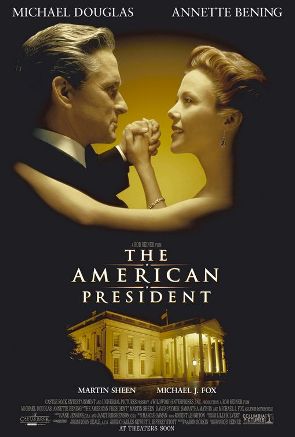
President Andrew Shepherd (Michael Douglas) is a liberal Democrat who, as he prepares to run for a second term, has a 63% approval rating. However, when Shepherd decides to push through a gun control bill, he finds that approval rating threatened. And then, when he listens to environmental lobbyist Sydney Wade (Annette Bening) and tries to push through legislation to reduce carbon emissions, his approval rating is again threatened. And then, to top it all off, he starts dating Sydney. It turns out that Sydney has protested American policy in the past. And, since this is an Aaron Sorkin film, everyone outside of the Northeast is scandalized that President Shepherd is having premarital sex in the White House.
And, to top it all off, there’s an evil Republican named Bob Rumson (Richard Dreyfuss) who wants to be President and is willing to use the President’s relationship with Sydney to further his own evil Republican ambitions.
But, ultimately, it’s not just those evil Republicans who make it difficult for Sydney and the President to have a relationship. It’s also the fact that the President agrees to a watered down crime bill and that he does not hold up his end of the bargain when it comes to reducing carbon emissions.
“You’ve lost my vote!” Sydney tells him.
But — fear not! There’s still time for President Shepherd to give a speech that will be so good and so brilliant that it will, within a matter of minutes, totally change every aspect of American culture and save the day. How do we know it’s a great speech? Because it was written by Aaron Sorkin!
Actually, I’m being too hard on the film and I’ll be the first admit that it’s because I’m personally not a huge fan of Aaron Sorkin’s. But, to be honest, The American President is Aaron Sorkin-lite. This film was written before the West Wing, before the Social Network, before that Studio Whatever show, and before The Newsroom. In short, it was written before he became THE Aaron Sorkin and, as such, it’s actually a lot less preachy than some of his other work. It’s true that, much like The Newsroom, The American President is definitely Sorkin’s fantasy of how things should work but at least you don’t have to deal with Jeff Daniels throwing stuff or Emily Mortimer not knowing how to properly forward an email.
Instead, it’s a film that will probably be enjoyed by those who share its politics. (And, make no mistake, The American President is more interested in politics than it is in the love story between Andrew and Sydney.) Michael Douglas does well in the role of the President. Meanwhile, Annette Bening is so likable and natural as Sydney that it almost make up for the fact that she’s yet another Sorkin woman whose existence is largely defined by looking up to her man while inspiring him to do the right thing and forgiving him when he doesn’t. Personally, I would have been happy if the film had ended with Sydney telling the President, “Thanks for finally doing the right thing but I have a life of my own to lead.”
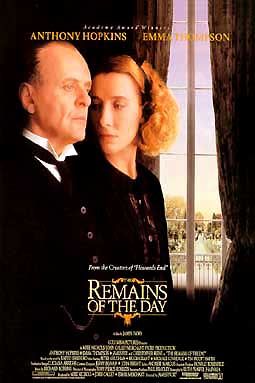
The 1993 Best Picture nominee The Remains of the Day is a love story. Actually, it’s a series of love stories. Every character in the film is in love with something or someone. It’s just that, with one exception, they’re all so extremely British that it’s sometimes hard to tell.
The one exception is an American congressman named Trent Lewis (Christopher Reeve). As the film opens in the 1950s, he’s just purchased Darlington Hall, which is one of those country manors that hold so much history and romance for those of us who regularly watch Downton Abbey. Lewis is excited to have a British manor of his very own. It even comes with its very own butler, a Mr. Stevens (Anthony Hopkins).
As we see in flashback, Stevens previously worked at Darlington Hall when it was owned by Lord Darlington (James Fox). In the 1930s, Lord Darlington may have loved Britain but he was also dangerously naive about the rise of Nazi Germany. Actually, to say that he was naive might be letting Lord Darlington off too easily. When we first meet Lord Darlington, he seems like a well-meaning but hopelessly out-of-touch aristocrat. He has so little understanding of the real world that he even asks Stevens to have the sex talk with his godson (played, somewhat inevitably, by Hugh Grant), who happens to be close to 30 years old at the time and, one would presume, far beyond the age when the talk is really necessary. When we first see Lord Darlington, who is hosting a conference on how to best deal with the rise of the Nazis, arguing that Britain should ignore the rise of Hitler, it’s easy to assume that he’s just as clueless about Germany as he is about his godson. But then, eventually, Lord Darlington orders Stevens to fire two Jewish maids and you’re forced to reconsider everything that you previously believed about him.
And then there’s Ms. Kenton (Emma Thompson), who worked as a housekeeper for Lord Darlington. She loves the repressed Mr. Stevens but continually finds herself frustrated by Stevens’s professional detachment. Unlike Stevens, Ms. Kenton doesn’t hold back on her opinions but, when she finally has a chance to stand up for her beliefs and defy the status quo at Darlington Hall, she backs down.
And then there’s Mr. Stevens. Mr. Stevens may be one of the most emotionally repressed characters in the history of the movies but the entire film revolves around trying to figure out what or who Stevens loves. It’s a little too easy to assume that he’s in love with Ms. Kenton, even though that will be the natural instinct of most viewers. While he obviously feels affection towards her, he can never bring himself to truly express it. (That said, getting a letter from her appears to be the only thing that can actually inspire him to leave the safety of Darlington Hall and venture into the outside world.) While it seems, at times, that he might love Lord Darlington, Stevens himself prefers to say that he respected Lord Darlington and, after the war, Stevens seems to have no trouble staying on at Darlington Hall even after its bought by Congressman Lewis. Much like the ghosts in The Shining, Stevens has always been the butler and always will be.
Ultimately, Mr. Stevens loves his job. He loves being a butler. He’s a man so dedicated to his job that he even continues to work even while his father is dying in the next room. He loves making sure that everything’s perfect at Darlington Hall and he never bothers with worrying about how imperfect the world outside Darlington Hall may be. In that way, Stevens is a stand-in for all of the European leaders who willfully chose to ignore what was happening in Germany in the days leading up to World War II. And, much like those European leaders, he finds himself forced to work for an American in the aftermath.
As a film, The Remains of the Day can be frustrating but in a good way. Mr. Stevens is such a repressed and detached character that, much like Ms. Kenton, we’re always tempted to give up on him. Fortunately, Anthony Hopkins is one of those actors who can suggest so much with just a pause in his dialogue or a quick glance to the side. You look at his sad eyes and suddenly, you know everything that Mr. Stevens cannot bring himself to say. Emma Thompson has a somewhat easier role because Ms. Kenton at least gets to say what she’s thinking but she still bring a lot of depth to the role and has a lot of chemistry with Hopkins. And finally, you’ve got James Fox who is so comically befuddled that it’s all the more shocking to consider all of the pain that he — intentionally or not — is partially responsible for.
The Remains of the Day is a great film for all of us Downton Abbey-loving history nerds.
Way back in 1919, the terrible U.S. President and tyrannical dictator Woodrow Wilson* suffered a stroke that left him semi-paralyzed and unable to perform his duties. By all standards, Wilson should have been removed from office, if just temporarily. However, in those pre-Internet days, it was a lot easier to hide the truth about Wilson’s physical and mental condition. While Wilson spent his days locked away in his bedroom, his wife Edith would forge his signature on bills. Whenever anyone asked for the President’s opinion, Edith would give her opinion and then assure everyone that it was actually the President’s.
(And really, as long as you were promoting eugenics and white supremacy, it probably was not difficult to imitate Wilson’s opinions.)
Of course, back then, people were used to the idea of never seeing their President in public. Hence, it was very easy for Wilson to remain sequestered in the White House. If a similar situation happened today, it’s doubtful that anyone could successfully keep the public from finding out. When we don’t see the President every day, we wonder why. How, in this day and age, could a Presidential incapacitation be covered up?
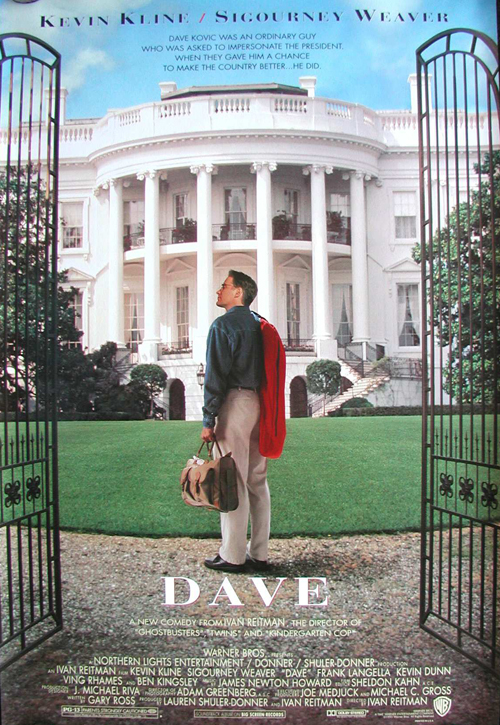
The 1993 film Dave offers up one possible solution.
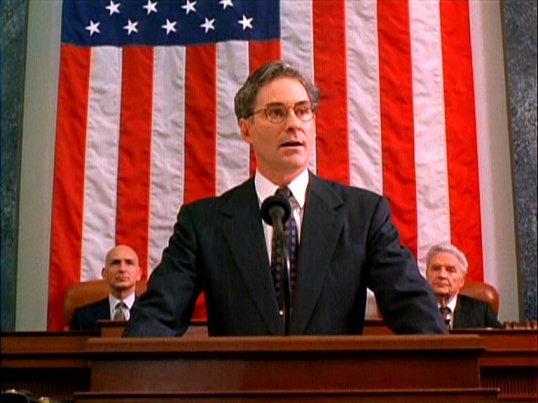
Dave is the story of two men who happen to look exactly like Kevin Kline. One of them is named Bill Mitchell and he’s the arrogant and corrupt President of the United States. The other is named Dave Kovic. He’s a nice guy who runs a temp agency and who has a nice side job going as a professional Bill Mitchell imitator.
So, when Bill has a stroke while having sex with a white house staffer (Laura Linney), it only makes sense to recruit Dave Kovic to pretend to the President. White House Chief of Staff Bob Alexander (played by Frank Langella, so you know he’s evil) tells Dave that Vice President Nance (Ben Kingsley) is insane and corrupt. Dave agrees to imitate the President. Of course, Alexander’s main plan is to convince Nance to resign and then get Dave to appoint him as Vice President. Once Alexander is Vice President, it will be announced that Mitchell has had another stroke and then Alexander will move into the Oval Office.
However, what Alexander did not take into account was just how much Dave would enjoy being President. From the moment that he joyfully shouts, “God Bless, America!,” Dave’s enthusiasm starts to win the public over. Suddenly, people are realizing that President Mitchell isn’t such a bad President after all. Even more importantly, Dave wins over the first lady (Sigourney Weaver) who, previously, had little use for her philandering husband. When Alexander claims that there’s no money in the budget to continue funding a program for the homeless, Dave calls in his best friend, an accountant named Murray (Charles Grodin), and has him rewrite the budget…
And you know what?
Dave is one of those films that tempts me to be all cynical and snarky but, ultimately, the film itself is so likable and earnest that I can even accept the idea that one accountant could balance the budget through common sense alone. I’ll even accept the idea that Dave could come up with a program that would guarantee everyone employment without, at the same time, bankrupting the country. Kevin Kline is so enthusiastic in the lead role and the film itself is so good-natured that it almost feels wrong to criticize it for being totally implausible.
Sometimes, you just have to appreciate a film for being likable.
—–
* For those of you keeping count, that’s the third time in two weeks that I’ve referred to Woodrow Wilson as being a dictator. Before anyone points out that some historians rank Wilson as being in the top ten of President, allow me to say that I don’t care. I DO WHAT I WANT!
First released in 1990, The Godfather Part III was nominated for best picture (it lost to Goodfellas Dances With Wolves) but it’s got a terrible reputation. Over the past two weeks, whenever I’ve mentioned that I was planning on reviewing The Godfather and The Godfather Part IIfor this series of reviews, everyone who I talked to mentioned that they loved the first two Godfather films and that they hated the third one. Quite a few, in fact, suggested that I shouldn’t even bother reviewing the third one. In their eyes, The Godfather Part III was like that one cousin who you know exists but, because he got caught cashing your grandma’s social security check, you never send a Christmas card.
But you know what?
It was never even an option for me to skip reviewing The Godfather, Part III. First off, I’m a completist. It’s long been my goal to review every single best picture nominee and, regardless of how much some people may dislike it, that’s exactly what The Godfather Part III is.
Plus, I love the Godfather movies. I’m a fourth Italian (and, much like the Corleones, my Italian side comes from Southern Italy) and I was raised Catholic. Let’s face it — The Godfather movies were made for me. Even Part III.
So, with all that in mind, I recently sat down and rewatched The Godfather Part III. And I’m not saying that it was an easy film to watch. It’s a flawed film and those flaws are made even more obvious when you compare it to the previous two Godfathers. It’s hard to follow up on perfection. And I have to admit that, even though I had seen Part III before, I was still expecting it to be better than it actually was. I had forgotten just how many slow spots there were. I had forgotten how confusing the plot could get. I had forgotten….
Okay, I’m really starting to sound negative here and I don’t want to sound negative. Because I like The Godfather, Part III. I think it’s a good but uneven film. Some of my favorite films are good but uneven…
But this is a Godfather film that we’re talking about here!
The Godfather Part III opens in 1979, 20+ years since the end of the second film. Tom Hagen has died off-screen (booo!) and Michael (Al Pacino) is nearly 60 and looking forward to retirement. He’s handed the Corleone criminal empire over to the flamboyant Joey Zasa (Joe Mantegna). Michael has finally become a legitimate businessman but he’s lost everyone that he loved. Kay (Diane Keaton) has divorced him. His son, Anthony (Franco D’Ambrosio), knows that Michael was responsible for killing Uncle Fredo and wants nothing to do with the family business. Instead, Anthony wants to be an opera singer. Meanwhile, his daughter Mary (Sofia Coppola) is headstrong and rebellious. (Or, at least, she’s supposed to be. That’s what the audience is told, anyway. None of that really comes across on the screen.)
Now, the first two Godfather films featured their share of melodrama but neither one of them comes close to matching all of the schemes, betrayals, and plots that play out over the course of Godfather, Part III. Let’s see if I can keep all of this straight:
As the film opens, Michael is receiving an award from the Vatican. Kay, who is now married to a judge, shows up with Mary and Anthony. Michael is obviously happy to see her. Kay glares at him and says, “That ceremony was disgusting!” (Damn, I thought, Kay’s suddenly being kind of a bitch. Fortunately, later on in the movie, Kay’s dialogue was both better written and delivered.)
Then, Vincent (Andy Garcia) shows up! Vincent is one of those handsome, sexy gangsters whose every action is followed by an exclamation point! Vincent is Sonny’s illegitimate son! He wears a cool leather jacket! He openly flirts with his cousin Mary! He has sex with Bridget Fonda! He kills Joey Zasa’s thugs! He convinces Michael to mentor him!
And, as soon as Vincent enters the film, suddenly every scene starts to end with an exclamation point!
And then, Michael goes to Sicily! He gets swindled by the corrupt Archbishop Gilday (Donal Donnelly)! He gets targeted by a corrupt Italian politician! He confesses his sins to Cardinal Lamberto (Raf Vallone)! Lamberto later becomes Pope!
Meanwhile, Don Altobello (Eli Wallach) is conspiring to kill Michael! Because that’s what elderly Mafia dons do! And then Kay, Anthony, and Mary all come to Sicily! Anthony is going to be making his opera debut! And soon Vincent is sleeping with Mary, even though they’re first cousins!
And even more people want Michael dead and I’m not really sure why! Everyone goes to the opera! We sit through the entire opera! Meanwhile, enemies of the Corleones are killed! And some Corleones are killed! And it all ends tragically!
Okay, I’m starting to get snarky here and it’s probably getting a little bit hard to believe that I actually do like The Godfather, Part III. And, as much as I hate to do it, there are a few more flaws that I do need to point out. Sofia Coppola is one of my favorite directors and she has really pretty hair and we both have similar noses but …. well, let’s just say that it’s probably a good thing that Sofia pursued a career as a director and not as an actress. Reportedly, Sofia was a last minute pick for the role, cast after Winona Ryder suddenly dropped out of the production. It’s not so much that her performance is terrible as much as it’s not up to the level of the rest of the cast. Watching this Godfather, you’re acutely aware of how much of what you’re seeing on screen was determined by Sofia’s inexperience as an actress.
And then there’s that opera. Now, I know that I’m supposed to love opera because I’m a girl and I’m a fourth Italian. And I do love big emotions and big drama and all the rest. But oh my God, the opera at the end of the movie went on and on. There’s only so much entertainment you can get out of watching actors watch other actors.
But, at the same time, for every flaw, there’s a part of the film that does work. First off, the film itself is gorgeous to look at, with a lot of wonderfully baroque sets and scenes taking place against the beautiful Italian landscape. Al Pacino brings a very real gravity to the role of Michael and it’s fun to watch him trying to win back Diane Keaton. (In those brief scenes, The Godfather Part III almost becomes a romantic comedy.) Talia Shire is obviously having a lot of fun playing Connie as being a Lady MacBeth-type of character. (In fact, they needed to give Connie a film of her own where she could poison anyone who get on her nerves.) And Andy Garcia does a great job as Vincent. You watch him and you never have any doubt that he could be Sonny’s son.
The Godfather Part III may not live up to the first two Godfather films but what film could?
As I’ve mentioned in a few other reviews, filmmakers have always loved to make movies about the crazy demagogues that we have historically tended to elect down here in the South. Sometimes, those movies are serious and thought-provoking, like All The King’s Men.And sometimes, like in Hold That Co-Ed, a film will attempt to play up the inherent humor in rabble rousing. And then you’ve got films like Adaand Hurry Sundown, which are so melodramatic that those of us down South just have to shake our heads in amazement that people up North actually believe this stuff.
The 1989 film Blaze (which is currently making the rounds on cable) is a part of this cinematic tradition of films about flamboyant Southern politicians. It’s part comedy and part melodrama and, perhaps not surprisingly, it takes place in 1950s Louisiana.
(Why isn’t that surprising? Listen, my family used to live in Louisiana. I still visit Louisiana on a fairly regularly basis. Louisiana is crazy. That’s one reason why I love it.)
Blaze is based on the true story of Gov. Earl K. Long (played here by Paul Newman). The younger brother of former Governor Huey P. Long (who himself served as the basis for the character of Willie Stark in All The King’s Men), Earl served as governor for three non-consecutive terms. He was a flamboyant populist, in the style of his older brother, the type who campaigned as one of the “common” people and who was either extremely corrupt or extremely progressive, depending on which historian you happen to be reading.
In Blaze, Earl is nearing the end of his third term. Because the state’s constitution does not allow a governor to succeed himself, Earl is currently campaigning for lieutenant governor, with the plan being that one of Earl’s allies will be elected governor and will then resign so that Earl can succeed him. While this is traditionally the sort of thing that voters in Louisiana would love, Earl is struggling because some voters are angry over his support for the civil rights movement.
Earl is also struggling because he’s just met Blaze Starr (Lolita Davidovich), a much younger stripper from West Virginia. For Earl, it’s love at first sight and soon, Blaze feels the same way. Soon, she and Earl are going across the state together. However, after Earl’s opponents arrange for him to be sent to a mental asylum, Blaze is forced to consider that she might be too big of a political liability to remain with the man she loves.
If that all sounds incredibly romanticized — well, it is. After I watched Blaze, I did a little bit research on Earl and Blaze. To say the film is fictionalized would be an understatement. (Though, interestingly enough, Earl actually was sent to a mental asylum while serving as governor.) But is that really a surprise? Would audiences rather watch a movie about a corrupt, old racist who regularly cheated on his wife or would they rather watch a romanticized love story with hissable villains and moments of crowd-pleasing comedy?
As for the film itself, it’s okay. It moves a bit too slowly for its own good and it’s never quite as enthralling as you might hope it would be, but both Paul Newman and Lolita Davidovich are well-cast and have a likable chemistry. I related to the film’s version of Blaze Starr, mostly because we’re both redheads with big boobs who have a natural distrust of authority figures. If you’re into Southern politics and you’re not obsessed with historical accuracy, you might enjoy Blaze.