Shattered Politics #50: Once Upon A Time In America (dir by Sergio Leone)


once-upon-a-time-in-america-5207d6cf9d3ac

Before I start this review of Sergio Leone’s 1984 gangster epic, Once Upon A Time In America, I want to issue two warnings.

First off, this review is going to have spoilers.  I’ve thought long and hard about it.  Usually, I try to avoid giving out spoilers but, in this case, there’s no way I can write about this movie without giving away a few very important plot points.  So, for those of you who don’t want to deal with spoilers, I’ll just say now that Once Upon A Time In America is a great film and it’s one that anyone who is serious about film must see.

Secondly, I’m not going to be able to do justice to this film.  There’s too much to praise and too much going on in the film for one simple blog post to tell you everything that you need to know.  Once Upon A Time In America is the type of film that books should be written about, not just mere blog posts.  Any words that I type are not going to be able to match the experience of watching this film.

For instance, I can tell you that, much as he did with his classic Spaghetti westerns, Sergio Leone uses the conventions of a familiar genre to tell an epic story about what it means to be poor and to be rich in America.  But you’ll never truly understand just how good a job Leone does until you actually see the film, with its haunting images of the poverty-stricken Jewish ghetto in 1920s New York and it’s surreal climax outside the mansion of a very rich and very corrupt man.

I can tell you that Ennio Morricone’s score is one of his best but you won’t truly know that until you hear it while gazing at Robert De Niro’s blissfully stoned face while the final credits roll up the screen.

I can tell you that the film’s cast is amazing but you probably already guessed that when you saw that it featured Robert De Niro, James Woods, Treat Williams, Danny Aiello, Joe Pesci, Burt Young, Tuesday Weld, Elizabeth McGovern, and Jennifer Connelly.  But, again, it’s only after you’ve seen the film that you truly understand just how perfectly cast it actually is.  Given the politics of Hollywood and the fact that he’s unapologetically critical of Barack Obama, it’s entirely possible that James Woods might never appear in another major motion picture.  A film like Once Upon A Time in America makes you realize what a loss that truly is.

So, if you haven’t seen it yet, I encourage you to see it.  Order it off of Amazon.  Do the one day shipping thing.  Pay the extra money, the film is worth it.

Much like The Godfather, Part II (and Cloud Atlas, for that matter), Once Upon A Time In America tells several different stories at once, jumping back and forth from the past to the present and onto to the future.

The film’s “past” is 1920.  Noodles (Scott Tiler) is a street kid who lives in New York’s ghetto.  He makes a living by doing small jobs for a local gangster and occasionally mugging a drunk.  He’s also the head of his own gang, made up of Patsy (Brian Bloom), Cockeye (Adrian Curry), and Dominic (Noah Moazezi).  Despite his rough edges, Noodles has a crush on Deborah (Jennifer Connelly), a refined girl who practices ballet in the back of her family’s store.  When Nooldes meets Max (Rusty Jacobs), the two of them become quick friends.  However, their criminal activities are noticed by the demonic Bugsy (James Russo), who demands any money that they make.

The film’s “present” is 1932.  Noodles (Robert De Niro) has spent twelve years in prison and, when he’s released, he discovers that some things have changed but some have remained the same.  Max (James Woods), Cockeye (William Forsythe), and Patsy (James Hayden) are still criminals but they’ve prospered as bootleggers.  Occasionally, they do jobs for a local gangster named Frankie (Joe Pesci) and sometimes, they just rob banks on their own.  During one such robbery, they meet a sado-masochistic woman named Carol (Tuesday Weld), who quickly becomes Max’s girlfriend.

As for Noodles, he continues to love Deborah (Elizabeth McGovern). But, when he discovers that she’s leaving New York to pursue a career as an actress, he reveals his true nature and rapes her.  It’s a devastating scene — both because all rape scenes are (or, at the very least, should be) devastating but also because it forces us to ask why we expected Noodles to somehow be better than the men who surround him.  After spending nearly two hours telling ourselves that Noodles is somehow better than his friends and his activities, the movie shows us that he’s even worse.  And, when we look back, we see that there was no reason for us to believe that Noodles was a good man.  It’s just what we, as an audience, wanted to believe.  After all, we all love the idea of the romanticized gangster, the dangerous man with a good heart who has been forced into a life of crime by his circumstances and who can be saved by love.  In that scene, Once Upon A Time In America asks us why audiences continue to romanticize men like Noodles and Max.

As for the gang, they’re hired to serve as unofficial bodyguards for labor leader Jimmy O’Donnell (Treat Williams) and, in their way, help to found the modern American labor movement.  (“I shed some blood for the cause,” Patsy says while showing off a huge bandage on his neck.) When fascistic police chief Aiello (Danny Aiello) needs to be taken down a notch, they kidnap his newborn son and hold him for ransom.  (While pulling off this crime, they also manages to switch around all the babies and, as a result, poor babies go home with rich families and vice versa, neatly highlighting both the power of class and the randomness of fate.)  However, the good times can’t last forever and, when prohibition is repealed, the increasingly unstable Max has to find a new way to make some money.

Finally, the film’s third storyline (the “future” storyline) takes place in 1967.  Noodles has spent decades living under a false identity in Buffalo.  When he gets a letter addressed to his real name, Noodles realizes that someone knows who he is.  He returns to a much changed New York.  Carol now lives in a retirement home.  Deborah is an acclaimed Broadway actress.  Jimmy O’Donnell is the most powerful union boss in America.  Fat Moe’s Speakeasy is now Fat Moe’s Restaurant.

Once Noodles is back in town, he receives a briefcase full of money and a note that tells him that it’s an advanced payment for his next job.  He also receives an invitation to a party that’s being held at the home of Christopher Bailey, the U.S. Secretary of Commerce.

Who is Secretary Bailey?  He’s a shadowy and powerful figure and he’s also a man who is at the center of a political scandal that has turned violent.  And, when Noodles eventually arrives at the party, he also discovers that Secretary Bailey is none other than his old friend Max.

How did a very Jewish gangster named Max transform himself into being the very WASPy U.S. Secretary of Commerce?  That’s a story that the film declines to answer and it’s all the better for it.  What doesn’t matter is how Max became Bailey.  All that matters is that he did.  And now, he has one final favor to ask Noodles.

(There’s a very popular theory that all of the 1967 scenes are actually meant to be a hallucination on Noodles’s part.  And the 1967 scenes are surreal enough that they very well could be.  Though you do have to wonder how Noodles in 1932 could hallucinate the Beatles song that is heard when he returns to New York in 1967.)

Once Upon A Time In America is an amazing film, an epic look at crime, business, and politics in America.  It’s a film that left me with tears in my eyes and questions in my mind.  The greatness of the film can not necessarily be put into words.  Instead, it’s a film that everyone needs to see.
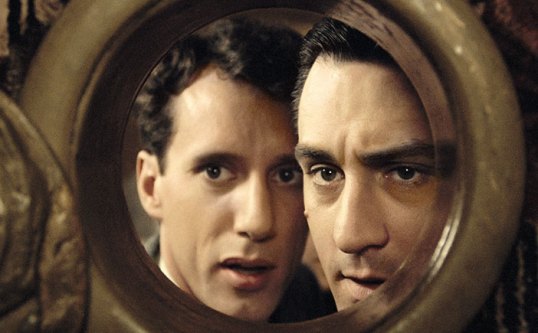
onceuponatimeinamerica1


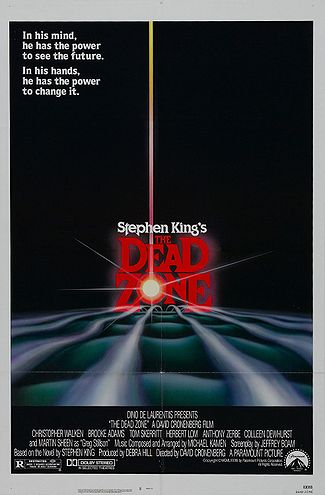
Shattered Politics #49: The Dead Zone (dir by David Cronenberg)


The_Dead_Zone

So, it seems like every time that I write a review of any film based on a novel by Stephen King, I always have to start out by explaining that I think, while King’s success is undeniable, the fact that he’s overrated is also undeniable.  It’s a comment that I always make and then I have to deal with people going, “But, Lisa, everyone loves Stephen King!  He’s the most commercially successful author ever!  He’s a modern-day Charles Dickens!”

Bleh.

Make no mistake, I think that Stephen King is a talented writer.  However, I don’t think that he’s the greatest writer that has ever lived and that’s where I often come into conflict with King’s fans.  (Stephen King fans tend to be like religious fanatics when it comes to defending their belief.)  Having read both King’s earlier work and his more recent books, it’s hard for me not to feel that Stephen King has been growing steadily complacent.  There’s a certain self-importance to his prose and his plotting that, for me, is the literary equivalent of nails on chalk board.  If anyone is guilty of believing the most fawning praise of his biggest fans, it would appears to be Stephen King who, to judge from his twitter feed, appears to also believe that he’s our most important cultural critic as well.

(To be honest, I’d probably have more tolerance for King’s attempts at cultural and political criticism if he wasn’t so  predictable about it all.  Stephen King may write best sellers but that doesn’t mean he has anything interesting or unique to say about current events.)

Anyway, since I don’t feel like having to deal with all of that shit all over again, I’m not going to start this review by saying that I think Stephen King is overrated.  In fact … whoops.

Okay, so much for that plan.

Even I have to admit that The Dead Zone is one of Stephen King’s better books.  First off, it’s less than a 1,000 pages long.  Secondly, the hero isn’t a writer who spends all of his time whining about the political preferences of his neighbors.  Third, it deals with all of the “big” issues of faith, destiny, and morality but it does so in a far less heavy-handed manner than most of King’s books.

The Dead Zone is also the basis for one of the better films to be adapted from a Stephen King novel.  Directed by David Cronenberg and starring Christopher Walken, the film’s plot closely follows the novel.  Johnny Smith (Christopher Walken) is a high school teacher who, after a horrific car crash, spends five years in a coma.  When he finally wakes up, he discovers that his girlfriend, Sarah (Brooke Adams), has married another man.  His mother has become a religious fanatic.  And, perhaps most importantly, whenever Johnny touches anyone, there’s a good chance that he’ll see either the person’s past or a possible future.

Needless to say, Johnny struggles with how to deal with his new powers.  After he helps to catch a local serial killer, Johnny goes into seclusion.  However, when he discovers that Sarah is now volunteering for ambitious politician Greg Stillson (Martin Sheen), Johnny goes to a Stillson rally, shakes the man’s hand, and has a vision.  Johnny discovers that, if Stillson is elected to the senate, he’ll eventually become President and then he’ll destroy the world.

Much like The Shining, The Dead Zone benefits from being directed by a filmmaker who was both confident and strong enough to bring his own individual style to the material.  (Usually, when a King adaptation fails, it’s because it followed the source material too closely, as if the film’s producers were scared of upsetting any of King’s constant readers.)  Though the film’s plot may closely follow the novel, the movie itself is still definitely more of a product of David Cronenberg than Stephen King.  Whereas King’s novel devoted a good deal of time to Johnny and Sarah’s relationship, it’s treated as almost an afterthought in Cronenberg’s film.  Whereas King’s novel presented Johnny Smith as being an everyman sort of character, Cronenberg’s film gives us a Johnny who, from the start of the film, is a bit of an outsider even before he starts to see the future.  Whereas King put the reader straight into Johnny’s head, Cronenberg approach is a bit more detached and clinical.  Cronenberg’s Johnny is a bit more of an enigma than King’s version.

Fortunately, Cronenberg was fortunate enough to be able to cast Christopher Walken in the role of Johnny Smith.  King’s preference for the role was Bill Murray.  As odd as it may sound, you can actually imagine Bill Murray in the role when you read King’s book.  But, for Cronenberg’s more detached vision, Walken was the perfect choice.  People tend to spend so much time focusing on Christopher Walken’s quirky screen presence that there’s a tendency to forget that he’s actually a very talented actor as well.  He’s very likable and sympathetic as Johnny and brings a humanity and a sense of humor to the role, which provides a good balance to Cronenberg’s sense of detachment.

The Dead Zone is a good book and it was later turned into an occasionally good (and, just as often, not-so-good) television series.  However, the film is still the best.

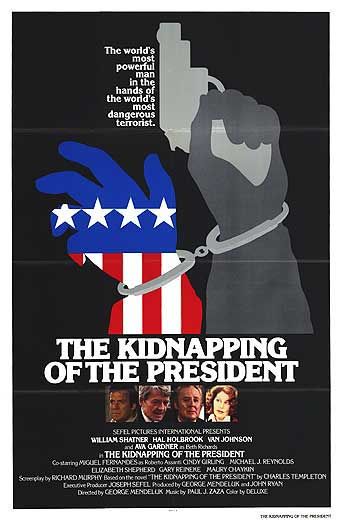
Shattered Politics #48: The Kidnapping of the President (dir by George Mendeluk)


Kidnapping_of_the_president

Agency was not the only Canadian film to be made about American politics in 1980.  There was also The Kidnapping of the President, a low-budget political thriller that, because it has since slipped into the public domain, can currently be found in a few dozen DVD box sets.  In fact, you may very well own a copy of The Kidnapping of the President without even realizing it!

Don’t worry if you do.  The Kidnapping of the President is a fairly harmless little film.

U.S. President Adam Scott (Hal Holbrook) is visiting Toronto when he gets handcuffed to a South American revolutionary named Roberto Assanti (Miguel Fernandes).  Assanti locks President Scott in an armored car that is wired with explosives and then demands a hundred million in diamonds and two planes.  (Though the film never explicitly states it, I imagine that Assanti was primarily motivated by jealousy over the fact that Che is on a million t-shirts while Assanti remains fairly unknown.)  It’s up to secret service agent Jerry O’Connor (William Shatner) to negotiate with Assanti and rescue the President!  Meanwhile, the ethically compromised Vice President (Van Johnson) is left as acting President in Washington and struggles to keep things calm while his ambitious wife (Ava Gardner) plots for a brighter future.

Overall, the Kidnapping of the President is okay for what it is.  It’s neither exceptionally good nor memorably bad.  It just sort of is.  Hal Holbrook is always well-cast as a President and William Shatner gives a typical Shatner performance, which is either a good or a bad thing depending on how you feel about William Shatner.  And, for that matter, Miguel Fernandes is a properly unlikable villain though he never really seems to have the charisma necessary to make him believable as the dynamic leader that he’s supposed to be.

Probably the most interesting thing about The Kidnapping of the President is that it doesn’t try to pass Montreal off for being a location in the United States.  Instead, the film was not only filmed in but is actually set in Toronto as well.  When Jerry attempts to deal with the local authorities, that means that he ends up talking to a bunch of very polite men in red uniforms.

But what’s strange about this is that the people of Toronto are so excited about the arrival of the President.  You half expect to hear one extra say, “I never thought I’d live long enough to see the day that a leader that I can’t vote for and who has next to nothing to do with my everyday life would come to visit Toronto.”

Don’t get me wrong.  If you follow me on twitter, then you know that I am unashamed to declare my love for all things Canadian.  And obviously, as neighbors, Canada and the United States do have a close relationship.  But would people in Toronto really be that excited to see the President?

If so, I think we really owe the people of Canada an apology for not knowing more about their government.  At the very least, we should definitely invite Stephen Harper over for lunch.

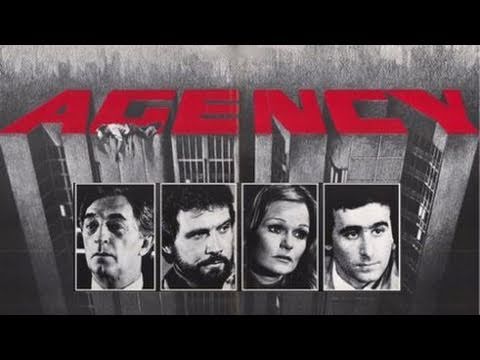
Shattered Politics #47: Agency (dir by George Kaczender)


Agency

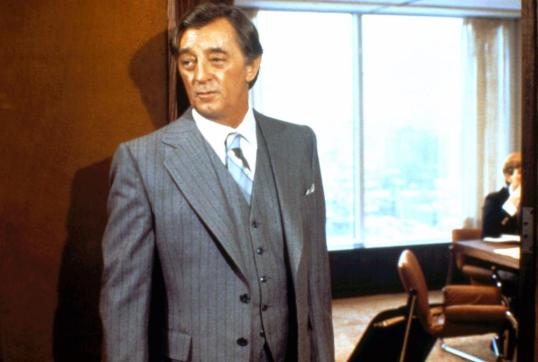
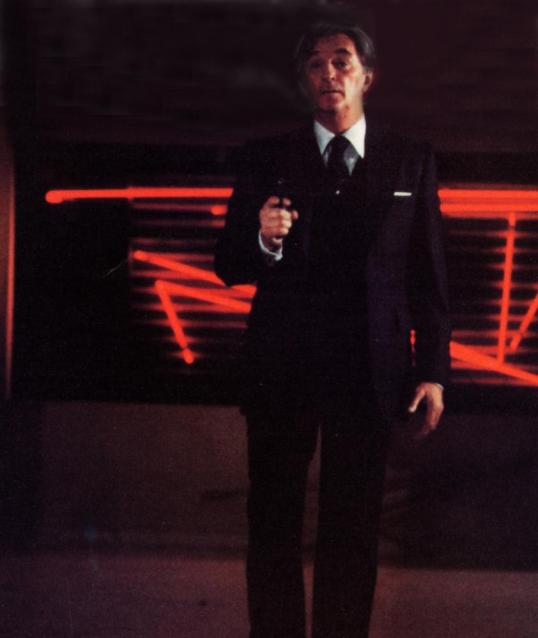
“Who are the other two lugs on this poster? And who’s the dame? Baby, I just don’t give a damn…” Robert Mitchum in Agency.

Like a lot of writers who occasionally have issues when it comes to balancing ambition with time management, I’ve discovered that it helps if I listen to music while I write.  For instance, while writing the majority of the reviews for Shattered Politics, I’ve been listening to Big Data’s Dangerous.

And that choice of music has actually turned out to be extremely appropriate.  No, not just because it’s dangerous to write about politics.  But also because the official music video for Dangerous deals with advertising and, more specifically, how sex and violence are used to sell everything from shoes to politicians.

Now, I don’t know about you but, whenever I see that video, I feel like I’m ready to put on a sports bra, running shorts, and of course my Big Data running shoes so that I can take control and headbutt my way through life!  A good commercial can do that.  (And don’t even get me started on what I’m going to do to the next person I see eating a hot dog…)

Interestingly enough, the 47th film that I’m reviewing for Shattered Politics also deals with the power of advertising.  First released in 1980, Agency stars Robert Mitchum as Ted Quinn, the mysterious new owner of a major ad company.  Out of all of the old school movie stars, Robert Mitchum is one of my favorites because he was not only a great actor but he was also a very honest one.  If he didn’t give a damn about a role, he wasn’t going to try to fool the audience otherwise.  Instead, he was going to deliver his lines and kind of smirk with his eyes, his way of subliminally asking the audience, “Are you actually watching this shit?”  And while this may have led to Mitchum giving several performances that were unworthy of his talent, it also means that if you see Robert Mitchum actually invested in a role than that means the film must be something really special.

Unfortunately, Agency is not one of those “something really special” films.  And Mitchum’s bored performance reflects that fact.

"Just try to make me care." Robert Mitchum in Agency.

“Just try to make me care.” Robert Mitchum in Agency.

Anyway, under Ted Quinn’s leadership, the ad agency is doing commercials for all the usual clients.  The movie starts with one of those commercials — a leather-themed, disco-scored short film extolling the virtues of No Sweat deodorant.  And then there’s also the big chocolate energy drink commercial.  However, copywriter Sam Goldstein (Saul Rubinek) suspects that Ted might have sinister motives.  After a right-wing  candidate comes out of nowhere to win a seat in the U.S. Senate, Sam suspects that the deodorant commercial may have contained subliminal messages…

That’s right!  It’s exactly like that episode of Saved By The Bell where Zack Morris brainwashed Mr. Belding by giving him that subliminally-spiked tape of the Beach Boys.

Well, before you can say “Zack Morris is a blonde Tom Cruise,” Sam has been murdered and it’s up to Sam’s best friend, Philip Morgan (Lee Majors), to reveal the truth about Ted’s sinister agenda…

Like many U.S.-set thrillers from the 1980s, Agency was actually a Canadian film.  Montreal stands in for an unnamed American city where it frequently snows and the supporting cast is full of actors with noticeable Canadian accents.  Mind you, that’s not a complaint.  I love Canada, I love Canadians, and I especially love Canuxploitation films.

That said, Agency is probably one of the least interesting Canadian thrillers that I’ve ever sat through.  (I should add, of course, that I saw Agency on a very low-quality DVD that was released by Miracle Pictures.  And I really do have to say that this was absolutely one of the worst transfers that I’ve ever seen.  It appears that the DVD was copied from an old VHS tape.)  It’s not so much that it’s a terrible film as much as it’s just not a very interesting one.  With the exception of Rubinek, the actors go through the motions with little enthusiasm and the story plods along.  Maybe back in 1980, the whole idea of subliminal advertising seemed exciting and relevant.  But seen today, it just all seems incredibly silly.

So, in the end, Agency did not make me want to headbutt my way through life.

Sorry.

(I still love you, Canada!)

(And you too, Robert Mitchum!)

"Baby, I just don't give a damn."  Robert Mitchum in Agency.

“Baby, I just don’t give a damn.” Robert Mitchum in Agency.


Shattered Politics #46: Used Cars (dir by Robert Zemeckis)


Used_Cars_film_poster

“Do you think we like being associated with the President of the United States?  I mean, we run an honest business here!” —

Jeff (Gerrit Graham) in Used Cars (1980)

As a film lover, I’ve sat through so many disappointing commentary tracks that, when I come across one that’s actually fun and informative, it causes me to like the film even more.  One of the best commentary tracks that I’ve ever heard was the one that Robert Zemeckis, Bob Gale, and Kurt Russell recorded for the DVD release of the 1980 comedy Used Cars.

The film — which was an early credit for both director Zemeckis and screenwriter Gale — tells the story of two rival used car lots.  The bad guy car lot is owned by Roy L. Fuchs (Jack Warden).  The good guy car lot is owned by Roy’s brother, Luke Fuchs (also played by Jack Warden).  The top salesman at the good guy car lot is Rudy Russo (Kurt Russell).  The film shows what happens when Luke dies and Rudy tries to prevent Roy from taking over the lot.

The commentary track is distinguished by just how much Zemeckis, Gale, and Russell seem to truly enjoy watching and talking about the film.  Kurt Russell, in particular, has an incredibly engaging laugh and his sense of fun is contagious.  However, for me, the most interesting part of the commentary track came when Bob Gale explicitly compared Rudy Russo and Luke’s daughter (played by Deborah Harmon) to Bill and Hillary Clinton and then even starts to do a surprisingly good imitation of Bill’s hoarse Arkansas accent.

What made it interesting was that the comparison was absolutely correct.

Politicians are salesmen.  Much as politicians will say anything to get your vote, the salesmen in Used Cars will say and do anything to get your money.  Politicians sell promises that are too good to be true.  Rudy Russo and Roy L. Fuchs do the same thing, claiming that their used cars are just as good and safe as a car that’s never been owned before.

In fact, one of the major plotlines in Used Cars is that Rudy is plotting to make the move from selling cars to buying votes.  There’s a vacancy in the state senate and Rudy is planning on running for the seat.  All he has to do is come up with the $10,000 necessary to buy the nomination from the local political machine. (I imagine it would be more expensive to buy a nomination today.)  Luke agrees to loan Rudy the money but, before he can, Luke goes on a test drive with a former race car driver.

The driver works for Luke’s evil brother, Roy.  Roy knows that Luke has a heart condition and he specifically sends over that driver to give Luke a fatal heart attack.  Just as Rudy is trying to sell a car to a costumer who is skeptical about whether or not he should pay an extra fifty dollar for something he doesn’t want (“$50.00 never killed anyone!” the customer insists), Luke staggers into the office and dies.

(The shocked customer agrees to pay the extra fifty dollars.  Ever the salesman, Luke grabs the fifty before he dies.)

With Luke dead and his estranged daughter nowhere to be seen, Roy is next-in-line to take over Luke’s car lot.  So, Rudy hides the body and tells everyone that Luke is down in Florida.  Both he and his fellow salesman, the hilariously superstitious Jeff (Gerrit Graham), conspire to make as much money as possible before anyone discovers the truth.

How do they do it?  Illegally, of course!

First off, they break into the broadcast of a football game and do an ad.  Then, they use strippers to attract customers.  And finally, Rudy comes up with his master plan, interrupting a televised address from the President of the United States.

“You can’t fuck with the President!” Jeff says.

“Hey, he fucks with us…” Rudy responds.

Seriously, I love Rudy.

In fact, I really liked Used Cars.  It’s a good combination of broad humor and clever satire and both Kurt Russell and Gerrit Graham give such likable performances that you can ignore the fact that they’re both playing total jerks.  (In fact, I would argue that one reason that we love Rudy is because he’s so honest about being so crooked.)  Not every scene worked perfectly.  The scene where Rudy and Jeff interrupt that football game goes on forever and, after a spokesmodel’s dress is ripped off, becomes so uncomfortable to watch that it actually takes the film a while to recover.  But then, after that, you get the interruption of the President’s speech.  You get Jeff freaking out over whether or not red cars or unlucky.  You get some fun driving school humor.  And, of course, you get a cute dog that can do tricks and helps to sell cars.  The film recovers and, ultimately, Used Cars is a celebration of small businesses everywhere.

And you know what?

I really hope Rudy did make it into the state senate.

We need more Rudy Russos in government.

And we really need more commentary tracks featuring Kurt Russell!

Shattered Politics #45: The Changeling (dir by Peter Medak)


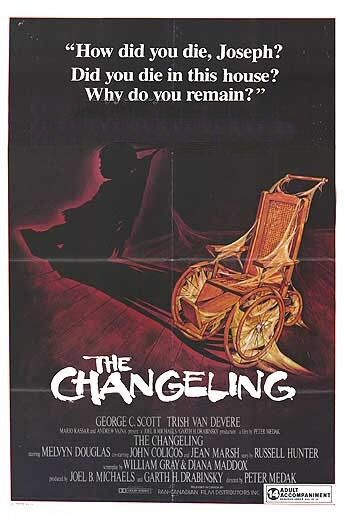
Changeling_ver1If you love horror movies, you have to track down and see The Changeling.

First released in 1980, The Changeling stars George C. Scott as John Russell, a composer.  At the start of the film, he watches helplessly as both his wife and his daughter are killed in a horrific auto accident.  The grieving John leaves his New York home and relocates to Seattle, Washington.  With the help of a sympathetic realtor, Claire Norman (Trish Van Devere), John finds and rents a previously abandoned Victorian mansion.

At first, it seems that John is alone with his grief.  But, as you can probably guess, it quickly becomes apparent that John isn’t alone in his house.  Windows shatter.  Doors slam.  And, most dramatically, every night a mysterious banging sound echoes through the house.  Slowly, John comes to suspect that his house might be haunted…

And, of course, it is!  It’s no spoiler to tell you that because the film is admirably straight forward about being a ghost story.  And what a clever ghost story it is.  I don’t want to give too much away so I’ll just say that the story behind the ghost involves a powerful family, an age-old scandal, and a powerful U.S. Senator (played, with a mixture of poignant sadness and menace, by Melvyn Douglas).

The Changeling is a very well-done and effective ghost story.  For the most part, director Peter Medak emphasizes atmosphere over easy shocks, the end result being a film that maintains a steady feeling of dread and sticks with you long after the final credit rolls up the screen.  George C. Scott is well-cast as John Russell, capturing both the character’s grief and his curiosity.  (There’s actually a very interesting subtext to the film, in that investigating death actually gives John a reason to live.)  At the time the film was made, he was married to Trish Van Devere and the two of them have a very likable chemistry.  And, as previously stated, Melvyn Douglas makes for a great quasi-villain.

(It’s interesting to compare Douglas’s intimidating work here with the far more sympathetic performances that he gave, around the same time, in Being There and The Seduction of Joe Tynan.)

My favorite scene in The Changeling comes when John and Claire hold a séance in order to try to discover what the ghost wants.  The séance team is made up one woman who asks questions, one woman who channels the spirit and writes down his answers, and one man who reads the answers after they’re written.  It’s a wonderfully effective scene, dominated by the eerie sounds of questions being asked, answers being scribbled, and then being shakily read aloud.  It’s probably one of the best cinematic séances that I’ve ever seen.

The Changeling is a wonderful mix of political intrigue and paranormal horror. It was also the first film ever to win a Genie award for Best Canadian Film, which just goes to prove the 90% of all good things come from Canada.

Shattered Politics #44: The Seduction of Joe Tynan (dir by Jerry Schatzberg)


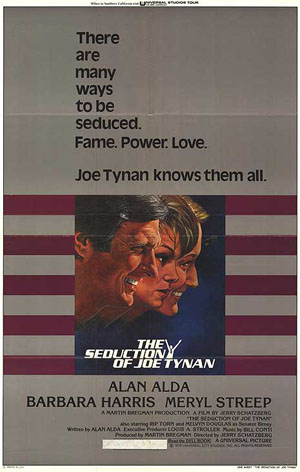
The Seduction of Joe Tynan (1979)

You know how sometimes you see a film and you can just tell that it was probably a big deal when it was first released but now, in the present day, it’s just not that interesting?  That’s the way that I felt when I saw 1979’s The Seduction of Joe Tynan on Netflix.  This is one of those film’s that you just know was probably praised for being adult and mature when it was first released but seen today, it’s just kinda bleh.

Joe Tynan (Alan Alda) is a Democratic senator from New York, a committed liberal who is also an ambitious pragmatist.  As quickly becomes apparent, Joe is happiest when he’s at work.  He struggles to talk to his rebellious teenage daughter (Blanche Baker).  While he may love his wife (Barbara Harris), she’s also one of the few people in his life who isn’t always telling him how great he is and, to an extent, she resents having to live in his shadow.  At times, it seems like the only thing holding Joe’s family together is the possibility that Joe could soon be nominated for the presidency.

When a Southern judge is nominated for the Supreme Court, Joe is asked by his mentor, Sen. Birney (a great Melvyn Douglas), to not oppose the nomination.  While Joe originally agrees to keep quiet, he soon changes his mind when he’s approached by lobbyists who make it clear that, if he goes back on his word to Birney, they’ll be willing to support Joe for President.

Leaving behind his family, Joe heads down south where he meets a researcher named Karen Traynor (Meryl Streep).  With Karen’s help, Joe discovers that the judge actually is a racist.  He also discovers that, politically, he has a lot more in common with Karen than he does with his own wife and soon, they’re having an affair.

The Seduction of Joe Tynan is an odd film.  As written, Tynan is a decent but flawed man.  He may do the right thing but he does so largely because of his own ambition.  That’s not a problem, of course.  If anything, that would seem to be the making of a great political film.  Some of the greatest film characters of all time have been morally ambiguous.  But then, Alan Alda (who also wrote the script) gives a performance that would seem to indicate that he was scared of being disliked by the audience.  Alda is believable when he’s being a self-righteous crusader but, whenever he has to play up the pragmatic and ruthless side of Joe Tynan, he almost seems to have zoned out.  It’s interesting to compare Alda’s lukewarm performance here with the far more nuanced performance that he would give, as a less idealistic Senator, decades later in The Aviator.  As far as the film’s senators are concerned, Melvyn Douglas and Rip Torn (playing a libertine colleague) are far more believable than Alda.

The film’s best performance is delivered by Meryl Streep.  That might not sound shocking but actually, Streep’s performance here is surprising because it’s far more natural and less mannered than some of her more acclaimed performances.  Believe it or not, you actually forget that you’re watching Meryl Streep.

Ultimately, you have to respect the fact that the film attempted to tell an adult and mature story about politics but that doesn’t make The Seduction of Joe Tynan any less forgettable.

Shattered Politics #43: Being There (dir by Hal Ashby)


Original_movie_poster_for_Being_There

As a general rule, I don’t watch the news.  However, a few nights ago, I made an exception and I watched CNN.  The reason was because it was snowing in New York City and apparently, CNN anchorman Don Lemon was broadcasting from something called the Blizzardmobile.  I just had to see that!

Well, the Blizzardmobile turned out to be huge letdown.  I was hoping for something like the Snowpiercer train but instead, it just turned out to be a SUV with a camera crew and a pompous anchorman who hilariously kept insisting that he was knee-deep in a blizzard when even a Texas girl like me could tell that the Blizzardmobile was only encountering a few snow flurries.

So, I flipped around to see if any of the other news stations had anyone in a blizzardmobile.  What I discovered was that only CNN had a blizzardmobile but one thing that every news station did have was a panel of experts.  An anchorperson would say something like, “What does the future look like?” and the panel of experts would tell us what the future looked like to them.  What I found interesting was that I had no idea who these experts were but yet I was supposed to just believe that their opinions were worth considering.

I mean, for all I knew, those experts could have just been people who were spotted wandering around New York at night.  But, because they were introduced as experts and looked directly at the camera whenever they spoke, they were suddenly authoritative voices.

Oddly enough, the very next night, I watched a movie from 1979 that dealt with the exact same issue.

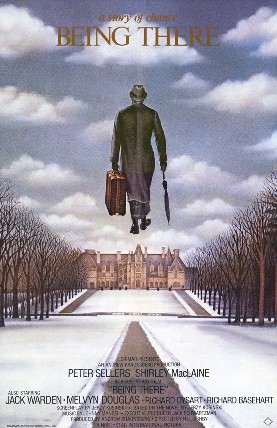
Being There tells the story of Chance (Peter Sellers), a dignified, middle-aged man who lives in Washington, D.C. and works as a gardener for a wealthy older man.  Chance cannot read.  Chance cannot write.  Chance goes through life with a blank smile on his face.  Chance has never experienced the outside world.  Instead, he spends all of his time working in the old man’s garden and obsessively watching TV.  When the old man dies, Chance finds himself exiled from the house.  Wandering around Washington D.C., Chance asks a random woman to make him dinner.  He politely speaks with a drug dealer who pulls a knife on him.  Finally, he finds himself entranced by a window display of televisions.  Backing away from the window, Chance stumbles into the street and is struck by a car.

Though he’s not seriously injured, the owner of the car, Eve Rand (Shirley MacClaine), insists that Chance come back to her mansion with him so that he can be checked out by her private physician (Richard Dysart).  As they drive back to the house, Eve asks Chance for his name.

“Chance the Gardner,” Chance replies.

“Chauncey Gardiner?” Eve asks.

Chance blankly nods.

Back the house, Chance meets Eve’s husband, Ben (Melvyn Douglas).  Ben is a wealthy industrialist who is dying of leukemia.  Ben takes an immediate liking to Chance.  Because Chance is wearing the old man’s suits, everyone assumes that Chance is a wealthy businessman.  When Chance says that he had to leave his home, they assume that his business must have failed due to government regulation.  When Chance talks about his garden, everyone assumes that he’s speaking in metaphors.

Soon, Ben is introducing Chance to his friend, Bobby (Jack Warden).  Bobby happens to be the President and when he quotes Chance in a speech, Chance the Gardner is suddenly the most famous man in the country.  When he appears on a TV talk show, the audience mistakes his emotionless comments for dry wit.  When he talks about how the garden reacts to different seasons, they assume that he’s an economic genius.  By the end of the film, Bobby has become so threatened by Chance’s popularity that he’s been rendered impotent while wealthy, rich men plot to make Chance the next President of the United States.

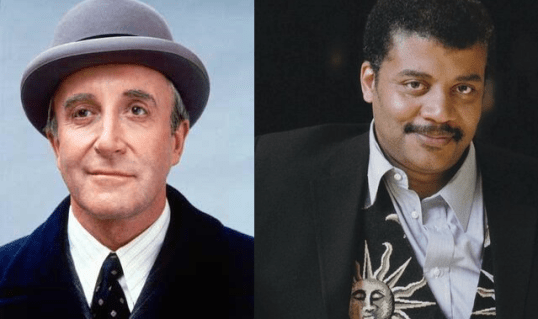
Chance and Neil

In many ways, Chauncey Gardiner was the Neil deGrasse Tyson of his era.

Being There is a one joke film and the idea of someone having no emotional skills beyond what he’s seen on television was probably a lot more mind-blowing back in 1979 than it is in 2015.  But I still enjoyed the film.  Peter Sellers gave a great performance as Chance, never sentimentalizing the character.  As well, the film’s point is still relevant.  If Being There were made today, Chance would be the subject of clickbait articles and Facebook memes.  (Chauncey Gardiner listed his ten top movies and number 8 will surprise you!  Or maybe This boy asked Chauncey Gardiner about his garden and his response was perfect.)

At its best, Being There is a film that will encourage you to question every expert you may see.  Especially if he’s just stepped out of a blizzardmobile…


Shattered Politics #42: Blue Sunshine (dir by Jeff Lieberman)


(I wrote an earlier version of this review for HorrorCritic.Com.)

Blue_Sunshine_(film)

Occasionally, on twitter, I would take part in the Drive-In Mob live tweet session.  Every Thursday night, a group of exploitation, grindhouse, and horror film fans gog together and watched the same film and, via twitter, provided their own running commentary track.  It was always terrific fun and a good opportunity to discover some films that you might have otherwise missed.  It was through the Drive-In Mob that I first discovered a low-budget cult classic from 1978, Blue Sunshine.

Blue Sunshine (directed by the underrated horror director Jeff Lieberman) opens in the late 1970s.  Across California, people are suddenly going bald and turning psychotic.  At a party, singer Frannie Scott (played by Richard Crystal) has a nervous breakdown when another reveler playfully pulls off his wig and reveals Frannie to be hairless.  Frannie responds by tossing half of the guests into the fireplace and then running out into the night.  He’s pursued by his best friend Jerry Zipkin (played by future director Zalman King) but when Frannie is accidentally killed while running away, Jerry finds himself accused of being a murderer.  Even as the police pursue him, Jerry starts his own investigation.  He quickly discovers that there’s an epidemic of bald people suddenly murdering those closest to them.  The one thing that these people have in common: they all attended Stanford University in the late 1960s and they all used a powerful form of LSD known as “blue sunshine.”  Now, ten years later, they’re all having the worst flashback imaginable.

And, perhaps most dangerously, the campus drug dealer, spoiled rich kid Edward Fleming (Mark Goddard), is on the verge of being elected to the U.S. Congress.  Not only it is possible that Edward may have taken the acid himself but Edward and his campaign manager have their own reasons to try to make sure that Jerry never reveals the truth behind Blue Sunshine.

Blue Sunshine is probably one of the best of the old grindhouse films, a film that embraces the conventions of both the horror and the political thriller genres while, at the same time, neatly subverting our expectations.  Director Jeff Lieberman emphasizes atmosphere over easy shocks and the film’s cast does a pretty good job of making us wonder who is normal and who has dropped the blue sunshine.  Wisely, Lieberman doesn’t resort to giving us any easy villains in this film.  Much like the best horror films, the monsters in Blue Sunshine are as much victims as victimizers.  I especially sympathized by one poor woman who was driven to rip off her wig by the sound of two particularly obnoxious children chanting, “We want Dr. Pepper!” over and over again.  Seriously, that’s enough to drive anyone crazy.

Blue Sunshine is one of those wonderfully odd little cult films that makes me thankful that I own a DVD player.  First released in 1978, Blue Sunshine mixes psychological horror with political conspiracy and the end result is an unusually intelligent B-movie that remains relevant even when seen today.  Blue Sunshine was originally released on DVD by Synapse Entertainment and it has since been re-released by the New Video Group.  I own the Synapse edition, which features a very entertaining director’s commentary with Jeff Lieberman as well as a bonus CD of the film’s haunting and atmospheric score.

Shattered Politics #41: Billy Jack Goes To Washington (dir by Tom Laughlin)


39c7523029bb4c926a278a4a6a333ae5

The Happy Hooker wasn’t the only person to go to Washington in 1977!  Billy Jack may have started out killing bikers and then moved on to killing Bernard Posner and then finally ended up killing yet another Mr. Posner but, in 1977, Billy Jack was appointed to the U.S. Senate.

Now, it may seem strange to think of someone like Billy Jack being appointed to the U.S. Senate.  Over the course of the previous three films in the franchise, Billy had been shot in the back, shot in the leg, arrested for murder, convicted of manslaughter, and then shot by the National Guard.  In Billy Jack and The Trial of Billy Jack, Billy goes as far as to state that he does not feel the laws of the United States apply to him.

And then, when you consider that the three previous films all featured old, rich, white guys plotting to kill Billy, you would be justified in wondering how he would ever find himself appointed to serve in the senate.

But it happened!

And we’ve got a movie to prove it.

Directed by and starring Tom Laughlin, Billy Jack Goes To Washington is actually a remake of Mr. Smith Goes To Washington.  (To the film’s credit, it’s honest enough to actually give credit to Mr. Smith‘s screenwriters in the opening credits.)  What’s remarkable is just how faithful a remake Billy Jack Goes To Washington actually is.  All the scenes made famous by Jimmy Stewart — the scene where the newest member of the Senate attempts to introduce his first bill, the scene where he’s shocked to discover that Sen. Paine (played here by E.G. Marshall) takes orders from Boss Bailey (Sam Wanamaker), the scene where cynical Saunders (Lucie Arnaz) tells the senator that he should leave Washington, and, of course, that famous filibuster — are all faithfully recreated here.  The only difference, of course, is that it’s no longer idealistic Jimmy Stewart proving himself to be incredibly naive about politics.  Instead, it’s a former Green Beret, half-Indian, judo master named Billy Jack.

Tom Laughlin was a good actor, which is something that’s often overlooked by reviewers writing about the Billy Jack films.  As flawed as The Trial of Billy Jack may have been, Tom Laughlin was a compelling enough presence that the film itself remains a compulsively watchable 3-hour mess.  Laughlin had a very authoritative presence.  You looked at him and you knew that he knew what he was doing.  He was someone who you automatically wanted on your side, a natural born leader who knew how to get things done.  However, in Billy Jack Goes To Washington, Laughlin attempts to play Billy Jack as the type of naive neophyte who would be shocked to discover that politicians are corrupt.  But surely, after spending three films being harassed by every authority figure in America, Billy would have already realized that.  There’s nothing about Laughlin’s screen presence that suggests he could ever be that innocent.

And that’s the main problem with Billy Jack Goes To Washington.  For the film to have any chance of working, you have to forget everything that you’ve learned about Billy Jack over the previous three films.  However, if you haven’t seen any of the other Billy Jack films, then you probably wouldn’t be watching Billy Jack Goes To Washington in the first place.

Of course, since this is a Billy Jack film, there are a few scenes that were nowhere to be found in Mr. Smith Goes To Washington.  For instance, Saunders’s husband is murdered when he threatens to reveal the truth about Bailey’s operation.  Later, Billy, Jean (Delores Taylor), and Carol (Teresa Laughlin) are confronted by a gang of Bailey’s assassins and, for the only time in the entire movie, Billy goes through that whole routine where he takes off his boots while slowly speaking and then kicks everyone’s ass.  (Jean and Carol get to join in the ass-kicking as well and good for them!)

And, of course, there’s the scene where Billy, Jean, and the kids from the Freedom School (who are apparently now known as Billy’s Raiders) have a meeting with two liberal social activists.  It’s an interesting scene because it was clearly unscripted and it has a naturalistic feel to it that’s lacking from the rest of the film.  However, that does not mean that it’s a particularly good scene.  If I learned anything from Billy Jack Goes To Washington, it’s that self-righteous activists in 1977 were just as boring as self-righteous activists in 2015.

And yet, as I’ve said about all of the other Billy Jack films, I can’t bring myself to be too hard on Billy Jack Goes To Washington.  Again, it all comes down to sincerity.  It’s clear that Laughlin and Taylor felt they were making a difference with their films and that sincerity comes through in a way that makes Billy Jack Goes To Washington a likable, if rather inept, film.

Billy Jack Goes To Washington ran for a week in one theater in 1977 and was reportedly such a box office disaster that it couldn’t get a wider release.  (In a commentary track that he recorded for the film’s DVD release, Laughlin suggests the film was the victim of shadowy government forces.)*  While Laughlin and Taylor would later try to make The Return of Billy Jack, that film was left uncompleted at the time of Laughlin’s death.  So, the last time that filmgoers would see Billy Jack, he would still be U.S. Sen. Billy Jack.

And really, that’s the perfect ending for the saga of Billy Jack.  Starting out as a loner who protected a small California town from a biker gang to eventually becoming the protector of the Freedom School to finally embracing both non-violence and his love for Jean, Billy Jack earned himself a happy ending.

Having now watched and reviewed all four of the Billy Jack films, all I can do is say thank you to Delores Taylor and the spirit of Tom Laughlin.  It was great ride.

1251421109_1

—-

* To be honest, the commentaries that Laughlin and Taylor recorded for the Billy Jack films are actually very informative and interesting.  Laughlin actually had a far better sense of humor than you might guess from some of the movies he directed.