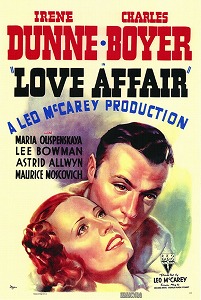
Lisa Watches An Oscar Nominee: Love Affair (dir by Leo McCarey)


Love_Affair

“If you can paint, I can walk!” — Terry McKay (Irene Dunne) in Love Affair (1939)

So, TCM’s 31 Days of Oscar has ended but I’m still on my mission to watch and review every single film that has ever been nominated for best picture.

Now, don’t get me wrong.  This isn’t going to be one of my series like Shattered Politics or Embracing the Melodrama.  I’m not going to post six best picture reviews a day for the next three weeks until I’ve reviewed every single one of them.  Instead, I’m just going to keep my eyes open.  When I see that a best picture nominee is going to be on TCM, I’ll be sure to record, watch, and review it.  On days that I have some extra time, I’ll watch and review something from my DVD and Blu-ray collection.  And, of course, I’ll keep make sure to keep up with what’s available on Netflix, Hulu, and all the other streaming services.

And, on a night like tonight when its sleeting outside and I’m aware that I probably won’t be going outside for the next two or three days, I’ll be sure to look through my DVR and see what I still need to watch.

Tonight, for example, I did just that and I ended up watching the 1939 best picture nominee, Love Affair.

Love Affair tells the story of two rich people in love.  Michel (Charles Boyer) is a painter and a notorious playboy. Terry (Irene Dunne) is an aspiring singer.  They’re both engaged to other people but, when they meet on a cruise, it’s love at first sight.  They try to avoid each other.  They try to remain faithful to their significant others.  But, when the boat docks off of the island of Madeira, Terry agrees to visit Michel’s grandmother with him.

Michel’s grandmother is played by Maria Ouspenkaya and, while Ouspenkaya does a good job playing the eccentric grandma and even received an Oscar nomination for her 10 minutes or so of screen time, it’s hard to look at her without imagining that she’s about to say something about what happens when the moon is full.  Or, at least, that’s the case if you’re a fan of the old Universal horror films and you’ve seen Ouspenkaya play the gypsy in original Wolf Man.  Instead of talking about the curse of lycanthropy, Michel’s grandma instead tells the two that they are meant to be together.

Anyway, once they return to New York, Michel and Terry agree to separate and, if after six months they still can’t stop thinking about each other, they’ll meet at the top of the Empire State Building.  Michel spends his six months becoming a more responsible human being.  Terry spends her six months singing.

Six months pass.  Michel stands at the top of the Empire State Building.  Little does he know that, on her way to meet him, Terry got struck by a car.  Michel is convinced that Terry stood him up.  Meanwhile, Terry is confined to a wheelchair.

Wow, depressing movie, huh?  Well, don’t worry.  That’s only the first half of the movie.  There’s still a lot more misunderstandings to get through before Terry can deliver her classic final line.

Occasionally, I’ve seen an old film referred to as being creaky but I don’t think I ever understood what that meant until I saw Love Affair.  Love Affair is such an old-fashioned melodrama and such a product of a bygone era that it can’t help but be a little bit fascinating.  Love Affair is definitely a film that was made at a different time and for a very different, far less cynical audiences and, watching the film today, definitely requires a bit of an attitude adjustment.  However, what Love Affair may now lack in entertainment value, it makes up for in historical value.  By today’s standards, Love Affair may seem slow and a bit too melodramatic but it remains a time capsule.  If you want to go back to 1939, you can either build a time machine or you can watch Love Affair.

(And, fortunately, Love Affair is in the public domain, which means it’ll be a lot easier to find than a working time machine.)
The Things You Find On Netflix: 88 (dir by April Mullen)


88

If you go over to Netflix right now, you can watch 88, the best film of the year so far.

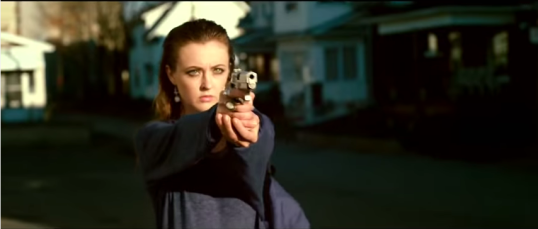
88 opens with a close-up of Gwen (Katharine Isabelle).  Gwen is sitting in a diner and she has no idea how she got there.  All she knows is that her boyfriend Aster (Kyle Schmid) is dead and that she believes that her former employer, Cyrus (Christopher Lloyd) is responsible.  Oh, and Gwen’s hand is also covered in a bloody bandage, largely because she’s missing a finger.  When Gwen tries to leave the diner, several gumballs and a gun fall out of her bag.  The cops eating breakfast overreact.  A waitress panics.  Gwen accidentally shoots someone as she flees.

Still with no idea where she is exactly or how she got there, Gwen discovers that she has a motel room key on her.  When she goes to the motel room, she discovers that the walls are covered with newspaper clippings.  And, of course, there’s a corpse in the bathtub.  On top of that, there’s also a rather hyperactive man named Ty (Tim Doiron, who also wrote the film’s script).  Gwen claims to have never seen Ty before.  Ty, however, says that they’re friends and they’re planning on killing Cyrus together.

Meanwhile, as we watch Gwen try to figure out what’s going on, we also follow the adventures of Flamingo (again played by Katharine Isabelle).  Flamingo is a tough-talking survivor, the type of girl who, when we first meet her, is busy strangling a random motorist so that she can use his car.  Flamingo goes from motel to motel, always staying in room 88.  She obsessively drinks milk.  When she runs into Cyrus and his gang on the street, they claim to know her.  However, Flamingo has no idea who they are.

Which, of course, does not mean that she’s not willing to kill them…

88 is a masterpiece of the grindhouse imagination, an over-the-top film that not only embraces its pulpy origins but practically revels in them as well.  The film is full of wonderfully strange and crazy moments, like when Gwen and Ty visit a flamboyant gun dealer or when Flamingo casually trashes a convenience store for no reason beyond the fact that she apparently feels like doing so.  There is not a single character in 88 who is not, in some way, memorably odd.  Between Gwen’s amnesia, Flamingo’s psychotic behavior, Ty’s cheerful embrace of violence, and Cyrus’s raspy monologues, 88 presents a world that is familiar and yet uniquely its own.  When Michael Ironside shows up as a strict but good-hearted sheriff, it only makes sense that, in the world of 88, Michael Ironside would be the face of law, order, and decency.

Now, to be honest, you’ll probably figure out just how exactly Gwen and Flamingo are related long before the film actually makes it explicit.  You probably figured it out just from reading this review.  But it doesn’t matter.  Ultimately, the specifics of the twist really doesn’t matter.  This film is a celebration of pure style and pulp energy.  Katharine Isabelle is brilliant, both as Gwen and as Flamingo.  In the role of Gwen, Isabelle gives a very sympathetic performance.  You want to understand what is happening to Gwen and, even more importantly, you want her to survive.  Meanwhile, as Flamingo, Isabelle is a force of pure, destructive nature.  Finally, in the role of Cyrus, Christopher Lloyd is a sleazy marvel and even manages to bring a hint of humanity to an occasionally demonic character.

88 is one of those films that will probably never get the critical support that it deserves.  However, I think it’s one of the best of the year so far.

A Blast From The Past: Charlton Heston Explains The Ratings System


Hi!

Are you confused by the ratings system?  Well, fortunately for you, Charlton Heston was willing to take some time out of his tennis game in order to explain it to you.  This short film is from 1972 so it’s a little bit out-of-date.  There’s no mention of PG-13 or NC-17, for instance.  (And, of course, Charlton Heston is no longer with us…)  But the point comes across regardless.

When I went to see Kingsmen at the Alamo Drafthouse, they showed this clip before the movie.  The audience absolutely loved it.

Film Review: Focus (dir by Glenn Ficara and John Requa)


2015_Focus_film_poster

The snow and ice finally melted today so, this afternoon, Jeff and I went down to the Alamo Drafthouse and we saw the just released Will Smith/Margot Robbie film, Focus.

You know how there’s some films that you see and you know that you had a good enough time while you were watching it and then, a few hours later, you realize that the movie itself is quickly fading from your memory?  It’s not that you just saw a bad movie as much as you just watched one that was not exceptionally good.  To a large extent, that sums up how I felt about Focus.  I watched it.  I was mildly entertained.  And I have a feeling that, 6 months from now, I’m going to come across this review and say something like, “Oh yeah, I guess I did see that movie.”  It gets the job done but it doesn’t do much else.

(I was actually tempted to start this review by saying that Focus was good for a “March movie” but then I remembered that last year, The Grand Budapest Hotel came out in March and proved that the date of release is no longer an excuse.)

In Focus, Will Smith plays Nicky Spurgeon.  Nicky’s nickname is Mellow but he didn’t get that nickname for the reason that you probably think he did.  (Though, rest assured, we do find out the exact reason why Nicky is called Mellow and yes, it does factor into the film’s final twist.)  Nicky is anything but mellow.  Instead, he’s a professional con artist who is always scheming, who always considers every detail, and who is always focused on getting what he wants.

The film is split into two parts and the first part is actually pretty good.  An inexperienced con artist named Jess (Margot Robbie) attempts to rob Nicky and gets a lecture as a result.  Nicky isn’t so much upset that Jess tried to con him as much as he, as a professional, is annoyed that Jess did such a bad job of it.  This leads to Nicky eventually becoming Jess’s mentor.  Nicky teaches Jess all the tools of the trade, introduces her to all the properly quirky members of his crew, and he even goes against his own advice (which is to never get close to anyone) when he and Jess become lovers.

The highlight of the first part of the film is a football game where Nicky and a compulsive gambler (B.D. Wong) end up making a series of increasingly ludicrous bets.  B.D. Wong gives such a memorably unhinged performance that he briefly made the entire film seem more interesting than it actually was.  In fact, as I look back over Focus, I find myself wishing that the entire film has just been about his character.

But, unfortunately, the film isn’t about B.D. Wong.  Instead, it’s about Nicky and Jess.  The second part of the film, which takes place three years after the first part, features Jess and Nicky as equals and it feels like almost an entirely different movie.  Whereas Smith and Robbie had a nice chemistry as teacher and student, that chemistry vanishes after the time jump.  Unfortunately, that’s not all that vanishes.  The film’s pace and playful sense of fun disappears as well.  If the first half of the film felt like an above average first episode of a quirky TV show, the second half felt like a long-running sitcom on which the show runner had been fired and suddenly replaced.  It was similar to what had come before but, ultimately, it felt very different.

Focus does end with a big twist but, long before it was revealed, Jeff and I both guessed what it was.  The problem is that we’ve seen so many movies about con artists that we know that all of them are destined to end with a big twist that reveals that there was another con going on that we didn’t know about.  It’s impossible to be surprised by the eventual twist because we all know that it’s coming.  For a “con movie” like Focus to work, it has to either be so cleverly written or so much fun to watch that we actually stop thinking about the inevitability of the upcoming twist.  But, since Focus is never as clever as it thinks it is, we instead spend our whole time thinking about the twist and, seeing as how you’re a clever and experience filmgoer, you probably won’t have much trouble predicting it.

But here’s the thing: I think it’s possible to be too critical of a film like Focus.  Focus may not be good but it does have it fun moments.  Will Smith could play Nicky in his sleep.  (And, to be honest, he occasionally seems to be doing just that.)  Margot Robbie looks like she belongs in an old film noir.  The settings are glamorous.  The clothes are to die for.  Ultimately, Focus is both moderately enjoyable and extremely forgettable.  If you don’t see it in a theater, you won’t regret it.  However, when it show up on cable in December, it’ll make for inoffensive background noise.

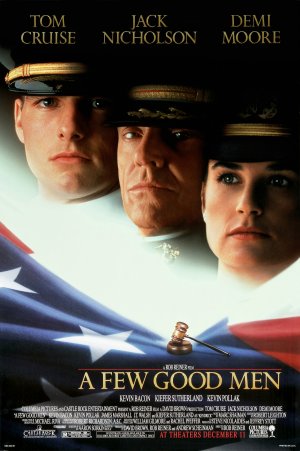
Lisa Watches An Oscar Nominee: A Few Good Men (dir by Rob Reiner)


A_Few_Good_Men_poster

So, late Saturday night, I turned over to TCM’s 31 Days Of Oscar and I was watching the 1992 best picture nominee, A Few Good Men, and I noticed that not only was there only one woman in the entire film but she was also portrayed as being humorless and overwhelmed.  While all of the male characters were allowed to speak in quippy one liners and all had at least one memorable personality trait, Lt. Commander Joanne Galloway (Demi Moore) didn’t get to do much beyond frown and struggle to keep up.

“Hmmmm…” I wondered, “why is it that the only woman in the film is portrayed as basically being a humorless scold?”  Then I remembered that A Few Good Men was written by Aaron Sorkin and it all made sense.  As I’ve discussed on this site before, Aaron Sorkin has no idea how to write woman and that’s certainly evident in A Few Good Men.  Joanne (who goes by the masculine Jo) is the one character who doesn’t get to say anything funny or wise.  Instead, she mostly serves to repeat platitudes and to be ridiculed (both subtly and not-so subtly) by her male colleagues.  You can tell that Sorkin was so busy patting himself on the back for making Jo into a professional that he never actually got around to actually giving her any personality.  As a result, there’s really not much for her to do, other than occasionally scowling and giving Tom Cruise a “that’s not funny” look.

(“C’mon,” Tom says at one point, “that one was pretty good.”  You tell her, Aaron Tom.)

A Few Good Men, of course, is the film where Tom Cruise yells, “I want the truth!” and then Jack Nicholson yells back, “You can’t handle the truth!”  At that point in the film, I was totally on Nicholson’s side and I was kinda hoping that the scene would conclude with Cruise staring down at the floor, struggling to find the perfect come back.  However, this is an Aaron Sorkin script which means that the big bad military guy is never going to have a legitimate point and that the film’s hero is always going to have the perfect comeback.  Fortunately, the scene took place in a courtroom so there was a wise judge present and he was able to let us know that, even if he seemed to be making the better point, Nicholson was still in the wrong.

As for the rest of the film, it’s a courtroom drama.  At Guantanamo Bay, a marine (Michael DeLorenzo) has died as the result of a hazing.  Two other marines (Wolfgang Bodison and James Marshall) have been accused of the murder.  Daniel Kafee (Tom Cruise), Joanne Galloyway (Demi Moore), and Sam Weinberg (Kevin Pollack) have been assigned to defend them.  Jack Ross (Kevin Bacon) is prosecuting them.  Kafee thinks that the hazing was ordered by Col. Nathan Jessup (Jack Nicholson) and Lt. Kendrick (Kiefer Sutherland).

We know that Kendrick’s a bad guy because he speaks in a Southern accent and is religious, which is pretty much the mark of the devil in an Aaron Sorkin script.  We know that Jessup is evil because he’s played by Jack Nicholson.  For that matter, we also know that Kafee is cocky, arrogant, and has father issues.  Why?  Because he’s played by Tom Cruise, of course.  And, while we’re at it, we know that Sam is going to be full of common sense wisdom because he’s played by Kevin Pollack…

What I’m saying here is that there’s absolutely nothing surprising about A Few Good Men.  It may pretend to be about big issues of national security but, ultimately, it’s a very slick and somewhat hollow Hollywood production.  This, after all, is a Rob Reiner film and that, above all else, means that it’s going to be a very conventional and very calculated crowd pleaser.

Which isn’t to say that A Few Good Men wasn’t enjoyable.  I love courtroom dramas and, with the exception of Demi Moore, all of the actors do a good job.  (And, in Demi’s defense, it’s not as if she had much to work with.  It’s not her fault that Sorkin hates women.)  A Few Good Men is entertaining without being particularly memorable.

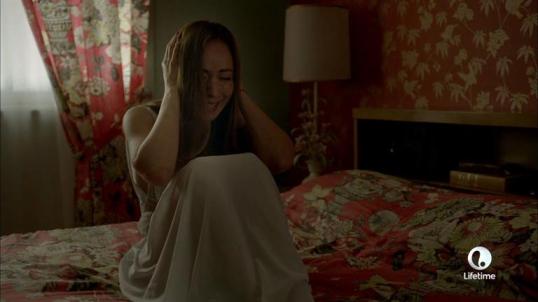
What Lisa Watched Last Night #115: Kept Woman (dir by Michel Poulette)


Earlier, I watched the latest Lifetime original film, Kept Woman!

Kept Woman

Why Was I Watching It?

Well, why not?  First off, it was on Lifetime.  Secondly, the commercials made it look really creepy.  Third, I checked on the imdb and I discovered that this film was made in Canada and everyone knows how much I love Canada.  And finally, I read a very misleading article on Bustle that insinuated that this film was based on the Ariel Castro case.

What Was It About?

One night, after an evening at the theater, Jessica (Courtney Ford) and her fiancée Evan (Andrew W. Walker) return to their apartment and discover that they’re being robbed by a guy who looks like Jack Black’s younger, thinner brother.

Jessica says, “Enough of this city living!  We’re moving to the suburbs!”  Evan agrees to use his life savings to purchase a house in the suburbs.  It’s here that Jessica will work on her book while skyping with her true crime-obsessed friend Oscar (Jesse Camacho).

From the minute he first shows up and offers them a bottle of wine as a welcoming gift, it’s obvious that there is something off about their new neighbor, Simon (Shaun Benson).  For one thing, he dresses like he’s in a community theater production of The Music Man.  He’s a professor of Men’s Studies at the local university and, when he comes over for dinner, he’s clearly both offended and aroused by the sight of Jessica’s visible bra straps.  Also, he’s likes to wear bowties and we all know that, in a Lifetime movie, bowties often equal evil.

Of course, the main clue that there’s something wrong with Simon comes when he kidnaps Jessica and locks her in his basement.  There’s another woman already living in the basement.  Her name is Robin (Rachel Wilson) and she’s been down in the basement for so long that she’s now in love with Simon.

And did I mention that the basement is specifically made up to look like the 1950s?

Because it so totally is!

What Worked?

Oh my God!  Shaun Benson was sooooo creepy!  Seriously, he gave a great over-the-top psycho performance in this film.  Rachel Wilson did a good job too, poignantly portraying just how brainwashed her character had become.  As well, whoever designed and decorated that basement deserves some sort of award.  It was truly a creepy location.

What Did Not Work?

This is one of those films that should have been an insane masterpiece but, somehow, it never worked quite as well as I wanted it to.  The film could never seem to quite decide whether it wanted to be an over-the-top melodrama or a serious look at abduction, abuse, and brainwashing.  Courtney Ford and Andrew W. Walker did not have much chemistry as the endangered couple and, for the film to work, characters often had to behave in the stupidest way possible.  Even the film’s ending, which was obviously meant to be a big “You go, girl!” moment, felt forced.

“Oh my God!  Just like me!” Moments

Much like Jessica, I am totally obsessed with true crime and I enjoy trying to solve real-life unsolved mysteries.  I also imagine that, much like Jessica, I would probably break into my neighbor’s house to investigate whether he was a potential murderer.

Lessons Learned

Creepy neighbors should be handled with extreme caution.

Lisa Watches An Oscar Winner: Chariots of Fire (dir by Hugh Hudson)


Chariots_of_fire

It took me two viewings to really appreciate the film Chariot of Fire.

First released in 1981, Chariots of Fire won the Oscar for best picture.  It’s also one of the few British productions to take the top award.  (British films are regularly nominated but the winner is usually an American production.)  A few nights ago, it was broadcast on TCM and I watched it for the first time.  And I have to admit that I struggled to follow the film.

It’s not that the film’s story was exceptionally complicated.  At heart, it’s an inspirational sports film and it features all of the clichés that one usually associates with inspirational sports films — i.e., come-from-behind victories, eccentric trainers, athletes who are determined to compete under their own terms, training montages, and a memorable score.  (The score for Chariots of Fire was so effective that it’s still used as the background music for countless Olympic specials.)

No, I struggled to follow the film because it really was just so extremely British, featuring everything from Cambridge to Gilbert and Sullivan to a rigidly enforced class system to casual anti-Semitism,  This may have been a sports film but it was a very reserved sports film.  If Chariots of Fire had been an American film, we would have gotten countless shots of people screaming, “YESSSSS!  GO! GO! GO! GO!” Instead, the characters in Chariots of Fire are far more likely to say, “Good show, old boy.”  Whereas an American sports film would have scored a montage of competition to the sound of “Eye of the Tiger,” Chariots of Fire features a men’s chorus singing, “For he is an Englishman….”

It takes a bit of getting used to and perhaps I knew that because, even as I was watching Chariots of Fire, I still set the DVR to record it.  The first time I watched the film, I was overwhelmed by the culture shock and the resolute Britishness of it all.  My reaction was to think that, much like The Big Chill, Chariots of Fire was a “you just had to be there” type of film, the type of film that was once impressive but now just inspires you to go “meh.”

And I was prepared to write a review stating just that.  But, somehow, in the back of my mind, I knew that I should give Chariots of Fire another chance before I dismissed it.  Maybe it was the fact that I couldn’t get the damn music out of my head.  Who knows?  But I couldn’t think about the film’s opening — with all those men running on the beach and getting mud all over their white uniforms — without smiling.

So, seeing as how I am currently snowed in for the weekend, I spent this morning watching Chariots of Fire for a second time and I’m glad that I did.  Because you know what?  Chariots of Fire is actually a pretty good film.  It tells the story of Eric Lidell (Ian Charleson) and Harold Abrahams (Ben Cross), two British runners who competed at the 1924 Olympics.  Harold is a student at Cambridge.  He’s an angry young man who is running to prove all of the anti-Semites wrong.  (Of course, Harold is angry in a very sort of upper class British way).  Eric is the son of missionaries who views running as a mission from God and who refuses to run on a Sunday.  The film looks gorgeous, Charleson and Cross both give good performances, and that music demands an emotional response.  While Chariots of Fire may not be a great film, it’s definitely a likable film and there’s something to be said for that.

Plus, did I mention that the music’s great?


Lisa Reviews An Oscar Nominee: The Big Chill (dir by Lawrence Kasdan)


Big_chill_ver1

There are certain films that truly are “You just had to be there” films.  These are the movies that were apparently loved by contemporary audiences but, when viewed today, it’s difficult to see just what exactly everyone was getting so excited about.  Sometimes, this is because the film itself was so influential and has been copied by so many other films that the original has had its power diluted.  And then, sometimes, it’s just a case that the film was never that good to begin with.

I’m guessing that The Big Chill must be one of those “you just had to be there” type of films.  First released in 1983, The Big Chill was nominated for best picture.  If you look the film up over at the imdb, you’ll find lots of comments from people who absolutely adore this film.  However, when I watched the film as a part of TCM’s 31 Days of Oscar, I have to admit that my reaction can be best summed in one word.

Meh.

Now, don’t get me wrong.  I’m not saying that The Big Chill was a bad film.  To be honest, it was neither memorably bad nor remarkably good.  Instead, it just was.  Overall, the performances were good, the direction was shallow, and the screenplay was occasionally good and occasionally shallow but mostly, it was the epitome of serviceable.

At the start of The Big Chill, Alex is dead.  With the exception of a scene where his corpse is being prepared for burial, Alex never actually appears on screen.  (Originally, Kevin Costner was cast to play the role in a flashback but director Lawrence Kasdan cut the scene.)  What little we learn about Alex, we learn from listening to the other characters in the film talk about him.  For instance, Alex was apparently brilliant but troubled.  He attended the University of Michigan in the 1960s and was close to 7 other politically radical students.  While everyone else was busy selling out their ideals, Alex stayed true to his and, as a result, he ended up spending his life depressed and poor.  Alex ultimately ended up committing suicide, an act that leads to his 7 friends reuniting for his funeral.

Opening with Alex’s funeral and taking place over one long weekend, The Big Chill follows Alex’s friends as they try to figure out why Alex committed suicide and debate whether or not they’ve sold out their college ideals.  They also spend a lot of time listening to the music of the youth, getting high, watching a football game, and washing dishes.

(Interestingly enough, they spend the weekend in the exact same house where Alex committed suicide.  Which, to be honest, I would think would be kind of creepy.)

There’s Harold (Kevin Kline) and Sarah (Glenn Close), who are the unofficial grown ups of the group.  It was at their vacation home that Alex committed suicide and, over the course of the film, we find out that Alex and Sarah had a brief affair.  Harold owns a company that makes running shoes and, to at least one friend’s horror, is now good friends with the local police.  Sarah, meanwhile, splits her time between crying in the shower and smiling beatifically at her friends.

(Incidentally, throughout the film, Kevin Kline speaks in one of the least convincing southern accents that I’ve ever heard…)

Meg (Mary Kay Place) is a former public defender who, after deciding that all of her poverty-stricken clients really were scum, has now become a real estate attorney.  Meg wants a baby and is hoping that one of the men at the funeral might be willing to impregnate her.  Meg is a chain smoker so good luck, unborn child.  Before Alex killed himself, she had an argument with him.  (“That’s probably why he killed himself,” someone suggests.)

I liked Karen (JoBeth Williams) because she’s prettier than Meg and less condescending than Sarah.  She’s unhappily married to an advertising executive named Richard (Dan Galloway).  As they drive to the cemetery, Richard tells Karen that he can’t believe her famous friends all turned out to be so boring.  Karen is unhappy in her marriage and, after Richard returns home and leaves her in South Carolina for the weekend, decides that she wants a divorce.

That’s good news for Sam (Tom Berenger), an actor who is best known for playing private detective J.T. Lancer on television.  Sam is upset that nobody takes him or his career seriously.  Meg was hoping that Sam would be the father of her baby but, instead, Sam is more interested in Karen.

And then there’s Nick (William Hurt), who is a former radio psychologist-turned-drug dealer.  Nick was wounded in Vietnam and is impotent as a result.  In case you somehow forget that fact, don’t worry.  Nick brings it up every few minutes.

Michael (Jeff Goldblum) was my favorite among the men because he’s at least willing to admit that he’s a self-centered jerk.  Michael is a former underground journalist who now works for People Magazine.  Nobody seems to like Michael and yet, he’s still invited to stay over the weekend.  Personally, I like to think that he does so just to get on everyone’s nerves.  Good for him.

And finally, there’s Chloe (Meg Tillis), who was Alex’s much younger girlfriend and who doesn’t seem to be impressed with any of Alex’s friends (with the exception, of course, of impotent old Nick).

I have to admit that I probably would have responded more to The Big Chill if it was actually about my generation, as opposed to being about my grandparents. Someday, someone my age will make a movie about a bunch of college friends reunited for a funeral and it will be filled with my music and my cultural references and I’ll think it’s brilliant.  And then, a 30 years later, some snotty little film reviewer will watch and probably say, “Meh.  Old people.”

Such is life.

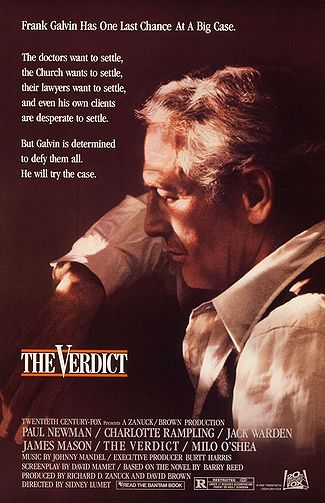
Lisa Watches An Oscar Nominee: The Verdict (dir by Sidney Lumet)


Verdict1

Speaking of the good, old-fashioned star power of Paul Newman, The Hustler and Butch Cassidy and the Sundance Kid were not the only films to receive an oscar nomination as the result of his charisma.  There’s also The Verdict, a 1982 best picture nominee that would probably be forgotten if not for Paul Newman’s performance.  However, since Paul Newman did play the lead role in The Verdict and he did give an amazing lead performance, The Verdict was nominated for best picture and, 33 years later, it ended up on TCM where I just watched it.

That’s the power of good acting.

Paul Newman plays Frank Galvin, a Boston-based attorney.  At one time, Frank was a lawyer at an elite firm.  But he has since fallen on hard times.  Now, he’s the type of attorney who crashes funerals and hands out his card.  He spends his spare time at his favorite bar, playing pinball and telling long jokes while stumbling about in a drunken haze.  In many ways, Frank represents everything that people hate about personal injury attorneys but, since he’s played by Paul Newman, you know that he’s going to turn out to be a good guy.

Frank only has one friend left in the world, his former mentor Mickey (Jack Warden).  Looking to help Frank out, Mickey sends Frank a medical malpractice suit.  A woman at a Catholic Hospital was given an anesthetic during child birth that has led to her now being brain dead.  Both the woman’s family and the Archdiocese are looking for a settlement.  The family needs the money to pay for her medical care.  The Archdiocese just wants the case to go away.  All Frank has to do is accept whatever settlement deal is offered…

However, something has changed for Frank.  He’s visited the comatose woman and, looking at her trapped in a vegetative state, he’s decided that the hospital needs to be held responsible for its mistake.  He rejects the settlement and takes the case to court, looking for both justice for the victim and redemption for himself.

That’s easier said than done, of course.  The Archdiocese has hired Ed Concannon (James Mason, perfectly cast), one of the best and most powerful attorneys in Boston.  Ed has a huge legal team working on the case.  Frank has Mickey.  As well, the Judge (Milo O’Shea) makes little effort to hide his contempt for Frank.

Probably the only bright spot in Frank’s life is that he’s met a woman.  Laura (Charlotte Rampling) meets him in a bar and soon, they’re lovers and Frank is confiding in her about the case.  What he doesn’t suspect is that Laura herself is a spy, hired by Concannon.

It looks like all is lost but then Frank discovers that there is one nurse (Lindsay Crouse) who might be willing to tell the truth about what happened at the hospital…

In many ways, The Verdict is a predictable film.  From the minute we first meet him, we know that Frank is going to be redeemed.  From the minutes that we hear about the case, we know who we’re supposed to root for and who we’re supposed to hiss.  Just about every courtroom cliché is present, right down to a surprise witness or two…

But no matter!  The Verdict may be predictable but it works.  As he proved with 12 Angry Men, Director Sidney Lumet knew how to make legal deliberations compelling and the entire film is full of small but memorable details that elevate it above its simplistic storyline.  As a director, Lumet gets good performances from his cast and, as a result, this is a film where the hero is flawed and the antagonists aren’t necessarily evil.  Even the Bishop of the Archdiocese of Boston (who, in most films, would have been a cardboard villain) is given a scene where he’s allowed to show some humanity.

And, of course, Paul Newman is great in the role of Frank.  When we first meet Frank, he looks and sounds terrible.  Indeed, it’s strange to see Paul Newman playing a character who is essentially such a loser.  (Even Eddie Felson in The Hustler had an appealing swagger about him.)  It’s during the scenes where Frank considers the woman in a coma that Newman starts to reveal that there’s more to Frank than what’s on the rough surface.  By the end of the film, Frank may be a hero but Newman doesn’t play him as such.  He’s still has that alcoholic rasp in his voice and his eyes still betray hints of insecurity and a fear that, at any minute, he’s going to screw up and mess everything up.  It’s a great performance, one for which Newman received a nomination for best actor.

Speaking of star power, Bruce Willis also shows up in The Verdict.  He’s an extra who appears as an observer in the courtroom.  He’s sitting a few rows behind Paul Newman.  (He’s also sitting beside Tobin Bell, the Jigsaw Killer from the Saw films).  It’s probably easiest to spot Willis towards the end of the film, when the verdict is read.  Bruce breaks out into a huge grin and almost looks like he’s about to start clapping.  Bruce only gets about 10 second of screen time but he acts the Hell out of them!

Thanks to Paul Newman, The Verdict is a memorable and entertaining film.  Be sure to watch it the next time it shows up on TCM.

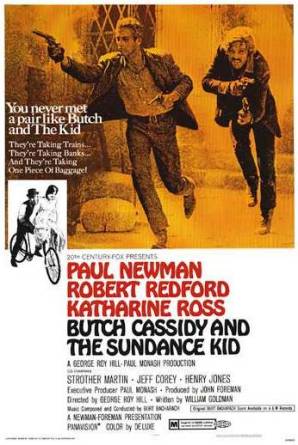
Lisa Watches An Oscar Nominee: Butch Cassidy and the Sundance Kid (dir by George Roy Hill)


Butch_sundance_poster

Should I start this post by ticking everyone off or should I start out by reviewing the 1969 best picture nominee Butch Cassidy and The Sundance Kid?

Let’s do the review first.  I recently watched Butch Cassidy and the Sundance Kid when it aired as a part of TCM’s 31 Days of Oscar.  This was actually my third time to see the film on TCM.  And, as I watched Butch Cassidy and the Sundance Kid for the third time, I was shocked to discover how much I had forgotten about the film.

Don’t get me wrong.  I remembered that it was a western and that it starred Paul Newman and Robert Redford as real-life outlaws Butch Cassidy and the Sundance Kid.  I remembered that it opened and ended with sepia-toned sequences that suggested that Butch and Sundance represented the last gasp of the old west.  I remembered that Butch won a fight by kicking a man in the balls.  I also remembered that they robbed the same train twice and, the second time, they accidentally used too much dynamite.  I remembered that, for some reason, Butch spent a lot of time riding around on a bicycle.  I remembered that Butch and Sundance ended up getting chased by a mysterious posse.  I remembered that Sundance could not swim.  And I remembered that the film eventually ended on a tragic note in South America…

And I know what you’re saying.  You’re saying, “It sounds like you remembered the whole movie, Lisa!”

No, actually I did not.  The thing with Butch Cassidy and the Sundance Kid is that the scenes that work are so memorable that it’s easy to forget that there’s also a lot of scenes that aren’t as memorable.  These are the scenes where the film drags and you’re thankful that Paul Newman and Robert Redford were cast as Butch and Sundance, because their charisma helps you overlook a lot of scenes that are either too heavy-handed or which drag on for too long.  You’re especially thankful for Newman, who plays every scene with a twinkle in his wonderful blue eyes and who is such a lively presence that it makes up for the fact that Redford’s performance occasionally crosses over from being stoic to wooden.  It can be argued that there’s no logical reason for a western to feature an outlaw riding around on a bicycle while Raindrops Keep Fallin’ On My Head plays on the soundtrack but Paul Newman’s so much fun to watch that you can forgive the film.

Newman and Redford both have so much chemistry that they’re always a joy to watch.  And really, that’s the whole appeal of Butch Cassidy and the Sundance Kid, the chance to watch two iconic actors have fun playing opposite each other.  Even though Katharine Ross appears as their shared romantic interest, the film’s love story is ultimately between Butch and Sundance (and, by extension, Newman and Redford).  You can find countless reviews that will give all the credit for the film’s appeal to William Goldman’s screenplay.  (You can also find countless self-satisfied essays by William Goldman where he does the exact same thing.)  But, honestly, the film’s screenplay is nothing special.  This film works because of good, old-fashioned star power.

Now, for the part that’ll probably tick everyone off (heh heh), I think that Butch Cassidy and the Sundance Kid is actually a pretty good pick for a future remake.  All you have to do is pick the right actors for Butch and Sundance.  I’m thinking Chris Pratt as Butch and Chris Evans as Sundance…

Oh, c’mon!  It’ll be great!