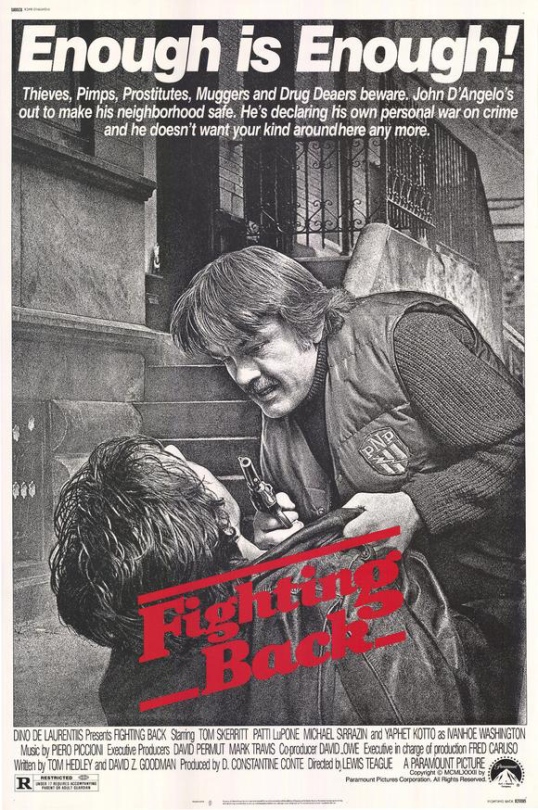
The time is 1982. The place is Hell on Earth, also known as Philadelphia. Crime is out of control and the police are powerless to stop it. When deli owner John D’Angelo (Tom Skerritt) and his wife, Lisa (Patti LuPone), confront a pimp named Eldorado (Pete Richardson), he rams his car into the back of their car, causing the pregnant Lisa to lose her unborn child. At almost the exact same time, John’s mother (Gina DeAngles) is mugged by two thugs who chop off her ring finger.
In the grand tradition of Charles Bronson, John decides to fight back. But he doesn’t go it alone. With his best friend, a police officer named Vince (Michael Sarrazin), John starts the People’s Neighborhood Patrol. The PNP is going to clean up Philadelphia, one street at a time. The media (represented by David Rasche) make John into a celebrity. The black community (represented by Yaphet Kotto) suspect that John and the PNP are guilty of racial discrimination. The Mafia wants to bring John over to their side. John runs for city council but he still has time to drop a grenade in a pimp’s car.
Fighting Back was one of the many urban vigiliante films to come out after the success of Death Wish. Fighting Back‘s producer, Dino De Laurentiis, also produced Death Wish but made the mistake of later selling the rights to Cannon. Fighting Back was not the box office success that either Death Wish or its sequels were, even though Fighting Back is actually the better movie. That’s because Fighting Back was directed by the underrated Lewis Teague. Teague does a good job of making Philadelphia look like a war zone and the scenes of vigilante justice are enjoyable but, overall, Teague takes a far more ambiguous approach to vigilantism than Michael Winner did when he directed Death Wish. As vile as Philadelphia criminals may be, John D’Angelo isn’t always that likable himself. When Kotto accuses John and the all-white PNP of being racially prejudiced, Teague suggests that he has a point. Tom Skerritt gives a good performance, playing John as a proud, blue collar guy who wants to do the right thing but gets seduced by his newfound celebrity.
Better acted than Death Wish and smarter than The Exterminator, Fighting Back is an underrated vigilante gem.
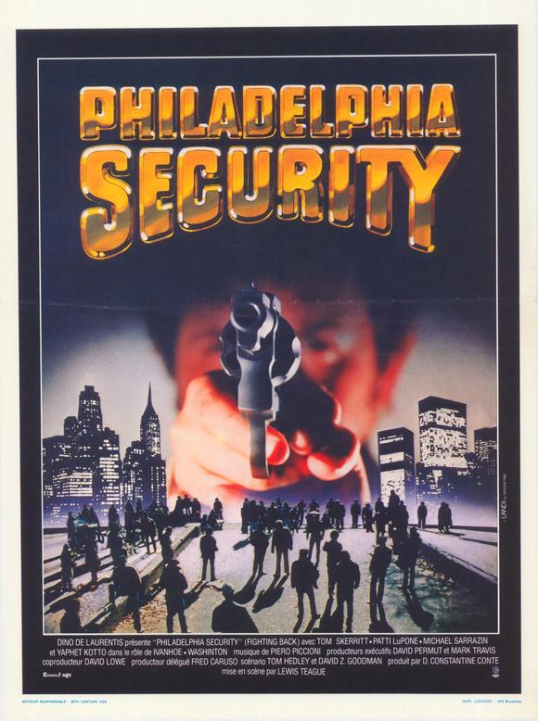
Fighting Back is also known as Philadelphia Security and Death Vengeance.
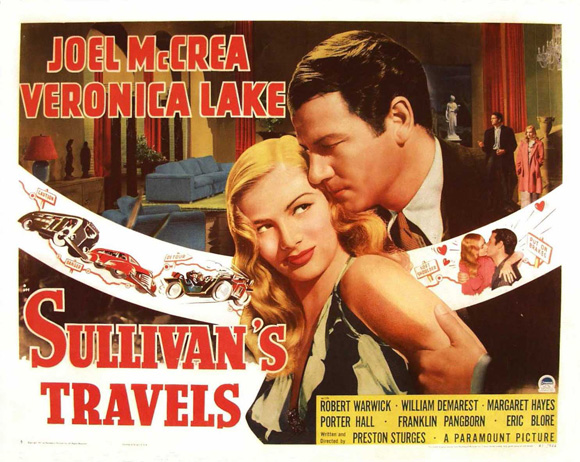
I’m no expert on Preston Sturges, having seen only two of his films, but after viewing SULLIVAN’S TRAVELS I now have a craving to see them all! This swift (and Swiftian) satire on Hollywood stars Joel McCrea as a successful slapstick comedy director yearning to make important, socially conscious films who gets more than he bargained for when he hits the road to discover what human misery and suffering is all about.
John L. “Sully” Sullivan sets his studio bosses on their collective ear when he tells them he wants to film an adaptation of ” O Brother, Where Art Thou?”, a serious novel by ‘Sinclair Beckstein’. The head honcho balks, wanting Sully to do another comedy, but Sully’s not dissuaded, deciding to see what life among the downtrodden is first-hand. He dresses in rags and sets out on his quest, followed by a gaggle of PR flacks in a bus. Somehow he…
With that in mind, I recently watched the 1928 film In Old Arizona. In Old Arizona is a bit of an oddity in Oscar history. Even though it is considered to have been a best picture nominee, it was never officially nominated. In fact, in 1929, there were no official nominees. Instead, the Academy simply announced the names of the winners. The winners were selected by a small committee of judges. The committee’s intentions are particularly obvious when you notice that not one film won more than one Oscar in 1929. At a time when the industry was struggling to make the transition from silent film to the talkies, the 1929 Oscars were all about spreading the wealth and reassuring everyone that they were doing worthwhile work. In Old Arizona‘s star, Warner Baxter, was named the year’s best actor while Broadway Melody was declared to have been the best picture.
(At that year’s Oscar ceremony, the second in the Academy’s history, the awards were reportedly handed out in 10 minutes and nobody gave an acceptance speech. If this all seems strange when compared to the annual extravaganza that we all know and love, consider that Louis B. Mayer originally formed the Academy in order to give the studio bosses the upper hand in a labor dispute. The awards were largely an afterthought.)
Years later, Oscar historians came across the notes of the committee’s meeting. The notes listed every other film and performer that the committee considered. Before settling on Broadway Melody, the committee apparently considered In Old Arizona. For that reason, In Old Arizona is considered to have been nominated for best picture of the year.
If it seems like I’ve spent a bit more time than necessary discussing the history behind the 1929 Oscars, that’s because In Old Arizona isn’t that interesting of a film. It was a huge box office success in 1929 and it was an undeniable influence on almost every Western that followed but seen today, it’s an extremely creaky film. Influential or not, there’s not a scene, character, or performance in In Old Arizona that hasn’t been done better by another western.
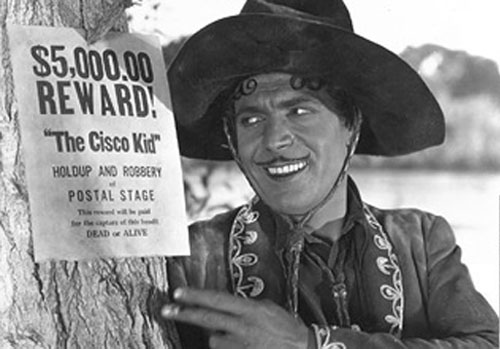
Based on a story by O. Henry, In Old Arizona tells the story of a bandit named The Cisco Kid (Warner Baxter). Cisco may be an outlaw but he’s also a nice guy who enjoys a good laugh and occasionally sings a song while riding his horse across the Arizona landscape. (California and Utah stood in for Arizona.) The Cisco Kid may rob stagecoaches but he always does it with a smile. Besides, he only needs the money so that he can give gifts to his girlfriend, Tonia (Dorothy Burgess). What the Cisco Kid doesn’t know is that Tonia is bored and frustrated by his frequent absences and she has been cheating on him. Then she’s approached by Sgt. Mickey Dunn (Edmund Lowe), the big dumb lug who has been ordered to bring the Kid in (dead or alive, of course). Will Tonia betrayed the Kid?
If you’re watching In Old Arizona and hoping to be entertained, you’ll probably be disappointed. Almost everything about this film has aged terribly. Watching the film, it’s obvious that none of the actors had quite figured out how to adapt to the sound era and, as such, all of the performances were very theatrical and overdone. Probably the easiest to take is Edmund Lowe, who at least managed to deliver his lines without screeching. Sadly, the same cannot be said of Dorothy Burgess. As for Warner Baxter, he may have won an Oscar for playing the Cisco Kid but that doesn’t make his acting any easier to take.
And yet, if you’re a history nerd like me, In Old Arizona is worth watching because it really is a time capsule of the era in which it was made. In Old Arizona was not only the first Western to ever receive an Oscar. This was also the first all-talking, all-sound picture. Watching it today, without that knowledge, you might be tempted to wonder why the film lingers so long over seemingly mundane details, like horses walking down a street, the ticking of a clock, a baby crying, or a church bell ringing. But, if you know the film’s significance, it’s fun to try to put yourself in the shoes of someone watching In Old Arizona in 1929 and, for the first time, realizing that film could not just a visual medium but one of sound as well. For some members of that 1929 audience, In Old Arizona was probably the first time they ever heard the sound of a horse galloping across the landscape.
(I have to admit that, as a student of American history, I couldn’t help but get excited when one of the characters mentioned President McKinley. McKinley may be forgotten today but audiences in 1929 would not only remember McKinley but also his tragic assassination. By mentioning that McKinley was President, In Old Arizona not only reminded audiences that it was taking in the past but that it was also taking place during what would have been considered a more innocent time. Much as how later movies would use John F. Kennedy as a nostalgic symbol of a more idealistic time, In Old Arizona uses William McKinley.)
In Old Arizona is no longer a particularly entertaining film but, as a historical artifact, it is absolutely fascinating.
A U.S. spy satellite has crashed onto an uninhabited island in the Pacific Ocean. Both the United States and an unnamed communist country (described as being “a fifth-rate China,” but obviously meant as a stand-in for not only China but North Korea and North Vietnam as well) have both lay claim to the satellite. To prevent a possible war, the two countries agree to a compromise. One American and one communist will be dropped off on the island and will fight to the death. The survivor gets the satellite. The communists send the disciplined Yuro (Mako). The American select Jacob Galley (Darren McGavin), a grizzled Vietnam veteran-turned-mercenary. Jacob is armed with the latest advancements in weaponry, including a double-barreled sub-machine gun. Yuro is armed mostly with his wits and an endless supply of booby traps. Jacob and Yuro fight to a stand still, growing to respect each other even as each tries to kill the other. However, both countries are willing to cheat to win the challenge.
Originally made for television, this is one of the many films to have been credited to Alan Smithee, the pseudonym that directors used to use whenever they felt that the finished film, usually because of studio interference, did not properly represent their vision. According to the imdb, The Challenge was actually directed by veteran television directed George McGowan, whose other credits includes episodes of shows like Fantasy Island, Starsky and Hutch, and Charlie’s Angels. I am surprised that McGowan chose to take his name off of The Challenge because, for a television movie, it’s not bad. The Vietnam analogy is laid on a little thick but the action is exciting and both McGavin and Mako give excellent performances as the two very different combatants.
The Challenge can be viewed on YouTube. Keep an eye out for a very young Sam Elliott, in the role of America’s insurance policy.
In America, they love winners and that’s especially true when it comes to the Super Bowl. Every year, one team wins the Super Bowl and goes home to a parade and sometimes a riot. Another teams loses the Super Bowl, often becomes a laughing-stock, and spends the next season searching for “redemption,” never mind that even the team that loses the Super Bowl still did something that 30 other NFL teams failed to do.
Just ask the Buffalo Bills. In the early 1990s, the Bills accomplished something that no other football team had ever accomplished. They went to four consecutive super bowls. And yet, because they lost all four times, the 90s Bills are remembered for what they lost instead of what they accomplished. If the Bills had won all four of those Super Bowls, they would be remembered as the greatest team of all time. But because they lost, they are forever remembered as being joke.
Four Falls of Buffalo is a documentary about those four Super Bowls, all told from the point of view of the players that lost and the city that loved them. Four Falls of Buffalo is very much a fan’s film but it’s still interesting to watch. Along with detailing what went wrong (and sometimes right) at all four of the Super Bowls that the Bills lost, it also features interviews with the Bills players. Particularly notewothy is an interview with Scott Norwood, the kicker who missed a field goal that, had he made it, would have won Super Bowl XXV for the Bills. Even though the city of Buffalo embraced him after the loss, it is obvious that missed kick still haunts him.
Watch Four Falls of Buffalo in honor of all the teams that made it to the Super Bowl but did not get that win.
Tonight, I watched the latest Lifetime premiere. The film was called High School Lover and, in many ways, it was a typical Lifetime film. As you might guess from the title, it’s tells the story of a teenage girl who defies her overly protective father and enters into a relationship with an older man. Since it’s never a good idea to defy your parents in a Lifetime film, the older man turns out to be an obsessive psycho, the type who shows up at his ex-girlfriend’s house with a crowbar and demands that she love him.
As I said, typical Lifetime film. Plotwise, this was almost identical to almost every thriller that Lifetime has premiered on Saturday night.
However, there were a few things that set High School Lover apart from something like Killer Coach.
Number one, the obsessive psycho was a movie star. That’s right — Christian Booth (Francois Arnaud) is a celebrity. He’s such a celebrity that, at one point, his teenage girlfriend is upset when she reads an article in US Weekly that claims that Christian is getting back together with his ex. And yet, for a celebrity who is well-known enough to appear on the cover of US Weekly, it was remarkable just how much Christian was able to do without anyone noticing. For instance, if Justin Bieber showed up at someone’s house with a crowbar and started breaking all the windows, you can be sure that the paparazzi would be right behind him, taking pictures and shouting out questions. If Ryan Gosling picked up a teenager in a limo and then flew her around in his own private helicopter, you imagine that it would at least be mentioned on TMZ. Yet, somehow, superfamous Christian Booth is able to do all of this without anyone noticing.
This leads me to suspect that Christian may not have been human. Though it’s never specifically stated, I suspect that Christian may have been a vampire, an alien, or a time traveler. He had to have some sort of mystical power to get away with everything that he did.
Secondly, this film was not only executive produced by James Franco but it also starred Franco as well! What’s strange is that this wasn’t a parody like A Deadly Adoption or Franco’s previous Lifetime film, the remake of Mother, May I Sleep With Danger? Instead, this was a totally typical Lifetime movie with James Franco in the role that would usually be played by a former cast member of One Tree Hill.
And yet, James Franco fit right in. He gets to flash his winning smile and there’s a scene where he shows off some dance moves that deserves to be put in the Hall of Fame of Fearless Franco Moments. Watching the film, one gets the feeling that James Franco woke up one day and said to himself, “I want to make some movies for Lifetime just because.” And that’s what he proceeded to do! And let’s give some credit where credit is due. Instead of slumming his way through the film, James Franco gave a good and sincere performance, as did Paulina Singer in the role of his daughter.
Anyway, if it sounds like I’m struggling to be objective when it comes to reviewing this film, you’re right. I love Lifetime melodrama and, though Arleigh likes to make fun of me for this, I love James Franco too. And really, that’s the best review that I can give you. If you like Lifetime movies and/or James Franco, you’ll like High School Lover.
It’s just an odd little movie. When I get around to writing my study of the career and accomplishments of Mr. James Franco, High School Lover will, at the very least, get a chapter or two.
Though it may be regarded as a joke today, the XFL was a big deal for a few months in 2001. The brainchild of the WWF’s Vince McMahon, the XFL was a football league that, like the USFL before it, would play during the NFL’s off-season. McMahon promised that, if the NFL was now the “No Fun League,” the XFL would be the “Extra Fun League.” McMahon’s longtime friend and the President of NBC sports, Dick Ebersol, purchased the rights to broadcast the XFL’s first two seasons.
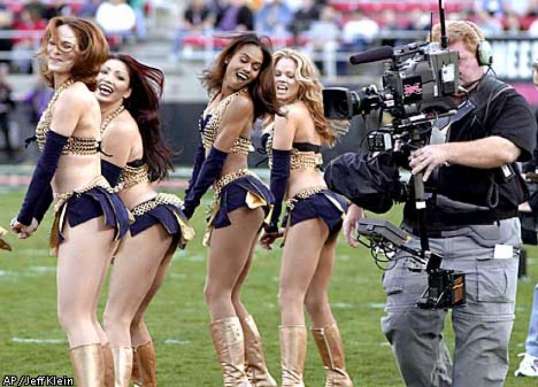
Ebersol and McMahon put together the XFL (8 teams and 2 divisions) in just a year’s time. They recruited players who hadn’t been able to find a place in NFL. Using many of the same techniques that he perfected in the world of professional wrestling, McMahon encouraged the players to be big personalities and allowed them to pick their own nicknames. Rod Smart would briefly become a star as He Hate Me while another player requested to be known as Teabagger. McMahon tweaked the rules, encouraging faster and more aggressive play. Instead of a coin flip, each game would start with two opposing players scrambling for the ball. The XFL was not only more violent than the NFL but it also had sexier cheerleaders.
In 2001, I was really excited for the XFL. It was everything that an 18 year-old male football fan could hope for. I was one of the 14 million people who watched the very first broadcast. I watched half of the second broadcast and that was it. I lost interest and I was not alone. The XFL started with higher ratings than expected but the final games of that inaugural season set records for being the lowest-rated prime time sports telecasts in history.
What went wrong? That’s what ESPN’s latest 30 for 30 documentary, This Was The XFL, explains. Directed by Dick Ebersol’s son, Charlie, This Was The XFL features interviews with McMahon, the senior Ebersol, players like Rod Smart and Tommy Maddox, and sports journalists like Bob Costas. The XFL’s rise and demise is presented as being a comedy of errors. Already viewed with skepticism because of McMahon’s unsavory reputation, the XFL was doomed by a combination of terrible luck and bad gameplay that confirmed why many XFL players couldn’t find a place in the NFL. During the first week, several players were injured during the opening scramble. In the 2nd week, a power outage interrupted the broadcast of a game in Los Angeles. With ratings in freefall, McMahon resorted to playing up the cheerleaders and sending Gov. Jesse “The Body” Ventura onto the field so that he could harass the coaches during the game. Trying to do damage control, McMahon appeared on The Bob Costas Show and their hostile interview is one of the highlights of the documentary. Even if the league ultimately failed, it is impossible not to admire McMahon’s determination to shake things up.
The XFL’s first season was also its last but, as This Was The XFL makes clear, its legacy is still evident today. Miked-up players, the skycam, sideline interviews, all of these are the legacy of the XFL. Even Jerry Jones, when interviewed, says that the XFL changed the way that NFL football is broadcast.
With this being Super Bowl weekend, take a moment to raise a toast to the memory of the XFL.
The 1950’s were a time of change in movies. Television was providing stiff competition, and studios were willing to do anything to fend it off. The bigger budgeted movies tried 3D, Cinerama, wide-screen, and other optical tricks, while smaller films chose to cover unusual subject matter. The following five films represent a cross-section of nifty 50’s cinema:
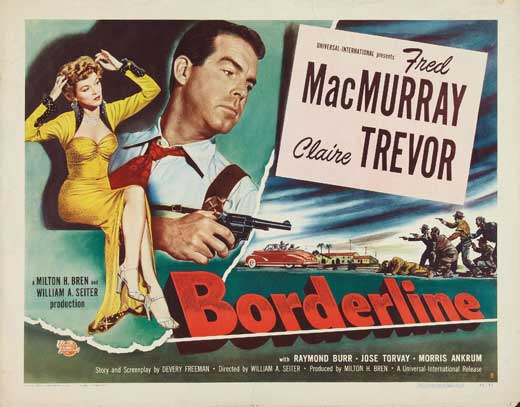
BORDERLINE (Universal-International 1950; D: William A. Seiter)
BORDERLINE is a strange film, straddling the borderline (sorry) between romantic comedy and crime drama, resulting in a rather mediocre movie. Claire Trevor plays an LAPD cop assigned to Customs who’s sent to Mexico to get the goods on drug smuggler Pete Ritchey (Raymond Burr , being his usual malevolent self). She’s tripped up by Ritchey’s rival Johnny Macklin (Fred MacMurray , channeling his inner Walter Neff), and taken along as he tries to get the dope over the border. What she doesn’t know is he’s also…
What’s an Insomnia File? You know how some times you just can’t get any sleep and, at about three in the morning, you’ll find yourself watching whatever you can find on cable? This feature is all about those insomnia-inspired discoveries!
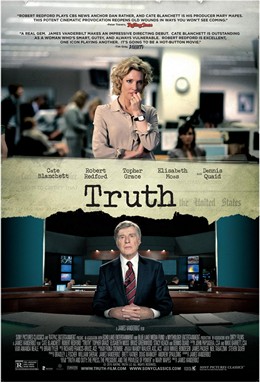
If, last night, you found yourself awake at three in the morning, you could have turned over to Starz and watched the 2015 film, Truth.
I can’t say for sure whether or not Truth would have put you to sleep. It kept me awake, largely because I was in a state of shock that any movie could be as bad as what I was watching. Without running the risk of hyperbole, I can say that Truth is one of the worst fucking movies that I’ve ever seen in my entire life. It’s not just that the film is poorly scripted, inconsistently acted, and directed in the most heavy-handed way possible. No, the problems with Truth went far beyond mere execution. Truth is a film with an agenda, one that I kind of agree with, but it’s such a total misfire that it ends up doing more damage to its cause than good. Truth is meant to be a defense of the much maligned mainstream media but it’s so poorly put together that it’s easy to imagine it being one of Donald Trump’s guilty pleasures. Remember how all of us musical theater nerds used to hatewatch Smash? I imagine that the White House staff does the same thing with Truth.
Truth is ostensibly based on a true story. In 2004, veteran anchorman Dan Rather (played by Robert Redford) reported a story that then-President George W. Bush got preferential treatment while he was serving in the Air National Guard. This story was considered to be especially big because 1) the Iraq War was deeply unpopular, 2) Bush was in a tight race for reelection, 3) his opponent, John F. Kerry, didn’t have much to offer beyond having served in Vietnam, and 4) questions were being raised about what Kerry actually did in Vietnam.
One of the most important pieces of evidence in Rather’s story were four memos that had been provided by a retired Lieutenant Colonel from the Air National Guard, a veteran Bush-hater named Bill Burkett (played, in the film, by Stacy Keach). Shortly after the story aired, conservative bloggers claimed that the memos were obvious forgeries. After spending weeks defending the story and haughtily dismissing anyone who didn’t collect an eight-figure paycheck from CBS, Rather admitted on air that the authenticity of the memos could not be verified. In the wake of the scandal, Rather’s longtime producer, Mary Mapes (Cate Blanchett), was fired. Rather retired a year earlier than expected and went on to become one of those reliably dull commentators who occasionally emerges to complain about how the world hasn’t been the same since Adlai Stevenson died. Mapes later wrote a book, which argued that 1) the memos were authentic and 2) it didn’t actually matter whether they were authentic, even though they like so totally were.
With all the current talk about fake news and whether both the media and Hollywood exist in a bubble, Truth is a film that should be especially relevant but, as previously stated, it’s so clumsy and heavy-handed that it actually does more harm than good. About halfway through the film, there’s a hilarious scene in which literally the entire country is shown watching 60 Minutes with awe-struck expression on their face. Children are watching. Customers in a bar are watching. The cooking staff in the kitchen pauses in their work to watch the report. Heroic music rises on the soundtrack. This scene, with all of its self-important grandeur, pretty much sums up everything that’s wrong with Truth. It’s one thing to argue that the news media does, should, and must play an important role in American life. It’s another thing to make your argument by constructing a fantasy world where the entire country plots their lives around watching 60 Minutes. But that’s the way Vanderbilt directs the entire film. He’s so high on the fumes of his good intentions that he doesn’t realize his film basically comes across like a parody of those intentions.
Especially in the second half of the film, there’s a lot of speeches about why journalism is important. And those speeches may actually make a great point but the problem is that none of them convince us that Mary Mapes and Dan Rather didn’t get fooled by some painfully obvious forgeries. In its laudable effort to defend journalism, Truth makes the mistake of excusing shoddy journalism. When, towards the end of the film, Mapes exclaims that the memos were only a minor part of the overall story and not necessary to prove that Bush got preferential treatment, you want someone to ask her, “If you could prove the story without them, then why did you include these unverifiable documents in the first place, especially considering that they were received from a questionable source?” But nobody does because none of the film’s saintly characters have been written or portrayed with the nuance necessary to be able to survive a question like that. Truth‘s problem is that it wants to have it both ways. “It doesn’t matter that this story was based on obviously fake documents,” Truth says, “And, because Mary Mapes and Dan Rather were sent by God to tell the truth, the obviously fake documents were completely real.”
And then there’s the film’s performers. Stacy Keach is great as Burkitt and his eccentric performance suggests the film that Truth could have been if it wasn’t so concerned with trying to portray its lead characters as saints. But then there’s Robert Redford, whose portrayal of Dan Rather has all the nuance and personality of a wax figure. (Redford wears suspenders. That’s the extent of his performance.) As Mary Mapes, Cate Blanchett is totally wasted. She doesn’t really have a character to play, beyond her male director’s conception of what a professional woman is supposed to be like. (She also has a traumatic back story of abuse, which the film trots out in such a klutzy manner that it’s actually incredibly insulting to real-life abuse victims.) Dennis Quaid, Topher Grace, and Elisabeth Moss all show up as members of Mapes’s team. Quaid is playing a military man so he gets to salute in slow motion. Grace is playing a hipster with a beard so he gets this embarrassing scene where he rants about how he’s being targeted not because of sloppy reporting but because of a corporate conspiracy. (This was obviously meant to be a huge applause moment but, like a lot of the movie, it doesn’t explain how the progressive cause is helped by shoddy journalism.) Moss doesn’t get to do anything, other than sit in the background. To waste a cast of this quality is a crime.
So why did this mostly terrible film get respectful reviews? Why did Sasha Stone and Jeff Wells insist that Truth was destined to be an Oscar contender? Call it confirmation bias. Truth plays to mainstream liberals (which includes the majority of film reviewers) in much the same way that God’s Not Dead 2 plays to Christians. But just because you agree with a film’s ideology, that doesn’t make it an example of good filmmaking. While artistic films are often political, it’s rare that political films are ever art. If every anti-Bush film was an artistic masterpiece, we would be living in a cinematic golden age.
Here’s the thing. We live in a time when the media is under attack and being used a convenient scapegoat for every bad thing in America. Donald Trump largely won in 2016 by portraying the media as being biased and that’s a charge that will undoubtedly be repeated many times over the next four years. A heavy-handed mess like Truth doesn’t help anything.
A part of ESPN’s 30 for 30 documentary series, Small Potatoes: Who Killed the USFL? tells the story of the United States Football League. The USFL was not the first American football league to try to take on the NFL but, arguably, it was one of the most successful. Playing a spring/summer schedule, the USFL lasted for three seasons, from 1983 to 1985. During that time, the USFL introduced many rules that would later be adopted by the NFL, including the two-point conversion and the coach’s challenge. Several future NFL superstars, like Herschel Walker and Steve Young, got their start in the USFL.
So, why is the USFL nearly forgotten today? This documentary largely lays the blame at the feet of none other than Donald Trump. Long before he was President or even a reality TV star, Trump wanted to own a football team. When it became obvious that he wasn’t going to be able to buy an NFL team, Trump purchased the USFL’s New Jersey Generals. Trump not only decided that the USFL needed to switch to a fall schedule and compete directly with the NFL but, under his direction, the USFL also filed an antitrust lawsuit against the NFL. Ironically, the USFL won that lawsuit but were only awarded $3.75 in damages. With the league’s financial resources depleted by the lawsuit, the USFL suspended the 1986 season and never came back.
For all the legitimate criticism that can be directed towards ESPN, the 30 for 30 documentaries have been consistently excellent. While Small Potatoes features plenty of exciting game footage and interviews with former USFL players, it’s not surprising that the most interesting thing about it is listening to Trump revealingly discuss his time as a USFL team owner with the same mix of self-aggrandizement and defensive posturing that he uses to discuss the size of the crowd at his inauguration. Unlike the majority of the players and former owners interviewed in Small Potatoes (including Burt Reynolds, who was one of the owners of the Tampa Bay Bandits), Trump still appears to take it personally that he was never taken seriously as the owner of a football team.
I did not know anything about the USFL before I watched Small Potatoes. My only complaint is that I wish it had been longer. The story of the USFL was too interesting to be confined to just one hour.


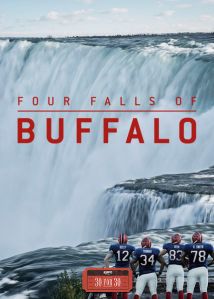 In America, they love winners and that’s especially true when it comes to the Super Bowl. Every year, one team wins the Super Bowl and goes home to a parade and sometimes a riot. Another teams loses the Super Bowl, often becomes a laughing-stock, and spends the next season searching for “redemption,” never mind that even the team that loses the Super Bowl still did something that 30 other NFL teams failed to do.
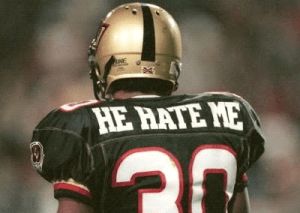 Remember the XFL?