Lisa Cleans Out Her DVR: Fathom (dir by Leslie H. Martinson)


(Lisa is currently in the process of cleaning out her DVR!  It’s going to take her forever but, with the help of Dexedrine and energy drinks, she is determined to get it done!  She recorded 1967’s Fathom off of FXM on April 3rd of this year!)
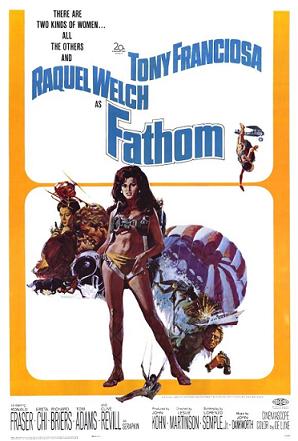
Fathom is a spy spoof, one that was made the height of the initial James Bond craze.  It’s very much a late 60s film, in everything from the way the film looks to the overly complicated storyline to the film’s cultural attitudes.  This is one of those films that you know was probably considered to be “naughty” when it was released but, seen today, it’s all rather quaint.  There’s no nudity, there’s no cursing, and there’s very little violence.  However, it does feature in Raquel Welch in a lime green bikini and you just know that, when this film came out, there were probably people bemoaning it as the end of civilization.  “What happened to the movies that you could take the entire family too!?” they probably wailed.  That’s the way history works.  What was once daring now seems remarkably innocent.

I watched the film last night but I’d be lying if I said I could follow the plot.  I think that was intentional on the part of the filmmakers.  Fathom satirizes the spy films of the late 60s by taking all of their familiar elements to their logical extreme.  Spy thrillers feature unexpected twists and turns.  Fathom has a new twist every 10 minutes or so.  Spy thrillers feature sudden betrayal and double agents.  With the exception of Raquel Welch, literally no one in Fathom is who they initially claim to be.  It becomes exhausting to try to keep up.  In many ways, Fathom plays out like an old serial.  Every few minutes or so, there’s another cliffhanger.  Oh no, Raquel Welch is on an out-of-control motorboat!  Oh no, the bad guys have got Raquel Welch on an airplane!  Oh no, Raquel Welch is being chased by a bull and she’s wearing a red dress!  ¡Olé!

Raquel plays Fathom Harvill, who works as a dental hygienist except for when she’s touring Europe as a member of the U.S. parachute team.  She’s recruited by some spies to help track down a nuclear triggering mechanism, one that is being hidden somewhere in Spain.  The Scottish secret service just wants her to parachute into a villa owned by a mysterious American named Peter Meriweather (Anthony Franciosa) and plant a recording device.  Things don’t go quite as smoothly as they should and soon, Fathom’s going from one extreme situation to another.

(Even though Peter is supposed to be a suave, James Bond-type, Franciosa gives such an oddly intense performance that it feels like a dry run for his later work in Dario Argento’s Tenebrae.  Interestingly enough, in Argento’s film, Franciosa’s character is named Peter Neal.  Is it possible that Peter Meriweather changed his last name?)

But really, the entire plot is just an excuse to get Raquel into that lime green bikini and she totally owns the moment.  Raquel Welch is one of my favorite of the old film stars because she never apologized for who she was.  She had the body, she was sexy, she knew it, and she used it to her advantage.  Of course, when seen today, it’s disappointing that Fathom spends the entire movie being rescued by men but then again, I imagine that just the idea of a woman being a secret agent was revolutionary in 1967.  Actually allowing her to get out of situations on her own might have made heads explode.  If Fathom were made today, Fathom would at least get one scene where she gets to kick some ass, Angelina Jolie-style.

Anyway, Fathom is an enjoyably silly spy film.  Don’t worry about trying to follow the plot and, instead, just enjoy it as an over-the-top time capsule.  It doesn’t get more 1967 than Fathom.
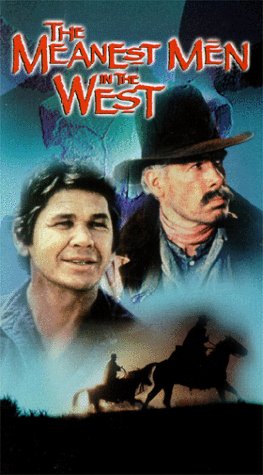
A Movie A Day #142: The Meanest Men In The West (1978, directed by Sam Fuller and Charles S. Dubin)


The Meanest Men In The West may “star” Charles Bronson and Lee Marvin and Sam Fuller may be credited as being one of the film’s two directors but don’t make the same mistake that I made.  Don’t get too excited.

There was once a TV western called The Virginian.  Starring James Drury as a ranch foreman, The Virginian ran for nine seasons on NBC.  A 1962 episode, which was written and directed by Sam Fuller, featured Lee Marvin as a sadistic outlaw who kidnapped The Virginian’s employer, a judge played by Lee J. Cobb.  Five years later, another episode features Charles Bronson as a less sadistic outlaw who kidnapped the Judge’s daughter.

The Meanest Men In The West mixes scenes from those two episode with western stock footage, a bank robbery that originally appeared in The Return of Frank James, an intrusive voice-over, and an almost incoherent prologue, all in order to tell an entirely new story.  Now, Charles Bronson and Lee Marvin are brothers and rivals.  After Marvin snitches on Bronson’s plan to rob a bank, Bronson blames his former friend, The Virginian.  In order to get the Virginian to come to his hideout, Bronson kidnaps Cobb’s daughter.  The Virginian manages to convince Bronson that he didn’t betray him, just to arrive back at the ranch and discover that Cobb has been kidnapped.  Meanwhile, Bronson and his gang set off after Marvin and his gang.  It ends with Charles Bronson, in 1967, shooting at Lee Marvin, who is still in 1962.

The Meanest Men In The West is so clumsily edited that the same shot of Charles Bronson holding a gun is spliced into a dozen different scenes.  Filmed on different film stocks, the Bronson scenes and the Marvin scenes look nothing alike and, since the two episodes were filmed five years apart, James Drury literally ages backwards over the course of the film.

The Meanest Men In The West is for Charles Bronson and Lee Marvin completists only.  I think Bronson and Marvin are two of the coolest individuals who ever existed and even I had a hard time making it through this one.  If you do watch it, keep an eye out for a young Charles Grodin, thoroughly miscast as a tough outlaw.

A Movie A Day #141: Breakheart Pass (1975, directed by Tom Gries)


California.  The 1870s.  Sheriff Pearce (Ben Johnson) boards a train with his prisoner, an alleged outlaw named John Deakin (Charles Bronson).  The train is mostly full of soldiers, under the command of Major Claremont (Ed Lauter), who are on their way to Fort Humboldt.  The fort has suffered a diphtheria epidemic and the soldiers are supposedly transporting medical supplies.
However, it’s not just soldiers on the train.  There’s also Gov. Fairchild (Richard Crenna) of Nevada, his fiancée (Jill Ireland), the Reverend Peabody (Bill McKinney), and a conductor named O’Brien (Charles Durning).  As the train continues on its journey, it becomes obvious that all is not as it seems.  People start to disappear.  A man is thrown from the train.  Two cars full of soldiers are separated from the train and plunge over a cliff.  There is also more to Deakin than anyone first realized and soon, he is the only person who can bring the murderers to justice.

In both real life and the movies, Charles Bronson was the epitome of a tough guy, so it’s always interesting to see him playing a more cerebral character than usual.  There are some exciting and surprisingly brutal action scenes, including a scene where Bronson fights a cook (played by former professional boxer Archie Moore) on top of the speeding train, but Breakheart Pass is more of a murder mystery than a typical action film.  If Louis L’Amour and Agatha Christie had collaborated on a story, the end result would be much like Breakheart Pass.  Bronson spends as much time investigating as he does swinging his fists or shooting a gun.  It’s not a typical Bronson role but he does a good job, showing that he could think as convincingly as he could kill.  Acting opposite some of the best character actors around in the 70s, Bronson more than holds his own.

Apparently, back in 1975, audiences were not interesting in watching Bronson think so Breakheart Pass was a disappointment at the box office and it is still not as well known as Bronson’s other films.  However, even if you’re not already a fan of the great Bronson, Breakheart Pass is worth discovering.

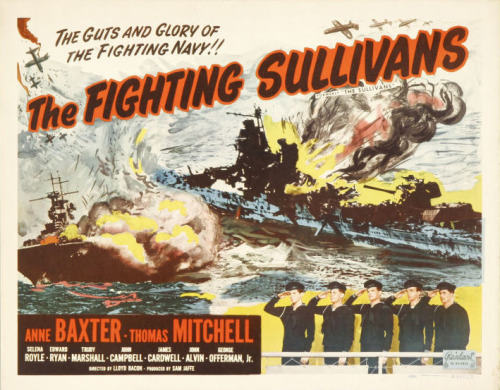
Special Memorial Day Edition: THE FIGHTING SULLIVANS (20th Century-Fox 1944)


gary loggins's avatarcracked rear viewer

War is hell, not only on the participants, but on those left home waiting for word on their loved ones, dreading the inevitable. THE FIGHTING SULLIVANS is based on the true story of five brothers who served and died together as shipmates, and their family. It’s a story of patriotism, of grief and loss, and its penultimate moment will rip your heart out. Finally, it’s an American story.

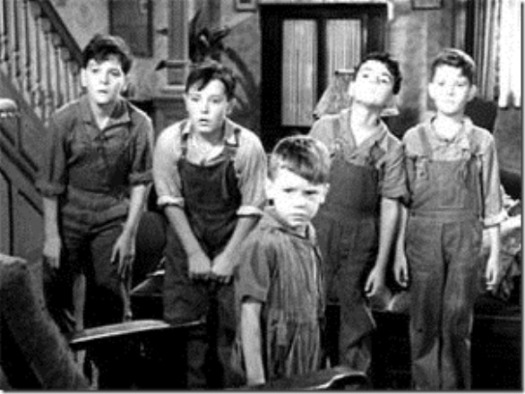
The Sullivans are a proud, close-knit Irish Catholic family living in Waterloo, Iowa. Patriarch Tom (played by Thomas Mitchell ) is a loyal railroad man whose five sons (George, Frank, Joe, Matt, and Al) climb the water tower every day to wave goodbye as the train pulls out. Mother Alleta (Selena Royale) keeps the family fires burning, with the help of daughter Gen. The scrappy brothers are a pint-sized version of the Dead End Kids, getting into mischief like a Donnybrook with neighborhood kids on little…

View original post 625 more words

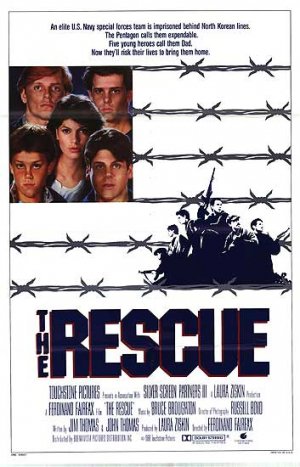
A Movie A Day #140: The Rescue (1988, directed by Ferdinand Fairfax)


A group of Navy SEALs enter North Korea on a mission to destroy a submarine that has fallen into Kim Il-sung’s hands.  They destroy the submarine but are captured before they can safely cross the border back into South Korea.  With the SEALs facing a show trial and probable public execution, Admiral Rothman (James Cromwell) draws up a plan to rescure them.  The U.S. government, not wanting to escalate the situation, shoots down the plan.  (Americans giving up?  Is Carter still president?)  However, Rothman’s nerdy son, Max (Marc Price), gets a hold of the plan.  Before you can say “Why didn’t anyone else think of this?”, he and the children of the SEALs are sneaking into North Korea and rescuing their fathers!
This is a pure 1980s film.  Like Red Dawn, it shows that America is such a great country that even our teenagers are stronger than the average well-armed communist.  Of the actors playing the rescuers, the best known is Kevin Dillon.  He plays the rebel who smokes cigarettes and rides a motorcycle.  Though their relationship may be strained, his father (Edward Albert) is still happy when Dillon suddenly shows up in North Korea.  Soon, father and son are working together to blow up America’s enemies.  This movie’s about as dumb as they come and it’s another example of Hollywood presenting North Korea as just being the junior varsity version of China but it’s also undeniably entertaining, especially if you don’t care about things like plausibility.  Watch it the next time that Kim Jong-un threatens to blow you up.  Who needs Chuck Norris when you’ve got Kevin Dillon?


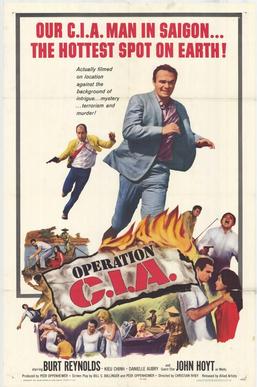
A Movie A Day #139: Operation C.I.A. (1965, directed by Christian Nyby)


Saigon, South Vietnam.  A CIA agent stands on a street corner when a young man parks his scooter in front of him.  The young man runs away and the scooter explodes, killing the agent.  Another agent, Mark Andrews (Burt Reynolds), is sent to Saigon to find out why the first agent was killed.  From the minute he arrives, Mark finds himself in the middle of a web of betrayal, intrigue, double agents, and a communist plot to assassinate the American ambassador.  Only Mark can prevent the assassination but first, he is going to have to survive a series of death traps.  He will also have to wrestle a boa constrictor.  If you have ever wanted to see Burt Reynolds wrestle a boa constrictor, this is the movie for you.


This low-budget James Bond rip off would be forgotten if not for three reasons.

First, this was one of the few American films to be made about the Vietnam War during the time of America’s involvement in that conflict.  Operation C.I.A. was released in September, a month after the passage of the Gulf of Tonkin Resolution.  Soon, the Vietnam War would become so unpopular that very few mainstream movies would even acknowledge it.  Originally, Operation C.I.A. was going to be filmed on location but, because of the rising hostilities, filming was instead done in Thailand, with Bangkok filling in for Saigon.  That Bangkok and Saigon had absolutely nothing in common was not considered to be a problem.

Secondly, this was one of the few films to be directed by Howard Hawks’s longtime editor, Christian Nyby.  Nyby is credited as directing The Thing, though many assume that Hawks actually directed that film.  Post-Thing, Nyby had an undistinguished directorial career, working mostly in television.  The black-and-white Operation C.I.A. has little in common with The Thing but it could pass for an episode of I Spy.

Finally, Operation C.I.A. was Burt Reynolds’s first starring role.  Burt is miscast as an American James Bond and he spends the majority of the movie looking stiff and uncomfortable.  The first time that Sean Connery left the role of James Bond, Burt Reynolds was one of the actors considered to replace him.  Judging from Operation C.I.A., everyone should be happy that George Lazenby got the role instead.

Especially Burt.

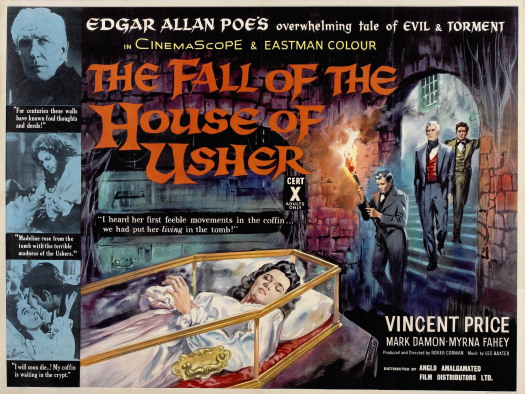
Happy Birthday Vincent Price: THE FALL OF THE HOUSE OF USHER (AIP 1960)


gary loggins's avatarcracked rear viewer

I’ve covered Vincent Price’s film work 17 times here, which must be some kind of record. Can you tell he’s one of my all-time favorite actors? Vincent Leonard Price, Jr. was born May 27, 1911 in St. Louis, Missouri. The elegant, eloquent Price was also an avid art collector and gourmet cook of some note. He’s justifiably famous for his film noir roles, but Price etched his name in cinematic stone as one of filmdom’s Masters of Horror.

Price starred in his first fright film way back in 1940 with THE INVISIBLE MAN RETURNS . But it wasn’t until 1953’s 3-D outry HOUSE OF WAX that he became tagged as a horror star. Later in that decade, he made a pair of gimmicky shockers for director William Castle ( THE HOUSE ON HAUNTED HILL , THE TINGLER), and in 1960 began his collaboration with Roger Corman on movies based (loosely, mind you) on the works of Edgar Allan Poe. The first…

View original post 584 more words

Lisa Cleans Out Her DVR: The Rachels (dir by Michael Civille)


(Hi, everyone!  I’ve been cleaning out my DVR and reviewing the films that I’ve recorded.  Here’s my final review of the day.  I recorded The Rachels off of Lifetime on January 29th!)

I want to tell you about The Rachels but it’s not going to be easy because, at the same time, I don’t want to tell you too much.  The Rachels is a whip-smart and wonderfully snarky little satire and, because of the non-linear narrative style that the first half of the film employs, there’s very little I can tell you about the plot without spoiling the movie.

Don’t be put off by its origins as a Lifetime film.  Don’t judge the film just because the title was obviously inspired by Heathers.  How good is The Rachels?  It’s so good that I’m tempted to call it nifty.  That’s how good it is.

It tells the story of two teenage girls named Rachel.  They’ve been best friends forever.  They do the morning announcements together, always ending things by reminding the school, “We’re the Rachels.”  Rachel Nelson (Madison Iseman) is blonde and popular, a track star who is loved by everyone.  Rachel Richards (Caitlin Carver) is brunette and she’s slightly less popular than Rachel Nelson.  Rachel Richards is almost always in the shadow of Rachel Nelson.  While Rachel Nelson is praised by her track coach, Rachel Richards is consistently told that she could do better.  And then there’s Roxie (Daniela Bobadilla), a photographer who seems to be slightly obsessed with Rachel Nelson but is disliked by Rachel Richards.  Roxie claims that she was once one of the Rachels but she is continually told, by one of the Rachels (I can’t reveal which one), that she was never really a Rachel.

At a late night party, one of these three girls will fall off of the roof and plunge to her death, the result of an apparent suicide.  The film, in its non-linear fashion, holds off an immediately revealing which one of them fell from the roof and I will do the same.  What I can tell you is that the entire school soon becomes a shrine to the dead girl and the two survivors both use her death to their own advantage.  Both of them, by linking themselves to the now sainted dead girl, become very different types of celebrities.

It makes for a very sharp satire, one that perfectly skewers today’s culture of instant fame and internet grieving.  All three of the main actresses — Maidson Iseman, Caitlin Carver, and Daniela Bobadilla — are perfectly cast and give pitch perfect performances.  This is one of those films where no one turns out to be exactly who you thought they would be.  Well-written, well-directed, and wonderfully acted, The Rachels keeps you thinking and guessing.

That’s really all I can say about the movie without giving away too much.  Keep an eye out for it.

Film Review: Space Trucker Bruce (dir by Anton Doiron)


For most of today, I’ve been posting reviews of films that I watched off of my DVR.  Well, I’m going to take a brief break from that pattern to tell you about a film that I watched last weekend.  It was a low-budget sci-fi film, a real labor of love that the director posted on YouTube.  I watched this film with some of my friends from the Late Night Movie Gang: there was me, Kurt Zellner, Holly Wilson, Janeen Worrall, Phil Kaine, Michael McDow, and Jes Coolbaugh.  For the most part, we enjoyed this film.

The name of the movie was Space Trucker Bruce.  I’m trying to think of the best way to explain the plot and it’s not easy.  It’s a very episodic film and I think it could actually be argued that there really isn’t a plot per se.  Instead, there’s just a lot of stuff that happens. Some of it is connected and some of it isn’t but the randomness of it all is part of the film’s charm.

Space Trucker Bruce takes place in the far future.  The Earth has colonized the solar system.  Humans and human businesses have taken over space.  Bruce (Karl Sears) is a space trucker.  He’s currently in the process of hauling 20,000 tons of hog fat from Earth to a space station.  It’s a lonely job, to be honest.  At the start of the film, Bruce doesn’t have any human companionship.  He does have a robot, though it’s possible that the robot might actually just be a trash can.  You’ll have to watch the film to know for sure.  He has several books to read, including a few by the noted Catholic historian Garry Wills.  He also has movies, which apparently hardly anyone watches in the future.  (Bruce is one of the few people in existence to still know what Star Wars is.)  There’s also a tub of cream cheese that has apparently come to life and which keeps encouraging Bruce to do some really bad things.  Or at least, we assume that the cream cheese has come to life.  Could Bruce just be crazy?

During the journey, Bruce gets some human companionship when he picks up a hitchhiker named Max (played by the film’s director and writer, Anton Doiron).  Max is an affable if occasionally neurotic guy.  He has a hard time adjusting to Bruce’s laid back personality but, on the plus side, Max is willing to watch movies.

The rest of the film — well, I guess the simplest way to put it would be that Bruce and Max have various adventures while making their way to the space station.  Except, they’re not really adventures as much as they’re just stuff that happens.  Calling them adventures would suggest that Bruce and Max were really active participants.  For the most part, they both spend the majority of the film just relaxing in the ship and occasionally responding to stuff that happens.  I mean, if the ship is about to be destroyed then sure, Bruce and Max are going to try to stop that from occurring.  But, for the most part, Bruce and Max are just kind of hanging out.

And that really is the film’s charm.  This is a low-budget film that proudly embraces the fact that it’s a low-budget film.  The sets and the special effects manage to look cheap and effective at the same time.  There’s a real charm to the fact that the director wanted to make a space epic and he managed to do it, despite not having much money.  Even the amateurish acting become charming after a while.  To say that the actors were stiff would be an understatement.  But, at the same time, Karl Sears was perfectly cast as Bruce.  He just was Bruce in much the same way that Anton Doiron just was Max.  There are some films that you appreciate just because they actually managed to get made and seen.  Space Trucker Bruce is one of those films.

Space Trucker Bruce is available, for free, on YouTube.  It’s not a film for everyone but here’s the thing.  If it’s not for you, you’ll know after the first ten minutes.  However, if you’re still watching after those ten minutes then you’ll probably enjoy this odd little movie.

Here’s the trailer!

As for the film, it can be watched here:


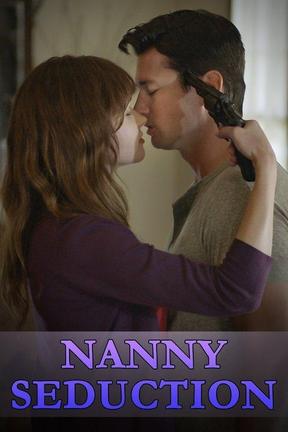
Lisa Cleans Out Her DVR: Nanny Seduction (dir by Emily Moss Wilson)


(Hi, everyone!  I’ve been cleaning out my DVR over the past week and, today, I’ve been sharing reviews of the film’s that I watched!  I recorded Nanny Seduction off of the Lifetime Movie Network on February 26th!)

Before I talk too much about Nanny Seduction, I want to engage in a little speculation.

First off, looking at the credits, I noticed that several crew members of Nanny Seduction have also been involved with some of the shark films that usually show up on SyFy in the week before the premiere of the latest Sharknado.  That wasn’t a shock.  SyFy and Lifetime movies often tend to be produced by the same companies.  But what I loved about Nanny Seduction is that, in the very first scene, a child is seen receiving a book about sharks for her birthday!  I’m assuming that was an inside joke and I absolutely loved it.

Secondly, I’m going to guess that Nanny Seduction and A Deadly Affair were both filmed at roughly the same time.  Not only do the two films share several actors in common but I’m also pretty sure that the main house in A Deadly Affair was also the main house in Nanny Seduction.  And again, I found that to be very charming.  One of the fun things about watching both Lifetime and SyFy movies is making the connections between them.  It’s actually rather fun to see a familiar face pop up and wonder what their role is going to be this time.  It’s kind of like when Dick Miller shows up in a Roger Corman film or Giovanni Lombardo Radice pops up in one of Michele Soavi’s movies.

As for the film itself, Nanny Seduction pretty much takes the standard Lifetime nanny film to its logical extreme.  Lifetime has a long history of nanny paranoia.  It makes sense, of course.  By hiring a nanny, you’re not only trusting your child with a stranger but, in a way, you’re also admitting that you can’t be two places at once.  You’re admitting that your powers are limited.  Of course, by hiring a nanny — who is inevitably always younger, prettier and more exciting than boring old mommy — you’re running the risk that the nanny will either try to run off with your child or your husband.  Nanny Seduction is one of the first films to suggest that the nanny might do both.

Of course, that’s not all that Kara (Austin Highsmith) has to worry about.  She also has to worry about the fact that her daughter, Erin (Lauren Gobuzzi), is adopted and that Erin’s birth mother (Erin Cahill) is apparently stalking her.  And then there’s the fact that Kara’s husband, Ben (Wes Brown), has a history of cheating.  Even more than the typical Lifetime protagonist, Kara has good reason to be worried when the new nanny, Alyssa (Valerie Azlynn), keeps hitting on her husband.

Speaking of Alyssa, she’s one of my favorite Lifetime nannies.  It’s not that she’s any more evil than the typical Lifetime nanny.  Instead, it’s just that she’s so unapologetic about it.  Most evil nannies at least try to be subtle but Alyssa never even pretends to be Kara’s friend.  She pretty much steps into the house and announces, “I’m going to kidnap your child and run off with your husband.  Deal with it!”  Alyssa is so joyfully and unapologetically evil and Valeria Azlynn is clearly having such a blast playing her that she elevates the entire film.

Nanny Seduction is a lot of fun.  It embraces the melodrama and thank goodness for that!