A Movie A Day #151: Easy Money (1983, directed by James Signorelli)


Rodney Dangerfield.  He didn’t get no respect but he did smoke a lot of weed.
It’s true.  Rodney first lit up in 1942 when he was a 21 year-old struggling nightclub comic.  According to his widow, the moment meant so much to Rodney that, decades later, he could still remember the room number — 1411, at the Belvedere Hotel in New York City — where he and fellow comedians Bobby Byron and Joe E. Ross smoked that first joint.  That was back when Rodney was performing under the name Jack Roy.  (His was born Jacob Cohen.)  Rodney’s first comedy career went so badly that he quit and spent the next twenty-two years as an aluminum siding salesman until he found the courage to return to the stage.  However, whether he was selling or performing, Rodney never stopped smoking marijuana.  When he was working on his autobiography, he wanted to call it My Lifelong Romance With Marijuana.  His wife convinced him to go with a different title:  It’s Not Easy Bein’ Me: A Lifetime of No Respect but Plenty of Sex and Drugs.

There’s plenty of drugs in Easy Money, which is a problem for baby photographer Monty Capuletti (Rodney, of course).  Monty likes to gamble, drink, and smoke pot, much to the disapproval of his wealthy mother-in-law (Geraldine Fitzgerald).  When she dies, she stipulates in her will that if Monty goes for a year without indulging in any of his vices, he and his family will receive 10 million dollars.  Sounds easy, right?  The only problem is that Monty really likes to eat, drink, gamble, and get high.  His best friend (Joe Pesci) doesn’t think he can do it.  His mother-in-law’s former assistant, Quincy Barlow (Jeffrey Jones), is determined to catch Monty slipping back into his old ways so that he can inherit the money.  Monty’s determined, though, to win the money for his family, especially now that his daughter (Jennifer Jason Leigh) has married the bizarre Julio (Taylor Negron).

The episodic plot is really just an excuse for Rodney to be Rodney, spouting off one liners and making snobs like Quincy look foolish.  Rodney and Joe Pesci were a surprisingly effective comedy team.  The scene where they get stoned and try to drive home without damaging the huge wedding cake in the back of the van is a hundred times funnier than it has any right being.  Even though it is hard to imagine her being, in any way, related to Rodney Dangerfield, Jennifer Jason Leigh is always a welcome presence.  Like many comedies of that era, Easy Money is uneven, with as many jokes failing as succeeding but, for Rodney Dangerfield fans, it is a must see.

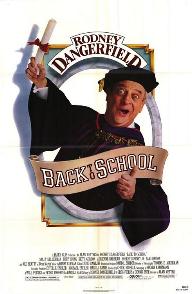
A Movie A Day #150: Back to School (1986, directed by Alan Metter)


Thornton Melon (Rodney Dangerfield) started with nothing but through a combination of hard work and chutzpah, he started a chain of “Tall and Fat” clothing stores and made a fortune.  Everyone has seen his commercials, the one where he asks his potential customers, “Do you look at the menu and say, ‘Okay?'”  He has a new trophy wife named Vanessa (Adrienne Barbeau) and a chauffeur named Lou (Burt Young).  Thornton never even graduated from high school but he gets respect.
However, his son, Jason (Keith Gordon), doesn’t get no respect.  No respect at all.  Jason is a student at a pricey university, where he is bullied by Chas Osborne (William Zabka) and can’t get a date to save his life.  Jason’s only friend is campus weirdo Derek Lutz (Robert Downey, Jr.).  When Thornton sees that his son isn’t having any fun, he decides to go back to school!

Back to School is a predictable but good-natured comedy.  It is like almost every other 80s college comedy except, this time, it’s a 65 year-old man throwing raging parties and making the frat boys look stupid instead of Robert Carradine or Curtis Armstrong.  On the stand-up stage, Dangerfield always played the (sometimes) lovable loser but in the movies, Dangerfield was always a winner.  In both Caddyshack and Back to School, Dangerfield played a self-made man who forced his way into high society and showed up all of the snobs.  While Back to School is no Caddyshack, it does feature Rodney at his best.

Rodney may be the funniest thing about Back to School but a close second is Sam Kinison, who owed much of his early success to Rodney Dangerfield’s support.  Kinison plays a history professor, who has some very strongly held views about the Vietnam War and who punctuates his points with a primal screen.

Also, keep an eye out Kurt Vonnegut, playing himself.  Rodney hires him to write a paper about Kurt Vonnegut for one of his classes.  The paper gets an F because Rodney’s literature professor (Sally Kellerman) can tell that not only did Rodney not write it but whoever did knows absolutely nothing about the work of Kurt Vonnegut.

So it goes.

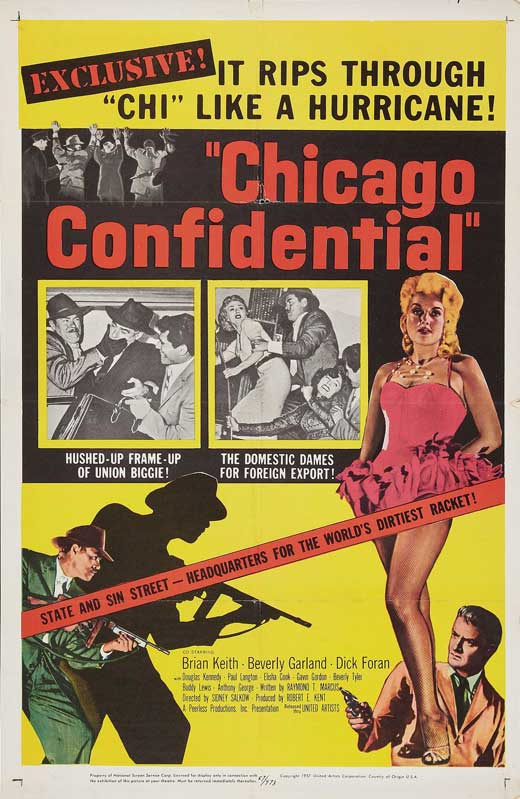
B-Girls and B-Movies: CHICAGO CONFIDENTIAL (United Artists 1957)


gary loggins's avatarcracked rear viewer

CHICAGO CONFIDENTIAL is just a routine ‘B’ crime drama, one of many churned out in the 50’s. Yet the performances of stars Brian Keith Beverly Garland , and an above-average supporting cast helped elevate the by-the-numbers material into something watchable. It’s those Familiar Faces we all know and love from countless movies that made CHICAGO CONFIDENTIAL work for me.

The story revolves around racketeers muscling in on the Worker’s National Union so they can bring their “numbers rackets and ‘B’ girls” to the city. Politically ambitious State’s Attorney Jim Fremont is dead set on busting them up, and when the union’s treasurer is murdered, the finger of suspicion is pointed at honest Union President Artie Blane. Blane’s been framed by his rival, VP Ken Harrison, who takes his orders from “disbarred attorney” Alan Dixon, “one of the masterminds of the old Capone gang”. Blane is brought to trial and, thanks to some chicanery by an “old derelict” with the…

View original post 506 more words

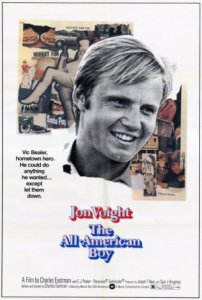
A Movie A Day #149: The All-American Boy (1973, directed by Charles Eastman)


Vic “The Bomber” Bealer is an amateur boxer who appears to be poised to escape from life in his dreary hometown.  He is such a good fighter that he is on the verge of making the U.S. Olympic Team and he is so good-looking that everyone, from his teenage girlfriend (Anne Archer) to his gay manager (Ned Glass) to a woman he meets at a gas station, automatically falls in love with him.  However, after his girlfriend tells him that she is pregnant, Vic abandons both her and boxing.  When she leaves town to have an abortion, Vic starts boxing again but then he learns that she may not have actually had an abortion and Vic leaves for Los Angeles, to see both her and his son.

Sadly, there is something about boxing that has always brought out the pretentious side of some filmmakers and that is the case with The All-American Boy.  This episodic film (which claims to portray “The Manly Art In Six Rounds”) tries to present Vic as being an anti-hero but mostly, he just seems to be vacant loser.  Vic sulks through the entire film, despite not really having much to sulk about.  When one of his conquests asks him what he is thinking, Vic replies, “I ain’t thinkin'” and the movie provides no reason to doubt him on this point.  I was not surprised to learn that The All-American Boy was filmed in 1969 and was deemed unreleasable until the combined success of Midnight Cowboy and Deliverance made Voight into a star.  On the plus side, when he made the film, Jon Voight looked like he could actually step inside the ring and throw a few punches.  On the negative side, the boxing scenes go heavy on the slow motion which, when overused, just looks stupid.  Raging Bull, this film is not.

When it comes to The All-American Boy, Duke has the right idea:

Lisa Reviews An Oscar Nominee: The Longest Day (dir by Ken Annakin, Andrew Marton, Bernhard Wicki, Gerd Oswald, and Darryl F. Zanuck)


As my sister has already pointed out, today is the 73rd anniversary of D-Day.  With that in mind, and as a part of my ongoing mission to see and review every single film ever nominated for best picture, I decided to watch the 1962 film, The Longest Day!

The Longest Day is a pain-staking and meticulous recreation of invasion of Normandy, much of it filmed on location.  It was reportedly something of a dream project for the head of the 20th Century Fox, Darryl F. Zanuck.  Zanuck set out to make both the ultimate tribute to the Allied forces and the greatest war movie ever.  Based on a best seller, The Longest Day has five credited screenwriters and three credited directors.  (Ken Annakin was credited with “British and French exteriors,” Andrew Marton did “American exteriors,” and the German scenes were credited to Bernhard Wicki.  Oddly, Gerd Oswald was not credited for his work on the parachuting scenes, even though those were some of the strongest scenes in the film.)  Even though he was not credited as either a screenwriter or a director, it is generally agreed that the film ultimately reflected the vision of Darryl F. Zanuck.  Zanuck not only rewrote the script but he also directed a few scenes as well.  The film had a budget of 7.75 million dollars, which was a huge amount in 1962.  (Until Steven Spielberg’s Schindler’s List, The Longest Day was the most expensive black-and-white film ever made.)  Not only did the film tell an epic story, but it also had an epic length.  Clocking in at 3 hours, The Longest Day was also one of the longest movies to ever be nominated for best picture.

The Longest Day also had an epic cast.  Zanuck assembled an all-star cast for his recreation of D-Day.  If you’re like me and you love watching old movies on TCM, you’ll see a lot of familiar faces go rushing by during the course of The Longest Day.  American generals were played by actors like Robert Mitchum, Robert Ryan, Henry Fonda, and John Wayne.  Peter Lawford, then the brother-in-law of the President of the United States, had a memorable role as the Scottish Lord Lovat, who marched through D-Day to the sounds of bagpipes.  When the Allied troops storm the beach, everyone from Roddy McDowall to Sal Mineo to Robert Wagner to singer Paul Anka can be seen dodging bullets.  Sean Connery pops up, speaking in his Scottish accent and providing comic relief.  When a group of paratroopers parachute into an occupied village, comedian Red Buttons ends up hanging from the steeple of a church.  When Richard Beymer (who is currently playing Ben Horne on Twin Peaks) gets separated from his squad, he stumbles across Richard Burton.  Among those representing the French are Arletty and Christian Marquand.  (Ironically, after World War II, Arletty was convicted of collaborating with the Germans and spent 18 months under house arrest.  Her crime was having a romantic relationship with a German soldier.  It is said that, in response to the charges, Arletty said, “My heart is French but my ass is international.”)  Meanwhile, among the Germans, one can find three future Bond villains: Gert Frobe, Curt Jurgens, and Walter Gotell.

It’s a big film and, to be honest, it’s too big.  It’s hard to keep track of everyone and, even though the battle scenes are probably about an intense as one could get away with in 1962 (though it’s nowhere near as effective as the famous opening of Saving Private Ryan, I still felt bad when Jeffrey Hunter and Eddie Albert were gunned down), their effectiveness is compromised by the film’s all-star approach.  Often times, the action threatens to come to a halt so that everyone can get their close-up.  Unfortunately, most of those famous faces don’t really get much of a chance to make an impression.  Even as the battle rages, you keep getting distracted by questions like, “Was that guy famous or was he just an extra?”

Among the big stars, most of them play to their personas.  John Wayne, for instance, may have been cast as General Benjamin Vandervoort but there’s never any doubt that he’s playing John Wayne.  When he tells his troops to “send them to Hell,” it’s not Vandervoort giving orders.  It’s John Wayne representing America.  Henry Fonda may be identified as being General Theodore Roosevelt II but, ultimately, you react to him because he’s Henry Fonda, a symbol of middle-American decency.  Neither Wayne nor Fonda gives a bad performance but you never forget that you’re watching Fonda and Wayne.

Throughout this huge film, there are bits and pieces that work so well that you wish the film had just concentrated on them as opposed to trying to tell every single story that occurred during D-Day.  I liked Robert Mitchum as a tough but caring general who, in the midst of battle, gives a speech that inspires his troops to keep fighting.  The scenes of Peter Lawford marching with a bagpiper at his side were nicely surreal.  Finally, there’s Richard Beymer, wandering around the French countryside and going through the entire day without firing his gun once.  Beymer gets the best line of the film when he says, “I wonder if we won.”  It’s such a modest line but it’s probably the most powerful line in the film.  I wish The Longest Day had more scenes like that.

The Longest Day was nominated for best picture of 1962 but it lost to an even longer film, Lawrence of Arabia.

A Movie A Day #148: Badge 373 (1973, directed by Howard W. Koch)


In this cop film, Robert Duvall plays Eddie Ryan, a tough New York detective who gets suspended from the force when he is accused of tossing a Puerto Rican suspect off of a roof.  Eddie’s innocent but, because he spends all of his time talking about how much he hates Puerto Ricans and using Archie Bunker-style racial slurs, everyone assumes that he is guilty.  Eddie is suspended from the force but then his former partner is killed while investigating an operation to smuggle guns to, you guessed it, Puerto Rico.  Suspended or not, Eddie is going to track down the man who killed his partner.  If that puts everyone from his girlfriend, Maureen (Verna Bloom), to NYC pedestrians in danger, that’s just the way it has to be.

Robert Duvall as an action star?  Duvall was only 41 when he starred in Badge 373 but it is still strange to see America’s greatest character actor jumping out of windows and chasing suspects.  Badge 373 was one of the many cop films made in the wake of Dirty Harry and The French Connection and the film is actually credited as being “inspired by the exploits of Eddie Egan.”  Egan also served as the inspiration for Gene Hackman’s Popeye Doyle in The French Connection. Duvall is good in the role but he is almost a little too good.   Hackman played Doyle with a twinkle in his eye that suggested his casual racism was just a part of his streetwise persona.  Duvall is so grim and determined as Eddie Ryan that there is never any doubt that he hates everyone just as much as he says he does.

(Just as he did in The French Connection, the real-life Eddie Egan has a role in Badge 373.  He plays Eddie Ryan’s supervisor and best friend.)

Like most of the cop films that came out immediately after The French Connection, the highlight of Badge 373 is an extended chase scene.  In this one, Eddie escapes from the gun smugglers by hijacking a city bus.  The only problem is that Eddie isn’t sure how to drive a bus and Duvall acts the hell out of his struggle to figure out how to switch gears.  It’s worth the price of admission.

Grand Dame Guignol: WHAT’S THE MATTER WITH HELEN? (United Artists 1971)


gary loggins's avatarcracked rear viewer

The recent FX mini-series FEUD has sparked a renewed interest in the “Older Actresses Doing Horror” genre, also known by the more obnoxious sobriquettes “Hagsploitaion” or “Psycho-Biddy” movies. This peculiar film category lasted from 1962’s WHATEVER HAPPENED TO BABY JANE? until winding down around the early Seventies. 1971’s WHAT’S THE MATTER WITH HELEN? came towards the end of the cycle, a creepy little chiller with Debbie Reynolds and Shelley Winters   getting caught up in murder and madness in 1930’s Hollywood.

I wouldn’t exactly call Debbie Reynolds a “hag”; she was only 39 when this was filmed, and still quite a hottie, especially when glammed-up in a Jean Harlow “Platinum Blond” wig. Deb gets to show off her tap-dancing and tangoing in a few scenes, showing off her still amazing legs for good measure. She and Shelley play a pair of Iowa mothers who (as the opening newsreel footage tells us) have spawned two killer sons that…

View original post 649 more words

What Lisa Watched Last Night #166: Daughter For Sale (dir by Farhad Mann)


Last night, I turned on Lifetime and I watched Daughter for Sale!

Why Was I Watching It?

Well, the main reason was because the film was on Lifetime and I always enjoy live tweeting Lifetime films.  There’s a strong community of Lifetime live tweeters.  We all appreciate Canadian location shooting and unapologetic melodrama.

Add to that, Daughter For Sale is a great title.  When you see that a movie is called Daughter for Sale, you really have no choice but to watch.

What Was It About?

Annalise O’Neil (Emily Rose) is a newly appointed judge.  We know this because 50% of her dialogue consists of her telling people, “I’m a judge.”  She also lives in a house that is almost totally made of glass.  Seriously, it’s all windows and there’s no privacy.

Anyway, when the movie starts, she’s celebrating being a judge by throwing a party at her glass house.  When she tells her teenage daughter, Carly (Emily Tennant), to put on a pink dress and come downstairs to the party, Carly responds by cutting the dress into pieces and then sneaking out of the house.  Somehow, nobody notices her running away, despite the fact that the house is almost all window.

Anyway, Carly wanders around Vancouver for a while and then ends up getting kidnapped by a human trafficking ring that is operated by a pretend do-gooder named John Gallant (Antonio Cupo).  Working with a whiny, leather jacket-wearing detective named Derek (Chris Kalhoon), Annalise searches for her missing daughter.  (Her search basically consists of approaching random people and saying, “I’m a judge.”)  Will Annalise and Whiny Detective Man be able to find Carly before she’s sold to the highest bidder?

What Worked?

Particularly for a Lifetime film, Daughter For Sale looked really good.  The shadowy cinematography created the perfect sense of menace.  The warehouse that Carly was kept in was pure nightmare fuel.  We tend to take production design for granted but the people responsible for the look of Daughter for Sale outdid themselves.

Emily Tennant did a pretty good job as Carly. (Remarkably, despite spending about a month in a dirty old warehouse, Carly’s hair and makeup remained perfect throughout the entire movie.)  Antonio Cupo was properly sleazy as the bad guy.  I enjoyed the way the film contrasted Gallant’s public image with the monstrous reality of who he truly was.

What Did Not Work?

“I’m a judge.”  Yes, we know, Analise!  You don’t have to mention it every two minutes!  You being a judge certainly isn’t going to get your daughter out of that warehouse…

This was one of those films where everyone continually switched from being super competent to being super stupid, depending on what was necessary for the scene.  Analise, in particular, was always either a genius or the most naive jurist in history.  Meanwhile, John Gallant was able to run a halfway house, a charity, and an international sex trafficking ring but he wasn’t smart enough to hide the incriminating evidence in his office.  If you’re going to send a thug to beat up a judge, it might be smart to not allow yourself to then be seen, in public, hanging out with the exact same thug.  Or, at least, that’s the way it would seem to me.

“Oh my God!  Just like me!” Moments

“I’m a judge!”

No, actually, I’m not.  But if I was, I would probably remind everyone every chance I got as well.

Lessons Learned

She’s a judge!

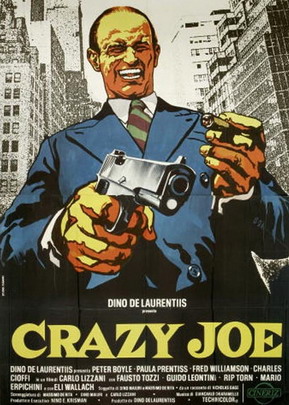
A Movie A Day #147: Crazy Joe (1974, directed by Carlo Lizzani)


Crazy Joe (Peter Boyle) is a gangster with a chip on his shoulder and a self-taught intellectual who can (misquote) Sartre and Camus with the best of them.  Sick of being taken for granted, Joe and his brother, Richie (Rip Torn), attempt to challenge the Mafia establishment.  The mob sets Joe up and gets him sent to prison.  While doing time, Joe befriends a Harlem gangster named Willy (Fred Williamson).  Refusing to associate with the other Italian prisoners, Joe allies himself with the black inmates and even helps to start a riot over the prison’s inhumane conditions.  When he is released, Joe hits the streets of New York with a vengeance, now backed up by Willy and his criminal organization.

Crazy Joe is based on the life of Joey Gallo, who was briefly a New York celebrity, hobnobbing with actors like Jerry Orbach and writers like Norman Mailer before he was gunned down at Umberto’s Clam Shop in Little Italy.  Though the names were changed to protect the guilty, Eli Wallach plays Vito Genovese, Charles Cioffi plays Joe Columbo, and Luther Adler is Joe Profaci.  Fred Williamson’s character is based on the infamous Nicky Barnes.

Crazy Joe is a good and violent mix of the gangster, prison, and blaxploitation genres.  Despite wearing an unfortunate toupee, Peter Boyle is great at putting the crazy in Crazy Joe and Fred Williamson ups the coolness factor of any movie he appears in.  Keep an eye out for Henry Winkler, giving a very un-Fonzie performance as Joe’s right-hand man.

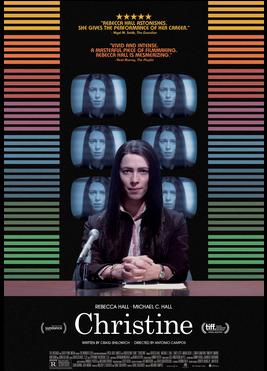
The Things You Find on Netflix: Christine (dir by Antonio Campos)


I really regret that I didn’t get a chance to see Christine when it played here last year.  I wanted to but the movie was only in theaters for a week and then it vanished.

I guess I shouldn’t be too surprised that Christine didn’t become a blockbuster.  I imagine that most potential viewers were turned off by the fact that 1) it wasn’t a remake of the movie about the killer car and 2) it was based on the true story of a reporter who, in 1974, committed suicide on live television.  I imagine that, to many people, the film sounded like it would be indescribably sad.  It certainly sounded that way to me.  That’s why, when the movie opened at the Dallas Angelika, I said, “I’ll see it next week.”  Of course, by the time “next week” rolled around, the movie was gone.

And that’s a shame.  I just watched Christine on Netflix and I discovered that it was one of the best films of 2016.  Yes, it is a sad film but it’s also a frequently fascinating one.  The movie may tell the story of a tragedy but it’s anchored and enlivened by a brilliant performance from Rebecca Hall.  People who love movies, of course, already know that Rebecca Hall is a brilliant actress but, unfortunately, she rarely gets the roles in the films that she deserves.  As of this writing, her most financially successful film was probably The Town and, in that film, she was pretty much wasted in a nothing role.  She is perfectly cast in Christine, perhaps as perfectly cast as any performer could ever hope to be.

Rebecca Hall plays Christine Chubbuck, a reporter who was based in Sarasota, Florida.  In 1974, she started a newscast by announcing, “”In keeping with Channel 40’s policy of bringing you the latest in ‘blood and guts’, and in living color, you are going to see another first—attempted suicide.”  She then drew a gun from a shopping bag that was sitting behind the anchor desk.  As thousands watched, she shot herself in the back of the head.

Along with the gun, the shopping bag had contained the homemade puppets that Christine used whenever she volunteered at the local children’s hospital.  On the anchor desk, among her papers, was a news report that she had written the previous night, announcing that “Local news personality Christine Chubbuck” had shot herself on live television and had been taken to the hospital in critical condition.  Christine, who was reportedly frustrated both personally and professionally, was briefly the number one story in the nation.

One of the more interesting things about the suicide of Christine Chubbuck is that it happened in 1974, long before YouTube, Facebook Live, or Twitter.  Chubbuck’s suicide was only aired once and the footage has subsequently vanished.  If Christine Chubbuck, or anyone else, committed suicide on television today, it would immediately be all over the internet.  We would end up seeing, at the very least, clips of it on an almost daily basis.  Sadly, we would see it so much that we would probably become desensitized to it.  Since Christine Chubbuck’s death was recorded but remains unseen, both she and her suicide have achieved an almost mythical quality.  One can look at the details of Christine Chubbuck’s death and see almost anything that they want.

Christine follows the last few months of Chubbuck’s life.  As played by Rebecca Hall, Christine is confident enough that she can imagine interviewing Richard Nixon but insecure enough to obsess over whether she was nodding too much while the imaginary President gave his imaginary answer.  She lives with her mother (J. Smith-Cameron), a self-described hippie who keeps making references to a breakdown that Christine had in Boston.  When she complains about the pressure that she’s under to sensationalize the news, her boss dismisses her with “You’re a feminist!”  (He says it like an accusation.)  When she gives in and purchases a police scanner so that she can find the stories that the boss is demanding, she ends up spending most of her night listening to two cops brag about “how far” they got with their girlfriends the night before. When she goes to the doctor to complain about chronic stomach pain, she’s told that she has to have an ovary removed and she’ll probably never be able to conceive.  When she thinks that she finally has a date with the man who she’s been crushing on, she is instead dragged to an empty-headed encounter group.  Her group partner has a slick answer for every problem that Christine has until Christine says that she’s thirty and she’s still a virgin.

“Oh,” her partner replies, flummoxed.

In the film, Christine struggles with both depression and, in my opinion, bipolar disorder as well.  Unfortunately, for her mental well-being, she’s a woman in 1974.  The only thing that the world has to offer her are vapid self-affirmation (“I’m okay, you’re okay!  I’m okay, you’re okay!” one co-worker chants at a particularly dramatic moment) and sexist bosses who dismiss what is clearly a manic episode as either “being moody” or “being difficult.”  Speaking as someone who is very sensitive as to how mental health issues are portrayed onscreen, all I can say is that Christine gets it right.

I’m probably making this film sound like the most depressing movie ever made and it’s definitely not a happy film.  I had tears in my eyes by the end of it.  At the same time, it’s also a compulsively watchable character study.  Rebecca Hall gives such a good and brave performance as Christine that you can’t look away, even when you feel like you should.  Rebecca Hall is also ably supported by Michael C. Hall, Tracy Letts, Morgan Spector, Timothy Simons, and Maria Dizzia, who all play her sometimes sympathetic, sometimes annoyed co-workers.

Now, I do think that I should warn anyone from thinking that Christine is a 100% accurate look at Christine Chubbuck’s life and death.  The film left me so moved that I actually did some research and I came across this article from the Washington Post — Christine Chubbuck: 29, Good-Looking, Educated, A Television Personality. Dead. Live and in Color.  After reading the profile, it was easy to see that the film did take some dramatic license.  However, it was also easy to see that Christine gets the essence of the story right.

If, like me, you missed Christine in the theaters, you can now see it on Netflix.  And you should!