Insomnia File #26: Rabbit Run (dir by Jack Smight)


What’s an Insomnia File? You know how some times you just can’t get any sleep and, at about three in the morning, you’ll find yourself watching whatever you can find on cable? This feature is all about those insomnia-inspired discoveries!

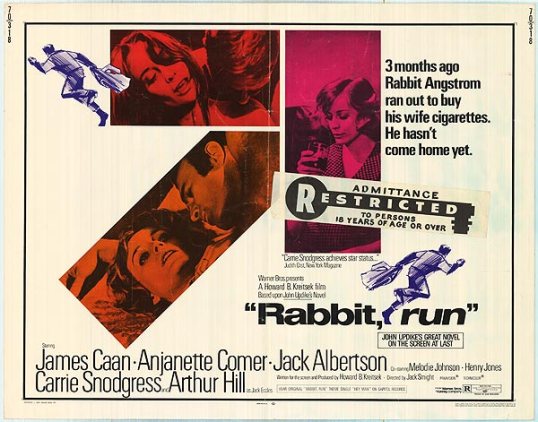
If, at one in the morning on Wednesday, you were suffering from insomnia, you could have turned over to TCM and watched the 1970 film, Rabbit Run.  That’s what I did.

Rabbit Run is the epitome of a dumb lug film.  In a dumb lug film, a male character finds himself living an unfulfilling life but he can’t figure out the reason.  Why can’t he figure it out?  Because he’s a dumb lug, with the emphasis on dumb.  Usually, the viewer is supposed to sympathize with the dumb lug because he doesn’t mean to hurt anyone and everyone else in his world is somehow even more annoying than he is.  Typically, the dumb lug will have an emotionally distant wife who refuses to have sex with him and who is usually portrayed as being somehow at fault for everything bad that has happened in the dumb lug’s face.  (Want to see a more recent dumb lug film than Rabbit Run?  American Beauty.)  Ever since the silent era, there have been dumb lug films.  In particular, male filmmakers and critics seem to love dumb lug films because they allow them to pat themselves on the back for admitting to being dumb while, at the same time, assuring them that everything is the fault of the wife or the girlfriend or the mother or the mother-in-law.

In Rabbit Run, the dumb lug is named Harry Angstrom (James Caan), though most people still remember him as Rabbit, the high school basketball star.  Harry’s life peaked in high school.  Now, he’s 28 and he can’t hold down a job.  He’s married to Janice (Carrie Snodgress), who spends all of her time drinking and watching TV.  He has a son and another baby is on the way.  One day, when the pregnant Janice asks him to go out and get her a pack of cigarettes, Harry responds by getting in his car and driving all the way from Pennsylvania to Virginia.

When he returns to Pennsylvania, Rabbit doesn’t go back to his wife.  Instead, he drops in on his former basketball coach (Jack Albertson) and begs for advice on what he should do.  The coach, it turns out, is more than little creepy.  He also has absolutely no practical advise to give.  He does introduce Rabbit to a part-time prostitute named Ruth (Anjanette Comer).  Rabbit quickly decides that he’s in love with Ruth and soon, he’s moved in with her.

Meanwhile, there’s all sorts of little things going on.  Rabbit gets a job working as a gardener.  Rabbit befriends the local Episcopal minister (Arthur Hill), even while the minister’s cynical wife (Melodie Johnson) tries to tempt Rabbit away from both his wife and his mistress.  Rabbit both resents and envies the sexual freedom of the counter culture, as represented by his younger sister.  And, of course, Janice is pregnant…

Rabbit Run is based on a highly acclaimed novel by John Updike.  I haven’t read the novel so I can’t compare it to the film, beyond pointing out that many great works of literature have been turned into mediocre movies, largely because the director never found a way to visually translate whatever it was that made the book so memorable in the first place.  Rabbit Run was directed by Jack Smight, who takes a rather frantic approach to the material.  Since Rabbit Run is primarily a character study, it needed a director who would be willing to get out of the way and let the actors dominate the film.  Instead, Smight overdirects, as if he was desperately trying to prove that he could keep up with all the other trendy filmmakers.  The whole movie is full of extreme close-ups, abrupt jump cuts, intrusive music, and delusions of ennui.  You find yourself wishing that someone had been willing to grab Smight and shout, “Calm down!”

(On the plus side, as far as the films of 1970 are concerned, Smight’s direction of Rabbit Run still isn’t as bad as Richard Rush’s direction of Gettting Straight.)

James Caan actually gives a likable performance as Rabbit, which is good because Rabbit would be totally unbearable if not played by an actor with at least a little genuine charisma.  There’s nothing subtle about Caan’s performance but he makes it work.  You never like Rabbit but, at the same time, you don’t hate him.

Unfortunately, there’s nothing subtle about the rest of the cast either.  Something rather tragic happens about 80 minutes into the film and, as much as I knew I shouldn’t, I still found myself giggling because Carrie Snodgress’s performance was so bad that it was impossible for me to take any of it seriously.  Even worse is Arthur Hill, as the minister who won’t stop trying to help Rabbit out.  I eventually reached the point where, every time that sanctimonious character started to open his mouth, I found myself hoping someone would hit him over the head and knock him out.  Among the major supporting players, only Anjanette Comer is allowed a chance to be something more than just a sterotype.  Like Caan, she does the best that she can but ultimately. this is James Caan’s movie.

It’s a disappointing movie but it did not put me to sleep.  Give credit for that to James Caan, who is the only reason to see Rabbit Run.
Previous Insomnia Files:

  1. Story of Mankind
  2. Stag
  3. Love Is A Gun
  4. Nina Takes A Lover
  5. Black Ice
  6. Frogs For Snakes
  7. Fair Game
  8. From The Hip
  9. Born Killers
  10. Eye For An Eye
  11. Summer Catch
  12. Beyond the Law
  13. Spring Broke
  14. Promise
  15. George Wallace
  16. Kill The Messenger
  17. The Suburbans
  18. Only The Strong
  19. Great Expectations
  20. Casual Sex?
  21. Truth
  22. Insomina
  23. Death Do Us Part
  24. A Star is Born
  25. The Winning Season


Film Review: Countdown (dir by Robert Altman)


Earlier tonight, on TCM, I watched the 1968 science fiction film, Countdown.

Who will be the first man to walk on the moon?  Will it be Chiz (Robert Duvall), who is a colonel in the Air Force and who has been training for years and who really should get the chance just because he has a really cool name like Chiz?  Or will it be Chiz’s best friend, Lee (James Caan)?  Lee may not have Chiz’s experience but he’s a scientist and selecting him would allow NASA to portray the mission of being one of peace as opposed to one of war.  Add to that, Lee has a full head of hair and he looks like a young James Caan, who was an undeniably handsome man back in his younger days!  I mean, seriously — who would you rather have as the face of the space program: Tom Hagen or Sonny Corleone?

Of course, it might not really matter who NASA picks because the Russians are determined to get to the moon as well.  And you know what that means!  If the Russians land on the moon first, they’ll turn it into a Socialist utopia and that’ll mean ugly architecture, bread lines, and a three-month wait for toilet paper.  The stakes have never been higher!

Countdown was made and released at the height of the space race, at a time when Americans really did feel that they were competing with the Russians to be the first to reach the moon.  (Of course later, it would be learned that the Russian space program actually managed to kill far more cosmonauts than it successfully sent into orbit.)  It came out a year before Apollo 11 landed on the moon and Neil Armstrong became the first Earthling since Stanley Kubrick to ever step on the lunar surface.  As such, it’s interesting to see how Countdown imagines the experience of exploring the moon.  I won’t spoil who reaches the moon first but I will say that he moves remarkably quickly and with great ease for someone in a gravity-free environment.

Countdown is a good example of what I like to call a “time capsule” film.  Seen today, it’s kinda slow and a bit predictable.  For all the time that is spent on getting the astronauts ready to go into space, very little time is actually spent in orbit.  This is a very Earth-bound film.  And yet, if you’re a history nerd like me, it’s hard not to be a little bit fascinated by a movie like this.  In everything, from its fashions to its dialogue to its cultural outlook, this is very much a document of its time.  It may be a while until we have the technology necessary to travel through time.  Until then, watching a film like this might be as close as I’ll ever get to experiencing what the straight, non-Hippie crowd was doing in 1968.

If you’re a student of film history, Countdown is significant for being one of the first films to be directed by Robert Altman.  To be honest, if not for his name in the opening credits, you would probably never guess that Countdown was directed by one of America’s most influential and iconic directors.  Altman specialized in making film that were almost defiantly iconaclastic and there’s very little of that to be found in Countdown.  Admittedly, there are a few scenes that make use of overlapping dialogue and there’s a party scene that’s definitely Altmanesque.  However, the only reason I really noticed that party scene is because I was specifically looking for evidence of Altman’s style.  For the most part, the most identifiably Altmanesque element of Countdown is the casting of Michael Murphy in a small role.

The film is dominated by Robert Duvall and James Caan and, especially if you’re a fan of The Godfather, it’s undeniably fun to see these two acting opposite each other in something other than an epic gangster film.  (Duvall and Caan also acted together in The Rain People and The Killer Elite and were reportedly great friends off-camera as well.)  Duvall is especially good in Countdown, playing Chiz as a man torn between an innate sense of loyalty and his own competitive nature.  The scenes between Duvall and Caan have a charge to them that occasionally bring some much-needed life to this film.

In the end, Countdown is a fairly forgettable film but it’s worth seeing as a piece of history.

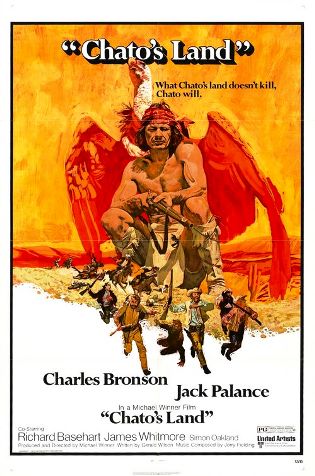
A Movie A Day #170: Chato’s Land (1972, directed by Michael Winner)


Don’t mess with Charles Bronson.

That’s the main lesson that can be taken away from Chato’s Land.  In this western, Bronson plays Chato, an Apache who enters the wrong saloon and is forced to shoot a racist sheriff in self-defense.  Former Confederate Captain Quincey Whitemore (Jack Palance) forms a posse to track Chato down but soon discovers that his posse is not made up of the best and brightest.  Instead, most of them are sadistic racists who just want to kill Apaches.  Despite Whitemore’s efforts to stop them, the posse rapes Chato’s wife and kills his best friend.  Chato trades his white man’s clothes for a loin cloth and sets out for revenge.

Chato’s Land is historically significant because it was the first of many films that Charles Bronson made with Michael Winner.  The most famous Bronson/Winner collaboration was Death Wish, which also featured Charles Bronson as a man who seeks revenge after his wife is raped.  What is surprising about Chato’s Land is how little screen time Bronson actually has.  Most the film is spent with the posse, which is full of familiar faces (Richard Jordan, Simon Oakland, Victor French, Ralph Waite, and James Whitmore all report for duty).  It actually works to the film’s advantage, making Bronson even more intimidating than usual.  There’s never any doubt that Chato is going to kill every member of the posse but since almost every member of the posse is loathsome, that’s not a problem.

It’s possible that Chato’s Land was meant to be an allegory for the Vietnam War, which is probably giving Michael Winner too much credit.  (In an interview, the author of Death Wish, Brian Garfield, once shared an anecdote about Winner inserting a shot of three nuns into Death Wish and bragging about how the shot was meaningless but that it would fool the critics into thinking he was making a grand statement about something.)  Like most of Winner’s films, Chato’s Land is good but not great.  There are parts of the movie that drag and Jack Palance and Charles Bronson don’t get to share any big scenes together, which seems like a missed opportunity.  Bronson, who was always underrated as an actor, gives one of his better performances as Chato.  Chato does not say much but Bronson could do more with one glare than most actors could do with a monologue.  In Europe, Bronson was known as Il Brutto and Chato’s Land features him at his most brutal.

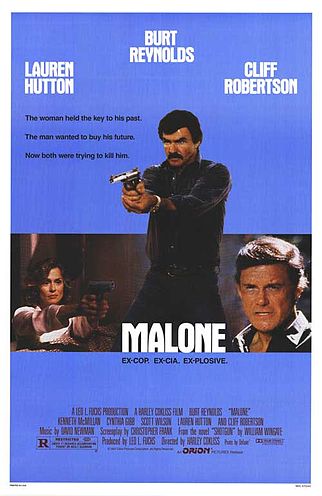
A Movie A Day #169: Malone (1987, directed by Harley Cokeliss)


It’s Burt Reynolds vs. Cliff Robertson.  Cliff has got the money but Burt’s got the mustache and the toupee.
Robertson plays Charles Delaney, a wealthy businessman who, with the help of a mercenary army, has bought nearly all the land in a small Oregon town.  Only the owner of a local gas station, Paul Barlow (Scott Wilson), has refused to sell.  Delaney and his men think that they can intimidate Paul into selling but what they do not realize is that Paul has a houseguest.  Richard Malone (Burt Reynolds) was driving through town when his car broke down.  While waiting for it to get fixed, he has been staying with Paul and his teenage daughter, Jo (Cynthia Gibb).  What no one knows is that Malone used to be an assassin for the CIA.

If ever there was a film that demanded the talents of Charles Bronson, it is Malone.  The tough and ruthless title character would have been a perfect Bronson role, especially if Malone had been made twenty years earlier.  Instead, the role went to Burt Reynolds, who was on the downside of his career as an action hero.  Sometimes, Burt tries to play the role as serious and emotionally guarded.  Then, in other scenes, Burt will suddenly smile and wink at the camera as he briefly turns back into the Bandit.  This is not one of Burt’s better performances.  He gets good support from the entire cast, including Lauren Hutton as his CIA handler, but, in most of his scenes, Burt comes across as being tired and his toupee makes him look like The Brady Bunch‘s Robert Reed.  Burt was 51 when he made Malone and he looked like he was at least ten years older, making the scenes where Jo comes onto him even more improbable.

Where Malone succeeds is in the action scenes.  Along with Burt’s final assault on Delaney’s compound, there is also a classic showdown in a barbershop.  Malone had a budget of ten million dollars.  How many blood squibs did that buy?  Pay close attention to the scene where two hitmen attempt to surprise Malone in his room and find out.

Malone is may not feature Burt at his best but it is still a damn sight better than some of the other films that awaited Burt once his starpower started to diminish.  Mad Dog Time, anyone?

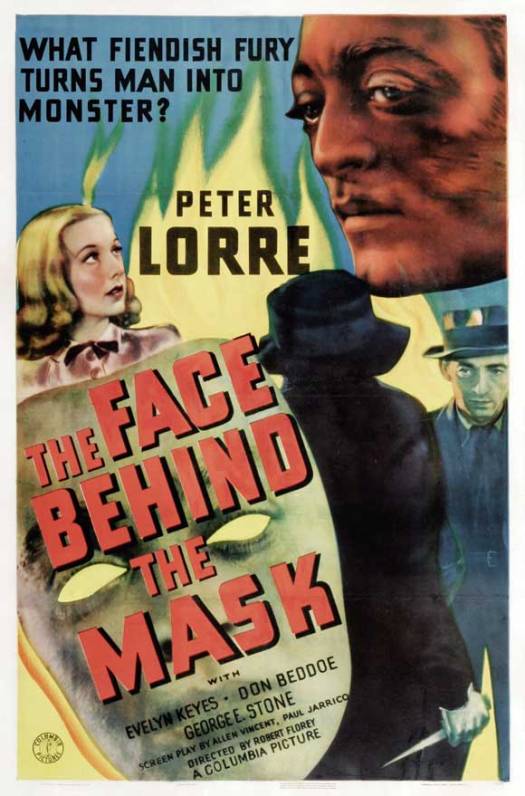
Happy Birthday Peter Lorre: THE FACE BEHIND THE MASK (Columbia 1941)


gary loggins's avatarcracked rear viewer

In honor of Cracked Rear Viewer’s second anniversary, I’m re-presenting my first post from June 26, 2015. I’ve re-edited it and added some pictures, something I didn’t know how to do at first. My, how times change! Anyway, I hope you enjoy this look at an early noir classic. (Coincidentally, this is also Mr. Lorre’s birthday!)

The sinister star Peter Lorre was born in Hungary on June 26, 1904. He became a big screen sensation as the child killer in Fritz Lang’s German classic M (1931), and like many Jews in Germany at the time, fled the Nazi regime, landing in Britain in 1933. Lorre worked with Alfred Hitchcock there in the original THE MAN WHO KNEW TOO MUCH, then immigrated to America, starring in films like MAD LOVE  , CRIME AND PUNISHMENT, and the Mr. Moto series. In 1940, the actor starred in what many consider the first film noir, STRANGER ON THE…

View original post 836 more words

A Movie A Day #168: The Harder They Fall (1956, directed by Mark Robson)


In his final film role, Humphrey Bogart exposes the seamy side of boxing.
Bogart plays Eddie Willis, a washed-up former sportswriter who, because he desperately needs the money, accepts a job offer from crooked boxing promoter, Nick Benko (Rod Steiger).  Eddie is working as a publicist for a South American boxer named Toro (Mike Lane).  Toro is big, strong, and not very bright.  He is not a great boxer but he does not realize that because the Mob has been fixing all of his fights.  After a punch drunk former boxer dies in the ring while fighting Toro, Toro wants to quit and return home to Argentina.  Eddie, who has grown sympathetic to Toro, convinces Toro to fight one last time, against the world champion, Buddy Brannen (Max Baer).  Eddie tells Toro that he does not have a chance of winning but at least he will be able to return home with money for his parents.  However, Benko has other plans for Toro’s money.

Bogart was visibly dying of cancer when he made this tough and uncompromising expose of the racket behind the fight game.  This was his final performance but it is also one of his best.  Even sick and more weary than usual, Bogart could still summon up righteous fury at the type of men that would exploit a fighter like Toro.  His scenes with Rod Steiger are charged with intensity, with Bogart’s film star charisma colliding with Steiger’s stylized method acting.  Both on-screen and 0ff, Humphrey Bogart was an actor who always stood up for the little guy.  Though the film itself may be predictable and Toro is sometimes too saintly to be believed, The Harder They Fall is still a proper finale to an important and distinguished career.

A Movie A Day #167: Stick (1985, directed by Burt Reynolds)


Stick (Burt Reynolds) is a veteran car thief who has just gotten out of prison.  No sooner has Stick arrived home in Florida then he accompanies his friend, Rainy (Jose Perez), on a drug deal that goes bad.  When Rainy is killed, Stick goes into hiding.  He manages to get a stable job, working as a chauffeur for an eccentric millionaire (George Segal).  He gets a new girlfriend (Candice Bergen) and starts to bond with his teenage daughter (Tricia Leigh Fisher).  Stick wants to go straight but, before he can, he knows that he has to confront the men who murdered Rainy.
Stick starts out strong.  The first half of the film finds Burt, who was often as underrated as a director as he was as an actor, in pure Sharky’s Machine mode, mixing the steamy Florida atmosphere with quirky character comedy and hardboiled action.  Adapting his own novel, Elmore Leonard wrote the screenplay and Stick seems like a classic Leonard hero, a criminal with his own moral code.  

But then Stick falls apart during the second half and it becomes obvious why both Reynolds and Leonard often cited this film as being one of the biggest disappointments of their careers.  Universal Studios disliked Burt’s first cut of the film and brought in a second screenwriter, who beefed up the action scenes and added the subplot with Stick’s teenage daughter.  Reynolds reshot the second half of the movie, no longer playing Stick as a tough criminal but instead as another variation on the Bandit.  The end result is a very disjointed movie, with Burt looking bored.

It does not help that the movie’s main villain is played by Charles Durning, who wears an orange fright wig and several Hawaiian shirts.  Durning was an actor who gave many great performances but never was he as miscast as when he played a drug dealer in Stick.

Summer Fun with Bill Murray in MEATBALLS (Paramount 1979)


gary loggins's avatarcracked rear viewer

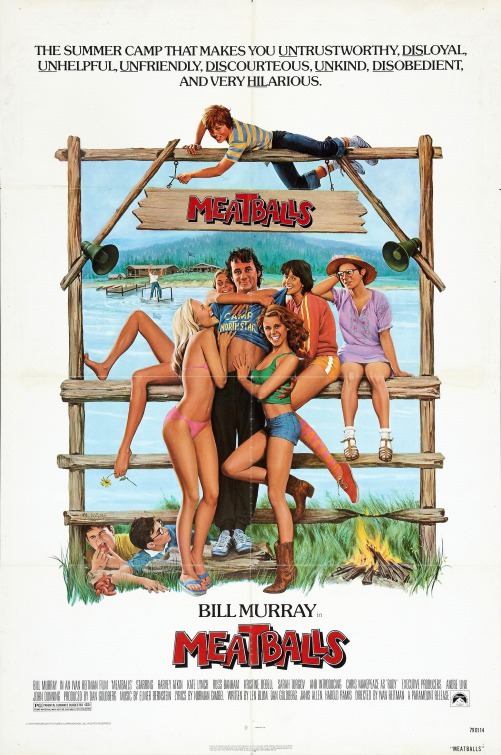
Summer is finally here, so what better way to celebrate than with a summer movie starring Bill Murray!  Bill had joined the cast of SATURDAY NIGHT LIVE in 1979 (back when it was actually funny) and quickly became a fan favorite with his smarmy, snarky persona and silly characterizations. After the film success of John Belushi, it was only natural for Hollywood to come calling, right? Wrong, bucko… it was Canada that lured Bill for his first starring vehicle, the oh-so-70’s teen comedy MEATBALLS! Yeah, you heard right, ’twas the Great White North that plucked Bill away from being “Live from New York” to a location shoot at good ol’ Camp White Pines in the wilds of Ontario.

Bill’s fellow ‘Second City’ alumnus Harold Ramis (or as he was called in SCTV’s credits, ‘Ha-Harold Ramis’!) was a cowriter of the screenplay, beginning a long string of movie collaborations between the two (STRIPES, CADDYSHACK,  GHOSTBUSTERS I…

View original post 433 more words

A Movie A Day #166: Warning Sign (1985, directed by Hal Barwood)


The world might end, again.

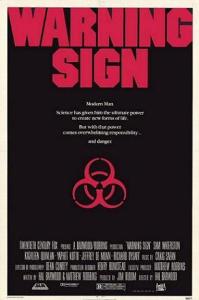
There is a laboratory in the middle of the desert.  While everyone thinks that the lab is developing pesticides, it is actually a secret government facility where the scientists have developed a chemical that will turn anyone exposed to it into a homicidal maniac.  While the scientists are celebrating the success of their project, Dr. Tom Schmidt (G.W. Bailey — yes, Captain Harris from the Police Academy movies) steps on a vial and releases the chemical.  The lab locks down and the army (led by Yaphet Kotto) arrives.  The government wants to let the scientists kill each other off but a pregnant security guard (Kathleen Quinlan) is also trapped in the lab and her husband, the county sheriff (Sam Waterston), is determined to get her out.

Warning Sign was blandly directed by Hal Barwood, a longtime associate of both George Lucas and Steven Spielberg.  (Barwood wrote the script for Spielberg’s The Sugarland Express and designed the title sequence for Lucas’s THX 1138.)  Barwood tried to take a very Spielbergian approach to Warning Sign, a mistake because successfully imitating Spielberg is easier said than done.  Replace the shark with germs and the ocean with a lab on lock down and Warning Sign is  like Jaws, without any of the suspense or humor.  Sam Waterston’s germaphobic sheriff feels like a knock off of Roy Scheider’s aquaphobic police chief while Jeffrey DeMunn, as an alcoholic scientist, stands in for both Richard Dreyfuss and Robert Shaw.    With the violence and the gore kept to a minimum, this is one of the most tasteful zombie films ever made.  Just compare it to George Romero’s The Crazies (or even the remake) to see how needlessly safe Warning Sign is.

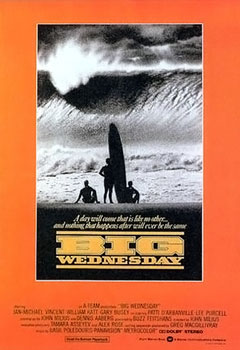
A Movie A Day #165: Big Wednesday (1978, directed by John Milius)


If there is a male bonding hall of fame, Big Wednesday has to be front and center.
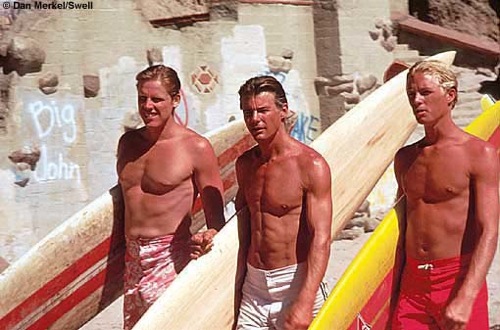
This episodic movie follows three legendary surfers over twelve years of change and turmoil.  Jack Barlowe (William Katt) is the straight arrow who keeps the peace.  Leroy “The Masochist” Smith (Gary Busey) is the wild man.  Matt Johnson (Jan-Michael Vincent) is the best surfer of them all but he resents both his fame and the expectation that he should be some sort of role model for the younger kids on the beach.  From 1962 until 1974, the three of them learn about love and responsibility while dealing with cultural turmoil (including, of course, the Vietnam War) and waiting for that one legendary wave.

After writing the screenplays for Dirty Harry and Apocalypse Now and directing The Wind and The Lion and Dillinger, John Milius finally got to make his dream project.  Big Wednesday was based on Milius’s own youth as a California surfer and he has said that all three of the main characters were based on different aspects of his own personality.  Expectations for Big Wednesday were so high that Milius’s friends, George Lucas and Steven Spielberg, exchanged percentages points for Star Wars and Close Encounters of  The Third Kind for a point of Big Wednesday.  The deal turned out to be worth millions to Milius but nothing to Lucas and Spielberg because Big Wednesday was a notorious box office flop.  Warner Bros. sold the film as a raunchy comedy, leaving audiences surprised to discover that Big Wednesday was actually, in Milius’s words, a “coming-of-age story with Arthurian overtones.”

I can understand why Big Wednesday may not be for everyone but it is one of my favorite movies.  It is one of the ultimate guy films.  Some of the dialogue and the narration may be overwrought but so are most guys, especially when they’re the same age as the surfers in Big Wednesday.  We all like to imagine that we are heroes in some sort of epic adventure.  The surfing footage is amazing but it is not necessary to be a surfer to relate to the film’s coming-of-age story or its celebration of the enduring bonds of friendship.  Katt, Vincent, and Busey all give great performances.  Considering their later careers, it is good that Big Wednesday is around to remind us of what Gary Busey and Jan-Michael Vincent were capable of at their best, before their promising careers were derailed by drugs and mental illness.  Be sure to also keep an eye out for infamous 70s character actor Joe Spinell as an army psychiatrist, a pre-Nightmare on Elm Street Robert Englund, playing a fellow surfer and providing the film’s narration, and Barbara Hale, playing the patient mother of her real-life son, William Katt.

One final note: At a time when the shameful stereotype of the psycho Vietnam vet was becoming popular and unfairly tarnishing the reputation of real-life vets, Big Wednesday was unique for featuring a character who not only joins the Army but who appears to return as a better person as a result.