I’ve covered producer/writer/director Larry Cohen’s marvelously manic work in the horror genre ( IT’S ALIVE! , GOD TOLD ME TO ), but did you know the low-budget auteur also contributed some solid entries to the Blaxploitation field? Cohen’s gangster epic BLACK CAESAR starred Fred “The Hammer” Williamson and was such a smash a sequel was rushed into production and released ten months later. HELL UP IN HARLEM picks up right where the original left off, as ‘Black Caesar’ Tommy Gibbs is set up by corrupt DA DiAngelo and shot on the streets of New York City. Tommy has possession of some ledgers with the names of all the crooked politicians and cops on his payroll, and DiAngelo and his Mafioso friends want to put him out of circulation for good. Escaping via a wild taxi ride, Tommy is back in business and out for revenge.
This enables Cohen to serve up a series of crazy/cool set pieces that…
Across America, strange things are happening. Seemingly ordinary, middle-aged citizens are, without explanation, attacking formerly top secret government facilities. The attackers are from all different walks of life. One was an auto mechanic. Another was a priest. There was even a housewife who, after blowing up a power station, committed suicide with a poison pill that the KGB stopped issuing a decade ago. Before launching their attacks, each one of them received a phone call in which a Russian man recited a poem by Robert Frost.
The Americans may not understand what is happening but the Soviets do. Immediately after the Cuban Missile Crisis, the KGB planted sleeper agents across the United States. They hypnotized and brainwashed the agents so thoroughly that they no longer remember that they are agents. The Frost poem was the trigger designed to activate the agents, all of whom were meant to attack what were then valuable parts of America’s infrastructure. With the arrival of détente, the program was abandoned and the sleeper agents were simply left behind in the United States. But now, a former hardliner (Donald Pleasence), is activating the agents one by one. Because he has a photographic memory, KGB colonel Charles Bronson is sent to the United States to track down and kill Pleasence before the United States discovers the truth about what is happening. Lee Remick, as an American KGB agent, is assigned to work with him but is also ordered to kill him once the assignment has been completed.
That Telfon is one of Charles Bronson’s better post-Death Wish films is largely due to the presence of Don Siegel in the director’s chair. As a director who specialized in intelligent genre films and who helped to make Clint Eastwood one of the world’s biggest stars with Dirty Harry, Coogan’s Bluff, The Beguiled, and Escape from Alcatraz, Don Siegel was the ideal director to bring out the best in Bronson. Like St. Ives, Telefon features Bronson in an uncharacteristically cerebral role. For once, he spends more time analyzing clues than he does shooting people and Bronson is surprisingly credible as a man with a photographic memory.
As directed by Siegel, Telefon is almost a satire of the type of violent action films that Bronson usually made for directors like Michael Winner. In Telefon, both the bad guys and the good guys are equally clueless. All of the KGB sleeper agents are dumpy and middle-aged and the film continually emphasizes that they’ve all been brainwashed to attack targets that are no longer strategically important. Donald Pleasence, playing one of his raving villains, wears a blonde, Beatles-style wig for much of the film.
Though the ending is a let down, Telefon is still one of the best of Bronson’s late 70s films.
Adam receives a mysterious box from a relative containing a creature that will kill everyone he cares about. The only way to be rid of the curse is to give the box to someone he loves. As the ominous timer on the box counts down to its end, he can only imagine the horrors that await. Does he give the box away to save his family, or unleash a monster upon humanity? He can’t destroy it. He can’t escape it. He can only give it to someone he loves…
Review:
Often I don’t like horror movies (actually rarely) But this time I got pulled in, so to speak. This movie will eventually eat at you. Literally EAT AT YOU! Also, would be a good idea not to cover your eyes!
Would I recommend this movie?
With a blind shot!
Now let’s all gather around and watch the trailer:
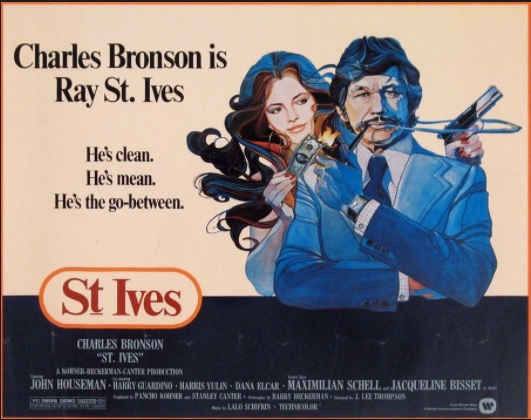
Raymond St. Ives (Charles Bronson) is a former cop-turned-writer who desperately needs money. Abner Procane (John Houseman) is a wealthy and cultured burglar who needs someone to serve as a go-between. Five of Procane’s ledgers have been stolen. The thieves are demanding a ransom and Procane believes that St. Ives is just the man to deliver the money. But every time that St. Ives tries to deliver the money, another person ends up getting murdered and St. Ives ends up looking more and more like a suspect. Who is the murderer? Is it Janet (Jacqueline Bisset), the seductive woman who lives in Procane’s mansion? Is it Procane’s eccentric psychiatrist (Maximillian Schell)? Could it be the two cops (Harry Guardino and Harris Yulin) who somehow show up at every murder scene? Only Ray St. Ives can solve the case!
Charles Bronson is best remembered for playing men of few words, the type who never hesitated to pull the trigger and do what they had to do. St. Ives was one of the few films in which Bronson got to play a cerebral character. Ray St. Ives may get into his share of fights but he spends most of the film examining clues and trying to solve a mystery. The mystery itself is not as important as the quirky people who St. Ives meets while solving it. St. Ives has a great, only in the 70s type of cast. Along with those already mentioned, keep an eye out for Robert Englund, Jeff Goldblum, Dana Elcar, Dick O’Neill, Daniel J. Travanti, Micheal Lerner, and Elisha Cook, Jr. It’s definitely different from the stereotypical Charles Bronson film, which is why it is also one of my favorites of his films. As this film shows, Bronson was an underrated actor. In St. Ives, Bronson proves that, not only could he have played Mike Hammer, he could have played Philip Marlowe a well.
St. Ives is historically significant because it was the first Bronson film to be directed by J. Lee Thompson. Thompson would go on to direct the majority of the films Bronson made for Cannon in 1980s, eventually even taking over the Death Wish franchise from Michael Winner.
When a former marine is framed for a deadly terrorist bombing, he must track down the mastermind behind the plot. But soon he discovers an even deadlier conspiracy that threatens the nation. One that will force him to choose between the freedom of millions, and his own survival.
Review:
I am going to make this short and sweet:
I love low budget indie films. They are the bread and butter of what I review. Getty somehow manages to pull me in by keeping a torrent pace, which is a good thing. You never really get to focus on what is right in front of you.
The CGI is just what you would expect. The acting, well the same.
Would I recommend this movie?
Let’s grab a few beers, sit down and watch the trailer:
And if you want, I’ll watch the movie with you!
America Has Fallen will be available on VOD July 4th 2017
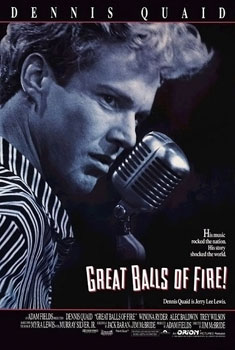
In the 1950s, Jerry Lee Lewis (Dennis Quaid) plays what his cousin, Jimmy Swaggart (Alec Baldwin), calls the devil’s music. After signing a contract with Sam Phillips (Trey Wilson), Jerry becomes a star with his wild man persona and crazed piano playing. When Elvis is drafted, it appears that Jerry is destined to take over as the new King of Rock and Roll. But, then, while touring England, the press discovers that Jerry is married to his 13 year-old cousin, Myra (Winona Ryder). When Jerry refuses to apologize for his private life, his career falls apart.
The real Jerry Lew Lewis has stated many times that he hates this musical biopic and that it has very little in common with his actual life. Jerry has a point. Great Balls of Fire is a highly stylized film, one that greatly sanitizes both the life of Jerry Lee Lewis and the early days of rock and roll. In the film, there’s no struggle or even hard work on the road to becoming a star. Jerry just drops off a recording of himself playing piano and viola! He’s a star! Soon, teenagers are dancing around his convertible, both civil rights protestors and white Southern cops start dancing whenever they see him driving down the street, the local radio DJ waves whenever he sees them, and Jerry’s sneaking into Mississippi so that he can marry his thirteen year-old cousin.
Great Balls of Fire! takes a superficially mater of fact approach to Jerry’s marriage to Myra, neither condemning nor excusing, though it does cheat by casting the 18 year-old Winona Ryder as the 13 year-old Myra. (If the film had cast an actress who was closer to Myra’s actual age, Great Balls of Fire! would never have been released.) Fortunately, history helped the movie out by making Jimmy Swaggart into Jerry’s main critic. Alec Baldwin’s performance as Jimmy Swaggart makes his interpretation of Donald Trump look subtle, nuanced, and award-worthy.
Dennis Quaid, at the height of his 80s stardom, is ideally cast as Jerry Lee Lewis, giving a good if broad performance and doing a convincing job lip-syncing to the music. Quaid has said that he was struggling with an addiction to cocaine while filming Great Balls of Fire! and that might have made him the perfect actor to play the always conflicted and always wild Jerry Lee Lewis. The best thing about the film is that Jerry Lee Lewis provided the music, re-recording his best known songs. While the movie may not tell the true story of Jerry Lee Lewis, it does feature enough of his music that it is obvious why Jerry Lee Lewis nearly became the king of rock and roll.
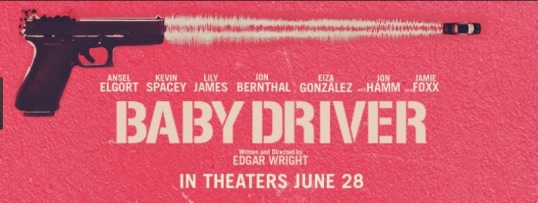
Baby Driver, the new film from director Edgar Wright, is awesome!
That’s the succinct way of putting it and, if you really want to fully enjoy this film, I suggest that you stop reading this review now. There’s no way that a review cannot, to a certain extent, spoil a movie. Baby Driver is a kinetic blend of action, comedy, romance, and music and it is a movie that you should see without any preconceived notions and expectations. It’s a movie that earns the right to surprise you with just how good and entertaining it is. It’s a movie that you should experience fresh.
So, go see the movie. Seriously, go right now. GET OUT OF HERE AND SEE THE MOVIE! This review will still be waiting for you when you get back. Who knows? Maybe, while you’re watching the movie, I’ll actually correct some of the typos. Or maybe not.
Anyway, go away. I’ll wait for you to return.
la dee da la dee da…
Okay, did you see the movie? It’s really great, isn’t it?
As a result of the childhood car accident that killed his parents, Baby (Ansel Elgort) has been left with a permanent case of tinnitus. He uses music to drown out the constant ringing in his ears. There’s almost never a time that Baby isn’t listening to his ipod. When we first see Baby, he’s sitting behind the wheel of a car, singing along with Jon Spencer and the Blues Explosion. The second time that we see him, he’s getting coffee while listening to Harlem Shuffle. In a delirious homage to Singin’ In The Rain (and in a scene that puts the opening traffic jam of La La Landto shame), Baby literally dances across the streets of Los Angeles. For Baby, every day is a musical.
Of course, Baby doesn’t just use music to block out the ringing. He also uses the music (and an ever-present pair of sunglasses) to keep the world out. He rarely speaks or even makes eye contact and, as long as he’s listening to his ipod, he has an excuse not to interact. He doesn’t have to explain the small scars around his eyes or how he makes his money. The few times that he does speak to people, it’s to record their voices, which he then turns into music. Music and the driving are the only two ways this orphan can express his feelings.
When the movie begins, Baby appears to be close to only two men. One is his deaf foster father, Joseph (CJ Jones). Baby lives with Joseph, in an apartment where Baby regularly stashes thousands of dollars. Joseph always watches in disapproval as Baby hides the money under the floorboards. Joseph signs at Baby that he deserves better than the life he’s leading. Baby always signs back that he’s only a few jobs away from being done.
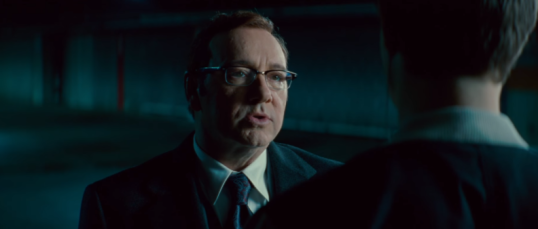
Baby’s other father figure is Doc (Kevin Spacey). Doc is a rich and connected man. At times, he seems to sincerely care about Baby but there are other times when Doc is just as quick to threaten to kill him and everyone that he loves. Doc plans bank robberies for a living. Doc may change associates from robbery to robbery but one thing always remains consistent. Baby is always his driver because Baby is the best. As Doc explains it, the first time he saw Baby, he was stealing Doc’s Mercedes. Baby drives for Doc as a way of paying off his debt to the older man but you still believe Baby’s sincerity when he tells Doc, “We’re a team.” (One the film’s best throw-away jokes is the line where Doc reveals that he knows where Baby got the idea to say that.)
Things start to change for Baby when he meets Debora (Lily James), a waitress who appears to love music just as much he does. For Baby and Debora, it’s love at first sight but Doc has one more job that he needs Baby for. It’s their most dangerous job yet and, making thing even more complicated, are the three people who Doc has recruited to work with Baby. Buddy (Jon Hamm) is a former wall street banker who is eager to prove what a badass he is. Darling (Eiza Gonzalez) is his wife, who enjoys talking about how many of their former partners have died. And finally, there’s Bats (Jamie Foxx), a complete and total psycho who brags about never telling a single story that doesn’t end with someone getting killed.
Baby Driver is a propulsive blast of pure adrenaline, perhaps the closest that we will ever get to a genuine pulp musical. The action scenes left me literally breathless. I saw the movie at the Alamo Drafthouse and, before the film started, there was a clip of Edgar Wright listing his favorite car chases. He listed all of the usual suspects, Bullitt, The French Connection, Mad Max: Thunder Road. The chases scenes in Baby Driver can proudly be listed next to all of those scenes. This is genuinely exciting crime film, featuring wonderfully over-the-top turns from Foxx, Hamm, and especially Spacey.
But you know what? Baby Driver may be a great action film but what makes it special is that it’s also a film with a heart. Rather bravely, Edgar Wright has not only made an action musical but he’s also mixed in a very sincere and unabashedly sentimental love story. You never doubt for a second that Baby would give up everything — music, driving, even his life — for Debora. The scenes between Baby and Debora are almost deliriously romantic. Ansel Elgort and Lily James both share a very likable and very real chemistry. You want things to work out for Debora and Baby. You feel like they belong together and, when it looks like either Baby or Debora might be in danger, you worry for both of them. As exciting as the film’s action sequences were, it was the ending that brought tears to my eyes and that was almost totally due to the performances of Elgort and James.
Baby Driver is one of the best films that I’ve seen so far this year. See it this weekend! If you’ve already seen it, see it again! This film deserves to be rewarded.
Doctor Ian Burton (Eric Roberts) is a college professor who believes that objects retain impressions of the past. To prove his theory (and hopefully, not lose tenure), Burton recruits one of his students, Lila Reed (Kari Wuhrer), who has shown that she may have psychic abilities. Lila holds objects and she sees the past. At first, she is intrigued but then she realizes that she keeps seeing the same woman in her visions. The woman was a former student of Burton’s. She was murdered and the good Doctor Burton is the number one suspect. Can Lila use her power to solve the crime and clear Burton’s name? Or is Burton guilty and using her for something more sinister than just testing a thesis?
Sensation is one of the many softcore neo-noirs that used to regularly appear, “after hours,” on HBO and Cinemax in the 1990s. Sensation has a tagline (“An experience in terror”) that it never lives up to but it is still watchable because of the combination of the sexiness of Kari Wuhrer and the strangeness of Eric Roberts. The tawdry mystery will not fool anyone and Wuhrer’s visions were all done better in The Dead Zone but Sensation deserves some credit for at least trying to be a little more creative than the average 1990s straight-to-video release.
Keep an eye out for Ron Pearlman, as the lead detective on the case. He does not get to do much but he’s still Ron Pearlman!
There’s not a single sports cliché that goes untouched in The Program.
A veteran college football coach who, after two disappointing seasons, is now being told that he must get wins at any cost? Check!
A cocky senior quarterback who is trying to live up to his father’s expectations? Check!
A cocky freshman who matures during the season? Check!
A cocky NFL prospect who suffers a career ending injury? Check!
Corrupt rich backers? Check!
Beer? Check!
Steroids? Check!
Hazing? Check!
Football groupies? Check!
Halle Berry wasted in a one-note role? Check!
Kristy Swanson as the one girl on campus who is not impressed by football? Check! Check! Check!
The Program has its good points. James Caan does a good job as the coach and Andrew Bryniarski, playing a player who is always on the verge of flying into roid rage, dominates every scene in which he appears. Kristy Swanson looks good in a tennis outfit, so it’s not all bad. But Craig Sheffer is neither credible nor likable as the star quarterback and there is not a single scene that won’t be seen coming.
When The Program came out in 1993, it included a scene where the team bonded by laying down in the middle of a busy street, while cars zoomed by on either side of them. Things turned out alright for the people in the movie but, for the idiots who tried to imitate the stunt in real life, it was a different story. It turns out that, in real life, drivers don’t always stay in their lane and, if you lay down in the middle of the street, there is a good chance that you are going to get run over. After several deaths, the scene was taken out of the film. If you’re going to die for a movie, do it for a movie better than The Program.
Culver City’s MGM “dream factory” and Gower Gulch’s PRC were miles apart both literally and figuratively. Metro-Goldwyn-Mayer boasted “more stars than there are in heaven”, while tiny Producer’s Releasing Corporation films starred faded names like Neil Hamilton, Harry Langdon, Bela Lugosi , and Anna May Wong. MGM films featured lavish, opulent sets; PRC’s cardboard walls looked like they would fall over if an actor sneezed. Poverty Row PRC movies were dark and grainy; MGM created glossy, gorgeous Technicolor productions. MGM specialized in big budget extravaganzas, whereas PRC rarely spent more than $1.98. Miles apart – so why did major studio MGM purchase and release a movie originally made for minor PRC, HITLER’S MADMAN?
For one thing, it’s a damn good film, and an important one as well. Based on the true-life atrocity of the destruction of Lidice, Czechoslovakia on June 10, 1942 after the assassination of Nazi Reichsprotektor Reinhardt Heydrich, known as “The Hangman of Prague”, HITLER’S MADMAN was…



 In the 1950s, Jerry Lee Lewis (Dennis Quaid) plays what his cousin, Jimmy Swaggart (Alec Baldwin), calls the devil’s music. After signing a contract with Sam Phillips (Trey Wilson), Jerry becomes a star with his wild man persona and crazed piano playing. When Elvis is drafted, it appears that Jerry is destined to take over as the new King of Rock and Roll. But, then, while touring England, the press discovers that Jerry is married to his 13 year-old cousin, Myra (Winona Ryder). When Jerry refuses to apologize for his private life, his career falls apart.


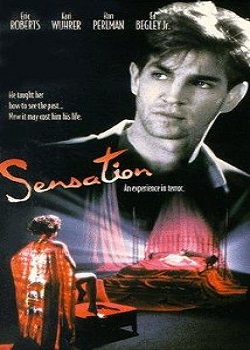 Doctor Ian Burton (Eric Roberts) is a college professor who believes that objects retain impressions of the past. To prove his theory (and hopefully, not lose tenure), Burton recruits one of his students, Lila Reed (Kari Wuhrer), who has shown that she may have psychic abilities. Lila holds objects and she sees the past. At first, she is intrigued but then she realizes that she keeps seeing the same woman in her visions. The woman was a former student of Burton’s. She was murdered and the good Doctor Burton is the number one suspect. Can Lila use her power to solve the crime and clear Burton’s name? Or is Burton guilty and using her for something more sinister than just testing a thesis?
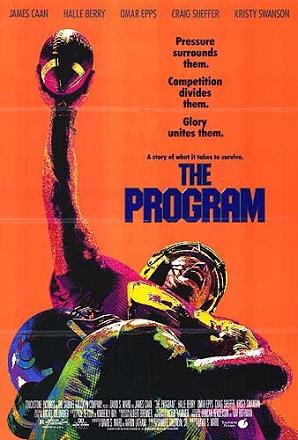 There’s not a single sports cliché that goes untouched in The Program.
 Through the Shattered Lens