The TSL’s Horror Grindhouse: Sorority House Massacre II (dir by Jim Wynorski)


Some movies just force the viewer to ask, “What would you do?”

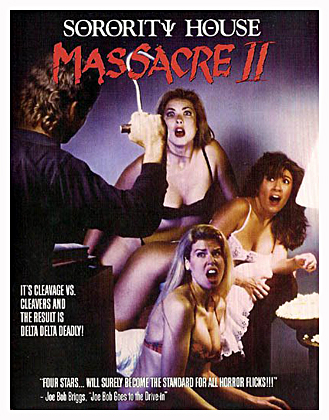
I mean, just consider what it would be like to be in the scenario that’s presented to us in the 1990 film, Sorority House Massacre II.  You’re a college student.  You’ve got your entire future ahead of you.  The president of your sorority has just purchased a new sorority house and she wants you and three others to spend the weekend helping her fix the place up.

You arrive at the house and you discover that it’s literally on the verge of collapsing.  There’s no electricity.  There’s no telephone.  (And remember, this is back when people just used landlines.)  There’s no hot water.  Soon after arriving, you’re informed that there’s two reasons why the house was being sold at such a cheap price.

First off, there’s the neighbor.  He’s a creepy, kinda pervy-looking guy named Orville Ketchum.  When Orville comes over to meet his new neighbors, he announces that he has the keys to the basement.  He reaches into his pants to retrieve them.  Ewwww!

Secondly, it turns out that the house isn’t just any deserted house.  It’s the old Hockstadder Place!  Years ago, Mr. Hockstadder killed his daughters before dying.  Orville witnessed the whole thing.  As he tells the story, you might notice that the flashbacks are lifted from a film called Slumber Party Massacre, despite the fact that you’re starring in Sorority House Massacre II.

Despite all of that, you still enter the house.  A storm is rolling in and, whenever you look out the window, you see the same lightning stock footage that has appeared in a countless number of cheap horror movies.

When you and your friends decide to explore the basement, you find a Ouija board.  You know that Ouija boards can be dangerous but everyone else wants to run upstairs and use it.  Someone suggests that maybe the board can be used to contact the spirit of Hockstadder.  After all, according to Orville, Hockstadder swore that his murderous spirit would never leave the house and would possess anyone who tried to move in.

At this point, you have two options.

Do you say, “Okay, obviously, it’s not a good idea to contact the spirit of a murderer — especially one that said he would possess anyone who tries to contact him — so I’m going to go ahead and leave now?”

or

Do you light some candles, strip down to your underwear in front of a bunch of open windows (despite the fact that weird old Orville is right across the street), sit on a filthy floor, and try to communicate with the spirit of a homicidal maniac?

The smart option would be the first one so, of course, the characters in Sorority House Massacre II do the exact opposite.  Then again, nobody in Sorority House Massacre II appears to be that smart.  For one thing, they’re all in their 30s and they have yet to graduate college.  Trust me, I wish I could have stayed in college forever but, at some point, you really do have to either graduate or drop out.  Tuition’s not cheap.

Anyway, Sorority House Massacre II is one of those movies that just amuses me to death.  There’s absolutely nothing subtle about it.  It’s such a blatant exploitation film that you can’t help but admire it for not pretending to be something that it isn’t.  (At the same time, it’s rather tame when compared to the movies that we’re used to today.  Whenever someone is killed, obviously fake blood is squirted on a wall.)  This may be a stupid movie but it’s very sincere in its stupidity and there’s something to be said for that.

Add to that, Peter Spellos is memorably weird as Orville.  The way he delivers his lines makes Orville into the neighbor that everyone would dread having next door.  In the end, though, it’s a good thing that Orville was there.

Finally, there is one surprisingly effective moment.  The movie starts with the “final girl” huddled in a dark room, begging the unseen killer to remember who they are.  The movie then flashes back to that morning, with the girls standing in front of the house.  The abrupt cut from darkness to the bright and sunny morning is surprisingly effective and feels almost dream-like.  Though one gets the feeling it was probably unintentional, it’s still works far better than you’d expect.
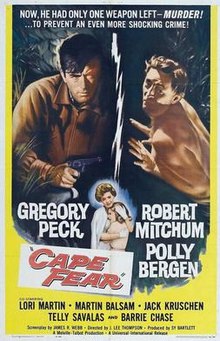
Horror Film Review: Cape Fear (dir by Martin Scorsese)


And I beheld as Scorsese remade a classic movie and, Lo, there was De Niro, decorated in india ink and speaking in tongues…

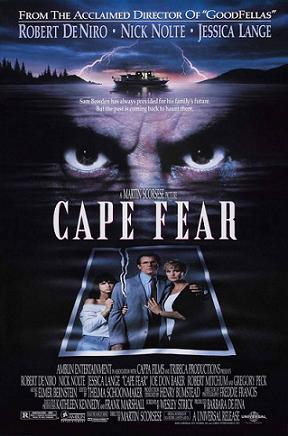
In 1991, Martin Scorsese remade the 1962 horror thriller, Cape Fear.  Both versions deal with the same basic story but each tells it in a very different way.  If the original Cape Fear was straightforward and to the point, Martin Scorsese’s version is so stylized that occasionally, it’s tempting to suspect that Scorsese might be parodying himself.  Zoom shots, negative shots, sweeping camera movements, Scorsese’s Cape Fear is full of all of them.  When a storm rolls in for the film’s operatic finale, the red clouds look as if their on fire.  Hell is coming to North Carolina, the film appears to be announcing.

While the plot largely remains the same, there are a few significant changes to the characters involved:

In the first Cape Fear, Robert Mitchum’s Max Cady was an arrogant, swaggering brute.  In the remake, Robert De Niro’s Cady is still an arrogant, swaggering brute but he’s now also an evangelical who is tattooed with bible verses and who speaks in tongues.  Cape Fear‘s approach to Cady’s religion is so over-the-top that it almost makes Stephen King’s approach to religious characters seem subtle and nuanced.  De Niro also speaks in a broad Southern accent.  Occasionally, De Niro gets the accent right but most of the time, he sounds like he’s in a Vermont community theater production of Cat On A Hot Tin Roof.

In the first Cape Fear, Gregory Peck’s Sam Bowden was a lawyer who caught Max while Max was attacking a woman and who then testified against Max in court.  That’s not the case with the remake’s version of Sam Bowden.  Despite being played by Nick Nolte, the remake’s Sam Bowden is such a wimp that you can’t help but dislike him.  His wife (Jessica Lange) doesn’t trust him.  His teenage daughter (Juliette Lewis) resents him and his attempts to control her life.  In this version, Sam didn’t testify against Max in court.  Instead, Sam was Max’s lawyer and withheld evidence that could have secured Max’s acquittal.  What Sam didn’t realize is that Max would spend his time in prison studying the law and that Max would eventually figure out what Sam did.

As in the original film, Max shows up in North Carolina and proceeds to stalk the Bowdens.  Unlike Mitchum, who was all quiet menace, De Niro plays Max as being loud and obnoxious, the type who will sit in a theater, light a cigar, and intentionally laugh at the top of his lungs.  Max knows enough about the law that he knows exactly what he can get away with.  He poisons Sam’s dog.  He rapes Sam’s associate, Lori (played, in a heart-breaking performance, by Ileana Douglas).  In one of the film’s most unsettling scenes, he pretends to be the new drama teacher and toys with Sam’s daughter.

With the help of a private eye (Joe Don Baker), Sam tries to get Max out of his life.  Eventually, Sam pretends to be out-of-town, all as part of a ruse to get Max to break into his house so that he can be shot in self-defense.  It’s here that Nolte’s wimpy performance becomes an issue.  It’s impossible not to laugh at the sight of Sam, all hunched down and desperately trying to run from room to room without being spotted through any of the windows.

To a certain extent, I suspect that were meant to see Sam as being a rather pathetic figure.  Scorsese doesn’t really seem to have much sympathy for him or his dysfunctional family.  If anything, the film seems to argue that Sam has been a bad lawyer, a bad husband, and a bad father and Max has been sent as a type of divine retribution.  Only by defeating Max can Sam find forgiveness and hope to have the type of life that Gregory Peck enjoyed in the first movie.

Scorsese’s Cape Fear is an uneasy mishmash of styles.  Is it an art film, a religious allegory, a horror film, or just a generic thriller?  It doesn’t seem to be sure.  Cape Fear‘s a Scorsese film so, of course, it’s always going to be worth watching.  But there are times when the film definitely runs the risk of overdosing on style.  Sometimes, Scorsese seems to be trying too hard to remind everyone that he’s a legitimately great director and ends up getting so invested in the film’s visuals that he runs the risk of losing the story.  De Niro has some scenes in which he is genuinely chilling but then he has other scenes where he is basically just a live action cartoon character.  The same can be said of the film itself.  It’s always watchable.  At times, it’s rather frightening.  But other times, it’s just too cartoonish to be effective.

If anything, this remake proves that sometimes, it’s best to keep things simple.

Horror Film Review: Cape Fear (dir by J. Lee Thompson)


There are two versions of Cape Fear out there.

The one that most people seem to know and which regularly shows up on cable is the 1991 version.  This version was directed by Martin Scorsese and features Oscar-nominated performances from Robert De Niro and Juliette Lewis.  This is the version that has De Niro speaking in a broad Southern accent and attacking people while speaking in tongues.  If you’ve ever watched a rerun of an old sitcom and wondered why the laugh track was going wild at the sight of a tattooed prisoner lifting weights in a cell while portentous music boomed in the background, it’s because you were watching a parody of Scorsese’s Cape Fear.

That, however, is not the first version of Cape Fear.

The first version of Cape Fear came out in 1962.  It was a black-and-white film that was directed by J. Lee Thompson.  In this version, the recently released rapist, Max Cady, is played by Robert Mitchum.  Sam Bowden, the attorney that Cady blames for his incarceration, is played by Gregory Peck.  Whereas the Scorsese version was highly stylized, the original Cape Fear is brutally straight forward.  (While Scorsese’s Cape Fear goes on for over two hours, the original Cape Fear tells its story in a brisk 100 minutes.)  While I think that Scorsese’s Cape Fear has its strong points, the original Cape Fear is superior in almost every way.

The original is certainly far more frightening than the remake.  What the original may lack in stylization, it makes up for in plausibility.  It’s scary because you can imagine everything in the film actually happening.  Robert Mitchum and Gregory Peck may both be iconic film stars but they’re also believable as human beings.

For modern audiences, it’s easy to smirk at Peck with his upright image and his sonorous voice but what made Peck a great actor was his ability to make it all seem natural.  Peck never seemed like he was acting like an honest man who always tried to do the right thing.  Instead, he simply was that man.  It’s perhaps significant that Peck played Sam Bowden the same year that he played another honest lawyer, Atticus Finch, in To Kill A Mockingbird.  The only real difference between them is that, whereas Atticus was always confident and sure of himself, Sam is frequently helpless.  He knows that Max is stalking him and his family and he’s just as aware that there’s nothing he can do about it.  When Max rapes a woman (Barrie Chase) that he meets at a bar, she refuses to testify against him.  When Sam’s dog turns up dead, everyone knows that Max killed him but there’s no way to prove it.  When Sam hires three men to intimidate Max, Max beats them up and promptly tries to get Sam disbarred.  When Sam finally resorts to plotting Max’s murder, we’re seeing Atticus Finch pushed beyond his limit.

As for Robert Mitchum, his animalistic performance is frightening precisely because it feels very real.  Everyone has known a Max Cady, even if they didn’t realize it at the time.  Max gives a fiercely physical performance, often appearing shirtless and strutting through his scenes with a sexual arrogance that’s both frightening and, at times, far more tempting than anyone would want to admit.  The scenes in which Max attacks Barrie Chase and Polly Bergen (who plays Peck’s wife) are absolutely terrifying but, for me, the most disturbing moments in Cape Fear are the moments when Max is silent.  Even when he’s not speaking, Mitchum allows you to see every depraved thought going through is head.

What’s the scariest moment for me?  When the camera catches Max watching Sam’s teenage daughter (Lori Martin).  It’s not just that I know what’s going on in Mitchum’s mind as he stares at her.  It’s because I know what it’s like to be watched.  It’s a scene that’s unsettling because it makes me consider just how many Max Cadys are out there right now.

The battle between Max and Sam is a fascinating one.  In prison, Max studied enough law to become as knowledgeable about how to manipulate it as Sam.  Under pressure, Sam grows more violent and more willing to circumvent his oath to uphold the same law that Max is now using against him.  It makes for a frightening  film, one that will stick with you long after you watch it.

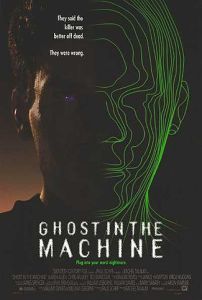
A Movie A Day #294: Ghost In the Machine (1993, directed by Rachel Talaly)


Karl (Ted Marcoux) is a serial killer who works in an electronics store and who steals address books and uses them to pick his victims.  His latest stolen address book belongs to Terry (Karen Allen).  Before Karl can start killing Terry’s family and friends, he is killed in a car accident.  Because there is a lightning storm going on at the same time, the dead Karl is able to transfer his evil soul into the electrical grid.  Traveling from appliance to appliance, Karl starts to kill all of Terry’s friends and co-workers.  A microwave oven.  A hand dryer.  A dishwasher.  If it is electrical, Karl can use it to kill.  Fortunately, Terry knows a legendary hacker (Chris Mulkey) who can help her fight back.
Like Prison, Destroyer, and The Horror Show, Ghost in the Machine is another dumb movie about a psycho who gets his soul transformed into electricity.  Ghost In The Machine was also obviously influenced by The Lawnmower Man and the entire movie is full of early 90s paranoia about the internet and computers in general.  Rachel Talaly, who got her start with the Nightmare on Elm Street franchise and who has recently directed some of the best received episodes of Doctor Who, does a good job with the deaths but cannot do anything with the lousy script and unlikable characters.  Nearly everyone who dies is killed because they know Terry but that never seems to bother her.

I think every 90s kid, or at least every 90s male, watched Ghost In The Machine on HBO and had a crush on Shevonne Durkin.

Horror Film Review: From Hell (dir by The Hughes Brothers)


Who was Jack the Ripper?

That’s a question that people have been asking for 129 years.  Arguably the world’s first famous serial killer, Jack the Ripper killed at least five prostitutes in the Whitechapel section of London.  Some claim that he killed as many as twenty.  He may have also written several taunting letters to the police.  Again, some say that the letters are authentic and some say that they were hoaxes.  Hell, there’s even some people who say that Jack the Ripper himself is a myth and the five murders attributed to him were actually five unconnected crimes.  It was speculated that Jack the Ripper was a butcher, a surgeon, or maybe a midwife.  Just as suddenly as the murders began, they ended.  The London police claimed that he had committed suicide by jumping into the Thames.  Few people believed them then and even less now.

The reason that there is so much uncertainty is because Jack the Ripper was never caught.  He was never identified.  There were stories of confessions, though many of them came from the mentally infirm or they were heard by someone who was a friend of someone who claimed to be the Butcher of Whitechapel.  At one point, there was even a claim that Jack’s diary had been found.

As a horror fan, a true crime fanatic, and a lover of history, I’ve read quite a few theories about who Jack the Ripper was.  Nearly every prominent (or, at the very least, remembered) Victorian has been accused of having been Jack the Ripper.  Oscar Wilde has been accused of hiding a confession in The Picture of Dorian Gray.  Various members of the Royal Family have been fingered as the culprit.  Even Lewis Carroll could not escape accusation.  The true crime author Patricia Cornwell wrote an entire book where she (wrongly) accused the painter Walter Sickert.  Cornwell’s case could basically be summed up as follows: “Walter Sicket’s paintings were weird.  Walter Sickert must be Jack the Ripper.”  Apparently, she managed to destroy one of Sickert’s paintings while looking for clues.

The truth of the matter is that Jack the Ripper was probably some guy who no one has ever heard of, most probably one of the unknown men who lived and worked in the shadows of Whitechapel.  For all the talk of Jack being a doctor, it can be argued that the surgical precision of his murders has been overstated.  He didn’t get away with murder because he was particularly clever.  Instead, he got away with it because, in 1888, even fingerprinting was considered to be a radical science.

But, honestly, that’s not very intriguing.  For those of us who have researched the case, it’s far more interesting to speculate that Jack the Ripper was either a famous person or that the murders were all the result of a huge conspiracy.

That’s certainly the appeal of From Hell, the 2001 film from The Hughes Brothers.  Making the same basic case as Bob Clark’s Murder By Decree, From Hell argues that the Jack the Ripper murders were the result of a royal conspiracy.  In reality, that theory has been discredited but it certainly is the most cinematic of all the possibilities.

And, speaking of cinematic, it must be said that From Hell is very stylish movie.  Though the title comes from one of Jack the Ripper’s letters, From Hell also could just as easily be used to describe the film’s vision of Whitechapel.  Whitechapel is full of shadows and secrets and the blood flows freely.  If Mary Kelly (Heather Graham) isn’t killed by Jack the Ripper, it’s just as likely she’ll be killed by one of her clients.  Even as the murders are committed, life and business in Whitechapel goes on.  What other choice is there?  It’s either risk being killed or starve.

It falls to Frederick Abberline (Johnny Depp) to solve the murders.  The real-life Abberline was an almost legendary detective who lived for decades after the final Jack the Ripper murder.  The movie’s Abberline is an opium addict who always seems to be on the verge of a breakdown.  When he and Mary Kelly fall in love, you’re not really sure if it’s something to be happy about.  Abberline seems just as likely to go crazy as everyone else.

From Hell is an uneven and somewhat overlong movie but I like it.  Heather Graham and Johnny Depp give somewhat odd performances but the oddness fits right in with the Hughes Brothers’s vision of a world that’s been turned permanently upside down.  It’s a movie that’s full of atmosphere and the story is intriguing even if it’s never exactly convincing.  For obvious reasons, I can’t reveal who plays Jack the Ripper but I will say that he gives a very good performance.  When he says that, “One day, men will look back and say that I gave birth to the 20th century,” you believe him.

Horror on the Lens: The Little Shop of Horrors (dir by Roger Corman)


(It’s tradition here at the Lens that, every October, we watch the original Little Shop of Horrors.  And always, I start things off by telling this story…)

Enter singing.

Little Shop…Little Shop of Horrors…Little Shop…Little Shop of Terrors…

Hi!  Good morning and Happy October the 29th!  For today’s plunge into the world of public domain horror films, I’d like to present you with a true classic.  From 1960, it’s the original Little Shop of Horrors!

When I was 19 years old, I was in a community theater production of the musical Little Shop of Horrors.  Though I think I would have made the perfect Audrey, everybody always snickered whenever I sang so I ended up as a part of “the ensemble.”  Being in the ensemble basically meant that I spent a lot of time dancing and showing off lots of cleavage.  And you know what?  The girl who did play Audrey was screechy, off-key, and annoying and after every show, all the old people in the audience always came back stage and ignored her and went straight over to me.  So there.

Anyway, during rehearsals, our director thought it would be so funny if we all watched the original film.  Now, I’m sorry to say, much like just about everyone else in the cast, this was my first exposure to the original and I even had to be told that the masochistic dentist patient was being played by Jack Nicholson.  However, I’m also very proud to say that — out of that entire cast — I’m the only one who understood that the zero-budget film I was watching was actually better than the big spectacle we were attempting to perform on stage.  Certainly, I understood the film better than that screechy little thing that was playing Audrey.

The first Little Shop of Horrors certainly isn’t scary and there’s nobody singing about somewhere that’s green (I always tear up when I hear that song, by the way).  However, it is a very, very funny film with the just the right amount of a dark streak to make it perfect Halloween viewing.

So, if you have 72 minutes to kill, check out the original and the best Little Shop of Horrors

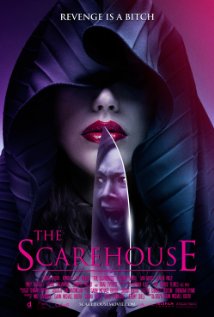
The TSL’s Horror Grindhouse: The Scarehouse (dir by Gavin Michael Booth)


One night, a college student named Brandon died.

While two sorority pledges painted his face and then posed for selfies with his unconscious body, Brandon choked to death on his own vomit.  The pledges were named Corey (Sarah Booth) and Elaina (Kimberly-Sue Murray) and when they were put on trial for manslaughter, they claimed that it was just a prank gone wrong and that the other members of the sorority put them up to it.  Of course, no one was willing to back up their stories.  Instead, the president of the sorority, Jacqueline Gill (Katherine Barrell), just went on television and said that she hoped the two would ask God for forgiveness.  Corey and Elaina were convicted and sent to prison.

Two years later, Corey and Elaina have been released and now they’re looking for revenge.  However, a simple revenge will not do.  Elaina is an engineering genius and Corey … well, Corey’s just really angry.  They’ve set up an elaborate haunted house and they’ve sent a private invite to each member of the sorority…

Two girls seeking revenge for a sorority prank gone wrong sound like either the set up for a Lifetime movie or the world’s worst Lime-a-rita commercial.  (“So, this happened: we thought we were going to a haunted house but then it turned out we were actually being invited to our violent doom.  Yep, it was a Lime-a-rita night.”)  However, The Scarehouse is neither.  Instead, it’s a rather grisly horror film with a streak of extremely dark humor.

But is it any good?

Let’s start with what works.  Both Sarah Booth and Kimberly-Sue Murray give very good performances as the two girls.  Even when the script lets them down, Booth and Murray keep the movie from dying.  The film actually does some interesting things with the two characters.  It keeps us guessing about which one of them is really the driving force behind the whole revenge plot.  No sooner do you think that you’ve figured out their power dynamic then something will happen or words will said that force you to reconsider what you previously assumed.

Though I had a hard time believing that such an elaborate death trap could have been designed by just two people, the haunted house was a memorable and creepy location.  It was full of atmosphere and the promise of doom.  If I ever found myself in there, I’d probably be scared.

Finally, you always have to admire a horror film that doesn’t shy away from pursuing things to their darkest conclusion.  Once one enters the Scarehouse, there is no escape and everyone’s worst nature will be exposed.  There is no exit and Hell is other people.

At the same time, I’ve grown tired of movies that feature lengthy scenes of people being tortured.  After nearly two decades of Saw films and Hostel rip-offs, whatever shock value those scenes may have once had are gone.  The tortures in The Scarehouse are elaborate and sadistic and thoroughly unpleasant to sit through.  A girl with an eating disorder has her corset tightened until she literally splits in half.  A forced pillow fight leads to corrosive chemicals eating away at flesh.  Some of it is clever but, far too often, these scenes go on too long.  There’s only so long you can spend watching someone being tortured until you mentally check out.

As well, The Scarehouse uses a nonlinear time line.  In between the scenes of Corey and Elaina getting their revenge, we see flashbacks to the prank that led to death of Brandon.  But, since we already know what happened because it’s all Corey and Elaina ever talk about, there’s not really anything new to be discovered in the flashbacks.

Obviously, my feelings about The Scarehouse are mixed.  I was pretty dismissive immediately after I watched it but the movie has definitely stuck with me.  It has its flaws but it also has two memorable and frightening performances.  Watch at your own discretion.


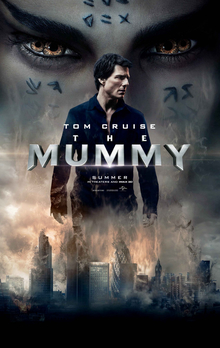
Horror Film Review: The Mummy (dir by Alex Kurtzman)


Oh, where to start?

The Mummy was promoted as being the first entry in Universal’s new Dark Universe, a shared cinematic universe that would supposedly do for the classic monsters what the MCU did for super heroes.  (Of course, horror fans with a good memory remember that Dracula Untold was originally supposed to be the first part of the Dark Universe franchise but, after that film bombed with both critics and audiences, Universal announced, “We were just kidding.  The Dark Universe starts with The Mummy.”)  The Mummy was released in June and it got absolutely decimated by critics.  That wasn’t too surprising.  One could tell from the commercials that, even with 2017 being a good year from horror, The Mummy was not going to be a critical favorite.  But then, audiences rejected it as well, throwing the whole future of the Dark Universe franchise into limbo.

To be honest, I think The Mummy could have been a fun little movie if it had only been 90 minutes long and hadn’t gotten bogged down with all that Dark Universe nonsense.  There are a few moments that actually do work, though they are few and far between.  The film stars Tom Cruise, who is a veteran at handling nonsense and who gives a somewhat lighter version of his standard Mission Impossible performance.  Jake Johnson shows up as a talking corpse and he has a way with a sarcastic line.  Some of the special effects are effective, though The Mummy is often far too dependent upon them.

The plot is damn near incoherent and it didn’t take long for me to give up on trying to follow it.  The film started with a bunch of crusaders moving in slow motion and then it jumped forward to modern-day Iraq, where Sgt. Nick (Cruise) and Cpl. Chris (Johnson) uncovered an ancient tomb.  Apparently, opening the tomb unleashes Princess Ahmanet (Sofia Boutella), who is thousands of years old and is still alive because she was cursed to be both immortal and buried alive.  So, now, she’s free and apparently, she wants Nick to merge with Set, the Egyptian god of all things evil.  But Nick doesn’t want to be evil.  He just wants to save the lives of Chris and Jenny (Annabelle Wallis), an archeologist who basically has the same role that Natalie Portman had in the first Thor film.

Meanwhile, Russell Crowe is wandering around as Dr. Jekyll.  This is where the whole Dark Universe things kicks.  Dr. Jekyll is in charge of this secret organization that keeps tabs on all the paranormal stuff that’s happening in the world.  However, if Dr. Jekyll doesn’t regularly get his injection, he turns into evil Mr. Hyde.  In this movie, that means that Crowe suddenly starts talking with a cockney accent.  I’m assuming that, much like Samuel L. Jackson did for the MCU, Russell Crowe is meant to link all of the Dark Universe films together.  Of course, the difference is that the early MCU films usually only had Jackson show up at the end of the movie, often in a post-credits scene.  Crowe, on the other hand, pops up out of nowhere, takes over a huge chunk of the film, and then vanishes.  I was already having enough trouble trying to keep up with the Mummy’s schemes without having to deal with a random Mr. Hyde sighting.

The Mummy is a mess.  When it starts, it’s a likable mess, with Cruise and Johnson exchanging silly lines.  But then the movie gets caught up in trying to launch a franchise and it all goes downhill from there.  There’s even a scene where Ahmanet stands in the middle of a London streets and starts throwing cars around.  It’s such an MCU scene that I was surprised Robert Downey, Jr. didn’t come flying by.  If The Mummy had just been a content to be a silly monster movie, it could have been fun.  But instead, The Mummy tried to launch an entire universe and it just wasn’t up to the task.

A Movie A Day #293: See No Evil (1971, directed by Richard Fleischer)


After a rain, a car drives through a puddle and splashes mud on a man’s designer boots.  The owner of the boots follows the car back to a country manor and murders everyone inside.  (Did he really kill everyone in the house because his boots get muddied?  It is never really clear.  Before his boots got splashed on, he was looking at violent comic books in a shop.  Maybe Wertham was right.)  Later, Sarah (Mia Farrow), the niece of the car’s driver, arrives at the house.  As the result of a recent horse riding accident, Sarah is blind.  She walks through the house, unaware that she is surrounded by dead bodies and unaware that the owner of the boots left behind a bracelet that he will soon be returning to retrieve.
Obviously inspired by Wait Until Dark, See No Evil is a well-done cat-and-mouse game between Sarah and her unseen stalker.  Mia Farrow is great as the blind woman and the scenes of her unknowingly walking past the dead bodies of her family while being followed are tense and suspenseful.  See No Evil has been overshadowed by Farrow’s other two horror films, Rosemary’s Baby and Full Circle, but it is definitely worth a look.

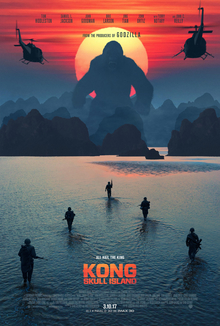
A Halloween Film Review: Kong: Skull Island (dir by Jordan Vogt-Roberts)


You may have noticed that, in the title of this post, I specifically referred to Kong: Skull Island as being a Halloween film but not a horror film.

That was very much intentional on my part.  Kong: Skull Island is really not a horror film.  (I think you could argue that the only King Kong film that can legitimately be considered a horror film would be Peter Jackson’s version and that’s just because he tossed in a few scenes that were obviously inspired by the old Italian cannibal films.)  I watched Kong: Skull Island a few months ago and I really can’t say that there was ever a moment where I was scared or even uneasy.  It’s just not that type of film.

At the same time, it is a fantastically fun and entertaining monster movie, one that has a good sense of humor about its own absurdity.  Halloween is not just a time to get scared.  It’s also a time to have fun and, for that reason, Kong: Skull Island is a perfect movie for October.  In fact, I think that it was actually a mistake for Warner Bros. to release the film in March.  They should have released it during the first weekend of October.  It could have provided a counterbalance to all of the depressing films that have been released this month,

Kong: Skull Island is a throwback to the gleefully absurd monster movies of the past.  Just so we don’t miss that point, the film starts with a 1944 prologue before then jumping forward to 1973.  (Significantly, not a single scene takes place in the 21st Century.)  Samuel L. Jackson plays Lt. Col. Preston Packard, the tough, no-nonsense commander of the Sky Devils helicopter squadron.  The Sky Devils are finally on the verge of leaving Vietnam but they’ve been asked to carry out on more mission.  They’ve been asked to fly an expedition over a newly discovered island.  The official story is that they’re going to be mapping the island but everyone knows better than to trust the government.

Kong: Skull Island is very well-cast, which is a good thing because the majority of the characters are thinly written.  Among the civilians in the helicopters: Tom Hiddleston, Brie Larson, and John Goodman.  Of course, they’re all playing characters but, for the most part, you’ll spend the entire movie thinking of them as being Tom Hiddleston, Brie Larson, and John Goodman.  For that matter, you never think of Samuel L. Jackson as being Preston Packard.  He simply is Samuel L. Jackson.  When they eventually discover a castaway living on the island, it doesn’t matter that the man’s “name” is supposedly Hank Marlow.  He’s played by john C. Reilly and that’s who you’ll always think of him as being.   They’re all charismatic actors so you certainly don’t mind watching them but, at the same time, the film understands that the main reason we’re all here is to see the giant gorilla.

To the film’s credit, it doesn’t take long for King Kong to show up.  This is not one of those films where things are dragged out in an unnecessary attempt to create suspense.  (After all, the audience already knows that King Kong’s on the island.)  Almost as soon as the helicopters breach the airspace over Skull Island, Kong shows up and starts knocking them out of the sky.  The survivors end up stranded on different parts of the island.

Of course, it’s not just Kong that they have to worry about.  In fact, from the start, the audience is smart enough to know that Kong is actually one of the good monsters.  However, Skull Island is also inhabited by bad monsters, like these giant reptiles that Kong keeps having to fight.

Early on, there’s a scene in America where, in regards to the Watergate scandal, John Goodman says that Washington, D.C. is never going to be more screwed up than it is at that moment.  That line pretty much epitomizes Kong: Skull Island.  It’s a lark with a knowing sense of humor and it is not meant to be taken at all seriously.  At it’s best, Kong: Skull Island satirizes some of the most pompous monster movies of the past.  Whenever someone says something portentous, you can be sure that the film will quickly find a way to puncture the somber mood.

And it’s all terrifically entertaining.  Watch, enjoy, and don’t worry too much about whether or not any of it makes sense.  A trip to Skull Island is a trip worth taking.