Film Review: Mr. Mean (dir by Fred Williamson)


In the 1977 film, Mr. Mean, Fred Williamson plays the title role.

He’s a former employee of the Cosa Nostra who now works as a sort of private investigator.  He’s cool.  He’s hip.  He’s sexy.  He’s Fred Williamson!  But the best thing about him is that his name actually is Mr. Mean.  Everyone in the film literally calls him “Mr. Mean.”  He introduces himself as being “Mr. Mean.”  The people who are closest to him occasionally leave out the “Mister” and just call him “Mean.”

The film begins with a woman approaching Fred Williamson on a basketball court and saying to him, “Hey, is your name Mr. Mean?”

Later, when he calls his office to check his messages, he tells his secretary, “This is Mr. Mean.”

When he goes to his favorite bar, he’s approached by two members of Ohio Players, the band behind Fire and Love Rollercoaster.  They tell him that they are such big fans of him and his reputation that they’ve actually written a song about him.  The song is called “Mr. Mean.”  They proceed to play the song over the opening credits.  For his part, Mr. Mean does not appear to be impressed.  That said, I imagine the Ohio Players were probably happier to be playing for Mr. Mean and than for the Brady Bunch.

Mr. Mean is summoned to Italy by a mob boss who wants Mr. Mean to do one last job.  He wants Mr. Mean to assassinate a rival gangster, Huberto (Lou Castel).  Mr. Mean explains that he may be a fighter and lover but he’s not a killer.  However, Mr. Mean then learns that Huberto has been running a scam charity, stealing money that people are donating to help fight hunger in Africa.  Mr. Mean takes on the contract.  However, Huberto knows that Mr. Mean is in Italy to take him out so Huberto hires an assassin named Rommell (Raimund Harmstorf) to take out Mr. Mean first.

Judging from the endless shots of Mr. Mean casually walking through Rome, it doesn’t appear that either man is in much of a hurry to get the job done.  Mr. Mean even takes time to pursue a romance with the mysterious Rene (Crippy Yocard).  What little action there is comes to a complete halt so the film can give us a lengthy scene of Mr. Mean and Rene walking along the beach.  Eventually, it turns out that Rene has a secret of her own and, for a few minutes, it seems like Mr. Mean might become yet another Fred Williamson film to feature a sudden downbeat finale.  But no worries!  Mr. Mean may be mean but he’s also clever!

(Actually, Mr. Mean turns out to be a surprisingly nice guy so I’m not really sure how he got that nickname.)

The film’s plot is next to impossible to really summarize because the plot doesn’t make any sense.  The story feels like it was made up on the spot, probably because it was.  Reportedly, Fred Williamson shot this film while he was in Italy to make Inglorious Bastards.  He would spend the week working on Bastards and then, on the weekend, he would borrow the film’s equipment and crew and secretly work on Mr. Mean.  He wrote the script while filming.  The result is a film that meanders without adding up to much.  The main theme of Mr. Mean appears to be that Fred Williamson was Fred Williamson’s biggest fan.

Mr. Mean is one of Fred Williamson’s lesser films.  Though he didn’t necessarily have a wide range as an actor, Fred Williamson had charisma and a lot of style and confidence.  All of that is on display in Mr. Mean but the film itself is impossible to follow and ultimately just feels like an extended home movie.  Mr. Mean just isn’t mean enough to be memorable.
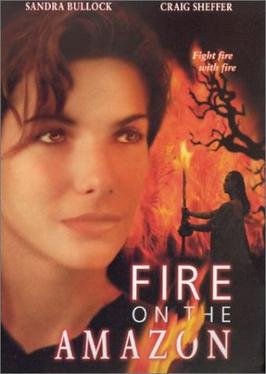
Film Review: Fire on the Amazon (dir by Luis Llosa)


Released in 1993 and produced by none other than Roger Corman, Fire on the Amazon takes place in Bolivia.  Despite the protests of the indigenous population and the environmental activists who have flown down to support them, the Rain Forest is being destroyed by corporations, cattle ranchers, and military units.  After an activist named Rafael Santos (Eduardo Cesti) is assassinated, photojournalist R.J. O’Brien (Craig Sheffer) comes down to document the accused assassin’s trial.

R.J. tries to remain detached from the injustices that he sees around him.  Much like Robert Forster in Medium Cool, R.J. claims to be an observer and not a participant.  But then he meets an environmentalist named Alyssa Rothman (a pre-stardom Sandra Bullock) and he comes to realize that the Bolivian government is covering up the details of Santos’s death.  R.J. and Alyssa go deep into the Rain Forest, searching for evidence that can prove that the military was behind the assassination.  The military, of course, is determined to keep them from doing that.

Fire on the Amazon is a Roger Corman films with a social conscience.  It features several speeches about the importance of the Rain Forest and it ends with a title card informing viewers of how much of the Rain Forest was destroyed on a daily basis in 1993.  Whatever else one might have to say about the films that Corman has either produced or directed, he has always seemed very sincere when it comes to his messages.  That said, Corman has also always been very sincere in his belief that movies should make money and Fire on the Amazon doesn’t allow its environmental message to get in the way of the sex and violence that most of the film’s viewers were probably looking for.  The film actually feels a bit like a companion piece to The Forbidden Dance.  Yes, saving the Rain Forest is importance but so is doing the Lambada.

Today, if Fire on the Amazon is known for anything, it’s probably for the rather random sex scene featuring Sandra Bullock and Craig Sheffer.  To be honest, while the scene is graphic and lengthy, the only thing that sets it apart from other low-budget sex scenes is the fact that it features a future Oscar winner.  A huge problem with the scene is that there are next to no romantic sparks between Bullock and Craig Sheffer.  Indeed, Sheffer gives such a lifeless performance that, at one point, it appears that he’s actually fallen asleep during the big sex scene.  Fortunately, Sheffer sticks out his tongue long enough to let us know that he’s still alive.

Make no mistake about it, while Sandra Bullock may be the name that’s highlighted whenever this film shows up on a streaming site, Craig Sheffer is the star of the film.  The majority of the film focuses on him as he wanders around Bolivia and whines about having to do his job.  Though he’s certainly not helped by the film’s script, Sheffer gives a performance that alternates between sleep-walking and histrionic shouting.  The problem is that the only time Sheffer shows any emotion is when his character has been inconvenienced.  He can watch the police beat up a man without barely lifting an eyebrow but, as soon as he’s arrested and put in a cell, the audience is subjected to over a minute of Sheffer shrilly screaming, “Call the embassy!”

It would be nice to say that Sandra Bullock gives a performance that transcends the material but, unfortunately, she’s miscast as a somber activist and, worst of all, she gets stuck with the film’s worst line when she tells Sheffer to write about what “you feel and not what you see.”  It seems like better advice would be to do both but what do I know?  I mean, as of right now, it seems like people focusing on what they feel as opposed to what they see has led to a lot of problems but maybe the 90s were a simpler time.

Just a year after this film was released, Sandra Bullock would star in Speed and become a star.  This meant that Bullock would no longer be filming sex scenes in Roger Corman-produced eco-thrillers.  It also meant that Fire on the Amazon would forever be promoted on DVD and Blu-ray as being a “Sandra Bullock film” while Craig Sheffer would often go unmentioned.  (In Sheffer’s defense, he’s still acting and has given many performances that are a hundred times better than his work in Fire on the Amazon.)  If you want to see a good film about Sandra Bullock in the jungle, check out The Lost City.  If you want to see an entertaining environmentally-themed thriller from director Luis Llosa, check out Anaconda.  Worthy intentions aside, Fire on the Amazon is best avoided.

Film Review: The Mad Bomber (dir by Bert I. Gordon)


Haunted by the death of his teenage daughter and the subsequent collapse of his marriage, William Dorn (Chuck Conners) feels that society is changing too quickly.  He misses the days when people were polite and followed the law.  Now, he’s upset that he can’t even walk around Los Angeles without seeing people littering.  The waitress at the local diner has forgotten the importance of smiling while taking her customer’s order.  Hospitals are full of doctors who don’t care about their patients.  The colleges are full of long-haired drug pushers.  His ex-wife is attending a consciousness raising seminar.  William has had it with the 1970s so he decides to start blowing stuff up.

William starts to wander around Los Angeles.  Usually, he’s carrying a brown paper sack and, inside the sack, he’s got a ticking time bomb.  He always wears the same suit and thick glasses and yet, somehow, no one ever seems to notice or remember him.  Even though all of his bombs are timebombs, they still go off within seconds of him planting them, which means that he’s usually only standing a few feet away with they explode.  William also sends the police tape-recorded manifestos without making any effort to disguise his voice.  William may not be the smartest criminal around but that still doesn’t stop him from terrorizing the city.

Detective Geronimo Minelli (Vince Edwards) is determined to track down the mad bomber, even if it means yelling at everyone that he meets.  Minelli is one of those intense detectives who doesn’t care about what the Supreme Court has to say about the rights of suspects and the accused.  Unfortunately, the only witness who can identify the bomb is George Fromley (Neville Brand), a sex offender who doesn’t want to admit that he saw the bomber blow up a hospital because he was busy assaulting one of the patients at the time.  Can Minelli convince Fromley to provide a physical description of the bomber?  And will William Dorn ever realize that it’s probably not a good idea to store a bunch of ticking time bombs in his basement?

First released in 1972 and also known as The Police Connection, Bert I. Gordon’s The Mad Bomber is unique amongst Gordon’s films in that it doesn’t feature any giant animals or killer bugs.  In this film, the monsters are all human and don’t have any convenient excuses for their behavior.  Though Neville Brand does a good job with the role, George Fromley is still probably one of the most unlikable and despicable characters to ever appear in the movie.  Meanwhile. Vince Edwards plays Minelli as being the type of cop who is one bad day away from massively violating someone’s civil rights during a traffic stop.  The film does build up some sympathy for William Dorn, with still shots of his daughter used to show us what’s going through Dorn’s mind as he plants his bombs.  But then it tosses all that sympathy away by having him target a meeting of feminists, apparently because he blames them for his wife leaving him.

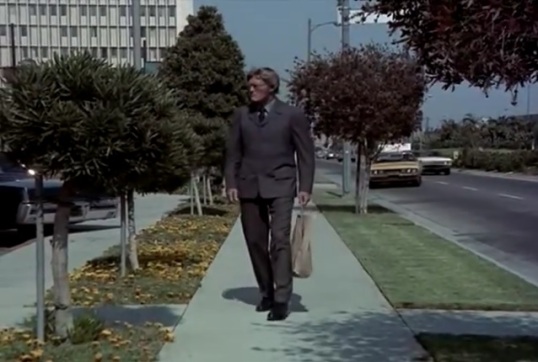
The main problem with the film is that we’re expected to believe that someone who looks like this would be able to walk around Los Angeles and plant bombs without anyone noticing.

That’s nothing against Chuck Conners, who does a good job of portraying William’s frustration with the world.  But still, it’s hard to believe that no one is going to notice a dude who is nearly seven feet tall and who is carrying a ticking shopping bag.

Flaws and all, The Mad Bomber is a watchable and occasionally even an engrossing film.  It’s certainly one Gordon’s better efforts and Gordon does a good job of creating and maintaining a properly ominous atmosphere, even if it sometimes hard to take seriously the sight of Chuck Conners, lumbering around in his suit and trying to discreetly drop off bombs.  In many ways, it’s a film that still feels relevant today. William, like so many. is trying to forcefully stop the world from changing around him.  He’s a man who has lost anything and has decided that it’s the fault of everyone else.  (In many ways, he’s like Rainn Wilson in Super, ragefully reacting to a world is not as simple as he believes it should be.)  The Mad Bomber may not be as much fun as Gordon’s giant monster films but it’s still a film that has something to say.

Film Review: The Black Godfather (dir by John Evans)


The 1974 film, The Black Godfather, opens with two black men attempting to break into the house of a white drug dealer.  Unfortunately, the drug dealer happens to be home.  Both of the men are shot.  One dies in the alley.  The other, J.J. (Rod Perry), is shot in the arm but survives.

J.J. may not have been able to rob the dealer but his bravery impresses Nate Williams (Jimmy Whitherspoon), a powerful neighborhood crime lord.  Nate allows J.J. to hide out at his place and, while J.J. heals, Nate offers up some advice on how to survive on the streets.  J.J. says that he’s only interested in making some “bread,” but Nate thinks that J.J. has what it takes to become one of the top men in his organization.

One opening credits montage later and J.J. has indeed become a powerful man on the streets.  Though he may sell drugs, J.J. is a gangster with a conscience.  As he explains to his old friend, Diablo (Damu King), there’s no way to create change unless you make some money beforehand.  Diablo is a political militant who has no interest in working with J.J. until he discovers that J.J. is planning on running Tony (Don Chastain) out of the neighborhood.  Tony is a white gangster who has made a fortune by destroying black communities with heroin.  Diablo and his followers become J.J.’s enforcers as he wages war against Tony.

Unfortunately, the always pragmatic Nate doesn’t want J.J. to wage war against Tony.  Nate believes that it is important to keep the peace.  That Nate is tying to prevent a war doesn’t matter to Tony, of course.  As soon as Tony finds out that J.J. has been seeing Nate’s daughter, Yvonne (Diane Sommerfeld), he makes his move.

Made at the height of the Blaxploitation era, The Black Godfather‘s title brings to mind memories of Don Corleone, Michael, Sonny, and Tom Hagen.  And it is true that the wise and patient Nate does, in many ways, come across like a black version of Don Corleone.  Nate is pragmatic and cautious almost to a fault.  Just as Don Corleone resisted going to the war with the Tattaglias, Nate resists going to war with Tony.  (And, much like the Tattaglias, Tony proves himself to be unworthy of Nate’s generosity.)  However, J.J. has far more in common with Sonny than with Michael.  Unlike the  calculating and patient Michael, J.J. is in a hurry to prove that he’s the most powerful gangster in the community.  Like Sonny, J.J. doesn’t hesitate before striking back at his enemies.

Unfortunately, despite having an intriguing premise, The Black Godfather is a bit of a chore to sit through.  The story moves slowly and even the scenes of gangster violence feel rather rudimentary.  Rod Perry projects a confident charisma and Jimmy Witherspoon does a good job as the wise Nate but otherwise, the cast is stiff and unconvincing.  It’s a shame.  The mix of crime and militant politics had potential.  Early on, Diablo and J.J. debate whether or not good can come out of bad, with J.J. arguing that money can get a lot more done than idealism.  It’s a debate that’s still relevant today but it’s also an issue that the film abandons fairly quickly.  Based on the film’s title, I had some hope for The Black Godfather but, in the end, it’s just too slow and amateurish to really be memorable.

Retro Television Review: Roll, Freddy, Roll (Dir by Bill Persky)


Welcome to Retro Television Reviews, a feature where we review some of our favorite and least favorite shows of the past!  On Sundays, I will be reviewing the made-for-television movies that used to be a primetime mainstay.  Today’s film is 1974’s Roll, Freddy, Roll!  It  can be viewed on YouTube!

Poor Freddy Menlo!

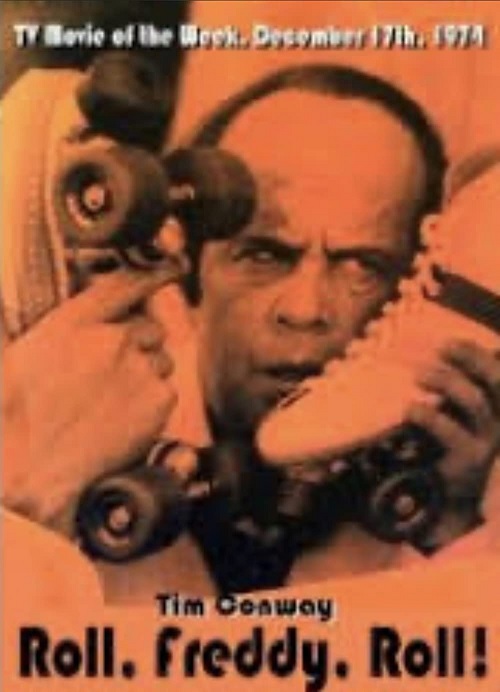
Played by Tim Conway, Freddy is a well-meaning guy who gets absolutely zero respect from the rest of the world.  He works as a computer programmer but his boss (Henry Jones) doesn’t think much of him and an attempt to score a contract with the U.S. Navy falls through when Admiral Norton (Scott Brady) announces that he doesn’t think much of computers.  Meanwhile, his ex-wife (Ruta Lee) has fallen in love with and married “Big Sid” Kane (Jan Murray).  Big Sid is a millionaire who made his fortune selling used cars.  Big Sid is seen every day on television.  And, due to catching the biggest bluefish tuna on record while on his honeymoon, Big Sid Kane is now in the Guinness Book of the World Records.

A lesser engineer would crack under the pressure and go on a rampage through Los Angeles, Falling Down-style.  But Freddy just wants to be a good father.  He just wants his son, Tommy (Moosie Drier), to look up to him the way that he now looks up to Big Sid.  Freddy takes Tommy to a roller skating rink and awkwardly skates around while Tommy talks about how much he enjoys going to Big Sid’s car lot.  When it’s time to leave the rink, Freddy is informed that his shoes have been lost.  An angry Freddy refuses to return the rink’s skates until he gets back his shoes.  Freddy then takes Tommy down to Big Sid’s used car lot, where Big Sid has invited other people to come and try to set world records of their own.  A local news reporter sees that Freddy is on roller skates and announces that Freddy is seeking to set the world record for the most time spent rolling around!  Finally, Freddy has found a way to impress his son!

Excuse me while I catch my breath.  That was a lot of plot to cram into just two paragraphs.

Roll, Freddy, Roll is not a particularly complicated movie.  For the most part, it exists solely so that Tim Conway can do some mild physical comedy while trying to balance himself on roller skates.  It only has a 73-minute run time and it basically feels like an extended episode of an old sitcom.  With all that in mind, it still seems like it takes forever to actually get Freddy into those roller skates and once he does put them on, the movie keeps up coming with implausible excuses to keep him from taking them off until he finally decides to go for the world record.  The story would have been stronger if Freddy has been the one to look at his feet and say, “I’m going to set a world record,” as opposed to him just being bullied into it by a news reporter.  Tim Conway’s likable but there’s only so many times you can watch someone fall on roller skates before the joke starts to wear thin.

It would not surprise me if Roll, Freddy, Roll was meant to be a pilot for a sitcom.  It’s easy to imagine Tim Conway trying to impress his son and win back his wife by doing something stupid on a weekly basis.  As far as I know, Roll, Freddy, Roll did not lead to a television series and that’s probably a good thing.  Freddy had a hard enough time just rolling around Los Angeles for two days!  Who knows what would have happened if he had tried to do it on a weekly basis!?

Retro Television Reviews: The Day The Earth Moved (dir by Robert Michael Lewis)


Welcome to Retro Television Reviews, a feature where we review some of our favorite and least favorite shows of the past!  On Sundays, I will be reviewing the made-for-television movies that used to be a primetime mainstay.  Today’s film is 1974’s The Day The Earth Moved!  It  can be viewed on YouTube!

Sitting in the middle of the Nevada desert, there’s a town called Bates.

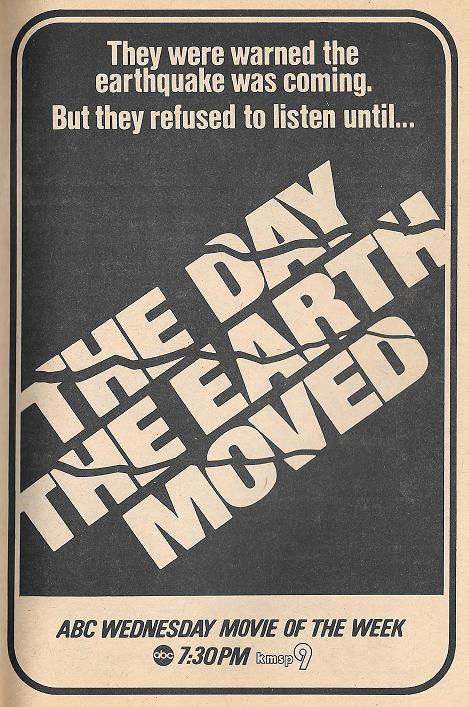
Bates was once a thriving community but the years and the hot Nevada winds have not been kind to it.  Now, it consists of only a  few buildings and a speed trap.  Judge Tom Backsler (William Windom) is the most powerful man in this tiny community and he’s determined to return Bates to its former glory.  His plan is to open up a Christmas park and to remake Bates as “Santa Claus’s home away from the North Pole.”  In order to raise the money for that project, he and the police run an aggressive speed trap.  When pilot and photographer Steve Barker (Jackie Cooper) is caught in the speed trap, it turns out that he doesn’t have enough money to pay his fine.  So, his car is impounded and he’s put to work, sweeping up the dust and helping to get the Christmas park ready to open.

With the help of friendly little townsgirl, Steve is finally able to escape from Bates and return to his job.  He works with his wife, Kate (Stella Stevens), and his best friend, Harley (Cleavon Little), as surveyors.  When someone wants to buy a stretch of the Nevada desert, Steve and Harley fly over the land and take pictures.  Looking over the latest batch of pictures, Steve deduces that not only is there going to be an earthquake but it’s going to destroy the town of Bates!  Can Steve return to the town that once held him prisoner and convince the townspeople to leave with him before disaster hits!?

In many ways, The Day The Earth Moved is a standard made-for-TV disaster flick.  Only Steve and Kate realize what’s about to happen and they struggle to get anyone else to believe them.  Indeed, it seems like the world is almost conspiring to keep them from warning everyone about the incoming earthquake.  The film’s story checks off all of the expected disaster movie plot points.  That said, the town of Bates itself — with its gigantic Santa Claus standing in the middle of the desert — is a nicely surreal location and the repeated shots of a deserted farm being gradually destroyed by minor tremors achieve a certain ominous grandeur.  Jackie Cooper and Stella Stevens are believable as a husband and wife who love each other despite the fact that they’re often very annoyed with each other.  To the film’s credit, William Windom’s character is not portrayed as being a cardboard villain but instead as someone who simply wants to give his neighbors some place decent to live.  The Day The Earth Moved is predictable but well-done.

Of course, the main reason anyone will have to watch this film will be for the earthquake.  Unfortunately, this is where viewers will run into a common problem that has afflicted many made-for-TV movies.  The low-budget earthquake is just not that impressive.  For all the scenes of people yelling, it’s always pretty obvious that the camera is doing most of the shaking.  But you know what?  It’s a made-for-TV movie from 1974.  Cut it some slack and just go with it.

Retro Television Reviews: Linda (dir by Jack Smight)


Welcome to Retro Television Reviews, a feature where we review some of our favorite and least favorite shows of the past!  On Sundays, I will be reviewing the made-for-television movies that used to be a primetime mainstay.  Today’s film is 1973’s Linda!  It  can be viewed on YouTube!

If nothing else, Linda has a wonderfully opening.

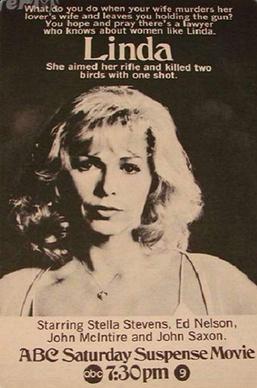
Two couples are on the beach.  Paul Reston (Ed Nelson) is talking to Anne Braden (Mary-Robin Redd) about his troubled marriage and his plans to leave his wife.  Paul’s wife, Linda (Stella Stevens), is talking to Jeff Braden (John Saxon) and looking at the rifle that he’s just handed her.  It doesn’t take long to notice that Paul and Linda seem to be closer, respectively, to Anne and Jeff than to each other.

When Anne stands up and walks toward the ocean, Linda shoots her in the back.  When Jeff runs over to Anne’s body, Linda pulls the trigger again and Jeff collapses.  Stunned by his wife’s actions, Paul runs back to his car and drives into town to get the police.  (This is another one of those movies that could have only been made in the pre-smartphone era.)  When Paul and the police return, they find Anne’s body but Jeff and Linda are nowhere to be seen.

Suddenly, Linda and Jeff come walking down the beach.  Jeff is carrying a bunch of fish and a fishing pole.  They look shocked when they see the police.  Then, when Jeff sees Anne’s body, he accuses Paul of killing her and attacks him.  Paul is arrested and taken to jail.

As I said, it’s a wonderful opening, full of twists and entertaining overemoting.  In fact, it’s so good that it’s difficult for the rest of the film to keep up.  After being charged with Anne’s murder, Paul hires a folksy attorney named Marshall Journeyman (John McIntire).  Unlike everyone else, Journeyman believes Paul’s story that he’s being framed by Jeff and Linda.  Journeyman sets out to prove that Paul is innocent.

Of course, the audience already know that Paul is innocent because the audience saw exactly what happened.  Watching the film, it was hard for me to not to feel that the story would have benefitted by a little more ambiguity as to whether or not Paul was a victim or if he truly was the delusional madman that both Linda and Jeff tried to paint him as being.  We know from the start what Jeff and Linda are doing so the only question really becomes how Journeyman is going to trick them into revealing the truth.  Unfortunately, even getting them to do that turns out to be a bit too easy.  The movie suggests that Journeyman is a brilliant investigator but, in the end, it all really just comes down to the villains not being very smart.

That said, the film’s cast does a good job.  Ed Nelson is sympathetic as the confused husband and John McIntire brings so much homespun charm to Journeyman that I got the feeling that this film was probably designed to be a pilot for a possible series.  Best of all, John Saxon and Stella Stevens play the scheming couple.  Saxon gets to wear a swimsuit and dramatically shout to the Heavens as he pretends to be shocked over Anne’s murder.  Stevens smirks at every question and accusation and appears to be having a great time playing an old school femme fatale.  The cast makes this movie worth it.

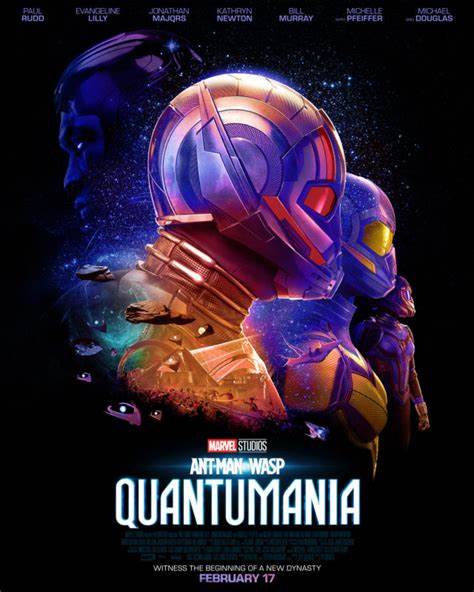
Film Review: Ant-Man and the Wasp: Quantumania (dir. by Peyton Reed)


I once read somewhere that in joining Marvel Comics, you could never get started writing or drawing any of the top tier characters like Spider-Man or any of the X-Men. Instead, you were left to work with some of the lesser known (or less famous) characters like the The Fantastic Four, Moon Knight or Namor and then work your way up to the big wigs. I don’t know if that’s true, but after having completed both Avengers: Infinity War and Avengers: Endgame, the MCU feels like it’s in the same position for me. Most of the S and A-Tier level heroes and villains were used in some way. Even their B-Class characters are in play (like who was the Multitude of Madness‘ Black Bolt, anyway?), so all they really have left are characters only the deepest comic fans know. It might be great for the movie fans who are just learning about them all (like myself, who primarily danced in the Spider-Man circles), but I wonder about the comic book fans and whether it’s all still holding up for them.

All that aside, it’s still better than getting a reboot of the same two or three heroes we keep getting over at DC – though they are learning. I’ll give Disney/Marvel credit for the attempt. I’m still waiting for DC to give either Green Arrow a try on film or Green Lantern another chance.

Ant-Man and the Wasp: Quantumania (or just Quantumania) finds Scott Lang (Paul Rudd) enjoying his life after the events of Avengers: Endgame. He’s a best selling author now, a welcome change from being unknown in Avengers: Endgame. He has a wonderful family in Hope Van Dyne (Evangelline Lilly), along with her parents, Hank Pym (Michael Douglas) & Janet Van Dyne (Michelle Pfeiffer). If only his daughter Cassie (Kathryn Newton, taking over for Endgame‘s Emma Fuhrmann) wasn’t getting into trouble all the time, things might just be perfect.

Cassie explains to Scott that with her free time, she’s been studying the Quantum Realm and managed to create a device that can track objects within it. At hearing this, Janet balks and demands Cassie shut down the device. This leads to a malfunction that pulls the entire family in to the Quantum Realm. The realm is full of life, much like the alternate dimensions that Doctor Strange has travelled. There is also a great evil dwelling in Kang (Jonathan Majors, Creed III), who hopes to escape. Can the family find a way back home, while dodging the threats that lie within?

The acting in Quantumania is fine. We’re introduced to some interesting supporting characters with William Jackson Harper (Midsommar) and Katy O’Brian’s (Syfy’s ZNation) performances. We’re also reunited with some familiar faces. Paul Rudd is charming and funny as always, as is Evangelline Lilly. Although we won’t get to know how Emma Fuhrmann would have done as Cassie this time, Kathryn Newton’s good here. It’s Marvel, I get it. Recasts can and do happen. We could argue that we’re a bit out of touch with this new casting, butCassie is given a lot to do in this installment, which really brings her full circle with some of the conversations she had with Scott, pre-Blip and all.

They all take a bit of a back seat to Michelle Pfeiffer, however. Janet Van Dyne is tight-lipped about the Quantum Realm, and Pfeiffer carries her experience there flawlessly. Her character is scared at the thought of returning, but once she arrives, Janet has layers of secrets that peel back. She and Kang were the most interesting characters of the group. There’s almost a covert agent quality to Janet, and I wouldn’t mind seeing a backstory of more of her adventures. An animated Adventures of The Wasp in the Quantum Realm, Disney?

And then there’s Jonathan Majors. You can’t have a good hero without a good villain, and his portrayal of Kang is scary. Anyone who watched Da 5 Bloods, The Harder They Fall or HBO’s Lovecraft Country knows that Majors can easily shift between quiet and reserved to explosive. He’s also physical enough to back his character’s words. I’m not entirely convinced of Kang’s motives for doing what he’s doing, but Majors’ presence is definitely felt when he’s in a scene.

Quantumania is basically 2010’s Tron: Legacy with a fresh coat of paint. Family gets pulled into another realm. Said realm is ruled by a major villain who wishes to spread their evil outside of the realm. Family must find a way to escape realm, yet ensure that the villain doesn’t get out as well. Quantumania‘s execution of the plan is far better than Tron‘s and I found myself truly worrying about the fates of the Lang/Van Dyne family in some of the scenes. I have to give a bit of kudos to whoever had the idea to have “the little guy” in Ant-Man be the first to square off with such a villain like Kang. For me, the end result was the opposite of watching the Hulk’s first interaction with Thanos. Back then, audiences may have thought that if the Hulk was dispatched so easily, what would that say for everyone else? In Quantumania, Scott and Hope give it their all, despite only really having their wits, fists, family & science. It was a bit more rewarding for me. There’s also something of a heist element to Quantumania, but it’s unfortunately weaker than the first two films. I would have loved to see a plan/info gathering/execution chapter to it all, but it never gets there.

Musically speaking, it’s nice to have Christophe Beck back on board for another installment. He’s taken the Ant-Man theme to new heights and the music throughout fits the film well. While there aren’t any standout songs like “Anthropodie” on the last film, the score overall turns a simple heist theme into an epic fight of good vs. evil.

Although the 3D in the film is nice, it’s not really required. For me, the effect faded after a while, only to resurface in key sequences. That could be mostly my fault for sitting in the front row, or perhaps the Avatar films have spoiled me. There’s a lot of CGI at work with the Quantum Zone, and I thought they did okay with it, for the most part. There’s nothing to complain about. Then again, we’ve kind of seen it before in every other multiverse story leading up to this.

Overall, Quantumania is a fun ride into the Quantum Zone. We’re given a chance to see Janet Van Dyne shine in her element. Every member of the entire Ant-Man family has something to offer (even Michael Douglas, who is smooth with the one liners), and it wasn’t particularly bad, as third films go.

Retro Television Reviews: The Tower (dir by Richard Kletter)


Welcome to Retro Television Reviews, a feature where we review some of our favorite and least favorite shows of the past!  On Sundays, I will be reviewing the made-for-television movies that used to be a primetime mainstay.  Today’s film is 1993’s The Tower!  It  can be viewed on YouTube!

The plot of 1993’s The Tower could probably best be described as, “Paul Reiser gets a job and gets everyone killed.”

Technically, Paul Reiser is playing Tony Minot, a guy who would rather spend his time in his apartment, composing new age synthesizer anthems and eating left over pizza, than actually go to work. But make no mistake about it. Tony is basically Paul Reiser, all the way down to the neurotic mannerisms and the bad jokes.

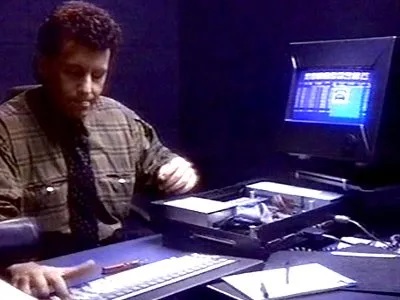
Anyway, through the help of an old friend, Tony has gotten a job. He’s going to be working in a state-of-the-art tower, one that is totally run by a computer system known as CAS. CAS is designed to eliminate any and all security threats. For instance, when an unauthorized pigeon lands on the tower’s roof, it doesn’t take long for CAS to reduce that pigeon to a bunch of floating feathers. Tony has been told that it’s very important that 1) he have his security card with him at all times and 2) that he not damage his security card in any way.

So, of course, Tony damages his security card.

With the help of a security guard, Tony still manages to get inside the tower but, since his card doesn’t work, CAS considers Tony to be a security risk. When Tony proceeds to casually violate several security rules and stays in the building after hours, CAS decides to destroy him. Unfortunately, since Tony is kind of needy and always has to have people around him, everyone else in the building ends up getting killed too.

(This is a 1993 film and it was made for television so none of the kills are especially interesting. One guy gets caught in the closing doors of an elevator. Someone else gets trapped in an overheated sauna.)

The majority of the film deals with Tony crawling around the building, just like Bruce Willis in Die Hard. CAS is determined to kill both him and his potential love interest. We’re supposed to be angry at CAS and concerned about the world’s dependence on technology but you know what?

THIS IS ALL TONY’S FAULT!

Seriously, if Tony hadn’t damaged his card, none of this would have happened. Tony was specifically told not to damage his card but obviously, it didn’t occur to him that maybe he should try to follow the rules of his new workplace during his first day on the job!

The Tower is very much a film of its time. That’s obvious just from the cartoonish CGI and the fact that someone thought casting Paul Reiser as a Die Hard-style action hero was a good idea. Beyond that, it’s a film that’s very concerned about the rise of computers and technology. In 1993, I’m sure audiences were like, “OH MY GOD! COMPUTERS CAN’T BE REASONED WITH!” but, when I watched the film last night, I was just like, “So, they don’t have voice or facial recognition? What type of company is this?”

Anyway, The Tower is not exactly a good movie but it’s oddly watchable. Maybe it’s just because of how strange it is to see Paul Reiser doing the whole Die Hard thing. (Before anyone asks, The Tower was not meant to be a spoof. In fact, it takes itself pretty seriously.) Or maybe it’s just the fact that, by the end of the movie, you’ll totally be on the Tower’s side.

Go, CAS, go!

Retro Television Reviews: Haunts of the Very Rich (dir by Paul Wendkos)


Welcome to Retro Television Reviews, a feature where we review some of our favorite and least favorite shows of the past!  On Sundays, I will be reviewing the made-for-television movies that used to be a primetime mainstay.  Today’s film is 1972’s Haunt of the Very Rich!  It  can be viewed on YouTube!

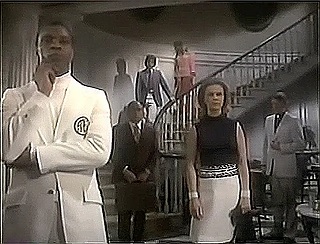
The 1972 made-for-TV movie Haunts of the Very Rich opens with a lengthy shot of Lyle (Tony Bill) and Laurie (Donna Mills) sharing a very long kiss.  Obviously, they’re very happy and why shouldn’t they be?  They’re young.  They’re beautiful.  They’re in love.  They’re newly married.  And …. they’re on an airplane!

It’s a private plane, one that’s heading towards a resort called The Portals of Eden.  There’s only a few other people on the plane.  David Woodrough (Lloyd Bridges) is a businessman who is looking forward to spend some time away from his wife, especially if it means a chance to get to know one of the other passengers, Ellen Blunt (Cloris Leachman).  Annette Larner (Anne Francis) is also traveling alone and is hoping she might finally be able to get some sleep without having to take a handful of pills beforehand.  Rev. Fellows (Robert Reed) appears to have lost his faith.  And then there’s Al Hunsicker (Ed Asner).  Hunsicker’s a little bit confused about how he ended up on the airplane.  As far as he knows, he’s supposed to be on his way to a business meeting in Dallas.  Portals of Eden?  Al’s never heard of the place!  Of course, nobody on the plane really seems to be sure where they’re going or how they even got on the plane in the first place.  Strangely, Al appears to be the only one who finds any of this to be strange.

When the plane lands, they discover that the Portals of Eden is a large hotel sitting at the edge of a tropical wilderness.  Their host, the always polite Mr. Seacrist (Moses Gunn), welcomes them but avoids answering anyone’s questions.  Seacrist tells them to enjoy their stay.

For the first day, that’s exactly what everyone does.  They relax.  They indulge in a little pampering.  David gets to know Ellen.  Al is still worried about getting to his business meeting but he is assured that he can always fly out to Dallas the following day.

The night, a violent storm hits.  The next day, everyone wakes up to discover that the resort is nearly deserted.  There’s no electricity.  There’s no way to call out.  There’s not much food.  Seacrist tells them not to worry.  He assures them that help is on the way.  As the guests wait to be rescued, they finally start to wonder just how exactly the ended up at the resort in the first place.  They realize that they’ve almost all had a recent brush with death.  David swears to Ellen that he’ll file for divorce as soon as they get back home but what if they don’t have a home to which to return?  Occasionally, the guests hear a plane flying overhead.  At one point, they even see one land.  But every time, just when it seems like they’re on the verge of finally being rescued, the plane vanishes.

And things just get stranger from there.

If Jean-Paul Sartre had ended up in the United States, writing for The Bold and the Beautiful, the end result would probably look a lot like Haunts of the Very Rich.  Considering that this is a made-for-TV movie from the early 70s, Haunts of the Very Rich is a surprisingly effective and atmospheric little horror film.  The story itself won’t exactly win any points for originality.  You’ll guess the secret of Portals of Eden long before any of the characters in the film.  But still, it’s a well-directed and nicely acted film, one that’s topped off with a suitably surreal (if somewhat abrupt) finale.

Haunts of the Very Rich can currently be found on YouTube and I recommend it for anyone who likes their melodrama served with a side of existential dread.