Film Review: Stay Hungry (dir by Bob Rafelson)


In the 1976 film Stay Hungry, Jeff Bridges plays Craig Blake.

When we first meet Craig, he doesn’t have much of a personality, though we still like him because he’s played by Jeff Bridges.  Living in Alabama, he’s a young rich kid who, after the death of his parents, divides his time between his nearly empty mansion and his country club.  Craig suffers from a good deal of ennui and seems to spend a lot of time writing letters to his uncle in which he promises that he’s going to eventually get his life together.  Craig eventually gets a job at a real estate firm that is managed by Jabo (Joe Spinell).  We know that the real estate firm is shady because Joe Spinell works there.

Craig is assigned to handle the purchase of a small gym so that he can eventually close the place and allow it to be torn down to make room for an office building.  However, Craig soon falls for the gang of colorful eccentrics whose lives revolve around the gym and bodybuilder Joe Santo (Arnold Schwarzenegger, who gets an “introducing” credit, even though this was his fourth film).  The friendly Franklin (Robert Englund) is Santo’s “grease” man.  Anita (Helena Kallianiotes) is tough and can kick anyone’s ass.  The receptionist, Mary Tate (Sally Field), is a free spirit with whom Craig soon falls in love.  In fact, the only less than likable person at the gym is the former owner, Thor Erickson (R.G. Armstrong), a heavy-drinking perv who has a hole in the floor of his office that he uses to peek down at the women’s locker room.

There’s not much of a plot here.  Instead, the film plays out in a rather laid back manner, with Santo befriending Craig and showing him the joy of embracing life.  Arnold Schwarzenegger actually won an award (well, a Golden Globe) for his performance here and it must be said that he’s very good as the gentle and easy-going Santo.  Because he’s huge and he’s Schwarzenegger, we expect him to be intimidating.  Instead, he’s a soft-spoken guy who is quick to smile and who doesn’t even get upset when he finds out that Mary Tate and Craig are now involved.  There’s even a surprising scene where Joe Santo picks up a fiddle and starts playing with a bluegrass band.  Schwarzenegger is so likable here that it’s easy to wonder where his career might have gone if he hadn’t become an action star.  Even early in his career (and when he was still speaking with a very thick accent), Schwarzenegger shows off a natural comic timing.  He’s fun to watch.

In fact, he’s so much fun that the rest of the film suffers whenever he’s not onscreen.  The cast is full of talented people but the film’s loose, plotless structure keeps us from truly getting too invested in any of them.  (Santo is training for Mr. Universe so at least he gets an actual storyline.)  Sally Field and Jeff Bridges are cute together but their romance is never quite as enchanting as it seems like it should be.  The main problem with the film is that, when it ends, one still feels like Craig will eventually get bored with the gym and return back to his mansion and his country club.  One doesn’t get the feeling that Craig has been changed so much as Craig just seems to be slumming for the heck of it.

There are charming moments in Stay Hungry.  I’m a Southern girl so I can attest that the film captured the feel of the South better than most films.  If you’re a Schwarzenegger fan, you have to see this film because it really does feature Arnie at his most charming and natural.  Unfortunately, despite all that, the film itself never really comes together.
Suburban Commando (1991, directed by Burt Kennedy)


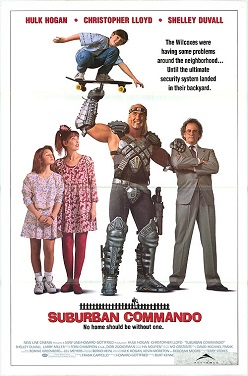
After screwing up a mission to save the leader of his planet from the intergalactic gangster Suitor (William Ball), Shep Ramsey (Hulk Hogan) is ordered to take a vacation.  When Shep gets mad and accidentally damages the controls of his spaceship, he’s forced to hide out on Earth while his ship repairs itself.  After stealing some clothes from a biker, Shep rents a room from Charlie (Christopher Lloyd) and Jenny Wilcox (Shelley Duvall).  Charlie is an architect who hates his job, his boss (Larry Miller), and a malfunctioning traffic light in the middle of town.   Charlie doesn’t trust Shep but when Suitor comes to Earth in search of his number one foe, Charlie and Shep are going to have to work together to save Charlie’s family.

Suburban Commando was originally envisioned as being an Arnold Schwarzenegger/Danny DeVito film.  Schwarzenegger and DeVito decided to do Twins instead and Suburban Command was (eventually) made with Hulk Hogan and Christopher Lloyd.  The idea behind the film had potential but the film itself never comes to life, thwarted by a low-budget and a cast that generates little in the way of chemistry.  Things start out well when Hogan is in outer space and the film parodies Star Wars but, once Hogan goes on vacation, the story crashes down to Earth in more ways than one.  Hogan was more of a personality than an actor and it’s impossible to see him as being anyone other than Hulk Hogan, even if he is flying through space and wearing intergalactic armor at the start of the movie.  Hogan getting angry in space is funny because space is not where you would expect to find him.  Hogan getting angry in the suburbs just feels like a half-baked sitcom.  Lloyd is too naturally eccentric to be believable as someone trapped in a go-nowhere job.  It’d hard to buy Christopher Lloyd as someone who would be scared to tell off his boss or who would need an alien warrior to come down and show him how to loosen up.  There’s a lot talented people in the cast but the ensemble never really gels.

This was the last film to be directed by veteran filmmaker Burt Kennedy.  Kennedy was best-known for his westerns, including Welcome to Hard Times, Support Your Local Sheriff, and Hannie Caulder.  He was not known for his wacky comedies and this film shows us why.

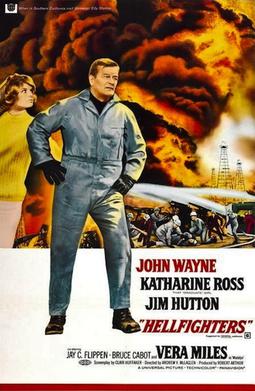
Hellfighters (1968, directed by Andrew McLaglen)


Chance Buckman (John Wayne) is the best there is when it comes to fighting oil fires.  Along with Greg Parker (Jim Hutton), Joe Horn (Bruce Cabot), and George Harris (Edward Faulkner), Chance travels the world and puts out fires that the regular authorities can’t handle.  Chance loves his job but he also loves his ex-wife, Madelyn (Vera Miles).  When Madelyn indicates that she wants to remarry Chance but only if he pursues a less dangerous line of work, Chance retires from firefighting and becomes an oil executive.  He leaves his firefighting company to his new son-in-law, Greg.  When Greg and Chance’s daughter (Katharine Ross) head down to Venezuela to battle a fire and find themselves not only having to deal with the flames but also with a band of revolutionaries, Chance is the only one who can help them.

When I was growing up, Hellfighters was one of those movies that seemed to turn up on the local stations a lot.  The commercials always emphasized the idea of John Wayne almost single-handedly fighting fires and made it seem as if the entire movie was just the Duke staring into the flames with that, “Don’t even try it, you SOB” look on his face.  As a result, the sight of John Wayne surrounded by a wall of fire is one of the defining images of my childhood, even though I didn’t actually watch all the way through until recently.  When I did watch it, I discovered that Hellfighters was actually a domestic drama, with an aging Wayne passing the torch to youngster Jim Hutton but then taking it back.

The fire scenes are the best part of Hellfighters and I wish there had been more of them.  The movie gets bogged down with all of Chance’s family dramas but it comes alive again as soon as John Wayne and his crew are in the middle of a raging inferno, putting their lives at risk to try to tame the fire.  Wayne was always at his best when he was playing strong, no-nonsense men who were the best at what they did.  Hellfighters is slow in spots but the fire scenes hold up well.  There’s no one I’d rather follow into an inferno than Chance Buckman.

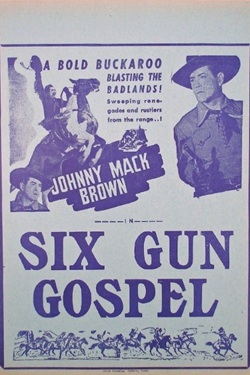
Six Gun Gospel (1943, directed by Lambert Hillyer)


Marshals Nevada Jack McKenzie (Johnny Mack Brown) and Sandy Hopkins (Raymond Hatton) are sent to the frontier mining community of Goldville to determine who is responsible for hijacking all of the gold that should be coming out of the town.  Not surprisingly, it’s all the work of another dastardly saloon owner (Kenneth MacDonald) who is planning on stealing all the gold, chasing off all the settlers, and then selling their land to the railroad company.  While Sandy goes undercover as the town’s new preacher, Jack agrees to ride shotgun on a gold shipment, along with with Dan Baxter (Eddie Drew).  Dan is in love with Jane Simms (Inna Gest), the daughter of honest miner Bill Simms (Kernan Cripps).

Johnny Mack Brown made a countless number of westerns for several different production companies but it seems like they always featured a crooked saloon owner and a plan to sell the land to a railroad company.  Luckily, nobody watches these movies for the plots and that was probably true even when they were first released.  People watch these movies for the nostalgia value of watching a movie where it’s good vs evil and good always triumphs without leaving any sort of lingering doubt about whether or not the heroes did the right thing.  Johnny Mack Brown is as authentic on a horse and carrying a gun as he ever was and there’s a scene where he manages to get a gun despite being tied up that’s pretty cool.  The appeal of Johnny Mack Brown was that he always seemed like he could do the things that he did in the movies in real life as well.  Raymond Hatton provides comic relief, pretending to know the hymns being sung by his congregation and providing some songs of his own.  There’s enough gun fights and horse chases to provide nostalgic happiness for fans of the genre and that’s the important thing.

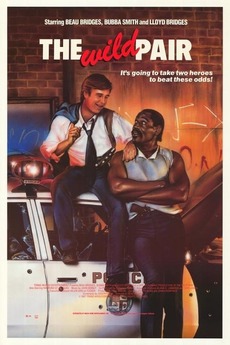
The Wild Pair (1987, directed by Beau Bridges)


A police detective named Benny Avalon (Bubba Smith) and an FBI agent named Joe Jennings (Beau Bridges) are assigned to work together to take down a drug dealer named Ivory Jones (Raymond St. Jacques).  Avalon and Jennings don’t immediately get along.  Avalon is tough and streetwise while Joe is a good example of what used to be called a yuppie.  When they discover that Ivory is connected to a white supremacist gang led by Col. Hester (Lloyd Bridges), Avalon and Jennings have to set aside their differences and work together.

The Wild Pair starts out as a standard buddy cop film until things take a sudden serious turn and it instead becomes a violent and blood-soaked revenge thriller.  It tries to mix comedy and action in the style of Beverly Hills Cop but it doesn’t work.  Beverly Hills Cop understood that you could only take the violence so far without losing the laughs.  The Wild Pair has the bad guys killing several innocent (and likable) people and also murdering Avalon’s cat.  Maybe Walter Hill could have pulled off what this film was going for.  He certainly managed to do so with 48 Hours.  But this film was the directorial debut of Beau Bridges, a good actor who, as a director, was no Walter Hill.  As for Bubba Smith, he was always more of a personality than an actor.  That served him well in the Police Academy films but here he’s actually supposed to be playing someone other than Bubba Smith and his limitations of an actor become especially glaring once the film turns serious.  Lloyd Bridges also seems miscast as the villain but that may just be because I’ve watched Airplane! and Hot Shots too many times.

The pair may be wild but they’re also forgettable.

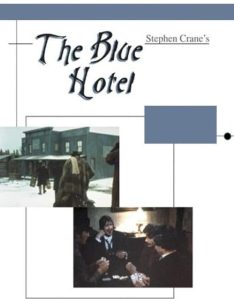
Retro Television Review: The American Short Story Episode 8 “The Blue Hotel”


Welcome to Retro Television Reviews, a feature where we review some of our favorite and least favorite shows of the past!  On Saturdays, I will be reviewing The American Short Story, which ran semi-regularly on PBS in 1974 to 1981.  The entire show can be purchased on Prime and found on YouTube and Tubi.

This week, we have an adaptation of a Stephen Crane short story.

Episode 1.8 “The Blue Hotel”

(Dir by Jan Kadar, originally aired in 1977)

In the dying days of the Old West, a train pulls into a station in a small frontier town.  Getting off the train, a Cowboy (John Bottoms), an Easterner (Geddeth Smith), and a Swede (David Warner) head to the town’s only hotel.  A blizzard is coming and the three men are seeking shelter for the night.  The owner of the hotel, Scully (Rex Everhart), is happy to provide it.  As the men wait for dinner to be served, they play a card game with Scully’s son, Johnnie (James Keach).

At first, the game plays out without incident.  The men are all friendly, with the exception of the Swede.  The Swede remains quiet and seems distrustful.  After a few hands of the game, the Swede accuses Johnnie of cheating.  Over the next few hours, as the wind howls outside, the Swede rants and raves.  Convinced that the wild west is truly full of outlaws and that it’s all exactly like the dime-store novels that he read before boarding the train, he cannot bring himself to accept that the men mean him no harm.  It all leads to violence and tragedy.

This episode made excellent use of the shadowy Blue Hotel and the desolate wind blowing outside.  Over the course of an hour, the hotel went from being a friendly shelter to an ominous location that seemed to pulse with paranoia.  David Warner gave a strong performance as the unstable Swede and the final act of violence (which was changed slightly from the short story’s original conclusion) comes as a genuine shock as does the final twist in the tale.  The Blue Hotel becomes a look at how people unknowingly shape their own destiny, for better or worse.

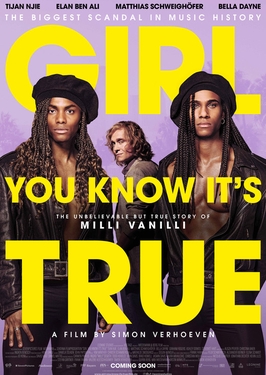
Girl You Know It’s True (2023, directed by Simon Verhoeven)


In 1988, a German music producer named Frank Farian (Matthias Schweighofer) has already recorded and produced a song called Girl You Know Its True.  He just needs to find two performers who are more photogenic than the middle-aged studio musicians who actually sang it.  Frank discovers Rob (Tijan Njie) and Fab (Elan Ben Ali), two friends who are trying to make it as dancers.  Rob is German and biracial.  Fab is French.  Frank tells them that all they have to do is lip-synch along with the record whenever they’re “performing” the song.  After Frank assures them that this type of thing is done all the time, they agree.  Frank also tells them that they will be known as Top Shelf.

The song becomes a hit and Rob and Fab become stars but they’re not known as Top Shelf, a name that is dismissed as being too German.  Instead, they find superstardom as Milli Vanilli.  With their popularity comes money, groupies, and drugs.  But when word gets out that neither Rob nor Fab actually sang on their record, everything collapses into one of the biggest entertainment scandals of the past 40 years.

I never would have guessed that a good movie could be made about the fall of Milli Vanilli but Girl You Know Its True is a surprisingly compelling and well-acted retelling of the familiar story.  The movie is as much as about the business of fame as it is about the band itself with Frank realizing and explaining that a band’s image is much more important than the music itself.  Rob and Fab are presented as being incredibly naive and trusting when it comes to Frank and his promises, with Rob also sabotaged by a need for acceptance that came out of his troubled childhood.  The villain in this story is not the band but instead a music industry that knowingly looked the other way on Frank’s deception and then scapegoated Rob and Fab when the truth came out.  Rob and Fab each deal with going from being superstars to being pariahs in their own individual way.  It leads to tragedy for one and regret for the other.

Even though I was familiar with the story, Girl You Know It’s True took me by surprise.  It’s a genuinely good film.

10 Films For The Weekend (7/25/25)


Leaving Soon

With the end of July approaching, I decided to take a look at what would soon be leaving Tubi.  I should mention that just because these films are leaving Tubi, that doesn’t mean they’re not going to start streaming somewhere else.  In fact, I imagine the reason that they’re leaving is because they’re going to start streaming somewhere else.  Here’s a few worthwhile films that are currently listed as “leaving soon” on Tubi.

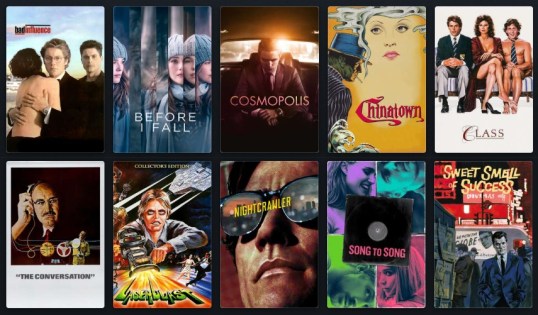
Sweet Smell of Success (1957) stars Burt Lancaster as a viscous columnist and Tony Curtis as his henchmen.  When Lancaster discovers that his sister is dating a jazz musician, Lancaster decides to destroy the man’s life.  One can view this film as a satire on the tabloids, a metaphor for McCarthyism, or a commentary on cancel culture.  All those interpretations are legitimate.  Then again, it can also be viewed as just being a tremendously enjoyable and endlessly quotable pulp masterpiece, a noir where the damage isn’t done by bullets but instead by words.  Here’s the link on Tubi.

Terence Malick’s Song to Song (2017) is an intriguing Texas-set film.  It’s a Malick film and, in many ways, it’s Malick at his most self-indulgent.  There are times when the film, with its languorous shots and its multiple narrators, almost becomes a self-parody.  But there are also images that are so strikingly beautiful that they stick with you.  A talented cast — Michael Fassbender, Ryan Gosling, Natalie Portman, Val Kilmer, and others — wanders through the film and offers up tantalizing hints of what’s going on underneath the surface of their ennui-drenched lives.  It’s left to the viewer to decide what it all means.  It’s a Malick film and, because of that, worth taking a chance on.  Here’s the link on Tubi.

Based on a novel by Don DeLillo and directed by David Cronenberg, Cosmopolis (2012) is a surreal film that follows a businessman (Robert Pattinson) as he is driven around New York.  This is one of those films that people seem to either love or hate.  I loved it and I thought this was the first film that showed Pattinson was capable of doing more than just Twilight.  In a key supporting role, Paul Giamatti gives a notably disturbing performance.  Here’s the link on Tubi.

What would you do if you had the chance to live the last day of your life over and over again?  That’s the question asked by one of my favorite films of the past ten years, Before I Fall (2017).  This is a film that brough back memories of me and my friends in high school and left me wondering if I needed to apologize to anyone.  Here’s the link on Tubi.

I’m still annoyed (if not necessarily surprised) that Nightcrawler (2014) was thoroughly ignored by the Academy.  Jake Gyllenhaal definitely deserved, at the very least, a nomination for his performance as a sociopath who finds a successful career in crime journalism.  Bill Paxton and Rene Russo give excellent supporting performances.  This may be a mainstream film but its heart belongs to the grindhouse.  Here’s the link on Tubi.

Finally, what can I say about Chinatown (1974) that hasn’t already been said by a hundred other critics?  It’s one of the best noirs ever made and it’s debatable whether or not Jack Nicholson has ever been better than he was here.  Along with an intriguing mystery, the film features one of the most loathsome villains of all time, John Huston’s Noah Cross.  Faye Dunaway is excellent as the femme fatale with a devastating secret.  Here’s the link on Tubi.

Odds and Ends

After watching Chinatown, why not check out Francis Ford Coppola’s The Conversation (1974)?  I have to admit that I envy those who were alive in 1974 and who got to see the second Godfather, Chinatown, and The Conversation when they were all first released.  What’s it like to live during a cinematic golden age?  The Conversation is a brilliant thriller, featuring Gene Hackman at his best.  This is a true masterpiece of paranoia and it can be viewed on Prime.

If you’re in the mood for something completely different, the dramedy Class (1983) features Andrew McCarthy as a nerdy student who has an affair with the mother (Jacqueline Bisset) of his roommate (Rob Lowe).  It’s a very 80s film and definitely a guilty pleasure.  It can be viewed on Prime.

Speaking of Rob Lowe, he plays a bad guy in the enjoyably melodramatic Bad Influence (1990).  James Spader plays the good guy for once, an adorably nerdy guy who discovers that his new best friend doesn’t exactly have his best interests at heart.  Directed by Curtis Hanson, Bad Influence is sordid fun.  It can be viewed on Prime.

Finally, I should mention that I bought a copy of Gianni Russo’s autobiography this week.  Russo is the entertainer who played Carlo Rizzi in The Godfather and who appeared in a handful of other films, usually playing a gangster.  I’m disappointed to say that Russo did not write about the experience of co-starring in the gloriously absurd, totally 70s sci-fi flick, Laserblast (1978).  Fortunately, you can watch the film for yourself.  Russo’s role is actually pretty small but the Claymation aliens are just adorable!  This is also probably the only film ever made to feature Eddie Deezen as a bully.  Laserblast is on Prime.

You can check out last week’s films but clicking here!


The Films of 2025: Happy Gilmore 2 (dir by Kyle Newacheck)


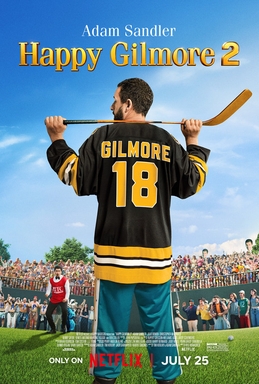
I love 1996’s Happy Gilmore and, over the past few months, I have very much been looking forward to the release of the long-delayed sequel, Happy Gilmore 2.  Still, I was a bit concerned when I opened the film on Netflix and discovered that the sequel had a nearly two-hour running time.  (The original clocked in at an efficient and fast-paced 90 minutes.)  Comedy is all about timing and, in general, shorter is funnier.  I know that Judd Apatow and Adam McKay might disagree with me on that but let’s be honest.  For all of the acclaim that it was met with, when was the last time you actually felt any desire to rewatch The King of Staten Island?  For that matter, if you have to pick between Anchorman or Anchorman 2, which are you going to pick?  The 90 minute original or the sequel that takes more than two hours to tell essentially the same story?

Having now watched the film, I can say that Happy Gilmore 2 does run a bit too long.  There are a few sequences that could have been trimmed without hurting the film.  I can also say that I thoroughly enjoyed the film.  I laughed more often than not.  It’s a funny film but it’s also a surprisingly touching one.

Taking place 29 years after the first film, Happy Gilmore 2 features an older and slightly more mature Happy.  It also features an older and slightly more mature Adam Sandler and, to its credit, the film acknowledges that.  It doesn’t try to convince us that Sandler and Gilmore are still the young hell-raisers that they once were.  (Happy’s Happy Place has changed considerably.)  I’ve often written that there are two Adam Sandlers.  There’s the youngish Sandler who made silly and often stupid films where he basically just hung out with his friends and didn’t seem to put much effort into anything.  That’s the Sandler who has won multiple Razzie awards.  And then there’s the older and wiser Adam Sandler, the sad-eyed character actor who gives sensitive performances as world-weary characters.  This is the Adam Sandler who seems to be overdue for an Oscar nomination.  If an alien came to Earth and only watched Adam Sandler’s serious films, they would probably think he was one our most-honored actors.  While Happy Gilmore 2 is definitely a comedy, it still features quite a bit more of the serious Sandler than I was expecting.

At the start of the movie, Happy is not in a happy place.  His grandmother has passed away.  His wife, Virginia, was killed by an errant tee shot.  He has four rambunctious sons and a daughter, Vienna (played by Sunny Sandler, who was so good in You Are So Not Invited To My Bat Mitzvah).  After Virginia’s death, Happy gave up golf.  He lost his money.  He lost his grandmother’s house.  Now, he’s working in a grocery store and he’s an almost forgotten figure.  He’s also an alcoholic, keeping bottles of liquor hidden around the house.  (A tiny liquor bottle is hidden in the cuckoo clock.)  And while this film is certainly not Uncut Gems or even The Meyerowitz Stories, Sandler still does a good job of capturing the reality of Happy’s depression.  There’s a true sense of melancholy running through the film’s first hour, as Happy returns to golf to try to make enough money to pay for Vienna to attend a prestigious dance academy.  The second hour, in which Happy leads a team of pro golfers against a team of “extreme” athletes is far more goofier but Happy’s love for his family is a theme that runs through the entire film.

Aging is the other theme that runs through the film.   Forced to play with three younger players (including Eric Andre and Margaret Qualley) at a local golf course, the rusty Happy grimaces when he hears one of them say, “Is he trying to do the Happy Gilmore swing?”  When Happy rejoins the PGA, he discovers that all of the younger players now hit the ball as hard as he used to.  An obnoxious tech bro (Benny Safdie) wants to start a new, extreme golf league, one that will “continue the revolution” that Happy started.  Happy finds himself defending traditional golf and it’s an acknowledgement that both Gilmore and Adam Sandler have grown up and have come to appreciate that not everything needs to change.  Sometimes, you just want to play a nice round of golf on a pretty course without having to deal with the sensory overload of the 2020s.

It’s a funny movie.  Even when he’s playing it straight, Sandler still knows how to deliver a funny line.  Ben Stiller returns as Hal L., who is now an addiction recovery specialist.  (His techniques include ordering people to wash his car.)  Christopher McDonald also returns as Shooter McGavin, having escaped from a mental asylum and now fighting, alongside Happy, to save the game that they both love.  As someone who always felt that Shooter kind of had every right to be upset during the first film, I was happy to see him get a bit of redemption.  Several professional golfers appear as themselves.  A running joke about Scottie Scheffler getting arrested and then forcing all of his cellmates to watch golf made me laugh a lot more than I was expecting it too.

The sequel is full of shout-outs to the first film.  A fight in a cemetery reveals that everyone who died during and after the first film just happens to have a gravestone and it was actually kind of a nice tribute.  (Even the “Get Me Out Of Here” Lady gets a headstone.)  It’s a sequel that truly appreciates and values the legacy and the fans of the first film.  It’s also a sequel that seems to truly love the game of golf, which is not necessarily something that could be said about the first film.

Happy Gilmore 2 is a worthy sequel, even if it is a bit long.  It made me laugh but, at the same time, it was hard not to be touched by the obvious love that Happy had for his family and that they had for him.  (It didn’t hurt that Happy’s daughter was played by Sandler’s daughter.)  In the first film, Happy played golf for his grandmother.  In the second film, he returns to the game for his daughter.  It’s all about family, as Adam Sandler’s unexpectedly heartfelt performance makes clear.

Film Review: Transformers: The Movie (dir. by Nelson Shin)


1986 was such a fantastic year.

With movies like Top Gun, Labyrinth and Ferris Bueller’s Day Off already out, the summer would give us Big Trouble in Little China, Aliens, & The Fly (Which at one point you could catch as a double feature with Aliens). The two best announcements at home were that a new baby was on the way and Transformers: The Movie was coming out. By August, we knew the baby would be a boy and a name was already set aside for him. We were naming him after a fallen Officer who was a friend of my father’s on the Force.

Impending older brotherhood was nice, but for 11 year old me, it all took a backseat to the Death of Optimus Prime. Up until then, the most shocking fictional event we had in school was either Return of the Jedi closing the book on Star Wars some years prior, K.I.T.T. getting destroyed (and rebuilt with Super Turbo Boost) in Knight Rider, or Rico losing Angelina in a car bomb during the Season Finale of Miami Vice just a few months back.

I didn’t get a chance to see Transformers: The Movie during the film’s initial run, simply because there wasn’t anyone at home who wanted to sit through it with me. My older brother, through other means, managed to score a VHS copy of the film within the first week or so of its theatrical release. I watched and re-watched that video so many times, and would even pause it to try to draw some of the characters. Eventually, I was able to catch a re-release for the film’s 30th Anniversary.

After two full seasons of the show, Transformers: The Movie was basically Hasbro’s way of cleaning house from the 1984 Generation 1 toy line to introduce a new set. The show sold figures, and the hopes were that the film would do the same. Granted, there were already a large number of Transformers to work with by the time the movie came out. With nearly 50 Autobots and about 35 Decepticons to choose from, the film focused on a few, such as the Insecticons, Dinobots and some of the G1 favorites like Soundwave, Starscream, Jazz & Bumblebee. The Constructicons (and Devestator)were the only group set to be featured in the movie. The Stunticons & Aerialbots would sit this one out. Hasbro really didn’t care too much about the impact of any of these changes on the movie’s plot. While most of the trailers asked “Does Optimus Die?”, their toy commercial line already introduced Rodimus Prime.

Produced by De Laurentiis Entertainment Group (Near Dark, Blue Velvet), Transformers: The Movie takes us to the future of 2005. The Autobots and Decepticons are still fighting it out, with a few changes in the war. The Decepticons own the Transformers home planet of Cybertron, but the Autobots have control of two of Cybertron’s Moons and a city on Earth. Lead by Optimus Prime (Peter Cullen, Eeyore on The Adventures of Winnie the Pooh), the plan is get back to Earth and then handle the Decepticons from there. Of course, the Decepticons and their leader, Megatron (Frank Welker, The Golden Child) find out about this and intercept an Autobot shuttle, outright killing classic show staples Prowl, Brawn, Rachet and Ironhide. I can’t imagine what it was like to be a kid, bring your favorite toy to the movies, only to see the character it’s based on killed on screen. To make things worse, a planet eating transformer named Unicron threatens both parties, including Cybertron. Can Unicron be stopped?


It wasn’t a total loss. We were introduced to new Autobots in the rookie Hot Rod (Judd Nelson, The Breakfast Club), the war hero Kup (Lionel Stander, TV’s Hart to Hart), the fast talking Blurr (John Moschitta, Jr., Dick Tracy), would be leader Ultra Magnus (Robert Stack, Airplane), an Autobot First Lady in Arcee (Susan Blu), and Triple Changer Springer (Neil Ross). The two most famous vocal additions were Leonard Nimoy (Invasion of the Body Snatchers) the new Deception leader Galvatron and Orson Welles (The Third Man) as Unicron. As a kid, it was pretty awesome to know that both Spock and the “No Wine Before It’s Time” guy were joining in all of this. It made Transformers seem a bit larger. My parents would point out that Orson Welles was “the” Orson Welles, but as Citizen Kane wasn’t on my radar (despite my Dad owning and watching it), I associated him with Wine commercials. To both their credit, Nimoy and Welles did just fine with their vocal talents.

While the animation for Transformers was never fantastic, the movie was a bit of an improvement. It never quite reached the levels of anime films like Fist of the North Star & Golgo 13: The Professional. The Soundtrack was ultimately where the film shined, with a mix of rock music from bands like Lion and Stan Bush and a score by Vince DiCola. Coming off of Staying Alive and Rocky IV, DiCola’s work on Transformers: The Movie was great, and remains a go to album for me when music is needed for a situation.

The Death of Optimus Prime was a bit of a shock to the audiences that saw (and cared about) it. Hasbro would eventually bring Prime back temporarily as a Zombie in an episode of the show’s 3rd Season, and then again to lead in the season’s 2 part finale, “The Return of Optimus Prime”.

After seeing the film, I asked me parents for some of the movie based Transformers. Christmas was put on hold by my Mom as she went into labor around Christmas Eve. I was able to open just one gift before Christmas. This happened to be a Hot Rod figure that I found in a toy store back in November, which was quickly snatched and wrapped for the Christmas Pile before I could get to open it. She had my little brother on Christmas Morning, and we eventually celebrated the holiday half a week later. Bless her heart, she gave me almost the entire Movie line – Galvatron, Rodimus Prime, Springer, Cyclonus, and the Predacons (who weren’t in the movie). Playing with them took a backseat to diaper detail, but hey, that Christmas was one of the best.

Overall, Transformers: The Movie is one of those films I happily return to from time to time. It’s not incredible in any major way, but it takes me back to one element of a magical year.