Chris and Lisa Mattson (Patrick Wilson and Kerry Washington) move in to a large house in the Lakeview Terrace neighborhood of Los Angeles. It’s a good house in a good neighborhood and it’s just too bad that their neighbor, Abel Turner (Samuel L. Jackson), is a corrupt cop who hates interracial couples.
I remember that Lakeview Terrace caused a brief stir when it was released in 2008. It was hardly the first film about an interracial couple being harassed by a bigot but it was one of the few where the bigot in question was a black man. Abel hates white people. He says it’s because his wife was cheating on him with a white man when she was killed in a car accident. He does not appreciate Chris listening to rap music and dropping his cigarettes on the street. When Abel’s children spot Chris and Lisa having sex in their swimming pool, that’s all Abel needs to justify his dislike of the couple and his feelings that he doesn’t want this couple living next door. When Chris asks if Abel could turn off the floodlights that shine into their bedroom window, Abel refuses. When Chris tries to plant privacy trees, Abel cuts them down. What starts out as a neighborhood feud escalates as Abel orders one of his informants to break into Chris and Lisa’s house. Unfortunately, that third act twist also signals the moment that Lakeview Terrace goes from being a reasonably intelligent social satire to being a standard thriller. Neil LaBute is a director who specializes in making people uncomfortable so it is too bad that Lakeview Terrace ends in a way designed to conform to what audiences have come to expect from thrillers.
Abel’s a hateful figure but Samuel L. Jackson is just as charismatic as ever and the passive-aggressive way that he initially responds to Chris and Lisa will be familiar to anyone who has ever had a bad neighbor or who has to deal with a cop having a bad day. Patrick Wilson and Kerry Washington, neither one of whom is really that interesting an actor to begin with, are both stuck in bland roles and struggle to keep up with Jackson. (Wilson and Washington even get out-acted by Ron Glass, playing Lisa’s disapproving father.) It throws the movie off-balance. At the same time, Jackson is such an actor who projects so much intelligence that it’s hard to believe that Abel would make the stupid mistakes that he makes towards the end of the movie. Lakeview Terrace starts out fairly strong but loses its way towards the end.
When a small farming community in the Dakotas gets hit by an outbreak of the flu, farmer and community leader John Phillips (John Wayne) invites a Dr. Karl Braun (Charles Coburn) to come and be the town’s doctor. A refugee from Austria, Dr. Braun arrives with his daughter, Leni (Sigrid Gurie). At first, Leni is not happy living in the heart of the Dust Bowl but then she falls for John Phillips. However, Leni is still mourning his ex-fiancé (Roland Varno), who Leni and Braun believe sacrificed his life to help them reach America.
Eventually realizing that the town cannot prospers in the heart of the Dust Bowl, John suggests that everyone pack up and move to Oregon. Almost everyone agrees and the one person who wants to go to California gets his van driven off the side of the road. But Leni and Dr. Braun still take a detour to San Francisco because it turns out that Leni’s ex is not dead after all. She and her father meet up with him and discover, to their horror, that he has become a fully committed Nazi.
This is an interesting change-of-pace for John Wayne. Though the film is a western (and even features its own version of wagon train), it’s set in what was then contemporary times and it deals with issues like the Great Depression and the rise of Nazism in Germany. The times may be hard but John Wayne isn’t going to let his community fall apart and, even more importantly, he’s not going to give up his beliefs or his ideals. Even though the movie was made at a time when the United States was still officially neutral, the film is strongly anti-Nazi. John Wayne, giving a strong performance, stands in for America while those who would collaborate with or make excuses for the Nazis represented by the weaselly Roland Varno. Leni’s ex-fiancé had no problem selling out his beliefs and embracing Nazism. Naturally, Leni and her father have no problem telling him off and then rejoining John Wayne in Oregon. The United States may have officially been neutral but this movie had no problem letting everyone know where it stood.
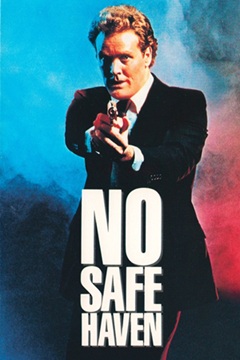
A group of drug dealers try to pressure football player Buddy Harris (Tom Campitelli) into throwing the big game. Buddy fakes an injury to get out of playing so the dealers murder not only Buddy but also his mother and his younger brother. Big mistake! Buddy’s older brother, Clete (Wings Hauser), is a CIA agent who is working as a listener in Honduras. Clete returns home and, with the help of an arms dealer (Robert Tessier, playing a good guy for change), Clete hunts down and kills everyone who killed his family. Clete not only gets revenge for his family but he also heads down to Bolivia to show the syndicate that, for them, there is no safe haven!
This is one of the ultimate Wings Hauser films, one that he both wrote and starred in. When Clete seeks revenge, he doesn’t mess around. One gunman gets set on fire while standing on his balcony. (He can either burn to death on the balcony or he can jump to a quicker death below. Either way, Clete’s going to take a lot of pictures) Wings chases the villains down with speedboats and helicopters and he does it all with a slight smirk that suggests he’s not only getting revenge but he’s also having the time of his life. This is Wings Hauser at his most demented and he’s playing the hero! Luckily, the villains are even crazier than Wings. I have to make a special mention of Branscombe Richmond, laughing and yelling and killing in a way that you would never expect if you only knew him from Renegade.
This is Wings Hauser at his best, in a movie that’s mean, violent, and never less than compelling. Clete kills a lot of people but it’s okay because, to quote True Lies, they were all bad. Wings throws himself into the role with his trademark intensity and shows why no one’s safe from Clete Harris. I’m going to miss Wings Hauser. Only he could have played Clete Harris. Only he could have made No Safe Haven the B-action classic of 1987.
What’s an Insomnia File? You know how some times you just can’t get any sleep and, at about three in the morning, you’ll find yourself watching whatever you can find on cable or streaming? This feature is all about those insomnia-inspired discoveries!
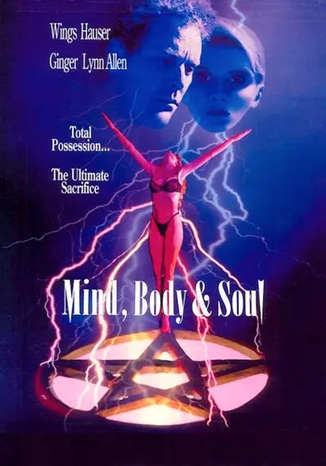
If you’re having trouble sleeping tonight, you can go over to Tubi and watch 1992’s Mind, Body & Soul.
Brenda (Ginger Lynn) has a new boyfriend! After years of getting stuck with duds, Brenda is happy to finally be dating Carl (Jesse Kaye), who is handsome and successful and has a thing about wanting her to drip hot candle wax on his body. Everything’s going fine until Carl asks her to come hang out with some friends of his. It turns out that they’re all Satanists and they’re planning on sacrificing a woman. Fortunately, the police arrive before the sacrifice can be carried out. Unfortunately, all the Satanists run off and leave innocent Brenda takes the blame.
After she’s arrested and spends several days in jail, Brenda is finally bailed out by defense attorney John Stockton (Wings Hauser). Because Carl apparently blew up her apartment (and, the police say, himself with it), Brenda doesn’t have anywhere to stay. She accepts John’s offer to stay at his place. John promises to be a perfect gentleman. He’s a former probation officer and he just wants to help.
And Brenda definitely needs some help! She suspects that Carl isn’t really dead. She keeps having bizarre visions of the robed and masked leader of the cult. She suspects that the cult might still be after her and, when she agrees to appear on a local talk show to tell her story, she finds herself stunned to be sitting across from an actual witch. Her former cellmate, Rachel (Tamara Clatterbuck), has just been released from prison and is willing to help Brenda out. Again, Brenda needs the help. The cult is after her and it’s going to take a lot of intelligence to survive and that’s probably going to be Brenda’s downfall because it’s hard to think of a dumber character than Brenda.
(Seriously, if my boyfriend took me to a Satanic cult meeting on a date, I would be out of there before they even got around to the human sacrifice part of the night.)
This film is so incredibly dumb that I don’t even know where to begin. Occasionally, I’ll see an incoherent horror film and I’ll give it a good review because the incoherence can sometimes add to the terror. Two of my favorite directors, Lucio Fulci and Jean Rollin, both deliberately made horror films that didn’t make sense because they were tying to capture the feeling of being in a nightmare. Mind, Body & Soul makes sense as long as you accept that Brenda, Rachel, and almost every other character in this film is mind-numbingly dumb. The plot works as long as you accept that there is not a shred of intelligence to be found amongst any of the characters, including the bad guys. This is a dumb film that is never scary. It does feature a fair amount of nudity, which I imagine was probably meant to be the film’s main selling point.
On the plus side, Wings Hauser is always entertaining. You’ll be able to guess the big plot twist that involves his character but no matter. With his quick smirk, he at least seems to be enjoying himself. As was so often the case, Hauser’s performance is the only one in this film that feels like an actual performance. Wings Hauser was an actor who always gave it his all, even while appearing in something like this.
First released in 2004, Irish Eyes tells the story of two brother, born eleven months apart.
Tom Phelan (John Novak) is the older brother, the one who is destined to go to law school, join the Justice Department, and to marry Erin (Veronica Carpenter), the daughter of one of Boston’s most prominent attorneys. Tom’s future lies in politics. As he makes his reputation by taking down members of the Boston underworld, he finds himself being groomed for attorney general and then who knows what else.
Sean Phelan (Daniel Baldwin) is the younger brother. Haunted by the murder of his father and stuck at home taking care of his mother (Alberta Watson) while Tom goes to college, Sean soon pursues a life of crime. He falls under the influence of the Irish mob, led by Kevin Kilpatrick (Wings Hauser). Sean quickly works his way up the ranks. It doesn’t matter how much time he does in prison. It doesn’t matter how many people he has to kill. It doesn’t matter if it alienates the woman that he loves or if it damages his brother’s political career, Sean is a career criminal. It’s the one thing that he knows. When Sean finds himself as the head of the Irish mob and also the American connection for the IRA, his activities are originally overlooked by his brother. Sean even threatens a reporter who makes the mistake of mentioning that Sean and Tom are brothers. But soon, Tom has no choice but to come after his brother. What’s more important? Family or politics?
Obviously (if loosely) based on Boston’s Bulger Brothers (Whitey became a feared criminal while brother John became a prominent Massachusetts politico), Irish Eyes doesn’t really break any no ground. Every mob cliché is present here and so is every Boston cliché. Don’t rat on the family. Don’t betray your friends. The only way to move up is to make a move on whoever has the spot above you. Every bar is full of angry Irish-Americans. Every fight on the street turns deadly. Everyone is obsessed with crime or politics. The film, to its credits, resists the temptation to have everyone speak in a bad Boston accent. (The Boston accent, much like the Southern accent, is one of the most abused accents in film.) Sean narrates the films and you better believe he hits all of the expected points about life on the street.
That said, it’s an effective film with enough grit and good performances to overcome the fact that it’s just a wee predictable. Daniel Baldwin is appropriately regretful as Sean and John Novak does a good job of capturing the conflict between Tom’s love of family and his own political ambitions. Curtis Armstrong shows up and is surprisingly convincing as a psychotic IRA assassin. Admittedly, the main reason that I watched this film was because Wings Hauser was third-billed in the credits. Hauser only appears in a handful of very short scenes and that’s a shame. In those few scenes, he has the rough charisma necessary to be believable as the crime boss who holds together the neighborhood and it’s hard not to regret that he didn’t get more to do in the film. That said, the film still works for what it is. It’s a good mob movie.
This film was originally entitled Irish Eyes. On Tubi, it can be found under the much clunkier name, Vendetta: No Conscience, No Mercy.
The 1987 film, Tough Guys Don’t Dance, opens with Tim Madden (Ryan O’Neal) talking to his father, tough Dougy (Lawrence Tierney). Dougy has stopped by Tim’s New England home to let Tim know that he has decided stop chemotherapy and accept his eventual death from cancer because, as Dougy puts it, “Tough guys don’t dance.” The tone of Dougy’s voice is all we need to hear to know that, in his opinion, his son has spent way too much time dancing.
Tim is an ex-convict turned writer and, when we first see him, he’s obviously had a few rough nights. He explains to Dougy that he woke up after a bender with his ex-girlfriend’s name tattooed on his arm, blood all over his jeep, and two heads dumped in his marijuana stash. Tim says that he’s hopeful that he’s not the murderer but he can’t be sure. He’s been drinking and doping too much. He suffers from blackouts. He’s not sure what happened.
The majority of the film is made up of flashbacks, detailing Tim’s affairs with a number of women and also his odd relationship with the town’s police chief, Luther Regency (Wings Hauser). Luther is married to Tim’s ex-girlfriend, Madeleine (Isabella Rossellini), who long ago accompanied Tim on a trip to North Carolina where they hooked up with a fundamentalist preacher (Penn Jillette) and his then-wife, Patty Lariene (Debra Sundland). (Tim found their personal ad while casually skimming the latest issue of Screw, as one does I suppose.) Patty Lariene eventually ended up married to Tim, though she has recently left him. As for Madeleine, she has never forgiven him for a car accident that they were involved in. Is Tim capable of loving anyone? Well, he does say, “Oh God, oh man,” repeatedly when he discovers that his wife has been having an affair.
Tim tries to solve the murders himself, finding that they involve not only him and Luther but also Tim’s old prep school friend, Wardley Meeks III (John Bedford Lloyd) and also some rather stupid drug dealers that Tim hangs out with. The plot is almost ludicrously convoluted and it’s tempting to assume that the film is meant to be a parody of the noir genre but then you remember that the film is not only based on a Norman Mailer movie but that it was directed by Mailer himself. Mailer, who was the type of public intellectual who we really don’t have anymore, was blessed with a brilliant mind and cursed with a lack of self-awareness. There’s little doubt that we are meant to take this entire mess of a film very seriously.
And the film’s theme isn’t hard to pick up on. By investigating the murders, Tim faces his own troubled past and finally comes to understand why tough guys, like his father, don’t hesitate to take action. Tough guys don’t dance around what they want or need. That’s a pretty common theme when it comes to Mailer. Tim Madden is not quite an autobiographical character but he is, by the end of the story, meant to represent the type of hard-living intellectual that Mailer always presented himself as being. Unfortunately, Ryan O’Neal wasn’t exactly an actor who projected a good deal of intelligence. And, despite his lengthy criminal record off-screen, O’Neal’s screen presence was somewhat docile. That served him well in films like Love Story and Barry Lyndon. It serves him less well in a film like this. It’s easy to imagine O’Neal’s Tim getting manipulated and, in those scenes where he’s supposed to be a chump, O’Neal is credible enough in the role. It’s far more difficult to buy the idea of Tim actually doing something about it.
Indeed, it’s hard not to feel that co-star Wings Hauser would have been far more credible in the lead role. But then, who would play Luther Regency? Hauser gives such a wonderfully unhinged and out-there performance as Luther that it’s impossible to imagine anyone else in the role. Maybe Hauser could have played both Tim and Luther. Now that would have made for a classic film!
Tough Guys Don’t Dance is weird enough to be watchable. The dialogue is both raunchy and thoroughly humorless, which makes it interesting to listen to, if nothing else. The moments that are meant to be funny are so obvious (like casting noted atheist Penn Jillette as a fundamentalist) that it’s obvious that the moment that feel like clever satire were actually all a happy accident. As far as Norman Mailer films go, this one is not as boring as Wild 90 but it also can’t match the unhinged lunacy of a frustrated Rip Torn spontaneously attacking Mailer with a hammer at the end of the unscripted Maidstone. It’s a success d’estime. Mailer flew too close to the sun but the crash into the ocean was oddly entertaining.
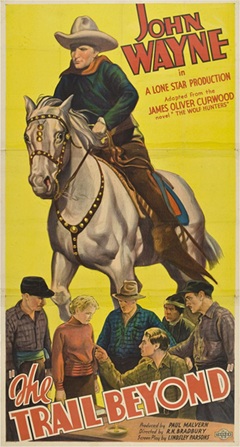
Falsely accused of murder, Rod Drew (John Wayne) and his buddy Wabi (Noah Beery, Jr.) jump off a train and end up in the Canadian wilderness, where they eventually find a deserted cabin, a map to a gold mine, and plenty of trouble when French-Canadian outlaw Jules LaRocque (Robert Frazer) decides that he wants the map and kidnaps Wabi’s girlfriend, Felice (Verna Hillie), to get it.
This was one of the many B-westerns that John Wayne made in between 1930’s The Big Trail and 1939’s Stagecoach. The film finds the youngish Wayne playing a slightly less upright character than usual. He’s still the hero but he’s also wanted by the police and spends much of the film fleeing from them. The movie is only 55 minutes long and the action moves quickly. The film’s Canadian locations and Robert Frazer’s over-the-top villain gives The Trail Beyond a slightly different and quirkier flavor than most the Duke’s 1930s output. I think this might be the only film to feature Wayne working with the Mounties. Even in this low-budget production, John Wayne is a strong hero who just looks like he belongs on a horse and traveling across the frontier. For someone who was the president of his high school’s Latin Club., Wayne had an automatic authenticity when it came to playing cowboys, even in the years before Stagecoach made him one of the biggest stars in the world. This is also one of the few films to feature both Noah Beery Sr. and Noah Beery Jr. While Beery Jr. plays Wayne’s sidekick and is in the film almost as much as John, Berry Sr.’s role is much smaller. He’s the store owner who is also Felice’s father.
Obviously, this is a film for fans of the genre only but it’s a good example of how John Wayne could make even his Poverty Row productions entertaining and watchable.
First released in 2021, American Traitor: The Trial of Axis Sally tells the story of Mildred Gillars, an American women who worked as propagandists for The Third Reich. Gillars would broadcast on German-radio, her show mixing music with propaganda messages that were meant to be heard by American and British soldiers in Europe. Gillars would talk about how wonderfully the war was going for Germany. She would tell the Americans that their mothers, sisters, and sweethearts were waiting for them back in the United States. She was one of the many female Nazi propagandists to be nicknamed “Axis Sally.”
(Interestingly enough, her broadcasts did gather a bit of cult following amongst U.S. personnel in Europe. Even though she was a propagandist, she played music and she also occasionally let slip the location of the German army. As the war progressed, her programs took on a “so bad it’s good” quality as she continued to insist that the Germans were still winning when they clearly weren’t.)
Mildred was arrested after the war ended and charged with treason against the United States. The prosecution claimed that Mildred was a committed Nazi who turned against her home country. Mildred and her defense attorneys claimed that Mildred only stayed in Germany because her boyfriend was there and that Mildred was largely apolitical. They also argued that Mildred would have been sent to a concentration camp if she had refused to do the broadcasts. Mildred Gillars became the first American woman to be convicted of treason. She lost her American citizenship, received a hefty fine, and spent 13 years in prison. Reportedly, she never showed much in the way of regret over being a Nazi propagandist.
It’s an interesting story but you wouldn’t know that from American Traitor, which is largely a vanity project. Meadow Williams not only plays Mildred Gillars but she also served as a producer on the film. Williams is the widow of vitamin tycoon Gerald Kessler. When Kessler died, he left his $800 million dollar fortune to Williams and, reportedly, a bit of that inheritance was used to fund this film. That perhaps explains why a name actor like Al Pacino shows up in the role of Gillars’s defense attorney. Pacino barks his lines with authority and manages to give a credible performance, even though he’s stuck wearing a ridiculous wig. There is absolutely nothing about Williams’s performance that suggests the type of charisma that Mildred Gillars would have needed to become an effective propagandist. She gives a blank-faced and blank-voiced performance, one that might be meant to seem enigmatic but which is instead just boring.
And really, that’s the best way to describe the film. It’s dull. The dialogue is dull. The performances, other than Al Pacino, are dull. Even the film’s visuals are dull. The film has little to say about propaganda, war, guilt, or innocence. It’s a vanity project turned Icarus file.
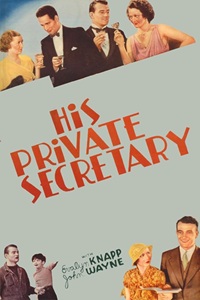
Business tycoon Mr. Wallace (Reginald Barlow) is sick and tired of his hard-drinking, hardy-partying son refusing to act in a responsible manner. Hoping to teach Dick Wallace about the value of hard work, Mr. Wallace sends Dick to a small town with instructions to collect a debt from the local preacher (Alec B. Francis). Dick, however, is more interested in the preacher’s daughter, Marion (Evelyn Knapp). After Dick finally convinces Marion that he’s not as bad his reputation, they got married. Mr. Wallace is disgusted and refuses to meet his new daughter-in-law, convinced that she’s a golddigger. Without revealing his true identity, Marion gets a job as Mr. Wallace’s private secretary and attempts to repair the relationship between father and son.
This is a creaky romantic comedy from the early days of sound film and it would probably be forgotten if not for the fact that Dick Wallace is played by John Wayne. Wayne was 26 when he played Dick Wallace and already a screen veteran, though most of his roles had been in B-westerns and had featured Wayne riding a horse and carrying a gun. Wayne actually gives a pretty good performance as Dick. He’s better and more natural here than he was in many of the singing cowboy films that he was making at the time and this film suggests an alternate timeline where Wayne become known as a romantic comedy star instead of a screen cowboy. Wayne is especially good in the early scenes, when he’s still a no-good, hard-drinking, no-account lout. I get the feeling he enjoyed not having to be the upright hero for once.
His Private Secretary definitely shows its age but it’s worth watching for a chance to see a young John Wayne in an unexpected role.
There are a lot of names that get mentioned. Some people give all the credit to U.S. Senator Gaylord Nelson of Wisconsin, who was an environmentalist before it was trendy and who proposed a day-long “teach-in” in 1970. (According to Norman Mailer, Hunter Thompson, and Gary Hart, Gaylord Nelson was also George McGovern’s personal pick for his running mate in 1972 but ultimately, Nelson didn’t get the spot because it was felt people would make fun of his first name. Considering how things went with Thomas Eagleton, one imagines that McGovern probably ended up wishing he had the courage to go with his first instinct.) A peace activist named John McConnell also proposed the idea of an Earth Day in 1969 but there’s some debate whether his proposed Earth Day became the actual Earth Day. Like all things, many people have taken credit for the idea behind Earth Day.
Ira Einhorn was one of those people. A prominent member of Pennsylvania’s counter-culture, Einhorn was a self-styled New Age environmentalist and he did speak at the first Earth Day event in Philadelphia. Einhorn went on to become a prominent guru, providing his services to several corporations that were looking to shake off their stodgy image. He led protests against nuclear energy. He wrote articles about CIA duplicity. He was, for a while, a popular figure and, due to his last name, he was nicknamed “The Unicorn.” He always claimed that he was instrumental in starting Earth Day but the organizers behind the event have always been quick to say that he had little do with it.
It’s understandable that the people behind Earth Day would rather not be associated with Ira Einhorn. Einhorn presented himself as being a quirky, fun-loving hippie but, in private, he was known for having both a violent temper and a misogynistic streak. In 1977, Einhorn’s ex-girlfriend, Texas-born Holly Maddux, disappeared. In 1979, her mummified remains were found in a box that Einhorn kept in his closet. Arrested for her murder and defended in court by future U.S. Sen. Arlen Specter, Einhorn claimed that he was innocent and that he had no idea how Holly Maddux ended up in his closet. (He suggested the CIA might be responsible.) With the help of his wealthy friends, Einhorn fled the United States and ended up in Europe. He lived in Europe for nearly 20 years until he was finally arrested in France. Einhorn’s claim that he was being framed for his anti-nuclear advocacy found a sympathetic audience amongst certain members of the French intellectual community. Eventually, though, Ira Einhorn was extradited to Pennsylvania. He spent the rest of his life in prison, eventually dying in 2020. To the end, he had his supporters despite the fact that he was clearly guilty.
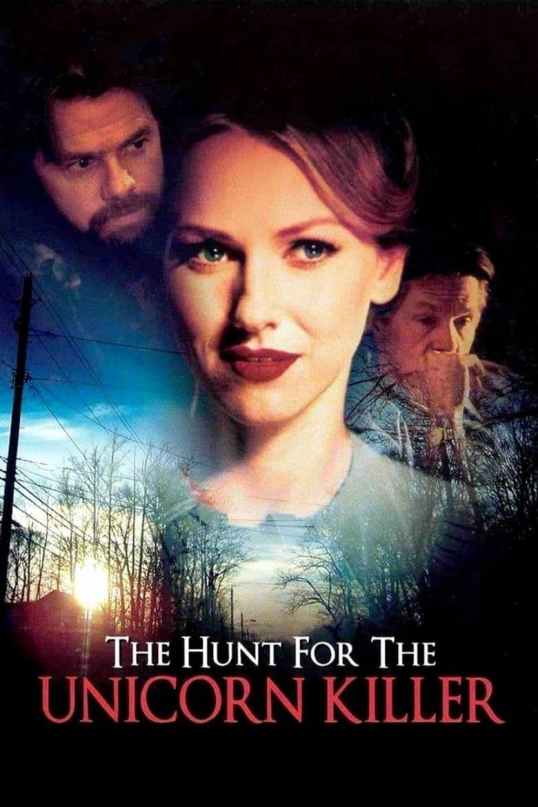
Made for television in 1999, The Hunt For The Unicorn Killer tells the story of Ira (Kevin Anderson), Holly (a pre-MulhollandDrive Naomi Watts), and Holly’s father, Fred (Tom Skerritt). It does a good job of telling the disturbing story of Ira Einhorn and it features good performances from its main stars. Tom Skerritt especially does a good job as a father determined to get justice for his daughter. The film shows how so many of Ira’s friends rationalized his actions, not wanting to admit that their nostalgia for the 60s and the counterculture was blinding them to the monster in their midst. It’s a portrait of how one evil man was able to take advantage of the idealism of others.
The Hunt For The Unicorn Killer‘s original running time was 163 minutes and it was aired over two nights. It was later edited down to 90 minutes for syndication. The uncut version is available on YouTube and that’s definitely the one to see.
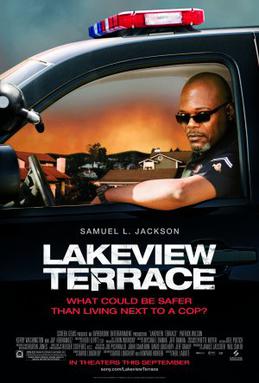 Chris and Lisa Mattson (Patrick Wilson and Kerry Washington) move in to a large house in the Lakeview Terrace neighborhood of Los Angeles. It’s a good house in a good neighborhood and it’s just too bad that their neighbor, Abel Turner (Samuel L. Jackson), is a corrupt cop who hates interracial couples.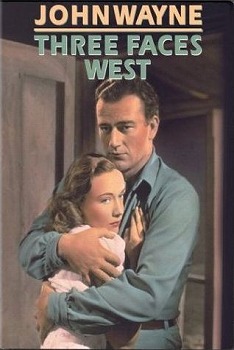
 Through the Shattered Lens