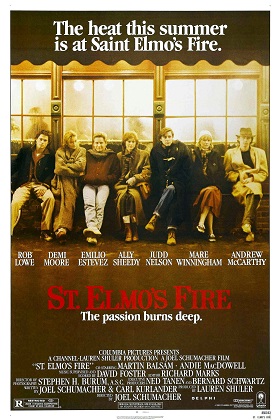
Embracing the Melodrama Part II #73: St. Elmo’s Fire (dir by Joel Schumacher)


St_elmo's_fire

Oh my God!  Aren’t rich, white people just like the worst!?

Actually, usually I would never say something like that.  I usually find class warfare to be tedious and I personally think poor people can be just as annoying as rich people.  I had no interest in the whole Occupy Wall Street thing and I once referred to V For Vendetta as being V For Vapid.

No, I may not be much of a class warrior but then again, that may be because I never met any of the characters at the center of the 1985 film St. Elmo’s Fire.  Seriously, if anything could turn me into a slogan-spouting, window-smashing revolutionary, it would be having to deal with any of the self-centered, entitled characters in St. Elmo’s Fire.

St. Elmo’s Fire is about a group of seven friends, three of whom are played by actors who co-starred in The Breakfast Club.  These friends all met at and are recent graduates from Georgetown University.  St. Elmo’s Fire follows them as they laugh, love, drink, do drugs, and try to figure out what they want to do with the rest of their lives.

For instance, there’s Billy (Rob Lowe), who has big hair and wears one dangling earring.  Billy was in a fraternity and spends most of the movie wishing that he still was.  Billy also plays the saxophone and he has a wife and a kid who he has pretty much abandoned … well, you know what?  I like Rob Lowe.  He seems like a fun guy and his DirectTV commercials were all classics but oh my God, does he ever give a bad performance in St. Elmo’s Fire.  Some of it is because Billy is not a very likable character.  He’s supposed to be the rough-around-the-edges, secretly sensitive rebel type but ultimately, he just comes across as being a loser.

And then there’s Jules (Demi Moore), who does too much cocaine and, as a result, finds herself fearing that she’s on the verge of being sold into a sexual slavery.  Jules doesn’t get to do much other than be rescued by the other characters.  Fortunately, when it looks like the group is drifting apart, Jules attempts to commit suicide and brings everyone back together.  Way to be a plot device, Jules!

Wendy (Mare Winningham) is the sweet but insecure virgin who has a crush on Billy.  Wendy works as a social worker and ends up getting insulted by the very people that she’s trying to help.  Winningham gives one of the film’s better performances but you can’t help but feel that Wendy deserves better friends.

Speaking of good performances, Andrew McCarthy also gives a pretty good one.  McCarthy plays Kevin Dolenz, the idealistic writer who everyone is convinced is gay because he hasn’t had sex in 2 years.  However, Kevin is actually in love with his best friend’s girlfriend.  As written, Kevin runs the risk of coming across as being insufferably moralistic but McCarthy gives a likable performance.  He turns Kevin into the nice guy that we all want to know.

And then there’s the Breakfast Club alumni.

Alec Newberry (Judd Nelson) was the vice-president of the Georgetown Democrats but now, because it pays better, he’s taken a job working for a Republican senator.  Alec’s girlfriend is Leslie (Ally Sheedy).  Alec obsessively cheats on Leslie, claiming that he can’t be loyal to her unless she’s willing to marry him.  The group of friends is largely centered around Alec and Leslie though it’s never really clear why.  Alec and Leslie are boring characters and, as a result, they’re a boring couple.

And then there’s Kirby (Emilio Estevez).  Estevez gives a likable performance but he often seems to be appearing in a different movie from everyone else.  Kirby is working on his law degree and he’s in love with a hospital intern named Dale (Andie MacDowell).  Unfortunately, Dale isn’t as interested in Kirby as he is in her so Kirby responds by stalking her and trying to change her mind.  There’s an earnestness and sincerity to Kirby that makes you like him, even if his behavior is actually rather creepy.

As for the film itself — well, it’s directed by Joel Schumacher and there’s a reason why Schmacher has the reputation that he does.  As a director, Schumacher is good at gathering together an attractive cast but he has close to no idea how to tell a compelling story.  St. Elmo’s Fire plods along, dutifully telling its story but providing little insight or surprise.

If you’ve read some of my previous reviews, you’re probably expecting this to be the point where I argue that St. Elmo’s Fire works as a time capsule.  But, honestly, this film doesn’t have enough insight to really work as a time capsule.  I mean, if you love 80s hair and 80s fashion, you might enjoy St. Elmo’s Fire but, then again, you could always just do a google image search and have the same basic experience.
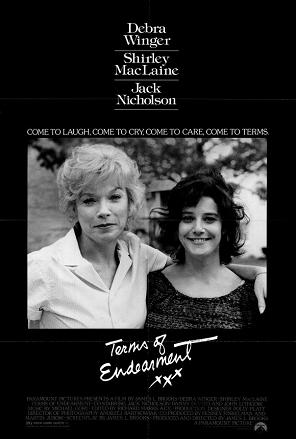
Embracing the Melodrama Part II #72: Terms of Endearment (dir by James L. Brooks)


Terms_of_Endearment,_1983_film

I have to admit that, when I first sat down and watched the 1983 best picture winner Terms of Endearment, I was actually taken by surprise.  Before I actually saw it, I was under the impression that Terms of Endearment was considered to be one of the weaker films to win best picture.  I had read a few reviews online that were rather dismissive of Terms, describing it as being well-made but overrated.

But then, a few weeks ago, I watched Terms of Endearment on Netflix.  The film started with a scene of new mother Aurora Greenwood (Shirley MacClaine) obsessively checking on her daughter, Emma.  Stepping into the bedroom, Aurora is, at first, scared that Emma’s dead.  Without bothering to take off her high heels, Aurora nearly climbs into the crib to check on her.  Fortunately, Emma starts to cry.

And I laughed because I’ve been told about how my mom used to obsessively check in on me when I was a baby.  And, while my mom was never the type to wear high heels around the house, I could still imagine her climbing into a crib to check on me and my sisters.

And then, when Emma (now played by Debra Winger) married Flap Horton (a very young Jeff Daniels) over the objections of her mother, I smiled but I didn’t laugh because, in this case, I was relating to Emma.  Because the fact of the matter is that every girl has known a boy like Flap Horton, the smart and funny guy who is destined to ultimately hurt her.

And when Flap got a job in Des Moines and Emma moved from Houston to Iowa, I knew — as did Aurora — what was going to happen.  I knew that Flap would deal with his insecurity over not being a good provider for his wife and children by cheating on his wife.  And when he did, I wanted to cry with Emma.

But then I wanted to cheer when Emma has an affair of her own.  In the role of Sam, John Lithgow doesn’t have much screen time in Terms of Endearment but he does get the best line.  When a rude cashier claims that she doesn’t feel that she was being rude to Emma, Sam replies, “Then you must be from New York.”

Meanwhile, the widowed Aurora is having an affair of her own.  Jack Nicholson plays Garrett Breedlove, a former astronaut who now has both a drinking problem and a house with a pool.  Garrett gets Aurora to loosen up.  Aurora makes Garrett realize that he actually is capable of being a decent guy.  MacClaine and Nicholson both won Oscars for their performances here and they deserved them.

And then, Emma was diagnosed with cancer.  And I cried and cried because, at this point, I had come to think of Emma and Aurora as being real people.  And when Emma told her friends that she was dying and she spent her final days with her children, I sobbed because it made me think about my mom.  And now I’m sobbing as I write this review.

But it’s a great film, even if it did make me cry.  Because, in the end, you’re glad that you got to know these characters.  And, even through the tears, the film leaves you happy that you got to spend some time with them.

And isn’t that what a great film is supposed to do?

Lisa’s Too Early Oscar Predictions for May!


oscar trailer kitties

Well, here we are!  The year is nearly halfway over and the Oscar picture … well, it’s really not that clear yet.  The Cannes Film Festival just opened and maybe that will help clear up the picture a bit.  Or maybe not.

Anyway, here are my early Oscar for predictions for May.  (In previous months, my Oscar predictions were “way too early.”  But now that we’re 5 months into 2015, the “way” can be dropped.  They’re just “too early” now.)  As is usual for any predictions made at this time of the year, these are mostly guesses, some random and some educated.  Be sure to check my predictions for January, February, March, and April as well!

(I know that rumor has it that the Academy is going to go back to only nominating five films this year.  However, I’m going to continue to make ten predictions because that’s more fun for an obsessive list maker like me.)

Last Dinosaur

Best Picture

Black Mass

Bridge of Spies

Brooklyn

Carol

Crimson Peak

The Danish Girl

The Good Dinosaur

Icon

In the Heart of the Sea

The Sea of Trees

Ben Foster in Icon

Best Actor

Johnny Depp in Black Mass

Michael Fassebender in Steve Jobs

Ben Foster in Icon

Eddie Redmanye in The Danish Girl

Jason Segel in The End of the Tour

Best Actress

Cate Blanchett in Carol

Jennifer Lawrence in Joy

Saoirse Ronan in Brooklyn

Meryl Streep in Ricki and the Flash

Lilly Tomlin in Grandma

idris-elba-beasts-of-no-nation1

Best Supporting Actor

Jim Broadbent in Brooklyn

Albert Brooks in Concussion

Joel Edgerton in Black Mass

Idris Elba in Beasts of No Nation

Kurt Russell in The Hateful Eight

meryl1-466733

Best Supporting Actress

Jessica Chastain in Crimson Peak

Jennifer Jason Leigh in The Hateful Eight

Seinna Miller in Black Mass

Parker Posey in Irrational Man

Meryl Streep in Suffragette

RonHowardJay-Z

Best Director

Guillermo Del Toro for Crimson Peak

Stephen Fears for Icon

Todd Haynes for Carol

Ron Howard for In The Heart of the Sea

Gus Van Sant for The Sea of Trees

Oscars

Embracing the Melodrama Part II #71: Cocaine: One Man’s Seduction (dir by Paul Wendkos)


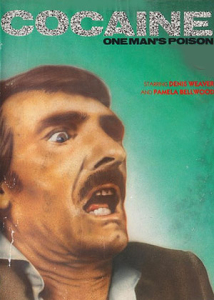
CocaineNow, I originally saw the 1983 made-for-TV movie Cocaine: One Man’s Seduction on Netflix so I have absolutely no first hand knowledge of how this film was advertised.  However, I have it on very good authority (i.e., I read it on another blog) that the image above is from the film’s VHS packaging.

Just looking at this image, you would be justified in thinking that Cocaine: One Man’s Seduction was an early David Cronenberg film.  Seriously, it looks like a deleted scene from Scanners and Dennis Weaver’s head is about to explode.

But no!  There are no scanners in Cocaine: One Man’s Seduction.  David Cronenberg did not direct this film.  As far as I can tell, it wasn’t even filmed in Canada.  Instead, Cocaine: One Man’s Seduction is about one man who gets seduced cocaine.

You may have noticed that I enjoy reminding you that this film is called Cocaine: One Man’s Seduction.  That’s because that’s a great title.  If the film had just been called Cocaine, you might watch the film expecting it to be set on a 1970s film set.  And if the film had just been called One Man’s Seduction, viewers may have watched the film expecting a Double Indemnity–style film noir.  But Cocaine: One Man’s Seduction leaves no doubt about what we’re about to see.

Add to that, it’s a very melodramatic title and the name of this series of reviews is, after all, Embracing the Melodrama Part 2!

Anyway, Cocaine: One Man’s Seduction is about a real estate agent named Eddie Grant (Dennis Weaver).  He’s the type of semi-successful white-collar suburban guy who you just know is going to have a really over-the-top midlife crisis.  He has a wife (Karen Grassle) who loves him.  He has a son (James Spader — yes, that James Spader!) who wants to put off going to college for a year.  Eddie also has a job where he’s viewed as being an over-the-hill relic.  People looking to buy a new home simply are not impressed with Eddie’s cheap suits, mild manner, and old-fashioned scotch-after-work style.

What Eddie needs is a new wardrobe and aviator sunglasses.  And, as we all know from watching movies set in the 70s and 80s, nothing gets you into aviator sunglasses faster than snorting a line of coke.

Soon, Eddie is driving a fast car, he’s wearing nicer suits, and he’s keeping a lot of secrets.  Then, one day, his son — JAMES SPADER! — happens to look inside Eddie’s shave kit and discovers where dad has been hiding his cocaine.

Now, this is where I was expecting Jeff VanVondern to show up and say, ” I see a bunch of people that love you like crazy and they feel like they are losing you. And they wanna fight to get you back.”  But apparently, people in the 80s did not need an intervention to get them to go to rehab.  Instead, they just needed to have a dramatic nose bleed at work and nearly overdose on someone else’s kitchen floor.  They also needed to be called out by James Spader.

Of course, it also helps that Eddie is friends with a recovering cocaine addict who is played by a very thin-but-already-bald Jeffrey Tambor.  Jeffrey Tambor is already something of a hyperactive actor (and that’s why we love him!) so when you combine that natural tendency with a character who is supposed to be coked up, it’s something that simply has to be seen.

Anyway, Cocaine: One Man’s Seduction is a fairly good example of the-worst-that-can-happen-will-happen cinema.  If nothing else, it has some worth as a time capsule and it’s undeniably interesting to see James Spader play a role that one would normally never associate with James Spader.

Cocaine: One Man’s Seduction is currently seducing viewers on Netflix.

Embracing the Melodrama Part II #70: Staying Alive (dir by Sylvester Stallone)


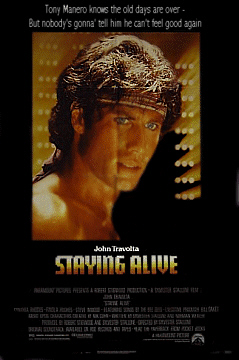
StayingaliveOh my God, this is so bad.

The 1983 film Staying Alive is a sequel to Saturday Night Fever.  That’s right, Tony Manero’s back!  And, if possible, he’s even dumber than before.

Actually, that’s not fair.  The whole point of Saturday Night Fever was that Tony really was not that dumb.  He was poorly educated.  He was a prisoner of his culture and his economic situation.  If he acted stupid, it was because he lived in a world that distrusted intelligence.  If he was selfish, it was because that was his way of dealing with his own insecurities.  If we got frustrated with him, it’s because we knew he was capable of more than he realized he was.  In Saturday Night Fever, John Travolta gave such good performance and Tony was such a carefully drawn character that we forgave him for the many times that he let us down.

But, in Staying Alive, Tony is just an idiot.  Somehow, he’s managed to escape Brooklyn.  He now works as a waiter and a dance instructor and goes on auditions for Broadway shows.  He has no contact with his old friends.  (He never even mentions the night that one of them jumped off a bridge.)  He lives in one of those scary New York flophouses — apparently the same one that Travis Bickle called home in Taxi Driver — but otherwise, Tony’s doing pretty well for himself.  The only problem is that Tony is now a complete and total moron.

That really is the only conclusion that one can draw from John Travolta’s performance here.  It’s not just that Travolta gives a bad performance in a role for which he was once nominated for an Oscar.  It’s that Travolta gives such a bad performance that he actually transcends the accepted definition of bad.  He resurrects all the tics from his Saturday Night Fever performance but he goes so overboard with them that you feel like you’re watching someone do an imitation of John Travolta playing Tony Manero than actually watching John Travolta.

Speaking of self-parody, Staying Alive was directed by Sylvester Stallone.  Now, I know that when you think of the ideal director for a dance movie, Sylvester Stallone is probably the first name that comes to mind.

As for the film itself, Tony gets a job working in the chorus of a Broadway show called Satan’s Alley and, wouldn’t you know it, he eventually replaces the male lead.  Tony finds himself torn between the bitchy (and, somewhat inevitably, British) star of the show (Finola Hughes) and his long-suffering, on-and-off again girlfriend Jackie (Cynthia Rhodes).

Jackie, incidentally, is also the lead singer in a band.  The band’s guitarist, Carl, is in love with her.  Guess who plays Carl?  Frank Stallone!  That’s right, the director’s brother.  There is a hilarious scene where Carl plays guitar while shooting a death glare at Tony.  Frank really nails that death glare.

But, ultimately, the main appeal of Staying Alive is that we get to see Satan’s Alley, which is probably the most unintentionally hilarious fake Broadway show to ever be immortalized on film.  Satan’s Alley is about one man’s journey into Hell and… well, that really sums it up, doesn’t it?  If you asked someone who has never danced, never listened to music, and perhaps never actually stepped outside of their bedroom to write a Broadway musical, chances are that they would come up with something like Satan’s Alley.

And they’d probably cast Tony Manero as the lead!

Embracing the Melodrama Part II #69: Bad Boys (dir by Rick Rosenthal)


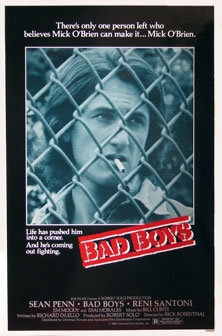
Bad_Boys_(1983_film_poster)First off, I am not about to review the Michael Bay film where Will Smith and Martin Lawrence shoot people and blow things up.  Instead, this Bad Boys is a film from 1983 where Sean Penn doesn’t shoot anyone but that’s mostly because he can’t get his hands on a gun.  And, at one point, a radio does blow up.  So, perhaps this Bad Boys has more in common with the Michael Bay Bad Boys than I originally realized.

Anyway, Bad Boys is about Mick O’Brien (Sean Penn), who is a 16 year-old criminal from Chicago.  One night, when one of his crimes goes wrong, Mick’s best friend (Alan Ruck) is killed and Mick accidentally runs over the brother of rival gang leader, Paco (Esai Morales).  Mick is sent to juvenile detention where he and his sociopathic cellmate, Horowitz (Eric Gurry), team up to overthrow the two “leaders” of their block, Viking (Clancy Brown, with scary blonde hair) and Tweety (Robert Lee Rush).  Meanwhile, Paco is arrested for raping Mick’s girlfriend, JC (Ally Sheedy), and soon finds himself living on the same cell block as Mick.

And it all leads to … violence!

(In the movies, everything leads to violence.)

Bad Boys is one of those films that seems to show up on cable at the most random of times.  I’ve never quite understood why because it’s not like Bad Boys is a particularly great film.  It’s hard to see anything about this film that would lead a programmer to say, “Let’s schedule 100 airings of Bad Boys!”  If anything, it’s the epitome of a good but not that good film.  On the one hand, you have to appreciate a film that attempts to take a serious look at both juvenile crime and the true life consequences of tossing every “lawbreaker” into a cell and locking the door.  People fetishize the idea of punishing criminals but they rarely consider whether those punishments actually accomplish anything beyond satisfying society’s obsessive need for revenge.  (And it’s interesting to note that the problems of 1983 are not that much different from the problems of 2015.)  On the other hand, Bad Boys is way too long, heavy-handed, and repetitive.  This was one of Sean Penn’s first roles and, much like the film itself, he’s good without being that good.  Watching his performance, you get the feeling that James Dean would say, “Nice try.”

However, the film is saved by two actor.  First off, there’s Clancy Brown as the stupid but intimidating Viking.  With his bad skin, blonde hair, and a permanent snarl on his face, Brown makes Viking into a character who is both ludicrous and scary.  And then there’s Eric Gurry as the small and demonic Horowitz.  According to his imdb page, Gurry long ago retired from acting but anybody who sees Bad Boys will never forget him.

Embracing the Melodrama Part II #68: Mazes and Monsters (dir Steven Hilliard Stern)


M_M_DVDIt’s amazing the things that you find when you randomly search the DVD section of Half-Price Books.  For instance, I found a very cheap DVD of the 1982 made-for-TV film Mazes and Monsters and I simply had to buy it.

Why?

Well, just look at the cover above.  Look at the ominous castle.  Look at the shadowy dragons flying around it.  Look at that Shining-style maze.  Look at the ominous tag line: “Danger lurks between fantasy and reality.”  And especially be sure to look at Tom Hanks gazing serenely over it all.

“Wow,” I thought, “Tom Hanks fights a dragon?  This is something that I’ve got to see!”

Well, there are no dragons in Mazes and Monsters.  There are a few monsters but they’re only briefly seen figments of Tom Hanks’s imagination.  The film is about a group of college students who obsessively play an RPG called Mazes and Monsters.  When one of the students (an annoying genius who wears wacky hats and is played by an actor with the surprisingly poetic name of Chris Makepeace) suggests that they play Mazes and Monsters “for real” in some caverns near the college, it leads to Robbie (Tom Hanks) have a mental breakdown.  Soon, Robbie is convinced that he’s actually a monk.  He breaks up with his girlfriend because he doesn’t want to violate his vow of celibacy.  (Of course, the real fantasy is that a college student obsessed with playing Mazes and Monsters would have a girlfriend in the first place but anyway…)  He keeps seeing imaginary minotaurs lurking in the shadows.  Finally, he runs off to New York on a quest to find “the great Hall.”  It’s up to his friends to find him and hopefully impart an important lesson about the dangerous reality of RPG addiction.

Or something.

Listen, to be honest, if not for Tom Hanks, there would be no reason to watch Mazes and Monsters.  It’s poorly acted.  It’s written and directed with a heavy hand.  There’s some nice shots of downtown New York City but otherwise, it’s visually drab.

But, because Tom Hanks is in it and he’s playing a role that demands that he go totally over-the-top in his performance, Mazes and Monsters is totally worth watching.  If you’ve ever wanted to see Tom Hanks wander around New York City while dressed like a monk, this is the film for you.  If you’ve ever wanted to see Tom Hanks start to tremble while explaining that, as a monk, he’s not allowed to kill minotaurs, this is the movie for you.  Most of all, if you’ve ever wanted to see Tom Hanks shrieking, “THERE’S BLOOD ON MY KNIFE!” while standing in an old school phone booth, this is definitely the movie for you!

Seriously.

Considering that Tom Hanks is currently viewed as being some sort of elder statesman of American film (and, even more importantly, Hanks seems to view himself as being some sort of national treasure), there’s something oddly satisfying about seeing him before he became THE Tom Hanks.  It’s good to be reminded that, at one time, he was just another young actor doing his best in a crappy made-for-TV movie.

Embracing the Melodrama Part II #67: Split Image (dir by Ted Kotcheff)


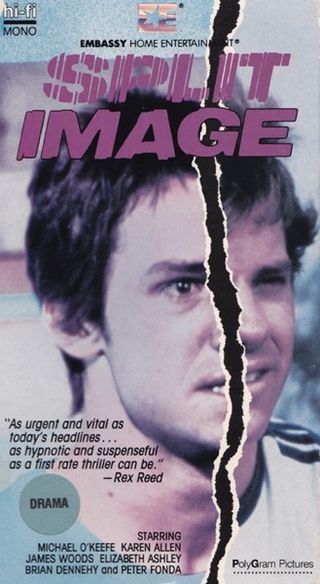
Split_Image_VHS_coverUnlike Desperate Lives, the 1982 melodrama Split Image is available to be viewed on YouTube.  In fact, you can watch it below and I suggest that you do so.  It’s a pretty good film and, apparently, it’s never been released on DVD or Blu-ray and it’ll probably never be available on Netflix either. So, if you’ve ever wanted to see Peter Fonda play a cult leader, your best bet is to watch the video below.

But before you watch the video, here’s a little information on Split Image, one of the best films that you’ve never heard of.

Essentially, the film follows the same plot as the Canadian film Ticket To Heaven.  A college athlete (played by Michael O’Keefe) starts dating a girl (Karen Allen) who is a member of a sinister religious cult.  Soon, O’Keefe is a brainwashed member of the cult and only answering to the name of Joshua.  (The head of the cult is played, in an appropriately spaced-out manner, by Peter Fonda.)  His parents (Brian Dennehy and Elizabeth Ashley) hire a cult deprogrammer (James Woods) to kidnap their son and break Fonda’s hold on him.  However, it turns out that Woods’ methods are almost as psychologically destructive as Fonda’s manipulation.

Even if it’s not quite as memorably creepy as Ticket To Heaven, Split Image is still a well-made film, featuring excellent performances from Dennehy, Woods, O’Keefe, and Fonda.  However, for me, the most interesting thing about Split Image is that it was largely filmed and set down here in Dallas.  Just watch the scene where Woods and his men attempt to kidnap Michael O’Keefe.  It was shot on the campus of Richland Community College, which is one of the places where I regularly go to run.

(Interestingly enough, 33 years after the release of Split Image, Richland still looks exactly the same!)

You can watch Split Image below!


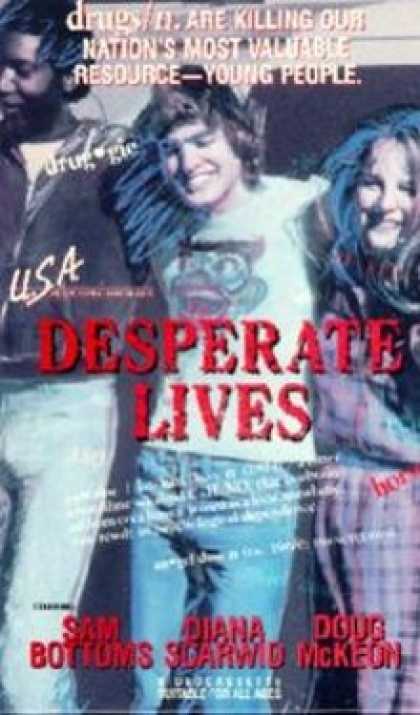
Embracing the Melodrama Part II #66: Desperate Lives (dir by Robert Michael Lewis)


DL-cov2YouTube, my old friend, you have failed me.

For the longest time, the 1982 anti-drug melodrama Desperate Lives has been available for viewing on YouTube.  I first watched it two years ago, after I read an online article about a scene in which a teenage Helen Hunt takes PCP and jumps through a window.  And, when I watched it, I was stunned.  I knew that the film was going to be over-the-top and silly, largely because it’s hard to imagine how a film featuring a teenage Helen Hunt taking PCP could be anything other than that.  But, even with my experience of watching over the top message movies, nothing could have quite prepared me for Desperate Lives.

So, I figured, for this review, that I’d say a few snarky words about Desperate Lives and then I’d just add something like, “And you can watch it below!”  And then I would embed the entire movie and all of y’all could just click on play and watch a movie on the Lens.

Unfortunately, Desperate Lives has been taken off of YouTube.  I assume the upload violated some sort of copyright thing.  And really, it’s kinda stupid because seriously, Desperate Lives is one of those films that really deserves to be seen for free on YouTube.

Oh well.  You can still watch a video of Helen Hunt jumping through that window.  The video below also features some additional elements from Desperate Lives.

For instance, you get to see Diana Scarwid playing the angriest high school guidance counselor in the world.  Scarwid knows that students like Helen Hunt are using drugs and that her fellow faculty members are turning a blind eye to everything’s that’s happening.  From the minute she first appears on screen, Scarwid is shouting at someone and she doesn’t stop screaming until the film ends.

And you also get to see Doug McKeon, playing Helen Hunt’s brother.  McKeon goes for a drive with his girlfriend, who has just taken PCP herself.  As their car goes flying off a mountain, she says, “Wheeee!”

In the video below, you also get to see that the only reason Helen Hunt used drugs was because her boyfriend begged her to.  That’s a scenario that seems to show up in a lot of high school drug films and it’s strange because it’s something that I’ve never actually seen happen or heard about happening in real life.  In fact, in real life, most users of hard drugs are actually very happy to not share their supply.

Unfortunately, the video below does not feature any scenes of Sam Bottoms as the world’s most charming drug dealer and that’s a shame because he gives the only good performance in the entire film (sorry, Helen!).

Even worse, the video doesn’t include any scenes from the film’s memorably insane conclusion, in which Scarwid searches every single locker in the school and then interrupts a pep rally so she can set everyone’s stash on fire in the middle of the gym.  Making it even better is that all the students are so moved by Scarwid’s final speech that they start tossing all of the drugs that they have on them into the fire.

Which means that the film essentially ends with the entire school getting high off of a huge marijuana bonfire.

No, that scene cannot be found in the video below.  But you can find Helen Hunt jumping through a window so enjoy.

Film Review: Stockholm, Pennsylvania (dir by Nikole Beckwith)


MV5BMTYwODA2NzA0Nl5BMl5BanBnXkFtZTgwMjk0Mzg4MzE@._V1_SY317_CR47,0,214,317_AL_I think I’m going to start writing Stockholm, Pennsylvania fanfic.  It’s not that I’m a fan of this particular movie.  It’s just that, after watching it last night, I’m convinced that I could probably write a better version of the same story.  At the very least, I could come up with a better ending.

(And who knows?  Pennsylvania is technically close enough to Canada that I could do a Degrassi/Stockholm crossover.)

Stockholm, Pennsylvania premiered on Lifetime last night and, as a result, it will always be known as being a Lifetime movie.  However, unlike such excellent films as Babysitter’s Black Book and Fab Five: The Texas Cheerleader Scandal, Stockholm was not originally made for television.  Instead, it was meant to be the feature film directorial debut of playwright Nikole Beckwith.  Earlier this year, it played at the Sundance Film Festival, where it received some memorably mixed reviews and the film’s star, Saoirse Ronan, received more attention for her work in Brooklyn.  And while Brooklyn was picked up by Fox Searchlight and declared an early Oscar contender, Stockholm, Pennsylvania was ultimately purchased by the Lifetime network.

Unfortunately, Stockholm, Pennsylvania is not the type of film that is served well by premiering on television.  For the first 45 minutes or so, it’s a low-key film that moves at its own deliberate and moody pace.  The film doesn’t have the right rhythm to remain compelling when combined with frequent commercial interruptions.  And make no mistake about it — the interruptions were frequent!  The 99 minute film was padded out with enough commercials so that, on television, it ran for 2 hours and 30 minutes.

Or, as I put it on twitter when I discovered that the movie wasn’t as close to being finished as I had originally assumed:

The film opens with kidnapping victim Leanne (Saoirse Ronan) being returned to her parents after spending 17 years living in the basement of Ben McKay (Jason Isaac).  As we see in flashbacks, Ben kept Leanne isolated from the rest of the world and raised her as his own daughter.  Ben also renamed her Leia but, at the same time, he apparently never let her watch any movies.  (“He said I was named after a princess,” Leia cluelessly says at one point.)  Ben also taught Leia to regularly pray to the Universe (“Dear Universe…”) and … well, that’s all we really learn about Leia’s relationship with Ben.  And while I love cinematic ambiguity, the ambiguity of Stockholm, Pennsylvania just feels lazy.

Having been rescued (under circumstances that are left ambiguous because this is a lazy fucking movie), Leia is reunited with her parents, Marcy (Cynthia Nixon) and Glen (David Warshofsky).  Leia doesn’t remember either of them and resists all of Marcy’s awkward attempts to force any sort of emotional relationship.

And, for the first half of the film, it’s actually fairly interesting.  Nixon gives a good performance and Ronan proves again that she’s one of the best actresses working today.  The film is moody and properly creepy and I was really interested in seeing what would happen…

And then, out of nowhere, an entirely different movie started.  Suddenly, Marcy’s character completely and totally changed.  Nixon stopped giving a good performance and instead became shrill and one-note.  Ronan continued to give a good performance but the entire film crashed and burned around her.  It all led up to quite possibly one of the worst endings that I have ever seen.  It was seriously one of those endings that made me want to throw my high heels at the TV.

Seriously, it was terrible.  In fact, it was so terrible that it didn’t matter that the first 45 minutes of the movie were not neccesarily bad.  It did not matter that Saoirse Ronan was giving a great performance.  It did not matter … well, nothing mattered.

Once I saw that ending, all I could think of was that I had just wasted two hours and 30 minutes on a film that was apparently made by someone who studied both Martha Marcy May Marlene  and We Need To Talk About Kevin without ever understanding what made those two films worth studying in the first place.

Saoirse Ronan saved the film from being a complete disaster.  It truly says something about her talent that she can give a good performance even when appearing in something like Stockholm, Pennsylvania (or Lost River for that matter).  She’s like Meryl Streep without the condescending attitude.

I’m looking forward to seeing Saoirse Ronan’s work in Brooklyn.  But Stockholm, Pennsylvania is best forgotten.

stockholm-pennsylvania