Here’s The Super Bowl TV Spot For Teenage Mutant Ninja Turtles: Out of The Shadows


Hi!  Captain American, Jason Bourne, and the X-Men weren’t the only ones to be featured in Super Bowl advertisements tonight!  The Teenage Mutant Ninja Turtles showed up as well.  And while I have less than zero desire to see this film, I know that there are plenty of people out there who disagree with me.  So, with those people in mind, here’s the ad for Teenage Mutant Ninja Turtles: Out Of The Shadows!


Here’s Who Won At The DGA (or The Unexpected Virtue of Making History)


The_Revenant_2015_film_poster

The Director’s Guild of America handed out their awards tonight and history was made!  (And the Oscar race got a little bit more complicated.)  First off, Alex Garland won the award for Best First-Time Feature Director for Ex Machina.  Then Cartel Land somehow defeated Amy for Best Documentary Direction.

And then Alejandro G. Inarritu was named Best Director for The Revenant!  This makes Inarritu the first film director to ever win back-to-back awards from the Director’s Guild.  As you may remember, he previously won for Birdman and when was the last time anyone thought about that damn movie?  (For the record, I thought the Revenant was far superior to Birdman.)

So, to recap, the Production Guild gave its top award to The Big Short.

The SAG gave its top award for Spotlight.

And now, the DGA — which is traditionally the most reliable of all the precursors — gave its top award to The Revenant!

In other words, for the first time in my lifetime, there are three films that seem to have a legitimate shot at winning best picture when the Oscars are awarded later this month.

Of the 8 films that were nominated, my personal favorite would be Brooklyn, which realistically has no chance of winning the top prize.  (Carol was my favorite film of the year but it was not nominated.)  However, there’s a part of me that still hopes that — despite not winning at the PGA or the DGA — Mad Max: Fury Road will pull off an upset.  Sadly, that probably won’t happen.  Not only would a Mad Max victory be a nice (and popular) surprise but it would completely redefine the stodgy old assumptions about what type of films qualify for Oscar consideration.

If The Big Short wins, it will be the biggest travesty since the victory of Crash.

Lifetime Movie Review: Manson’s Lost Girls (dir by Leslie Libman)


MLG

I know way too much about the crimes of Charles Manson.

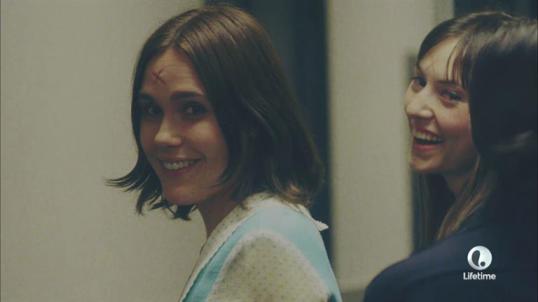
I realized that, earlier tonight, as I watched the latest Lifetime original film, Manson’s Lost Girls.  It was one of the better films that I’ve recently seen on Lifetime and it was certainly superior to NBC’s Aquarius, the TV show that tried to turn Manson into some sort of sexy anti-hero.  (Memo to NBC:  Walter White was a great anti-hero.  Charles Manson was just a grubby little serial killer.)  Manson’s Lost Girls was well-acted and it did a fairly good job of portraying the 60s without falling back on too many of the usual clichés (at no point was White Rabbit heard on the soundtrack), and it also did a pretty good job of portraying how certain lost people can be brainwashed by one cunning sociopath.

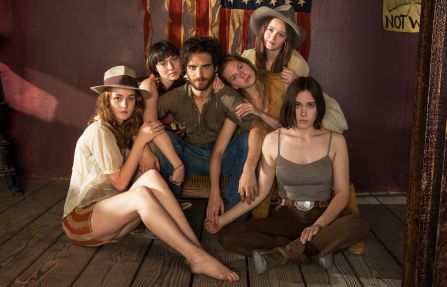
Yet, with all that in mind, I found myself watching the film and thinking, Where is Bruce Davis?  Where’s Clem Grogan?  What about Catherine Share, whose parents were both members of the resistance during the Nazi occupation of Germany just for their daughter to end up a brainwashed member of Manson’s Family?”  For whatever reason, the Family portrayed in Manson’s Lost Girls was considerably smaller than the real-life Family and seriously, how disturbing is that?  I mean, the 10-member cult in Mason’s Lost Girls was bad enough but, in real life, there were even more of them!  How disturbing is that!?  But, in retrospect, it’s even more disturbing that I knew enough about the Family to know that Bruce Davis, Clem Grogan, and Catherine Share were all missing from the film.

(Actually, I just looked at the credits on the imdb and I saw that Diana Irvine is credited as playing Catherine.  So, perhaps Catherine Share was included as a character and I just didn’t notice.)

When I was 16, I took a sociology class in high school.  One of the class assignments was to do a report on a subculture.  I did my report on vampires and the less said about that the better.  However, the hot and troubled guy who sat in front of me did his report on the Manson Family.  As a part of his report, he handed out a little booklet that had pictures of all the Family members in it.  I can remember looking through those pictures and thinking that Charles Manson looked scary and that Tex Watson was kind of hot, in a rebellious son of an evangelical preacher sort of way.  (Tex Watson spent a semester at North Texas State University.  Four decades later, I went to NTSU — or UNT as its now called.  Around the campus, you can find pictures of famous former students like Joe Don Baker, Peter Weller, Pat Boone, and Roy Orbison.  For obvious reasons, you will never find a picture of Charles “Tex” Watson.)  But, as I listened to the details of Manson’s crimes and his belief that the Beatles were sending him secret messages and that those messages justified murder, I found myself wondering how any of the fresh-faced people in those pictures could have possibly believed a word that Manson said.  It just seemed so weird and …. stupid.

(By the end of the presentation, Tex Watson no longer looked hot.)

And I have to admit that I was a bit intrigued by it all.  It wasn’t that I had any sympathy for those murderers.  But I found myself wondering how they could have done what they did.  I wondered how so many different people from different background could come together and all buy into the same stupid bullshit.  Though I didn’t realize it at the time, I was struggling to understand the very nature of evil.  To most people, it was easy enough to say that Manson and his followers were evil but I wanted to know how they had become evil.  I wanted to understand why and, though I may not have wanted to admit it, I wanted to make sure that I never woke up to discover that I had made the same mistake of surrendering my free will to a some nut just because he was able to look at me and tell that I had issues with my father.

By telling the story of Linda Kasabian (played quite well by MacKenzie Mauzy), Manson’s Lost Girls attempts to answer that question.  Linda was a young mother who, after her drug dealing husband deserted her, found herself living on the Spahn Movie Ranch with Manson and the Family.  Linda spent a month with Manson.  At first, she felt as if she had a found a new home and a new family but soon, things started to unravel.  In hopes of bringing about a race war (and also looking for vengeance over his own failure to become a rock star), Manson ordered his followers to commit murder.  Linda witnessed the tragic and brutal murder of actress Sharon Tate and her friends.  After the murders, Linda fled the Family and she would later serve as the prosecution’s star witness in Manson’s murder trial.

Manson’s Lost Girls is told almost totally from Linda’s point of view.  It’s through her that we are introduced to Manson and his Family.  The film doesn’t quite succeed in giving us a definitive answer as to how Manson could get people to kill for him but, then again, there may not be a definitive answer.  Fortunately, Manson’s Lost Girls does provide hints.  In her narration, Linda emphasizes that Manson kept everyone perpetually wasted.  But, even more importantly, the film highlights that, for these brainwashed future murderers, the Family truly was a family.  They were lost.  They were rejected by conventional society.  And when they met Manson, they were given a chance to belong.  The film suggests that need to belong and to be a part of something greater than what they had left all the members of the Family vulnerable to Charlie’s manipulations.

Manson was played by Jeff Ward, who did a pretty good job in the role.  Wisely, the film didn’t overplay Manson’s charisma or attempt to turn him into some sort of supervillain.  (In short, it didn’t make the same mistake as Aquarius.)  Instead, it portrayed him as what he probably was — a grubby hustler with a massive chip on his shoulder.  As played by Ward, Manson is less a messiah and more an extremely lucky con artist.  Manson’s Lost Girls deserves credit for portraying Manson without a hint of glamour.

The film suggests that Manson’s rampage was largely motivated by his bitterness over not being able to get a record contract.  As I watched, I found myself what would have happened if Manson had gotten that contract.  Would he now be remembered as one of those obscure musicians from the 60s and 70s whose later career was made up of performing at fairs and cheap clubs?  Or, if he had found success, would he have eventually ended up as a mentor on an early episode of American Idol?

Far more importantly, I found myself wondering what the future would have held for his most famous victim, Sharon Tate?  Sharon gave a such good performance in Valley of the Dolls, one that suggested she was capable of a lot more than she had been given credit for.  Would she have continued to grow and develop as an actress?  And what of her unborn son?  If not for Manson and his followers, Paul Polanski would now be 46 years old.

Manson’s Lost Girls does not linger on the murders.  They largely happen off-screen and, for that, I’m thankful.  But, at the same time, it never shies away from the real-life tragedy of Manson’s crimes.  And, even if the film did not have all the answers, it did remind us why the questions must be asked.  In the end, Manson’s Lost Girls reminds us of what evil can come from surrendering our independence and our free will.

It’s a film that reminds us that no matter how lost we may be, we must always be careful about those who claim to have found us.  Instead of waiting for others to find us, we must find ourselves.
MansonGirls_Group07172015_JZ_0020.psd_copy

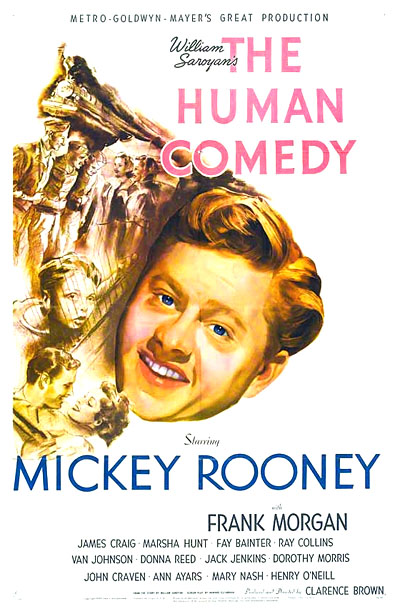
Lisa Reviews An Oscar Nominee: The Human Comedy (dir by Clarence Brown)


The-human-comedy-1943Thanks to TCM’s 31 Days of Oscar, I now have several movies on my DVR that I need to watch over the upcoming month.  Don’t get me wrong — I’m not complaining.  I’m always happy to have any reason to discover (or perhaps even rediscover) a movie.  And, being an Oscar junkie, I especially enjoy the opportunity to watch the movies that were nominated in the past and compare them to the movies that have been nominated more recently.

For instance, tonight, I watched The Human Comedy, a film from 1943.  Along with being a considerable box office success, The Human Comedy won on Oscar (for Best Story) and was nominated for four others: picture, director (Clarence Brown), actor (Mickey Rooney), and black-and-white cinematography.  The Human Comedy was quite a success in 1943 but I imagine that, if it were released today, it would probably be dismissed as being too sentimental.  Watching The Human Comedy today is something of a strange experience because it is a film without a hint of cynicism.  It deals with serious issues but it does so in such a positive and optimistic manner that, for those of us who are used to films like The Big Short and Spotlight, a bit of an attitude adjustment is necessary before watching.

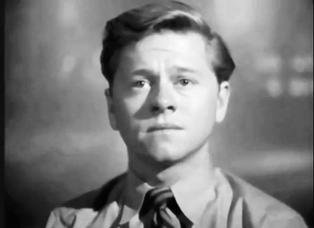
And yet that doesn’t mean that The Human Comedy is a bad film.  In fact, I quite enjoyed it.  The Human Comedy is a time capsule, a chance to look into the past.  It also features a great central performance, one that was quite rightfully nominated for an Oscar.  As I watched Mickey Rooney in this film, I started to feel guilty for some of the comments I made when I reviewed Mickey in The Manipulator last October.

2Mickey Rooney in The Human Comedy

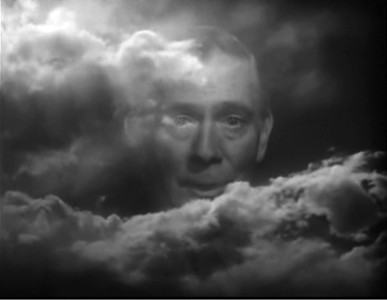
The Human Comedy opens with an overhead shot of the small town of Ithaca, California.  The face of Mr. McCauley (Ray Collins, who you’ll recognize immediately as Boss Jim Gettys from Citizen Kane) suddenly appears in the clouds.  Mr. McCauley explains that he’s dead and he’s been dead for quite some time.  But he loves Ithaca so much that his spirit still hangs around the town and keeps an eye on his family.  Somehow, the use of dead Mr. McCauley as the film’s narrator comes across as being both creepy and silly.

Matthew-clouds-400-387x300

But no sooner has Mr. McCauley stopped extolling the virtues of small town life than we see his youngest song, 7 year-old Ulysseus (Jack Jenkins), standing beside a railroad track and watching a train as it rumbles by.  Sitting on the cars are a combination of soldiers and hobos.  Ulysseus waves at some of the soldiers but none of them wave back.  Finally, one man waves back at Ulysseus and calls out, “Going home, I’m going home!”  It’s a beautifully shot scene, one that verges on the surreal.

That opening pretty much epitomizes the experience of watching The Human Comedy.  For every overly sentimental moment, there will be an effective one that will take you by surprise.  The end result may be uneven but it’s still undeniably effective.

The majority of the film deals with Homer McCauley (Mickey Rooney).  Homer may still be in high school but, with his older brother, Marcus (Van Johnson), serving overseas and his father dead, Homer is also the man of the house.  Homer not only serves as a role model for Ulysseus but he’s also protector for his sister, Bess (Donna Reed).   (At one point in the film, she gets hit on by three soldiers on leave.  One of them is played by none other than Robert Mitchum.)  In order to bring in extra money for the household, Homer gets a job delivering telegrams.

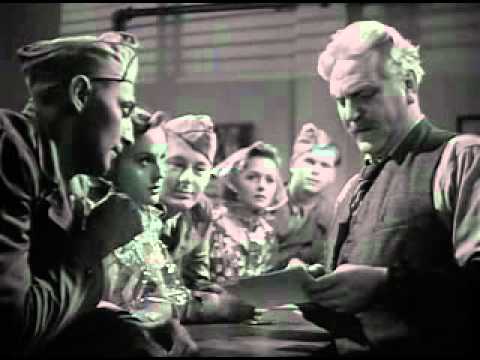
hqdefault

In between scenes of Homer in Ithaca, we get oddly dream-like scenes of Marcus and his army buddies hanging out.  Marcus spends all of his time talking about how much he loves Ithaca and how he can’t wait for the war to be over so he can return home.  One of his fellow soldiers says, “I almost feel like Ithaca is my hometown, too.”  Marcus promises him that they’ll all visit Ithaca.  As soon as the war is over…

With World War II raging, Homer’s job largely consists of delivering death notices (and the occasional singing telegram, as well).  Telegraph operator Willie Grogan (Frank Morgan) deals with the burden of having to transcribe bad news by drinking.  Homer, meanwhile, tries to do his job with compassion and dignity but one day, he has to deliver a telegram to his own house…

The Human Comedy is an episodic film, full of vignettes of life in Ithaca and Homer growing up.  There’s quite a few subplots (along with a lot of speeches about how America is the best country in the world) but, for the most part, the film works best when it concentrates on Homer and Mickey Rooney’s surprisingly subdued lead performance.  By today’s standards, it may seem a bit predictable and overly sentimental but it’s also so achingly sincere that you can’t help but appreciate it.

The Human Comedy was nominated for best picture but it lost to a somewhat more cynical film about life during World War II, Casablanca.

Here’s the Latest Trailer For Demolition!


Much like Miles Ahead, Demolition is another film that was briefly pegged as a certain 2015 Oscar nominee until its release date was moved back to 2016.  Jean-Marc Vallee’s follow-up to the wonderful Wild, Demolition features Jake Gyllenhaal as a recent widower who struggles to deal with his grief.

I have to admit that I’ve seen the first trailer for Demolition about a hundred times now (it plays before every film at the Alamo Drafthouse) and I’m kind of sick of listening to Gyllenhaal talk about that damn vending machine.  That said, I’ll watch Jake Gyllenhaal in just about anything.  If I could force myself to sit through Southpaw, I’m sure I’ll be able to handle Demolition when it opens in April.

Here’s the latest trailer for Demolition!  Unfortunately, it opens with that same endless vending machine monologue but it does go on to reveal that one of my favorite actresses, Naomi Watts, is in the film as well.  So, that’s a good thing.

Here’s The Trailer for Miles Ahead!


With Miles Ahead, Don Cheadle both directs and stars as jazz legend Miles Davis.  Originally expected to be released at the end of last year, Miles Ahead is also a film that many of us were expecting to be a definite Oscar contender.  However, the film’s release was delayed, the Oscar nominations led to #OscarsSoWhite trending on twitter for the second year in a row, and Miles Ahead will finally be released in April of this year.

And here’s the trailer!  With a few notable exceptions — like Grand Budapest Hotel — it’s rare that anything too good is ever released in March or April.  But I remain cautiously optimistic, if just because of the pairing of Don Cheadle and Ewan McGregor.

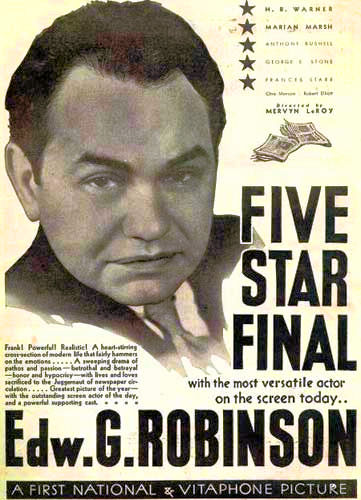
Lisa Reviews An Oscar Nominee: Five Star Final (dir by Mervyn LeRoy)


Five_Star_Final_1931_poster

In 1911, a pregnant secretary named Nancy Voorhees (Frances Starr) shot and killed her boss and lover.  It was quite a scandal at the time but, twenty years later, it has largely been forgotten.  Nancy has married a successful businessman named Michael Townsend (H.B. Warner) and is a respected member of society.  Her daughter, Jenny (Marian Marsh), has no idea about Nancy’s past and believes Michael to be her father.  Jenny is now engaged to marry the handsome and rich Phillip Weeks (Anthony Bushnell).

Everything seems to be perfect but you know what they say about perfection.

Bernard Hincliffe (Oscar Apfel) is the publisher of a struggling tabloid newspaper.  He is frustrated by city editor Joseph Randall (Edward G. Robinson) and Randall’s refusal to do whatever it takes to boost circulation.  “Why, he won’t even print pictures of women in their underwear!” one of Hincliffe’s assistants exclaims.  Finally, Hincliffe orders Randall to publish a series of articles that will take a retrospective look at both the scandal and what has happened to those involved in the years since.  At first, the cynical Randall refuses but eventually, he gives in.

He assigns two reporters to crack the story.  One of them, Kitty Carmody (Ona Munson) is first introduced showing off her legs and bragging about how there’s no way that she won’t be hired to work at the newspaper.  (By the way, if anyone ever remakes Five Star Final and needs someone to play Kitty, I am ready and available.)  The other is the incredibly creepy T. Vernon Isopod (Boris Karloff).  Isopod was a divinity student until he was arrested on a “morals charge.”  Now, he pretends to be a minister as a way to fool people into revealing their deepest secrets to him.  Kitty and Isopod dig into the life of Nancy and Michael.  The stories appear on the front page.  Suicide and melodrama follow and Randall is forced to finally take a stand.

Released in 1931, Five Star Final was nominated for best picture but lost to Grand Hotel.  Seen today, Five Star Final is undeniably stagey (it was based on a play) but it’s still a compulsively watchable melodrama, featuring good performances and a lot of memorably snappy 30s dialogue. Five Star Final is one of several films about journalism to have been nominated for best picture.  Most of these films — like All The Presidents Men, The Front Page, and this year’s front-runner, Spotlight — have featured journalists as heroic seekers of the truth.  Five Star Final, on the other hand, plays more like a pre-Code version of Network set at a newspaper.  It’s a deeply angry film and, when Randall finally tells off Hincliffe, it feels like the 30s equivalent of Peter Finch shouting that he’s mad as hell and not going to take it anymore.

Finally, the best part of the film, for me, was Boris Karloff as the sleazy Isopod.  Karloff made Five Star Final right before he played the creature in Frankenstein and it’s interesting to see him play a totally different type of monster here.  If I had to choose which character is scarier, I’m going with T. Vernon Isopod.

Prepare To Cringe Your Way Through The Red Band Trailer For Green Room!


OH MY GOD!

So, here’s the thing: there is an intense moment towards the end of the just released red band trailer for Green Room that is literally bone snapping.  I saw it, I heard it, and I literally threw my hands over my eyes and went, “Agck!”

Green Room is about a punk band who finds themselves fighting for their lives against Patrick Stewart and a bunch of Neo-Nazis.  The red band trailer (which you can watch below) is seriously intense!  Now I have to admit that I’ve reached a point of exhaustion when it comes to film violence but I’m still going to see Green Room because it was directed by Jeremy Saulnier, who previously directed the brilliant (and unapologetically violent) Blue Ruin.  Saulnier’s involvement promises that, at the very least, Green Room will be a hundred times better than Kevin Smith’s Red State.

Anyway, here’s the trailer!


You Are The Shooter! Here’s The Trailer for Pandemic!


Here’s the trailer for the upcoming action film, Pandemic.  It’s a zombie apocalypse film that is entirely shot in the first person.  Judging from the trailer … well, it looks kinda awkward.  Since you’re viewing the film through the eyes of a soldier, I imagine that a good deal of the film will be made up of people telling the solider (and by extension, you) to do things.  I don’t know about you but I would have a problem with that.  I don’t like being told what to do, I’m not good at following orders, and I think I would resent a film that would suggest otherwise.

Then again, I really loved Unfriended and that was also shot in the first person.  So, I will try to keep an open eye.  (Not to mention an open mind!)

(Assuming, of course, that I actually see Pandemic…)