Lisa Reviews an Oscar Winner: The Sting (dir by George Roy Hill)


Earlier tonight, as a part of their 31 Days of Oscar, TCM aired The Sting, the film that the Academy selected as being the best of 1973.  I just finished watching it and what can I say?  Based on what I’ve seen of the competition (and there were a lot of great films released in 1973), I would not necessarily have picked The Sting for best picture.  However, the movie is still fantastic fun.

The Sting reunited the director (George Roy Hill) and the stars (Robert Redford and Paul Newman) of Butch Cassidy and the Sundance Kid and told yet another story of likable criminals living in the past.  However, whereas Butch Cassidy largely satirized the conventions of the traditional Hollywood western, The Sting is feels like a loving homage to the films of 1930s, a combination of a gritty, low-budget gangster film and a big budget musical extravaganza.  The musical comparison may sound strange at first, especially considering that nobody in The Sting randomly breaks out into song.  However, the musical score (which is famously dominated by Scott Joplin’s The Entertainer) is ultimately as much of a character as the roles played by Redford, Newman, and Robert Shaw.  And, for that matter, the film’s “let-pull-off-a-con” plot feels like an illegal version of “let’s-put-on-a-show.”

The film takes place in the 1936 of the cultural imagination, a world dominated by flashy criminals and snappy dialogue.  When con artists Johnny Hooker (Robert Redford) and Luther Coleman (Robert Earl Jones) inadvertently steal money from a gangster named Lonnegan (Robert Shaw), Lonnegan has Luther murdered.  Fleeing for his life, Hooker goes to Chicago where he teams up with Luther’s former partner, veteran con man Henry Gondorff (Paul Newman).  Gondorff used to be one of the great con artists but he is now living in self-imposed obscurity, spending most of his time drinking and trying to avoid the FBI.  Hooker wants to get revenge on Lonnegan by pulling an elaborate con on him.  When Gondorff asks Hooker why, Hooker explains that he can either con Lonnegan or he can kill him and he doesn’t know enough about killing.

The rest of the film deals with Hooker and Gondorff’s plan to con Lonnegan out of a half million dollars.  It’s all very elaborate and complicated and a bit confusing if you don’t pay close enough attention and if you’re ADHD like me.  But it’s also a lot of fun and terrifically entertaining and that’s the important thing.  The Sting is one of those films that shows just how much you can accomplish through the smart use of movie star charisma.  Redford and Newman have such great chemistry and are so much fun to watch that it really doesn’t matter whether or not you always understand what they’re actually doing.

It also helps that, in the great 70s tradition, they’re taking down stuffy establishment types.  Lonnegan may be a gangster but he’s also a highly respected and very wealthy gangster.  When Newman interrupts a poker game, Lonnegan glares at him and tells him that he’ll have to put on a tie before he’s allowed to play.  Lonnegan may operate outside the law but, in many ways, he is the establishment and who doesn’t enjoy seeing the establishment taken down a notch?

As entertaining as The Sting may be and as influential as it undoubtedly is (Steven Soderbergh’s Ocean films may be a lot more pretentious — which makes sense considering that Soderbergh is one of the most pretentious directors in film history — but they all owe a clear debt to The Sting), it still feels like an unlikely best picture winner.  Consider, for instance, that The Sting not only defeated American Graffiti and The Exorcist but Ingmar Bergman’s Cries and Whispers as well.  On top of that, when you consider some of the films that were released in 1973 and not nominated — Mean Streets, Badlands, The Candy Snatchers, Day of the Jackal, Don’t Look Now, Jesus Christ Superstar, and The Long Goodbye — it’s debatable whether The Sting should have been nominated at all.  That’s not a criticism of The Sting as much as it’s an acknowledgement that 1973 was a very good year in film.

So, maybe The Sting didn’t deserve its Oscar.  But it’s still a wonderfully entertaining film.  And just try to get that music out of your head!
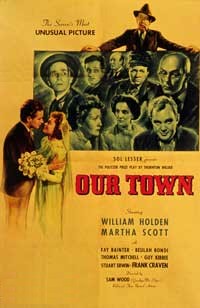
Lisa Reviews an Oscar Nominee: Our Town (dir by Sam Wood)


Original_movie_poster_for_the_film_Our_Town_(1940_film)

(SPOILERS BELOW!  THE END OF THIS FILM WILL BE REVEALED!  I will also be revealing who played George Gibbs but that’s probably not as big a spoiler.  It depends how you look at it.)

I was only 15 years old when I first read Our Town.  Because I was a theater nerd, I knew a little about the play.  For instance, I knew it took place in a small town.  I knew that it was narrated by a character known as the Stage Manager.  I knew that the play was meant to be performed on a bare stage, with no sets or props.  What I did not know, as I innocently opened up that booklet, is that Our Town is probably one of the most traumatically depressing plays ever written.

When the stage manager appears at the start of the play and talks about the town of Grover’s Corner, he lulls you into believing that you’re about to see a sentimental, comedic, and old-fashioned celebration of small town life.  We meet the characters and they all seem to be quirky in a properly non-threatening way.  Joe Crowell shows up delivers a newspaper to Doc Gibbs.  The stage manager mentions that Joe will eventually grow up to attend to M.I.T.

“Awwwww!  Good for Joe!” the audience says.

And, the Stage Manager goes on to inform us, as soon as Joe graduates, he will be killed in World War I, his expensive education wasted.

Okay, the audience thinks, that was a dark moment but this play was written at a time when World War I was still fresh on everyone’s mind.  Surely the rest of the play will not be quite as dark…

And fortunately, George Gibbs and Emily Webb show up.  They’re young, they’re likable, and they’re in love!  George and Emily get married and they’re prepared to live a long and happy life in our town!  Good for them!  YAY!

And then Act III begins…

Oh my God, Act III.  Act III begins with almost everyone dead.  Emily died in child birth so she hangs out at the local cemetery and talks to all the other dead people, the majority of whom only have vague memories of their former lives.  Emily relives the day of her 12th birthday and discovers that it’s too painful to remember what it was like to once be alive.  Emily asks the Stage Manager if anyone truly appreciates life.  The Stage Manager replies, “No.”  In the world of the living, George Gibbs sobs over his wife’s grave….

And the play ends!

OH MY GOD!

Seriously, reading Our Town was probably one of the most traumatic experiences of my life!

The 1940 film version of Our Town is a little less traumatic because it changes the ending.  In the film version, Emily doesn’t die.  She nearly dies while giving birth to her second child and the entire third act of the play is basically portrayed as being a near-death hallucination.  But, in the end, she survives and she comes through the experience with a new found appreciation for life.

And it’s certainly the type of happy ending that I was hoping for when I first read the play but, as much as I hate to admit it, the story works better with Emily dying than with Emily surviving.  The play presents death as being as inevitable as life and love and it makes the point that there’s nothing we can do to truly prepare for it.  By allowing Emily to live, the film gives us a ray of hope that wasn’t present anywhere else in Our Town.  The happy ending feels inauthentic.  If Emily could live then why couldn’t Joe Crowell?  For that matter, why did Emily’s younger brother have to die of a burst appendix on a camping trip?

But, other than the changed ending, Our Town is a pretty good adaptation of the stage play.  While the film features an actual set (as opposed to the bare stage on which theatrical versions of Our Town are meant to be performed), director Sam Wood does a good job of retaining the play’s surreal, metatheatrical style.  Making good use of shadow and darkness, Wood and cinematographer Bert Glennon made Grover’s Corner seem like a half-remembered memory or a fragment of a barely cohesive dream.

Frank Craven, who originated the role on Broadway, is properly dry as the Stage Manager and, in the role of Doc Gibbs, Thomas Mitchell is so sober and respectable that it’s hard to believe that, in just 6 years, the same actor would play the delightfully irresponsible Uncle Billy in It’s A Wonderful Life.  Emily and George are played by Martha Scott and an impossibly young William Holden, both of whom give wonderfully appealing performances.

With the exception of that changed ending, Our Town is a worthy adaptation of a classic play.  It was nominated for Best Picture but lost to another literary adaptation, Alfred Hitchcock’s Rebecca.

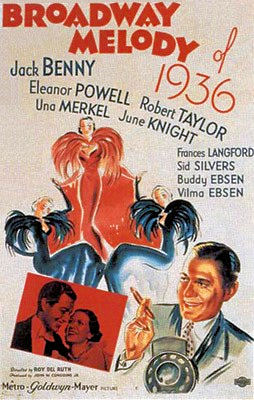
Lisa Reviews An Oscar Nominee: Broadway Melody of 1936 (dir by Roy Del Ruth)


PosterBroadwayMelody1936_01

It’s Oscar month and you know what that means!  It’s time for TCM to do their annual 31 Days of Oscars!  For the next 31 days, TCM is going to be showing movies that were nominated for and occasionally won Oscars.  This is a great month for me because it has long been my goal to see and review every single film that has ever been nominated for best picture.  Considering that close to 500 movies have been nominated, that’s no small task.  However, over the past four years, I have definitely made some progress, as you can see by clicking on this link and looking at a list of every single best picture nominee.  Thank you, TCM, for helping me get closer to my goal!

For instance, if not for TCM, how would I ever had the chance to watch Broadway Melody of 1936?  Broadway Melody of 1936 was one of the twelve films to be nominated for best picture of 1935 but it’s now largely forgotten.  When film loves discuss the best musicals of the 30s, it’s rare that you ever hear mention of Broadway Melody of 1936.

Technically, it can be argued that Broadway Melody of 1936 was the first sequel to ever be nominated for best picture, despite the fact that it has little in common with Broadway Melody, beyond taking place on Broadway and being nominated for best picture.  (Broadway Melody won the award.  Broadway Melody of 1936 lost to Mutiny on the Bounty.)  Silence of the Lambs, The Godfather, Part II, Mad Max: Fury Road, Toy Story 3, and The Bells of St. Mary’s are all sequels that were nominated for best picture but Broadway Melody of 1936 did it first.

As for what Broadway Melody of 1936 is about … well, it’s really not about anything.  Oh, don’t get me wrong.  The film has a plot.  Irene Foster (Eleanor Powell) wants her former high school boyfriend, Broadway director Robert Gordon (Robert Taylor), to cast her in his new show but Gordon refuses because he doesn’t want the innocent Irene to be exposed to the sordid world of show business.  Fortunately, Irene has some allies who are willing to help her get that role.  Ted Burke (Buddy Ebsen) is an appealingly goofy dancer who, at one point, wears a Mickey Mouse sweatshirt.  Bert Keeler (Jack Benny) is a columnist who rattles off his “New Yawk cynical” dialogue in the style of most 1930s news reporters.

Broadway Melody of 1936 has a plot but it’s not really that important.  The story is just an excuse for the songs and the dance numbers.  And while none of the numbers are spectacular (especially when compared to other 30s musicals, like 42nd Street), they are all definitely likable.

Seen today, Broadway Melody of 1936 seems like an odd best picture nominee.  It’s not bad but there’s nothing particularly great about it.  To truly appreciate the film, it’s probably necessary to try to imagine what it was like to watch the film in 1935.  At a time when the country was still in the throes of the Great Depression, Broadway Melody of 1936 provided audiences with an escape.  Audiences could watch the film and imagine that they, just like Eleanor Powell, could leave behind the dullness of reality and find stardom in the glamorous and glitzy world of Broadway.

Never doubt the power of escapism.


A Few Thoughts on The X-Files 10.3 “Mulder & Scully Meet The Were-Monster”


x_files-fox

After watching last night’s episode of The X-Files, I finally feel like I’m starting to get it.  You have to realize that I came into this revival with only a casual knowledge of what the whole show was about.  Since I didn’t watch the show when it originally aired and have only seen a few reruns (and the movies, neither of which did much for me), I’ve often felt rather detached from all the excitement that’s been generated by the revival.

And the previous two episode did not help.  My Struggle was a mess.  The second episode was a definite improvement but still, it did not exactly blow me away.  I watched these episodes and I assumed that The X-Files was one of those revivals that would largely succeed only on the strength of nostalgia for the show it once was.

But then I watched last night’s episode, the wonderfully titled Mulder & Scully Meet The Were-Monster.  After two episodes that occasionally felt as if they were straining a bit too hard to be taken seriously, Mulder & Scully Meet The Were-Monster was a comedic deconstruction of the whole “cult-show-about-paranormal-investigators” genre.  While never quite slipping into the realm of self-parody, the episode had a lot of fun with the conventions of the show.

It also had a lot of fun with David Duchovny’s performance as Fox Mulder.  Duchovny is one of those confident actors who is always more likable when he’s befuddled.  A good deal of the pleasure of last night’s episode came from watching Mulder literally stumble through the plot.

As for the plot itself, it was wonderfully nonsensical.  Someone is murdering random people.  Is it a frightening lizard-like creature that some of the locals have spotted?  Well, there is a lizard-like creature but he’s not the murderer.  The murderer is Pasha, a sociopathic animal control officer, played by the always welcome Kumail Nanjiani.  You pretty much know that Pasha is the murderer from the minute you see him, if just because there’s no other reason for him to be played by a familiar actor.  When Pasha is unmasked as the killer and arrested, he starts to give the usual lengthy explanation for his crimes, just to be ignored by Mulder.  Mulder mentions that he’s sick of serial killer profiling.  Take that, Criminal Minds!

The Were-Monster of the title was played by Rhys Darby, who we all remember and love as Murray on The Flight of the Conchords.  It turns out that the Were-Monster was a lizard creature who was bit by a man and who now cursed to turn into a man whenever the sun rises.  Whenever the Were-Monster transforms into Guy Mann (that’s the name it uses!), he has to worry about stuff like holding down a job and impressing other people by lying about his sex life.  Poor Guy!  But, at least he wasn’t a murderer and at least he wasn’t successful in his attempt to convince Mulder to kill him.

(You can’t kill Murray!  He was the last Bret!)

Hopefully, the quality and sheer fun of Mulder & Scully And The Were-Monster is a sign of things to come as far as the remaining episodes of The X-Files are concerned.


Scenes That I Love: Happy Groundhog Day!


Today’s scene that I love comes from Groundhog Day!  In this scene, Bill Murray speaks truth to power and let’s us all know what the future holds for us!

(Incidentally, I believe that, earlier today, the groundhog did not see his shadow, which means that we’re going to have an early spring.  Bleh!  I was hoping for a longer winter, if just because I’d like to get some snow down here.  I’m tired of living vicariously through my blizzard-addled friends in the North!)

Oh my God, Ulli Lommel’s Back and So Is The Boogeyman…


PCAS

Apparently, Ulli Lommel is taking a break from making low-budget serial killer biopics to make another sequel to his 1980 film, The Boogeyman!  This sequel will be titled Boogeyman: Reincarnation, which is an improvement over the previous Boogeyman sequel, Revenge of the Boogeyman.

(As a film blogger writing about Ulli Lommel, I am now contractually obligated to point out that Revenge of the Boogeyman was largely made up of flashbacks to the first Boogeyman film.)

Now, here at the Shattered Lens offices, we have a long-running debate going over whether Ulli Lommel or Uwe Boll is the worst director of all time.  Usually, I pick Lommel but let’s give credit where credit is due.  Both The Boogeyman and The Devonsville Terror had plenty of spooky atmosphere.  They certainly were far better than Curse of the Zodiac or any of Lommel’s more recent films.

(As a film blogger writing about Ulli Lommel, I am now contractually obligated to point out that Curse of the Zodiac is the worst film ever made.)

And the trailer for Boogeyman: Reincarnation may not look great but it doesn’t look as bad as most of Lommel’s films.  In fact, I would even say that Boogeyman: Reincarnation looks almost good enough to be mistaken for a Bill Rebane film!

Anyway, here’s the trailer for Boogeyman: Reincarnation, which has no release date but which will probably end up on Netflix at some point in the future.


Here’s What Won At The SAG Awards


Howdy, y’all!  The SAG Awards were given out tonight but I did not see it because I was busy down at City Limits Texas, watching Joey Green and Luke Wade and gettin’ my country on!  (Boots and denim, y’all!)  So, I missed the show but I can still post the winners!  Spotlight won the SAG equivalent of Best Picture so it looks like right now, the best picture race is pretty much between that film and the PGA winner, The Big Short.  But what if George Miller or Alejandro Inarritu ends up winnin’ at the DGA?  This Oscar race is gettin’ as unpredictable as a cow chewin’ magic mushrooms.  Yee haw!

ANYWAY, here’s the winners!

BEST PERFORMANCE BY A CAST ENSEMBLE – “Spotlight“
BEST PERFORMANCE BY A MALE ACTOR IN A LEADING ROLE – Leonardo DiCaprio in “The Revenant”
BEST PERFORMANCE BY A FEMALE ACTOR IN A LEADING ROLE – Brie Larson in “Room”
BEST PERFORMANCE BY A MALE ACTOR IN A SUPPORTING ROLE IN A MOTION PICTURE – Idris Elba in “Beasts of No Nation”
BEST PERFORMANCE BY A FEMALE ACTOR IN A SUPPORTING ROLE IN A MOTION PICTURE – Alicia Vikander in “The Danish Girl”
BEST PERFORMANCE BY A CAST ENSEMBLE IN A DRAMA SERIES – “Downton Abbey“
BEST PERFORMANCE BY A MALE ACTOR IN A DRAMA SERIES – Kevin Spacey in “House of Cards”
BEST PERFORMANCE BY A FEMALE ACTOR IN A DRAMA SERIES – Viola Davis in “How to Get Away with Murder”
BEST PERFORMANCE BY A CAST ENSEMBLE IN A COMEDY SERIES – “Orange is the New Black“
BEST PERFORMANCE BY A MALE ACTOR IN A COMEDY SERIES – Jeffrey Tambor in “Transparent”
BEST PERFORMANCE BY A FEMALE ACTOR IN A COMEDY SERIES – Uzo Aduba in “Orange is the New Black”
BEST PERFORMANCE BY AN ACTOR IN A TV MOVIE OR MINI-SERIES – Idris Elba in “Luther”
BEST PERFORMANCE BY A FEMALE ACTOR IN A TV MOVIE OR MINI-SERIES – Queen Latifah in “Bessie”
BEST PERFORMANCE BY A STUNT ENSEMBLE IN A MOTION PICTURE – “Mad Max: Fury Road“
BEST PERFORMANCE BY A STUNT ENSEMBLE IN A COMEDY OR DRAMA SERIES – “Game of Thrones“
LIFETIME ACHIEVEMENT AWARD – Carol Burnett

(By the way, y’all, I love you all…)

It’s Great Detective Pikachu!


Apparently, it’s not just Satan who is solving crimes…

Look, I’ll just be absolutely honest here.  I know next to little about Pokemon.  I neither speak nor read Japanese.  I don’t have the slightest damn idea what is actually going on in the video below but it sure is cute!

Apparently, Great Detective Pikachu will be released on Nintendo 3DS in Japan on February 3rd, 2016.  There’s no set date for a Western release.

Scenes I Love: Oh my God! Teen Witch!


So, I’ve never actually sat through the 1989 movie Teen Witch but, thanks largely to Val and her review of the second Nightmare On Elm Street film, I have sat through several YouTube clips.  Fortunately, Teen Witch is going to be coming to Netflix in February so I’ll be able to get some context to go along with the two scenes below.

First off, there’s this scene featuring a bunch of suburban teenagers telling each other to “top that!”  It’s hard to know where to start with this scene.  I’ve watched it a countless number of times and I’m still not quite sure what to make of it.  The main theme seems to be that teenagers in the 80s were incredibly lame but I’ve seen Fast Times At Ridgemont High, The Breakfast Club, and Say Anything so I know that can’t be totally true.

Another odd thing about this clip is that looking at the guy wearing the suspenders fills me with an indescribable rage.  If I ever ran into the actor, I would probably end up yelling at him, freaking him out, and then feeling really bad about it afterwards.

ANYWAY!  Here’s the Top That scene from Teen Witch!  It’s a scene that I love despite myself:

And here’s the second scene from Teen Witch that I love, the I Like Boys musical number.  Seriously, if I didn’t know this was a low-budget teen movie from the 80s, I would think it was a documentary filmed at J.J. Pearce High School.

I’ll be so happy once February arrives and I will finally be able to put these two scenes into the larger context that is Teen Witch.

A Few Thoughts On … The X-Files 10.2 “Founder’s Mutation”


x_files-fox

Last night, I promised that I wait for the second episode of The X-Files revival before passing too much judgment on the series as a whole.  One reason why that was an easy promise to make was that the 2nd episode was scheduled to air less than 24 hours after the first one.  And since I’m coming down with a cold, I was home and able to watch that 2nd episode.

The 2nd episode was a definite improvement over the first.  For one thing, it told an actual story that felt like more than just a collection of hastily compiled scenes.  There were still some weaknesses, though I’ve been told that some people consider these weaknesses to be strengths.  For instance, I will never be a fan of the muttering.  I understand that this is a show about secrets and conspiracies and that people dealing with secrets often speak in low voices but seriously, I could not hear about half of the dialogue.  Beyond that, the episode still suffered from some of the bad editing that marred My Struggle.  With the exception of Mulder’s fantasy about his son, the final few minutes of the show especially felt a bit hasty and abrupt.

There were other moments when I was painfully aware that this was a revival of a show that went off the air 14 years ago.  The opening credits featured pictures of David Duchovny and Gillian Anderson from the original series and it was a bit jarring to realize just how much these two have aged over the past decade.  As I watched Mulder and Scully investigating a mysterious death and a mad scientist, it was hard not to notice that both of them seemed to be moving a bit slower than they did in the past.

And then there was the scene in which a potential witness mistook Mulder for being gay.  That scene felt very 1999.

But otherwise, the 2nd episode worked pretty well.  It was nothing great but it had a few creepy moments and the scene in the pool totally freaked me out.  (Not to mention the sheer length of the blade the Scully pulled out of that guy’s ear.)  If nothing else, it seems to indicate that, should The X-Files revival go on past these 6 episodes, it will be a solid enough show.  It may never be great but it will be entertaining enough.

As for my favorite part of tonight’s episode, it was when Scully and then Mulder imagined what would have happened if they hadn’t given their son William up for adoption.  (On twitter, I suggested that the baby should be called Sculder but apparently, everyone’s sticking with William.)  It was interesting to note that both Scully and Mulder fantasized about having an ideal relationship with their son but, in both cases, that fantasy ended with a moment of sudden terror.  If nothing else, it showed the psychological effects of not being able to trust anyone or anything.

William will probably show up before this season ends.  I imagine it will be in the final episode and things will probably wrap up with one of those open-ended finales that will make fans of the show scream, “Bring back The X-Files!  We promise we’ll buy anything advertised during the show!”

Anyway, based on the 2nd episode, I would say The X-Files has earned its revival.