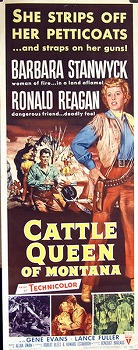
Cattle Queen of Montana (1954, directed by Allan Dwan)


Pop Jones (Morris Ankurm) and his daughter Sierra Nevada (Barbara Stanwyck) leave their ranch in Texas and head up to Montana to take over some land that Pop has inherited.  Evil Tom McCord (Gene Evans) wants the land for himself and conspires with a member of the local Blackfoot tribe, Natchakoa (Tony Caruso), to take it over.  After a surprise attack leaves Pop dead, Sierra is nursed back to health by Colorados (Lance Fuller), the son of the Blackfoot chief.  Sierra tries to reclaim her land from McCord, with the eventual help of the mysterious gunslinger Farrell (Ronald Reagan).

There are a lot of reasons why this B-western doesn’t really work, a huge one of them being that Barbara Stanwyck was several years too old to be playing Morris Ankrum’s innocent daughter.  The biggest problem though was casting Ronald Reagan as a mysterious gunslinger.  Farrell is a character who is supposed to keep us guessing.  We’re not supposed to know if he’s a good guy or a bad guy.  But as soon as Ronald Reagan shows up and starts to speak, we know everything we need to know about Farrell.  There was nothing enigmatic or even dangerous about Ronald Reagan’s screen persona.  He came across as being more open and honest as just about any other actor from Hollywood’s Golden Age.  For the role of Farrell, it appears that he went a day without shaving and he tried not to smile while on-camera but he’s still good old dependable Ronald Reagan.  That pleasantness and lack of danger may have kept him from becoming an enduring movie star but it did serve him very well when he moved into the political arena.

Cattle Queen of Montana was one of the 200 westerns that Allan Dwan directed over his long career.  It’s not one of his more interesting films, though he does manage a few good action sequences.  A far better Dwan/Reagan collaboration was Tennessee’s Partner, which was released four years after this film.
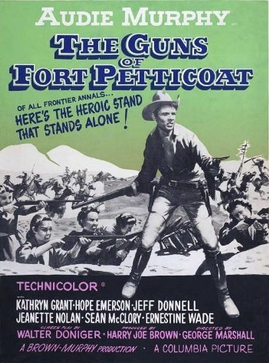
The Guns of Fort Petticoat (1957, directed by George Marshall)


During the waning days of the Civil War, Lt. Frank Hewitt (Audie Murphy) is a man without a country.  A Texan, he joined the Union Army even as his home state was voting to secede from the United States.  In the Army, Hewitt is viewed with distrust by his autocratic superior, Col. John Chivington (Ainslie Pryor).  When Hewitt learns that Chivington has ordered a surprise attack on an unarmed local Indian tribe in order to drive them into Texas where they will attack the nearest settlement for revenge, Hewitt deserts the Army to warn the people left in his hometown.

When Hewitt arrives, he discovers that all of the men in town have left to join the Confederate Army.  Only their wives, mothers, and sisters remain.  Though Hewitt is, at first, accused of being a traitor, he sticks around and trains the women on how to fight not only the incoming Comanches but also any outlaws who ride into town looking to take advantage of the situation.

The Guns of Fort Petticoat is an interesting B-western that holds up well today.  Even though the film ends with a Comanche attack, it’s made clear that the attack would not have happened if not for the actions Col. Chivington.  Chivington, who doesn’t care that the victims of his actions would not be Confederate soldiers but instead just helpless woman and children, is the film’s true villain, even if he only appears in the first and final scenes.  Audie Murphy, who was America’s most decorated World War II veteran, not only starred in but produced the movie.  Murphy was a stiff actor but he looked believable in uniform and obviously knew how to convincingly shoot a rifle and that’s all this role really demands of him.  Kathryn Grant plays the woman who goes from distrusting Hewitt to falling in love with him and she and Murphy work well together.  The final battle between the women and the Comanches is exciting and well-shot by veteran western director George Marshall.  The movie’s final scene may not be totally believable but it’s still very satisfying.

Fans of the western genre and Audie Murphy will find much to enjoy about The Guns of Fort Petticoat.

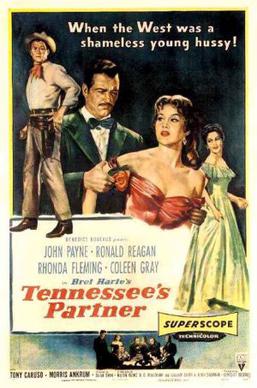
Tennessee’s Partner (1955, directed by Allan Dwan)


Tennesse (John Payne) is an old west gambler who co-owns a saloon (and bordello) with Elizabeth Farnham (Rhonda Fleming).  When Tennessee is ambushed after a poker game, he’s saved by a local man who goes by the name of Cowpoke (Ronald Reagan).  Tennessee and Cowpoke become fast friends but when Tennessee realizes that Cowpoke is about to marry a golddigger (Coleen Gray), Tennessee puts the woman on the next boat out of town.  Cowpoke vows to get vengeance but Tennessee has bigger things to worry about.  Rival businessman Turner (Tony Caruso) has framed Tennessee for the murder of a local prospector, Grubstake McNiven (Chubby Johnson).

Very loosely based on a short story by Bret Harte, Tennessee’s Partner has surprisingly high production values for a B-western.  Director Allan Dwan started his career in the 1910s and directed over 200 westerns.  He knew how to keep the action moving.  Tennessee’s Partner is also the only film that old friends John Payne and Ronald Reagan made together.  Reagan, whose days as a major studio leading man had ended by the time he made this film, gives one of his better performances in the role of the simple but honest Cowpoke and shows the likability that he was later able to translate into a political career.  Reagan could be a stiff actor but his naturally amiable manner made him perfect for best friend and sidekick roles, like in this movie.  Payne also gives a good performance as the gambler with a moral code.  However, the best thing about the film is Rhonda Fleming, giving a tough and sexy performance as Elizabeth.  Because this film came out in 1955, it couldn’t really come out and say that Elizabeth was a madam and the saloon was a bordello but Fleming’s performance and a few lines of innuendo left little doubt about what was actually going on upstairs from the bar.  Keep an eye out for Angie Dickinson, playing one of Elizabeth’s girls.

The performance elevate Tennessee’s Partner, making it a B-western that can be enjoyed even by people who aren’t necessarily into westerns.

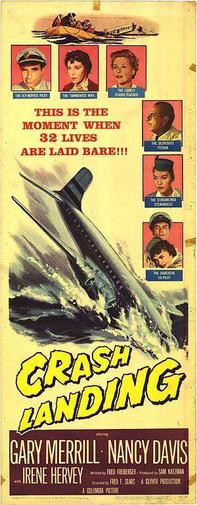
Crash Landing (1958, directed by Fred F. Sears)


Flying from Lisbon to New York City, a commercial airline is flying over the ocean when two of its engines fail.  When the propellers fail to restart, Captain Steve Williams (Gary Merrill) realizes that he will have to land the plane in the ocean.  The Navy is standing by to rescue the passengers.  It’s just a question of whether or not Steve and his crew can land the plane without injuring the passengers or causing the plan to break in half.

This is a disaster film that doesn’t really have a disaster.  The members of the crew all work professionally and efficiently to make sure that the landing is a success, even though none of them have ever had to ditch a plane before.  The Navy shows up on time and ready to help.  With one exception, the passengers react calmly and do what they’re told.  An Orthodox priest prays for the plane.  The flight attendants neatly pack all of the kitchen utensils.  The only drama comes from a boy who is traveling with his dog Wilbur and is upset to hear that Wilbur will have to stay in the back of the plane, where he will probably drown.  The boy’s father says, “I’ll buy you a new dog,” and the boy asks that his baseball cap be placed by Wilbur’s cage so that Wilbur knows his owner was thinking of him.  Don’t worry kid!  Steve Williams isn’t going to let your dog die.

It’s strange to see a disaster film without any real drama.  The crew thinks that Williams can be overbearing but it turns out he knows what he’s doing.  At home, his wife (Nancy Davis, in her final film role) thinks that Steve is too hard on their son.  Their son is going to grow up knowing how to land airplanes in water.  This is almost the Sully origin story.  Otherwise, the film emphasizes the way that everyone works together and doesn’t panic.  The scene where the plane lands in the water features some good special effects but otherwise, the movie is pretty dull.  It could have used Leslie Nielsen and Peter Graves.

Actress Nancy Davis retired from movies after this one but she remained in the public eye as the wife of future President Ronald Reagan.

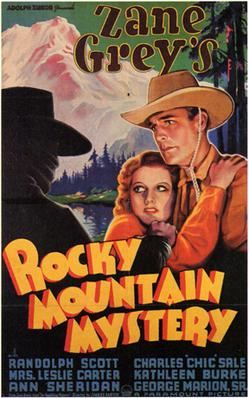
Rocky Mountain Mystery (1935, directed by Charles Barton)


Larry Sutton (Randolph Scott) is an engineer who has been sent to take over operations at a radium mine that is owned by the Ballard family.  Previously, Larry’s bother-in-law was in charge of the mine but he has disappeared and is suspected of having murdered the foreman at the Ballard Ranch.  With Jim Ballard (George F. Marion) on his deathbed and being cared for by the foreman’s wife (Caroline Dudley, credited as Mrs. Leslie Carter), Ballard’s nieces (Ann Sheridan and Kathleen Burke) and nephew (Howard Wilson) have come to the ranch to find out about their inheritance.

Soon, a cloaked figure starts to murder Ballard’s heirs, one-by-one.  Working with eccentric Deputy Sheriff Tex Murdock (Chic Sale), Larry tries to discover the identity of the killer and keep the mine from falling into the wrong hands.

Rocky Mountain Mystery is unique in that it is a Randolph Scott western that takes place in what was then modern times.  Even though both Larry and Tex prefer to ride horses, the murderer tries to escape in a car, people use phones, and the entire plot revolves around a radium mine.  The film mixes the usual western tropes of grim heroes, eccentric lawmen, and valley shoot-outs with a dark mystery that actually holds your attention while you’re watching the film.  Always ideally cast in these type of films, Randolph Scott is both tough and intelligent as Larry Sutton.  He may be a cowboy but he’s a detective too.  Scott gets good support from a cast of familiar faces.  Ann Sheridan is especially good as the niece who knows how to handle a rifle.

These B-westerns can be a mixed bag but Rocky Mountain Mystery held my attention with a plot that was actually interesting and a strong performance from Randolph Scott.  Watch it and see if you can guess who the identity of the Ballard Ranch murderer.

Electric Dreams (1984, directed by Steve Barron)


Electric Dreams is a film about a love triangle between a man, his neighbor, and his personal computer.

Miles (Lenny Von Dohlen) is an architect who wants to develop a special brick that can withstand earthquakes.  One of his colleagues suggests that he buy something called a — let me check my notes to make sure I got it right — com-put-er.  Apparently, computers can do anything!  Miles is skeptical but he decides to give it a try.

(In all fairness, this movie came out at a time when there were no iPhones or even laptops and personal computers were viewed as being strange and exotic. )

Miles get his computer and it’s basically one of those boxy computers that used to populate computer labs in high schools across the country.  As soon as I saw the computer, I wanted to play Oregon Trail.  After the computer overheats and Miles tries to cool it down by pouring champagne on it (!), the computer comes to life.  Now voiced by Burt Cort, the computer develops a crush on Mile’s neighbor, a cellist named Madeleine (Virginia Madsen).  The computer hears Madeleine playing her cello and composes its own music to play with her.  Madeleine hears the music and assumes that Miles must be a great composer.  Soon, Miles and Madeleine are falling in love and the computer is getting jealous.  The computer composes more more music for Miles but grows angry when Miles doesn’t give the computer any credit.  Even though the computer can’t move from the desk and has to be plugged in to work, it still manages to wreck havoc with Miles’s life.  When this movie came out, the idea of someone’s entire life being electronically monitored and recorded probably seemed like an out-there idea.  Today, that’s just a normal Tuesday for most people.

Electric Dreams is a mix of romance, comedy, and science fiction.  The scenes of Miles and Madeleine falling in love are mixed with scenes of the computer basically having a nervous breakdown and conspiring to ruin Miles’s credit and even trap him in his apartment.  Electric Dreams is probably the most good-natured film ever made about a computer run amuck.  The computer doesn’t mean to hurt anyone, it’s just jealous and feeling neglected.  It’s a weird mix but the movie is so dedicated to its premise and Lenny Von Dohlen and Virginia Madsen are so appealing as the romantic leads that it works.  Electric Dreams proves that true love can conquer all, even in the Computer Age.

Music Video of the Day: When Loves To Town by U2, featuring B.B. King (1987, directed by Phil Joanou)


Back in the day and before they became synonymous with failed product promotions, U2 was actually a pretty cool band.  In this video for When Love Comes To Town, they team up with the great BB King.  The performance was recorded for the 1987 documentary film, Rattle and Hum, and the video features scenes and outtakes from that film.  The video won the MTV Movie Award for Best Music Video From A Film.

Today, it’s easy to see some warning signs of U2’s high self-regard while watching a documentary like Rattle and Hum.  Even back then, Bono was of the opinion that he was the lead singer of the most important band in the history of the world and he wasn’t going to let you forget it.  But this was Joshua Tree-era U2 and they were so good that no one cared that Bono could be self-important.  He had earned the right.  It’s a shame that the band will forever be associated with the Songs of Innocence fiasco because back in the day, they rocked.

As for this song, it was a success for both U2 and BB King.  Even after U2 stopped regularly performing it, When Love Comes To Town remained a part of BB King’s setlist.

Enjoy!

Top Of the World (1997, directed by Sidney J. Furie)


Ray Mercer (Peter Weller) has just gotten out of prison and already, he and his wife Rebecca (Tia Carrere) are heading to Nevada for a quicky divorce.  However, a stopover in Las Vegas leads to Ray having a run of luck in a casino owned by Charles Atlas (Dennis Hopper).  Ray and Rebecca start to reconsider their divorce but their reconciliation is temporarily put on hold when the casino is robbed by a bunch of thieves led by Martin Kove.  Because of Ray’s criminal history, the police (led by David Alan Grier) consider Ray to be the number one suspect.  Ray and Rebecca try to escape from the casino and clear Ray’s name, leading to a night on nonstop action and an explosive climax at the Hoover dam.

One thing that you can say about Top of the World is that it certainly isn’t boring.  The action starts earlier and lasts nonstop until the end of the movie.  No sooner has Ray escaped from one scrape than he finds himself in another.  Despite the low-budget, the action scenes are often spectacularly staged and exciting to watch.  Another thing that you can say about Top of the World is that, for a B-movie, it certainly has a packed cast.  Along with Weller, Carrere, Hopper, Grier, and Kove, the movie also finds room for Peter Coyote, Joe Pantoliano, Ed Lauter, Gavan O’Herlihy, Eddie Mekka, Cary-Hiroyuki Tagawa, and even Larry Manetti of Magnum P.I. fame.  This movie paid off a lot of mortgages and probably funded more than a few vacations.

One thing you can’t say about Top of the World is that it makes any sense.  It doesn’t.  There are so many holes in the plot that you could fly a helicopter through them and that’s exactly what this film does.  But with the nonstop action and the entertaining cast, most people won’t mind.  I certainly didn’t!

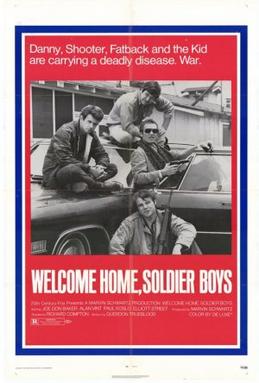
Welcome Home, Soldier Boys (1971, directed by Richard Compton)


Talk about embarrassing!  When Lisa told me that today was Joe Don Baker’s birthday, I decided that I would review Speedtrap, as 1977 car theft movie that Lisa and I watched last week.  But, when I took a look at the imdb to double check the name of the character that Baker played in Speedtrap, I discovered that I had already reviewed it!

Instead of talking about Speedtrap a second time, I’m going to recommend one of Joe Don Baker’s early films.  In Welcome Home, Soldier Boys, Baker stars as Danny, the leader of a group of Green Berets who have just returned from Vietnam and can no longer find a place in society.  Danny, Kid (Alan Vint), Shooter (Paul Koslo), and Fatback (Elliott Street) go on a cross-country road trip.  After they kill a prostitute (Jennifer Billingsley) who demanded more money than they were willing to pay, they visit many sites from their youth.  They go to a high school basketball team.  They spend some time in a sleazy motel.  (Geoffrey Lewis plays the desk clerk.)  They get into a fight with a mechanic (Timothy Scott) over the price of some auto repairs.  After being cheated by one too many people and realizing that no one cares about the sacrifices that they made for their country, they put on their uniforms and violently take over a small town, leading the National Guard to show up to take them all out.

Welcome Home, Soldier Boys is a pretty ham-fisted anti-war allegory and the plot sometimes meanders too much for its own good.  With its road trip violence, its a dry run for director Richard Compton’s far more cohesive Macon County Line.  The movie still packs a punch, due to the efforts of the cast and the violent ending.  The movie is full of familiar characters actors, who are all convincing in their roles but it really is dominated by Joe Don Baker’s hulking intensity.  Danny is the dark side of the amiable country boys that Joe Don Baker would play in so many other movies.  Danny is angry but, as a stranger in a strange land, he’s sometimes sympathetic.  Ultimately, Danny wants the respect that was given to the returning soldiers of the previous generation.  Instead, he comes back to country that doesn’t want much to do with him or his friends.  Returning from serving overseas and still trying to deal with the things that he saw in overseas, Danny feels lost in and rejected by his home country.  It’s one of Baker’s best performances.

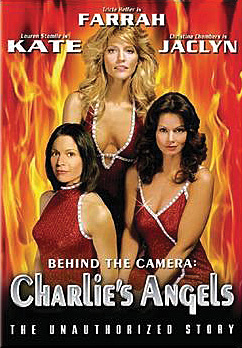
Behind The Camera: The Unauthorized Story of Charlie’s Angel (2004, directed by Francine McDougall)


Looking for a new hit, television producer Aaron Spelling (Dan Castellanata) comes up with the story of “three little girls who went to the police academy and who were assigned very hazardous duties” but who were taken away from all that by the mysterious Charlie.  The show is conceived as a star vehicle for Kate Jackson (Lauren Stamile), with fashion model Jaclyn Smith (Christina Chambers) and actress Farrah Fawcett-Majors (Tricia Helfer) playing her partners in investigating and solving crimes.  Kate wants to make a feminist statement.  Jaclyn wants to be a good role model to the little girls who sneak out of their room to watch the show.  Farrah wants to be a star without losing her possessive husband, Lee Majors (Ben Browder).  The critics hate the show.  Studio president Fred Silverman (Dan Lauria) and showrunner Barney Rozenweig (Michael Tomlinson) are embarrassed by it.  But Spelling has a hit and the actresses become stars.  But when Farrah decides she wants to leave after one season, the show’s future is put in doubt.

This was one of NBC’s Behind The Camera films and the only one to take us behind the scenes of a “drama” program.  (The other films looked at Diff’Rent Strokes, Mork and Mindy, and Three’s Company.)  This is probably the best of them, though “good” and “best” are both relative terms when it comes to these movies.  As with all of the films, there’s too many inside jokes about the network execs, with Dan Lauria stepping into the shoes of Brian Dennehy and Saul Rubinek as Fred Silverman.  But Dan Castellanata did a surprisingly good job as Aaron Spelling and the three actresses playing the Angels were all convincing, especially Christina Chambers.  The film’s main villain is Lee Majors, who is blamed for forcing Farrah to leave the show and who is portrayed as yelling, “Her name is Farrah Fawcett-Majors!”  It’s low-budget and doesn’t offer much that isn’t already known but at the cast keeps the story interesting.