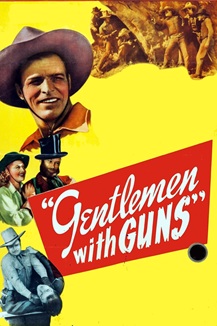
Gentlemen With Guns (1946, directed by Sam Newfield)


In the old west, Billy Carson (Buster Crabbe) gets a letter from his old friend, Fuzzy Q. Jones (Al St. John).  Fuzzy writes that he’s in “a little trouble” and requests that Billy “mosey on over” if he has time.  When Billy shows up at Fuzzy’s ranch, Fuzzy explains that Jim McAllister (Steve Derrell) wants his land and his water rights.  McAllister not only his own gang but he’s got the sheriff in his pocket as well.  When two of McAllister’s men show up at the ranch to try to force Fuzzy out, Billy is there to throw a punch in the defense of his good friend.

Billy is surprised to learn that Fuzzy is getting married to a woman that he’s never met for.  Fuzzy gotten to know Matilda Boggs (Patricia Knox) only through the letters that they’ve exchanged as members of a lonely hearts club.  By the time Matilda arrives in town, McAllister has already arranged for Fuzzy to be framed for murder and arrested.  Fuzzy is sitting in jail, hoping that Billy can clear his name.  Matilda is only after Fuzzy’s money and if they get married and Fuzzy gets hanged for murder or shot after breaking out jail to see her, that’ll just make it easier for her to get all of it.  Billy can see through Matilda’s schemes but Fuzzy is blinded by love.

This was an interesting and engaging B-western.  It had all the usual fist fights and horse chases that you expect to find in these films but there was also some unexpected emotional depth.  Usually, Fuzzy was the just comedic sidekick in these movies.  In this one, he’s not only facing the hangman’s noose but he’s also looking for love.  Life gets lonely on the frontier.  Buster Crabbe is his usual dependable and likable self.  Buster always looked convincing throwing a punch and both he and Fuzzy get to throw a lot of them here.

For many, B-westerns like this will always be an acquired taste but, for fans of the genre, Gentlemen With Guns is a superior example.
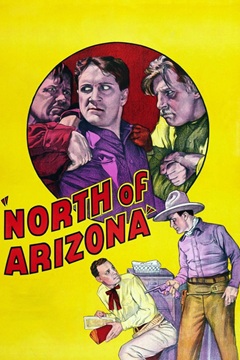
 

North of Arizona (1935, directed by Harry S. Webb)


Newly hired ranch foreman Jack Loomis (Jack Perrin) comes to the aid of two Indians who were nearly swindled out of their land during a card game.  The Indians inform Jack that his new boss, George Tully (Al Bridge), is actually a crook and the ranch is just a front for his criminal activities.  When Jack says he doesn’t want to be a part of Tully’s schemes, Tully and his men frame Jack for a robbery.

After you watch enough of these Poverty Row westerns, you start to get the feeling that anyone in the 30s could walk into a studio and star in a B-western.  Jack Perrin was a World War I veteran who had the right look to be the star of several silent films but once the sound era came along, his deficiencies as an actor became very apparent.  He could ride a horse and throw a punch without looking too foolish but his flat line delivery made him one of the least interesting of the B-western stars.  That’s the case here, where Perrin is a boring hero and the entire plot hinges on the villain making one really big and really stupid mistake.  John Wayne could have pulled this movie off but Jack Perrin was lost.

Jack Perrin’s career as a star ended just a few years after this film but not because he was a bad actor.  Instead, Perrin filed a lawsuit after a studio failed to pay him for starring in one of their films.  From 1937 until he retirement in 1960, Perrin was reduced to playing minor roles for which he often went uncredited.  Hollywood could handle a bad actor but not an actor who expected to be paid for his work.

Phantom Ranger (1938, directed by Sam Newfield)


Treasury agent Pat Doyle (John St. Polis) is sent to investigate a counterfeiting ring in Wyoming but ends up getting kidnapped by gang leader Sharpe (Karl Hackett) instead.  With Doyle’s daughter, Joan (Suzanne Kaaren), demanding that the government rescue her father and generating all sorts of bad publicity for the Secret Service, the decision is made to send in Tim Hayes (Tim McCoy).  Hayes, who will be working undercover, is selected because he’s not a “city boy.”  He’s a cowboy, through and through.  If you want to tame the west, you have to send a cowboy.

Phantom Ranger is a low-budget, 56-minute western from Monogram Pictures.  The plot is nothing special but the film itself still interesting because it’s a western that takes place in the 1930s.  Tim Hayes may ride a horse and wear a cowboy hat but he also works in a Washington D.C. office building and he interacts with a woman dressed like a flapper.  In this movie, the frontier has not caught up with the modern world but the modern world has also forgotten what life is like away from civilization.

The movie has the usual collection of B-western stalwarts.  Karl Hackett, John Merton, Charles King, Frank Ellis, Herman Hack, and Horace B. Carpenter are all present and accounted for.  Tim McCoy, a former rodeo performer and army officer, plays the hero and brings a lot of natural authority to the role.  McCoy was not only one of the first western heroes but he was also one of the best.

There’s no phantoms to be found in Phantom Ranger.  It’s still a good western.

Gun Lords of Stirrup Basin (1937, directed by Sam Newfield)


On the frontier, crooked lawyer Gabe Bowdre (Karl Hackett) is trying to secure all of the local water rights for himself and that means running off both the homesteaders and the ranchers.  Bowdre and his men try to start a range war between the ranching Stocktown family and the homesteading Dawsons.  Meanwhile, Dan Stockton (Bob Steele) has fallen in love with Gail Dawson (Louise Stanley) and marries her mere minutes before someone shoots his father in the back.

Gun Lords of Stirrup Basin has all the common elements that usually come with a B-western.  I have lost track of how many times I have watched Karl Hackett play a crooked businessman who tries to start a range war to win either the water rights or the property deeds.  Bob Steele spent a good deal of his career beating up Karl Hackett on screen.

What sets Gun Lords of Stirrup Basin apart is the Romeo and Juliet angle.  While it’s predictable, the love story between Dan and Gail still adds more emotional depth than is usually found in these movies.  The scene where all of the ranchers glare daggers at Dan’s new wife is powerful.

Bob Steele’s as good a hero as usual and Karl Hackett is a dastardly villain.  Gun Lords of Stirrup Basin runs a little less than an hour, making it a good western for an afternoon break.

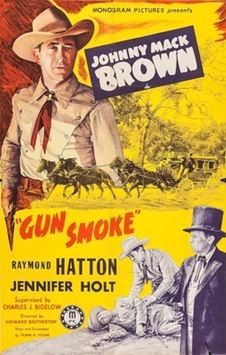
Gun Smoke (1945, directed by Howard Bretherton)


On the frontier, a stagecoach has been overturned and both the passenger and the driver have been killed by outlaws.  The passenger was Hinkley, an archeologist.  Who would want to kill a harmless archeologist?  That’s what Marshals Nevada Jack McKenzie (Johnny Mack Brown) and Sandy Hopkins (Raymond Hatton) set out to discover.  While Nevada Jack asks questions in the nearby town, Sandy disguises himself as a medicine man.

It all links back to an old Indian site that is said to be full of gold relics.  Jane (Jennifer Holt), the daughter of Hinkley’s partner, reveals that the only other person who knows the location of the site is an old Indian named Shag (Dimas Sotello).  Jack and Sandy have to try to track down Shag before he’s found the gang that killed Hinkley.

Yes, it’s another Johnny Mack Brown western.  Despite the title, this has nothing to do with the television series that featured James Arness and Amanda Blake.  Gun Smoke is still a solid western, featuring a determined performance from Johnny Mack Brown and some memorable villains from the usual poverty row western stock company.  Once again, Frank Ellis shows up as a henchman, though the identity of the main villain is actually a little more interesting than was typical for these films.  Johnny Mack Brown is a little more serious than usual, throwing punches with authority.  For fans of B-westerns, Gun Smoke is an above average entry in Johnny Mack Brown’s seemingly endless filmography.

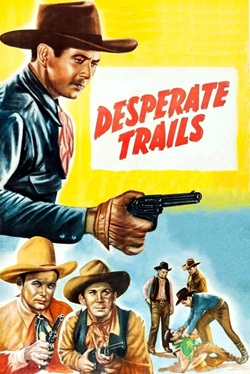
Desperate Trails (1939, directed by Albert Ray)


The frontier town of Denton has become lawless, plagued by murders, robberies, and cattle rustling.  The town’s sheriff (Russell Simpson) just cannot seem to bring peace to the streets.  That’s because the sheriff is secretly responsible for all the crime.  He’s working in cahoots with the town banker (Clarence Wilson) and he’s sets his sights on taking over a ranch owned by Frances Robinson.  As was so often the case with B-westerns, it all comes down to stealing someone else’s land.

The federal government sends Marshal Johnny Mack Brown to bring some order to the town.  Working undercover, Brown gets hired as Robinson’s ranch and he quickly chases off all of the bad ranchhands,  He brings his friend, singing cowboy Bob Baker, onboard to work as the ranch foreman.  With Fuzzy Knight providing comic relief, Brown sets out to thwart the next stagecoach robbery and to expose the evildoers of Denton.

This was the first western that Brown made with Universal Pictures.  Bob Baker, who had previously been the star of the studio’s B-westerns, was demoted to second lead and, eventually, he quit making films for Universal all together.  Unlike Baker, who was angry at being demoted, Fuzzy Knight was always happy to provide sidekick duty and would go on to co-star in all of Brown’s Universal westerns.  From the start, Brown and Knight had the chemistry that made them a good B-movie team.

Desperate Trails is a typical B-western but, as always, Brown elevates things with his performance.  From the minute that Brown rides into town, he screams authenticity.  He’s pretty tough in this film, which includes a scene where he coolly takes care of a gang of outlaws with just one rifle.  The best performance here comes from Russell Simpson, who gets angrier and angrier as the film goes on and all of his plans fall apart.

For fans of the B-western genre, Desperate Trails has a lot of entertainment to offer.

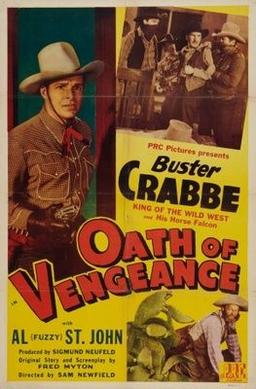
Oath of Vengeance (1944, directed by Sam Newfield)


In a small frontier town, the ranchers and the farmers are nearly at war with each other.  Cattle are being rustled.  The head of the farmers (Karl Hackett) is accused of killing a ranch hand.  Store owner Fuzzy Q. Jones (Al St. John) suspects that it’s all a set-up and he’s not going to stand for it.  If the farmers kill all the ranchers and the ranchers kill all the farmers, there won’t be anyone left to shop at his store.  Fuzzy calls in his friend, Billy Carson (Buster Crabbe).

Buster Crabbe may have gotten his start in the westerns by playing Billy the Kid but the producers of his films eventually realized that there was only so long that Buster could play a character known as “the Kid” and Billy the Kid’s reputation as an outlaw was actually not helpful at the box office because parents didn’t want to send their kids to a matinee that might teach them the wrong lessons.  After a handful of “Billy the Kid” films, Buster’s western hero suddenly had a new name.  Billy Carson was a standard western do-gooder, called in whenever a town needed to be cleaned up or his old sidekick Fuzzy needed some help around the store.  Crabbe was a convincing hero no matter what but the Billy Carson films lacked the thing that made the Billy the Kid films interesting.  Usually, no one was trying to arrest Billy Carson.

Oath of Vengeance isn’t bad, at least not by the standards of Poverty Row westerns.  There’s plenty of fights and Crabbe, being a former Olympian, looks convincing with he throws a punch.  The plot is a pretty standard B-western plot but Crabbe’s natural likability carries the day.  Fans of the genre will be happy to see Charles King and Kermit Maynard, playing bad guys.  Frank Ellis plays the ranch hand whose murder sets off the story.  It’s always good to see the old gang back together again.

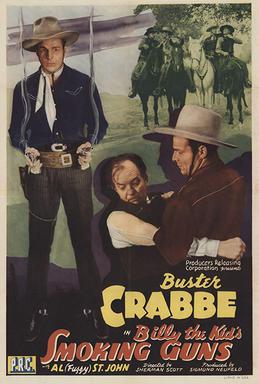
Billy The Kid’s Smoking Guns (1942, directed by Sam Newfield)


It’s a tale as old as time.  During the days when the west was wild, the U.S. Army is planning on setting up a new outpost near a town so the bad guys want to run all the ranchers off of their land so that they can be the ones to sell it.  Sheriff Carson (Ted Adams) is corrupt and working for the bad guys so the ranchers have to turn to Billy the Kid (Buster Crabbe) and his sidekicks, Jeff (Dave O’Brien) and Fuzzy (Al St. John) for help.  When Jeff is wounded in a fight, Fuzzy takes him to Doc Hagen (Milton Kibbee), little suspecting the doctor is actually the leader of the bad guys and using his medical practice to kill anyone who won’t give up their land!

Coming to us straight from Poverty Row, this B-western is interesting in that it seems to take a very cynical view of law enforcement.  Sheriff Carson is corrupt and Billy and his friends are running from the law themselves.  Buster Crabbe’s Billy the Kid films always kept it unclear why Billy was in trouble with the authorities.  Crabbe’s Billy the Kid always seemed to be the nicest guy in the west.  (Of course, Crabbe was also 33 and no longer seemed like he should have been known as “the Kid.”)  Eventually, the series was retconned and Buster Crabbe was no longer playing Billy the Kid but instead he was playing an upstanding citizen named Billy Carson.

Crabbe may not be a convincing outlaw but he is a convincing hero, which is all these films really required.  Billy the Kid’s Smoking Guns is a little bit interesting because of the character of Doc Hagen, whose occupation makes him a little more memorable than typical B-western bad guy.  The film is also interesting in that, for once, there’s no love interest.  Instead, it’s just men in hats shooting at each other.  That probably made the film’s youthful target audience happy.

The real-life Billy The Kid was killed when he was only 21 and after he had been an outlaw for only three years.  Buster Crabbe would g0 on to play Billy (or o some variation of Billy) until he was closing in on 40.


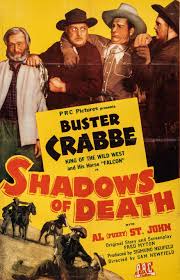
Shadows of Death (1945, directed by Sam Newfield)


After a railroad agent is murdered and his map of the future locations of the railroad is stolen, Billy Carson (Buster Crabbe) rides into a frontier town and searches for the guilty party.  Fortunately, for Billy, his best Fuzzy Q. Jones is the mayor, the sheriff, and the town barber!  Unfortunately, local gunslinger Clay Kincaid (Eddie Hall) wants to make a name for himself by taking on the famous Billy Carson.  Corrupt businessman Landreau (Charles King) encourages Clay by lying to him and telling him that Bully is planning on stealing Clay’s girl, Babs (Dona Dax).

A standard Poverty Row western, Shadows of Death was made by the same crew and cast who were involved with most of Buster Crabbe’s Billy The Kid films.  I’m not sure if Billy Carson is meant to be the same character as Billy the Kid, though.  Billy the Kid always had bounty hunters after him but Billy Carson works for the railroad.  However, it would be strange if Fuzzy Q. Jones just happened to be the favored sidekick of two gunslingers who just happen to both be named Billy.  Along with Fuzzy’s vaudeville style comedy, one thing that audiences could always take for granted was that Charles King would play the villain in these movies and Frank Ellis would always be his henchman.  I always wonder if audiences in the 40s noticed that Charles King’s businessman and Frank Ellis’s gunslinger always returned from the dead with every B-western that came out.

My favorite scene in this one is Billy bursting into Landreau’s office, just for Landreau to say that he expects visitors to knock.  Billy pauses long enough to knock on the door before getting down to the business of frontier justice.

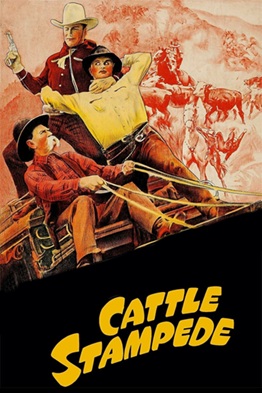
Cattle Stampede (1943, directed by Sam Newfield)


Billy the Kid (Buster Crabbe), that western do-gooder who has been framed for crimes that he didn’t commit, narrowly escapes being captured by a group of bounty hunters.  To thank the man who helped him and his sidekick, Fuzzy Q. Jones (Al  St. John), escape, Billy agrees to help the man’s family make a cattle drive.  It turns out that local ranchers are being targeted by rustlers who cause the cattle to stampede and then buy up what’s left of the herd at a discount.  Even though Mary Dawson (Frances Gladwin) doesn’t trust Billy and initially suspects him of being one of the rustlers, Billy and Fuzzy take over the cattle drive and protect the family from Coulter (Glenn Strange) and Elkins (Frank Ellis).  They even prove their worth by rescuing Mary after she’s kidnapped by the villains.

This is one of the many Poverty Row westerns to feature Billy the Kid not as an outlaw but instead as a hero.  Best-known for playing Tarzan, Flash Gordon, and Buck Rogers, Buster Crabbe was a believable hero even if he was more than a little too old to be nicknamed “the kid.”  Al St. John provides the comedic relief and veteran bad guys Charles King, Glenn Strange and Frank Ellis go through the motions as the villains, much as they did in countless other westerns of the era.  Cattle Stampede is typical of the cheap western programmers that came out of the Poverty Row studios in the 40s.  It was simplistic and predictable but featured enough western action to keep the kids in the audience entertained.  Today, its main selling point is a nostalgic one.

The Billy the Kid films are always strange because they avoid the reason why Billy is being pursued by the law and instead just present him as being another generic western hero.  It seems like a waste of a good legend.