The fourth episode of The Frank Sinatra Timex Show was officially called It’s Nice To Go Trav’ling but it’s unofficial name was Welcome Home Elvis. That’s because this special, which aired on May 12th, 1960, also marked Elvis Presley’s first appearance on television after his release from the U.S. Army.
It was a 30-minute special, sponsored by Timex. Elvis only appeared in 8 of those minutes. The rest of the show’s running time was made up of Frank Sinatra hanging out with his Rat Pack pals. Still, in those 8 minutes, Elvis performed with Sinatra and television history was made. (Elvis even wore a tuxedo for the occasion, so he would fit in with Frank and the pack.) This special was the highest rating program of the week and it proved that being away in Germany hadn’t diminished Elvis’s popularity one bit.
Elvis, who was born 87 years ago on this day, would later go on to star with Nancy Sinatra in 1968’s Speedway.
Sixteen year-old Jimmy Mulligan (Tucker Albrizzi) is a nice kid with a big problem. His high school is ruled by a gang led by a bully named Miles (Jack DiFalco) and the overweight and quiet Jimmy has become the gang’s number one target.
Miles has decided that Jimmy owes him a hundred dollars. Even though Jimmy has never borrowed any money from Miles and is obviously not from a family that would have a hundred dollars to just toss around, Miles insists that Jimmy is in his debt. When Jimmy refuses to pay, Miles beats the poor kid while he’s walking home from school. However, the beating is observed by a retired boxer named Clarence “Action” Jackson (Ron Canada). Action runs off Miles and then he makes Jimmy an offer. He’ll help Jimmy learn how to box as long as Jimmy agrees to only use his skills for self-defense. At first Jimmy and his parents are reluctant but, after he gets beaten up for a second time, it’s time to go to Manny’s Gym!
Manny (Danny Trejo!), who is a legendary trainer, takes Jimmy under his wing and teaches him how to throw a punch and avoid a jab. Soon, Jimmy is losing weight, gaining confidence, and even going out on a date with a supercool goth girl named Adrian (Elanna White). But Miles still wants his money and eventually, Jimmy is going to have to put his training to use.
In many ways, Bully is every bullied kid’s dream. Not only does Jimmy learn how to throw a punch and get a girlfriend but he also gets to hang out with Danny Trejo! Manny is a tough but funny guy with a rough past but a good heart and he is using his skills to try to make the world a better place. The same can be said for Danny Trejo himself, so he’s the perfect choice to play Manny. Ron Canada is also good as Action Jackson, bringing a lot of quiet dignity to the part. Tucker Albrizzi does a good job of going from being insecure to being confident.
It’s just too bad that the film itself isn’t better. Bully has good intentions but the execution is lacking. The movie kept suggesting that there would be a scene where Jimmy had to chose between using his new skills for revenge or just for self-defense but it never happened. There were too many scenes that did not seem to go anywhere and, for all of the build-up, the final fight between Jimmy and Miles was anti-climatic and confusingly filmed. During the final 15 minutes, several new characters show up and suddenly become central to the story. Somehow, the Mafia finds out about the fight and takes an interest in whether or not Jimmy is going to be able to beat up Miles. On the one hand, it’s cool because Vincent Pastore is one of the gangsters but on the other hand, what’s going on? Why are they there?
Danny Trejo’s cool, though. That counts for a lot.
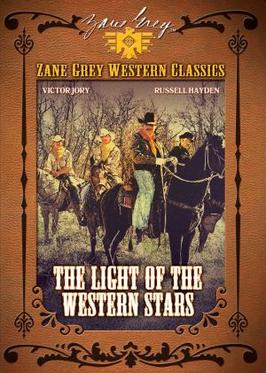
In the dead of night, a train stops in an isolated western town. Only one passenger disembarks. Majesty Hammond (Jo Ann Sayers) is a wealthy Bostonian, who has traveled all the way to the town to try to prevent her bother from marrying a local woman. Majesty takes a seat in the station and waits for someone to come get her.
After a few minutes, a drunken ranch foreman named Gene Stewart (Victor Jory) enters the station. He has made a bet with the local sheriff (Tom Tyler) that he can convince the first new woman to arrive in town to marry him. Stewart’s friends find a priest but before Gene can force the priest to marry them, a local girl named Bonita (Esther Estrella) rides up and tells Gene that one of the ranch hands, Danny (Alan Ladd, the future Shane in one of his earliest roles), has been forced to flee town after getting into a fight with the sheriff.
As if that’s not bad enough, Gene then discovers that Majesty’s brother is going to marry Flo Kingsley (Ruth Rogers), who happens to be Gene’s employer! Ashamed of his behavior, Gene leads Majesty to Flo’s ranch.
After some initial weariness, Majesty is convinced that Flo and her brother really are in love. Flo explains to Majesty how life works out in the frontier and Majesty is even able to forgive Gene for his drunken antics. Majesty decides to buy a ranch in town but what she doesn’t know is that corrupt businessman Hayworth (Morris Ankrum) is using the ranch to smuggle weapons to the Mexican army and that he’s working with the sheriff! Majesty is going to need Gene’s help to run the ranch but, after getting into another fighting with the sheriff, Gene goes into hiding. Can Majesty find Gene and convince him to return to town?
Based on a novel by Western specialist Zane Grey, The Light of Western Stars is only 65 minutes long but it packs a lot of plot and a lot of action into those sixty minutes. Of course, the plot is pretty standard stuff but, for B-movie fans, it’s a chance to see Victor Jory in a rare leading role and also a chance to see what Alan Ladd was doing before he became a noir mainstay. Hard-drinking and occasionally irresponsible, Gene is an interesting hero and Jory does a good job playing him. Alan Ladd doesn’t make a huge impression as Danny but he looks convincing fleeing town on horseback and that’s all the role really requires.
For many viewers, though, the main appeal of Light of Western Stars will be the beautiful Jo Ann Sayers as Majesty. Primarily a stage actress, Sayers only appeared in 16 films before she got married and semi-retired but she made an impression in every one of them. That’s certainly the case here, where her beauty makes it very plausible that even a wanted man would return to town just to be with her.
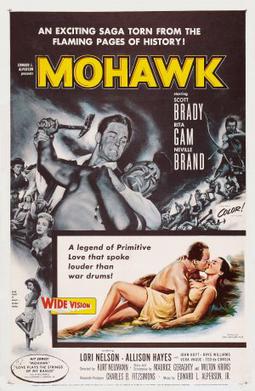
In the late 18th century, Boston socialite Cynthia Stanhope (Lori Nelson) travels to Fort Alden in upstate New York to visit her fiancé, a painter named Jonathan Adams (Scott Brady), who has been commissioned to paint the local scenery. As soon as Cynthia and her mother arrive, they are shocked to discover that not only Jonathan has been painting pictures of the members of the Native local tribes but that he is also now flirting with a barmaid named Greta. Greta is played by Allison Hayes so who can blame him? Cynthia wants to return to their normal upper class life in Boston but Adams has fallen for the untamed wilderness of the frontier.
When Onida (Rita Gam), the daughter of Iroquois chief Kowanen (Ted de Corsia) is captured during a raid on the fort, Adams is assigned to escort her back to her tribe. Leaving behind Cynthia and Greta, Adams falls in love with Onida over the course of the journey. When he meets the Iroquois, he earns the respect of her father and the entire tribe when he agrees to paint the chief’s portrait.
Meanwhile, a haughty settler named Butler (John Hoyt) is trying to play the army and the Iroquois against each other, feeding both of them false information in an attempt to spark a war. Butler is hoping that a war will lead to both sides wiping each other out so that he can once again have the valley to himself. When it turns out that his words might not be enough to spark a war, Butler resorts to murder. When Kowanen’s son is killed, the Iroquois prepare for war while Adams is framed for the crime and finds himself tied to a stake.
Mohawk is a standard B-western, with a plot that is largely lifted from John Ford’s Drums Along The Mohawk. Unfortunately, Adams is about as sympathetic hero as you would expect someone manipulating three different women to be and, when it comes to depicting the Iroquois, Mohawk resorts to too many clichés. This is one of those westerns where the Native characters speak broken English, even when they are just talking to each other.
Mohawk does have three things to recommend it. Number one, John Hoyt was a master at playing haughty villains and Butler is easy to root against. You will look forward to seeing him get his comeuppance. Number two, Allison Hayes was a force of nature and that’s true even in this film, where she’s not given nearly enough to do. Number three, one of Iroquois braves is played by Neville Brand. A highly decorated World War II veteran, Brand built a long career playing tough guys. In Mohawk, it only takes one look at Neville Brand to know that this isn’t someone you want to mess with. Anyone watching would want to stay on Neville Brand’s good side.
Otherwise, Mohawk is forgettable. Two years after it was released, Mohawk’s director Kurt Neumann, would be responsible for the much more memorable The Fly.
In the post-civil war west, two Calvary troopers steal a Gatling Gun, the weapon that was invented to be such a powerful instrument of death that people would stop fighting wars just to avoid finding themselves in front of its barrel. (It didn’t work out that way, of course.) With the help of a pacifist reverend named Harper (John Carradine), they smuggle the gun into Apache territory. Rev. Harper thinks that the gun is going to be destroyed and, thus, another instrument death will be eliminated. from the world Instead, the greedy troopers are planning on selling the gun to Apache Chief Two Knife (Carlos Rivas). Two Knife has promised a fortune’s worth of gold to anyone who can deliver to him the deadliest weapon in the west.
Before the gun can be exchanged, the reverend, his daughter, and the two deserters are intercepted by a group of Calvary troops led by Lt. Wayne Malcolm (Guy Stockwell). One of the deserters is killed while the other, Pvt. Sneed (Robert Fuller) is captured.
However, Chief Two Knife still wants what he calls “the king gun.” Malcolm and his troops find themselves pinned down by the Apaches. Can Malcolm, with the help of a rancher (Phil Harris), a scout (Woody Strode), and a cook (Pat Buttram), keep both the gun and the all important firing pin from falling into the hands of Two Knife?
The Gatling Gun is a low-budget western that would probably be today forgotten except that it has fallen into the public domain and has been included in several DVD box sets. It has the flat, generic look of a Western television show and Guy Stockwell’s stiff performance may be believable for a 19th century Calvary captain but it’s still doesn’t exactly make for compelling viewing. The main problem is that the most exciting and interesting part of the story, the two deserters stealing the gun and tricking the Reverend into helping them, occurs off-screen and the movie instead begins with Malcolm capturing Sneed.
Western fans will mostly want to watch this one to see John Carradine and Woody Strode, two very different actors who were both favorites of John Ford’s and who appeared in several other, better westerns. (Strode and Carradine had both previously appeared in The Man Who Shot Liberty Valance, to name just one example.) Carradine is typically theatrical, delivering his lines like the old Shakespearean that he was. Strode, as usual, is stoic but his imposing screen presence makes him the most memorable of the film’s heroes. Also keep an eye out for Patrick “son of John” Wayne, playing the rancher’s son.
Though The Gatling Gun has the look of a film that was shot on a studio backlot in Hollywood, it was actually filmed, on location, in New Mexico. The state’s then-governor, David Cargo, has a small role as Corporal Benton and is listed in the credits as “Honorable Governor David Cargo.” A look at his imdb page reveals that David Cargo appeared in four films while he was governor. All of them were filmed in New Mexico so I guess casting the governor was a requirement for filming in that state. When Cargo left office in 1971, his movie career ended.
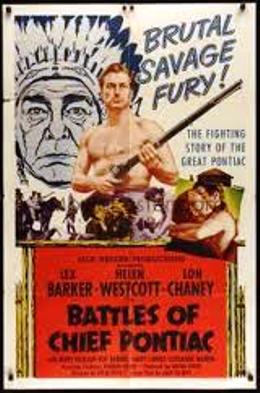
A decade before the start of the American Revolution, the British have managed to force the French out of the Great Lakes region. Fort Detroit has been established to oversee the area and provide protection from the Odawa tribe. Chief Pontiac (Lon Chaney, Jr.) believes that the Odawa and the White Man can live in peace but his beliefs are challenged when the British bring in a brutal German mercenary, Col. von Weber (Berry Kroeger), to patrol the land. After Col. von Weber and his soldiers massacre a village, Pontiac and the Odawa prepare for war.
Lt. Kent McIntire (Lex Barker, who was best known for playing the role of Tarzan in several movies) is a Colonial officer and a scout who is convinced that he can broker a peace between the Odawa and the British. Odawa respects and trusts McIntire but when von Weber tries to wipe the Odawa out by sending them small pox-infected blankets, Pontiac realizes that there can be no peace and he launches an attack on Fort Detroit.
Though hardly a great film, Battles of Chief Pontiac deserves some credit for its sympathetic portrayal of the Odawa People. From the start, the film makes clear that everything that the Pontiac does, he does out of self-defense. Even the most enthusiastic of his warriors, Hawkbill (Larry Chance), is not fighting because he wants to fight but he’s fighting because it is evident that von Weber is not going to leave the Odawa any other choice. Though the small pox-ridden blankets were actually given to a different tribe, just the fact that Battles of Chief Pontiac acknowledges that it happened sets it apart from many other B-movies of the period. Though not a Native American himself, Lon Chaney, Jr. gives a surprisingly dignified performance as Pontiac and he doesn’t allow the character to become a caricature. Again, that alone is enough to set Battles of Chief Pontiac apart from a lot of the other films of the period.
Battles of Chief Pontiac still cheats by laying the blame on the Hessians, the German mercenaries who, historically, were not even present in North America until they were hired by the British during the American Revolution, which happened ten years after Pontiac’s siege of Fort Detroit. Berry Kroeger plays Von Weber as if he was a high-ranking Gestapo officer who somehow found himself in the 18th Century. By making Von Weber the villain, the film lets the British off the hook. The only mistakes that the British officers make in Battles of Chief Pontiac is that they trust a German and fail to listen to the advice of the all-American Lex Barker.
Battles of Chief Pontiac has a narrator who sounds like he would have been better suited for an educational filmstrip about hygiene and its epic ambitions are thwarted by its low-budget. There’s a not very interesting love story between McIntire and a white woman (Helen Westcott) who is being held prisoner by the Odawa. The movie’s intentions go a long way towards making up for the flaws but they can’t do all the work. At least, Barker, Chaney, and Kroeger manage to keep thing interesting.
Above, we see Captain America punching out Hitler on the cover of the first issue of his new comic book.
It’s an image that we’ve all seen before. It’s often held up as a perfect piece of wartime propaganda, as well as an answer to question of what should be done to anyone who wants to follow in Hitler’s footsteps. However, the most important thing about this cover is often overlooked.
It was published in December of 1940.
In 1940, America was officially neutral. Europe was at war and, while the U.S. was on the side of the Allies, the country still hadn’t entered the conflict. Due to the trauma of World War I, many American voters and politicians were still “isolationists,” saying that it was not America’s place to get involved in a conflict taking place on the other side of the world.
Joe Simon and Jack Kirby, however, disagreed. Kirby and Simon were both first-generation Americans and they understood what was happening in Europe. As Jews, they understood the evil that Hitler represented and, Simon later said, they both felt helpless whenever they heard reports about what was happening from the members of their family who were still in Europe. In one of his final interviews, Joe Simon said that he and Kirby created Captain America to serve as the antithesis of Hitler. And, with this cover, Simon and Kirby left no doubt where they and Captain America stood on the issue of neutrality. What is often forgotten today is how much courage it took to take that stand in 1940. At a time when comic books were viewed as being for kids and avoided taking a stand on anything beyond being anti-crime and also when there were any who still defended Hitler and shared his anti-Semitic views, Simon and Kirby took a stand and, to his credit, publisher Martin Goodman took that stand with them.
When this issue first came out, it sold a million copies. At the time, that was an unheard of amount. Though it would be another year before the U.S. officially entered the war after the attack on Pearl Harbor, Simon and Kirby took an early stand and created a great moment in comic book history.
Back in 2012, someone at KDOC-TV, an independent television station in Orange County, was trying to figure out a new and unique way to welcome the new year. The major networks had their own spectaculars set up for the new year, with live shots from Times Square and big-time celebrity hosts. What could a little independent station do to compete with that?
Two words: Jamie Kennedy.
Why not bring in stand-up comedian and occasional actor Jamie Kennedy to host the station’s New Year’s special and hopefully bring his own “unique” style of comedy to the proceedings?
Kennedy was hired and the show that he hosted went on to become infamous far beyond Los Angeles. Featuring a myriad of technical issues, problematic humor, and even a fight that broke out on stage during the closing credits, First Night With Jamie Kennedy has since regularly been cited as one of the worst shows of all time. Patton Oswalt talks about in his stand-up. Nathan Rabin wrote an entire article about it. First Night has become a legendary disaster.
What happened during First Night that made it such a surreal disaster? Let us count the ways.
The mics often did not work when they were supposed to and the suddenly came on whenever nearby was uttering an expletive.
The crews’ walkie-talkies failed early, which meant that Kennedy was often not aware of when he was on camera and when he wasn’t. There were frequent shots of Kennedy standing on the stage, looking miserable and obviously wondering how he had gone from Scream to hosting First Night. At one point, when Stu Stone was interviewing Shannon Elizabeth, the camera lingered on an abject-looking Jamie Kennedy.
Along with making jokes about “Asian rappers,” Kennedy also appeared in comedy skit where he played a Mayan chief at a casino.
Macy Gray performed a song while appearing to be under the influence of something.
The countdown started late, so by 2013 had already arrived by the time the crowd hit zero.
Kennedy awkwardly hit on two drunk girls, one of whom resolved to “get rid of all my haters.” Kennedy told two girls (who were both black) a joke about what happens when you “go white.”
As if the night could not get bad enough, there was skit featuring puppets making lewd jokes.
And, of course, A FIGHT BROKE OUT DURING THE END CREDITS!
As the legend of First Night spread, Kennedy said that it was supposed to be bad and a parody of a typical network TV new year’s special. Sure, Jamie, we believe you.
The entirety of the show has been uploaded to YouTube. It’s not pretty and it’s not great but it is a Moment in Television History!
That is the question at the heart of A Blank Page, a work of interactive fiction that anyone with a creative spirit should be able to understand. In A Blank Page, you are the writer, sitting in front of a blank screen and trying to figure out how to begin. It seems like it should be so easy. You’re smart. You’re imaginative. You have ideas. The keyboard is right there in front of you.
So, why is it so easy to find something else to do?
You can look out the window. You can chat with your friends. You can go for a walk. You can even go through your notebook and look at all of the ideas that you’ve had, ideas that seemed good at the time but which now add up to a big pile of What Was I Thinking? Why can you do all of that but you can’t start your masterpiece?
Trust me, I’ve been there.
In fact, I’m there right now.
I have been playing and reading interactive fiction like A Blank Page for years but I’ve never actually written one. I have had ideas for a few. I’ve even started on a few. But I’ve never gotten past the first room description or the solution for the first puzzle. In October, when I was playing the entries in the 2021 Interactive Fiction Competition, I decided that 2022 was going to be the year that I was not only going to finally write a game but I was also going to let the rest of the world see it. It’s been tough getting started, though. I’ve played some good games and I’ve played some bad and really sloppy games and I would definitely rather be responsible for a good one. My hope is that I’ll have something to enter into the 2022 Interactive Fiction Competition. I don’t care if my game is ranked in top ten of the entries. I just don’t want it to be dead last.
That’s where something like A Blank Page is helpful. It’s a reminder that I’m not the only one who sometimes doesn’t know where to begin. It’s good to know that I’m not the first person to have ever struggled with this. Somewhere, someone else is also struggling to write their first game or their first story or create their first painting and they’re hoping that, whatever the final result of their efforts may be, it will be good enough to justify a second one. As A Blank Page‘s creator says in the introduction to the game, “all arts have their own version of the ‘Blank Page Syndrome.'”
A Blank Page is a short Twine game, full of details that will resonate with any artist who has struggled. It’s good and comforting to know that I’m not the only person who has ever spent more than one day looking at a blank page or screen and asking, Where to Begin?
Norwood Pratt (played by country singer Glenn Campbell) is a just a good old boy who has just returned home from serving in the Marines over in Vietnam. After saying goodbye to his Marine buddy, Joe William Reese (played by quarterback Joe Namath), Norwood heads to his hometown of Ralph, Texas. Norwood discovers this his sister (Leigh French) has married an idiot named Bill (Dom DeLuise!)
Norwood gets a job working at the local garage but he’s got his guitar and he’s got his dreams. All he wants to do is play his music on the Louisiana Hayride radio program. But with no money and no connections, how is he going to make it there? When a shady businessman (Pat Hingles) offers to pay him fifty bucks to drive a car and prostitute (Carol Lynley) to New York City, Norwood agrees. When Norwood discovers the car is stolen, he abandons both the vehicle and the girl but he still heads up to New York City.
Norwood has plenty of adventures and he meets plenty of people, like a hippie (Tisha Stirling) who invites him to open mike night at a coffee house in the Village. Later, she invites him to join her in a bathtub by asking him if his guitar plays underwater. “No, ma’m,” Norwood says, “but I do.” He also meets a pregnant teenager (Kim Darby, Campbell’s co-star from True Grit) and a little person (Billy Curtis) who is traveling with a super intelligent chicken.
There have been a lot of very good films made about the struggle of military veterans to transition back to civilian life after their tour of duty comes to an end. Unfortunately, Norwood is not one of those films. Both Norwood and Joe have just returned from Vietnam but neither one of them seems to carry any lingering effects from their time overseas. Neither of them shares any war stories or any thoughts on war in general. (Someone does point out that Norwood has a scar. Norwood says it’s a war wound that he got when he accidentally fell off a water truck.) There’s no hint that the war itself was not going well for the United States in 1970 or that it wasn’t a popular war and that returning veterans often felt as if they had been rejected by the same country that asked (or forced) them to serve. Even when Norwood meets the hippies in the Village, there’s no mention of protests. Instead, Norwood presents 1970 as a time with no real conflicts, which is the perfect era for someone as forgettable as Norwood Pratt to become a star.
Norwood has the same basic and episodic structure as an Elvis movie, except that Elvis could actually act when he wanted to. No one can deny Glenn Campbell’s talent as a singer but as an actor, he had very little screen presence. In True Grit and this movie, the best that he could come up with was an amiable dullness. In True Grit, it didn’t matter because John Wayne was in the movie. But in Norwood, Campbell had to carry the story and his acting limitations were much more obvious. Campbell even managed to get outacted by Joe Namath, who, as far as pro football player-turned-actors were concerned, was no Alex Karras. Wisely, Campbell didn’t further pursue a career as an actor and instead concentrated on singing. When Campbell died in 2017, he was praised for both his musical legacy and his honesty and courage while facing Alzheimer’s. He may not have made it as an actor but he still touched a lot of lives.






 Through the Shattered Lens