Ring of Terror (1961, directed by Clark L. Paylow)


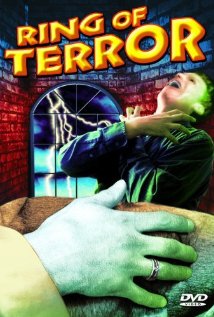
Whilst stumbling around his office in a drunken daze, graveyard keeper R.J. Dobson (Joseph Conway) accidentally steps on his cat’s tail.  The cat runs out of the office.  Dobson stumbles after it.  Dobson eventually finds the cat sitting by a grave in the cemetery.  Dobson picks the cat up and starts to tell it (or maybe the people watching at home), the story behind the tombstone.

Lewis B. Moffit (George E. Mather) was a med student who had a reputation for not being scared of anything.  He killed a rattlesnake without a second’s hesitation.  He didn’t flinch while watching an autopsy.  For some reason, this upsets his frat brothers so they decide to pull a prank on him to see how brave he really is.  As a part of his initiation, Lewis has to break into the mortuary and retrieve a gold ring off of a corpse’s finger.  Of course, the prank goes wrong and there are serious consequences to Lewis’s sanity.

Ring of Terror is based on the old urban legend in which a promising but tightly wound college student is either killed or driven mad by a thoughtless fraternity prank.  Ring of Terror doesn’t really add anything to the basic story.  The only thing that distinguishes it is that all of the college students are played by middle-aged actors so they all seem as if they should have graduated from college and outgrown the frat life a long time ago.  George E. Mather was in his 40s when he starred in this film so even if the prank hadn’t broken his mind and he had graduated from medical school, he wouldn’t have had a very long practice.

The story would feel slight for even a 30-minute episode of The Twilight Zone so the director tries to pad out Ring of Terror with a visit to a “swinging” jazz club (and I use the term swinging loosely because there ain’t swinging about that joint), an autopsy, and, of course, those scenes in the cemetery with RJ and his cat.  The padding doesn’t help make the story any more intersting but the autopsy scene is at least amusing.  Because all of the college students are played by middle-aged actors and are wearing suits, the scene really does look as if a group of wall street brokers decided to spend their lunch hour in the hospital basement.  It’s like the episode of Seinfeld where Jerry and Kramer observe an operation and accidentally drop a junior mint in the patient’s chest cavity.

Today, Ring of Terror is best known for being featured on an early episode of Mystery Science Theater 3000.  (It was actually such a short movie that it had to be paired up with the third chapter of The Phantom Creeps serial.)  I’ve seen both the original version and the version with Joel and the Bots and the MST 3K way is the best way to watch this movie.  Without Joel and the Bots, it’s so slow and poorly acted that it is nearly unwatchable.  With Joel and the Bots, there’s at least a few laughs to be found.
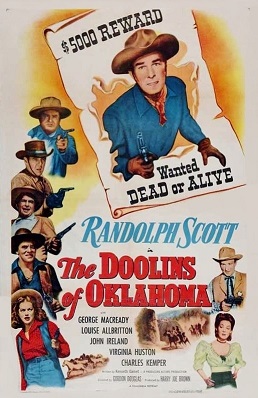
The Doolins of Oklahoma (1949, directed by Gordon Douglas)


Randolph Scott stars in The Doolins of Oklahoma, a fictionalized account of the career of the real-life western outlaw, Bill Doolin.

Doolin (played, naturally, by Randolph Scott) may have once rode with the fearsome Dalton Brothers but, according to this film, he was actually just an ordinary, salt of the Earth type who wanted to settle down with the right woman and lead a normal life. It looks like he might get that opportunity after the Daltons are killed and Doolin tires of leading his own gang of outlaws. Doolin settles in a Oklahoma town, takes a new name, and falls in love with Elaine (Virginia Hutton). But when both the members of his old gang and a veteran lawman (George Macready) show up in town, Doolin learns that the past cannot be escaped.

The plot of The Doolins of Oklahoma is nothing special, though it’s portrayal of the outlaws being more honorable than law enforcement may have been surprising in 1949. The main thing that distinguishes The Doolins of Oklahoma is the cast, which is full of western veterans like John Ireland, Noah Beery Jr., Charles Kemper, Frank Fenton, and Jock Mahoney. Not surprisingly Randolph Scott is ideally cast as a weary cowboy who just wants to settle down and live the rest of his life in peace. Scott is well-matched by MacReady, as the marshal who will not let anything stand in the way doing his duty as a member of law enforcement. Gordon Douglas directs crisply and energetically and every member of the main cast gets at least one big moment in which to distinguish themselves. The Doolins of Oklahoma may not be a groundbreaking film but it will be enjoyed by fans of the western genre.


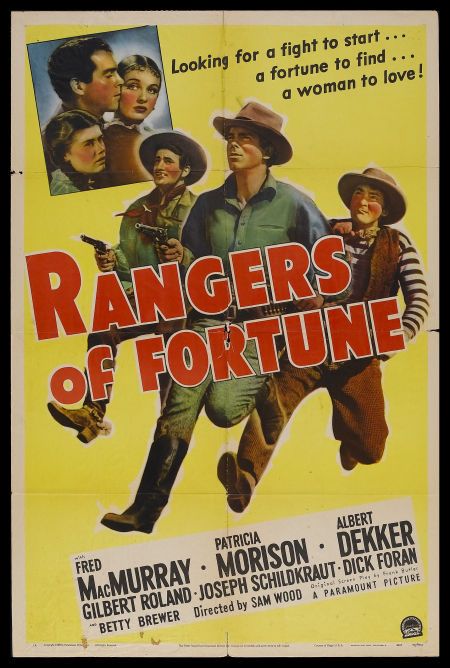
Rangers of Fortune (1940, directed by Sam Wood)


After narrowly avoiding execution by a firing squad in Mexico, three good natured outlaws head back to Texas.  Gil (Fred MacMurray) is their leader, a former army officer.  Antonio (GIlbert Roland) is the charming caballero.  George (Albert Dekker!) is the punch-drunk former prizefighter who provides comedic relief.  When they reach Texas, they meet and become involved in the efforts of a newspaper publisher (Brandon Tynan) and his daughter (Betty Brewer) to free their hometown from the control of an aristocratic landowner named Col. Rebstock (Joseph Schildkraut), who rules the town with the help of a sadistic group of cowboys.  It turns out that the three outlaws aren’t so bad while the respectable and wealthy Col. Rebstock is as bad as they come.

Rangers of Fortune is a standard 1940’s western programmer, though it’s distinguished by a better than usual cast and the quick-paced direction of Sam Wood.  It starts out almost as a comedy, with MacMurray, Roland, and Dekker cracking jokes and getting the better of almost anyone that they come across.  The screenwriter of Rangers of Fortune, Frank Butler, also wrote some of Bing Crosby and Bob Hope’s road films and he’s just as good as coming up with comedic dialogue for the team of MacMurray, Roland, and Dekker as he was for Hope and Crosby.

But the movie takes a serious turn once MacMurray, Roland, and Dekker cross the Texas border and they discover that Col. Rebstock will do almost anything and kill just about anyone to keep his hold on the town.  Even a successful scheme to install Gil as sheriff just leads to more innocent people dying.  When Rangers of Fortune turns dark, it turns very dark, with characters, who we usually don’t expect to die in a film like this, meeting a violent end.  Though it won’t convert any skeptics, it’s an interesting film for those who are already fans of old Hollywood westerns.

Rangers of Fortune has never gotten a proper video release but it is on YouTube.  Unfortunately, the copy uploaded to YouTube was in terrible condition so it’s difficult to fairly judge the film’s production values.  However, even on a damaged print, the natural authority of Fred MacMurray’s lead performance comes through and Joseph Schildkraut is as good a villain as always.  Patricia Morrison plays the prettiest girl in town and, even on YouTube, it’s easy to see why every man in town is competing for her attentions.  Seeing Albert Dekker, usually cast as intelligent and often conniving character, playing dumb is also an interesting experience, even on a bad print.  Hopefully, someday, Rangers of Fortune will get a decent restoration.

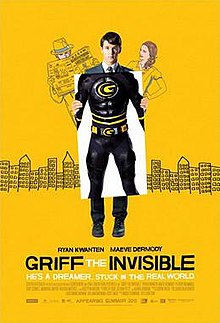
Griff the Invisible (2010, directed by Leon Ford)


Griff (Ryan Kwanten) is a socially awkward young office worker who keep a rubber suit hidden away in his apartment.  When he returns home from work, he puts on the suit and searches the night for crimes to stop and criminals to thwart.. Or at least he thinks that he’s fighting crime. The neighbors seem to be afraid of the man in the rubber suit and there are posters on every street corner, asking if anyone can identity the masked voyeur who has been spotted walking about the neighborhood at night.  The only one his neighbors who appreciates him is the stray cat that waits every morning for a tin of tuna.

Though he might fight crime at night, no one thinks much of Griff during the day. His co-worker, Tony (Toby Schmitz), constantly bullies him. His older brother, Tim (Patrick Brammall), resents that he had to move back home to keep an eye on him and he is constantly asking Griff if he is having another breakdown.  Only the owner of the local hardware store is polite to Griff and that’s just because Griff spends a lot of money in the store, buying what he needs to make what he thinks will be an invisibility suit.

When Tim brings his new girlfriend, Melody (Maeve Dermody), over to meet Griff, she discovers that she has more in common with Griff than with Tim. Griff wants to be invisible while Melody wants to learn how to walk through solid objects. Melody and Griff could be the prefect crime fighting team and also the perfect romantic couple, but only if their fantasy world is allowed to exist uninterrupted.  That may be difficult because both Griff and Melody are coming under more and more pressure to get it togther, conform, and start living in the real world with everyone else.

Griff the Invisible is a likable comedy-drama from Australia. At first, it seemed like the film was going to idealize Griff’s fantasy existence but it’s actually fair in its treatment of Tim and everyone who wants Griff to snap out of it and join them in the real life. Being Griff’s friend or relative can be demanding. At the same time, Griff and Melody’s fantasy world is inviting too. Who hasn’t imagined themselves as a super hero at some point?  Most importantly, the pairing of Ryan Kwanten and Maeve Dermody works well. By the end of the movie, you’re happy that they have their fantasy as long as they also have each other.

End of a Gun (2016, directed by Keoni Waxman)


Decker (Steven Seagal) is a former DEA agent who now lives in France.  Lisa Durant (Jade Ewen) is a stripper who Decker saves from getting beat up one night.  Decker and Lisa become lovers and Lisa recruits Decker to help her steal two million dollars from a sadistic drug lord named Gage (Florin Piersic, Jr.).  Gage doesn’t like having his money stolen so he has his men kidnap Lisa.  Decker eventually gets around to trying to do something about it.

First question: Why is this movie set in France?  There’s nothing notably French about the story or any of the characters.  According to Wikipedia, End of a Gun was filmed in Romania, New Orleans, and Atlanta.  The movie does include stock footage of the Eiffel Tower and there’s a French flag in one scene.

Second question: who was this movie made for?  Will Seagal fans want to see their man Steve standing in a corner while his stunt double handles all of the action?  I know Seagal has claimed that he did all of his own stunts in End of a Gun but it’s hard not to notice that Decker’s face is never visible whenever he fights anyone.  Even though Seagal is not as heavy as he’s been in some of his direct-to-video films, he still seems out of breath for much of the film.  Seagal still whispers all of his lines.

Seagal is not in much of End of a Gun.  Most of the movie is about Gage looking for Decker and Lisa.  That works to the film’s advantage.  The more Seagal is in a film, the more difficult it gets not to focus on his deficiencies as an actor.  Steve showed up long enough to pick up his paycheck and probably sat in on the stripper casting call.  It’s all in a day’s work.

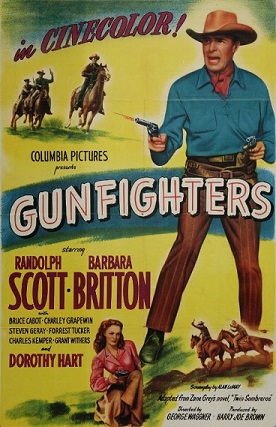
Gunfighters (1947, directed by George Waggner)


Brazos Kane (Randolph Scott) is a legendary gunfighter who has more notches on his gunbelt then he can count.  His reputation is so fearsome that he can’t even enter a town without having to worry about someone drawing a gun on him in an attempt to make a name for themselves.  When he’s forced to shoot his own best friend when the latter tries to outdraw him, Brazos says that he’s had enough.  He tosses aside his guns and he heads to the home of his friend, Bob Tyrell.  Brazos says he’s going to retire from gunfighting and just “ride the range.”

When Brazos reaches Bob’s cabin, he discovers that Bob has been murdered.  When Brazos rides to the nearby Banner ranch to report the crime, he’s arrested and accused of shooting Bob.  When it’s pointed out that Brazos doesn’t have a gun, corrupt Deputy Yount (Grant Withers) says that Brazos most have tossed it in the creek after he shot Bob.

With the help of Bob’s employer, a rancher named Inslip (Charley Grapewin), Brazos narrowly avoids getting hung.  Both Yount and the sheriff (Charles Kemper) encourage Brazos to leave town but Brazos isn’t going anywhere until he gets justice for Bob.  His investigation leads to him getting involved with two sisters (Dorothy Hart and Barbara Britton) and a young cowhand named Johnny (John Miles), who wants to become a famous gunslinger.  It also leads Bob into conflict with Bard Macky (Bruce Cabot) and Hen Orcutt (Forrest Tucker), who are both determined to run Brazos out of town.  Brazos finds himself tempted to go back on his word and pick up his guns yet again.

Based on a novel by Zane Grey, Gunfighters is a surprisingly mature and multi-layered western.  Brazos’s refusal to carry a gun and his genuine dislike of violence makes him a far more interesting protagonist than the typical B-western hero and Randolph Scott, one of the best of the cowboy actors, is appropriately world-weary in the role.  The villains are also written and played with an unexpected amount of depth, with Bruce Cabot the stand-out as Bard Macky.

Gunfighters is full of good scenes.  The opening sequence, featuring the pivotal gunfight between Brazos and his best friend, is excellently directed and captures how quickly violence can erupt in the old west.  Later, when Brazos first meets Johnny, the younger man is engaged in target practice and talking about how a man named Brazos Kane murdered Johnny’s best friend.  Johnny is practicing so he can kill Brazos himself.  Without revealing his identity, Kane gives Johnny a few pointers on how to draw and aim his gun.  It’s only after Johnny has perfected the quick draw that Kane laconically introduces himself and explains that he had nothing to do with Bob’s death.  Later, in a powerfully acted scene, Kane explains to Johnny just what exactly it means to be a famous gunfighter and to know that everyone you see is a potential threat.

Directed by George Waggner, Gunfighters is an intelligent and well-acted western and one of Radolph Scott’s best.

Great Moments In Comic Book History #14: Spider-Man No More!


One of the things that made Spider-man unique amongst the heroes of the Silver Age was that he often didn’t want to be a hero.  When he first got his powers, he wanted to make money.  It was the death of Uncle Ben that left him feeling obligated to fight crime.  But even then, he would have much rather have been Peter Parker.  Often times, when Spider-Man swinging across New York and fighting folks like Electro and the Sandman, he would have much rather have been at home, taking care of Aunt May or studying for a midterm or out on a date with Gwen Stacy or Mary Jane Watson.   Unlike the similarly angsty Hulk and The Thing, Spider-Man actually could had the option of abandoning his secret identity and trying to live a normal life if he wanted.  That Peter Parker not only felt obligated but often resentful made him a hero to which readers could relate.

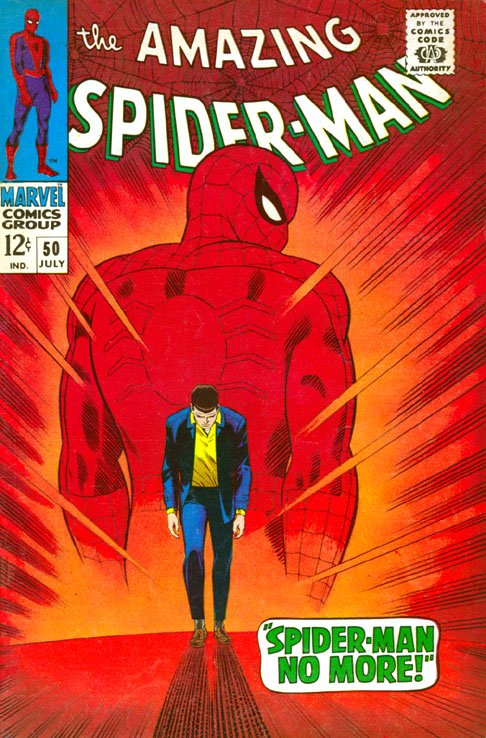
He finally did try to walk away in 1967’s Amazing Spider-Man #50 and it led to a classic cover from John Romita.  This cover, with both Peter and Spider-Man turning their backs on each other, perfectly captures the inner conflict that Peter dealt with every issue.  When he was Peter, he didn’t want to be Spider-Man and when he was Spider-Man, he didn’t always want to be Peter Parker.  In Amazing Spider-Man #50, exhausted from being continually condemned by J. Jonah Jameson and worried about Aunt May’s health (as always), Peter tried to walk away.

It didn’t last, of course.  At first, Peter enjoyed not being Spider-Man but, as crime increased, Peter realized that he still owed it to the people of New York City and the spirit of Uncle Ben to fulfil his “great responsiblity.”  At the end of the issue, Peter retrieved his costume and once again took to the streets.  It wasn’t a minute too soon because this issue featured not only a classic cover.  It also featured the first appearance of the crime lord known as the Kingpin.  New York needed Spider-Man more than ever.

Previous Great Moments In Comic Book History:

  1. Winchester Before Winchester: Swamp Thing Vol. 2 #45 “Ghost Dance” 
  2. The Avengers Appear on David Letterman
  3. Crisis on Campus
  4. “Even in Death”
  5. The Debut of Man-Wolf in Amazing Spider-Man
  6. Spider-Man Meets The Monster Maker
  7. Conan The Barbarian Visits Times Square
  8. Dracula Joins The Marvel Universe
  9. The Death of Dr. Druid
  10. To All A Good Night
  11. Zombie!
  12. The First Appearance of Ghost Rider
  13. The First Appearance of Werewolf By Night
  14. Captain America Punches Hitler

The Fighting Vigilantes (1947, directed by Ray Taylor)


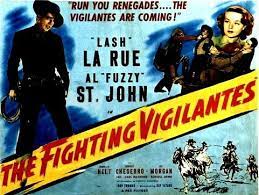
A town in the old west has problem.  Any wagon that comes into town carrying food or cooking supplies is robbed by a group of bandits hired by Price Taylor (George Chesebro), who wants to make sure that he doesn’t have any competition when it comes to selling food at inflated prices to the townspeople.  Because of Taylor’s price gouging, the ranchers are now in danger of starving but the law refuses to do anything to help because they’ve all been paid off by Taylor as well.  Another group of masked people, known as The Fighting Vigilantes, are now robbing Taylor’s wagons.  Things are getting violent and someone is going to get hurt.

Fortunately, Cheyenne Davis (Lash LaRue) and his sidekick, Fuzzy Q. Jones (Al St. John), ride into town.  Everyone thinks that Cheyenne is an outlaw because he wears all black and he carries a whip.  What they don’t know is that Cheyenne and Fuzzy are actually undercover U.S. marshals.  It doesn’t take long for Cheyenne to fall for Abby (Jennifer Holt), the daughter of a local rancher who is involved with the Vigilantes.  When Abby’s father is arrested, Abby blames Cheyenne and says that Taylor will never be defeated.  Fuzzy says that this proves that it’s best to stay away from women.  Can Cheyenne Davis and his trust bullwhip prove them both wrong?

This was one of the many B-western programmers in which Lash LaRue played the role of Cheyenne Davis.  Lash was unique amongst B-western heroes, in that he always dressed in black and he used a whip instead of a gun.  Unfortunately, he wasn’t much of an actor and all of his films were low-budget, rush jobs but he did look pretty cool with a whip.  The Fighting Vigilantes is typical of Lash’s later films but it does deserve some credit for having its heroes go up against not just a gang of outlaws but instead an entirely corrupt town.  Taylor has taken over every institution in the town, leaving the people living under them no choice but to turn vigilante.  The villains are so evil that they even shoot people in the back.  It’s impossible not to enjoy Cheyenne demonstrating, via his whip, the foolishness of trying to draw a gun on Lash LaRue.

The movie ends as almost all of Lash LaRue’s adventures did, with everyone laughing as Cheyenne uses his bullwhip to nearly kill Fuzzy Jones before the two of them ride off to find more injustices that can be fixed with the crack of a whip.  As for the real-life Lash LaRue, his movies eventually went out-of-style and, like a lot of the B-western stars, he moved over to television.  He struggled with alcoholism and was arrested for vagrancy in 1966.  However, he eventually turned his life around and, along with appearing in a few low-budget movies in the 70s, he spent his remaining years ministering to alcoholics in Florida, showing that the real-life Lash LaRue could do just as much good in the real world as he did in the movies.

Interactive Fiction Review: Being a Thing (2021, R. Asu)


Are you a person or a thing is the question at the heart of this game and finding out is going to take some courage.

At the start of Being A Thing 2, you are standing outside a dark city, unsure of who you are and what you are going to find inside of there. From the start, you have two choices. You can either follow what you feel you’re supposed to do and enter the city or you can turn around and leave and fail. Usually, it’s a bad thing to fail but considering what is waiting for you inside of the city, it might actually be the better option.

Most people playing Being A Thing 2 are going to want to explore. Since it’s a short game, why not take the 10 minutes necessary to discover what is inside of the city instead of turning around and leaving? And once you enter the city, you’ll still have the option to turn and leave. For a while, at least. Stay too long and you might lose that option but you may not have any other choice if you want to determine whether you’re a person or a thing.

This is one of those works of Interactive Fiction that is more of a short story with options instead of being a straight-forward game. Your main decision is how much of the story you want to explore before bringing things to an end by turning around and leaving the city. This really isn’t for people looking for complex puzzles or a huge range of choices to make. But if you’re looking for a well-written piece that actually has something to say about the human (or non-human) condition, Being A Thing 2 might be right up your alley.

Play Being A Thing 2.

Riders of Destiny (1933, directed by Robert N. Bradbury)


John Wayne sings!

Well, not really.  Wayne does play a cowboy named Singin’ Sandy Saunders in this early, pre-code Western but his voice was dubbed by someone who didn’t sound anything like Wayne.  Wayne was only 25 when he starred in Riders of Destiny and this was six years before Stagecoach made him a star but he already had his famous way of speaking.

Riders of Destiny starts off with Singin’ Sandy riding through the west.  When he comes across a wounded sheriff and then witnesses a stagecoach being robbed by Ms. Fay Denton (Cecilia Parker), he knows that he’s reached the town of Destiny.  The town is under the control of a land developer named Kincaid (Forrest Taylor).  Kincaid and his henchmen have been extorting the local citizens and stealing money from Fay and her father (George “Gabby” Hayes).  After Singin’ Sandy reveals his skills with a gun, Kincaid offers him a position in his gang and if Sandy accepts, Kincaid will be unstoppable.  Before Sandy’s mysterious appearance, the townspeople wrote to Washington to help and Washington has agreed to send down one of their best agents.  Could that agent be traveling in disguise as a singing cowboy?

It’s always difficult for me to take a Singing Cowboy film seriously.  (That’s especially true after watching Tim Blake Nelson in The Ballad of Buster Scruggs.)  John Wayne is not an actor who was ever meant to be seen playing a guitar and singing a song, even if his voice was dubbed.  But Riders of Destiny is not that bad of a programmer.  If you can overlook the singing, the story is surprisingly mature and violent and Forrest Taylor is a good villain as the oily Kincaid.  (With Kincaid demanding protection money and gunning down anyone who refuses to play it, he has more in common with the type of gangsters who were appearing in Warner Bros. crime films than with the typical western bad guy.)  Cecilia Parker, who would eventually be best known for appearing in the wholesome Andy Hardy films, is sexy as Fay and, because this is a pre-code film, she gets away with robbing a stagecoach.  With a running time of barely an hour, the action has to move quickly and there’s no need for any padding.  Finally, even this early in his career, John Wayne was a perfect western hero, whether he was on his horse chasing the bad guys or walking down a dusty street, singing a song about how the “streets will run with blood” before drawing his guns.

Wayne would go on to play one more Singing Cowboy, in 1935’s The Lawless Range.  Again, his voice was dubbed.  He later said that he abandoned the Singing Cowboy genre because the children who saw the films would often approach him and ask him to sing one of the songs and they were always disappointed to learn that he couldn’t actually a sing a note.  Of course, in 1939, John Ford would select Wayne to play The Ringo Kid in Stagecoach and Wayne would never have to sing again.