4 Shots From 4 Sam Peckinpah Films


4 Or More Shots From 4 Or More Films is just what it says it is, 4 shots from 4 of our favorite films. As opposed to the reviews and recaps that we usually post, 4 Shots From 4 Films lets the visuals do the talking!

Today would have been Sam Peckinpah’s 97th birthday.  No one raised Hell like Peckinpah so in honor of the day and his legacy, here are 4 shots from 4 of my favorite Peckinpah films.

4 Shots From 4 Sam Peckinpah Films

Ride the High Country (1967, directed by Sam Peckinpah, Cinematography by Lucien Ballard)

The Wild Bunch (1969, directed by Sam Peckinpah, Cinematography by Lucien Ballard)

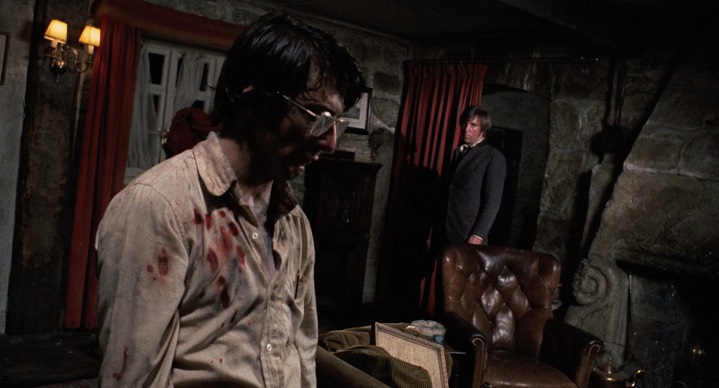
Straw Dogs (1971, directed by Sam Peckinpah, Cinematography by John Coquillon)

Bring Me The Head of Alfredo Garcia (1974, directed by Sam Peckinpah, Cinematography by Alex Phillips, Jr.)

Game Review: Locked Door V: Switched On (2022, Cody Gaisser)


Last week, when I played the fourth game in Cody Gaisser’s Locked Door series, I got bogged down in trying to figure out how to unlock a safe.  It was a real case of “guess the verb.”  Eventually, it turned out that I was guessing the right verb but I just wasn’t using it correctly in the game.  Once I got the safe open, I was able to get the key from Bob, open the wooden door, and get that all important trophy!

It’s a good thing that I eventually figured out how to open that safe because I had to do it all over again in Locked Door V.  That’s the way the Locked Door games work.  Each game features the same locations and puzzles from the previous games, along with new rooms to explore and new puzzles to solve.  Locked Door V also adds a new NPC, Rex the Dog.  Rex follows you everywhere and says, “Arf!”

After all of the difficulty that I had during the fourth game, I was relieved that I had a much easier time with Locked Door V.  It helped that I now knew how to open that safe.  Locked Door V‘s biggest puzzle comes from exploring the newly added basement.  Not only do you have to figure out how to make your way through a room that is completely dark but there’s also a puzzle that can only be solved by searching the rooms and being sure to pay attention to the details.  Do that and you’ll get the trophy!

I enjoyed Locked Door V.  Next week, I’ll see what Locked Door VI has in store for me!

Played Locked Door V: Switched On.

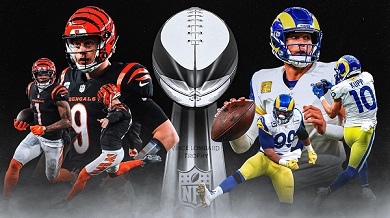
My 2022 Super Bowl Prediction


Bengals 27

Rams 24

It’s hard for me to make a prediction when Tom Brady isn’t playing the game.  This is a new situation for me but I guess it’s one that we’re all going to have to get used to.  I don’t know much about either team but I’m going with the Bengals because I like Cincinnati more than Los Angeles.  The Bengals achieving their first Super Bowl win would be the perfect ending for a season that few saw coming.

The Rams are fierce, though.  They’ll put up a good fight.  I think this game could go either way but I’m picking the Bengals.

Great Moments In Comic Book History #20: Kickers Inc. Comes To The World Outside Your Window


“The world outside your window!”

That’s how the Marvel described it’s new line of comic books, New Universe, is 1986.  The brainchild of Jim Shooter, New Universe was launched to celebrate the 25th anniversary of Marvel.  Consisting of 8 titles that were specifically advertised as not being a part of the regular Marvel universe, New Universe was advertised as featuring heroes who existed in the real world and who dealt with real world issues.  The plots would be realistic.  There would be no aliens or superhuman technology.  The superheroes would have powers but they would react to them in the same way that normal people would.  The stories would play out in real time, with a month passing from issue to issue.  It was the world outside your window!  According to Marvel: The Untold Story by Sean Howe, no one other than Jim Shooter thought New Universe was a good idea and, as Shooter became more and more obsessed with the New Universe, artists like John Byrne grew to resent Shooter’s focus on it.

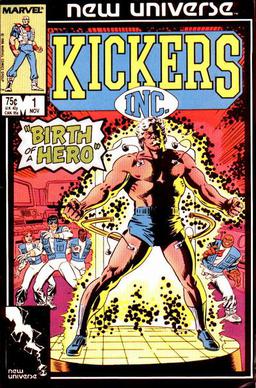
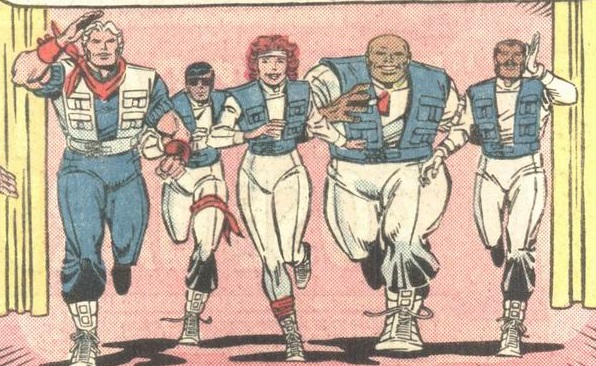
Among the New Universe titles released in 1986, there was Kickers, Inc.  According to Kickers, Inc., the world outside your window featured a football team called The New York Smashers whose top players, after retiring from football, became a crime-fighting group called Kickers, Inc.  They were led by Mr. Magnificent, who had super strength as the result of super technology (and who, therefore, featured two things that Jim Shooter said would not be present in the New Universe titles) and who became a hero after his brother was killed by gangsters who were tying to pressure Magnificent into throwing the Super Bowl.  That may not sound much like the world outside your window but, of course, Kickers, Inc. was not originally created with New Universe in mind.  Kickers, Inc. was originally envisioned as being a regular Marvel series but when Shooter learned about it, he insisted that it be modified into a New Universe title.  Creator Tom DeFalco wasn’t interested in doing a realistic comic book series about superpowered football players and he left the book after only a 3 issues.

Like almost all of the New Universe titles, Kickers, Inc. was canceled after just 12 issues.  It turned out that comic book readers, many of whom used comics to take a break from the real world, didn’t have much interest in super heroes existing in the world outside their window.  Strangely, the promise that new popular Marvel characters would appear in the New Universe books didn’t bring readers over.  (Again according to Sean Howe’s book, John Byrne and several other artists celebrated the death of the New Universe by gathering in Byrne’s backyard and setting a pile of New Universe books on fire.)  The New Universe debacle led to Jim Shooter leaving Marvel but, despite it all, the New Universe and its characters have occasionally been revived over the years and the idea of exploring how the real world would react to the presence of super heroes is one that has run through not the MCU but instead the Snyderverse.

Kickers, Inc. may not have been a success but at least it gives us some idea of what may lay in store for whichever team loses the Super Bowl this year.  The losing players may not leave with a super bowl championship but they may gain an entirely new career opportunity.

Previous Great Moments In Comic Book History:

  1. Winchester Before Winchester: Swamp Thing Vol. 2 #45 “Ghost Dance” 
  2. The Avengers Appear on David Letterman
  3. Crisis on Campus
  4. “Even in Death”
  5. The Debut of Man-Wolf in Amazing Spider-Man
  6. Spider-Man Meets The Monster Maker
  7. Conan The Barbarian Visits Times Square
  8. Dracula Joins The Marvel Universe
  9. The Death of Dr. Druid
  10. To All A Good Night
  11. Zombie!
  12. The First Appearance of Ghost Rider
  13. The First Appearance of Werewolf By Night
  14. Captain America Punches Hitler
  15. Spider-Man No More!
  16. Alex Ross Captures Galactus
  17. Spider-Man And The Dallas Cowboys Battle The Circus of Crime
  18. Goliath Towers Over New York
  19. NFL SuperPro is Here!

Great Moments In Television History #16: Maude Flanders Gets Hit By A T-Shirt Cannon


Twenty-two years ago, on this very date, this happened on The Simpsons:

Today, it is easy to forget what an impact the death of Maude Flanders had on viewers.  We are now used to semi-regular characters dying on TV shows and, of course, no one really cares that much about The Simpsons any more.

In 2000, though, this was a big deal.  There were weeks of speculation over which Simpsons character would die, though most of us figured that it would be Maude Flanders early on.  Maude had never been a major character, as Rev. Lovejoy pointed out in his eulogy.  Plus, the actress that voice Maude, Maggie Roswell, had left the show.  (Roswell later returned.)  At the time, killing Maude was a controversial move, especially as she died as a result of Homer acting like a jerk.  (Then again, everything that ever happened in Springfield was a result of Homer acting like a jerk.)  Some critics complained that the show treated her death too cavalierly and that such morbid subject matter did not belong on a show like The Simpsons.  But, as the show’s producers pointed out, the death of Maude also opened the door for new storylines involving Ned Flanders and, as a result, Ned became one of the few characters on the show to actually grow as a person.

Even though Ned was invented to act as a foil to Homer and he’s been the victim of some lazy writing (especially in the more recent season), Ned Flanders has a dedicated fan base and a lot it is due to him being one of the few people in Springfield to actually show any sort of decency on a consistent basis.  That Homer is incapable of understanding that Ned is the only person (outside of the family) that he can depend on is one of the show’s best and longest-running jokes.  As a character, Ned was at his best when he was coming to terms with Maude’s death, learning how to date again, and even forgiving Homer for the role he played in the tragedy.  (Homer never really seemed to realize that it was all his fault.  Typical Homer.)  The show deserved more than a little credit for how it handled the fallout of Maude’s death, from Rod and Todd’s sadness to Ned’s very temporary loss of faith.  Over the upcoming years, Ned Flanders went to marry Edna Krapapple and, after the passing of Carol Wallace, became a widower for a second time.

One final note: Marvin Monroe later turned out to be alive so I wonder who was buried in his grave at teh cemetery.

Previous Great Moments In Television History:

  1. Planet of the Apes The TV Series
  2. Lonely Water
  3. Ghostwatch Traumatizes The UK
  4. Frasier Meets The Candidate
  5. The Autons Terrify The UK
  6. Freedom’s Last Stand
  7. Bing Crosby and David Bowie Share A Duet
  8. Apaches Traumatizes the UK
  9. Doctor Who Begins Its 100th Serial
  10. First Night 2013 With Jamie Kennedy
  11. Elvis Sings With Sinatra
  12. NBC Airs Their First Football Game
  13. The A-Team Premieres
  14. The Birth of Dr. Johnny Fever
  15. The Second NFL Pro Bowl Is Broadcast

Game Review: Locked Door IV (2022, Cody Gaisser)


Once again, you are in a white room, with  locked door that needs to be unlocked.  Actually, there are two this time.  There are other exits that are not locked and which lead to other areas that were not featured in the previous Locked Room games.  Search the warehouse.  Examine the garden.  Or talk to Bob, who is again standing in the room and holding a key that he won’t just hand over.

Safety in Numbers is the fourth Locked Room game.  Again, the aim is simple.  Give Bob something he wants.  Get that key.  Unlock that door.  Get your trophy.  But this time, there are more rooms to explore.  There are extra puzzles to be solved.  And there is a safe that needs to be opened.  Finding the combination for the safe should be easy.  Any experienced IF player will know where to look.  Using that combination to unlock the safe is much less easy.  As much as I appreciate what the Locked Door games are doing, the fourth entry leads to one of the most frustrating cases of “guess the verb” that I’ve ever come across.  Turn, set, spin, what the Hell am I supposed to do with this dial?

Play Locked Door IV and let know if you figure it out.

Banjo Hackett: Roamin’ Free (1976, directed by Andrew V. McLaglen)


The great Don Meredith will always be remembered for a few things.

He’s remembered for being the first Dallas Cowboys quarterback, leading the team to multiple championship games but sadly never making it to the Super Bowl.  If you’ve seen North Dallas Forty, the quarterback played by Mac Davis was based on Meredith.  North Dallas Forty was based on a book by Phil Gent, a former Cowboys wide receiver.  When asked about the book and Gent’s portrayal of himself as being the best player on the team, Meredith reportedly said, “Hell, if I had known Phil was that good, I would have thrown him the ball more often.”

Don Mereidth was also one of the first players to make the jump from playing on the field to calling plays in the broadcast booth.  He was the good old boy who served as a foil to Howard Cosell and who sang “Turn out the lights, the party’s over” whenever it became obvious that one team was going to win the game.

He will also always be remembered for an incident in 1979 when, while covering a game in Denver, he supposedly said, “Welcome to Mile High Stadium — and I am!”  This is actually an urban legend.  Meredith never actually said he was high on national television but if a member of the original Monday Night Football Team was going to say that, it probably would have been Dandy Don.

Don Meredith is less remembered for his acting career but, like a lot of retired football players in the 70s, he tried his hand at performing.  As an actor, Don Meredith was a very good quarterback.  His performances were superior to Joe Namath’s but his range was undeniably limited.  Smart producers essentially had Don Meredith play himself, a laid back good old boy who liked his beer and enjoyed hanging out with his buddies.

Banjo Hackett was typical of Don Meredith’s films.  In this made-for-TV movie, Meredith plays the title character.  He’s the nicest horse trader in the old west but not even someone as laid back as Banjo Hackett is going to stand for someone stealing from him.  When he learns that his nephew, Jubal (Ike Eisenmann), has been put into an orphanage and that evil bounty hunter Sam Ivory (Chuck Conners) has stolen Jubal’s favorite horse, Banjo steps up to the huddle.  First, he engineers Jubal’s escape from the orphanage. Then he and his nephew track Sam across the frontier, determined to catch up with him before he sells Jubal’s horse.

Banjo Hackett was obviously meant to serve as a pilot for a television series.  The series never happened but Banjo Hackett itself is a likable film that will be best appreciated by western fans who are looking for something harmless to watch.  Don Meredith may not have been a versatile actor but he had a sincere screen presence and Chuck Conners was always an effective bad guy.  The cast is full of familiar western actors, including Slim Pickens, L.Q. Jones, and Jeff Corey.  As a movie, Banjo Hackett is as amiable as its lead character.

True Grit: A Further Adventure (1978, directed by Richard T. Heffron)


Warren Oates as the legendary, one-eyed old west lawman Rooster Cogburn?

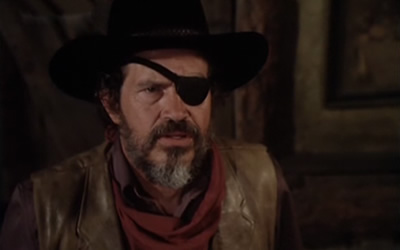
That was the idea behind True Grit: A Further Adventure, a made-for-TV movie that was meant to serve as a pilot for a potential television series.  The film is a direct sequel to 1969’s True Grit and it features Warren Oates stepping into the role of Rooster Cogburn, the character that John Wayne famously played in the original film and who Jeff Bridges later played in the 2010 remake.  In A Further Adventure, Cogburn is once again hired to escort teenager Mattie Ross (Lisa Pelikan) across the country.  Along the way, Rooster gambles away all their money, meets an attractive widow (Lee Meriwether), and gets a job in a mining town.  With the help of Mattie, he also gets a job as a bounty hunter and the two of them go after a group of wanted outlaws.  Mattie tries to reform Rooster and make him act like more of a traditional western hero while Rooster drinks and gambles and complains.

I am a huge Warren Oates fan but even I have to admit that he’s miscast of Rooster Cogburn.  In both Charles Portis’s original novel and the two films that were adapted from it, Rooster was overweight and physically imposing,  He wasn’t book-smart but he was wise in the ways of the frontier.  Physically, Warren Oates is too slightly built and his trademark nervous energy feels out of place in the role of Rooster.  Wayne and Bridges were both believable as men who would draw first and ask questions later but Oates was a natural-born talker.  That’s one of the things that made him one of the best actors of the 70s but it doesn’t serve him well in the role of Rooster Cogburn.

On the plus side, Lisa Pelikan is a considerable improvement on Kim Darby in the role of Mattie, though she’s nowhere near as good as Hailee Steinfeld would later be in the 2010 film.  Lee Meriwether and Warren Oates shares some good scenes together but the film’s made-for-TV origins makes Meriwether’s overall performance feel like a special guest star diversion.  True Grit: A Further Adventure is a throw-back to the type of formulaic western television programs that were popular in the late 60s.  It’s easy to see why the pilot didn’t get picked up.  It was miscast and it was too late.  If it had aired a few years earlier, it’s possible to imagine Oates and Pelikan traveling to a different town and getting involved in a different story on a weekly basis and perhaps the role would have been changed to better suit Oates’s style of acting.  But, by 1978, television was heading in the direction of Hill Street Blues and the days of the western were over.

Unfortunately. Warren Oates would die just four years after this film aired, a tragically early passing that robbed the world of a unique actor who was in his prime.  Though Oates may not have been right for Rooster Cogburn, he will always be remembered for films like Badlands, Bring Me The Head of Alfredo Garcia, Stripes, Dillinger, and Two-Lane Blacktop.  He was truly a one of a kind talent.

Great Moments In Television History #15: The Second NFL Pro Bowl is Broadcast


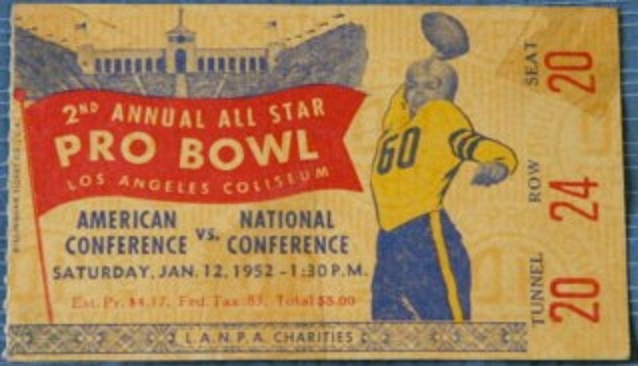
On January 12th, 1952, NBC aired the Pro Bowl.

Though this was the first time that the Pro Bowl was aired on network television, it was actually the second Pro Bowl to be played.  The 1951 Pro Bowl, which was not televised, was a legendary game featuring amazing plays by both the American Conference Team and the National Conference Team.  The final score was 28 to 27, with the America Conference triumphant.  That was the unaired Pro Bowl.

The second Pro Bowl, which went out to viewers all across America, was closer than the final score indicated.  At the end of the first half, the American Conference led by a score of 13-10.  After a scoreless Third Quarter, the National Conference came roaring back during the 4th Quarter.  During the final quarter, the National Team scored 20 unanswered points and went on to win by a score of 13-30.

I haven’t been able to find out much about what specifically happened during the second Pro Bowl but the stats would seem to indicate that it was a good game!  And it played out to a nationwide audience on January 12th, 1952.

As far as Pro Bowls go, it’s all been downhill from there.

Previous Great Moments In Television History:

  1. Planet of the Apes The TV Series
  2. Lonely Water
  3. Ghostwatch Traumatizes The UK
  4. Frasier Meets The Candidate
  5. The Autons Terrify The UK
  6. Freedom’s Last Stand
  7. Bing Crosby and David Bowie Share A Duet
  8. Apaches Traumatizes the UK
  9. Doctor Who Begins Its 100th Serial
  10. First Night 2013 With Jamie Kennedy
  11. Elvis Sings With Sinatra
  12. NBC Airs Their First Football Game
  13. The A-Team Premieres
  14. The Birth of Dr. Johnny Fever

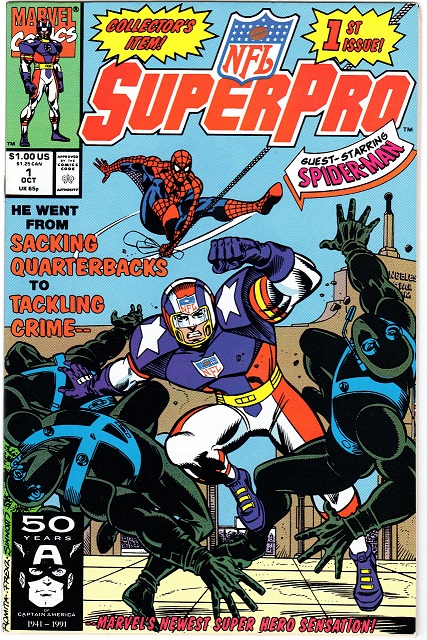
Not So Great Moments In Comic Book History #19: NFL SuperPro Is Here!


Behold, the one Marvel super hero who will never get his own movie or even a show on Disney Plus!  Behold, NFL SuperPro!

He went from sacking quarterback to tackling crime!  That tells you all you really need to know about NFL SuperPro.  His real name was Phil Grayson.  He dreamed of being a football star until he was sidelined by a knee injury.  Working as a sports reporter, Phil one day interviewed an eccentric fan who revealed that he specialized in making special football uniforms that would turn the players into superheroes.  At that very moment, a group of burglars broke into the fan’s home.  They stole all of the fan’s memorabilia (and later set it all on fire) but, for some reason, ignored all of the super costumes on display.  The fan ended up dead but Phil Grayson ended up with a uniform and, thanks to a chemical spill, super strength!

It may sound like a parody but it was actually a very real comic book and, due to guest appearances from both Spider-Man and Captain America, NFL SuperPro was very much a part of the Marvel universe.  Marvel, back in the days when the company was always just a few months away from bankruptcy, partnered with the NFL to develop NFL SuperPro. The NFL wanted to reach news fans.  Marvel needed money.

Fabian Nicieza, who wrote the first five issues of NFL SuperPro, said that he only worked on the book because the NFL agreed to give him free tickets to all the games.  The NFL thought they would be getting some new fans.  Marvel thought they’d be getting some NFL money.  Instead, they both got years of ridicule that lasted far beyond the end of NFL SuperPro’s series.

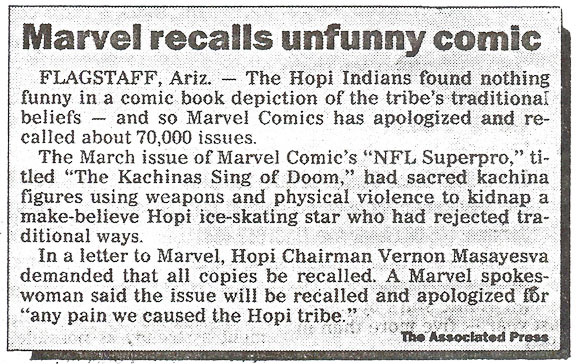
NFL SuperPro ran for 12 issues, from 1991 all the way to 1992.  He fought a collection of villains who were all related to football.  His main enemy was a crime boss called Sanction and let’s just say that the Kingpin wasn’t losing any sleep over losing his status as Marvel’s main criminal mastermind.  NFL SuperPro also faced off against a time traveling assassin named, you got it, Instant Replay!  And then there was Quickkick, a villain who used to be a placekicker!  In one issue, NFL SuperPro fought a gang of Hopi criminals and the reaction from representatives of the Hopi Tribe was so fiercely negative that the issue itself was recalled.  That’s probably not what the NFL had in mind when it came to attracting new fans.

Along with that controversy, NFL SuperPro did not last because it wasn’t very good and an early 90s comic book reader was probably the least likely person to idolize someone who was essentially a jock.  In fact, as a character, NFL Superpro has not appeared since 1992, which is a little amazing when you consider that Marvel still occasionally trots out U.S. Trucker for a guest appearance or two.  It is tempting to think that Marvel is embarrassed by NFL SuperPro but his absence probably has more to do with NFL copyright issues.  And the NFL definitely was embarrassed.

As much as Marvel has tried to memoryhole the character, NFL SuperPro has not been forgotten.  He may never appear in a film but he will live on as long as collectors and fans debate who was the worst Marvel hero of all time.

Previous Great Moments In Comic Book History:

  1. Winchester Before Winchester: Swamp Thing Vol. 2 #45 “Ghost Dance” 
  2. The Avengers Appear on David Letterman
  3. Crisis on Campus
  4. “Even in Death”
  5. The Debut of Man-Wolf in Amazing Spider-Man
  6. Spider-Man Meets The Monster Maker
  7. Conan The Barbarian Visits Times Square
  8. Dracula Joins The Marvel Universe
  9. The Death of Dr. Druid
  10. To All A Good Night
  11. Zombie!
  12. The First Appearance of Ghost Rider
  13. The First Appearance of Werewolf By Night
  14. Captain America Punches Hitler
  15. Spider-Man No More!
  16. Alex Ross Captures Galactus
  17. Spider-Man And The Dallas Cowboys Battle The Circus of Crime
  18. Goliath Towers Over New York