Game Review: Locked Door III: Crate Expectations (2022, Cody Gaisser)


Once again, you are standing in a white room that is the most boring room in existence.  There are two archways, one to the east and one to the west.  There’s a man named Bob who you might remember from a previous game.  And there’s a door to the north that’s locked.

Can you unlock the door?  You’ll have to figure out how to get the key first!

This is the third Locked Door game.  You’ve now got slightly more rooms to explore.  And you’ve got a puzzle to solve.  Unlike the first two Locked Door games, you now have to use your IF skills if you want to unlock that door.  Luckily, it’s a very simple puzzle and your trophy awaits!  I solved it in 27 turns and scored all 3 points.

Like the previous two games, Locked Door III works best as a parody of the locked room puzzles that every IF player has gotten frustrated with at some point.  It’s amazing how there’s always something just lying around that the player can use to open whatever needs to be opened.  Most houses don’t have crowbars, hammers, and and wooden planks in every room.

Next week: Locked Room 4!  As long as I can keep figuring out how to unlock the doors, I’ll keep playing each installment.

Play Locked Room III.  

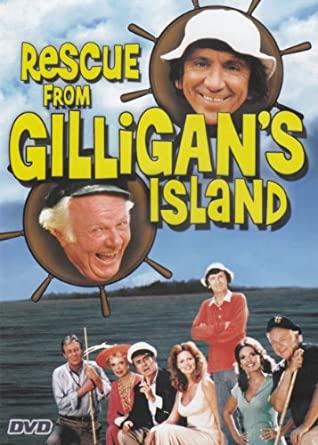
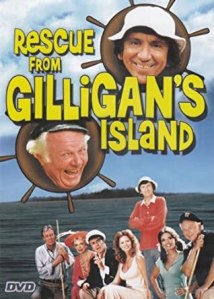
Rescue From Gilligan’s Island (1978, directed by Leslie H. Martinson)


I know that this is going to shock some people but Rescue From Gilligan’s Island is dumb.  In fact, it is not just dumb.  Instead, it is very, very, very dumb.  It’s just about the dumbest goddamn thing I’ve ever seen.

The first TV movie sequel to the 60s television show about a group of castaways on an uncharted isle, Rescue From Gilligan’s Island picks up ten years after the final episode of Gilligan’s Island.  The castaways are still living on the island and trying to figure out how to get back home.  There’s the Skipper (Alan Hale, Jr.) and Gilligan (Bob Denver).  There’s Mary Ann (Dawn Wells), the Howells (Jim Backus and Natalie Schaefer), and the Professor (Russell Johnson).  Ginger is also there but there’s something different about her.  Tina Louise refused to return to the role because she always said appearing on Gilligan’s Island ruined her career.  Ginger is now played by Judith Baldwin, who looks glamorous but who also plays her role distressingly straight, as if she was the only person unaware that nothing about Gilligan’s Island should have been taken seriously.

After ten years of being stranded, the professor finally figures out how to get the castaways off the island!  You’ll never believe the plan he comes up with.  He decides that the castaways should build, get this … a raft!  Ten years on the island and it never occurred to them to just make a raft?  The castways do get some help from a tsunami, which pushes them out to the ocean.  And then when Gilligan sets the raft on fire, they’re saved by the Coast Guard.

(How did they spend ten years on the island without killing Gilligan?)

Despite having been away from ten years, everyone settles back into their old routines but it’s not just the same.  The Professor tries to teach but the students just want to hear about what it was like to be marooned on an island.  Ginger returns to acting but is expected to now appear in PG-rated films!  Mary Ann agrees to marry her old boyfriend, Herbert, despite not loving him.  The Howells go right back to their old lives because the Howells are just as weird as on the mainland as they were on the island.

As for Gilligan and Skipper, they try to convince their insurance company to pay to fix the Minnow so that they can go back to giving three-hour tours but to do that, they have to convince all of the castaways to sign a form swearing that the Skipper was not liable for what happened during that last tour.  (But, even if they could fix up the Minnow, why would anyone want to take a tour with the Skipper and Gilligan when the entire world probably knows that doing so mean risking having to spend ten years on a deserted island?  There’s a reason why no one wanted to fly with George Kennedy after the fourth Airport movie.)  So, Gilligan and the Skipper travel the country and visit old friends while being pursued by two Russian agents (Vincent Shiavelli and Art LeFleur) who want to steal a metal disc that Gilligan found on the island.

I told you it was dumb.

Dumb it may have been but it was also the highest rated show for the week that it aired.  While this didn’t lead to a new series, it did lead to two more made-for-TV movies.  In the first one, the castaways opened a resort.  In the second one, they teamed up with a group of sports superstars and kept Martin Landau from exploiting the island’s natural resources.  Dumb as this movie may be, it was necessary steps towards teaming the Skipper up with the Harlem Globetrotters.

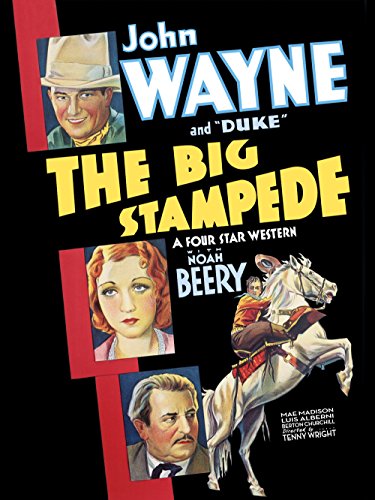
The Big Stampede (1932, directed by Tenny Wright)


On the New Mexico frontier, war is breaking out behind rancher Sam Chew (Noah Beery) and rustler Sonora Joe (Luis Alberni).  Both want to control the land and the cattle that graze upon it and innocent settlers are getting trapped in the middle!  The governor decides to send a young sheriff named John Steele to maintain order.  No sooner has Steele arrived then he meets a young woman (Mae Madison) and her father, who have both been attacked by and had their cattle stolen by Sam Chew.  After Sonora Joe and his gang save his life from Sam’s men, Steele realizes that Sam is more malicious and dangerous than Sonora Joe so he decides that the best way to handle the situation is to deputize Joe and team up with him to stop Sam and his men.  It’s a tall order but John Steele is just the man to handle it because John Steele is John Wayne!

This was one of the many B-westerns that the former Marion Morrison made in the decade before John Ford made him a star by casting him in Stagecoach.  Wayne was always a good hero, even in a 54-minute programmer like this one.  Though there is, as the title promises, an impressive stampede, Wayne is the main attraction here, with Noah Beery serving as a good heavy as always.  Perhaps the most interesting thing about this movie, if you’re a western or a John Wayne fan, is that Wayne’s horse is named Duke.  This was one of six films that Wayne made with Duke. Back in the 30s, the horses were often as a big a star as the men who rode them and, from the posters I’ve seen, it does appear that The Big Stampede was advertised as starring, “John Wayne and DUKE!”  At least Wayne was still able to get top billing.

The Big Stampede had previously been made as a silent film and the remake reuses a lot of old footage from the original.  John Wayne, needless to say, did not star in the original film, though he did wear the same costume that Ken Maynard wore in an attempt to keep people from noticing that the footage didn’t always match.  It’s not a totally successful ploy, though undemanding audiences in 1932 probably accepted it.  The Big Stampede would be remade one more time, in 1936, with Dick Foran taking the starring role.

4 Shots From 4 John Ford Films: The Informer, Stagecoach, The Quiet Man, The Man Who Shot Liberty Valance


4 Or More Shots From 4 Or More Films is just what it says it is, 4 shots from 4 of our favorite films. As opposed to the reviews and recaps that we usually post, 4 Shots From 4 Films lets the visuals do the talking!

Yesterday was John Ford’s birthday.  Better late than never, here are four shots from four of my favorite John Ford films!

4 Shots From 4 John Ford Films

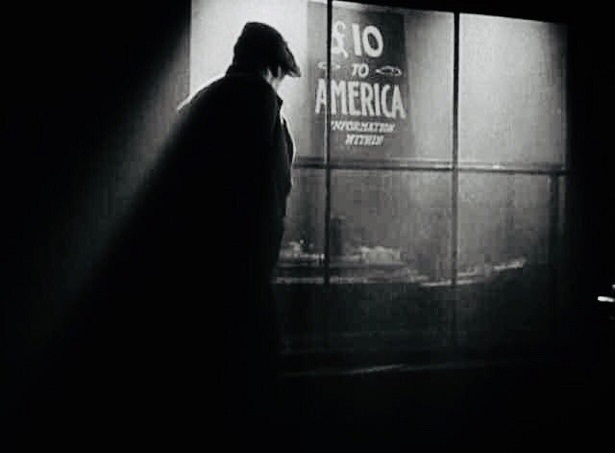
The Informer (1935, directed by John Ford. Cinematography by Joseph August)

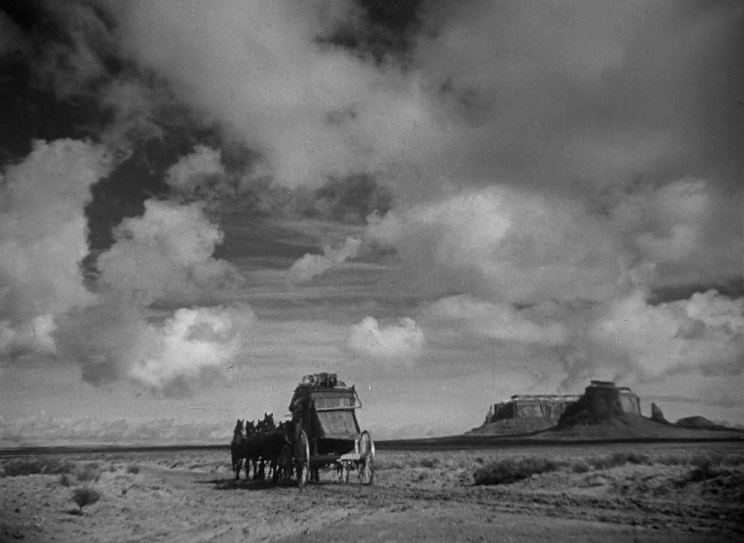
Stagecoach (1939, directed by John Ford, Cinematography by Bert Glennon)

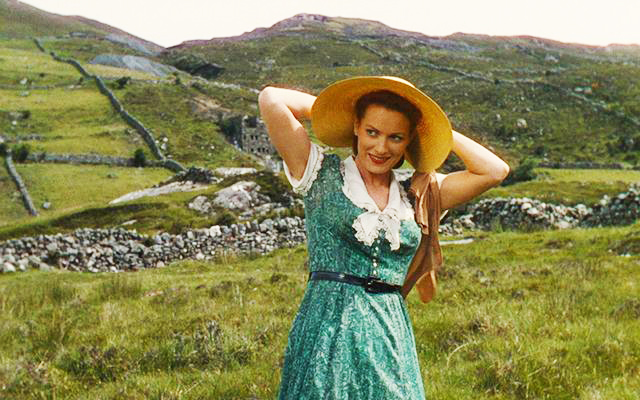
The Quiet Man (1952, directed by John Ford. Cinematography by Winton C. Hoch)

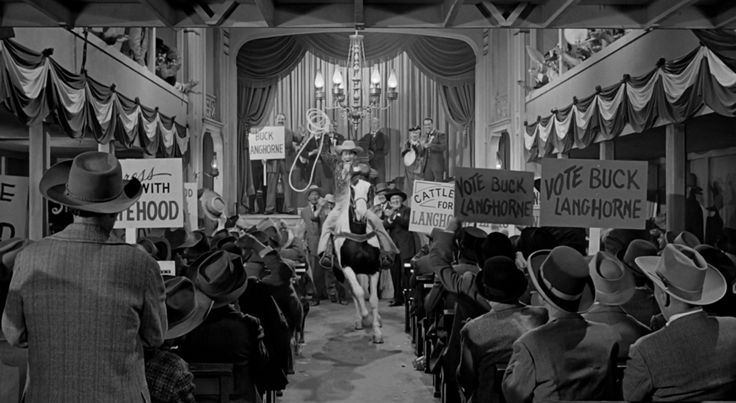
The Man Who Shot Liberty Valance (1962, directed by John Ford. Cinematography by William Clothier)

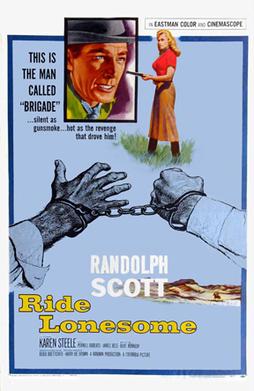
Ride Lonesome (1959, directed by Budd Boetticher)


In the western Ride Lonesome, Randolph Scott plays Ben Brigade. Brigade is a bounty hunter. The only thing that really differentiates him from the outlaws that he captures is that he gets paid for what he does. When Brigade arrests a young outlaw named Billy John (James Best), he gives Billy just enough time to send word to his older brother, Frank (Lee Van Cleef). And when Brigade starts to lead Billy John back to the town of Santa Cruz, he takes his time and fails to cover his tracks, almost as if he is intentionally making time for Frank to eventually catch up to him. Along the way, Brigade meets up with three others, a woman named Carrie (Karen Steele) and two outlaws named Boone (Pernell Roberts) and Whit (James Coburn). Carrie is searching for her husband while Boone and Whit want to arrest Billy John themselves so that they can turn him in and get a pardon for their own crimes.

Ride Lonesome is one of the best of the many films that Randolph Scott made with director Budd Boetticher.  Boetticher specialized in making fast-paced westerns that had deceptively simple plots.  Nobody in a Boetticher western was totally good or totally bad and that’s certainly the case with Ride Lonesome, which may seem like a typical western but which is actually a character study of 6 very different people.  Brigade is often only the hero by default and his actions are often as ruthless as those of the men who are tracking him.  It’s only after he meets and gets to know Carrie that he starts to seriously consider that his plans could lead to innocent people getting hurt. Billy John may be a wanted killer but, underneath his bravado, he’s just someone trying to live up to his brother’s example.  Meanwhile, Boone and Whit may be outlaws but they turn out to be the most morally upright characters in the film.  Ride Lonesome takes a serious look at frontier justice and suggests that maybe black-and-white morality isn’t all that it’s cracked up to be.

Needless to say, the cast is great.  Randolph Scott was one of the great western heroes and Karen Steele, Pernell Roberts, Lee Van Cleef, and James Best all turn in memorable performances.  Best of all is James Coburn, making his film debut and showing that, even at the start of his career, he was already the epitome of cool.  Ride Lonesome is one of the best of of the Boetticher/Scott westerns and a true classic of the genre.


In The Line of Duty: Siege at Marion (1992, directed by Charles Haid)


After bombing several Mormon centers in Utah, religious extremist and polygamist Adam Swapp (Kyle Secord) has barricaded himself inside of a farm house with his wives and supporters. The FBI, led by Bob Bryant (Dennis Franz), have the house surrounded and are trying to convince Swapp to peacefully surrender. Swapp, however, has no intention of going down without a fight.

In the 1990s, NBC did a whole series of made-for-TV miniseries about real-life law enforcement operations that inevitably led to the death of at least one of the officers involved. They made so many of them and they churned them out so quickly that NBC even aired a movie about the Branch Davidian stand-off while it was still going on. Siege at Marion, the fourth of the In The Line of Duty films, feels like a precursor to what was eventually happen in Waco. Just as happened in Waco and with the attempts to arrest Randy Weaver at Ruby Ridge, critics claimed that the government came on too strong while the government claimed that they were merely enforcing the law.

Siege at Marion is the least interesting of all of the In The Line of Duty movies, mostly because the Marion siege was neither as mismanaged as what happened in Waco or as egregiously heavy-handed and disturbing as what happened in Ruby Ridge. Though based on a true story, Siege at Marion is a standard stand-off film with the only suspense coming from the film’s distasteful attempts to build up suspense as to whether it’ll be Dennis Franz, William H. Macy, or Ed Begley, Jr. who is killed in the line of duty. Since only one of them is given a backstory and a family, it’s easy to guess which one it will be.

The best thing about Siege of Marion is the cast. Dennis Franz was born to play cops and it’s interesting to see a pre-Fargo William H. Macy playing a non-nervous character. Kyle Secor is convincingly fanatical and unhinged as the messianic Adam Swapp. Secor would go on to star as Tim Bayliss on the much-missed Baltimore-set cop show, Homicide: Life on the Street. Speaking of classic cop shows, Siege at Marion was also directed by Charles Haid, who played Andy Renko on Hill Street Blues. As for the In The Line of Duty films, the last one was made in 1994 but they all live on in syndication.

Great Moments In Television History #14: The Birth of Dr. Johnny Fever


Today’s great moment comes from the pilot episode of WKRP In Cincinnati.  This first aired on September 18th, 1978 and Johnny Carvaello allowing the spirit of rock and roll to turn him into Dr. Johnny Fever would forever be one of the show’s most famous moments.

Rest in Peace, Howard Hesseman.

Previous Great Moments In Television History:

  1. Planet of the Apes The TV Series
  2. Lonely Water
  3. Ghostwatch Traumatizes The UK
  4. Frasier Meets The Candidate
  5. The Autons Terrify The UK
  6. Freedom’s Last Stand
  7. Bing Crosby and David Bowie Share A Duet
  8. Apaches Traumatizes the UK
  9. Doctor Who Begins Its 100th Serial
  10. First Night 2013 With Jamie Kennedy
  11. Elvis Sings With Sinatra
  12. NBC Airs Their First Football Game
  13. The A-Team Premieres

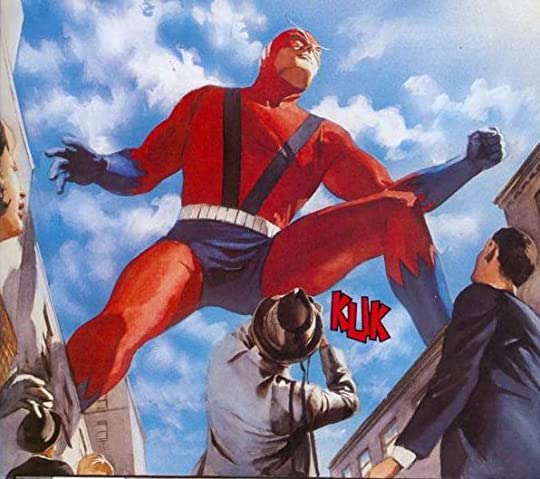
Great Moments In Comic Book History #18: Goliath Towers Over New York


This is one of my favorite Alex Ross images.  I’m not sure if that’s Henry Pym or Clint Barton towering over the city but this painting captures the shock and wonder that would be generated by such a sight.  It’s from the 2nd issue of Marvels and to me, this is what the MCU films should take some times to explore, not just the activities of super-powered heroes but also of all the ordinary people who have to try to live their lives while all of the heroes and the villains fight their petty battles.

Previous Great Moments In Comic Book History:

  1. Winchester Before Winchester: Swamp Thing Vol. 2 #45 “Ghost Dance” 
  2. The Avengers Appear on David Letterman
  3. Crisis on Campus
  4. “Even in Death”
  5. The Debut of Man-Wolf in Amazing Spider-Man
  6. Spider-Man Meets The Monster Maker
  7. Conan The Barbarian Visits Times Square
  8. Dracula Joins The Marvel Universe
  9. The Death of Dr. Druid
  10. To All A Good Night
  11. Zombie!
  12. The First Appearance of Ghost Rider
  13. The First Appearance of Werewolf By Night
  14. Captain America Punches Hitler
  15. Spider-Man No More!
  16. Alex Ross Captures Galactus
  17. Spider-Man And The Dallas Cowboys Battle The Circus of Crime


Game Review: Locked Door II: Fair Trade (2022, Cody Gaisser)


(SPOILER WARNING)

You’re in a room.  There’s one door.  It’s locked.  Does this seem familiar?  Maybe you played Locked Door, to which this game is the first of many sequels.  Can you figure out how to unlock the door?  In the first game, the key was just sitting in the room.  In this game, the key is not mentioned as being in the room.  Instead, there’s some schlub named Bob and there’s an apple.  Can you figure out what to do?

Like the first game, Locked Door II will be appreciated by people who have played and struggled with games that require them to figure out some sort of complex puzzle in order to open up a door.  Locked Door II does have a puzzle but it’s so simple that it makes a statement about how needlessly complicated some other games can be.

If you get that door unlocked, you’ll get a prize.  Unlike the first game, you’ll have to find prize, though.  Just look in the most obvious place.

So far, there are seven different Locked Door games.  From what I understand, each game gets progressively more complex.  Eventually, I’ll probably end up in a room that I can’t get out of and I’ll have to stop playing.  Will it happen with Locked Door III?  Tune in next week to find out.

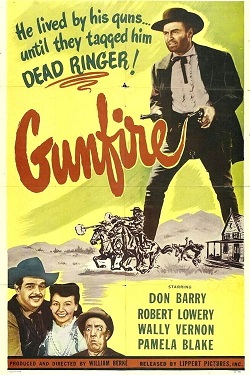
Gunfire (1950, directed by William Berke)


Years after the death of his brother Jesse, Frank James (Don “Red” Barry) has settled down in Colorado and is living a peaceful life as a rancher.  He is even friends with the town’s sheriff, John Kelly (Robert Lowery).  Unfortunately, it’s not always so easy to escape the past, especially when you are one of the few surviving members of one of the Old West’s most notorious gangs.  A former member of the James Gang, Mundy (Claude Stroud), shows up at Frank’s cabin and tries to talk Frank into joining up with him, the Ford brothers (Gaylord Pendleton and Roger Anderson), and their new leader, Bat Fenton (Don “Red” Barry, playing a second role).  When Frank refuses and makes clear that he still wants revenge on the Ford brothers for the murder of Jesse James, the gang goes on a crime spree.  Because he and Fenton look exactly alike, the entire town thinks that Frank is responsible.  Can Frank clear his name and avenge the death of his brother?

There were a lot of poverty row B-westerns produced in the early 1950s and most of them are pretty bad.  However, occasionally you come across a diamond in the rough and that’s the case with Gunfire.  Gunfire tells an interesting story, it has exciting gunfights, and it also features not one but two good performances from Don “Red” Barry!  Barry is equally convincing as both the good Frank and the bad Fenton and the movie uses the double plot as a way to illustrate how difficult it is to escape the sins of the past.  Frank has been “born again” but every time he sees Fenton, he sees not only who he used to be but also who many will always believe him to be.  Gunfire is a good western that shows that you don’t need a huge budget to tell an engaging story.