Running For His Life: The Lawrence Phillips Story (2016, directed by Ross Greenburg)


Lawrence Phillips could have been one of the greatest professional football running backs of all time but he couldn’t outrun his demons.

Phillips was a great high school and college player.  He led the University of Nebraska to victory in the 1995 Orange Bowl and the 1996 Fiesta Bowl.  But even when he was playing under the legendary coach Tom Osborne at Nebraska, there were signs of the issues that would eventually end his professional career.  In 1995, he was arrested for breaking into an apartment, grabbing his ex-girlfriend, dragging her down three flights of stairs by her hair and then smashing her head into a mailbox.  At first, he was suspended from playing football but he was eventually reinstated by Coach Osborne.  At the time, Osborne said that football was perhaps the only thing in Phillips’s life that could keep him on track.

The assault may have kept Phillips from winning the Heisman Trophy that he had been widely considered a favorite to receive but it didn’t keep him out of the NFL.  In the 1996 Draft, the Rams selected him as the 6th overall pick.  Phillips proved himself to be a talented running back but his life off the field continued to be erratic.  When he showed up drunk for a pre-game practice, Phillips was cut from the team.

Phillips went to Miami, where he played two games for the Dolphins before he was arrested and charged with assaulting a woman in a nightclub.  Again cut from the team, Phillips eventually ended up in NFL Europe, where he set records and proved that he could still play.  Returning to America in 1999, Phillips was signed by the 49ers but he was cut after refusing to practice and missing a block that led to quarterback Steve Young suffering a season (and career) ending concussion.

With no future in the NFL, Phillips signed with the Arena Football League but was cut when he failed to show up for practice.  He then went to Canada, where he had one good season with Montreal Alouettes before again getting cut after being charged with a sexual assault.  The last team he played for was the Calgary Stampede.  He was cut for arguing with the coach.

Phillips was 30 years old and washed up as an athlete.  After his then-girlfriend tried to break-up with him, he grab her by the throat and nearly strangled her.  A few days later, while driving around Los Angeles, he spotted three teenagers playing a pick-up football game.  He joined their game but, after he became convinced one of them had stolen some money from him, Phillips ran the teen over with his car.  Convicted of both domestic abuse and attempted murder, Phillips was sentenced to a total of 31 years in prison.

In prison, he originally kept his head down, refused to join any of the prison gangs, and stayed out of trouble.  But, in 2015, Phillips’s cellmate was found strangled to death in their cell.  Phillips claimed that he had accidentally killed him in self-defense.  Charged with murder and facing the death penalty, Lawrence Phillips was found hanging in his cell.  The official ruling was suicide.

What happened to Lawrence Phillips?  How did he go from being one of the best players in the game to being an inmate in the California penal system?  That’s the question that’s considered by the documentary, Running For His Life.  Featuring interviews with his friends, coaches, teammates, and one of his victims, Running For His Life follows Phillips from his abusive childhood to his final days in prison.  Almost everyone who is interviewed describes Phillips as being outwardly intelligent, friendly, and talented, except for when he was angry.  That was when the other Lawrence would come out.  Most of the people interviewed still seem to be shocked that Phillips’s life derailed the way that it did.  Tom Osborne comes across as being particularly troubled that he wasn’t able to do more to help Phillips overcome his demons.  The majority of the people interviewed say that Phillips’s problems were the result of growing up in group homes and spending his childhood being abused by the people who were supposed to be looking out for him.

It’s a compelling argument but Running For His Life could have used a greater variety of voices.  Almost everyone who is interviewed was a friend of Phillips’s and, even though they acknowledge his crimes, it still seems that they are sometimes too quick to make excuses for him.  Many of the women who he victimized were not interviewed and, as a result, the documentary feels incomplete.  His victims deserved more than just a cursory mention.  It may be a tragedy that Lawrence Phillips never lived up to his potential but the far greater tragedy is that so many people were hurt by his actions.

Music Video of the Day: Addams Groove by MC Hammer (1991, directed by Rupert Wainwright)


As far as videos about Christina Ricci chopping off MC Hammer’s head are concerned, this is probably the best.

Addams Groove was the theme song for 1991’s The Addams Family.  The video opens with MC Hammer losing his head but it turns out that not even decapitation can silence Hammer.  Hammer eventually ends up fighting with Raul Julia over Anjelica Huston, proving that anything was possible in the 90s.  It’s easy to laugh at a video like this today but, back in 1991, videos like this were a big deal and it was a rare for any film to be released with an accompanying music video.  This song was MC Hammer’s last top ten hit in the United States.  It also received a Razzie nomination for Worst Song of the Year.

Though the film was the directorial debut of Barry Sonnenfeld, this video was directed by Rupert Wainwright, who was responsible for directing most of MC Hammer’s videos.  He also did the video for N.W.A’s Straight Outta Compton.  Wainwright would eventually go on to direct Stigmata and the remake of The Fog.

Enjoy!

Game Review: Locked Door VI: It Takes Two (2022, Cody Gaisser)


You’re back in the most boring room that you’ve ever seen, once again trying to figure out how to get Bob to give you the key so you can open the wooden door and get the trophy.

Locked Door VI continues on the path set by the other Locked Door games.  You are once again in the same strange location and Bob and Rex are with you.  Some new rooms have been added and there are new puzzles to solve.  After playing the first five versions of this game, I was feeling pretty cocky dealing with the first set of puzzles so imagine my surprise when I went to the place where I usually found the apple and I instead found an ingot waiting for me.  You’ll have to explore all of the new rooms in order to discover what to do with that ingot and even after that, the puzzles aren’t done. It’s getting more complicated to unlock that door.  Bob is no help.  Rex is a good companion, though.

I’m enjoying the Locked Door games, though there are still too many instances where you have to play guess the verb.  In that way, the Locked Door games feel like a first draft and I think people who haven’t played a lot of Interactive Fiction will probably lose patience, especially when they’re trying to figure out how to unlock the safe.  But the idea of each game adding to the previous game has turned out to be much more interesting than I was originally expecting so I will be playing Locked Door VII next week.

Play Locked Door VI.

Music Video of the Day: The Freshmen by The Verve Pipe (1997, directed by Mark Neale)


For the life of me, I cannot remember what made me think Everything Zen by Bush was the worst song of the 90s while this song exists.

I guess I forced The Freshmen out of my head, despite the fact that it was inescapable in 1997.  When the song came out, everyone assumed that it was about a rape that was followed by a suicide but the The Verve Pipe’s lead singer later said that the song was inspired by his girlfriend getting an abortion when they were younger and that the lyrics about Valium were poetic license.  (The amount of valium mentioned in the song would not be fatal.)  Abortion is a serious subject matter and there’s been a lot of good songs written about that very topic.  Of course, this derivative dirge isn’t exactly one of them.

A quick google search revealed that there are a lot of people who are under the impression that the “I can’t be held responsible” line is meant to be taken literally.  Though I’m not a fan of the song, I will say that I don’t think we’re necessarily meant to agree with the all of the lyrics.  I think that the “Can’t be held responsible,” is just something the song’s narrator is telling himself as a way to deal with his guilt.  That this fairly obvious point was missed by both critics and fans says more about them than it does the song.

This video is pure 90s angst, from the room with the one light bulb to the band slowly appearing behind the lead singer.  Angst was big in the 90s, though there was eventually enough of an angst backlash that it led to the era of the boy bands and pop queens.  Still, those of us who grew up in the 90s can’t be held responsible.  We won’t be held responsible.  People listened in the first place.

Enjoy!

The TV Set (2006, directed by Jake Kasdan)


Mike Klein (David Duchovny) is a scriptwriter who suffers from chronic backpain and whose wife (Justine Bateman) is pregnant.  Mike has developed an autobiographical TV dramedy about a young man trying to come to terms with the suicide of his brother.  He’s sold it to one of the networks but, when he tries to shoot the pilot, he watches as his original concept is continually compromised and diluted by Lenny (Sigourney Weaver), the president of the network.  After rejecting Mike’s choice for the lead role because the actor had a beard, Lenny forces him to cast Zack Harper (Fran Kranz), a mugging young actor who lets pre-stardom go to his head.  Lenny continues to change Mike’s concept until he can barely even recognize his pilot.  Will Mike be able to retain his vision or will network TV continue to be dominated by shows like Slut Wars?

Occasionally, you’ll see a film that was obviously made by a writer/director who was obviously looking to settle some old scores with the studio execs that he had to deal with in the past.  Christopher Guest’s first film as a director was The Big Picture, a sharp and clever satire with Kevin Bacon as a film student who discovers there’s little he won’t compromise on to get his film made.  Before Guest’s film, Blake Edwards lost a fortune making a film called S.O.B. because he wanted to get back at the people who he blamed for ruining Darling Lili.  Continuing the tradition of those films but moving the action to the networks, The TV Set was directed by Jake Kasdan, the son of Lawrence Kasdan.  Jake worked on a number of TV shows with Judd Apatow (most famously, Freaks and Geeks) and The TV Set feels like his chance to get revenge on any number of real-life studio execs.  It’s an insider’s view of what’s wrong with television but sometimes it becomes such an insider’s view that it becomes hard to relate to Mike and or really care about his show, which sounded pretty bad even before the network suits got involved.  Too often, it feels like the movie itself is more about settling personal grudges than saying anything about the state of television.

The TV Set has got a large cast, some of whom manage to create an interesting character despite Kasdan’s overstuffed script.  I especially liked Judy Greer, who played Mike’s always-positive agent.  I got the feeling that we were supposed to be as annoyed with Greer’s character as Mike often was but Greer gives such an energetic performance that it’s impossible to dislike her, no matter how far she went in her attempts to always put a positive spin on the bad news coming from the set of Mike’s pilot.  I also like Fran Kranz and Lindsay Sloane, who played the two actors forced on Mike by the studio.  Indeed, probably one of the film’s biggest problems is that all of the characters that we’re supposed to find annoying are played such likable actors that it’s hard to really sympathize with Mike when he starts complaining about them.  David Duchovny sleepwalks through the role of Mike but he’s not helped by a script that can never seem to decide if Mike’s supposed to be a visionary or just a hopeless naïve victim of the industry.

The TV Set, which was made a few years before the start of the streaming revolution, ends with a warning that television will soon be full of shows like Slut Wars and there won’t be any room for artists like Mike Klein.  The TV Set wasn’t wrong but what it failed to predict was that there would soon be other platforms on which the Mike Kleins of the word could broadcast their shows.

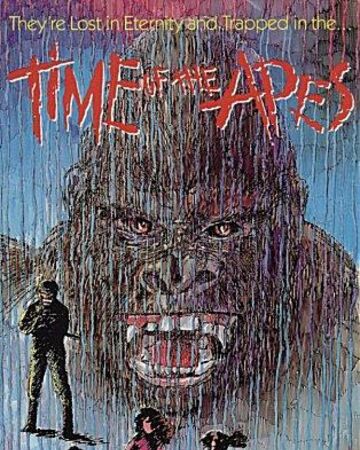
Time of the Apes (1974/1987, directed by Kiyosumi Fukazawa and Atsuo Okunaka)


Stop me if you’ve heard this one before.

As a result of a natural disaster, three people are frozen.  By the time that they thaw it, several hundreds of years have passed and Earth is now a very different place.  Humans are now second-class citizens and the planet is ruled by apes, who speak English, live in their own cities, and have their own militaristic society.  The humans go on the run, to avoid being possibly destroyed by the ape leaders who either cannot accept or are trying to cover up the fact that Earth was once dominated by humans.  In fact, it’s almost as if the humans have found themselves on a planet of the…

You get the idea.

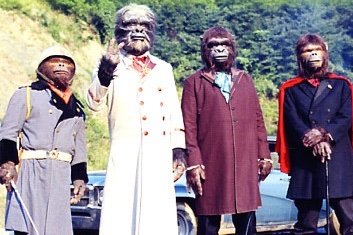
Time of the Apes may sound like a blatant Planet of the Apes rip-off but there are a few differences.  First off, instead of Charlton Heston, humanity is represented by Catherine and two children who, for reasons that are not exactly clear, thought it would be a good idea to ride out an earthquake in a cryogenic chamber.  (You science teacher right.  That’s exactly how you accidentally freeze yourself for several centuries.)  Secondly, the apes in Time of the Apes don’t ride horses or wear their leather outfits.  Instead, they were suits and police uniforms and they drive Buicks and station wagons.  Time of the Apes may take place far in the future but the ape way of life is still trapped in 1974.  Catherine and the two brats eventually meet another human named Godo (Tetsuya Ushio).  Unlike the nearly-naked future humans in Planet of the Apes, Godo wears a turtleneck.

To understand Time of the Apes, you have to understand that it was originally a 26-episode Japanese television series that aired in 1974, at the height of Planet of the Apes mania.  13 years later, America producer Sandy Frank got the rights to the series and decided to edit it down from 26 hours to 93 minutes so that he could release it as a movie.  As a result, Time of the Apes is a disjointed movie in which the action seems to frequently repeat itself but it’s never boring.  Between the apes and the sudden appearance of a flying saucer, there’s always something to watch.  It’s never really good either, though.  The ape makeup is terrible.  The dubbing is worse.  If you can watch the movie for five minutes without laughing at the ineptitude of it all, you’re a stronger movie watcher than me.

Time of the Apes is pretty much impossible to see unless you’re watching the Mystery Science Theater version.  The MST 3K gang liked the film so much that they actually did it twice, once during the show’s later disowned first season (when it was basically just a cable access program in Minnesota) and once more after the show started to air nationally.  It’s rightfully considered to be one of MST 3K’s best episodes and it’s probably the best possible way to watch Time of the Apes.  You need Joel and the Bots there to assure you that you did actually just see and hear what you think you saw and heard.  Sandy Frank was apparently not amused by the show’s lampooning of Time of the Apes but he really should lighten up.  MST 3K brought Time of the Apes to an entirely new and appreciative audience.

Moments in Television History #17: Charles Rocket Nearly Ends SNL


On this day, 41 years ago, Saturday Night Live was nearly canceled.

In 1981, Saturday Night Live was in its 6th season and things weren’t going so well.  Lorne Michaels had left the program and he had taken what was left of the original cast with him.  The new producer, Jean Doumanian, had hired an entirely new group of writers and performers.  Doumanian felt that her biggest star would be a former news anchorman-turned-comedian named Charles Rocket.  In order to prop up Rocket, she surrounded him with a cast that included Gilbert Gottfried, Denny Dillon, and Joe Piscopo.  (Among those who auditioned but were not selected: Jim Carrey, John Goodman and Paul Reubens.)  Seeking a black comedian who could take over the roles that were previously played by Garrett Morris, Doumanian tried to recruit a performer named Charlie Barnett.  When Barnett skipped his second audition, she then considered hiring Robert Townsend before she finally settled on a 19 year-old stand-up comedian named Eddie Murphy.

To no one’s surprise, the initial reviews of the new Saturday Night Live were brutal.  Everyone knew it would be difficult, at first, to win over the critics who were used to Bill Murray, Gilda Radner, Belushi, Aykroyd, and Lorne Michaels.  What no one expected was that the reviews would never get better and that, instead of Charles Rocket, it would be Eddie Murphy and Joe Piscopo who would emerge as the new fan favorites.  Reportedly, a few of the cast members resented Murphy and Piscopo’s success.  No one was happy with the way Doumanian was running the show.  It didn’t take long until Season 6 was better known for its backstage tension than for it comedy.  As ratings plunged, there were even rumors that the show might not be renewed.

On February 21st, 1981, those tensions went from being backstage to being on thousands of televisions.  The night’s episode was hosted by Charlene Tilton, a cast member of what was then the most popular show in prime time, Dallas.  Everyone in the country was debating who had shot J.R. Ewing.  Saturday Night Live decided to do its own tak on the phenomenon by asking, “Who shot Charles Rocket?”  Over the course of the show, Rocket was shown having a conflict with every member of the cast.  Finally, towards the end of the episode, Rocket was shot.  During the traditional goodbyes, Rocket appeared sitting in a wheelchair and smoking a cigarette.  With the rest of the cast surrounding him, Tilton asked him how he was feeling.

Here’s what happened:

“Oh, man.” Rocket said, “I’ve never been shot before.  I wish I knew who the fuck did it.”  It can be difficult to hear him in the video above but you can tell from the reactions of the cast that everyone immediately knew what Rocket had said.

This may not seem like a big deal today but this happened in 1981.  This was before HBO started producing their own shows.  This was before anyone had ever heard of a streaming service.  This was when there was only three major networks and they were all closely watched by the FCC.  Dropping an F-bomb on live television, with no tape delay or chance to bleep it out, was a big deal.

Later, Charles Rocket would say that he didn’t even realize what he had said.  That could have been true but the look on his face after he said it suggests that Rocket was aware of what he was saying.  Before Rocket said it, there had been reports that NBC was planning on firing the entire cast at the end of the season.  Did Rocket make an honest mistake (one that has since been made a few more times by cast members and guests on SNL) or was he going out with a bang?  Was this Rocket’s way of getting back at a network that didn’t appreciate him?

The reports about NBC planning to make changes were true, to an extent.  The plan was to fire Doumanian and replace her with Dick Ebersol.  Most of the cast was going to be fired but NBC was specifically planning on keeping the three performers who it was felt were the strongest members of the ensemble: Eddie Murphy, Joe Piscopo, and Charles Rocket!  Needless to say, after Rocket’s bit of improvisation, NBC changed its mind.

At first, it seemed like the show itself might also get canceled as a result.  In1981, the networks had to deal with people like Jerry Falwell leading crusades to cleans up network television.  Just as Fredric Wertham once blamed juvenile delinquency on comic books, all sorts of problems were being blamed on television.  Jean Doumanian was fired after one more episode, along with Charles Rocket, Gilbert Gottfried, and cast member Ann Risley.  Tragically, Charles Rocket’s career never recovered from this moment.  Today, it probably wouldn’t be as big a deal.  NBC would get hit by a fine but the moment itself would go viral and lead to even bigger ratings.  But in 1981, saying the F-word on national television was a career killer.  Rocket did appear in several movies, usually playing smarmy villains.  But he never reached the stardom that had been predicted for him and ended up taking his own life in 2005.

In the end, the only thing that saved Saturday Night Live was that the Writers Guild went on strike and production on every NBC show shut down.  By the time the strike was settled, the season was over and Dick Ebersol had managed to convince NBC to let him keep the series going by focusing on Eddie Murphy and Joe Piscopo.  When Saturday Night Live returned for its seventh season, Murphy was the undisputed center of the show.  He achieved the stardom that had originally been predicted for Charles Rocket.

Previous Moments In Television History:

  1. Planet of the Apes The TV Series
  2. Lonely Water
  3. Ghostwatch Traumatizes The UK
  4. Frasier Meets The Candidate
  5. The Autons Terrify The UK
  6. Freedom’s Last Stand
  7. Bing Crosby and David Bowie Share A Duet
  8. Apaches Traumatizes the UK
  9. Doctor Who Begins Its 100th Serial
  10. First Night 2013 With Jamie Kennedy
  11. Elvis Sings With Sinatra
  12. NBC Airs Their First Football Game
  13. The A-Team Premieres
  14. The Birth of Dr. Johnny Fever
  15. The Second NFL Pro Bowl Is Broadcast
  16. Maude Flanders Gets Hit By A T-Shirt Cannon

Great Moments In Comic Book History #21: Captain America For President


In 1980, John Anderson was briefly a viable third party presidential candidate so it made sense that Marvel would come up with a storyline in which a group of activists attempt to convince Captain America to make a third party bid of his own.  When The Daily Globe broke the news that Captain America was being courted by the New Populist Party, both the Democrats and the Republicans offered to nominate him.  The Beast offered to be his campaign manager.  (Imagine that!)  The Wasp said that Captain America was the people’s choice.  Iron Man warned that the red tape would get frustrating while the always logical Vision argued that, other than having a patriotic spirit, Captain America knew nothing about politics and international relations.

As a patriot, Captain America was tempted though, in typical Marvel fashion, his actual positions were kept vague.  Ultimately, Cap turned down their offer because he felt that it was important that he remain above the pettiness of partisan politics.  Captain America was meant to protect all the people of America, regardless of whether they voted for Ronald Reagan, Jimmy Carter, John Anderson, Ed Clark, Barry Commoner, or even Gus Hall!

(In the end, the activists approached the wrong Avenger.  Despite what he told Cap, Iron Man would have done it in a heartbeat.)

A later issue of What If… revealed that, if Captain America had run, he would have easily been elected President.  Then, he would have been assassinated because almost every issue of What If… ended with everyone dead.  It’s a good thing he didn’t run.  By not running, he not only saved his own life but he also set a precedent that has kept a countless number of super powered individual from taking the plunge into electoral politics.  It didn’t stop J. Jonah Jameson from running for mayor of New York but I doubt anything could have.

Could Captain America win the election if he ran today?  As a fictional character who has a history of making questionable decisions and who is now over a hundred years old, it’s doubtful.  Despite what happened in What If, it was probably just as much of a lost cause in 1980.  If Howard the Duck couldn’t beat Carter and Ford in 1976, it’s doubtful Captain America could have beaten both Reagan and Ed Clark in 1980.  Still, who better to rebuild America than America himself?

Captain America Vol. 1 No. 250 (October, 1980)

“Cap President”

  • Writer(s) Roger Stern, Don Perlin, Roger McKenzie, Jim Shooter
  • Penciler(s) John Byrne, Ed Hannigan
  • Inker(s) Josef Rubinstein
  • Colorist(s) George Roussos
  • Letterer(s) Jim Novak
  • Editor(s) Jim Salicrup, Bob Budiansky

Previous Great Moments In Comic Book History:

  1. Winchester Before Winchester: Swamp Thing Vol. 2 #45 “Ghost Dance” 
  2. The Avengers Appear on David Letterman
  3. Crisis on Campus
  4. “Even in Death”
  5. The Debut of Man-Wolf in Amazing Spider-Man
  6. Spider-Man Meets The Monster Maker
  7. Conan The Barbarian Visits Times Square
  8. Dracula Joins The Marvel Universe
  9. The Death of Dr. Druid
  10. To All A Good Night
  11. Zombie!
  12. The First Appearance of Ghost Rider
  13. The First Appearance of Werewolf By Night
  14. Captain America Punches Hitler
  15. Spider-Man No More!
  16. Alex Ross Captures Galactus
  17. Spider-Man And The Dallas Cowboys Battle The Circus of Crime
  18. Goliath Towers Over New York
  19. NFL SuperPro is Here!
  20. Kickers Inc. Comes To The World Outside Your Window

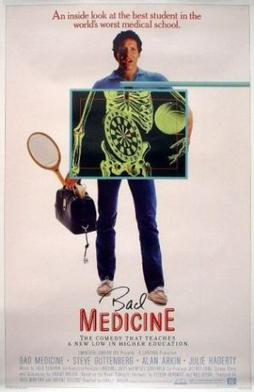
Bad Medicine (1985, directed by Harvey Miller)


Jeff Marx (Steve Guttenberg) is a smart but lazy pre-med student whose grades are so bad that he can’t get accepted to any of the good medical schools.  His father (Bill Macy), who is also a doctor and who wants Jeff to one day take over the family practice, arranges for Jeff to attend medical school in a fictional Central American country.  The head of the school, Dr. Ramon Madera (Alan Arkin), is also the country’s dictator.  Dr. Madera is happy to make money off of desperate Americans but he still enforces strict rules of behavior at the school.  He also makes it clear that none of the medical students are to treat the poor villagers who live near the school.

When Jeff arrives at his new school, he discovers that his classmates are, like him, all screw-ups.  They’re also played by a cast of actors who, like Guttenberg, epitomize the 80s ensemble comedy craze.  Curtis Armstrong, of Revenge of the Nerds and Risky Business, plays Jeff’s best friend.  Fast Times At Ridgemont High‘s Robert Romanus is the Italian medical student who is loved by all the ladies.  Airplane!‘s Julie Haggerty is the idealistic medical student who wants to take care of the local villagers.  Even Gilbert Gottfried is in this movie!  He plays Dr. Madera’s main assistant and hatchet man.

Bad Medicine was released in between the first and the second Police Academy films and it basically tells the same sort of story that made those two films unlikely hits.  Guttenberg and his fellow students start out as a screw-ups but, by the end of the movie, they’ve proven themselves as doctors.  Perhaps because it was based on a novel that was written by an actual doctor, Bad Medicine is a little more sincere than Police Academy.  In Police Academy, the scenes of the recruits doing police work were the biggest jokes of all and, even after he helped to save the city, you still never bought the idea that Steve Guttenberg would have stuck around after graduation so that he could wear a uniform and walk a beat everyday.  Though Bad Medicine is full of the usual Police Academy-style hijinks, it doesn’t treat the work that the doctors are doing as a joke.  Though regrettable stereotypes abound (this is a film that features Gilbert Gottfriend playing a character named Tony Sandoval, after all), Bad Medicine treats the villagers with respect.  Guttenberg gives a relaxed and likable performance, without making Jeff into as much of a wiseass of Police Academy‘s Cary Mahoney.  Julie Haggerty brings her usual spacey charm to her role.  Not surprisingly, it’s Alan Arkin who steals the film, though you do have to wonder how Dr. Madera has time to run both a country and a medical school while also falling in love with Julie Haggerty.  Give the man some credit for knowing how to multitask.

It ends, much like Police Academy, with the med students giving a chance to prove themselves in a crisis situation.  Unlike Police Academy, Bad Medicine was not a hit at the box office, though it did make a small profit.  As a result, there was never a Bad Medicine 2, which is unfortunate because we could always use more good doctors.