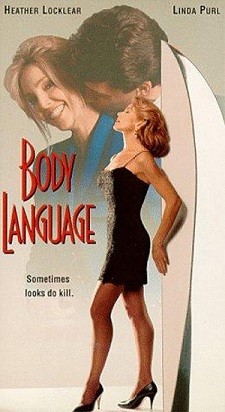
Body Language (1992, directed by Arthur Allen Seidelman)


Betsy (Heather Locklear) is a workaholic executive who has finally gotten the prize promotion at the Orpheus Capital Corporation.  Along with her new office, Betsy also gets a new assistant but when that assistant mysteriously disappears, she is replaced by Norma (Linda Purl).  Norma is just as ambitious as Betsy but she just can’t seem to make her way up the corporate ladder, no matter how hard she tries.  Norma soon grows indispensable to Betsy, comforting her when she breaks up with her boyfriend (James Acheson) and also supporting her when Betsy refuses to sleep with her sexist new boss (Edward Albert).  Before you can say “Single White Female,” Norma is dressing like Betsy, talking like Betsy, dating Betsy’s ex, and trying to take over Betsy’s life.  When Betsy eventually catches on, she discovers just how far Norma will go to be her.

It is easy to compare this film to Single White Female, though Body Language actually aired on the USA Network two months before Single White Female was released.  The main difference between the two films is that Single White Female was an R-rated theatrical release whereas Body Language is unmistakably a television production.  That means no bad language, no nudity, no graphic violence, only a little sex, and not a hint of psychological nuance beyond Norma being the type of girl who snuffs out candles with her fingers.  Single White Female‘s main strength was the effort that Jennifer Jason Leigh went to make her unstable stalker into a believable character who had more motivation than just being crazy.  The script for Body Language is less concerned with why Norma does what she does.  Betsy is glamorous and successful.  Norma is neither of those things and, in this film’s view of things, that is more than enough motivation for her to try to take over Betsy’s life.

Still, the underrated Linda Purl does the best that she can with the role of Norma and she has a few good moments where Norma lets the mask slip and reveals how unstable she actually is.  Heather Locklear matches her as the workaholic who learns that climbing the corporate ladder can be murder and she shows why she was so often cast in films like in-between appearing on shows like T.J. Hooker, Dynasty, and Melrose Place.  If you grew up in the 90s, it’s hard to watch any old Heather Locklear tv movie without feeling nostalgic.
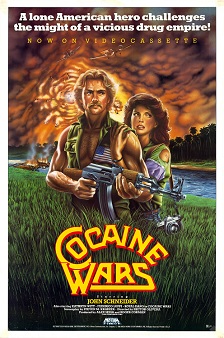

Cocaine Wars (1985, directed by Hector Olivera)


In 1980s Bolivia, the most powerful drug lord is Gonzalo Reyes (Federico Luppi).  Working with General Lujan (Rodolfo Ranni), Reyes runs his own concentration camp, where people are forced to process the cocaine that is then sold in the United States.  Reyes’s pilot is an American named Cliff Adams (John Schneider).  Reyes eventually gives Cliff a very important assignment.  He wants Cliff to assassinate Marcelo Villalba (John Vitali), a crusading journalist who is running for president of the country.

What Reyes and Lugan don’t know but soon learn is that Cliff is actually a Miami-based DEA agent who has been working deep undercover.  Despite his assignment and the fact that even the U.S. government seems to consider Villalba to be expendable, Cliff refuses to carry out the assassination.  Soon, he and his girlfriend (Kathryn Witt) and their friend Bailey (Royal Dano) are being pursued by Reyes and Lujan.  Cliff’s girlfriend is also a reporter and she has compiled a story that, if it is published, will blow the lid off of Reyes and Lujan’s partndership.

Produced by Roger Corman and filmed in Argentina, Cocaine Wars is very much a product of its time.  In the 1980s, America was all about the War on Drugs, especially the War on Cocaine.  However, some of the world’s biggest drug lords were working with the tactic approval of some of America’s most important allies in South and Central America.  For as long as it was convenient and strategically useful, the American government would look the other way.  It was only when the situation became internationally embarrassing, as in the case of Panama’s General Manuel Noriega, that the U.S. would actually step in.  This was certainly the case in Bolivia, where drug lords were so essential to overthrowing the government that the subsequent coup was referred to as being “the cocaine coup.”  General Lujan is a stand-in for a large number of Bolivian military men who continually overthrew the country’s democratically-elected leaders.  By including several Germans among Reyes’s organization, Cocaine Wars also acknowledges the role that Nazi war criminal Klaus Barbie played in not only propping up a series of Bolivian strongmen and drug organizations but also teaching the Bolivian secret police how to torture information out of political prisoners.  While Cocaine Wars is not primarily a political film, it is still notable as an early example of a film that pointed out why the War on Drugs was destined for failure.

As for the film itself, it is a standard low-budget action film.  There aren’t any huge surprises to be found but, at 82 minutes, it moves quickly and it has enough action to satisfy fans of the genre.  John Schneider may not have been Sylvester Stallone, Arnold Schwarzengger, or even Chuck Norris but that works to the movie’s advantage.  Unlike those bigger-than-life heroes, Schneider does not come across as being indestructible and that adds a little more suspense to the inevitable gunfights and torture scenes.  Schneider is a likable and effective action lead, even if you never do forget that you’re essentially watching a TV actor taking a stab at the big screen.

Music Video of the Day: Wild Thing by Sam Kinison (1988, directed by ????)


In 1988, evangelical preacher-turned-comedian Sam Kinison had a hit with his cover of Wild Thing.  For the music video, he not only recruited Rodney Dangerfield and a host of other 80s rockers, he also cast Jessica Hahn, who was at the center of the scandal that took down two other evangelical preachers, Jim and Tammy Faye Bakker.

For completists, here is who can be seen in this video, backing up Sam, Rodney, and Jessica: Joe Perry and Steven Tyler (Aerosmith), Steve Adler and Slah (Guns ‘n Roses), Sebastian Bach (Skid Row), Jon Bon Jovi, Alec John Such, and Richie Sambora (Bon Jovi), Jonathan Cain and Deen Castronovo (Journey), Robbin Crossby and Warren DeMartini (Ratt), C.C. Deville (Poison), Tommy Lee (Motley Crue), Rudy Sarzo (Quiet Riot), Billy Idol, and Dweezil Zappa.

Enjoy!

Class Warfare (2001, directed by Richard Shepard)


Kristen Marshall (Lindsey McKeon) is a rich high school girl with a problem.  She’s not rich anymore!  Her parents have lost all of their money due to a shady business deal and now, Kristen might not even be able to afford to go to Harvard!  Even the fact that she’s the senior class president and drives an expensive car might not be enough to convince those Boston brahmins to give her a scholarship.  Looking to get away from all of her problems, Kristen and her boyfriend, Jason (Wade Carpenter), decide to spend the weekend at their friend Graham’s (Dave McGowan) lakehouse.  Kristen, however, is upset to discover that Graham has also invited Richard Ashbury (Robin Dunne).

Richard is a high school activist, a self-professed Socialist who spends his time putting up flyers for a food and clothing drive.  Kristen first met Richard when she accidentally hits him with her car.  (Kristen was in a hurry and she didn’t notice Richard riding by on his bicycle.)  Though Richard was uninjured, Kristen’s car was slightly dented and Richard told her that he was sure that her family would be able to pay for it.  Now, Kristen is stuck spending the weekend with him and, to make things even worse, Richard looks at a newspaper and discovers that he has got a winning lottery ticket.  As soon as the weekend ends, he’ll turn in the ticket and get $25 million dollars!  Meanwhile, Kristen is having nightmares about her guidance counselor denying her application for a college loan while Richard lights a cigar with a hundred dollar bill!

Eager to that get that ticket for herself, Kristen first tries to seduce Richard.  When that doesn’t work, Kristen orders Jason to kill him.

Class Warfare definitely has a made-for-TV look about it but, when taken on its own terms, it’s not bad.  Lindsey McKeon is an effective villain and the other actors are all credible in their roles, even if it’s obvious that most of them haven’t been in high school for a good couple of years.  The movie’s class warfare theme was sometimes simplistic but the film still did a good job of ratcheting up the stakes as one mistake led to another.  Nowadays, people take the lottery for granted but Class Warfare does capture that moment when people really did feel like their lives could be changed in an instant.

Class Warfare was produced by the USA Network and originally aired on December 24th, 2001.  I guess that was USA’s way of saying, “Merry Christmas!”

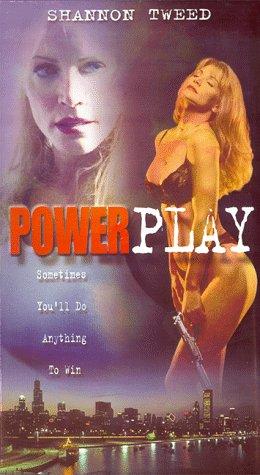
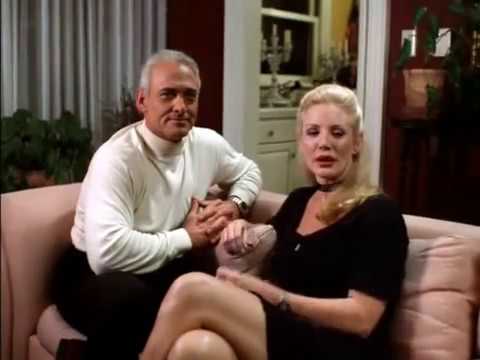
Powerplay (1999, directed by Chris Baugh)


Shannon Tweed plays Jacqueline, a sexy con artist who seduces older men and then, after she poisons them, runs away with all of their money.  After her latest target, Benjamin Alcott (Bryan Kent), ends up floating dead in his swimming pool, Jacqueline heads off to find her next target.  Ben’s estranged daughter, Candice (Danielle Ciardi), is upset to learn that Ben only left her his library of book while leaving all of his money to Jacqueline.  Along with her sleazy boyfriend, Steve (Jim Richer), Candice tracks Jacqueline down and tries to con the con artist.

Shannon Tweed is top-billed in Powerplay but she’s not in much of the movie.  Both onscreen and off, this was clearly a take the money and run job for Tweed.  Still, a little bit of Tweed is better than no Tweed at all, especially where a film like Powerplay is concerned.  Of all the actresses who regularly appeared in late night Cinemax in the 90s, Tweed was definitely the most talented and she brings some needed energy to her scenes.  Tweed’s main strength as a star was always that she could be appealing and sexy even while she was smirking about killing someone and Powerplay makes good use of that ability.

The majority of the film, though, follows Candice and Steve as they try to track Jacqueline down.  In a nice twist, Candice is just as greedy, voracious, and cold-hearted as Jacqueline and Danielle Ciardi (who bore a probably not coincidental resemblance to Neve Campbell in Wild Things) does a good job of playing her.   This was Ciardi’s film debut and, according to the imdb, her only starring role.  That is too bad because it seems like she had the talent to do much more.  Unfortunately, Jim Richer is far less effective in the role of Steve.  In fact, all of the male performances in Powerplay are lousy and are not helped by an overly convoluted script that features a few plot twists that are incoherent even by the standards of the typical direct-to-video neonoir.  Powerplay ends with multiple cons and double-crosses but none of them feel earned.  There’s a difference between something like Stephen Frears’s The Grifters, where the con is obvious once you know what to look for, and Powerplay, where the con feels like a last minute addition to the script.

But who am I kidding?  This film wasn’t made for an audience that’s going to be watching for the plot.  They’re going to be watching because Shannon Tweed takes a shower while the man she poisoned dies nearby and because Candice is written and portrayed as almost being a nymphomaniac.  (Candice has a creative way of handling things when a hotel employee knock on the door of a room that she’s not supposed to be in.)  Powerplay has enough sex and nudity that it was undoubtedly popular when it showed up on late night Cinemax in 1999.  But it doesn’t have enough of a story to be memorable for any reason beyond that.

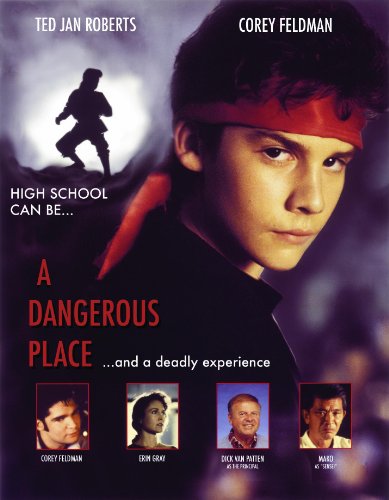
A Dangerous Place (1994, directed by Jerry P. Jacobs)


In A Dangerous Place, a young karate student avenges his brother’s death and Corey Feldman impersonates Christian Slater.

Greg (Dean Cochran) and his younger brother, Ethan (Ted Jan Roberts), are both students of a sensei (Mako) who teaches that sparing an enemy is the best way to make a friend and that true martial artists do not compete in tournaments.  Greg wants more out of karate so he starts hanging out with The Scorpions, a gang led by Taylor (Corey Feldman).  The Scorpions all belong to a dojo owned by Gavin (Marshall R. Teague), who teaches that mercy is a weakness.  When the Scorpions aren’t beating up people at the beach, they’re “scavenging.”  They break into houses and businesses, steal what they can, and claim that homeowners insurance means that they’re actually doing everyone a favor.  When one robbery goes wrong, Greg tries to stop Taylor from killing a homeowner.  Taylor fights back and the end result is Greg falling over a railing and dying.  

The Scorpions leave Greg hanging in the high school gym.  The police think that Greg committed suicide but Ethan knows that his brother would never end his own life.  Ethan knows that the Scorpions are responsible.  He leaves his old dojo and joins Gavin’s dojo.  Ethan now has an in with the Scorpions but, if Gavin and Taylor are going to trust him enough to reveal the truth about what happened to Greg, Ethan is going to have to betray his old sensei and set up a match between the two dojos.  Ethan is going to have to abandon his own peaceful principles about become as bad as the people he is trying to take down.

For a low-budget Karate Kid rip-off, A Dangerous Place is not as bad as it sounds.  Some of the fight scenes are exciting, Mako is a decent stand-in for Pat Morita, and Marshall R. Teague does a passable Martin Kove impersonation as the leader of the bad dojo.  Corey Feldman imitating Christian Slater imitating Jack Nicholson does eventually get old but, since Feldman is playing the bad guy here and we’re not supposed to like him, it actually works to the film’s advantage.  Finally, Dick Van Patten, of all people, has a small role as the high school’s principal.  Mako, Feldman, Van Patten, and karate?  A Dangerous Place is dumb but entertaining.

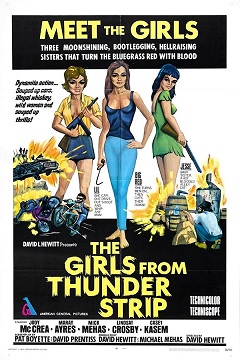
The Girls From Thunder Strip (1970, directed by David L. Hewitt)


This one is pretty bad.

A group of dirty, good-for-nothing bikers roll into a Southern town.  Led by Teach (Gary Kent), the bikers are obsessed with murder and rape, the latter of which opens the film and is treated in a fashion that is meant to be comedic.  When some pointless bullying of a gas station attendant leads to the gang’s only female member getting stabbed to death, the bikers are arrested and thrown in the county jail.

Meanwhile, three sisters (Maray Ayres, Megan Timothy, and Melinda MacHarg) are making their own moonshine and selling it to the local hillbillies.  A federal agent (played by Casey Kasem, the DJ who used to countdown the Top 40 songs in America and who voiced Scooby-Doo’s stoner friend, Shaggy) comes to town and insists that the local sheriff (Jack Starrett) arrest the three sisters.  However, only one of the sisters is taken to jail while the other two escape.  The federal agent manages to accidentally blow up the still but he only ends up with a face full of soot as a result.  That Kasem can survive getting blown up without getting so much of a scratch on him would make sense if the rest of The Girls From Thunder Strip were presented as being a live-action cartoon but it’s not so the entire Kasem storyline feels like it was lifted from another, more light-hearted moonshiner movie.

With the help of the bikers, the incarcerated sister is able to break out of the county jail.  But just because they helped each other, that doesn’t mean that the sisters trust the bikers, especially after the bikers murder a deputy who happened to be a cousin to the bootleggers.  The bikers try to take over the moonshine business while the sisters (and one convenient mountain lion) take on the bikers.

The movie is all over the place.  On the one hand, you’ve got the bikers raping and killing nearly everyone they meet.  On the other hand, you’ve got Casey Kasem, playing a federal agent and pursuing the sisters with all the panache of a cartoon cat chasing a mouse.  The action scenes are lousy.  The characters have no motivation.  With one exception, the actors are terrible and no, that exception is not Casey Kasem.  Instead, the one exception is Jack Starrett, who plays the sheriff.  Starrett, with his trademark gravelly voice, was a director who had sideline playing intimidating authority figures.  In First Blood, he played Galt, the worst member of Brian Dennehy’s police force.  (He was the one who laughed when he ordered the deputies to shave Rambo with a straight razor.  Later he fell out of a helicopter and Rambo was blamed for his death.)  Starrett gives the same performance in The Girls From Thunder Strip that he later gave in First Blood and since the sheriff is not actually given a name, I’ve decided that he and Galt are the same character and Girls From Thunder Strip takes place in the Rambo Cinematic Universe.

Other than providing a look at the early life of Art Galt, there’s not much else to recommend The Girls From Thunder Strip.  Even aficionados of the biker and moonshine genres will want to look elsewhere.

Great Moments In Television History #20: Eisenhower In Color


The very first color television transmission occurred 94 years ago today, in the UK.  Scottish engineer John Logie Baird, the man who built the first television, was also responsible for showing that images could be broadcast in color.  

Unfortunately, no footage or record of that 1928 transmission remains.  Instead, the earliest surviving color videotape recording is one of then-President Dwight D. Eisenhower, delivering remarks during the inaugural color broadcast of WRC-TV on May 22nd, 1958.  The broadcast began in black-and-white before switching to color after 15 minutes.  Of course, only the people who could afford a color television could experience the switch but, at a time when most people still had a black-and-white television and even color films where the exception instead of the rule, this was still many people’s introduction to the idea that television could regularly be viewed in color.  

Even Dwight D. Eisenhower was impressed.

Previous Moments In Television History:

  1. Planet of the Apes The TV Series
  2. Lonely Water
  3. Ghostwatch Traumatizes The UK
  4. Frasier Meets The Candidate
  5. The Autons Terrify The UK
  6. Freedom’s Last Stand
  7. Bing Crosby and David Bowie Share A Duet
  8. Apaches Traumatizes the UK
  9. Doctor Who Begins Its 100th Serial
  10. First Night 2013 With Jamie Kennedy
  11. Elvis Sings With Sinatra
  12. NBC Airs Their First Football Game
  13. The A-Team Premieres
  14. The Birth of Dr. Johnny Fever
  15. The Second NFL Pro Bowl Is Broadcast
  16. Maude Flanders Gets Hit By A T-Shirt Cannon
  17. Charles Rocket Nearly Ends SNL
  18. Frank Sinatra Wins An Oscar
  19. CHiPs Skates With The Stars

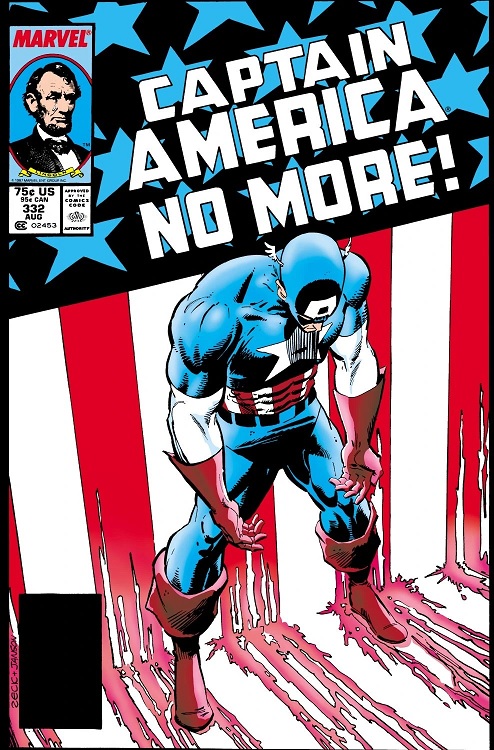
Great Moments In Comic Book History #24: Captain America Quits


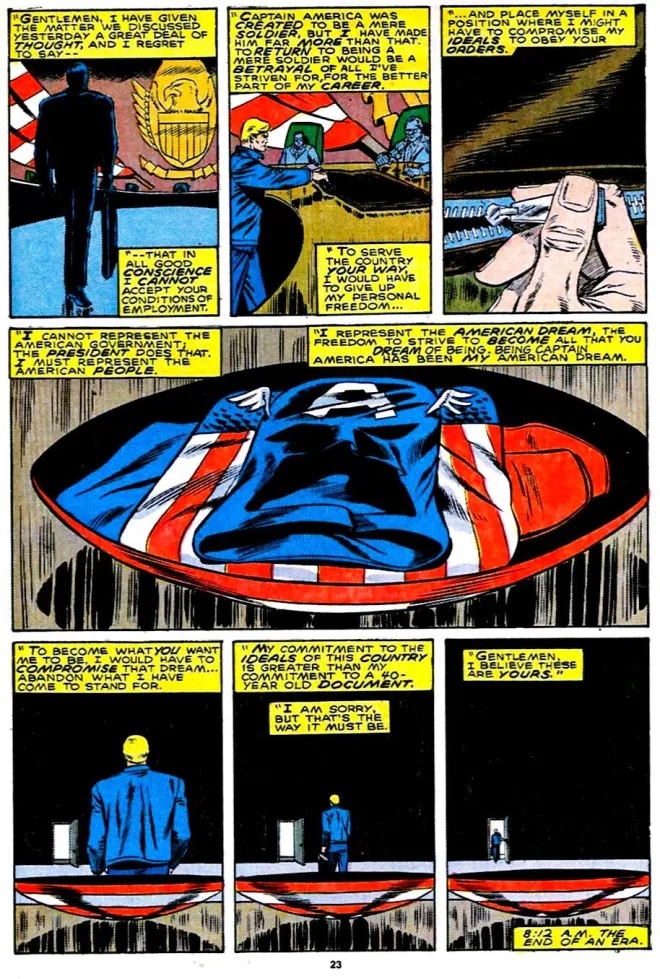
Captain America #332 (August, 1987) opens with Captain America, the living symbol of the USA, being summoned to the Pentagon.  A group of faceless bureaucrats known as The Commission tell Captain America that it is time for him to become an official agent of the U.S. Government.  They argue that Steve Rogers would not even be Captain America if he hadn’t enlisted in the armed forces and been injected with the super soldier formula.  It’s time for Steve Rogers to stop acting as a free agent and serve his government.  And, if Steve can’t do that, the Commission can find someone to take his place, someone who understands the importance of following orders.  Maybe even someone like the Super-Patriot, who is busy fighting a group of terrorists while Steve is at the meeting.

Steve thinks it over and then does the only thing that his conscience will allow.

He quits.

Of course, this wasn’t the first time that Steve Rogers quit being Captain America.  In the 1970s, he was so disillusioned to discover that the President was a part of a secret conspiracy that he resigned his commission and briefly called himself The Captain.  Eventually, he returned to being Captain America, just as he would do the second time that he quit.  After The Commission named recruited Super Patriot to carry the shield, Steve didn’t have much choice but to take it back.

Still, this moment defined what Steve Rogers was all about.  He wasn’t about serving the government or enforcing anyone’s particular policy.  He was about America and the ideals that he felt it should stand for.  And if that meant defying his government, that’s what he would do.

It was a great moment.

Captain America Vol. 1#332 (August, 1987)

“The Choice”

  • Writer — Mark Gruenwald
    Penciler — Tom Morgan
    Inker — Bob McLeod
    Colorist — Ken Feduniewicz
    Letterer — Diana Albers
    Editor — Don Daley

Previous Great Moments In Comic Book History:

  1. Winchester Before Winchester: Swamp Thing Vol. 2 #45 “Ghost Dance” 
  2. The Avengers Appear on David Letterman
  3. Crisis on Campus
  4. “Even in Death”
  5. The Debut of Man-Wolf in Amazing Spider-Man
  6. Spider-Man Meets The Monster Maker
  7. Conan The Barbarian Visits Times Square
  8. Dracula Joins The Marvel Universe
  9. The Death of Dr. Druid
  10. To All A Good Night
  11. Zombie!
  12. The First Appearance of Ghost Rider
  13. The First Appearance of Werewolf By Night
  14. Captain America Punches Hitler
  15. Spider-Man No More!
  16. Alex Ross Captures Galactus
  17. Spider-Man And The Dallas Cowboys Battle The Circus of Crime
  18. Goliath Towers Over New York
  19. NFL SuperPro is Here!
  20. Kickers Inc. Comes To The World Outside Your Window
  21. Captain America For President
  22. Alex Ross Captures Spider-Man
  23. J. Jonah Jameson Is Elected Mayor of New York City

Game Review: You Arrive In America (2015, Clickhole)


Welcome to America!

If you’ve ever wanted to experience what it would be like to arrive in America for the first time, Clickhole has had you covered since 2015.  In You Arrive In America, you begin the game standing on a boat that is sailing into New York Harbor.  Soon, you will dock at Ellis Island and you will have many decisions and opportunities ahead of you.

Will you look at the Statue Liberty?

Will you be able to convince the immigration official that your name really is George Clooney?

Will you get a job at a factory?

Will you head to the tenements or spend the day at Coney Island?

Will you start a family and will they grow up to understand the sacrifices that you made to give them a good life?

How many times will you see Yankees great Yogi Berra?

All these questions and more can be answered by playing You Arrive In America.  You Arrive in America uses a Choose Your Own Adventure style of gameplay.  Simply click on what you want to do.  If you want to look at the ground and do nothing, that’s fine.  If you want to get the entire city to join you in chanting, “Let’s go Yankees!,” you can do that too and, as an extra bonus, it will increase your chances of seeing Yogi Berra.  The choice is yours.  You’ve arrived in America and you can do whatever you want!

Play You Arrive In America