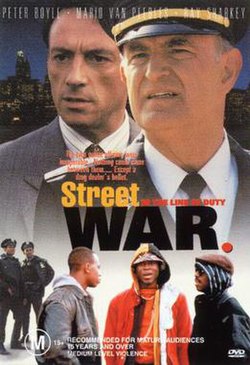
In the Line of Duty: Street War (1992, directed by Dick Lowry)


Street War, the fifth In The Line of Duty movie to be produced by NBC, takes place in Brooklyn.  Raymond Williams (Mario Van Peebles) and Robert Dayton (Michael Boatman) are two uniformed officers trying to keep the peace in the projects.  When Raymond is shot and killed in a stairwell, everyone knows that drug dealer Justice Butler (Courtney B. Vance) was responsible but no one can prove it.

The case is assigned to two detectives, Dan Reilly (Peter Boyle) and Victor Tomasino (Ray Sharkey).  Reilly is a veteran cop who is just a few months away from retirement.  Tomasino is the son of a “made man” who can’t understand why the drug lords in Brooklyn aren’t as interested in keeping the peace as the old Mafiosos were.

When Justice leaves Brooklyn so that he can hide out with his family in South Carolina, Reilly and Dayton follow him down there and discover that people in South Carolina distrust the cops just as much as people in Brooklyn.  Meanwhile, back in Brooklyn, Justice’s second-in-command, Prince (Morris Chestnut), tries to keep an all-out war from breaking out.

Prince and Tomasino take turns narrating the movie.  Prince talks about the reality of trying to restart your life after doing time in prison while Tomasino complains that “the animals” have taken over the city.  (Because this was made for television, “Animals” is Tomasino’s go-to label for anyone he dislikes.  Anyone with any experience with the police will know what word he is actually thinking.)  While Chestnut gives a restrained and thoughtful performance, Ray Sharkey shouts his lines and snarls whenever he’s onscreen.  Though it’s not always evident in this movie, Sharkey started out as a talented actor who played small roles in several independent films before starring in The Idolmaker.  Unfortunately, Sharkey was also a heroin addict whose once promising career was derailed by a series of arrests and jail sentences.  He looks thin and tired in Street Wars and, one year after the film aired, he would die of complications from AIDS.

With Sharkey yelling his lines, it falls on Peter Boyle to play the voice of reason in Street War.  Dan Reilly is a cliché, the weary cop who still wants to make the world a better place and who is just a few days away from retirement.  But Boyle does a good job playing him and brings his own natural gravitas to the movie.

Dick Lowry, who directed the first three In The Line of Duty movies, returns for this one and he keeps the action moving.  Street War is significantly more violent than the previous movies, with even two children getting shot onscreen.  The story itself is a predictable and Tomasino’s casual racism can be hard to take (even if he does eventually called out about it) but, thanks to the performances of Boyle, Boatman, Chestnut, and Vance, Street War is an improvement on Mob Justice and an adequate entry in the series.

Street War would be followed by two movies about FBI sieges, The Siege at Marion and Ambush in Waco.  Since I’ve already reviewed both of those, I will be moving onto In the Line of Duty: The Price of Vengeance tomorrow.
Music Video of the Day: Atlas, Rise! by Metallica (2013, directed by Clark Eddy)


In Atlas, Rise!, Metallica sings about having the weight of the world on your shoulders and refusing to let it hold you down.  No matter how much Atlas has to carry, he will always rise and so will Metallica.

The video keeps things simple, focusing on the band’s skill.  The video was directed by Clark Eddy, who has also directed videos for Sublime, Crash Test Dummies, and Kid Rock.  Most of Eddy’s credits, though, are as an editor.  As an editor, he has worked on videos for Dua Lipa, Rihanna, Destiny’s Child, Iggy Pop, and Pitbull.  That is quite a collection.

Enjoy!

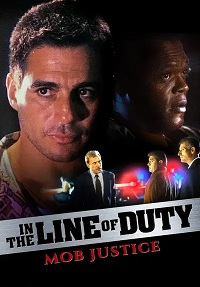
In The Line of Duty: Mob Justice (1991, directed by Peter Markle)


The fourth of NBC’s In The Line of Duty movies, Mob Justice opens with the murder of an undercover DEA agent by a low-level gangster who has just been released from prison.  While the gangster goes into hiding, the DEA mobilizes and starts to make life so difficult for all of the other mobsters in New York that soon, the Mafia is as determined to get justice as law enforcement.

This was the first In The Line Of Duty film not be directed by Dick Lowry.  Lowry’s fast-paced style is missed as Mob Justice takes forever to get going and regularly gets bogged down with scenes lifted from other mafia movies.  The old mobsters talk about the importance of family, play cards in the backroom, and eat big dinners.  Opera blares on the soundtrack when the DEA starts to harass them.  For a movie that is supposed to honor the work and the sacrifice of federal law enforcement, the DEA actually comes across as being thoroughly incompetent in Mob Justice.  A dumb mistake leads to the first murder.  A series of other misjudgments lead to the Mafia dispensing the own type of violent justice before the DEA can arrest their man.

The most interesting thing about Mob Justice is the cast.

The trigger-happy gangster is played by Tony Danza, who I guess was trying to prove himself as a dramatic actor after spending years on Taxi and Who’s The Boss but who still comes across like Tony Micelli having a bad day.  His best friend is played Nicholas Turturro, who later played a straight arrow detective on NYPD Blue.  Frank Vincent and Leonardo Cimino plays the mob bosses who knows that murdering a federal agent is bad for business.

The head of the investigation is played by Ted Levine, who has had a long career but will always be remembered as the killer from The Silence of the Lambs.  Working under him is Dan Lauria, who a generation will instantly recognize as being the long-suffering and frequently angry father from The Wonder Years.  You know that this is a big case is Buffalo Bill and Jack Arnold are working together.  (Dan Lauria actually appeared in several In The Line of Duty films, always playing different characters.)

And finally, the murdered DEA agent is played by none other than Samuel L. Jackson.  It’s never a good thing when the best actor in a movie is killed off after the first fifteen minutes.

The cast is great but Mob Justice is forgettable.  The main problem is that, after Jackson is taken out of the picture, the rest of the movie is just Danza hiding in different apartments while Levine and Lauria annoy Frank Vincent.  Danza’s murderer is never smart nor interesting enough to be a compelling antagonist and there’s never any doubt that, one way or another, he will pay for his stupidity.  There is one memorable scene where Danza freaks out while wearing a blonde wig but otherwise, Mob Justice doesn’t leave much of an impression.

Music Video of the Day: The Wicker Man by Iron Maiden (2012, directed by ????)


In the year 2000, Iron Maiden proved that they still had it with a song based on the movie The Wicker Man.  The song became one of their late career hits, earning the band another Grammy nomination.  This was the first song that the band rehearsed after the return of Bruce Dickinson and Adrian Smith.  Dickinson later said the song was an attempt to capture the feeling of being on stage and watching the audience chant along to what you’re singing.

This video features the band performing the song live in 2012, in Santiago, Chile.  An earlier video, which was released at the same time as the song and which was directed by Dean Karr, featured the band performing the song on a stage while a fire raged behind them.

Enjoy!

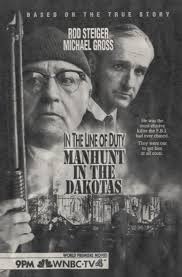
In The Line of Duty: Manhunt in the Dakotas (1991, directed by Dick Lowry)


On February 13th, 1983, a group of U.S. Marshals attempted to arrest a man named Gordon Kahl in North Dakota.  Kahl was an outspoken tax resistor.  He had already served time in Leavenworth for refusing to pay his taxes.  When he was released, he continued to refuse to pay and, in violation of his parole, started to attend meetings of the Posse Comitatus, an organization that refused to recognize the authority of any government above the county level.  Because Kahl was so prominent in anti-government circles, the plan was to make an example out of him by arresting him as he left a Posse Comitatus meeting.  Instead, Kahl,  his son, and an associate opened fire on the U.S. Marshals, killing two of them.  Kahl escaped and, for several months, was the subject of an FBI manhunt.

To make clear, Gordon Kahl was not a good man.  Gordon Kahl was a white supremacist and an anti-Semitic conspiracy theorist who was a follower of the Christian Identity movement.  While Kahl’s supporters claimed that Kahl originally fired on the marshals in self-defense, eyewitnesses testified that Kahl personally executed one marshal after he had already been wounded and was no longer a threat.  Gordon Kahl was no hero but, at a time when many farmers were struggling financially and felt helpless as they watched the banks and the government seize their land, many locals did sympathize with him.  The government’s attempt to publicly arrest Kahl and make an example out of him was seen as a classic example of government overreach.  The government was so eager to catch Kahl and Kahl was initially so successful in eluding them that Gordon Kahl became a folk hero.  When Kahl was discovered hiding out in an Arkansas farmhouse, it led to Kahl killing another deputy and the the government firing over a thousand rounds into the house before eventually setting it on fire.  In their effort to capture Gordon Kahl, the government behaved just as destructively as Kahl always said they would.

The hunt for Gordon Kahl served as the basis for the third of NBC’s In The Line of Duty films, Manhunt in the Dakotas.  Rod Steiger played Gordon Kahl.  Michael Gross, fresh off of playing a tax resistor in Tremors, played the FBI agent who headed up the manhunt.  Dick Lowry, director of the previous two installments of In The Line of Duty, returned to direct.

Manhunt in the Dakotas is a fair and even-handed look at the search for Gordon Kahl.  The film doesn’t shy away from Kahl’s racism and his paranoia but, at the same time, it also shows why many people instinctively distrust anyone who says that he’s from the government.  The film shows why so many supported Kahl without supporting Kahl itself.  Gross’s FBI agent may start out as rigid and by-the-book but he quickly learns that’s not the best way to get people to answer his questions.  Having come to understand why the people of the Dakotas don’t trust the government, he can only helplessly watch as the government does everything in its power to make Kahl’s paranoid claims seem plausible.  The FBI agent is determined to bring Gordon Kahl in alive but Kahl would rather be a martyr and it seems that the rest of law enforcement is all too happy to help Kahl achieve that.  Other than a few scenes were he indulges in his tendency to overact, Steiger gives a convincing performance as Kahl and he is well-matched by Michael Gross as the agent who comes to realize that there’s more to enforcing the law than giving orders and threatening to send people to prison.

Manhunt in the Dakotas would be followed by In The Line of Duty: Mob Justice, which I will review tomorrow.

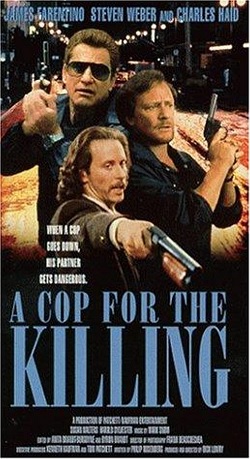
In the Line of Duty: A Cop For The Killing (1990, directed by Dick Lowry)


When an undercover narcotics operation goes wrong, a veteran cop (Charles Haid) is killed.  While the cop’s killer goes on trial, the members of the undercover squad struggle to deal with their feelings about what has happened.  The head of the squad (James Farentino) struggles with how much emotion he can show while still remaining a leader.  As his ex-wife puts it, he’s so busy staying strong for everyone else that he hasn’t been able to deal with his emotions.  Meanwhile, the dead cop’s partner (Steve Weber) has the opposite problem and starts to take dangerous risks on the job.  When it looks like the killer might get a plea deal from the district attorney, both Farentino and Weber are forced to come to terms with Haid’s death and their own feelings of anger and guilt.

In the early 90s, there was several “In the Line of Duty” films made for NBC.  They were all based (often loosely) on true stories and they dealt with members of the law enforcement who died while on the job.  The best known of these was probably Ambush in Waco, which went into production while the Branch Davidian siege was still ongoing.

A Cop For The Killing was the second of the In The Line of Duty films.  Unlike the later films in the series, it didn’t deal with a nationally-known case.  Instead, it just focused on one squad of cops and how the death of a member of the squad effected them.  With its ensemble of familiar television actors and Dick Lowry’s efficient but not particularly splashy direction, it feels more like a pilot than an actual movie.  Even though this film features the cops opening up about their feelings, there’s not much to distinguish it from other cop shows of the period.  If someone digitally replaced Steven Weber with Fred Dryer, it would be easy to mistake A Cop For The Killing for a two-hour episode of Hunter.  As with all of the In The Line of Duty films, there are a few scenes designed to show the comradery of the members of the squad but it again all feels too familiar to be effective.  Before Charles Haid dies, he and Steven Weber hang out at a bar and wrestle.  After Haid dies, Weber hangs out at a strip club that’s safe for prime time.  Judging from 90s television cop shows, undercover detectives were solely responsible for keeping most strip clubs profitable.

The cast is adequate.  Farentino is believable as the emotionally withdrawn commander.  Charles Haid makes the most of his limited screen time.  Tony Plana plays a smug drug lord who smiles even when he’s being booked.  It takes a while to adjust to Steven Weber playing a serious role but his courtroom meltdown is the movie’s highlight.  In The Line of Duty: A Cop For The Killing may not have led to a television series featuring Farentino and Weber taking down the bad guys but it did lead to another In The Line of Duty movie that I will take a look at tomorrow.

Music Video of the Day: Seasons In The Abyss by Slayer (1990, directed by Di Puglia Gerard)


Yes, that is Slayer rocking out at the base of the Sphinx.

For their very first music video, Slayer traveled to Egypt.  At the time the video was shot, Iraq had just invaded Kuwait and the world was on the verge of war.  Despite all of the tension in the region, the members of Slayer said that they were warmly received by both the citizens of Egypt and the American soldiers who were preparing for Operation Desert Storm.  The Egyptian government was so eager to show that it wasn’t anti-American that it allowed Slayer access that the band might not have otherwise been given.  At the same time, back in the United States, the Satanic moral panic was still in force and Slayer was being accused of leading its fans into lives of sin and decadence.  Slayer was promoting diplomacy while Tipper Gore was still playing records backwards.

Enjoy!

Homicide: The Movie (2001, directed by Jean de Segoznac)


Before The Wire, there was Homicide: Life On The Streets.

Based on a non-fiction book by the Baltimore Sun’s David Simon, Homicide: Life on the Streets aired for seven seasons on NBC, from 1993 to 1999. For five of those seasons, Homicide was the best show on television. Produced and occasionally directed by Barry Levinson, Homicide was filmed on location in Baltimore and it followed a group of Homicide detectives as they went about their job. From the start, the show had a strong and diverse ensemble, made up of actors like Andre Braugher, Ned Beatty, Jon Polito, Melissa Leo, Kyle Secor, Clark Johnson, Richard Belzer, Daniel Baldwin, and Yaphet Kotto. When Polito’s character committed suicide at the start of the third season (in a storyline that few other shows would have had the courage to try), he was replaced in the squad by Reed Diamond.

Homicide was a show that was willing to challenge the assumptions of its audiences. The murders were not always solved. The detectives didn’t always get along.  Some of them, like Clark Johnson’s Meldrick Lewis, had such bad luck at their job that it was cause for alarm whenever they picked up the ringing phone. As played by Andre Braugher, Frank Pembleton may have been the most brilliant detective in Baltimore but his brilliance came with a price and his non-stop intensity even led to him having a stroke while interrogating a prisoner. Kyle Secor played Pembleton’s partner, Tim Bayliss.  Bayliss went from being an idealistic rookie to a mentally unstable veteran murder cop in record time, spending seven seasons obsessing on his first unsolved case. Homicide dealt with big issues and, much like its spiritual successor The Wire, it refused to offer up easy solutions.

Despite the critical acclaim and a much hyped second season appearance by Robin Williams (playing a father who was outraged to hear the detectives joking about the murder of his family), Homicide was never a ratings success. After five seasons of perennially being on the verge of cancellation, the producers of Homicide finally caved into NBC’s demands.  The storylines became more soapy and the cases went form being random and tragic to being what the detectives had previously dismissively called “stone cold whodunits.”   New detectives joined the squad and the focus shifted away from the more complex veterans. Not only did this not improve ratings but also those who had been watching the show from the start were not happy to see Pembleton and Bayliss being pushed to the side for new characters like Paul Falsone (Jon Seda) and Laura Ballard (Callie Thorne). Falsone, in particular, was so disliked that there was even an “I Hate Falsone” website. At the end of the sixth season, Andre Braugher left the show and that was the end. The seventh season limped along, with Bayliss growing increasingly unstable.  The show ended with the implication of Bayliss turning into a vigilante and resigning from the Baltimore PD. It was not a satisfying ending. Richard Belzer’s John Munch moved to New York and became a regular on Law & Order: SVU but the rest of the detectives and their fates were left in limbo.

Fortunately, on February 13th, 2000, NBC gave Homicide another chance to have a proper conclusion with Homicide: The Movie.

Homicide: The Movie opens with a montage of Baltimore at its best and its worst, a reminder that Homicide never abandoned the city that had supported it for seven years.  While other shows recreated New York or Chicago on a soundstage, Homicide was always an authentic product of Baltimore. Lt. Al Giardello (Yaphet Kotto) is now running for mayor on a platform calling for drug legalization. When Giardello is shot at a campaign stop, all of the current and former members of the Homicide Unit come together to investigate the case.   While Giardello fights for his life, Pembleton and Bayliss partner up for one final time.

Homicide: The Movie fixes the main mistake that was made by the final two seasons of the show. Though all of the detectives get their moment in the spotlight (and all true Homicide fans will be happy to see Richard Belzer and Ned Beatty acting opposite each other for one final time), the focus is firmly on Pembleton and Bayliss. It doesn’t take long for these two former detectives, both of whom left the unit for their own different reasons, to start picking up on each other’s rhythms. Soon, they’re talking, arguing, and sometimes joking as if absolutely no time has passed since they were last partnered up together. But, one thing has changed. Bayliss now has a secret and if anyone can figure it out, it will be Frank Pembleton. What will Pembleton, the moral crusader, do when he finds out that Bayliss is now a killer himself?

The movie follows the detectives as they search for clues, interview suspects, and complain about the state of the world.  However, in the best Homicide tradition, the investigation is just a launching point to investigate what it means to be right or wrong in a city as troubled as Baltimore.  In the movie’s final half, it becomes more than just a reunion movie of a show that had a small but fervent group of fans. It becomes an extended debate about guilt, morality, and what it means to take responsibility for one’s actions. The final few scenes even take on the supernatural, allowing Jon Polito and Daniel Baldwin a chance to appear in the reunion despite the previous deaths of their characters.

Despite being one the best shows in the history of television, Homicide: Life on the Streets is not currently streaming anywhere, not even on Peacock.   (Considering how many Homicide people later went on to work on both Oz and The Wire, it would seem like it should be a natural fit for HBOMax.) From what I understand, this is because of the show’s signature use of popular music would make it prohibitively expensive to pay for the streaming rights. Fortunately, every season has been released on home video.   Homicide: The Movie is on YouTube, with the music removed.  The movie’s final montage is actually more effective when viewed in complete silence.

Music Video of the Day: Everything Counts by Depeche Mode (1983, directed by Clive Richardson)


The video for this fan favorite was shot around what was then West Berlin.  (This was before the wall came down.)  Clive Richardson had also directed the video for Just Can’t Get Enough and the band turned to him, after previously working with Julian Temple, because they felt that Richardson could visually toughen up their image and help the band move away from the more self-consciously artsy style that Julian Temple had attempted to go with.  The end result was a video that quickly went into regular rotation on MTV and a song that proved to be one of Depeche Mode’s most enduring hits.

Enjoy!

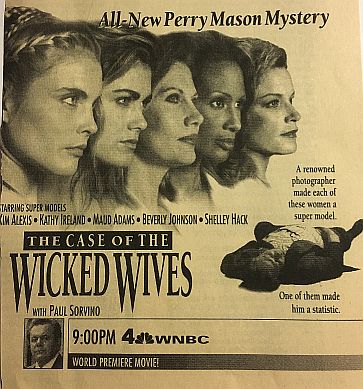
A Perry Mason Mystery: The Case Of The Wicked Wives (1993, directed by Christian Nyby II)


Famed fashion photographer David Morrison (Eric Braeden) has fallen on hard times but things are looking up.  The American Museum of Art wants to do a retrospective of his work.  He just has to get the permission of his current wife, Dee (Kathy Ireland), and his four ex-wives (Shelley Hack, Kim Alexis, Maud Adams, and Beverly Johnson).  All of them are super models who owe their careers to David but four of them hate his guts and Dee isn’t happy when she sees evidence that he has been cheating on her.  When David turns up dead, Dee is arrested.  She claims that she’s innocent but the prosecution is sure that they have an airtight case.

This sounds like a case for Perry Mason!

However, Perry’s out of town so it falls to Perry’s never previously mentioned best friend, Tony Caruso (Paul Sorvino), to solve The Case of the Wicked Wives!  With the help of Perry’s tireless associates, Della Street (Barbara Hale) and Ken Malansky (William R. Moses), Caruso works to solve the case and prove the Dee is innocent.  He also prepares many pasta dinners and frequently sings.

So, where was Perry?  As everyone knows, Raymond Burr played Perry Mason for 9 seasons in the 50s and the 60s.  20 years after the show aired its final episode, Burr returned to the role in a series of highly rated, made for television movies.  Unfortunately, Burr died in 1993 with several movies left to be filmed.  In his will, Burr specifically requested that production on the remaining films continue so that the cast and crew wouldn’t lose their jobs.  Since the role of Mason obviously could not be recast that soon after Burrs’s death, it was decided that the remaining movies would feature guest lawyers.  Enter Paul Sorvino.

The Case of the Wicked Wives was the first Perry Mason film to be made after Burr’s death.  As his replacement, Tony Caruso has much in common with Mason, including the ability to make the guilty confess in open court.  Unlike Mason, Caruso is also obsessed with cooking elaborate spaghetti dinners and singing operatic arias.  This movie came out just a year after Sorvino left Law & Order to specifically pursue his opera career.  Sorvino sings a lot in The Case of the Wicked Wives, sometimes in court.  Unfortunately, a love of singing and pasta are the only two personality traits that are really given to Caruso.  Through no fault of Paul Sorvino’s, Caruso is never as compelling a character as the coolly calculating Mason.  Mason could trick anyone into confessing through perfectly asked questions.  Caruso is more into courtroom stunts that would get most lawyer disbarred.

Because the mystery itself is a dud, the main reason to watch The Case of the Wicked Wives is for the wives.  Who wouldn’t want to keep Kathy Ireland from being wrongly convicted?  All of the wives get at least one big moment to shine and tear up the scenery.  You’ll guess who the murderer is long before anyone else in court.