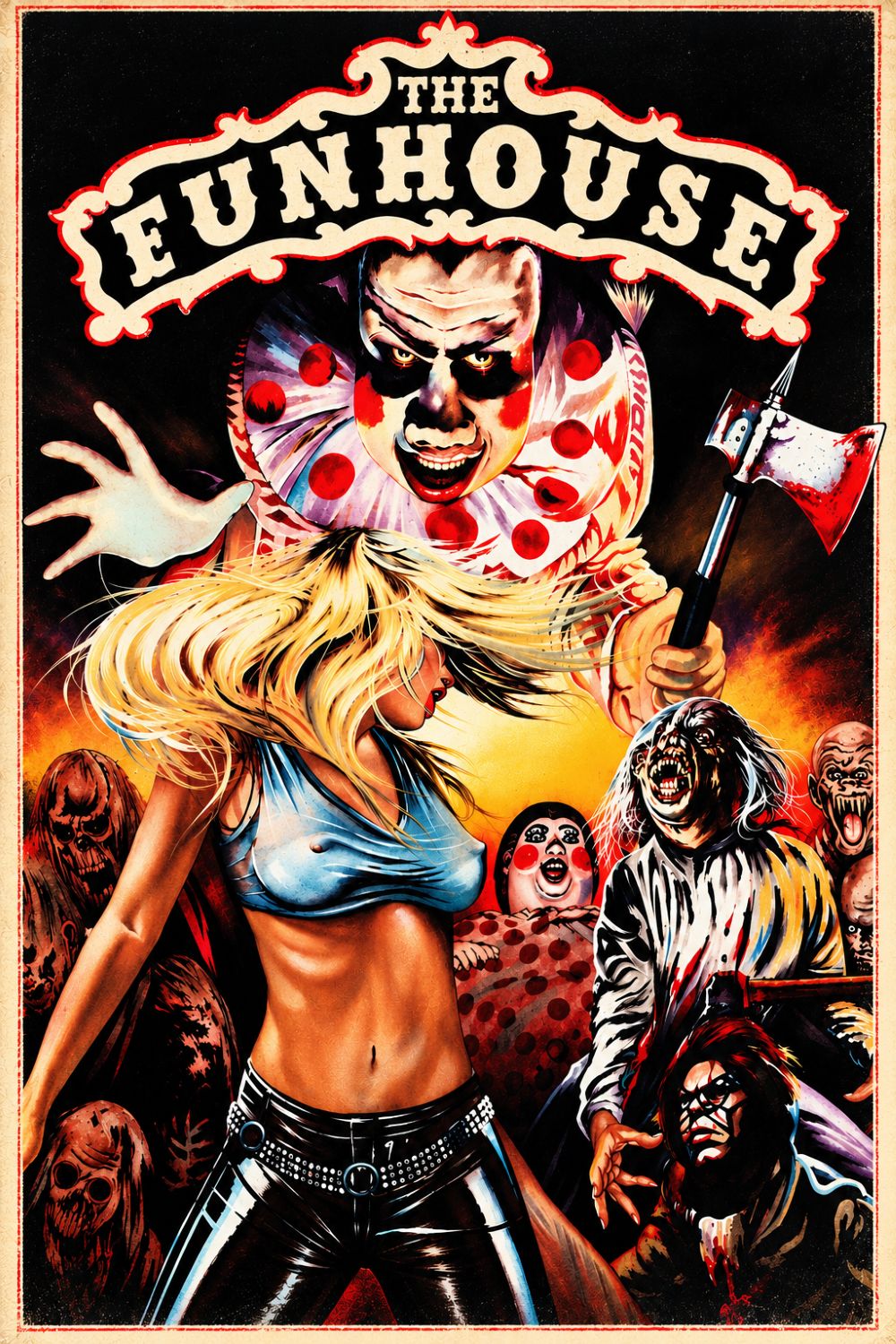
Horror Film Review: The Funhouse (dir. by Tobe Hooper)


“Who will dare to face the challenge of the Funhouse? Who is mad enough to enter that world of darkness?” — Funhouse Barker

There’s something wonderfully sleazy about a horror movie that makes you feel like you need a shower before anyone has even been murdered. Tobe Hooper’s The Funhouse (1981) gets that feeling just right, turning a traveling carnival into a place where the entertainment seems questionable and whatever happens behind the scenes looks considerably worse. It’s not Hooper’s most relentless film, and its straightforward story sometimes struggles to justify the leisurely buildup. Still, there’s enough grime, menace, and visual imagination here to make a familiar teenagers-in-trouble premise feel like more than another ride around the slasher circuit.

The teenagers are Amy Harper, played by Elizabeth Berridge, her date Buzz, and their friends Liz and Richie. Their evening starts with the usual carnival activities: wandering around, checking out attractions, and looking for ways to entertain themselves. Eventually, they decide to hide inside the funhouse overnight. It’s the kind of bad idea that becomes irresistible when nobody wants to be the boring one who objects. After witnessing a murder involving a worker wearing a Frankenstein mask, they find themselves trapped inside with people who have a very good reason to make sure they never leave.

Before any of that, Hooper introduces a playful awareness of horror movies through Amy’s younger brother. He’s a horror fan whose enthusiasm spills into an elaborate prank, approaching Amy in the shower while wearing a mask. The sequence borrows from Halloween and Psycho, turning familiar suspense techniques into a kid’s obnoxious attempt to stage his own scary movie. It’s a neat little meta touch because horror already exists as entertainment within these characters’ lives. They recognize its costumes and enjoy its tricks. The trouble begins when that familiarity encourages them to treat danger as something they can safely play around with.

The carnival extends that idea on a larger scale. Its business depends on selling fear without consequences, and the teenagers arrive expecting every unsettling sight to be part of the experience. Hooper makes that expectation increasingly difficult to maintain. There’s a sourness underneath the attractions, a sense that the smiles and sales pitches barely cover the irritation of the people working there. The movie’s sleaze isn’t just a matter of dirty surroundings. It comes from the uneasy relationship between the customers looking for cheap thrills and the workers who seem to regard them with boredom, contempt, or something less easily identified.

Hooper spends a substantial amount of time letting us absorb that atmosphere. Depending on your patience, this either gives the movie its personality or makes the first half feel like an extended wait for something to happen. There are stretches where the teenagers’ wandering could have been tightened without losing much. On the other hand, rushing directly to the murders would sacrifice the sense that this place has an existence beyond the plot. By the time the group becomes trapped, the carnival feels less like a collection of convenient horror props than a shabby little world with its own unpleasant routines.

Once inside the funhouse, the visual design takes over. Mechanical figures, grotesque faces, and cluttered passageways make it difficult to separate an actual threat from another piece of scenery. Hooper gets suspense out of that uncertainty, giving your eyes plenty to investigate without always rewarding the effort with an immediate scare. The machinery keeps moving regardless of what happens around it, which becomes increasingly unnerving. Something designed to provide a few minutes of harmless excitement turns into an obstacle course whose mechanisms have no interest in whether anyone gets hurt. The attraction doesn’t become evil; its normal operation simply becomes dangerous.

The characters are less distinctive than their surroundings. Berridge gives Amy a believable vulnerability, and her discomfort never feels like an excuse for smugly announcing that everyone else should have known better. She’s simply a young woman whose evening gets horribly out of hand. Buzz, Liz, and Richie have enough personality to establish the group, but not enough to make their individual fates especially affecting. That’s the main limitation of the screenplay: the situation generates more investment than the people caught in it. You’re anxious about what might happen without necessarily feeling that you know these kids very well.

Kevin Conway adds a stronger dose of personality as three different carnival barkers, especially in his role as the masked killer’s father. His combination of aggression and warped protectiveness gives the horror an ugly domestic undercurrent. The creature is frightening, but his vulnerability makes the relationship more disturbing than a simple partnership between villains. The Frankenstein mask also pays off the movie’s interest in familiar horror imagery: a recognizable monster face initially offers something almost reassuring, until its removal destroys that comfort. The makeup is memorable, although the film’s use of physical difference as a source of monstrous terror remains an uncomfortable shortcut.

When the chase finally takes over, The Funhouse delivers tense, claustrophobic suspense without becoming an endless procession of elaborate kills. Its cramped spaces and unreliable hiding places make escape feel frustratingly difficult. The thin characterization and occasional sluggishness keep it from matching Hooper’s strongest work, but the setting remains potent enough to carry the film. From the brother playing horror director to the carnival packaging fear for paying customers, the movie keeps showing people enjoying pretend terror before confronting something they can’t control. It’s an effective, grimy little nightmare that makes the midway’s cheap pleasures look a lot less inviting.

Retro Television Review: Miami Vice 3.24 “Heroes of the Revolution”


Welcome to Retro Television Reviews, a feature where we review some of our favorite and least favorite shows of the past!  On Mondays, I will be reviewing Miami Vice, which ran on NBC from 1984 to 1989.  The entire show can be purchased on Prime!

This week, season 3 comes to a close with a threat from the past!

Episode 3.24 “Heroes of the Revolution”

(Dir by Gabrielle Beaumont, originally aired on May 8th, 1987)

The Vice Squad is investigating Orrestes Pedrosa (Shawn Elliott), a former Fidel Castro henchman who has since come to Miami and is now trying to set himself up a major drug supplier.  There’s also a mysterious German named Klaus Herzog (Jeroen Krabbe) who appears to be following Pedrosa around Miami.

After getting wounded in a nearly-successful drive-by shooting, Herzog breaks into Gina’s apartment and introduces himself as the ex-boyfriend of Gina’s mother.  He goes to explain that Pedrosa was also in love with Gina’s mother and that he killed her when Gina was just a baby.  Pedrosa is still obsessed with Gina’s mother so Herzog suggests that Gina should get a job singing at a club.  Pedrosa will come out of hiding to see her and Herzog will get his chance for revenge.

Gina agrees, even though it means violating every rule in the Vice book.  The end result is that we get a lot of scenes of Saundra Santiago singing and eventually, she shoots Pedrosa dead when he attempts to shoot Herzog.

It’s an interesting choice for a season finale.  Crockett and Tubbs are barely present in this episode, allowing Gina to finally have center stage.  (Interestingly enough, the third season opened with a Gina episode as well.)  Saundra Santiago was often underused by the show so it’s always good to see her getting a chance to do something other than telling Sonny that he got a call.  She and the wonderful Jeroen Krabbe have an interesting chemistry in this episode.  Pedrosa isn’t the only one who is still in love with Gina’s mother.

On the one hand, I was happy that Miami Vice finally featured a villainous communist.  Politically, Miami Vice tends to be so left-wing that it sometimes verges on parody so a villainous Castroite was a change of pace.  But then Krabbe’s character introduced himself by saying, “I am a communist.”  It was as if the show had to make sure we understood that it was still on the side of Marx.  It felt kind of silly, to be honest.

Anyway, the third season ended on a fairly good note.  Neither Don Johnson nor Philip Michael Thomas really seemed that invested in their characters for much of the third season so it’s been nice to see Michael Talbott, Saundra Santiago, and Olivia Brown each get an opportunity to show off what they could do when given the opportunity.  This was an uneven season but it had its share of good episodes.  I’m still struggling to deal with the death of Larry Zito.

Next week, we begin season 4!

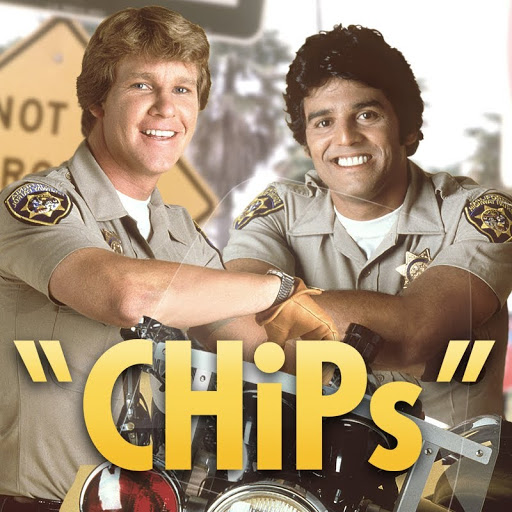
Late Night Retro Television Review: CHiPs 3.5 “Death Watch”


Welcome to Late Night Retro Television Reviews, a feature where we review some of our favorite and least favorite shows of the past!  On Mondays, I will be reviewing CHiPs, which ran on NBC from 1977 to 1983.  The entire show is currently streaming on Prime!

This week, someone dies!  OH MY GOD!

Episode 3.5 “Death Watch”

(Dir by Barry Crane, originally aired on October 13th, 1979)

Dennis (Christopher Stone) is a veteran movie stunt driver who has never gotten over the tragic death of his child and the way he was treated by a heartless insurance company.  He now drives up and down the freeway, looking for drivers who look like they have good insurance.  Using his stunt skills, he causes accidents and then, under one of many assumed names, he files an insurance claim.  Dennis’s wife (played by Dee Wallace, who was married to Stone at the time) thinks that Dennis is taking things too far but Dennis is convinced that he’s earned the right to commit insurance fraud.  As he puts it, the companies have enough money that it’s not going to hurt them if he steals some of it.

Unfortunately, his latest attempt to cause an accident results in a delivery van swerving to the side of the road and striking two policemen who have pulled over a drunk driver.  One of the policeman is series regular Bear (played by Brodie Greer).  The other is a guy named Steve (Stephen Parr) who we’ve never seen before but who is quickly established as being everyone’s best friend.  Or, I guess, he was everyone’s best friend as he dies shortly after being taken to the hospital.  I have to admit that Steve dying was a bit jarring.  It’s rare that anyone on CHiPs is seriously injured, much less killed.

The highway patrol officers are shaken by Steve’s death.  Ponch and Baker go to the station’s gym and work off their frustration.  Jon lifts weights.  Ponch takes off his shirt and starts hitting a punching bag and, despite the tragedy of the situation, it was hard not to laugh at the show using it as an excuse for Erik Estrada to once again take off his shirt.

The members of the highway patrol attend Steve’s funeral.  It’s pretty somber until Bear rolls into the church in his wheelchair and everyone breaks out into a huge smile.  They’re happy that Bear survived but I do have to wonder how Steve’s family felt when they saw all those smiles and heard the officers joking amongst themselves.  I guess they should have been happy that Ponch actually wore pants and a shirt to the funeral as opposed to showing up in a speedo.  Seriously, if anyone would do that, it would be Ponch.

All of the bad drivers are brought to justice.  The driver of the delivery van loses his job.  Dennis goes to prison.  By the end of the episode, everyone’s in a good mood again.  Rest in peace, Steve!

This episode deserves some credit for trying to deal with a serious issue.  Death is a big deal.  Unfortunately, CHiPs really isn’t the best format for heart-rendering drama.  Even after Steve was killed, the show still teased the audience with the promise of another crash.  In the end, the main message seemed to be that it was better to lose Steve than Bear …. or, God forbid, Ponch!

Embracing the Melodrama Part II #59: Hardcore (dir by Paul Schrader)


Hardcore_(1979_film)

“Turn it off…turn it off…turn it off…TURN IT OFF!” — Jake Van Dorn (George C. Scott) in Hardcore (1979)

Jake Van Dorn (George C. Scott) is a businessman who lives in Grand Rapids, Michigan.  He’s a deeply religious man, a sincere believer in predestination and the idea that only an elite few has been prelected to go to Heaven.  Jake is divorced (though he occasionally tells people that his wife died) and is the father of a teenage girl named Kristen (Ilah Davis).

One of the first things that we notice about Jake is that there appears to be something off about his smile.  There’s no warmth or genuine good feeling behind it.  Instead, whenever Jake smile, it’s obvious that it’s something he does because that what he’s supposed to do.  Indeed, everything Jake does is what he’s supposed to do and he expects his daughter to do the same.

When Kristen goes to a church camp in California, she soon disappears.  Jake and his brother-in-law, Wes (Dick Sargent), fly down to Los Angeles and hire a sleazy private investigator, Andy Mast (Peter Boyle), to look for her.  A few weeks later, Andy shows Jake a pornographic film.  The star?  Kristen.

Jake is convinced that Kristen has been kidnapped and is being held captive.  Wes tells Jake that he should just accept that this is God’s will.  Andy tells Jake that, even if he does find Kristen, Jake might not want her back.  Finally, Jake tells off Wes, fires Andy, and ends up in Los Angeles himself.  Pretending to be a film producer and recruiting a prostitute named Nikki (Season Hubley) to serve as a guide, Jake searches for his daughter.

The relationship between Jake and Nikki is really the heart of the film.  For Jake, Nikki becomes a temporary replacement for his own daughter.  For Nikki, Jake appears to be the only man in the world who doesn’t want to use her sexually.  But, as Jake gets closer and closer to finding his daughter, Nikki realizes that she’s getting closer and closer to being abandoned.

Hardcore is a pretty good film, one that was shot in location in some of the sleaziest parts of 70s Los Angeles.  Plotwise, the film is fairly predictable but George C. Scott, Season Hubley, and Peter Boyle all give excellent performances.  (The scenes were Scott pretends to be a porn producer are especially memorable, with Scott perfectly capturing Jake’s discomfort while also subtly suggesting that Jake is enjoying himself more than he wants to admit.)  And, even if you see it coming from miles away, the film’s ending will stick with you.