Decade of last.fm scrobbling countdown:
37. Drudkh (841 plays)
Top track (67 plays): Fate, from The Swan Road (2005)
Ukraine was my gateway into black metal. My earliest exposure to bm in general was met with a closed mind; I remember picking up IX Equilibrium not long after it came out, hearing nothing but distortion and blast beats, and wondering what all the fuss was about, as if its brilliant classical component was non-existent. But somehow Nokturnal Mortum’s Goat Horns blew my mind on first exposure, when I was still a teenager rocking out to In Flames, Opeth, Iced Earth and the like. That pagan spirit screaming murder beneath a wall of chaos struck me with more force than “satanic” or “progressive” bm ever would, then or now. I spent a substantial chunk of my paychecks at The End Records in the years that followed, and I was not searching for “black metal” so much as “Ukraine”. The consequence was that I got to enjoy bands like Drudkh, Hate Forest, and Astrofaes before it was “cool” to do so. (Let’s face it, hype always influences our perspective on a band in one way or another, whether we like to admit it or not.)
Drudkh quickly became my second favorite band in that scene after Nokturnal Mortum, and what I have heard in them over the years is nothing like the steady degradation from Forgotten Legends downward that supposedly “old school” fans are inclined to proclaim. I don’t know why so many people see Drudkh as a one-track band. Perhaps it is because the rate at which they release new material softens perception of the major shifts in their evolution as artists. Handful of Stars (2010) was the only album on which fans actually had to stop and go “wait, is this still Drudkh?”, and the band answered that question decisively with the Slavonic Chronicles EP. But if you listen to Drudkh as a band who played the same solid thing for four or five albums and then got too successful and lost their touch, you’re fairly misguided. It’s true that their first three albums have a lot of similarities. I sort of feel as though their vision on all three was roughly the same, with Swan Road (2005) marking the point at which they had enough recording experience to really make their sound fully capture that vision. The band has rarely repeated the same sound since. Blood in Our Wells (2006), my personal favorite, was a tremendous shift in favor of their pagan undertones, with songs like “Solitude” and “Eternity” crushing the listener through anthems more than atmospherics. Songs of Grief and Solitude (2006) was perhaps the best folk interlude album in black metal since Ulver famously did it, and Estrangement (2007) completely revisioned their sound, replacing characteristic deep plods with rabid, shrill blast beats and grittier production. Microcosmos (2009) was a significant change in production towards the other end of the spectrum, and I rather doubt the gut-wrenching quality of “Ars Poetica” (a song I still think has an almost screamo vibe to it at the climax) would have hit home so forcefully otherwise.
Drudkh’s trip to France on Handful of Stars (2010) may have left some fans disgusted, but it would be frankly stupid to call a band so consistently open to change “sell-outs” the moment their vision failed to reflect stereotypical expectations of aggression, masculinity, whatever the fuck tr00 cvlt dandies demand. And anyone who thinks Eternal Turn of the Wheel (2012) was some grand return to the good old days is in stark denial of the (I think quite intentional) persistent French influence underlining this newest chapter in their discography.
If I seem to be taking a defensive stance here, it might be in part because I’m arguing against my own initial inclinations. I’ve made the shallow mistake of blowing off Drudkh as washed up many times before, and I never fail to regret it once I’ve given the album in question substantially more time to grow on me. (My initial review here of Eternal Turn of the Wheel was cautiously negative. Today I would say it’s great.) I think over the years I’ve developed some boneheaded stereotype of Ukraine as a third world nation–an opinion based mainly on Ukrainian Americans whose pseudo-heritage reeks of self-debasing Cold War propaganda and “world music” zines. (“Only my American non-profit organization can preserve the endangered culture of our pathetic, eternally oppressed, utopianly pacifistic Slavic ancestors! I’ll give you a cultural awareness award and my new Carpathian-Caribbean fusion cd! Buy my shitty handicrafts! Send money!”) I try to forget about it and remind myself that these people are the ultimate American idiots with no actual connection to the people they pretend to represent, but I still find it hard at times to give Slavic musicians the intellectual credit they deserve. Roman Saenko and co are actually among the most intelligent musicians of our generation, and when I remind myself of that and revisit their discography, I realize again that it has been consistently solid from start to finish.
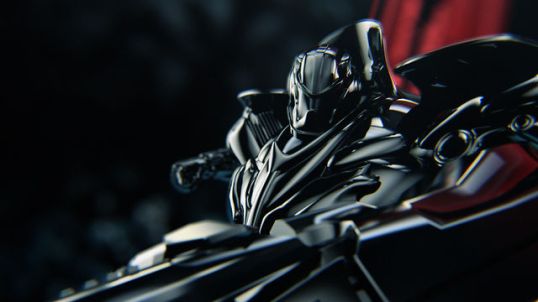
There’s nothing spoilerish in this video that has joined the End Titles sequence of Marvel’s The Avengers as a favorite of mine. Who said end titles for a film has to be the usual text scrawl we’ve been getting for decades. I’m not saying that every film should follow the digital effects used to make the end titles for Pacific Rim and The Avengers, but for summer blockbusters and epic holiday films this is a route that may just become the norm.
The end titles was created by the folks over at Imaginary Forces and all credit goes to these digital artists who made what was already an awesome and fun film even more.
Ok, to say that my latest musical obsession comes directly from Pacific Rim shouldn’t be quite a surprise. I’ve been so hyped about Guillermo Del Toro’s valentines card to all things mecha and daikaiju that it is only logical that it should progress right to it’s soundtrack. The latest “Song of the Day” is the awesometastic and auralgasmic opening theme song to Pacific Rim composed by Game of Thrones composer Ramin Djawadi featuring the lead guitar stylings of Rage Against the Machine’s Tom Morello.
The “Pacific Rim Theme” is quite the homage to the classic mecha and giant robot anime series of the 70’s and early 80’s. It doesn’t go for the recent trend of classical-based opening credits song with the latest mecha series from Japan, but it instead goes for the full-on rock’n’roll treatment. It’s mostly brass and strings with some cameos from the horn section. It also makes great use of the electronic style that evokes early John Carpenter and some of the scifi action films of the early 80’s.
It helps to have Tom Morello of Rage Against the Machine doing lead guitar duties throughout the piece.
In the film, the Jaeger pilots were seen as rock stars by the public and this theme made damn sure that we know that when it plays out in the beginning.
I’ll just say it outright and get it out of the way and say that Guillermo Del Toro is one of the few filmmakers whose body of work has earned him my admiration. The Mexican-born filmmaker has made some of the most fully-realized and visually-beautiful films of the last twenty years. It doesn’t matter whether its genre staples like Blade II and the two Hellboy films or arthouse fares like The Devil’s Backbone and Pan’s Labyrinth, Del Toro has a unique talent for making one believe in the world his films inhabit. This is probably the reason why Peter Jackson had tapped him to direct the film adaptation of J.R.R. Tolkien’s The Hobbit. The man just has an eye for every detail, no matter how big or small, that he believes will add to the overall experience of watching his films.
When delays and behind-the-scenes studio bickerings kept the production of The Hobbit from moving forward Del Toro was already two years into pre-production of the long-awaited new trilogy, but finally backed out. He would try to make one of his dream projects his next move with the film adaptation of H.P. Lovecraft’s classic At the Mountain of Madness. This was a film that looked to set the horror and genre scene by storm. It was a story that was right in Del Toro’s wheelhouse. The film would require him to create a believable world where cosmic Elder Gods and Old Ones existed and still make it terrifying and awe-inspiring. But once again his ideas would require a huge budget from the studios and his stance on making the film an R-rated one finally shelved it (though hopefully not for good).
With two major productions either cancelled or dropped out of, Guillermo Del Toro was now without a film to direct and it’s been years since his last (Hellboy II: The Golden Army). Maybe it was providence or just plain ol’ dumb luck, but in comes a screenplay from Travis Beacham which included such terms as “Jaegers” and “Kaiju” and Del Toro finally got a film that wasn’t an adaptation of someone elses work, but something he could build from the ground up and make his own. That film was and is Pacific Rim.
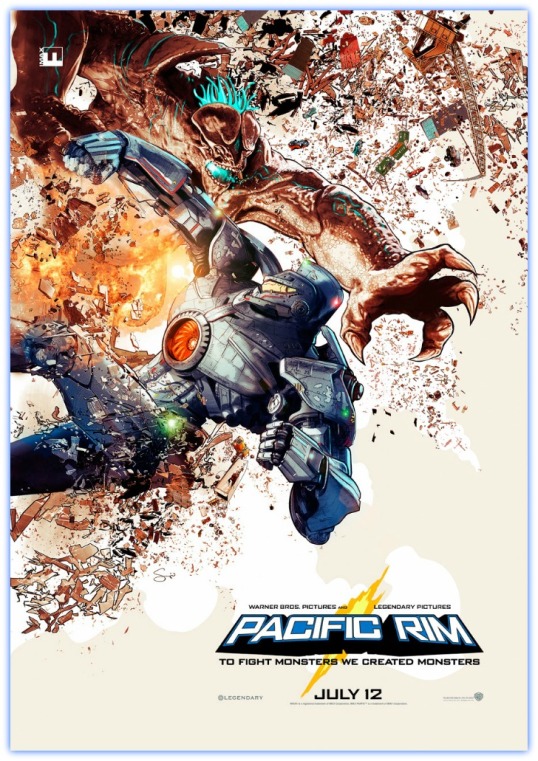
Pacific Rim finally arrives in cinemas around the world and it couldn’t come at a better time. The last couple years have seen summer blockbusters get bigger and bigger. Each new blockbuster tried to outdo the next with something more extravagant, louder and, to their detriment, more complex and convoluted in their storytelling. This is not the case for Pacific Rim which comes in with a simple premise that managed to stay together from start to finish: giant robots fighting giant monsters.
From that idea was born a film that lends itself well into Guillermo Del Toro’s visual and world-building talent. He had to find a way to make this film, that harkens back to the old kaiju films from Japan’s Toho studio and its mecha/giant robot anime genre, a believable world where adventure and spectacle ruled and not post-modern deconstruction and cynical characters and storytelling. It’s an endeavor that succeeds, though not perfectly, to do more than just entertain but also show that sometimes the old ways of telling a story does belong in this new world of hi-tech filmmaking.
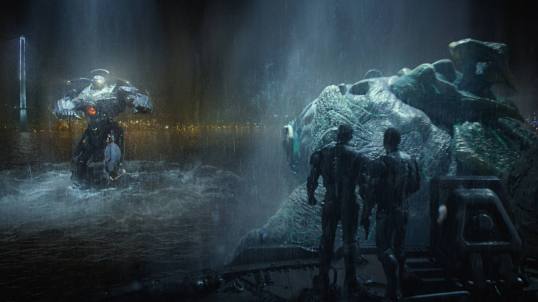
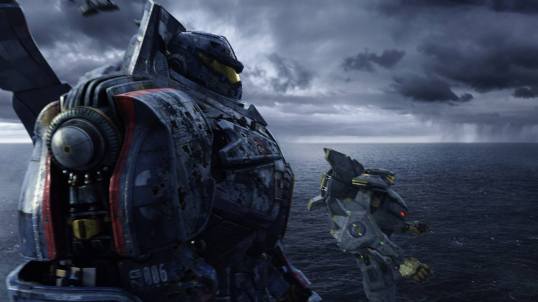
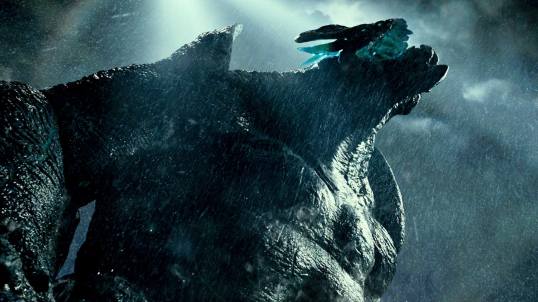
The plot to Pacific Rim is simple enough and an extended opening prologue narrated by one of it’s lead character (Charlie Hunnam of Sons of Anarchy fame playing the role of Jaeger pilot Raleigh Becket). Sometime in the very near future an interdimensional rift (called The Breach) in the Pacific Ocean where two tectonic plates meet open up to allow gigantic creatures dubbed by people as “kaiju”. These kaiju wreak destruction and havoc on a massive scale to the world’s Pacific coastline cities like San Francisco, Manila, Cabo and Tokyo. When conventional military means take too long and and only nuclear options remain on the table the world’s governments band their resources and technical know-how to find a new weapon to combat these kaiju. In comes the “Jaeger Program” where two pilots control 25-story tall giant robots through a “dark science” called “The Drift” to finally fight the kaiju on even terms.
We see through this prologue how the “Jaegers” and their pilots have become rock stars in the eyes of the public as their successes stems and stops the tide that’s been destroying cities in the Pacific Rim for years. It’s also in this prologue that we get to the point of the film where this success has led to overconfidence and the beginning of the end of not just the “Jaeger Program” but that gradual slope that leads to humanity’s inevitable extinction.
The bulk of the film deals with the last few days of the war when the world’s government have stopped funding the Jaeger Program and instead have pooled all resources and manpower towards building massive anti-kaiju walls along city coastlines as a measure of defense. The Jaeger Programs leader, Marshal Stacker Pentecost (played by the ever-present Idris Elba who seem to live the role), believes that his Jaegers and the Rangers piloting them still can finish the war once and for all with a final strike on The Breach with the remaining four Jaegers left in his arsenal. When the politicians tell him no he resorts to dealing with the less than legitimate sector to fund this final strike. But for this last mission to succeed he needs one of his best pilots back from the brink of remorse and mourning to pilot an older, refurbished Jaeger by the name of Gipsy Danger.
From then on the film takes on the premise that Del Toro promised when he first took on the project. We finally get to see giant robots fighting giant monsters.
Pacific Rim lives on it’s simplicity. Whether the simplicity of it’s story, dialogue, characters and themes. The film works within those parameters and does it well. One never feels lost with in the film’s narrative. There’s nothing convoluted with this film’s story. Some have said this need to be simple is an inherent flaw. I would agree with this if someone with less talent took on the job. Del Toro understands that keeping the story simple doesn’t mean dumbing it down, but keeping the promise of what the audience expects from a genre film of giant robots fighting giant monsters needs to deliver. The film’s simplicity allows for the story to flow from it’s hi-octane action sequences to it’s more personal moments without having it seemed forced.
Even the characters themselves come off as the archetypes of past adventure films. Whether it’s the stern father figure leading the pack to the hot-shot hero looking to redeem himself for a past failure to the cocky rival whose hothead personality acts as a counter-balance to the hero’s. Even the mysterious newcomer whose past acts as one of the film’s central emotional anchors harkens back to an earlier era of storytelling that preceded the more realistic and gritty era of film narrative born during the late 60’s and 70’s.
These characters some would call one-dimensional or plain cardboard cutouts, but in the context of the film being seen they work. We get enough of what motivates each character to fully understand why their characters do what they do in the film. The motivations range from honor-bound duty to accomplishing the mission, to revenge, redemption and just plain old-school heroism. Yes, this film brings back heroism minus the recent trend to downplay such an archaic notion. The film treats heroism as something noble born out of the shared sacrifice and the need to do what’s right and to protect not just the person next to them but everyone else who cannot fight the monsters that are at their doors.
The characters of Raleigh Becket, Stacker Pentecost, Mako Mori (played by Oscar-nominatedted actress Rinko Kikuchi who channels her inner anime not just in her attitude but even her appearance) and even the dueling scientists Newton Geizler and Gottlieb (played with manic and eccentric enthusiasm by Charlie Day and Burn Gorman respectively) all come off as heroes who accepts the challenge and nobility inherent in the term. They don’t balk at the duty put on their shoulders, but go full-bore in making sure what they do doesn’t have any moments of self-doubt or cynicism. These are characters who don’t become heroes because they were forced into it. They’ve made their choice and thus have to realize that taking on the mantle of heroism would mean making the ultimate sacrifice.
Yet, for all the talk of themes and narrative styles the film will ultimately live or die on the film’s promise. Does the giant robot fighting giant monsters hold up?
I can honestly say that it does and goes beyond what the studios have been hyping it up to be.
The action sequences between the Jaegers and the kaiju have to be some of the best action sequences of the past decade if not even farther back. It’s a loving homage to the classic daikaiju and mecha of old from Japan that Westerners grew up watching on Saturday mornings on the local UHF channels. It’s mecha anime like Mazinger Z, Macross, Gundam, Neon Genesis Evangelion, Tetsujin-28, Tengen Toppa Gurren Lagann and many others seamlessly melded with the old-school monsters flicks from the Toho Studios with kaiju bearing the iconic names of Godzilla, Gamera, Rodan, Mothra, King Ghidorah and many more. Pacific Rim is a film aimed at the inner-child of men and women who grew up watching these films and shows, but also one that seeks to fire up the imagination of the current generation of children who have been fed on the latest trend of snarky and self-doubting heroes.
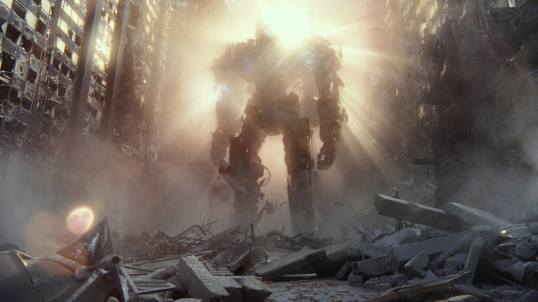
The fights between the the jaegers and kaiju also does one thing that most Hollywood filmmakers who make action films have been unable to pull off. I’m talking about action sequences that remains as kinetic and explosive as any we’ve seen in the past but also aware of it’s space and environment. Pacific Rim’s action sequences never come off as being confusing. There’s no hand-held, cinema verite stylistic choices when it came to filming these sequences. We know exactly which jaeger is doing to fighting and which kaiju is fighting back. Even while set mostly at night and in the rain (or in some cases in the water and underneath in ocean), these fights and the digital effects created by ILM (with some practical ones from Legacy Effects) come off just as clear as if they were done for daytime. In fact, having them set at night with the many differing kinds of light sources available in the scene sometimes gave the fight scenes an almost psychedelic look with Hong Kong’s neon-lit streets and cityscape to the reflected bio-luminescence of the kaiju to the utilitarian lights on the jaegers themselves.
Yet, it still all comes down on whether the promised throwndown delivers and yes it does. We’ve come to learn that even ILM can make the most awesome looking digital effect visuals but still having them end up being confusing because of the filmmaker involved. Some have called this the Michael Bay Effect. Even some of today’s most visually talented filmmakers have fallen prey to it, but not Del Toro who eschews rapid-fire editing and shaky-cam moves. He instead goes from strady shots both close-up and wide to show the battle progress from one move to the next as we see each counter-move develop into more counter-moves. These jaeger-kaiju fight scenes have an almost balletic grace to them despite the massive amount of destruction heaped not just on each other but their surrounding environment as well. They also have a sense of weight to both jaeger and kaiju. With each step, punch, crash and bodyslam there’s a sense of real actual weight being protrayed on the screen unlike films like the Transformers trilogy and, more recently, Man of Steel during some of it’s major action sequences.
Once again this boils down to the simplicity of the scenes and how this choice makes the fights more exciting and thrilling than anything we’ve seen this summer. Up-and-coming filmmakers looking to find out how to set, block and choreograph action scenes could find no better filmmaker than Guillermo Del Toro to learn from.
So, does this mean that Pacific Rim is a perfect film which has no flaws and can do no wrong. It’s a question that probably splits critics and those who talk endlessly about film, but the simple answer is that Pacific Rim is not a perfect film. It does have it’s faults that’s born out of it’s simple narrative and simple-drawn characters. Yet, these flaws also comes across as strengths depending on who ones asks. But as a piece of action-adventure filmmaking that promised the simple idea of giant robots fighting giant monsters the film was perfect.
Pacific Rim reminds us that Guillermo Del Toro is one of the few filmmakers who definitely earns the label of genius. It’s not hyperbole. It’s just fact. It takes a genius filmmaker to do the sort of varied films as he has done throughout his career both as director and producer and still have each and everyone of them feel original (whether they are or not), thought-provoking and just plain old fun. Pacific Rim may be Del Toro’s love letter to his childhood loves of mecha anime and daikaiju films from Toho and other such studios, but it’s really a rallying cry to audiences both young and old that blockbuster filmmaking doesn’t have to be gritty, journeys through psychological darkness to be successful. He’s brought the fun back in epic, grandiose filmmaking that hopefully becomes a trend and not a one-shot.
P.S.: Also, make sure to stay to watch the end title sequence that was created by Imaginary Forces to make a sequence similar to the awesome end titles for The Avengers last year. Plus, there’s a small scene mid-credits at the end that ends the film on the proper note.
Dreamworks Animation’s How to Train Your Dragon was one of those films for 2010 that caught me completely off-guard. I had dismissed it as another Dreamworks attempt to try and take the crown from Pixar. So, it was quite a surprise when I finally saw it and realized that Dreamworks had out-Pixared Pixar with this latest offering.
The film did great in the box-office and made the names Hiccup and Toothless names to remember fondly. So, it was a given that a sequel was going to be made and now it is 2013 and we finally have the first teaser trailer for How to Train Your Dragon 2 which will splash across all big-screen theaters around 2014.
To say that this teaser trailer evoked all the fun of the original would be an understatement. I would say that this simple teaser showing Toothless just flying around with Hiccup gave a better sense of the joy of flying than this year’s Man of Steel.
I had only the most honest of intentions when I stumbled upon Ms. Yeh. I was sampling the new album by Taiwanese black metallers 閃靈 (Chthonic), and I casually plugged them into Google image search. Grim frostbitten glamor shots immediately bombarded me with all the force of Satan’s Almighty Penis thrust into my lusting goatholes of blasphemy. Doris Yeh has been playing bass for the band since 1999. On top of being a great musician, she has effectively employed her phenomenal body to both market the band and garner attention towards their political activism. Chthonic are actively involved in promoting human rights in Taiwan and throughout Asia, speaking out against Chinese imperialism in Tibet and their home country and advocating a greater awareness of women’s rights. Visually, Doris Yeh stuns me most in more traditional black metal attire and on stage (the last two pictures in this compilation), but she’s just as gorgeous in her modeling and goth photo shoots.
Musically, Chthonic are better than most at what they play. I give them props for incorporating that delightful and underrepresented world of Asian folk into metal, but their glossy, high production, symphonic brand of black, melodic death, and folk metal isn’t really my style. Here is a sample track from their new album, 武徳 (Bú-Tik), if you’re curious:
Decade of last.fm scrobbling countdown:
38. Split Lip Rayfield (789 plays)
Top track (46 plays): Thief, from Never Make It Home (2001)
Featured track: Barnburner, from Split Lip Rayfield (1998)
I chose the soundtrack to my four years in Texas appropriately: 92.5 The Outlaw. Poor San Antone lost its favored child–the only country station in the area that focused specifically on bands from Texas and the surrounding region–about a year after I left. (The owners thought they could make more money by instead offering another ultra-right Rick Perry-worshipping neo nazi talk show station.) Well, I didn’t actually ever hear Wichita, Kansas-based Split Lip Rayfield on The Outlaw anyway, oddly enough, but I did stumble upon them while listening to last.fm radio playlists of Texas country bands. It’s not like I’d never heard boisterous, edgy folk music before; the stuff The Outlaw was spinning had more balls than half the heavy metal out there. But to hear it in bluegrass was still a bit of a novelty to me at the time, and to hear it with this degree of technical proficiency blew me away.
They/their label unfortunately seems to have fallen pray to that fallacy that non-mainstream file sharing diminishes revenue–as if people just randomly buy albums from groups they’ve never heard without sampling a track or two first–so I can’t offer any studio selections, but the live video I’m showcasing here was one of the first recordings of the band I ever heard. In retrospect, it was a huge influence on my own personal guitar style. A bit of guitarist and singer Kirk Rundstrom’s total disregard for any supposedly necessary point of transition from acoustic to electric guitar has resonated in everything I’ve written or performed since. Sad to say, he tragically passed away of esophageal cancer right around the time I started listening to them. Rest in peace.
Today saw the release of the red band trailer for the remake of Park Chan-wook’s classic neo-noir Oldboy. This remake by Spike Lee already looks to pay homage (or imitate) the look and feel of Park’s adaptation of the Japanese manga of the same name by Garon Tsuchiya and Nobuaki Mineshigi. We see quick glimpses of the hallway fight scene and a montage of the main character’s 20 years spent locked up in an unknown hotel room.
There’s a great chance for Spike Lee to make this remake his very own by using the Park film as a template but not as gospel. The Park adaptation itself took some liberties with the story told in the manga. Lee and the screenplay by Protosevich could do same to allow this Oldboy a chance to stand on its own instead of becoming another Gus Van Sant Psycho.
Though I wouldn’t mind to see what Lee has in mind as Josh Brolin’s character’s first choice of a meal once getting out.
If there’s one filmmaker alive today who probably deserves the label of genius it’s probably Mexican-born filmmaker Guillermo Del Toro. Yes, that’s probably hyperbolic high praise, but then with each new film he releases he shows audiences and critics something rarely seen before that gradually knocks down any doubts as to why he deserves the praise.
In 2006, Del Toro released the Spanish-language dark fantasy film Pan’s Labyrinth and people who had only known him as the guy who directed Blade II and Hellboy finally understood why critics both high and low were having such a major crush on the man’s work and talent. My favorite scene from this film was a major example why Guillermo Del Toro is such a genius. I’m talking about the scene with the “Pale Man” and Ofelia’s encounter with it during her second task given to her by the The Faun.
This sequence showed Del Toro not just juggling the dark fantasy aspect of the film, but also his talent for world-building and horror. This scene was the one which probably sold those still on the fence about the film as they watched it. It’s a scene which showed Del Toro’s love for monsters and he created one which has left an indelible mark on the film-going audience that still resonates to this day.
Decade of last.fm scrobbling countdown:
39. Camera Obscura (786 plays)
Top track (228 plays): Country Mile, from Let’s Get Out of This Country (2006)
Featured track: Razzle Dazzle Rose, from Let’s Get Out Of This Country (2006)
The presence of Camera Obscura on my decade-spanning last.fm charts might be the only fluke in this series. They basically got here because I listened to “Country Mile” on repeat for about 12 hours one day. Let’s Get Out of This Country is the only album I’ve really listened to extensively in their discography (they just released their fifth last month), and while I did get the pleasure of seeing them live once, I can’t say I know much about the band. But I do think this album is absolutely delightful–a little hidden ray of light in my mostly heavier music collection that warmed my heart the first time I heard it and still does today. Its retro vibe feels oddly more authentic than any of the actual classic pop sounds it replicates, made fresh by a heavy dose of 2000s indie aesthetics and Tracyanne Campbell’s angelic vocals. Let’s Get Out of This Country takes me back in time so vividly that I swear I remember growing up surrounded by the wallpaper on the album’s cover. It’s flooded with innocent ennui, played out in front of a kitchen window on a rainy Saturday afternoon. Its depression is refreshing and nostalgic, replaying some childhood memory in which boredom seemed to be the worst thing life had to offer.













 Through the Shattered Lens