Welcome to Retro Television Reviews, a feature where we review some of our favorite and least favorite shows of the past! On Saturdays, I will be reviewing Baywatch, which ran on NBC and then in syndication from 1989 to 2001. The entire show can be viewed on Tubi.
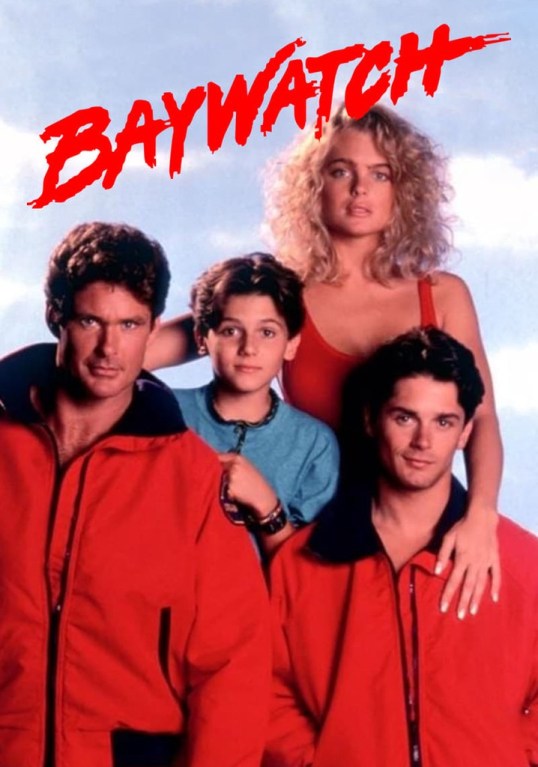
This week, Mitch goes to his high school reunion!
Episode 2.12 “Reunion”
(Dir by Gus Trikonis, originally aired on January 27th, 1992)
Mitch gets laid.
That’s pretty much the plot of this incredibly simple episode.
It’s time for Mitch’s 20-year high school reunion but he doesn’t want to go because he’s worried about seeing his ex-wife, Gayle (Wendie Malick). However, at the last moment, Mitch suddenly does decide to go. He meets up with Gayle, who is wearing a blue dress that is simply to die for. With Gayle’s help, Mitch also rescues the class bully (Tim Rossovich) after two former high school outcasts (Tom Villard and Glenn Morshower) bury him in the sand just as the tide starts to come in. And then Mitch and Gayle go back to the Buchanan house and do it like it’s prom night.
Fortunately, Hobie is gone for the weekend. (It’s kind of funny how Hobie is always off with relatives or friends whenever Mitch needs the house to himself.) I will say that, as a child of divorce, there’s nothing more painful than thinking your parents are going to get back together just because one of them was still in the house when you woke up in the morning. Hobie is spared the trauma of Mitch and Gaye’s post-reunion hook-up.
Mitch, however, is disappointed to learn that Gayle has a boyfriend and that she’s going to be marrying him. The only reason Gayle went to the reunion was to work out her feelings about Mitch. Hasselhoff handles the revelation with his trademark emotional earnestness. Left unmentioned is the fact that having sex with Mitch apparently convinced Gayle that she should marry the other guy.
Finally, someone left a baby in Eddie’s lifeguard station. Eddie and Shauni looked after it for the weekend. This led to a lot of, “Wow, sometimes babies smell bad,” humor. In the end, the baby’s father shows up to get the baby but it turns out that he doesn’t actually have custody and that his ex-wife left the baby at the lifeguard station specifically to keep her safe from him. Obviously, this couple has issues that will not be resolved by a high school reunion hook-up.
Even by the standards of Baywatch, this was a remarkably empty episode. Between Mitch quickly getting over the fact that Gayle is getting remarried and Eddie and Shauni taking care of a random baby, it was hard to escape the feeling that nothing really matters on this show. There are no real consequences to anyone’s actions. No one has any sort of emotional conflict that can’t be solved with a musical montage. Eddie and Shauni end the episode thinking about what it would like to be parents. They’ll be over it in a week.
Baywatch was a show where nothing really mattered and that’s probably why it was so popular.

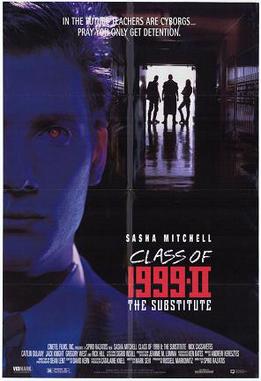 There’s a new substitute teacher at a local high school in Oregon and he’s not going to put up with any disrespectful punks. John Bolen (Sasha Mitchell) can educate minds and change lives but only when he’s not busy killing any student with a bad attitude and trying to protect his fellow teacher, Jenna McKenzie (Caitlin Dulany). Jenna is scheduled to testify against the local gang leader so every punk at school is trying to intimidate her and her boyfriend, Emmett (Nick Cassavetes!). It takes Jenna and Emmett a while to realize that John is killing all of their students but soon, a mysterious man named G.D. Ash (Rick Hill) shows up and insinuates that John might be connected to the robot teachers that, two years earlier, terrorized a high school in Seattle.

