Remembering Wings Hauser… a personal reflection. 


As a teenager of the late 80’s who was absolutely obsessed with movies, I spent a lot of time in the local videos store in and around Conway, Arkansas. I would meticulously go through their entire inventory. Nobody wanted to go with me to the video store because they knew they were going to be there for awhile. That’s where I first became obsessed with Charles Bronson, and he’s been my obsession to this day, over 20 years after his death. 

The video store was a place where I also discovered a lot of other amazing actors. It would always go something like this; I would see a person’s name on a movie that looked good. I would watch the movie and enjoy it. I would go back to the store and notice that person was in a lot more movies. I would then try to watch them all. This pattern started with Bronson, and then moved on to actors like Clint Eastwood, Roy Scheider, Burt Reynolds, Rutger Hauer, and yes, Wings Hauser. On a side note, I always thought it was pretty cool that two of my favorite actors had practically the same name, Hauer and Hauser. The video stores were full of movies starring Hauser that I thought looked good. My preferred box art would generally feature Hauser holding a gun (see picture at the top), and usually with generic sounding titles like DEADLY FORCE (1983), HOSTAGE (1986), NO SAFE HAVEN (1987), DEAD MAN WALKING (1988), and MARKED FOR MURDER (1990). When I rented a movie “starring Wings Hauser” in the 80’s through the early 90’s, I had a pretty good idea what I’d be getting. It would usually be a low budget movie, with some solid action and some sexy ladies, all anchored by a likable and charismatic performance from Wings Hauser. Those are the types of low budget, action movies that I really loved and Hauser did a bunch of him. I know they aren’t great movies, certainly not of the same quality of Hauser’s own best work in movies like VICE SQUAD (1982) and THE SIEGE OF FIREBASE GLORIA (1988), but I enjoyed them so much growing up. 

While my favorite Wings Hauser movies featured him as a cop, we watched him in so many different types of roles. I remember our family renting TOUGH GUYS DON’T DANCE (1987). None of us knew what the hell was going on in that movie. Hauser would co-star in movies like BEDROOM EYES II (1989), OUT OF SIGHT, OUT OF MIND (1990), and BEASTMASTER 2: THROUGH THE PORTAL OF TIME (1991). I’d watch them all. Hell, he even directed a graphic slasher flick called THE ART OF DYING (1991). That movie is nuts! No matter the quality of the movie, I always enjoyed seeing Hauser on screen. 

When YELLOWSTONE hit it big on TV a few years back, my wife Sierra loved the character Rip Wheeler. Since Rip is played by Cole Hauser, I took that as an opportunity to introduce her to his dad Wings Hauser. I never watch an episode of YELLOWSTONE that I don’t think of Wings Hauser and those old times at the video store. The first Wings Hauser movie I introduced my wife to was VICE SQUAD, but we watched quite a few of his movies over the last couple of years. It has been fun revisiting the films and sharing them with her. 

Wings Hauser will always have a special place in my heart, because I spent a lot of time with him. Today, as a tribute to him, I share my story and a scene from DEADLY FORCE. It’s just a fun car chase scene featuring Wings in one of his low budget action movies. This is the Hauser I loved the most. Rest in peace, sir! 

An Offer You Can’t Refuse: Irish Eyes (dir by Daniel McCarthy)


First released in 2004, Irish Eyes tells the story of two brother, born eleven months apart.

Tom Phelan (John Novak) is the older brother, the one who is destined to go to law school, join the Justice Department, and to marry Erin (Veronica Carpenter), the daughter of one of Boston’s most prominent attorneys.  Tom’s future lies in politics.  As he makes his reputation by taking down members of the Boston underworld, he finds himself being groomed for attorney general and then who knows what else.

Sean Phelan (Daniel Baldwin) is the younger brother.  Haunted by the murder of his father and stuck at home taking care of his mother (Alberta Watson) while Tom goes to college, Sean soon pursues a life of crime.  He falls under the influence of the Irish mob, led by Kevin Kilpatrick (Wings Hauser).  Sean quickly works his way up the ranks.  It doesn’t matter how much time he does in prison.  It doesn’t matter how many people he has to kill.  It doesn’t matter if it alienates the woman that he loves or if it damages his brother’s political career, Sean is a career criminal.  It’s the one thing that he knows.  When Sean finds himself as the head of the Irish mob and also the American connection for the IRA, his activities are originally overlooked by his brother.  Sean even threatens a reporter who makes the mistake of mentioning that Sean and Tom are brothers.  But soon, Tom has no choice but to come after his brother.  What’s more important?  Family or politics?

Obviously (if loosely) based on Boston’s Bulger Brothers (Whitey became a feared criminal while brother John became a prominent Massachusetts politico), Irish Eyes doesn’t really break any no ground.  Every mob cliché is present here and so is every Boston cliché.  Don’t rat on the family.  Don’t betray your friends.  The only way to move up is to make a move on whoever has the spot above you.  Every bar is full of angry Irish-Americans.  Every fight on the street turns deadly.  Everyone is obsessed with crime or politics.  The film, to its credits, resists the temptation to have everyone speak in a bad Boston accent.  (The Boston accent, much like the Southern accent, is one of the most abused accents in film.)  Sean narrates the films and you better believe he hits all of the expected points about life on the street.

That said, it’s an effective film with enough grit and good performances to overcome the fact that it’s just a wee predictable.  Daniel Baldwin is appropriately regretful as Sean and John Novak does a good job of capturing the conflict between Tom’s love of family and his own political ambitions.  Curtis Armstrong shows up and is surprisingly convincing as a psychotic IRA assassin.  Admittedly, the main reason that I watched this film was because Wings Hauser was third-billed in the credits.  Hauser only appears in a handful of very short scenes and that’s a shame.  In those few scenes, he has the rough charisma necessary to be believable as the crime boss who holds together the neighborhood and it’s hard not to regret that he didn’t get more to do in the film.  That said, the film still works for what it is.  It’s a good mob movie.

This film was originally entitled Irish Eyes.  On Tubi, it can be found under the much clunkier name, Vendetta: No Conscience, No Mercy.

Icarus File No. 20: Tough Guys Don’t Dance (dir by Norman Mailer)


The 1987 film, Tough Guys Don’t Dance, opens with Tim Madden (Ryan O’Neal) talking to his father, tough Dougy (Lawrence Tierney).  Dougy has stopped by Tim’s New England home to let Tim know that he has decided stop chemotherapy and accept his eventual death from cancer because, as Dougy puts it, “Tough guys don’t dance.”  The tone of Dougy’s voice is all we need to hear to know that, in his opinion, his son has spent way too much time dancing.

Tim is an ex-convict turned writer and, when we first see him, he’s obviously had a few rough nights.  He explains to Dougy that he woke up after a bender with his ex-girlfriend’s name tattooed on his arm, blood all over his jeep, and two heads dumped in his marijuana stash.  Tim says that he’s hopeful that he’s not the murderer but he can’t be sure.  He’s been drinking and doping too much.  He suffers from blackouts.  He’s not sure what happened.

The majority of the film is made up of flashbacks, detailing Tim’s affairs with a number of women and also his odd relationship with the town’s police chief, Luther Regency (Wings Hauser).  Luther is married to Tim’s ex-girlfriend, Madeleine (Isabella Rossellini), who long ago accompanied Tim on a trip to North Carolina where they hooked up with a fundamentalist preacher (Penn Jillette) and his then-wife, Patty Lariene (Debra Sundland).  (Tim found their personal ad while casually skimming the latest issue of Screw, as one does I suppose.)  Patty Lariene eventually ended up married to Tim, though she has recently left him.  As for Madeleine, she has never forgiven him for a car accident that they were involved in.  Is Tim capable of loving anyone?  Well, he does say, “Oh God, oh man,” repeatedly when he discovers that his wife has been having an affair.

Tim tries to solve the murders himself, finding that they involve not only him and Luther but also Tim’s old prep school friend, Wardley Meeks III (John Bedford Lloyd) and also some rather stupid drug dealers that Tim hangs out with.  The plot is almost ludicrously convoluted and it’s tempting to assume that the film is meant to be a parody of the noir genre but then you remember that the film is not only based on a Norman Mailer movie but that it was directed by Mailer himself.  Mailer, who was the type of public intellectual who we really don’t have anymore, was blessed with a brilliant mind and cursed with a lack of self-awareness.  There’s little doubt that we are meant to take this entire mess of a film very seriously.

And the film’s theme isn’t hard to pick up on.  By investigating the murders, Tim faces his own troubled past and finally comes to understand why tough guys, like his father, don’t hesitate to take action.  Tough guys don’t dance around what they want or need.  That’s a pretty common theme when it comes to Mailer.  Tim Madden is not quite an autobiographical character but he is, by the end of the story, meant to represent the type of hard-living intellectual that Mailer always presented himself as being.  Unfortunately, Ryan O’Neal wasn’t exactly an actor who projected a good deal of intelligence.  And, despite his lengthy criminal record off-screen, O’Neal’s screen presence was somewhat docile.  That served him well in films like Love Story and Barry Lyndon.  It serves him less well in a film like this.  It’s easy to imagine O’Neal’s Tim getting manipulated and, in those scenes where he’s supposed to be a chump, O’Neal is credible enough in the role.  It’s far more difficult to buy the idea of Tim actually doing something about it.

Indeed, it’s hard not to feel that co-star Wings Hauser would have been far more credible in the lead role.  But then, who would play Luther Regency?  Hauser gives such a wonderfully unhinged and out-there performance as Luther that it’s impossible to imagine anyone else in the role.  Maybe Hauser could have played both Tim and Luther.  Now that would have made for a classic film!

Tough Guys Don’t Dance is weird enough to be watchable.  The dialogue is both raunchy and thoroughly humorless, which makes it interesting to listen to, if nothing else.  The moments that are meant to be funny are so obvious (like casting noted atheist Penn Jillette as a fundamentalist) that it’s obvious that the moment that feel like clever satire were actually all a happy accident.  As far as Norman Mailer films go, this one is not as boring as Wild 90 but it also can’t match the unhinged lunacy of a frustrated Rip Torn spontaneously attacking Mailer with a hammer at the end of the unscripted Maidstone.  It’s a success d’estime.  Mailer flew too close to the sun but the crash into the ocean was oddly entertaining.

Previous Icarus Files:

  1. Cloud Atlas
  2. Maximum Overdrive
  3. Glass
  4. Captive State
  5. Mother!
  6. The Man Who Killed Don Quixote
  7. Last Days
  8. Plan 9 From Outer Space
  9. The Last Movie
  10. 88
  11. The Bonfire of the Vanities
  12. Birdemic
  13. Birdemic 2: The Resurrection 
  14. Last Exit To Brooklyn
  15. Glen or Glenda
  16. The Assassination of Trotsky
  17. Che!
  18. Brewster McCloud
  19. American Traitor: The Trial of Axis Sally

4 Shots From 4 Films: Special Wings Hauser Edition


4 Shots From 4 Films is just what it says it is, 4 shots from 4 of our favorite films. As opposed to the reviews and recaps that we usually post, 4 Shots From 4 Films lets the visuals do the talking!

Today, it’s time for….

4 Shots From 4 Wings Hauser Films

Vice Squad (1982, dir by Gary Sherman, DP: John Alcott)

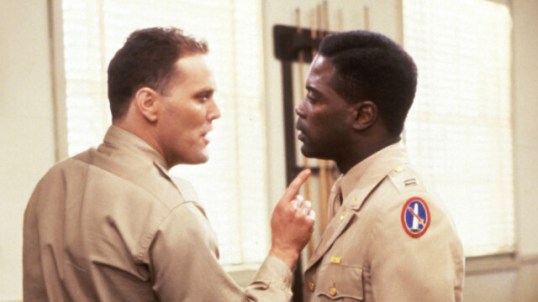
A Soldier’s Story (1984, dir by Norman Jewison, DP: Russell Boyd)

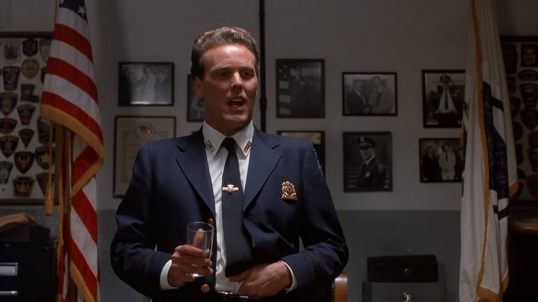
Tough Guys Don’t Dance (1987, dir by Norman Mailer, DP: Mike Moyer)

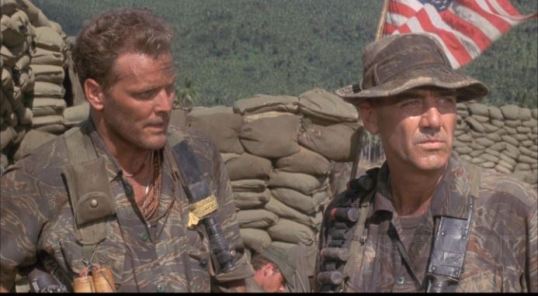
The Siege of Firebase Gloria (1989, dir by Brian Trenchard-Smith, DP: Kevin Lind)

Scenes That I Love: Wing Hauser Gets Busted In Vice Squad


Wings Hauser, the great character actor who brought his unhinged intensity to many a film, has passed away.  Rest in Peace.

Today’s scene that I love comes from what may be Hauser’s best-known film, 1983’s Vice Squad.  In this scene, the Vice Squad thinks that they have busted Ramrod, the sadistic pimp played by Hauser.  In this scene, Hauser makes Ramrod into an intimidating figure even as he’s being arrested.  Martin Scorsese once said Wings Hauser deserved an Oscar for his performance in Vice Squad and he was right.

Original Gangstas (1996, directed by Larry Cohen)


Original Gangstas opens with shots of the deserted streets and burned-out store fronts of Gary, Indiana and narration telling us how a once great American city came to be in such disrepair.  The steel plant closed and put much of the city out of work.  While the politicians and the police looked the other way, violent street gangs rose up and took over entire neighborhoods.  Now, Gary is a shell of its former self.  Even the local movie theater has closed down.  The narrators tells us that the last movie to play at the theater was Star Wars.

Led by Spyro (Christoper B. Duncan) and Damien (Eddie Bo Smith, Jr.), the Rebels are the most feared and powerful gang in Gary.  They rule through violence and intimidation.  Talk to the police and your business is liable to get torched and you’re likely to get shot.  However, Spyro and Damien have finally gone too far and now, two men who previously escaped from Gary are returning to town to dish out some justice.

John Bookman (Fred Williamson) is a former football player who wants to avenge the shooting of his father.  Jake Trevor (Jim Brown) is a boxer who once killed a man in the ring and who wants revenge for the death of his son.  When they were young men, John and Jake were the original Rebels and now they’re getting the old gang back together again.  With the help of Laurie (Pam Grier), Bubba (Ron O’Neal), and Slick (Richard Roundtree), the original gangstas are going to take back the streets of Gary.

Original Gangstas was released at a time when, largely thanks to the influence of Quentin Tarantino, people were just starting to feel nostalgic for the old blaxploitation movies.  The main appeal of the film, not surprisingly, is that it brings together so many of the great blaxploitation stars and sets them loose in what was then the modern era.  (Jim Kelly is missed.)  When John and Jake talk about how they’re responsible for the Rebels, they could just as easily be talking about how they’re responsible for both all of the independent crime films that came out in the wake of Reservoir Dogs and Pulp Fiction.

Original Gangstas is a tribute to both the Blaxploitation genre and the oversized personalities that made that era so memorable.  Neither Fred Williamson, Jim Brown, nor Richard Roundtree were particularly good actors but they all had so much screen presence and such an innate sense of cool that it didn’t matter whether they could convincingly show emotion or not.  (Original Gangstas gives all of the big dramatic scenes to Pam Grier, who was not only naturally cool but a damn good actress to boot.)  The minute Fred Williamson lights his cigar, he control the entire movie.  He and Jim Brown make a good team and Original Gangstas is an entertaining and violent trip down memory lane.

Lisa Reviews An Oscar Nominee: A Soldier’s Story (dir by Norman Jewison)


Set during World War II, 1984’s A Soldier’s Story opens with a murder.

On a rural road outside of a segregated army base in Louisiana, someone has gunned down Sergeant Vernon Walters (Adolph Caesar).  At the time, Walters was staggering back to the base after a night of heavy drinking.  Both the local authorities and Watlers’s fellow soldiers assume that the murder was the work of the Ku Klux Klan.  Captain Richard Davenport (Howard Rollins) isn’t so sure.

Captain Davenport is the officer who has been assigned to investigate the murder.  From the minute that he arrives at the base, the soldiers stare at him.  As Cpl. Ellis (Robert Townsend) explains it, the enlisted men are shocked because they’ve never seen a black officer before.  Some of the soldiers admire Davenport while other view him with suspicion, wondering what Davenport must have done or who he must have sold out to earn his commission.

Meanwhile, the other officers (who are all white) view Davenport with a combination of condescension and hostility.  Col. Nivens (Trey Wilson) only allows Davenport three days to wrap up his investigation and assigns the polite but skeptical Capt. Taylor (Dennis Lipscomb) to work with him.  Taylor suspects that Walters may have been murdered by the openly racist Lt. Byrd (Wings Hauser!).  Davenport, however, isn’t so sure.  Even though the official story is that Walters was a tough but fair sergeant who was respected by his company, Davenport suspects that one of them may have killed him.

Davenport and Taylor start to interview the soldiers who actually had to deal with Walters on a daily basis.  Through the use of flashbacks, Walters is revealed to be a far more complex man than anyone knew.  We see that Walters was a man who was bitterly aware of the fact that, even after a lifetime of military service, he was destined to always be treated as a second-class citizen by the nation that he served.  Unable to strike out at the men who the army and society had placed over him, Walters instead struck at the men serving underneath him.  While the man in Walters’s company wait for word on whether or not they’ll be allowed to serve overseas, Davenport tries to determine if one or more of them is a murderer.

A Soldier’s Story was adapted from a play but director Norman Jewison is careful to prevent the material from becoming stagey.  Effortlessly transitioning from the film’s present to flashbacks of the events that led to Walters’s murder, Jewison crafts both an incendiary look at race relations and a compelling murder mystery.  He’s helped by a strong cast of predominately African-American actors.  In one of his earliest roles, Denzel Washington plays Pfc. Peterson with a smoldering intensity.  David Alan Grier and Robert Townsend, two actors known for their comedic skills, impress in dramatic roles.  Seen primarily in flashbacks, Adolph Caesar turns Walters into a complex monster.

And yet, with all the talent on display, it is Howard Rollins who ultimately steals the movie.  As  a character, Captain Davenport has the potential to be a rather thankless role.  He spends most of the movie listening to other people talk and, because of his status as both an officer and a black man in the rural south, he’s rarely allowed to show much anger or, for that matter, any other emotion.  However, Rollins gives a performance of such quiet intelligence that Davenport becomes the most interesting character in the movie.  He’s the ultimate outsider.  Because of his higher rank and his role as an investigator, he can’t fraternize with the enlisted men but, as an African-American, he’s still expected to remain separate from and differential to his fellow officers.  As the only black officer on a segregated base, Davenport is assigned to stay in an empty barrack.  One of the best scenes in the film is Davenport standing alone and surveying the stark layout of his temporary quarters.  The expression on his face tells you everything you need to know.

(Towards the end of the film, when Davenport finally gets a chance to drop his rigid facade and, if just for one line, be himself, you want to cheer for him.)

A Soldier’s Story was nominated for best picture but it lost to another theatrical adaptation, Milos Forman’s Amadeus.


All In A Day’s Work: The Carpenter (1988, directed by Daving Wellington)


Alice Jarett (Lynne Adams) has problems.

She’s recovering her latest nervous breakdown and her husband, Martin (Pierre Lenoir) is having an affair with one of his students.  Martin and Alice have just moved into a new house that was never actually completed and the construction crew that they’ve hired is made up of lazy nogoodniks who all have mullets.  Alice’s only relief is the carpenter (Wings Hauser) who materializes in the house every midnight and who, unlike the construction crew, carefully and lovingly works on the house while talking about the value of doing a good day’s work.

Even though she comes to believe that the carpenter might be the ghost of a murderer, Alice still falls in love with him and he seems to fall for her too.   Want to get on the carpenter’s bad side?  Just try to hurt Alice or the house.   When a member of the construction crew attempts to rape Alice, the carpenter chops off the rapist’s arm with a radial saw.  When two other construction workers break into the house, the carpenter kills them too.  In fact, the carpenter kills a lot of people and what gives this movie a new wrinkle is that Alice seems to be okay with a lot of those murders.  Is the carpenter real, dead, or a product of Alice’s fragile mental state?  No one knows but the carpenter himself.

The Carpenter is all about Wings Hauser, who was practically the patron saint of straight-to-video exploitation films in the late 80s and early 90s.  The movies tries to keep us guessing as to whether the carpenter is a real person or a ghost but all that matters is that he’s Wings Hauser, giving one of his most crazed performances.  Wings Hauser could make any otherwise bad movie watchable and that’s the case with The Carpenter.

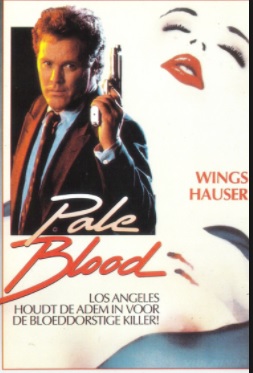
A Movie A Day #291: Pale Blood (1990, directed by V.V. Dachin Hsu and Michael W. Leighton)


Someone is murdering women in Los Angeles and draining them of their blood.  A mysterious detective named Michael Fury (George Chakiris) arrives from London and starts to investigate.  Fury is a vampire but he is a thoroughly modern vampire.  He even has his own special travel coffin that he takes with him on trips.  To help him with his investigation, he hires a researcher named Lori (Pamela Ludwig).  Lori is convinced that the killings are being committed by a real vampire but Michael believes that they are actually the work of a human who is only pretending to be one of the undead.  Michael is worried that this fake vampire will make real vampires look bad.  Meanwhile, a crazy photographer (Wings Hauser) stalks Michael, determined to capture a vampire of his very own.

Pale Blood went straight-to-video and does not have the budget to match its ambitions but it is still a fairly good, if overlooked, vampire movie.  George Chakiris, who is best known for his role in West Side Story, had the right look to play a brooding vampire and he and Pamela Ludwig made a good team.  Not surprisingly, the best thing about Pale Blood was Wings Hauser.  In this movie, Wings Hauser gave a performance that was demented even by the standards of Wings Haauser.  Hauser is so crazy in this movie that Pale Blood sets the standard by which all other crazy Wing Hauser performances must be judged.

One final note: the vhs cover art, which is pictured above, features a shot of Wings Hauser that was apparently lifted from a different movie.