Brad reviews AMERICAN OUTLAWS (2023)!


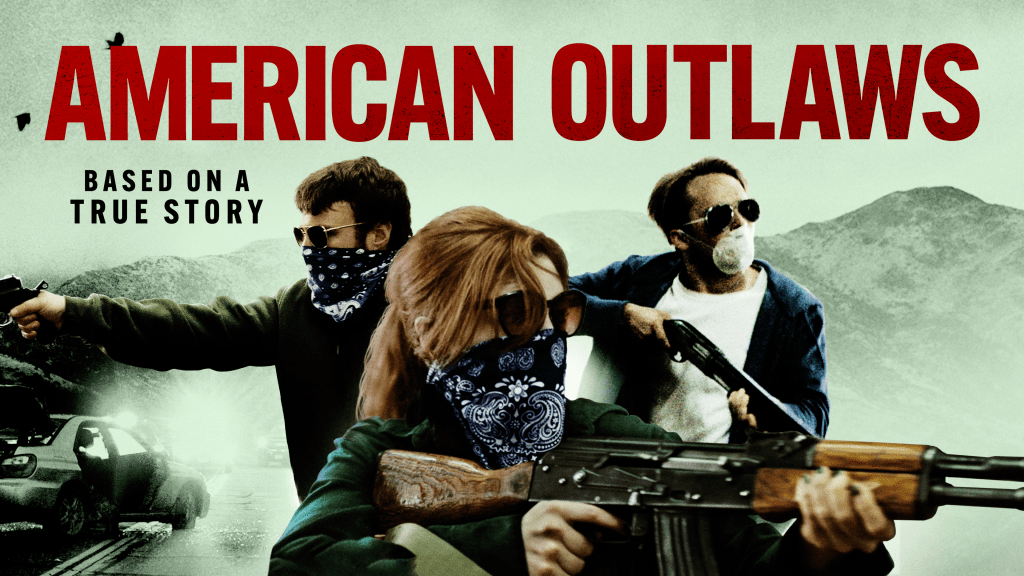
AMERICAN OUTLAWS is a 2023 crime drama inspired by the true story of the Dougherty siblings, Dylan (Emory Cohen), Lee-Grace (India Eisley), and Ryan (Sam Strike). Starting in Florida, the film follows the three siblings, who, facing potential prison time, embark on a desperate cross-country crime spree in 2011. Dylan, the older brother, leads the trio, with Lee-Grace, a former stripper battling drug addiction, and Ryan, a soon-to-be father at risk of returning to prison for a parole violation. Their plan is to flee to Costa Rica for a fresh start, but their journey spirals into chaos after Dylan escalates a routine traffic stop by shooting at police, leading to a series of bank robberies and an eight-day manhunt. The film explores their loyalty and reckless pursuit of freedom, set against a backdrop of poverty, ultimately culminating with their capture, and collective jail sentences of 179 years in prison.

AMERICAN OUTLAWS, written and directed by Sean McEwen, is a mixed bag, but I definitely enjoyed watching it. It’s a low-budget, ambitious B-movie, but it’s also somewhat a victim of its budget. On the positive side, McEwen creates a gritty feel, particularly during the car chases, shootouts and various criminal acts. He also incorporates real news footage that adds authenticity and grounds the story in a specific date and time. The cast, led by India Eisley’s uninhibited portrayal of Lee-Grace, delivers committed performances, with Emory Cohen and Sam Strike capturing the siblings’ desperate bond. On the negative side, the low budget is also quite evident at times. You can’t help but wonder what McEwen could have done with more money to throw at the production. He’s clearly a talented filmmaker, and I’m looking forward to watching his future projects.

I did want to note that AMERICAN OUTLAWS is the final role of actor Treat Williams, who would pass away in a tragic accident on June 12th, 2023. The actor, who would have roles in classic films like Sidney Lumet’s PRINCE OF THE CITY (1981) and Sergio Leone’s ONCE UPON A TIME IN AMERICA (1984), adds gravitas as Agent Jameison R. Donovan, though his screen time is limited. His five decade career doesn’t end on an extremely high note, but it’s still a joy to see him in a solid, authoritative role. 

Ultimately, AMERICAN OUTLAWS is a solid thriller that gets by on a committed cast and a true-crime story, but it isn’t able to fully capitalize on its premise due to budget limitations. It’s worth a watch for fans of gritty crime dramas. Just be sure to keep your expectations in check. 

Film Review: The Pursuit of D.B. Cooper (dir by Roger Spottiswoode and Buzz Kulik)


The story of D.B. Cooper has always fascinated me.

D.B. Cooper is the name assigned to a man who, in 1971, hijacked an airplane, demanded $200,000, and then jumped off the plane after he got the money.  Reportedly, he was well-dressed and unfailingly polite during the entire hijacking.  When he jumped off the plane, he was about 10,000 feet over the Washington wilderness.  After he jumped, no further trace was found of him.  Over 50 years after the incident, the identity and the location of D.B. Cooper remains a mystery.

It’s been said that, even though Cooper had a parachute with him when he jumped, there’s no way that he could have survived the jump.  And yet, no body has ever been found.  (Of course, finding a body in the wilderness is not as easy as some people assume.)  Nine years after the the skyjacking, some of the money that Cooper received was found on the banks of the Columbia River, which was several miles away from the area that Cooper jumped over.  Did Cooper survive the jump and lose the money?  No one can say for sure.

Over the years, many people have come forward to say that they know the identity of D.B. Cooper.  Many distant fathers and secretive boyfriends and long lost friends have been accused of being D.B. Cooper.  Some of those suspects are more likely than others.  Even John List, the murderer who inspired the Stepfather films, was suspected at one point.

D.B. Cooper remains a fascinating character precisely because he’s never been captured and the mystery itself will probably never be solved.  Because he remains an enigma, it’s easy to project your own pet obsessions on him and his story.  Myself, I always imagine D.B. Cooper as being some sort of clever, fun-loving international rogue, even though there’s not really any evidence to back that up.  But, the fact of the matter is that I have a weakness for clever, fun-loving international rogues so, of course, that’s who I’m going to imagine D.B. to be.

I certainly would never imagine him to be like the character at the center of 1981’s The Pursuit of D.B. Cooper.

In this film, D.B. Cooper turns out to be Jim Meade (Treat Williams), a Vietnam vet and all around jackass who steals the money so that he can get back together with his estranged wife, Hannah (Kathryn Harrold).  Hannah does take him back because, seriously, who is going to say no to that much money?  Jim and Hannah spend the entire film running from one wilderness location to another.  They steal cars.  They steal trucks.  Meade steals an airplane at one point.  Hannah gets worried often and Jim tends to yell, “Woo hoo!” whenever he gets excited about anything.  At one point, Jim and Hannah are chased across some white water rapids.  When Hannah and Jim reach dry land, Jim gives the finger to the river.  I will say that, as someone who grew up in the South, Jim is a type of character who seems very familiar to me.  I’ve known a lot of Jim Meades and Treat Williams doesn’t do bad job playing Meade as being an impulsive, loud-mouthed good old boy.  The only problem is that, at no point, does Jim Meade come across like someone who could have pulled off what D.B. Cooper pulled off.

Jim is being pursued by two old army buddies.  The scruffier of the two is Remson (Paul Gleason), who somehow manages to keep popping up like a cartoon character at the most inopportune of times.  No matter what bad thing happens to Remson, he still shows up good-as-new a few minutes later.  Paul Gleason gives an energetic performance as Remson, a character who has little in common with the uptight authority figures that Gleason later played in The Breakfast Club and Die Hard.

The other person chasing Jim is Bill Gruen (Robert Duvall), who served with Meade in Vietnam but who is now working as an insurance investigator.  Gruen says that he knew Meade had to be D.B. Cooper because only Meade could survive jumping out of a plane over wilderness terrain.  Gruen wants some of the money for himself.  Despite his greed, it’s hard not to like Gruen because he’s played by Robert Duvall.  The best scene in the film is one where Duvall and Williams, exhausted from chasing each other, have a weary but friendly conversation.  It’s the one moment where Williams actually calms down and provides some hint that there’s actually something going on underneath Meade’s manic exterior.  Acting opposite Duvall brings out the best in him.

The Pursuit of D.B. Cooper had a notoriously troubled production and apparently, there was never a completed script during shooting.  Reportedly, bits of the film were directed by Robert Mulligan, John Frankenheimer, and Buzz Kulik before Roger Spottiswoode took over.  It’s a film that was obviously inspired by 70s chase films like Smokey and the Bandit but it also somehow managed to attract actors like Robert Duvall, who does his best to class up the joint.  The action quickly gets repetitive and the movie never seems to know if it wants to be a comedy or a drama.  On the plus side, Treat Williams and Kathryn Harrold make for a cute couple.

When this picture first came out, Universal Pictures offered a million dollar reward for any information that would lead to the capture and arrest of the real D.B. Cooper.  No one collected.

Monday Live Tweet Alert: Join Us For Deep Rising and Lone Wolf McQuade!


As some of our regular readers undoubtedly know, I am involved in hosting a few weekly live tweets on twitter and occasion ally Mastodon.  I host #FridayNightFlix every Friday, I co-host #ScarySocial on Saturday, and I am one of the five hosts of Mastodon’s #MondayActionMovie!  Every week, we get together.  We watch a movie.  We snark our way through it.

Tonight, for #MondayActionMovie, the film will be 1998’s Deep Rising!  We’ll be paying tribute to the great Treat Williams.

Following #MondayActionMovie, I will be guest-hosting the #MondayMuggers live tweet!  We will be watching 1983’s Lone Wolf McQuade, starring Chuck Norris and David Carradine!  The film is on Prime and Tubi!

It should make for a night of fun viewing and I invite all of you to join in.  If you want to join the live tweets, just hop onto Mastodon, pull up Deep Rising on YouTube, start the movie at 8 pm et, and use the #MondayActionMovie hashtag!  Then, at 10 pm et, switch over to Twitter and Prime, start Lone Wolf McQuade, and use the #MondayMuggers hashtag!  The live tweet community is a friendly group and welcoming of newcomers so don’t be shy.   

Enjoy!

Film Review: Deadly Hero (dir by Ivan Nagy)


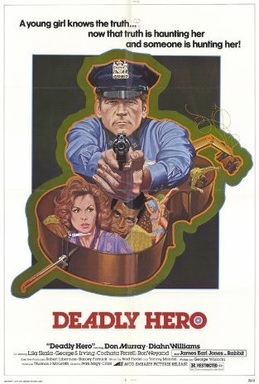
First released in 1975, Deadly Hero tells the story of Edward Lacy (Don Murray).

Lacy is an 18-year veteran of the New York Police Department and a proud family man.  Lacy is clean-cut, handsome in a blandly pleasant way, and he has a wife and several children.  He’s a member of the Knights of Columbus and there are times when he imagines himself pursuing a career in politics.  One of the first things that we see Lacy do is introduce an anti-crime mayoral candidate named Reilly (George S. Irving) at a Knights of Columbus rally.  Lacy goes out of his way to make sure that he and his family make a good impression but Reilly barely seems to notice him.

Lacy is also a racist who enjoys pulling and using his gun.  He was once a detective but a long string of brutality complaints has led to him being demoted back down to being a patrolman.  He and his partner (Treat Williams, making his film debut) spend their time patrolling the streets of New York City, getting dirty looks and verbal abuse from the people who they are supposed to be protecting.  Much like Travis Bickle in the following year’s Taxi Driver, Lacy obsesses on the crime and the decay that he sees all around him.

Sally (Diahn Williams) lives a life that is a hundred times different from Lacy’s.  She’s a cellist and a conductor.  She spends her days teaching and her nights conducting at an avant-garde theater.  Sally and Lacy have little in common but their lives become intertwined when Sally is attacked and briefly held hostage by a mentally disturbed mugger named Rabbit (James Earl Jones).  Responding to a call put in by Sally’s neighbor (Lila Skala), Lacy discovers Rabbit holding a knife to Sally’s throat in the hallway of Sally’s apartment building.  At first, Lacy handles the situation calmly and he manages to talk Rabbit into not only releasing Sally but also dropping his knife.  However, instead of arresting the now unarmed and docile Rabbit, Lacy shoots and kills him.

Knowing that he’s about to be investigated and that he’s made enemies in the department due to his political activities, Lacy convinces the still-shocked Sally to lie and say that she witnessed Rabbit lunging for Lacy’s gun before Lacy fired.  Lacy is proclaimed a hero and soon, Reilly is inviting him to appear at rallies with him.  Lacy’s political dreams seem to be coming true but Sally starts to feel guilty about lying.  Realizing that Sally is planning on revealing the truth about what happened, Lacy goes to extreme measures to try to keep her quiet.

Deadly Hero is an interesting film, one that is certainly flawed but which ultimately works as a portrait of the authoritarian mindset.  Ivan Nagy directs without much visual flair and, especially at the start of the film, he struggles to maintain a consistent pace.  For instance, the scene where Rabbit initially menaces Sally seems to go on forever, long beyond whatever was necessary to convince the audience that Rabbit was a dangerous guy.  (With the amount of time that Nagy lingers over shots of Sally being menaced by Rabbit, I was not surprised to read that Nagy and Dianh Williams apparently did not get along during filming.)  That said, the film’s low budget actually works to its advantage, with the grainy cinematography giving the film a gritty, documentary feel.  The film was shot on location in New York City and it’s interesting to watch the actors interact with real New Yorkers.  While Lacy is never a sympathetic character, seeing the actual streets of New York does go a long way to explaining why he’s so paranoid.  This is one of the many 70s films in which the overriding message seemed to be that New York City was the worst place on the planet.

The film is dominated by Don Murray, who plays Lacy as being a blue-collar fascist who has learned how to hide his anger and his hatred behind a quick smile and an outwardly friendly manner.  Feeling confident that everyone will back him up, he has no hesitation about executing an unarmed black man.  Even when it becomes obvious that Sally is not going to continue to lie about what happened, Lacy is still arrogant enough to assume that he can charm her into changing her mind.  When that doesn’t work, Lacy becomes increasingly unhinged and vindictive.  The film’s final ambiguous image suggests that there really is no way to escape the Edward Lacys of the world.

With its portrayal of a violent cop who is convinced that he will be protected by the system, Deadly Hero feels extremely relevant today.  Of course, Deadly Hero also suggests that the same system that Lacy is exploiting can be used to take him down, with Lacy eventually being investigated by both Internal Affairs and the District Attorney’s office.  The film leaves it ambiguous as to whether or not the rest of the police are as dangerous as Lacy.  Is Lacy a product of the system or is he just someone who has figured out how to exploit the system?  To its detriment, that’s a question that the film doesn’t answer.  Still, much like Harvey Hart’s similarly underappreciated Shoot, Deadly Hero is an always-interesting and occasionally insightful look at the authoritarian mindset.

The Late Shift (1996, directed by Betty Thomas)


Want to relive the public battle over whether David Letterman or Jay Leno would be Johnny Carson’s successor?

Then The Late Shift is the film for you!

Though it pales when compared to the subsequent battle between Leno and Conan O’Brien, the competition between Letterman and Leno to succeed Johnny Carson as host of The Tonight Show riveted America in the early 90s.  Most media critics (and, reportedly, Carson himself) felt that Letterman had not only earned the right to host The Tonight Show but that he represented the future of late night comedy.  The NBC network execs, however, preferred Leno, who had served for years as Carson’s permanent guest host and who was viewed as being more of a team player than Letterman.  The end result, of course, was that Leno got The Tonight Show, Letterman switched networks, and for years the country was separated into Leno people and Letterman people.  (Letterman got the critical acclaim but Leno got the ratings.)

The Late Shift opens with the unexpected retirement of Johnny Carson (played, as an enigma, by Rich Little) and then follows Letterman (John Michael Higgins) and Leno (Daniel Roebuck) as they maneuver their way to become his successor.  Unfortunately, neither Higgins nor Roebuck are particularly believable in their roles, though Roebuck does get to wear a truly impressive fake chin.  Far more impressive are Kathy Bates as Leno’s manager and Treat Williams as Mike Ovitz.  Bates rips through her scenes, destroying anyone standing in the way of Jay Leno while Williams is cool, calm, and menacing as the agent who was, at the time the film was made, the most powerful man in Hollywood.

The main problem with The Late Shift is that, when it went into production, Letterman was ahead in the ratings and the film is clearly sympathetic to him.  Leno comes across as a weasel while Letterman is portrayed as being neurotic but brilliant.  But, shortly before the film made its debut on HBO, Leno landed the first interview with Hugh Grant after the latter’s arrest with a prostitute.  Leno not only won that night in the ratings but he won every subsequent night and soon, Letterman was the one who was forever stuck in second place.  A title card was added to the end of  The Late Shift, admitting that Leno was now winning the war for the late night.  Since every minute of the film was designed to make Letterman appear to the winner, it’s hard not to be let down by the ending.

Despite the disappointing ending, The Late Shift is an entertaining look at network politics.  (Seinfeld fans will note that, after playing a version of Warren Littlefield during the show’s 4th season, Bob Balaban was cast as the real thing in The Late Shift.)  After watching the movie, be sure to read the Bill Carter book on which it’s based.

Parallel Lives (1994, directed by Linda Yellen)


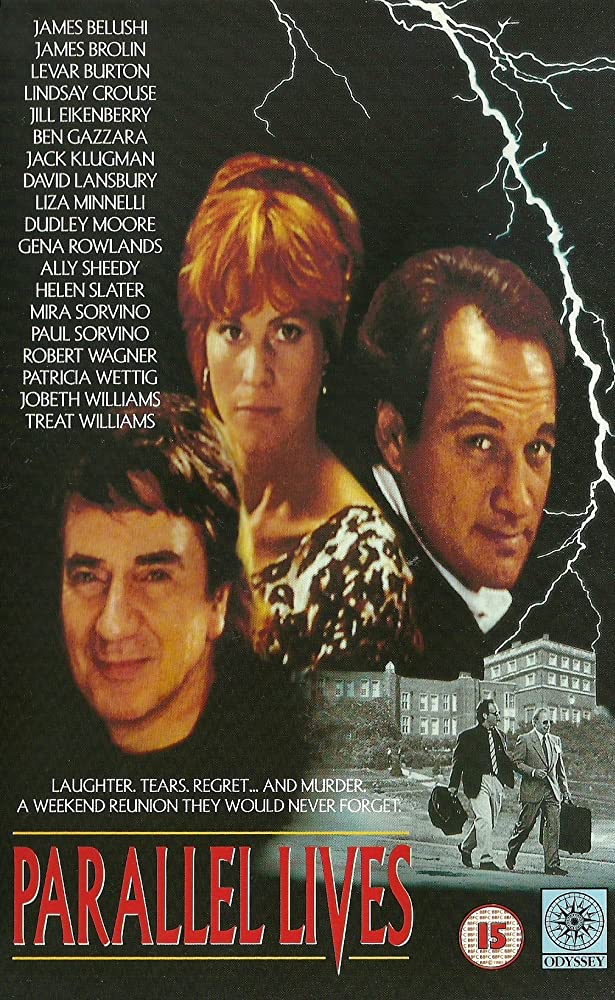
A large group of people gather together one weekend for a fraternity/sorority reunion.  Since college, some of them have become rich and powerful.  Some of them are now famous.  Some of them are now seedy and disreputable.  They all have college memories, though there’s such a wide variety of age groups represented that it’s hard to believe that any of them actually went to college together.  After the men spend the day playing practical jokes and touch football and the women spend the night talking about their hopes and dreams, they wake up the next morning to discover the someone has murdered Treat Williams.  A pony-tailed sheriff (Robert Wagner) shows up to question everyone.

Parallel Lives was made for Showtime with the help of the Sundance Institute.  Today, it’s a forgotten film but, for some reason, it was very popular with American Airlines during the summer of 1997.  That summer, when I flew to the UK, Parallel Lives was one of the movies that we were shown.  (It was the second feature.  The first feature was Down Periscope, a submarine comedy starring Kelsey Grammar.  Fourteen year-old me enjoyed Down Periscope but, in retrospect, it wasn’t much of a flight.)  A month and a half later, when I flew back to the U.S., Parallel Lives was again one of the films shown on the flight!  For that reason, I may be the only person on the planet who has not forgotten that a film called Parallel Lives exists.

Parallel Lives, I later learned, was an entirely improvised film.  The huge cast were all given their characters and a brief outline of the film’s story and they were then allowed to come up with their own dialogue.  Unfortunately, no one did a very good job of it and the men were reduced to bro-ing it up while the women spent most of the movie having extended group therapy.  The story doesn’t add up too much and, even when I rewatched it from an adult’s perspective, I wasn’t sure what I was supposed to get out of everyone talking about how different the real world was from college.  Technically, the film’s a murder mystery but you can’t improvise a successful murder mystery.  This film proves that point.

Of course, it doesn’t help that there are 26 characters, all trying to get a word in at the same time.  Some of the roles don’t make much sense.  Dudley Moore shows up, playing an imaginary friend.  (How do you improvise being a figment of someone’s imagination?)  James Brolin introduces himself to everyone as being, “Professor Doctor Spencer Jones” and that appears to be as far as he got with his improv.  Ben Gazzara is a gambler and Mira Sorvino is the prostitute that he brings to the reunion while Mira’s father, Paul Sorvino, moons the camera several times.  Jack Klugman is a senator with Alzheimer’s and Patricia Wettig is his daughter.  The majority of the movie centers around Jim Belushi, playing a reporter and falling in love with JoBeth Williams.  Liza Minnelli, Helen Slater, Levar Burton, Lindsay Crouse, Matthew Perry, Ally Sheedy, and Gena Rowlands all have small roles.  How did so many talented people come together to make such a forgettable movie and why did American Airlines decide it was the movie to show people on their way to another country?  That’s the true mystery of Parallel Lives.

Insomnia File #32: Smooth Talk (dir by Joyce Chopra)


What’s an Insomnia File? You know how some times you just can’t get any sleep and, at about three in the morning, you’ll find yourself watching whatever you can find on cable? This feature is all about those insomnia-inspired discoveries!

If you were having trouble getting to sleep around one in the morning last night, you could have turned over to This TV and watched Smooth Talk, a disturbingly creepy coming-of-age film from 1985.

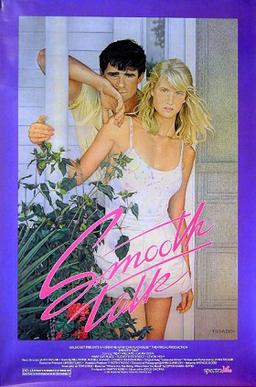
Connie Wyatt (played by Laura Dern in one of her first film roles) is fifteen years old and ready to discover the word.  It’s the summer and, for Connie and her friends, that means going to the mall, trying to capture the attention of the cute boys who go to their school, and lying to her parents about where she goes at night.  (She tells them that she and her friends have been going to the same movie, night-after-night.)  She likes it when the boys in the mall smile at her but not when the stranger honk their car horn at her whenever she walking at night.  Connie thinks of herself as being an independent adult, even though she’s not sure what that means.

Connie does know that she doesn’t want to be like her mother (Mary Kay Place).  Her mother, who claims that she was once a great beauty herself, complains that all Connie does is indulge in “trashy daydreams.”  Her mother tells Connie to be careful about who she flirts with and constantly demands that Connie stay home and help to paint the house.

Connie also doesn’t want to be like her older sister, June (Elizabeth Berridge).  June is obviously her mother’s favorite.  June never sneaks out.  June never rebels.  Whenever Connie and her mother argue, June always take their mother’s side.

In fact, the only member of her family that Connie’s close with is her father (Levon Helm).  Her father is always cheerful and always in a good mood.  Somehow, the constant tension in the house never seems to get to him and he never seems to be worried about anything.  He’s nice but he’s hardly an authority figure.

And then there’s an older man (Treat Wiliams).  When we first see him, he’s sitting outside of a diner and casually watching all of the teenage girls as they walk by.  (We all know the type.)  When he sees Connie and her friends, he looks over at Connie and tells her, “I’m watching you.”  Later, when Connie is alone at her house, the man pulls up in front of her house and starts to talk to her.

His name, he explains, is Arnold Friend.  “A. Friend,” he puts it.  That’s what he wants to be to her.  When she asks how old he is, he says that he’s 18, though he’s clearly closer to 30.  He’s handsome and he’s charming but there’s something off about him.  He shows Connie his car.  “Arnold Friend” is written on the side.  “33, 19, 17,” is written on the back.  Written next to a dent: “A woman driver did this.” Sitting in the car is a friend of Arnold’s, a man who hides his face behind a portable radio.

“He’s strange,” Arnold explains with a sly smile, before suggesting that Connie get in the car with them…

Smooth Talk is based on a short story by Joyce Carol Oates and, oh my God, is it ever creepy!  The first half of the movie plays out like a typical coming-of-age teen film but then Arnold shows up in that car and the film turns into a nightmare.  I spent almost the entire movie cringing, mostly because I once was Connie Wyatt, the only real difference being that I was even younger when I decided that I understood how the world worked better than my parents and I started rebelling.  As I watched the movie, I found myself wondering what I would have done if Arnold Friend had pulled up in front of my house.  Would I have gotten in the car or what I would have run back into the house, locked the door, and called the police?  I’d like to think I would have done the smart thing but … no.  Doing the smart thing would have meant admitting that the adults were right and there were situations that I couldn’t control or even really understand.

Laura Dern was 18 years old when she played 15 year-old Connie and she gave an amazing and naturalistic performance.  When Treat Williams first appeared as Arnold, I thought that he was overacting but, as the film progressed, I came to see that he was actually perfectly cast and giving exactly the type of performance that the movie’s story needed.  Arnold Friend, who speaks in outdated slang and always seems to be trying just a little bit too hard, has to be a slightly ridiculous figure because otherwise, no one would drop their guard enough to get into his car.  As I watched the movie, I realized that it was a mistake to think of Arnold as being a human being.  Instead, he’s a nightmare come to life.

Smooth Talk was a deeply unsettling film about growing up in an increasingly dangerous world.  It’s right up there with Out of The Blue, Christiane F, and Blue Velvet among nightmarish coming-of-age stories.

Previous Insomnia Files:

  1. Story of Mankind
  2. Stag
  3. Love Is A Gun
  4. Nina Takes A Lover
  5. Black Ice
  6. Frogs For Snakes
  7. Fair Game
  8. From The Hip
  9. Born Killers
  10. Eye For An Eye
  11. Summer Catch
  12. Beyond the Law
  13. Spring Broke
  14. Promise
  15. George Wallace
  16. Kill The Messenger
  17. The Suburbans
  18. Only The Strong
  19. Great Expectations
  20. Casual Sex?
  21. Truth
  22. Insomina
  23. Death Do Us Part
  24. A Star is Born
  25. The Winning Season
  26. Rabbit Run
  27. Remember My Name
  28. The Arrangement
  29. Day of the Animals
  30. Still of The Night
  31. Arsenal

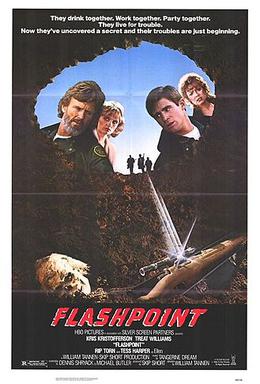
A Movie A Day #317: Flashpoint (1984, directed by William Tannen)


November 22, 1963.  While the rest of the world deals with the aftermath of the assassination of John F. Kennedy in Dallas, a man named Michael Curtis drives a jeep across the South Texas desert, heading for the border.  In the jeep, he has a $800,000 and a high-powered rifle.  When the jeep crashes, the man, the rifle, and the money are left undiscovered in the desert for 21 years.

1984.  Two border patrol agents, Logan (Kris Kristofferson) and Wyatt (Treat Williams), are complaining about their job and hoping for a better life.  It looks like they might get that opportunity when they come across both the jeep and the money.  A bitter Vietnam vet, Logan wants to take the money and run but Wyatt is more cautious.  Shortly after Wyatt runs a check on the jeep’s license plate, a FBI agent (Kurtwood Smith) shows up at the station and both Logan and Wyatt discover their lives are in danger.

Though it was made seven years before Oliver Stone’s JFK, Flashpoint makes the same argument, that Kennedy was killed as the result of a massive government conspiracy and that the conspirators are still in power and doing whatever they have to do keep the truth from being discovered.  The difference is that Flashpoint doesn’t try to convince anyone.  If you’re watching because you’re hoping to see a serious examination of the Kennedy conspiracy theories, Flashpoint is not for you.  Instead, Flashpoint is a simple but effective action film, a modern western that uses the assassination as a MacGuffin.  Though Kris Kristofferson has never been the most expressive of actors, he was well-cast as the archetypical gunslinger with a past.  Rip Torn also gives a good performance as a morally ambiguous sheriff and fans of great character acting will want to keep an eye out for both Kevin Conway and Miguel Ferrer in small roles.

A Movie A Day #30: Prince of the City (1981, directed by Sidney Lumet)


220px-prince_of_the_city_foldedIn 1970s New York City, Danny Ciello (Treat Williams) is a self-described “prince of the city.”  A narcotics detective, Ciello is the youngest member of the Special Investigations Unit.  Because of their constant success, the SIU is given wide latitude by their superiors at the police department.  The SIU puts mobsters and drug dealers behind bars.  They get results.  If they sometimes cut corners or skim a little money for themselves, who cares?

It turns out that a lot of people care.  When a federal prosecutor, Rick Cappalino (Norman Parker), first approaches Ciello and asks him if he knows anything about police corruption, Ciello refuses to speak to him.  As Ciello puts it, “I sleep with my wife but I live with my partners.”  But Ciello already has doubts.  His drug addict brother calls him out on his hypocrisy. Ciello spends one harrowing night with one of his informants, a pathetic addict who Ciello keeps supplied with heroin in return for information.  Ciello finally agrees to help the investigation but with one condition: he will not testify against anyone in the SIU.  Before accepting Ciello’s help, Cappalino asks him one question.  Has Ciello ever done anything illegal while a cop?  Ciello says that he has only broken the law three times and each time, it was a minor infraction.

For the next two years, Ciello wears a wire nearly every day and helps to build cases against other cops, some of which are more corrupt than others.  It turns out that being an informant is not as easy as it looks.  Along with getting burned by malfunctioning wires and having to deal with incompetent backup, Ciello struggles with his own guilt.  When Cappalino is assigned to another case, Ciello finds himself working with two prosecutors (Bob Balaban and James Tolkan) who are less sympathetic to him and his desire to protect the SIU.  When evidence comes to light that Ciello may have lied about the extent of his own corruption, Ciello may become the investigation’s newest target.

prince-of-the-city

Prince of the City is one of the best of Sidney Lumet’s many films but it is not as well-known as 12 Angry Men, Dog Day Afternoon, Network, Serpico, The Verdict, or even The Wiz.  Why is it such an underrated film?  As good as it is, Prince of the City is not always an easy movie to watch.  It’s nearly three hours long and almost every minute is spent with Danny Ciello, who is not always likable and often seems to be on the verge of having a nervous breakdown.  Treat Williams gives an intense and powerful performance but he is such a raw nerve that sometimes it is a relief when Lumet cuts away to Jerry Orbach (as one of Ciello’s partners) telling off a district attorney or to a meeting where a group of prosecutors debate where a group of prosecutors debate whether or not to charge Ciello with perjury.

Prince of the City may be about the police but there’s very little of the typical cop movie clichés.  The most exciting scenes in the movie are the ones, like that scene with all the prosecutors arguing, where the characters debate what “corruption” actually means.  Throughout Prince of the City, Lumet contrasts the moral ambiguity of otherwise effective cops with the self-righteous certitude of the federal prosecutors.  Unlike Lumet’s other films about police corruption (Serpico, Q&A), Prince of the City doesn’t come down firmly on either side.

(Though the names have been changed, Prince of the City was based on a true story.  Ciello’s biggest ally among the investigators, Rick Cappalino, was based on a young federal prosecutor named Rudy Giuliani.)

Prince of the City is dominated by Treat Williams but the entire cast is full of great New York character actors.  It would not surprise me if Jerry Orbach’s performance here was in the back of someone’s mind when he was cast as Law & Order‘s Lenny Briscoe.  Keep an eye out for familiar actors like Lance Henriksen, Lane Smith, Lee Richardson, Carmine Caridi, and Cynthia Nixon, all appearing in small roles.

Prince of the City is a very long movie but it needs to be.  Much as David Simon would later do with The Wire, Lumet uses this police story as a way to present a sprawling portrait of New York City.  In fact, if Prince of the City were made today, it probably would be a David Simon-penned miniseries for HBO.

image-w1280

Hallmark Review: Chasing A Dream (2009, dir. David Burton Morris)


IMG_1468

You know, as much as I hated Freshman Father, I really like it when Hallmark actually tries to do something different. That’s the case with Chasing A Dream. This is going to be a short one because there is very little to this movie.

IMG_1482

That’s our main character Cam Stiles (Andrew Lawrence). He is a high school football star. He and a runner friend of his are at a party. Cam wants to stay, the friend wants to go, and go he does. Of course something happens to him on the way home and he gets killed by a car.

IMG_1506

Cam takes it hard and his father played by Treat Williams isn’t exactly understanding. His father coaches the football team on which his son plays. It’s not that his friend was some nobody that hasn’t been properly memorialized or anything. It’s just that Cam is having trouble getting over it. That is, until he stumbles upon a little booklet his friend had. In it his friend was keeping track of mile times. His friend was trying to do a 4 minute mile.

IMG_1518

And that’s the rest of the movie. Cam decides that he certainly isn’t slow being an athlete and all. So he decides that for him, getting over the loss of his friend would be finishing what his friend started. That is it. Seriously, up to and including the last line of the movie, it is about Cam doing a four minute mile, then he’ll be okay.

Along the way he has to convince the track/cross country coach to let him in. He has to fight his father a bit because football was his way to college. And finally he has to actually do it, which includes his own Apollo Creed. HINT! HINT! HINT!

IMG_1580

I liked this one. It does have a couple of problems that are worth mentioning though. It’s one of those Hallmark movies where it feels like the script was longer, then certain scenes were cut out. A couple of times there’s a bit of a jump where it feels like there should have been something in between to smooth it out. Also, the dead friend appears as a ghost of sorts in a couple of scenes. It’s just an idealized version of his friend that Cam is seeing encouraging him on, but I think given that they followed through with the right ending, then they should have left those parts out.

Otherwise, I recommend this one.