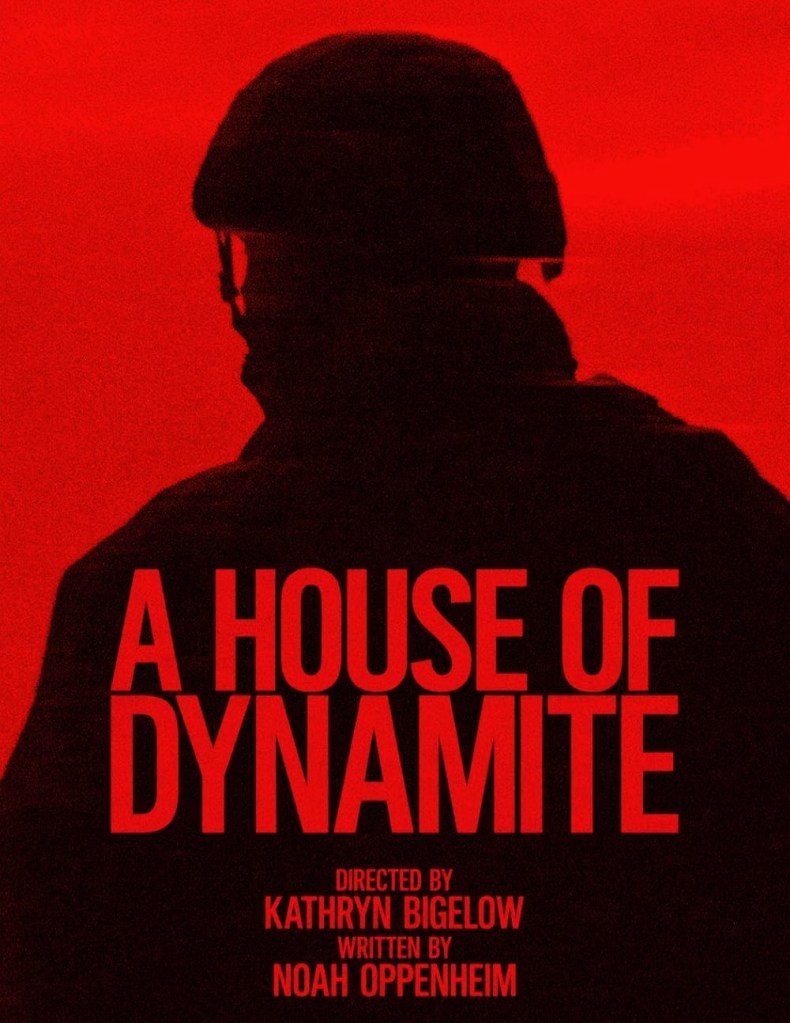
Horror Review: A House of Dynamite (dir. by Kathryn Bigelow)


“So it’s a fucking coin toss? That’s what 50 billion dollars buys us?” — Secretary of Defense Reid Baker

The end of the Cold War was supposed to close a chapter of fear. With the superpowers stepping back from the brink, the world briefly believed it had entered an era of stability. Yet that promise never held. The weapons remained, the rivalries adapted, and the global machinery of deterrence continued to hum beneath the surface. Kathryn Bigelow’s A House of Dynamite faces this reality head-on, transforming the mechanics of modern nuclear defense into something unnervingly human. On the surface, it plays as a high-tension political technothriller, but beneath that precision lies a deeply existential horror film—one built not on shadows or monsters, but on daylight, competence, and the narrow margins of human fallibility.

The premise is piercingly simple. An unidentified missile is detected over the Pacific. Analysts assume it’s a test or a glitch—another false alarm in a world overflowing with them. But within minutes, as conflicting data streams converge, what seemed routine begins to look real. The film unfolds in real time over twenty excruciating minutes, charting the reactions of those charged with interpreting and responding to the potential catastrophe. Bigelow divides the film into three interwoven perspectives: the White House Situation Room, the missile intercept base at Fort Greely, and the President’s mobile command aboard Marine One. The structure allows tension to grow from every direction at once, each perspective magnifying the other until the screen feels ready to collapse under its own pressure.

Capt. Olivia Walker (Rebecca Ferguson), commanding officer of the Situation Room, anchors the story with calm professionalism that gradually frays into disbelief. Ferguson’s performance is clear-eyed and tightly modulated—precise, disciplined, and quietly devastating. She stands as the rational center inside chaos, her composure the last gesture of control in a world that no longer follows reason.

Over her is Adm. Mark Miller (Jason Clarke), Director of the Situation Room, who represents the institutional embodiment of confidence. Clarke plays him with methodical restraint, a man who trusts procedure long after it stops earning trust. Miller’s authority is both comforting and horrifying: a portrait of leadership built on ritual rather than certainty.

At Fort Greely, Anthony Ramos brings an intimate immediacy as the officer charged with the missile intercept. His scenes hum with kinetic dread—the physical execution of decisions made thousands of miles away. Through him, the film captures the most primal kind of fear: acting when hesitation could mean extinction, knowing that success and failure are separated only by chance.

The President, portrayed by Idris Elba, spends much of the crisis in motion—first within the cocoon of the presidential limousine, and later, aboard Marine One as it carves through blinding daylight. Elba gives a performance of subtle, steady erosion. At first, he embodies unshakeable calm, a figure of poise and authority; but as the situation deepens, his steadiness wanes. Words become shorter, pauses longer. Every decision carries consequences too vast for resolution. It is a measured, understated portrait of power giving way to human uncertainty.

Bigelow’s direction is stripped of ornament and focused on precision. Barry Ackroyd’s cinematography heightens the claustrophobia of command centers—the sterile light, the reflective glass, the sense that every surface observes its occupants—while his exterior scenes pierce with harsh brightness, suggesting that no sanctuary exists under full exposure. Kirk Baxter’s editing maintains an unrelenting pulse, cutting with mathematical precision while preserving the eerie stillness of the moments where no one dares to speak.

​A House of Dynamite also shows how even with the most competent experts—military, intelligence, and political—working to manage an escalating crisis, there is no path to victory. The professionals at every level stop seeking to prevent the worst and instead focus on saving what they can when the worst becomes inevitable. The film’s scariest revelation is not the potential for destruction, but the paralysis that intelligence creates. If the brightest, most disciplined people in the world cannot find an answer, what happens when power falls into the hands of those less prepared or less rational? In its quiet way, the film poses that question that we see more and more each day on the news and on social media and we are left with silence and realization of the horror of it all.

Despite its precision, the film isn’t without flaws. Bigelow’s triptych structure—cutting between the three perspectives—works brilliantly to escalate tension, yet the repetition of similar beats slightly blunts the impact. Each segment revisits the same crisis rhythms—a data discrepancy, an argument over authority, another uncertain update—sometimes slowing the natural momentum. While the repetition underlines the futility of bureaucratic systems in chaos, the transitions don’t flow as fluidly as the rest of the film’s airtight craftsmanship. The result is a film that is gripping overall, occasionally uneven in rhythm, but never less than absorbing.

When the final minutes arrive, Bigelow declines to deliver resolution. No mushroom clouds, no catharsis. The President sits in Marine One, head down with the weight of the world on his shoulders as he contemplates his options in the Black Book (options in how to retaliate) and knowing that he has no good choices in front of him. The world remains suspended between survival and oblivion, and the silence that follows feels heavier than sound. The ending resists closure because endings, in the nuclear age, are an illusion—the fear continues no matter what happens next.

In a year crowded with strong horror releases—SinnersWeapons, The Long Walk and Frankenstein among them—A House of Dynamite stands apart. Dressed in the crisp realism of a technothriller, it’s a horror film defined by procedure, light, and silence. Bigelow builds terror from competence, from the steady voices and confident gestures of people trying to manage the unmanageable. This is not the chaos of fiction but the dread of reality, a reminder that the systems meant to preserve and protect might one day fail to deliver on its promise. For all its precision and restraint, A House of Dynamite shakes in the memory long after it ends—the year’s most quietly terrifying film.

Nuclear Close Calls: The situation and question brought up in the film has basis in history as there has been many instances of close calls and false alarms. The film itself doesn’t confirm that the missile detonated, but the implications in past confirmed events just shows how close the world has been to a completed catastrophe.
Catching Up With The Films of 2024: Saturday Night (dir by Jason Reitman)


Saturday Night, which presents what I assume to be a highly fictionalized account of the 90 minutes before the 1975 premiere of Saturday Night Live, did the impossible.  It made me feel sorry for Chevy Chase.

Don’t get me wrong.  As played by Cory Michael Smith, Chevy Chase is not presented as being a sympathetic character in Saturday Night.  The film acknowledges his talent as a comedian and that he was the first star to come out of Saturday Night Live.  But he’s still presented as being arrogant, self-centered, rude, and often deliberately self-destructive.  The film portrays Chevy Chase in much the same way that most people describe him in real life.  Chevy Chase has apparently always been a difficult person to work with and, I suppose to his credit, it doesn’t appear that Chevy himself has ever claimed anything different.  But Saturday Night so piles on Chevy that even I felt it went a bit overboard.  It’s one thing to present Chevy as being the arrogant jerk that he’s admitted to being.  It’s another thing to fill the movie with moments in which people stop what they’re doing to tell Chevy that his career is going to start strong and then fade due to his bad behavior.  At one point, the NBC executive played by Willem DaFoe comments that Chevy could host his own late night talk show.  We’re all meant to laugh because eventually, Chevy Chase did host a late night talk show and it was such a disaster that it’s still, decades after its cancellation, held up as a prime example of a bad career move.  But, in the context of the film, it feels a bit like overkill.  It’s one thing to be honest about someone being a pain in the ass.  It’s another thing to repeatedly kick someone while they’re down.  Chevy, much like the NBC censor who is chanted down in the film’s cringiest moment, simply feels like too easy of a target.

Of course, Saturday Night is full of moments that are meant to comment more on the future than on whatever was going on in 1975.  The whole point of the film is that Saturday Night Live, a show that the network has little faith in and which is being produced by a hyperactive visionary (Gabriel LaBelle as Lorne Michaels) who seems to be making it up as he goes along, is eventually going to become a cultural phenomenon.  Every time someone tries to convince Lorne Michaels to cancel the premiere or to miss with the format, we’re meant to think to ourselves, “Little do they know that this show is going to be huge for several decades before eventually just becoming another predictable part of the media landscape.” The scenes of Garrett Morris (Lamorne Morris) wandering around the set and asking, “What is my purpose?  Why am I here?” may not feel like something that would have happened in 1975 but they’re there because it’s something that people were asking about in 2024.  Watching the film, it helps if you know something about the history of Saturday Night Live.  It helps to know that Dan Aykryod (Dylan O’Brien), John Belushi (Matt Wood), and Gilda Radner (Ella Hunt) are going to carry the show after Chevy Chase leaves.  It helps to know that Billy Crystal (Nicholas Podany) is going to become a Hollywood mainstay even after he gets dumped from the premiere for refusing to cut any material out of his act.  It helps to know that the mellow, pot-smoking band leader is actually Paul Shaffer (Paul Rust).  It helps to know that Lorne Michael and Dick Ebersol (Cooper Hoffman, giving one of the best performances in the film) are going to become powerful names in American television.  The film may be set in 1975 but it’s actually about all the years to come.

It’s still an entertaining and well-made film, one that I enjoyed watching.  Saturday Night manages to create the illusion of playing out in real time and director Jason Reitman captures the excitement of being backstage before opening night.  It’s an excitement that everyone can relate to, whether their opening night was on television, Broadway, or just a community theater in their small college town.  The backstage chaos of Saturday Night is wonderfully choreographed and, most importantly, it captures the feeling of being young, idealistic, and convinced that you can change the world.  Reitman also gets good performances from his cast, with Cooper Hoffman, Dylan O’Brien, and Rachel Sennott (playing writer Rosie Shuster) as stand-outs.  That said, the film is pretty much stolen by J.K. Simmons, who has a memorably lecherous cameo as Milton Berle and who provides Chevy Chase with a look at what waits for him in the future.  If the film is never quite as poignant as it wants to be, that’s because Saturday Night Live is no longer the cultural powerhouse that it once was.  If Saturday Night had been released just 18 years ago, before SNL became best-known as the place where Alec Baldwin hides out from bad publicity, it would probably be an Oscar front runner right now.  Released today, it’s just makes one feel a little bit sad.  The show that was built on never selling out eventually sold out.

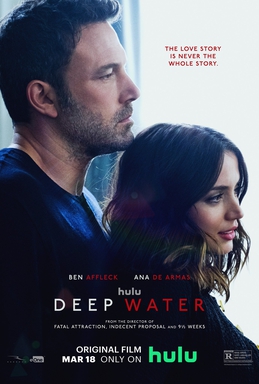
Film Review: Deep Water (dir by Adrian Lyne)


Just released on Hulu, Deep Water is the funniest film of the year so far.

Ben Affleck stars as Vic Van Allen.  (Even his name is funny!)  Vic made a fortune by inventing a computer chip that is used to help drones track people down and blow them up.  Now, Vic is retired, living in a nice and small town, and publishing a photography/poetry magazine.  He enjoys going to parties with his friends, joking about committing murder, and riding the heck out of his bike.  Seriously, the shots of Affleck riding that bike are comparable to Will Ferrell playing the flute in Anchorman.

Ana de Armas plays Vic’s wife, Melinda.  Everyone, including Vic, knows that Melinda cheats on Vic with almost every man that she meets.  Vic accepts Melina’s infidelities on the condition that she not leave him and their daughter, Trixie (Grace Jenkins).  Of course, Vic does still get upset.  When Melinda’s former lover vanishes, Vic jokes to Melinda’s current lover that he killed the previous lover.  Everyone in town gets a good laugh out of that one.  Everyone, that is, but for Melinda and local busybody Don Wilson (Tracy Letts).

Both Melinda and Don think that Vic is capable of murder.  As far as Don is concerned, Vic is responsible for the death of every single person who has ever been blown by a drone.  Meanwhile, Melinda knows that there’s something strange about the way that Vic spends all of his time taking care of the hundreds of snails that he keeps in the basement.  Vic, of course, insists that he was just making a joke when he said that he was a murderer.  But then Vic actually does murder someone and things get complicated….

From what I understand, Deep Water is supposed to be a serious thriller but I absolutely refuse to believe that it’s not actually meant to be a parody of the genre.  It’s director Adrian Lyne’s first film in 20 years.  Lyne is best know for directing movies like 9 1/2 Weeks, Fatal Attraction. Indecent Proposal, and Unfaithful and so many of the scenes in Deep Water feel as if they’ve been specifically designed as a way to poke fun at Lyne’s previous films that one can’t help but suspect that at least a few of the film’s laughs are meant to be intentional.  This is a film that features Ben Affleck, on a bicycle, chasing a car while the driver rants about how autocorrect is always ruining his text messages.  I absolutely refuse to accept that this was truly meant to be taken seriously.

That said, Affleck wanders through the film with a glum expression on his face, one that suggests that he wasn’t let in on the joke ahead of time.  Ana de Armas is ultimately defeated by a script that refuses to allow her character to behave with any consistency but she’s still smart enough to play Melinda as being a character who is at least partially aware that she’s in a movie.  As for Tracy Letts, I have never seen any reputable actor overact quite as much as Tracy Letts does towards the end of Deep Water.  It’s a sight to behold.

Adrian Lyne makes sure that the film looks good but he never manages to strike a consistent tone and the film’s plot is full of holes.  Affleck spends a lot of time gazing at snails while Ana de Armas throws a fit when her daughter keeps insisting that Alexa play Old MacDonald.  Tracy Letts, at one point, sees Affleck riding his bicycle and starts cursing like Linda Blair in The ExorcistDeep Water doesn’t really work as a thriller but, as a comedy, it’s a lot of fun.

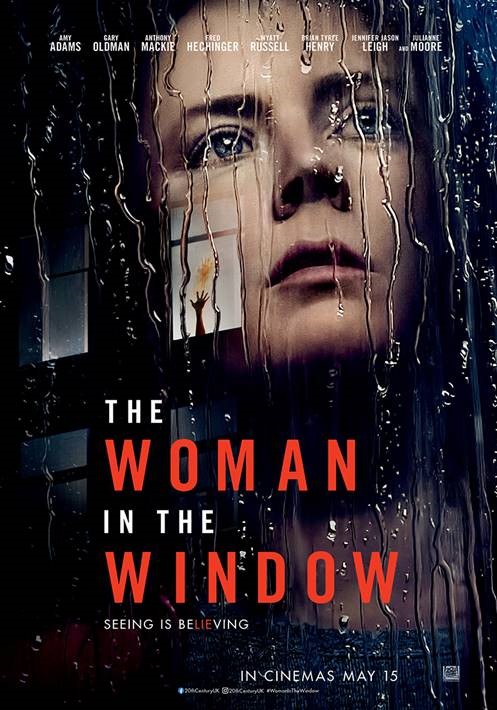
Film Review: The Woman In The Window (dir by Joe Wright)


Joe Wright’s The Woman In The Window is a film that was kicked around a bit before it was eventually released.

Based on the best-selling novel by A.J. Finn, The Woman In The Window was filmed in 2018 and was originally set to be released in October of 2019.  At the time, there were many who predicted that this would be the film for which Amy Adams would finally win an Oscar.  However, after a few poor test screenings, the release of Woman In The Window was pushed back.  The film’s producer, the now-infamous Scott Rudin, reportedly brought in Tony Gilory to re-shoot a few scenes.  The film was finally set to be released in May of 2020 and, needless to say, it was no longer expected to be an Oscar contender.  Then, the pandemic hit and, like so many movies, The Woman In The Window was left in limbo.  With its theatrical release canceled, the film was eventually purchased by Netflix.  Netflix finally released it in May of this year.  With all of the delays and the bad buzz, the critics had plenty of time to sharpen their knives and I don’t think anyone was surprised when the film got scathing reviews.

Though the film was completed long before the lockdowns, The Woman In The Window does feel like a COVID thriller.  Anna Fox (played by Amy Adams) is a child psychologist who is afraid to leave her Manhattan brownstone.  She has agoraphobia, the result of a personal trauma.  She’s not only scared to leave the safety of her apartment but she’s also terrified of anyone else getting inside.  She spends her days spying on the neighbors, drinking wine, and watching old movies.  Of course, that’s also what many people in the real world spent most of the past year doing.  As I watched Anna freak out over some trick or treaters throwing eggs at her door, I was reminded of my neighbor who, a few months ago, nearly had a panic attack because she saw someone walking past her house without a mask.  One could argue that the world itself has become agoraphobic.

Despite her housebound status, Anna does still have a few contacts with the outside world.  For instance, a psychiatrist (played by Tracy Letts, who also wrote the script) comes by every weekend.  She has a tenant named David (Wyatt Russell) who lives in her basement.  She regularly has conversations with her husband and her daughter, who she says are both living in another state.  And eventually, she meets Ethan (Fred Hechinger), the 15 year-old who has just moved in across the street.  When Anna thinks that she’s witnessed Ethan’s father (Gary Oldman) murdering his mother (Julianne Moore), Anna calls the cops.  However, when a totally different woman (Jennifer Jason Leigh) shows up and claims to be Ethan’s mother, Anna is forced to try to solve the mystery herself.

The Woman In The Window is a disjointed and rather messy film but I’d be lying if I said that I didn’t enjoy it.  The novel (which I also greatly enjoyed) was told entirely from Anna’s point of view, which means that we saw everything through the eyes of a sometimes unreliable narrator.  The novel did such a good job of putting us inside of Anna’s head that it didn’t matter that the story itself was full of improbable coincidences.  Director Joe Wright tries to recreate the novel’s uneasiness through garish lighting, crooked camera angles, and abrupt jump cuts.  Sometimes, it’s effective (as when Anna tries to leave her apartment in the rain, just to pass out after having a panic attack) and other times, the technique feels a bit too obvious.  And then there’s other scenes — like when Anna suddenly sees an overturned car in the middle of her living room — where it becomes brilliantly bizarre.  It’s in those scenes, in which the film carefully balances on the line between the surreal and the silly, that Wright seems to be most comfortable as a director.  Much as he did with Anna Karenina, Wright fills The Woman In The Window with scenes that suggest that, on some level, the characters are aware that they’re just characters in a B-melodrama.

Indeed, despite being directed by a great filmmaker and featuring a cast of award-winning actors, The Woman In The Window is a B-movie and, when taken on those terms, it’s an entertaining melodrama.  Interestingly enough, it actually helps that almost everyone in the film has either been miscast or is too obvious a choice for their role.  Gary Oldman is such an on-the-nose choice to play a tyrannical authority figure that it actually makes sense that a film buff like Anna would automatically assume the worst about him.  Julianne Moore has even less screen time than Oldman but she makes the most of it, playing yet another one of her talkative characters who doesn’t appear to have the ability to filter her thoughts.  It’s the type of role that Moore specializes in and one that she could probably play in her sleep but she and Adams establish a good rapport and the scene that they share is one of the best in the film.  Speaking of which, Amy Adams is so incredibly miscast as Anna that you actually find yourself rooting for her to somehow bring the character to life.  Amy Adams is one of the few performers who can make being cheerful compelling so it seems like a bit of a waste to cast her as a self-destructive agoraphobe who can’t leave her apartment  And yet, much as in Hillbilly Elegy where she was similarly miscast, Adams seems to be trying so hard to make her casting work that you appreciate the effort, even if she doesn’t quite succeed.  She’s just so likable that you sympathize with her, even if she isn’t quite right for the role.

(Myself, I pictured Naomi Watts in the role when I read the book.)

As a film, The Woman In The Window shares the book’s flaws.  The plot is a bit too heavy on coincidences and we’re asked to believe that Anna, who can’t leave her house without having a panic attack and who is terrified of someone getting into her house without her knowledge, would also invite Ethan to visit her and allow David to live in her basement.  As well, it’s hard to watch the movie without wondering which scenes were reshot by Tony Gilroy.  (The final scene especially feels out-of-place with what came before it, leading me to suspect that it may have been added in response to those negative test screenings.)  But, while the film’s defects are obvious, I still enjoyed it.  It may be flawed but it’s hardly the disaster that some have made it out to be.

The Woman in the Window

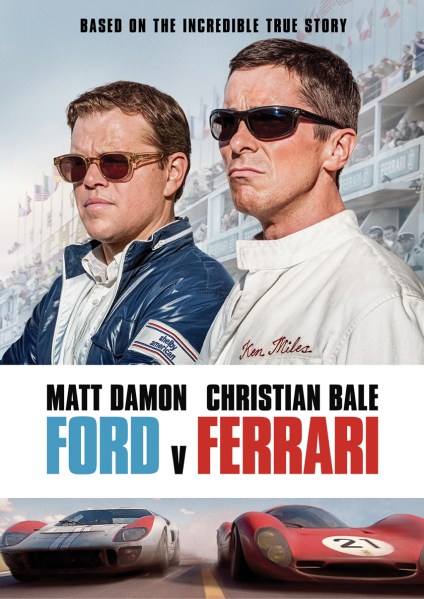
Ford v Ferrari (dir. by James Mangold)


fordvferrari posterIt’s rare for me to say that I enjoyed a film so much that I didn’t want it to end, but James Mangold’s Ford v. Ferrari hits all the right notes. A fantastic cast, impressive visuals on the races, scenes that flow without any time wasted and sound that begs to be heard on a surround system. It’s no surprise that the film earned Four Oscar Nominations – Best Sound Editing, Best Sound Mixing, Best Film Editing and Best Picture, all of which are well deserved. If the lineup this year wasn’t so stacked, I’d say that Ford v Ferrari would score quite a bit. It can go any way, but It may end up like The Shawshank Redemption – A great film that could be eclipsed by giants.
Based on a true story, Ford v. Ferrari focuses on the Ford Motor Company in the mid 60’s, down on its luck and looking for a way to stay ahead of the game. Henry Ford II, played by a scene stealing Tracy Letts (August: Osage County), asks his workers to come up with an idea. A young Lee Iacoccoa  (Jon Bernthal, The Punisher) feels the best way to do so is to attempt to win the famed 24 hour race at Le Mans in France. The LeMans is dominated by Ferrari, who hand manufactures their machines to be legends in the racing circuit. If Ford could win, it would put them in a better light to consumers, but winning requires more than just a fast car.

Ford enlists the help of Carroll Shelby (Matt Damon, The Martian), along with his brash and skillful driver, Ken Miles (Christian Bale, 3:10 to Yuma), Ken has a few issues getting along with others, but his knowledge of cars is brilliant. Shelby continuously goes to bat for Miles, who isn’t exactly poster boy material in the eyes of Ford.  Together, they work on building a competitive vehicle. The poster may suggest the story is about the cars, but at its heart, I felt that Ford v. Ferrari was more about the friendship between Shelby and Miles than anything else. Their mutual love of cars and racing is what ties it all together.

When it comes to the technical points of racing, Ford v Ferrari’s script doesn’t ask you to know much about cars going in. Just about everything you need to about the LeMans and the abilities of the cars is explained through the characters over time. Car gurus may find areas where liberties are taken, but casual watchers should find themselves entertained.

Kudos goes out to the casting for Ford v. Ferrari. Josh Lucas (Poseidon) plays the heavy in the film as a Ford businessman who would love to see Miles out of the spotlight. Caitriona Balfe (Starz’ Outlander) has some good moments with Bale as Miles’ wife, Mollie, though she happens to be the only woman in the film with many lines. Given that the story takes place in the 1960s and its guys building cars, it made sense. Playing Miles son, Peter, Noah Jupe (Honey Boy, A Quiet Place) is that character that helps the audience understand the nuances of racing. I kind of wish Bernthal had more to do here, but he’s cool when he’s on screen and carries his weight easily.

The film belongs to Damon and Bale, though. Damon’s Shelby is full of attitude. He knows what he wants to get done, what needs to happen and just does it. Damon carries this with ease, and it’s easy to forget that the actor is there at times (for me, anyway). Bale does the same, but is on a different level, with his Ken Miles being both focused and a little wild, perhaps even cynical. There’s a great mix of comedy and drama between the two actors.

The sound quality of Ford v. Ferrari is amazing. If you had the chance to see it in the cinema, consider yourself lucky. The rev of the engines are crisp, the shifting the of gears sublime. I’d be somewhat shocked if the film doesn’t walk away with the Sound Mixing / Sound Editing Oscars. From a visual standpoint, the races themselves offer some nice tracking shots, though there may be one or two scenes that particularly stand out.

Mangold and Phedon Papamichael (his Director of Photography for Walk the Line) perform some interesting tricks with the camera. With the races themselves, the cuts are smooth. You have dynamic tracking shots of cars  in some cases while others are lit enough to be comfortable. One of my favorite scenes involves a play on shadows that makes it appear like you’re watching a race, complete with the sound of the cars in the background. It’s subtle touches like that make me wonder why it wasn’t nominated for Best Cinematography. I should also note that for a 2:30 minute film, it flies by. I found very few (if any) moments where I felt a scene wasn’t particularly needed to push the narrative along. You can thank Jez and John-Henry Butterworth (Edge of Tomorrow) for that screenplay.

I can’t say I have any real problems with Ford v Ferrari. Overall, it’s an entertaining film right from the start that gets you into the story and behind the wheel.

https://www.youtube.com/watch?v=v0_iqYgOdvM

Lisa Reviews An Oscar Nominee: The Post (dir by Steven Spielberg)


So, I finally sat down and watched the 2017 film, The Post.

The Post is something of an odd film.  Imagine if someone made a film about the production of a movie.  And imagine if, instead of focusing on the actors or the members of the crew or even the director, the film was instead about the studio executives sitting back in Hollywood and debating whether or not they should agree to give the director another million dollars to complete the film.  Imagine dramatic scenes of the execs meeting with their accountants to determine whether they can spare an extra million dollars.  Imagine triumphant music swelling in the background as one of the execs announces that they’ll raise the budget but only in return for getting to pick the title of the director’s next film.  The Post is kind of like that.  It’s a film about journalism that’s more concerned with publishers and editors than with actual journalists.

To be honest, The Post‘s deification of the bosses shouldn’t really be that much of a shock.  This is a Steven Spielberg film and a part of Spielberg’s legend has always been that, of all the young, maverick directors who emerged in the 70s, he was always the one who was the most comfortable dealing with the studio execs.  As opposed to directors like Martin Scorsese, Brian DePalma, and Francis Ford Coppola, Spielberg got along with the bosses and they loved him.  While his contemporaries were talking about burning Hollywood down and transforming the culture, Spielberg was happily joining the establishment and reshaping American cinema.  No one can deny that Spielberg is a talented filmmaker.  It’s just that, if anyone was going to make a movie celebrating management, you just know it would be Steven Spielberg.

Taking place in the early 70s, The Post deals with the decision to publish The Pentagon Papers, which were thirty years worth of classified documents dealing with America’s involvement in the Vietnam War.  Since the Pentagon Papers revealed that the government spent several decades lying to the American people about the situation in Vietnam, there’s naturally a lot of pushback from the government.  It all leads to one of those monumental supreme court decisions, the type that usually ends a movie like this.  And while the film does acknowledge that there were journalists involved in breaking the story, it devotes most of its attention to editor Ben Bradlee (Tom Hanks) and publisher Katharine Graham (Meryl Streep).

Gasp as Ben and Katharine debate whether to publish the story!

Shudder as Katharine tries to figure out how to keep the Post from going bankrupt.

Watch as Ben Bradlee talks to the legal department!

Thrill as Katharine Graham learns that her family friends, John F. Kennedy and Lyndon B. Johnson, weren’t always honest with her!

And listen, I get it.  The Post isn’t as much about Nixon and the Vietnam War as it’s about Trump and the modern-day war on the media.  And yes, we get plenty of scenes of Tom Hanks explaining why freedom of the press is important and the movie ends in typical Spielberg fashion, with triumphant music and all the rest.  But watching The Post, it’s hard not to think about other films that celebrated journalism, films like All The President’s Men and Spotlight.  Both of those films featured scenes of editors supporting their reporters.  In fact, All The President’s Men featured Jason Robards playing the same editor that Tom Hanks plays in The Post.  But Spotlight and All The President’s Men focused on the journalists and the hard work that goes into breaking an important story.  Robards and Spotlight‘s Michael Keaton played editors who were willing to stand up and defend their reporters but, at the same time, those films emphasized that it was the underpaid and underappreciated reporters who were often putting their careers (and sometimes, their lives) on the line to break a story.  Whereas Spotlight and All The President’s Men showed us why journalism is important, The Post is content to merely tell us.

The Post was a famously rushed production.  Shooting started in May of 2017 and was completed in November, all so it could be released in December and receive Oscar consideration.  Production was rushed because Spielberg, Streep, and Hanks all felt that it was important to make a statement about Trump’s treatment of the press.  While I can see their point and I don’t deny that they had noble intentions, a rushed production is still going to lead to a rushed film.  The Post is a sloppy film, full of way too much on-the-nose dialogue and scenes that just seem to be missing Spielberg’s usual visual spark.  It feels less like a feature film and more like a well-made HBO production.  Tom Hanks and Meryl Streep give performances that are all surface.  Streep’s performance is all mannered technique while Hanks occasionally puts his feet up on his desk and furrows his brow.

It gets frustrating because, watching the film, you get the feeling that there’s a great movie to be made about the Pentagon Papers and the struggle to publish them.  I’d love to know what the actual reporters went through to get their hands on the papers.  But The Post is more interested in management than the workers.

All through 2017, The Post was touted as being a sure Oscar front-runner.  When it was released, it received respectful but hardly enthusiastic reviews.  In the end, it only received two nominations — one for best picture and one for Streep.  In a year dominated by Lady Bird, Shape of Water, Get Out, and Three Billboards Outside Ebbing, Missouri, The Post turned to be a nonfactor.  For all the hype and expectations, it’s the film that you usually forget whenever you’re trying to remember everything that was nominated last year.

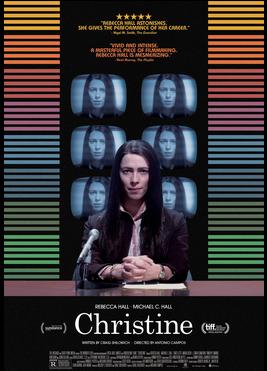
The Things You Find on Netflix: Christine (dir by Antonio Campos)


I really regret that I didn’t get a chance to see Christine when it played here last year.  I wanted to but the movie was only in theaters for a week and then it vanished.

I guess I shouldn’t be too surprised that Christine didn’t become a blockbuster.  I imagine that most potential viewers were turned off by the fact that 1) it wasn’t a remake of the movie about the killer car and 2) it was based on the true story of a reporter who, in 1974, committed suicide on live television.  I imagine that, to many people, the film sounded like it would be indescribably sad.  It certainly sounded that way to me.  That’s why, when the movie opened at the Dallas Angelika, I said, “I’ll see it next week.”  Of course, by the time “next week” rolled around, the movie was gone.

And that’s a shame.  I just watched Christine on Netflix and I discovered that it was one of the best films of 2016.  Yes, it is a sad film but it’s also a frequently fascinating one.  The movie may tell the story of a tragedy but it’s anchored and enlivened by a brilliant performance from Rebecca Hall.  People who love movies, of course, already know that Rebecca Hall is a brilliant actress but, unfortunately, she rarely gets the roles in the films that she deserves.  As of this writing, her most financially successful film was probably The Town and, in that film, she was pretty much wasted in a nothing role.  She is perfectly cast in Christine, perhaps as perfectly cast as any performer could ever hope to be.

Rebecca Hall plays Christine Chubbuck, a reporter who was based in Sarasota, Florida.  In 1974, she started a newscast by announcing, “”In keeping with Channel 40’s policy of bringing you the latest in ‘blood and guts’, and in living color, you are going to see another first—attempted suicide.”  She then drew a gun from a shopping bag that was sitting behind the anchor desk.  As thousands watched, she shot herself in the back of the head.

Along with the gun, the shopping bag had contained the homemade puppets that Christine used whenever she volunteered at the local children’s hospital.  On the anchor desk, among her papers, was a news report that she had written the previous night, announcing that “Local news personality Christine Chubbuck” had shot herself on live television and had been taken to the hospital in critical condition.  Christine, who was reportedly frustrated both personally and professionally, was briefly the number one story in the nation.

One of the more interesting things about the suicide of Christine Chubbuck is that it happened in 1974, long before YouTube, Facebook Live, or Twitter.  Chubbuck’s suicide was only aired once and the footage has subsequently vanished.  If Christine Chubbuck, or anyone else, committed suicide on television today, it would immediately be all over the internet.  We would end up seeing, at the very least, clips of it on an almost daily basis.  Sadly, we would see it so much that we would probably become desensitized to it.  Since Christine Chubbuck’s death was recorded but remains unseen, both she and her suicide have achieved an almost mythical quality.  One can look at the details of Christine Chubbuck’s death and see almost anything that they want.

Christine follows the last few months of Chubbuck’s life.  As played by Rebecca Hall, Christine is confident enough that she can imagine interviewing Richard Nixon but insecure enough to obsess over whether she was nodding too much while the imaginary President gave his imaginary answer.  She lives with her mother (J. Smith-Cameron), a self-described hippie who keeps making references to a breakdown that Christine had in Boston.  When she complains about the pressure that she’s under to sensationalize the news, her boss dismisses her with “You’re a feminist!”  (He says it like an accusation.)  When she gives in and purchases a police scanner so that she can find the stories that the boss is demanding, she ends up spending most of her night listening to two cops brag about “how far” they got with their girlfriends the night before. When she goes to the doctor to complain about chronic stomach pain, she’s told that she has to have an ovary removed and she’ll probably never be able to conceive.  When she thinks that she finally has a date with the man who she’s been crushing on, she is instead dragged to an empty-headed encounter group.  Her group partner has a slick answer for every problem that Christine has until Christine says that she’s thirty and she’s still a virgin.

“Oh,” her partner replies, flummoxed.

In the film, Christine struggles with both depression and, in my opinion, bipolar disorder as well.  Unfortunately, for her mental well-being, she’s a woman in 1974.  The only thing that the world has to offer her are vapid self-affirmation (“I’m okay, you’re okay!  I’m okay, you’re okay!” one co-worker chants at a particularly dramatic moment) and sexist bosses who dismiss what is clearly a manic episode as either “being moody” or “being difficult.”  Speaking as someone who is very sensitive as to how mental health issues are portrayed onscreen, all I can say is that Christine gets it right.

I’m probably making this film sound like the most depressing movie ever made and it’s definitely not a happy film.  I had tears in my eyes by the end of it.  At the same time, it’s also a compulsively watchable character study.  Rebecca Hall gives such a good and brave performance as Christine that you can’t look away, even when you feel like you should.  Rebecca Hall is also ably supported by Michael C. Hall, Tracy Letts, Morgan Spector, Timothy Simons, and Maria Dizzia, who all play her sometimes sympathetic, sometimes annoyed co-workers.

Now, I do think that I should warn anyone from thinking that Christine is a 100% accurate look at Christine Chubbuck’s life and death.  The film left me so moved that I actually did some research and I came across this article from the Washington Post — Christine Chubbuck: 29, Good-Looking, Educated, A Television Personality. Dead. Live and in Color.  After reading the profile, it was easy to see that the film did take some dramatic license.  However, it was also easy to see that Christine gets the essence of the story right.

If, like me, you missed Christine in the theaters, you can now see it on Netflix.  And you should!

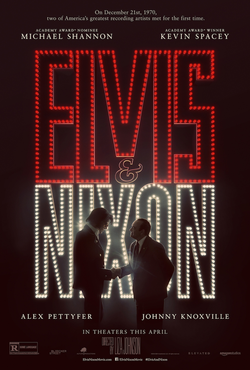
Playing Catch-Up With The Films of 2016: Elvis & Nixon (dir by Liza Johnson)


elvis__nixon_poster

When you think of actors who you could cast in a biopic of Elvis Presley, Michael Shannon is probably not the first actor who comes to mind.  And yet that’s just what the people behind Elvis & Nixon did.  They also cast Kevin Spacey as Richard Nixon, a decision that, on the surface, makes more sense than Shannon playing Elvis.

And yet, in the finished film, it’s Shannon who gives the memorable performance while Spacey often seems lost in the role of Nixon.  Fortunately, with Kevin Spacey’s role largely being an extended cameo, Michael Shannon is the one who is in nearly every scene of the movie.

Elvis and Nixon is based on a true story.  In 1970, Elvis Presley asked for a meeting with Richard Nixon who, if the film is to be believed, wasn’t quite sure who Elvis actually was.  It turns out that Elvis was very concerned about the growing popularity of illegal drugs.  In between consuming prodigious amounts of legal drugs, Elvis formulated a plan.  Perhaps he could go to the White House and convince Nixon to deputize him.  Elvis could be a special agent of the FBI.  Even more importantly, maybe Elvis could get a FBI badge.

So, was Elvis sincere or was he just crazy?  Elvis & Nixon walks a thin line between those two possibilities, suggesting that Elvis may have been a bit unblanced but he was also achingly sincere.  Michael Shannon plays Elvis as a man who is blissfully out-of-touch but who truly wants to make the world a better place.  As played by Shannon, Elvis is defined by ennui.   He may be the biggest star in the world but he still struggles with the feeling that he hasn’t accomplished anything.  This is a film that asks, “When you’ve reached top, where else can you do?”  Elvis wants to make the world a better place by combating the spread of drugs.

And he also really, really wants that badge.  There’s an almost child-like petulance to Shannon’s Elvis.  He may be sincere but he’s also very much used to getting whatever he wants.

For that matter, so is Nixon.  And Nixon really doesn’t want to visit with Elvis.  Of course, that’s before his White House aides mention that being seen with Elvis could help him with the youth vote when he runs for reelection.  And then his daughter says that she wants Elvis’s autograph….

Anyway, it all leads to a meeting in the Oval Office and a scene that would have worked better if Spacey’s performance as Nixon was a bit less of caricature.  That said, the scene still works because Michael Shannon totally invests himself in the role of Elvis.  When he’s talking to Nixon and showing off his karate moves, Elvis is happier than we’ve ever seen him.  He’s performing on the biggest stage of his career.

Elvis & Nixon came out earlier this year.  It’s an enjoyable film, even if it’s never quite as good as you might want it to be.  If nothing else, this film proves that Michael Shannon can pretty much do anything.


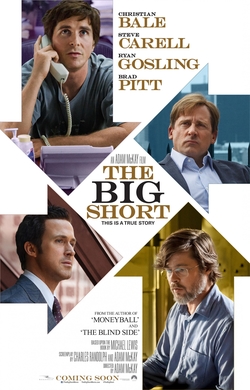
Playing Catch-Up: The Big Short (dir by Adam McKay)


The_Big_Short_teaser_poster

The Big Short is a film that is so critically acclaimed and that has been so passionately embraced by those who enjoyed it that it’s a bit intimidating to admit that it really didn’t do much for me.  (It’s even more intimidating for me to admit that I nearly included it on my list of the 16 worst films of 2015.)  It’s a big, angry movie and, even though it’s not really that good, it definitely taps into the zeitgeist.  It captures the anger, the frustration, and the fears that people (including me) are feeling right now.  It didn’t do much for me but I can understand why others have so passionately embraced it.

As for the film itself, it’s about the housing collapse and the financial crisis of 2008.  The main characters are all people who realized that the economy was about to collapse and who managed to make a profit off of the crisis.  For the most part, everyone gets at least two scenes where they get to rail about how angry they are that they’re making a profit off of other people’s misery.  However, they all still collect their money at the end of the film.

For the most part, our main characters are the type of quirky eccentrics who always tend to pop up in ensemble films like this.  They’re all played by recognizable actors and they all have an identifiable trait or two so we can keep them straight.  For instance, Christian Bale has trouble relating to people socially, plays drums, and looks like he probably has terrible body odor.  Steve Carell has a bad haircut and spends a lot of time yelling at people.  He’s also haunted by the suicide of his brother and he’s married to Marisa Tomei but she only gets to appear in two scenes and doesn’t really do much because this is a film about menfolk, dagnabit.  (I love Steve Carell but this is probably the least interesting performance that he’s ever given.)  John Magaro and Finn Wittrock are two young investors and they especially get upset when they realize that the economy is about to collapse.  Their mentor is played by Brad Pitt.  Since this is an important film, Brad Pitt plays his role with his important actor beard.

And then there’s Ryan Gosling.  Gosling plays a trader and he also narrates the film.  And really, Gosling probably gives the best performance in the film, perhaps because his character is the only one who is actually allowed to enjoy making money.  I think we’re supposed to be outraged when he brags about making money while people lose their houses but Gosling’s so charismatic and the character is so cheerful that it’s hard to dislike him.

(Of course, listening to Gosling’s narration, it’s impossible not to be reminded of The Wolf of Wall Street.  And it’s appropriate because The Big Short is kind of like The Wolf of Wall Street for people who don’t want to have to deal with ambiguity or nuance.)

The film has gotten a lot of attention for Adam McKay’s direction, which is flashy and always watchable but, at the same time, also rather shallow.  For the most part, McKay’s directorial tricks only served to remind me of other movies.  The narration, of course, made me think about The Wolf of Wall Street.  The scenes where characters look straight at the camera and say, “This isn’t the way it really happened,” only reminded me of how much more effective it was when the same thing happened in Michael Winterbottom’s 24 Hour Party People.

And then there’s the celebrity cameos.  These are the scenes where a special guest celebrity is brought on screen to explain to us how Wall Street actually works.  The first time, it’s Margot Robbie in a bubble bath and it works well because it admits the debt that The Big Short owes to Wolf of Wall Street.  (Plus, it ends with Robbie telling the viewers to “fuck off,” which is probably what I would do if a huge group of strangers interrupted my bubble bath.)  If McKay had limited himself to just doing it once, it would have been brilliant.  But McKay drags out three more celebs and, with repeated use, the technique gets less and less interesting.

But I guess it’s debatable whether any of that matters.  The Big Short taps into the way people are feeling now.  It’s a zeitgeist film.  People are rightfully angry and The Big Short is all about that anger.  A decade from now, it’ll probably be as forgotten as Gabriel Over The White House.  But for now, it’s definitely the film of the moment.