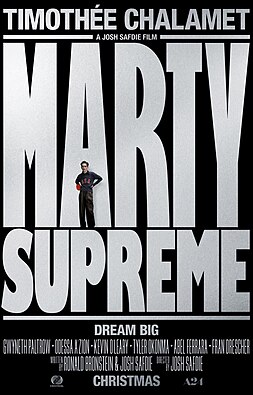
Lisa Marie Reviews An Oscar Nominee: Marty Supreme (dir by Josh Safdie)


Leave it to Josh Safdie to make an anxiety-ridden film about ping pong.

That’s not a complaint, by the way.  Both with his brother Benny and working solo on this film, Josh Safdie has proven himself to be a master at making anxiety compelling.  Much more so than Benny’s 20205 offering, The Smashing Machine, Josh’s Marty Supreme keeps you off-balance.  Marty Supreme may be set in the 50s but it’s deliberately shot in the gritty style of 70s-era Scorese and Lumet.  Meanwhile, the background music is largely made up of classic songs from the 80s.  Timothee Chalamet may play the title role of Marty Mauser, a shoe salesman who also happens to be a ping pong champion.  And the film may also feature recognizable actors like Odessa A’Zion, Gwyneth Paltrow, Fran Drescher, and Emory Cohen (remember him?).   But the majority of the cast is made up of people best-known for not being actors.  Shark Tank co-host and aspiring lead of Canada Kevin O’Leary plays Paltrow’s husband and Marty’s occasional sponsor.  Director Abel Ferrara plays a gangster who is searching for his dog.  Penn Jillette plays a New Jersey farmer who shoots first and asks questions later.  David Mamet, Isaac Mizrahi, early internet sensation Ted Williams, former New York mayoral candidateJ ohn Catsimatidis, rapper Tyler The Creator, and performance artist Sandra Bernhard all show up in small roles, creating a very New York atmosphere that somehow feels both familiar and artificial.  Watching the movie is like living the tourist’s dream of traveling to New York, seeing your favorite Manhattan celebrities hanging out in Brooklyn, and then having them curse you out for owing them money.

As is to be expected from a Safdie film, Marty Mauser is not always a sympathetic protagonist.  He’s been having an affair with the married Rachel (Odessa A’Zion) but, even after he finds out that Rachel is pregnant, that doesn’t stop him from having a purely sexual relationship with former actress Kay Stone (Gwyneth Paltrow), the wife of businessman Milton Rockwell (Kevin O’Leary).  Marty thinks that he’s the world’s best ping pong player, which is why he has a hard time accepting being humiliated at the hands of Japan’s champion, Endo (Koto Kawaguchi).  Marty’s efforts to return to Japan for a rematch lead to an at times dizzying array of complications.  Marty is the type who will steal his lover’s necklace just to return it and apologize after learning that it was only worth two bucks because it was costume jewelry.  Fortunately, Marty is played by Timothee Chalamet, who gives such an energetic and charismatic performance that it’s hard not to be charmed by the character even while his actions might upset, annoy, or even offend you.  The film never claims that Marty is the best ping pong player in the world.  Only Marty claims that.  Instead, the film shows just how unshakeable Marty’s belief in himself is.  It’s hard not to like someone who refuses to accept defeat.

In many ways, Marty is a quintessential American figure.  He believes in himself and he’s not going to apologize for it.  Both the character and the film celebrate the individualism that make America unique.  That 50s setting really does make sense.  Marty truly is the post-war American, dedicated and unapologetic.  And, in that context, the film’s “stunt” casting, for lack of a better description, makes sense as well.  David Mamet, Kevin O’Leary, Penn Jillette, Abel Ferrara, John Catsimatidis, and so many of the other familiar faces that float through Marty Supreme: they’re all people who have gone their own way, even at the risk of alienating the establishment.

Marty Supreme was nominated for 9 Oscars but failed to win any of them.  Indeed, the amount of negative stories that were breathlessly reported about the film’s director and lead actor after the nominations were announced indicates that there was an organized whisper campaign against the film.  (In a sad sign of the time, there was a good deal of negative backlash online from the dishrag brigade, who were upset that the film’s lead character was Jewish.)  Despite being the best of the nominated films, Marty Supreme lost to One Battle After Another.

Review: Kraven the Hunter (dir. by J. C. Chandor)


Kraven is Sony’s latest attempt to mine its Spider-Man-adjacent characters for cinematic gold, this time taking a stab at Sergei Kravinoff, better known as Kraven the Hunter. Even if you’re going in with rock-bottom expectations set by Morbius or the patchy Venom films, you might find yourself torn between mild intrigue and full-on indifference. The movie doesn’t bomb, but it certainly doesn’t soar either—it lands squarely in the “it’s fine, I guess” territory, buoyed by a handful of positive elements but weighed down by a laundry list of issues.

The film tries to position itself as a darker, grittier entry in Sony’s Spider-Man Universe but ultimately falls flat in several key areas. The movie follows Sergei Kravinoff (Aaron Taylor-Johnson), a man battling his toxic past and violent instincts, trying to define himself apart from his ruthless father, Nikolai (Russell Crowe). While Taylor-Johnson puts in a committed, physical performance and the action sequences deliver some visceral excitement—with brutal fight scenes and a snowy prison breakout standing out—the film struggles to transcend its predictable, shallow narrative.

One of the strongest aspects of Kraven is its commitment to visceral, intense action. The movie doesn’t shy away from bloody, fierce fights, embracing Kraven’s nature as a hunter rather than a hero. Physicality is a highlight here with Taylor-Johnson convincingly portraying the character’s power and agility. Some of the choreography—such as a snow-covered prison escape and a jungle chase—inject adrenaline into the movie, complemented by Russell Crowe’s imposing presence as the domineering father. Ariana DeBose’s Calypso and Alessandro Nivola’s Rhino provide interesting, if underdeveloped, counterparts that add flavor to the otherwise monochrome supporting cast.

However, the film is weighed down by a paint-by-numbers storyline that treads the well-worn path of antihero origin stories without adding fresh insight or emotional texture. The plot feels cliched and forgettable, with many moments so awkward and stilted that the dialogue and narrative flow could easily be accused of being AI-generated—and that accusation wouldn’t be out of place. This mechanical, artificial quality in the script creates a disconnect that makes characters seem like hollow archetypes rather than fully realized people. It’s as if the story was stitched together by a formula rather than human creativity, robbing the film of natural humor, depth, or emotional impact.

The biggest glaring example of this artificiality comes in the odd use of CGI for some of the characters’ facial movements. In particular, a scene with DeBose’s Calypso involved digital manipulation of her mouth and eyes to sync dialogue after filming, creating an uncanny, often distracting effect. This technique, reminiscent of the awkward, jarring movement of digitally animated mouths on still images, recalls the uncomfortable “Annoying Orange” vibe and highlights a troubling overreliance on technology rather than retakes or better production planning. It is a standout low point that further reinforces the impression of a rushed or overly engineered project.

The emotional core of Kraven revolves around the toxic father-son dynamic, which Crowe and Taylor-Johnson approach with convincing intensity, though the writing undermines their efforts with repetitive, obvious lines. The other characters, including Calypso, Rhino, and the Foreigner, suffer from limited screen time and one-dimensional arcs, often serving only to advance the plot mechanically rather than enrich the story. The film’s isolation from the broader Spider-Man universe also makes the stakes feel lower, leaving Kraven’s violent vendetta somewhat directionless and detached from broader consequences.

Visually, the film is inconsistent. While it nails gritty, physical action sequences, the CGI and digital alterations break immersion. The attempt at a darker, more grounded tone battles against these technical missteps and a narrative stuck in early-2000s superhero tropes.

Kraven offers some genuinely brutal action and committed performances but is hamstrung by a formulaic, AI-esque script and distracting technical glitches like the digital mouth-sync. It feels like a film caught between creative ambition and lazy execution, where flashes of potential are overwhelmed by awkward dialogue and uninspired plotting. For fans craving raw action or eager to see a Spider-Man villain on screen, it may be a mildly watchable diversion; for anyone seeking a fully fleshed-out, emotionally engaging story, Kraven is likely to disappoint.

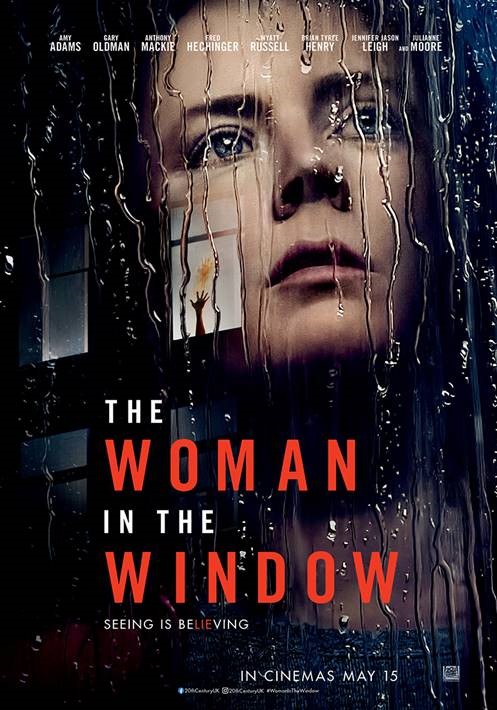
Film Review: The Woman In The Window (dir by Joe Wright)


Joe Wright’s The Woman In The Window is a film that was kicked around a bit before it was eventually released.

Based on the best-selling novel by A.J. Finn, The Woman In The Window was filmed in 2018 and was originally set to be released in October of 2019.  At the time, there were many who predicted that this would be the film for which Amy Adams would finally win an Oscar.  However, after a few poor test screenings, the release of Woman In The Window was pushed back.  The film’s producer, the now-infamous Scott Rudin, reportedly brought in Tony Gilory to re-shoot a few scenes.  The film was finally set to be released in May of 2020 and, needless to say, it was no longer expected to be an Oscar contender.  Then, the pandemic hit and, like so many movies, The Woman In The Window was left in limbo.  With its theatrical release canceled, the film was eventually purchased by Netflix.  Netflix finally released it in May of this year.  With all of the delays and the bad buzz, the critics had plenty of time to sharpen their knives and I don’t think anyone was surprised when the film got scathing reviews.

Though the film was completed long before the lockdowns, The Woman In The Window does feel like a COVID thriller.  Anna Fox (played by Amy Adams) is a child psychologist who is afraid to leave her Manhattan brownstone.  She has agoraphobia, the result of a personal trauma.  She’s not only scared to leave the safety of her apartment but she’s also terrified of anyone else getting inside.  She spends her days spying on the neighbors, drinking wine, and watching old movies.  Of course, that’s also what many people in the real world spent most of the past year doing.  As I watched Anna freak out over some trick or treaters throwing eggs at her door, I was reminded of my neighbor who, a few months ago, nearly had a panic attack because she saw someone walking past her house without a mask.  One could argue that the world itself has become agoraphobic.

Despite her housebound status, Anna does still have a few contacts with the outside world.  For instance, a psychiatrist (played by Tracy Letts, who also wrote the script) comes by every weekend.  She has a tenant named David (Wyatt Russell) who lives in her basement.  She regularly has conversations with her husband and her daughter, who she says are both living in another state.  And eventually, she meets Ethan (Fred Hechinger), the 15 year-old who has just moved in across the street.  When Anna thinks that she’s witnessed Ethan’s father (Gary Oldman) murdering his mother (Julianne Moore), Anna calls the cops.  However, when a totally different woman (Jennifer Jason Leigh) shows up and claims to be Ethan’s mother, Anna is forced to try to solve the mystery herself.

The Woman In The Window is a disjointed and rather messy film but I’d be lying if I said that I didn’t enjoy it.  The novel (which I also greatly enjoyed) was told entirely from Anna’s point of view, which means that we saw everything through the eyes of a sometimes unreliable narrator.  The novel did such a good job of putting us inside of Anna’s head that it didn’t matter that the story itself was full of improbable coincidences.  Director Joe Wright tries to recreate the novel’s uneasiness through garish lighting, crooked camera angles, and abrupt jump cuts.  Sometimes, it’s effective (as when Anna tries to leave her apartment in the rain, just to pass out after having a panic attack) and other times, the technique feels a bit too obvious.  And then there’s other scenes — like when Anna suddenly sees an overturned car in the middle of her living room — where it becomes brilliantly bizarre.  It’s in those scenes, in which the film carefully balances on the line between the surreal and the silly, that Wright seems to be most comfortable as a director.  Much as he did with Anna Karenina, Wright fills The Woman In The Window with scenes that suggest that, on some level, the characters are aware that they’re just characters in a B-melodrama.

Indeed, despite being directed by a great filmmaker and featuring a cast of award-winning actors, The Woman In The Window is a B-movie and, when taken on those terms, it’s an entertaining melodrama.  Interestingly enough, it actually helps that almost everyone in the film has either been miscast or is too obvious a choice for their role.  Gary Oldman is such an on-the-nose choice to play a tyrannical authority figure that it actually makes sense that a film buff like Anna would automatically assume the worst about him.  Julianne Moore has even less screen time than Oldman but she makes the most of it, playing yet another one of her talkative characters who doesn’t appear to have the ability to filter her thoughts.  It’s the type of role that Moore specializes in and one that she could probably play in her sleep but she and Adams establish a good rapport and the scene that they share is one of the best in the film.  Speaking of which, Amy Adams is so incredibly miscast as Anna that you actually find yourself rooting for her to somehow bring the character to life.  Amy Adams is one of the few performers who can make being cheerful compelling so it seems like a bit of a waste to cast her as a self-destructive agoraphobe who can’t leave her apartment  And yet, much as in Hillbilly Elegy where she was similarly miscast, Adams seems to be trying so hard to make her casting work that you appreciate the effort, even if she doesn’t quite succeed.  She’s just so likable that you sympathize with her, even if she isn’t quite right for the role.

(Myself, I pictured Naomi Watts in the role when I read the book.)

As a film, The Woman In The Window shares the book’s flaws.  The plot is a bit too heavy on coincidences and we’re asked to believe that Anna, who can’t leave her house without having a panic attack and who is terrified of someone getting into her house without her knowledge, would also invite Ethan to visit her and allow David to live in her basement.  As well, it’s hard to watch the movie without wondering which scenes were reshot by Tony Gilroy.  (The final scene especially feels out-of-place with what came before it, leading me to suspect that it may have been added in response to those negative test screenings.)  But, while the film’s defects are obvious, I still enjoyed it.  It may be flawed but it’s hardly the disaster that some have made it out to be.

The Woman in the Window