Captain America: Brave New World (dir. by Julius Onah)


Walk into a comic store, and you’ll sometimes find whole collections of comics in one large binder or book. The book that was The Infinity Saga ended with 2019’s Avengers: Endgame and that really should have been the hard stop for Marvel Studios for a while. Still, the Marvel Engine continues to run. Sometimes, we get hits, like 2021’s Shang-Chi and the Legend of the Ten Rings and 2023’s Guardians of the Galaxy, Vol. 3. On occasion, we’ve had that rare film that knocks it out of the park in 2021’s Spider-Man: No Way Home. Mostly, however, we’ve had “okay” stories, like that comic in a pile that you enjoyed reading, but wouldn’t really remember much about it after 15 minutes. These are the ones like Black Widow and Doctor Strange in the Multiverse of Madness (the latter of which I personally hated, despite it being a Raimi film).

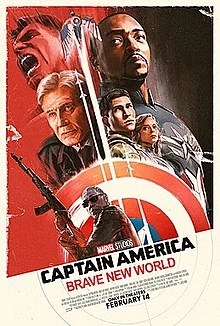
I enjoyed Captain America: Brave New World, but the story didn’t feel as expansive as I thought it could be. It still is grounded in the political intrigue of Captain America: The Winter Soldier and Captain America: Civil War, but I felt like it lacked the same kind of weight those previous films did. There are some good fight scenes and even better flight scene thoughout.

Brave New World finds Sam Wilson (Anthony Mackie) doing very well since taking on the mantle of Captain America. Despite not having any powers, he can still handle his own, somewhat. With a suit and new Vibranium wings, compliments of Wakanda, Wilson’s quite a force to be reckoned with, though he still tends to approach certain situations with de-escalation in mind instead of brute force. He also has some help in the form of Joaquin Torres (Danny Ramirez), who has worked with Sam even before using the shield. Mackie carries this easily with the occassional joke or two. It’s also amazing to watch when you know the character isn’t enhanced and is really just one or two good punches away from a broken limb. I see in Sam Wilson a pre-super serum Steve Rogers, fending off enhanced bullies with nothing but a garbage can lid and lots of heart. That’s heroic and perhaps even Worthy, an underdog still fighting the fight (at least to me, anyway). Ramirez’ Torres is the plucky comic relief in all this. Serious when needed, but playful otherwise. His character reminded me a bit of Pablo Schreiber’s one in Michael Bay’s 13 Hours.

The political landscape has also changed since the days of Iron Man 3’s Matthew Ellis (played by William Sadler). General Thaddeus “Thunderbolt” Ross has risen through the ranks to become the President of the United States. Harrison Ford (Clear and Present Danger) takes over the role of Ross from William Hurt (Altered States), who passed away in 2022. At this stage in his career, Ford doesn’t have to do much to be effective in a scene. He’s played political characters in his Tom Clancy / Jack Ryan era, so this isn’t really new to him. His version of Ross still carries the gruff nature that Hurt had, though personally, I don’t feel either performance was as good as Sam Elliot’s in Ang Lee’s Hulk. Ford’s Ross is a man haunted by the disconnection from his family and a reputation he’d rather put behind him. The same can be said for Carl Lumbly’s Isaiah Bradley. As the forgotten Super Soldier, his character is still slowly integrating into public life after a past that left him cautious and weary.

After a successful mission, Wilson, Torres, and Bradley are invited to the White House for a special announcement. The announcement involves the discovery of the “Celestial Island”, the Continent sized remains of Tiamat from The Eternals. Even better, the entire island is made of a material that appears to be stronger than even Vibranium. The metal, dubbed “Adamantium”, causes a race between the Superpowers to acquire it. Thankfully, a treaty formed by Ross helps to keep conflict at bay.

As exciting as it sounds to hear that this particular Universe suddenly (finally!) has Adamantium in it, the announcement is as far as anyone will get to seeing it. Put away any thoughts of seeing Weapon-X plans in Canada. Japan won’t produce a Silver Samurai, and Russia won’t have Omega Red any time soon. That is not this story, and it’s an outright shame that none of that is even hinted to because the only Marvel solid references we have on Mutants to date are from Ms. Marvel at this point. At best, the Adamantium angle serves as a reason to finally include the aftermath of The Eternals into the story and possibly set up something for future films. Why is Marvel so hesitant on touching the X-Men? Ugh, that’s an argument for a different story.

An incident occurs that finds Sam and Joaquin having to exonerate Isaiah Bradley, while at the same time, trying to unravel the mystery involving a terrorist known only as Sidewinder (Giancarlo Esposito, Abigail) that puts both The President and possibly the entire nation in danger. Can Sam and Joaquin take down the Sidewinder and save the day? That is mostly the gist behind Captain America: Brave New World.

Outside of the performances, From a production standpoint, the film had 5 separate screenplay writers and a number of reshoots. It’s not terrible, but the film does feel a little like the writers were unsure of what they wanted to do from scene to scene. There was one shot involving a prison ward that made me wonder why more guards weren’t present. It’s more a nitpick than anything else. I compare it more to Nolan’s editing mistake with The Dark Knight, where the Joker crashes a party, but we never actually see him leave or learn the fates of the people there after Batman saves Rachel. There were also a number of cuts made to the film that removed scenes by actors such as Wrestling’s Seth Rollins and Alita Battle Angel’s Rosa Salazar. You won’t even notice those unless you’re actively expecting to see them in the film (I didn’t know either actor was involved, honestly).

The big showdown that all of the posters couldn’t seem to hide does happen, and the sequence itself is good, given the weaknesses of our heroes and strengths of our villains. It felt a little shorter to me than I expected it to be though it could be on par with the now classic Battle of Harlem in The Incredible Hulk. There was a time where Marvel was able to keep things like this under wraps, but given the state of the MCU and Hollywood in general, I can understand the marketing team’s fight to pull more people into cinemas.

Overall, Captain America: Brave New World is a good popcorn flick. Will you rave about it? Perhaps. Was it fun? Sure. Was it memorable? I’m not totally sure. I enjoyed where the story took me, but my expectations maybe veered to levels that the story couldn’t reach for me. That’s more a “me” problem than a movie problem. Also note that the film does have a Marvel Post-Credit moment. It doesn’t reveal much or anything specific of where the overall arc is reaching. It’s more of a “Captain America Will Return” than anything else, but of course, we all knew that.
Lisa Marie Reviews An Oscar Nominee: The Thin Red Line (dir by Terrence Malick)


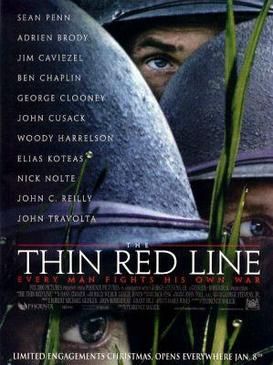
Based on a novel by James Jones (and technically, a sequel of sorts to From Here To Eternity), 1998’s The Thin Red Line is one of those Best Picture nominees that people seem to either love or hate.

Those who love it point out that the film is visually stunning and that director Terrence Malick takes a unique approach to portraying both the Battle of Guadalcanal and war in general.  Whereas Steven Spielberg’s Saving Private Ryan told a rather traditional story about the tragedy of war (albeit with much more blood than previous World War II films), The Thin Red Line used the war as a way to consider the innocence of nature and the corrupting influence of mankind.  “It’s all about property,” one shell-shocked soldier shouts in the middle of a battle and later, as soldiers die in the tall green grass of the film’s island setting, a baby bird hatches out of an egg.  Malick’s film may have been an adaptation of James Jones’s novel but its concerns were all pure Malick, right down to the philosophical voice-overs that were heard throughout the film.

Those who dislike the film point out that it moves at a very deliberate pace and that we don’t really learn much about the characters that the film follows.  In fact, with everyone wearing helmets and running through the overgrown grass, it’s often difficult to tell who is who.  (One gets the feeling that deliberate on Malick’s point.)  They complain that the story is difficult to follow.  They point out that the parade of star cameos can be distracting.  And they also complain that infantrymen who are constantly having to look out for enemy snipers would not necessarily be having an inner debate about the spirituality of nature.

I will agree that the cameos can be distracting.  John Cusack, for example, pops up out of nowhere, plays a major role for a few minutes, and then vanishes from the film.  The sight of John Travolta playing an admiral is also a bit distracting, if just because Travolta’s mustache makes him look a bit goofy.  George Clooney appears towards the end of the film and delivers a somewhat patronizing lecture to the men under his command.  Though his role was apparently meant to be much larger, Adrien Brody ends up two lines of dialogue and eleven minutes of screentime in the film’s final cut.

That said, The Thin Red Line works for me.  The film is not meant to be a traditional war film and it’s not necessarily meant to be a realistic recreation of the Battle of Guadalcanal.  Instead, it’s a film that plays out like a dream and, when viewed a dream, the philosophical voice overs and the scenes of eerie beauty all make sense.  Like the majority of Malick’s films, The Thin Red Line is ultimately a visual poem.  The plot is far less important than how the film is put together.  It’s a film that immerses you in its world.  Even the seeming randomness of the film’s battles and deaths fits together in a definite patten.  It’s a Malick film.  It’s not for everyone but those who are attuned to Malick’s wavelength will appreciate it even if they don’t understand it.

And while Malick does definitely put an emphasis on the visuals, he still gets some good performances out of his cast.  Nick Nolte is chilling as the frustrated officer who has no hesitation about ordering his men to go on a suicide mission.  Elias Koteas is genuinely moving as the captain whose military career is ultimately sabotaged by his kind nature.  Sean Penn is surprisingly convincing as a cynical sergeant while Jim Caviezel (playing the closest thing the film has to a main character) gets a head start on humanizing messianic characters by playing the most philosophical of the soldiers.  Ben Chaplin spends most of his time worrying about his wife back home and his fantasies give us a glimpse of what’s going on in America while its soldiers fight and die overseas.

The Thin Red Line was the first of Terrence Malick’s films to be nominated for Best Picture and it was one of three World War II films to be nominated that year.  However, it lost to Shakespeare In Love.

The Films of 2024: The Bricklayer (dir by Renny Harlin)


Someone is assassinating commie journalists in Europe and making it appear as if the CIA is responsible.  O’Malley (Tim Blake Nelson) of the CIA suspects that the assassin is Michael Radek (Clifton Collins, Jr.), a former intelligence asset who faked his own death but who has now returned and is seeking vengeance on the Agency for the death of his wife and daughter.  O’Malley decides that Radek’s friend and former CIA handler, Steve Vail (Aaron Eckhart), is the only man who can track Radek down.

The problem is that Vail is as disillusioned with intelligence work as Radek.  Vail walked away from the Agency years ago and now spends his time listening to jazz and working as a bricklayer.  Vail explains that, when working with bricks, everything is predictable and everything fits together perfectly.  It’s the opposite of the chaotic world of spies and assassinations.  O’Malley think that Vail is full of crap and I would be tempted to agree if not for the fact that Aaron Eckhart is one of the few actors who can make you believe anything that he says.

At first, Vail refuses to help but then Radek sends a group of assassins to kill him.  That changes Vail’s mind.  Along with an inexperienced supervisor named Kate (Nina Dobrev), Vail heads to Greece to not only track down Radek but also discover the identity of a mole in the CIA.

The Bricklayer was advertised as being a return-to-form of sorts for director Renny Harlin.  In many ways, it’s a typical Harlin film.  For the most part, it looks good.  Some of the action scenes are exciting.  A car flips over and explodes.  At the same time, it never quite reaches the heights of Harlin’s heyday.  This film has neither the grandeur of Die Hard 2, the romantic sparks of The Long Kiss Goodnight, or the energy of Deep Blue Sea.  The film’s low-budget is definitely a factor in that.  There are scenes in the film that look about as cheap as some of the movies that Bruce Willis was making before he announced his retirement.

That said, The Bricklayer does what it does with efficiency and Renny Harlin still knows how to keep the action moving.  Though the story is a bit too familiar to really be intriguing, Aaron Eckhart makes for a surprisingly believable secret agent.  One thing I especially liked about Eckhart’s performance is that he didn’t go for the “grim” stereotype of the former intelligence agent.  As played by Aaron Eckhart, Steve Vail may have had his regrets but he wasn’t some sort of emotionless zombie.  He enjoyed jazz.  He enjoyed the work that he did as a bricklayer.  Though the rules of the genre demand that he and Nina Dobrev start the film as mild adversaries, they quickly developed a likable chemistry.

The Bricklayer is the epitome of an okay, middle of the road movie.  It’s neither good nor bad enough to be especially memorable but it’s entertaining enough if you’ve got 100 minutes to kill.

Lisa Marie Reviews An Oscar Nominee: Nightmare Alley (dir by Guillermo del Toro)


In March, CODA won the Oscar for Best Picture.

By May, I think most people had forgotten about it.

I point this out not to be snarky about CODA (which, for the most part, I found to be a well-made and sweet-natured movie) but to just point out that occasionally, the Oscar for Best Picture Of The Year does not go to the nominee that’s necessarily going to be remembered and watched by future generations.  CODA’s victory is not a travesty, regardless of what some members of Film Twitter insisted.  This isn’t like when Green Book won.  It’s just that CODA seems to be destined to be remembered in much the same way that we remember Argo and Spotlight, i.e. a well-made and well-acted film that gets the job done but don’t necessarily stick around in your mind for long after you watch it.

In fact, looking back at all of the 2021 Best Picture nominees, the one that has really stuck with me is Guillermo del Toro’s Nightmare Alley.

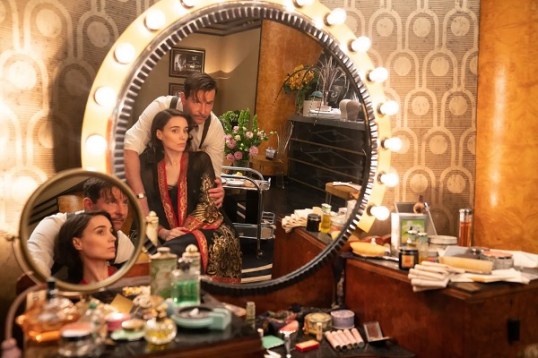
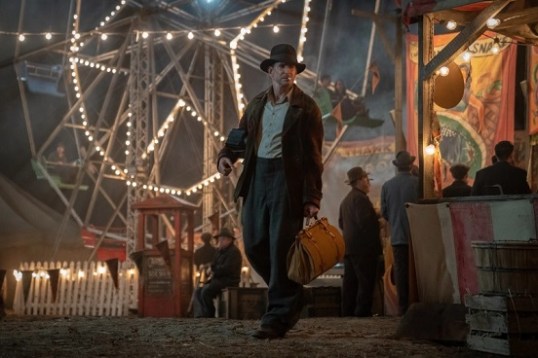
Nightmare Alley tells the story of Stan Carlisle (Bradley Cooper), a drifter who, in 1939, gets a job with a carnival.  Stan is running from his past.  He’s haunted by visions and dreams of a dying old man and a burning farm house.  When we first meet him, he avoids alcohol which is perhaps a good thing as getting drunk at the carnival just makes someone easier to exploit and, ultimately, the carnival is all about exploitation.  The carnival’s owner, Clem (Willem DaFoe), specializes in tricking alcoholics into becoming opium-addicted “geeks,” who bite the heads off of chickens for gawking country audiences.

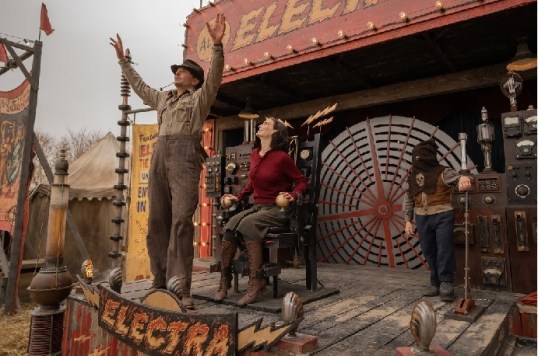
It’s not a glamorous life but it’s one that allows Stan to hide from his past.  He comes under the tutelage of Madame Zeena (Toni Collette) and her husband, Pete (David Straithairn).  They teach him how to give “cold readings,” and Stan proves to be an eager student.  Pete tells Stan to never pretend to be able to speak to the dead and, from the minute that Pete says it, we can tell that Stan is already thinking about how much money he could make by doing just that.  Stan also appears to fall in love with Molly (Rooney Mara), a performer whose act involves a fake electric chair.  When Stan eventually abandons the carnival, Molly goes with him.  When Stan finds success as a fake medium, Molly is his assistant.

Stan becomes quite a success in Buffalo, trading in his shabby clothes and his unshaven appearance for a tuxedo and suave mustache.  With success comes arrogance and Stan soon ignore what Pete told him about pretending to be able to speak to the dead.  When Stan meets a psychologist named Dr. Lillian Rith (Cate Blanchett), he gets involved in a plot to con a judge who is still mourning for his deceased son.  It also leads to Stan meeting a corrupt and murderous businessman (Richard Jenkins).  Ignoring Pete’s lesson sets off a chain of events that leads Stan right back to where he started.

There’s something wonderfully subversive about taking Bradley Cooper, a legitimate movie star who is probably one of the most personable and likable actors working today, and casting him as such a sleazy character.  This isn’t a case, as in American Hustle or even The Hangover movies, where Cooper is playing a goof who gets in over his head.  Instead, Stan is someone who uses his eager manner and his natural charm to cover up the fact that he’s hollow on the inside.  Watching the film, you’re never quite sure as to whether or not Stan truly cares about any of the people who come into his life.  Does he love Molly or is he just using her?  Does he care about his friends from the carnival or is he just manipulating them into acting as a shield to keep out his former life?  When he goes against Pete’s lessons about pretending to speak to the dead, is he motivated by greed or arrogance?  Or does he truly want to believe that he’s somehow become the all-powerful psychic that he pretends to be?  Stan becomes a success because he knows how to con everyone but eventually, he meets someone who is even emptier than he is.  Ultimately, Stan cons himself.  He tricks himself into believing that he’s more clever than he actually is and he ends up facing the fate that he secretly always knew was waiting for him.  Cooper gives an outstanding performance as Stan.  Both he and del Toro cleverly play with what audiences expect when they see Bradley Cooper onscreen.  In the end, the film suggests that not even charm can ward off karma.

Nightmare Alley is work of what Lucio Fulci called “pure cinema,” one in which the imagery and the emotions generated by that imagery is even more important than the story itself.  The sets, whether it’s the carnival or Dr. Ritter’s office or the Buffalo ballroom where Stan cons the wealthy, are large and ornate.  The cinematography is gorgeous.  The supporting performances are arch and witty.  Cate Blanchett’s and Rooney Mara’s costumes are to die for.  Nearly every shot feels as if it could have been lifted from a particularly vivid dream.  Guillermo del Toro’s love of cinema is evident in every frame of Nightmare Alley.  It’s a film that celebrates the grandeur and the power of imagination and also warns about the destructive power of hubris.  Despite the fact that del Toro has gone on the record saying that there’s nothing supernatural about Nightmare Alley, it’s still a wonderful film for the Halloween season.  The costumes are beautiful and the final third of the movie plays like an homage to the classic German expressionistic horror films, with Blanchett playing her role as a mix of Dr. Caligari and a classic noir feeme fatale.  Nightmare Alley is a big, flamboyant, and unforgettable work of pure cinema and, looking back, it’s my favorite film of 2021.

It’s a film that stays with you.

Ghosts of Sundance Past #2: The Report (dir by Scott Z. Burns)


Remember The Report?

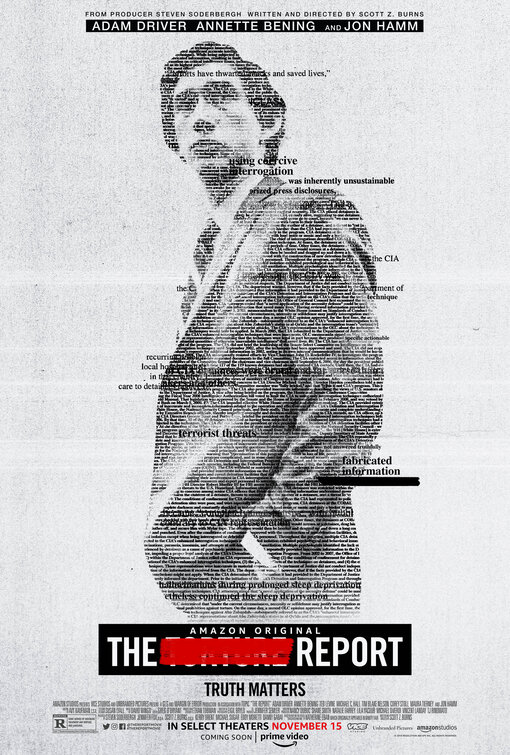
The Report premiered at last year’s Sundance Film Festival, where it was a hit with the critics who saw it.  Amazon acquired the distribution rights and, for the first part of 2019, The Report was one of those films that was regularly discussed as being a potential Oscar nominee.  Not only was it based on a true story but it starred Adam Driver and Annette Bening.  There are several online film critics and award bloggers who are convinced that any film featuring Annette Bening will automatically be an Oscar contender, despite the fact that it rarely seems to work out that way.

Certainly, that ended up being the case with The Report.  Despite all of the hype from Sundance, The Report kind of fizzled when it was finally released.  That it didn’t do much business at the box office makes sense because it was only given a limited release and everyone knew that it would soon be available to stream on Prime.  But even after it was made available on Prime, The Report never really seemed to make much of a dent in the public consciousness.  When the Oscar nominations were announced, The Report was not mentioned once.  Adam Driver did receive a nomination for Best Actor but it was for Marriage Story.

What happened to The Report?  It may have been too low-key for audiences (and, let’s be honest, critics) who have come to expect even a movie about a Senate committee to be experimental and overly stylized.  It could be that, even though the film was critical of the CIA and the War on Terror, it wasn’t angry enough for the same people who thought Adam McKay’s Vice was a brilliantly conceived work of political cinema.  A more realistic explanation is probably that, in this hyper political age, people didn’t want to watch a 2-hour movie about a senate staffer.  Instead, people wanted an escape from all that.

It’s understandable but it’s also a shame because The Report is a very good film.  I mean, I usually hate films like this but I was surprised by how much I liked it.
The Report deals with the efforts of Senate staffer Daniel Jones (Adam Driver) and the members of the Senate Intelligence Committee to investigate the CIA’s use of torture in the aftermath of 9-11.  Skipping back and forth through time, the film shows us how Jones was first assigned to lead an investigation into the CIA’s activities in 2005 and how, over the course of seven years, Jones puts together not one but two reports that absolutely nobody wants released.  Along the way, Jones goes from being a generally idealistic and optimistic staffer to eventually becoming the type of paranoid and obsessive man who meets with reporters in underground garages and who considers leaking classified information.  Daniel has what he believes to be proof that using torture is not only unethical but also counter-productive but, as he discovers, even the members of his own political party aren’t particularly interested in releasing his report.  Adam Driver gives a memorably intense performance of Daniel, playing him as someone whose obsession with his report sometimes threatens to push him over the edge and transform him from being a crusader to being a zealot.

Annette Bening plays Daniel’s boss, Sen. Dianne Feinstein.  It’s interesting casting and, to be honest, it doesn’t quite work.  I almost feel like it would have been better for the film to have either kept Feinstein off-screen or to have at least minimized her role.  The problem is that Dianne Feinstein is a widely-known figure and it’s jarring to see Annette Bening, another well-known figure (at least among film fans), in the role.  Bening plays Feinstein as being a ethical and serious-minded stateswoman and she does what she can with what the film gives her but, at the same time, it’s still kind of a boring performance.  The film presents Feinstein, a not uncontroversial figure, in a positive light and I’m sure some, on both the Right and the Left would say that it’s perhaps a bit too positive.  One gets the feeling that Feinstein’s main role in the film is to assure us that the system works but we just have to take one look at Adam Driver losing his mind to realize that it doesn’t.

That misstep aside, The Report still works far better than I was expecting it too.  Taking obvious inspiration from All The President’s Men, Scott Z. Burns directs the film as if it were a thriller and the deeper that Adam Driver gets into his research, the darker and more shadowy Washington D.C. seems to become.  Even though the film clearly has an agenda, Burns gives the other side a chance to make their case without presenting them as being cartoonish villains.  In other words, this is the opposite of an Aaron Sorkin or Adam McKay-style diatribe.  Instead, this is an intelligent movie about intelligent people.  It’s a film that makes some of the same points as many other similarly liberal films but it makes them without taking cheap shots or resorting to a heavy hand. Long after Vice has been forgotten, The Report will be remembered.

And, if you haven’t seen it yet, it’s on Prime!

Film Review: Hamlet (dir by Michael Almereyda)


What if Hamlet was a hipster douchebag?

That appears to be the question at the heart of the 2000 film adaptation of William Shakespeare’s most famous play.  In this adaptation, a young Ethan Hawke plays a Hamlet who is no longer a melancholy prince but who is instead a film student with a petulant attitude.

As you probably already guessed, this is one of those modern day adaptations of Shakespeare.  Denmark is now a Manhattan-based corporation.  Elsinore is a hotel.  Hamlet ponders life while wandering around a Blockbuster and, at one point, the ghost of his father stands in front of a Pepsi machine.  While Shakespeare’s dialogue remains unchanged, everyone delivers their lives while wearing modern clothing.  It’s one of those things that would seem rather brave and experimental if not for the fact that modern day versions of Shakespeare have gone from being daring to being a cliché.

At the film’s start, the former CEO of the Denmark Corporation has mysteriously died and his brother, Claudius (Kyle MacLachlan), has not only taken over the company but he’s also married the widow, Gertrude (Diane Venora).  Hamlet comes home from film school, convinced that there has been a murder and his suspicions are eventually confirmed by the ghost of his father (Sam Shepard).  Meanwhile, poor Ophelia (Julia Stiles) takes pictures of flowers while her brother, Laertes (Liev Schreiber), glowers in the background.  Polonius (Bill Murray) offers up pointless advice while Fortinbras (Casey Affleck) is reimagined as a corporate investor and Rosencrantz (Steve Zahn) wears a hockey jersey.  Hamlet spends a lot of time filming himself talking and the Mousetrap is no longer a player but instead an incredibly over-the-top short film that will probably remind you of the killer video from The Ring.

I guess a huge part of this film’s appeal was meant to be that it featured a lot of people who you wouldn’t necessarily think of as being Shakespearean actors. Some of them did a surprisingly good job.  For instance, Kyle MacLachlan was wonderully villainous as Claudius and Steve Zahn was the perfect Rosencrantz.  Others, like Diane Venora and Liev Schreiber, were adequate without being particularly interesting.  But then you get to Bill Murray as Polonius and you start to realize that quirkiness can only take things so far.  Murray does a pretty good job handling Shakespeare’s dialogue but that doesn’t change the fact that he’s totally miscast as the misguided and foolish Polonius.  One could easily imagine Murray in the role of Osiric.  Though it may initially seem a stretch, one could even imagine him playing Claudius.  But he’s simply not right for the role of Polonius.  Murray’s screen presence is just too naturally snarky for him to be convincing as a character who alternates between being a “tedious, old fool” and an obsequious ass kisser.

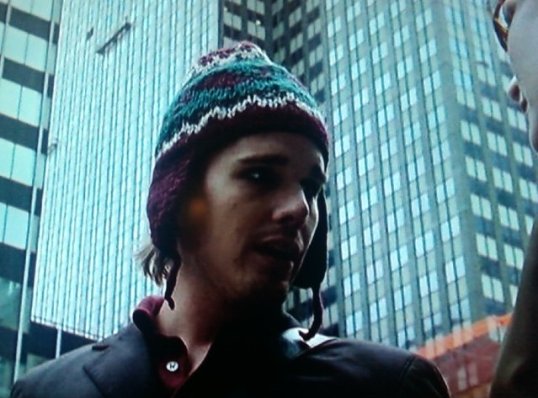
Considering that he spends a large deal of the movie wearing a snow cap while wandering around downtown Manhattan, Ethan Hawke does a surprisingly good job as Hamlet.  Or, I should say, he does a good job as this film’s version of Hamlet.  Here, Hamlet is neither the indecisive avenger nor the Oedipal madman of previous adaptations.  Instead, he’s portrayed as being rather petulant and self-absorbed, which doesn’t necessarily go against anything that one might find within Shakespeare’s original text.  Hawke’s not necessarily a likable Hamlet but his interpretation is still a credible one.

At one point, while Hamlet thinks about revenge, we see that he’s watching Laurence Olivier’s version of Hamlet on television.  There’s Olivier talking to Yorick’s skull while Hawke watches.  It’s a scene that is somehow both annoying and amusing at the same time.  On the one hand, it feels rather cutesy and more than a little pretentious.  At the same time, it’s so over-the-top in its pretension that you can’t help but kind of smile at the sight of it.  To me, that scene epitomizes the film as a whole.  It’s incredibly silly but it’s so unapologetic that it’s easy to forgive.

What If Lisa Picked The Oscar Nominees: 2018 Edition


With the Oscar nominations due to be announced tomorrow, now is the time that the Shattered Lens indulges in a little something called, “What if Lisa had all the power.” Listed below are my personal Oscar nominations. Please note that these are not the films that I necessarily think will be nominated. The fact of the matter is that the many of them will not. Instead, these are the films that would be nominated if I was solely responsible for deciding the nominees this year. Winners are starred and listed in bold.

(You’ll also note that I’ve added four categories, all of which I believe the Academy should adopt — Best Voice-Over Performance, Best Casting, Best Stunt Work, and Best Overall Use Of Music In A Film.)

(Click on the links to see my nominations for 2017201620152014201320122011, and 2010!)

Best Picture

Avengers: Infinity War

The Ballad of Buster Scruggs

Blindspotting

*Eighth Grade

The Favourite

Leave No Trace

The Other Side of the Wind

Roma

A Simple Favor

Support the Girls


Best Director

*Bo Burnham for Eighth Grade

The Coen Brothers for The Ballad of Buster Scruggs

Alfonso Cuaron for Roma

Debra Granik for Leave No Trace

Yorgos Lanthimos for The Favourite

Orson Welles for The Other Side of the Wind


Best Actor

John Cho in Searching

Jason Clarke in Chappaquiddick

Bradley Cooper in A Star is Born

Daveed Diggs in Blindspotting

*Ethan Hawke in First Reformed

Joaquin Phoenix in You Were Never Really Here


Best Actress

Yalitza Aparicio in Roma

Elsie Fisher in Eighth Grade

Lady Gaga in A Star is Born

*Regina Hall in Support the Girls

Anna Kendrick in A Simple Favor

Thomason McKenzie in Leave No Trace


Best Supporting Actor

Peter Bogdonavich in The Other Side of the Wind

*Ben Foster in Leave No Trace

Michael B. Jordan in Black Panther

Josh Hamilton in Eighth Grade

Tim Blake Nelson in The Ballad of Buster Scruggs

Michael Palin in The Death of Stalin


Best Supporting Actress

Emily Blunt in A Quiet Place

*Olivia Colman in The Favourite

Zoe Kazan in The Ballad of Buster Scruggs

Blake Lively in A Simple Favor

Emma Stone in The Favourite

Rachel Weisz in The Favourite


Best Voice Over or Motion-Capture Performance

*Josh Brolin in Avengers: Infinity War

Jake Johnson in Spider-Man: Into the Spider-Verse

Holly Hunter in The Incredibles 2

Shamiek Moore in Spider-Man: Into the Spider-Verse

John C. Reilly in Ralph Breaks The Internet

Ben Whishaw in Paddington 2


Best Original Screenplay

Blindspotting

The Death of Stalin

*Eighth Grade

The Favourite

Game Night

Support the Girls


Best Adapted Screenplay

Avengers: Infinity War

The Ballad of Buster Scruggs

If Beale Street Could Talk

Leave No Trace

*A Simple Favor

A Star is Born


Best Animated Feature

Early Man

Have A Nice Day

The Incredibles 2

Isle of Dogs

Ralph Breaks the Internet

*Spider-Man: Into the Spider-Verse


Best Documentary Feature

Avicii: True Stories

Recovery Boys

Shirkers

They’ll Love Me When I’m Dead

*Three Identical Strangers

Won’t You Be My Neighbor?


Best Foreign Language Film

Battle

Gun City

Happy as Lazzaro

Have A Nice Day

The Most Assassinated Woman In The World

*Roma


Best Casting

Blindspotting

Eighth Grade

Mandy

Mid90s

Roma

*Support the Girls


Best Cinematography

Aquaman

Avengers: Infinity Wars

The Ballad of Buster Scruggs

Black Panther

*Mandy

Roma

Best Costume Design

The Ballad of Buster Scruggs

*Black Panther

The Favourite

Lizzie

Mary, Queen of Scots

A Simple Favor


Best Film Editing

Avengers: Infinity Wars

Eighth Grade

Mission Impossible: Fallout

*The Other Side of the Wind

Roma

Searching

Best Makeup and Hair Styling

*The Favourite

Lizzie

Mandy

Mary, Queen of Scots

A Simple Favor

Support the Girls

Best Original Score

Avengers: Infinity War

The Ballad of Buster Scruggs

The Death of Stalin

If Beale Street Could Talk

*Mandy

The Other Side of the Wind

Best Original Song

*“When a Cowboy Trades His Spurs For Wings” from The Ballad of Buster Scruggs

“All the Stars” from Black Panther

“Limitless” from Second Act

“I’ll Never Love Again” from A Star is Born

“Is that Alright” from A Star is Born

“Shallow” from A Star is Born


Best Overall Use of Music

Bohemian Rhapsody

Eighth Grade

Mamma Mia: Here We Go Again

Mid90s

*A Star is Born

Three Identical Strangers


Best Production Design

Avengers: Infinity War

Black Panther

The Commuter

*The Favourite

Mary, Queen of Scots

A Quiet Place

Best Sound Editing

Annihilation

*Avengers: Infinity War

Mission Impossible: Fallout

The Other Side of the Wind

Roma

12 Strong

Best Sound Mixing

Annihilation

Avengers: Infinity War

Mission Impossible: Fallout

The Other Side of the Wind

Roma

*A Star is Born

Best Stuntwork

Avengers: Infinity War

Beirut

Black Panther

*Mission Impossible: Fallout

12 Strong

Upgrade

Best Visual Effects

Annihilation

Ant-Man and the Wasp

Aquaman

*Avengers: Infinity War

Black Panther

First Man

Films Listed By Number of Nominations:

11 Nominations – Avengers: Infinity War

9 Nominations – The Ballad of Buster Scruggs, The Favourite, Roma

8 Nominations – Eighth Grade, A Star is Born

7 Nominations – Black Panther, The Other Side of the Wind

6 Nominations – A Simple Favor

5 Nominations – Leave No Trace, Support the Girls

4 Nominations – Blindspotting, Mandy, Mission Impossible: Fallout

3 Nominations – Annihilation, The Death of Stalin, Mary Queen of Scots, Spider-Man: Into the Spider-Verse

2 Nominations – Aquaman, Have A Nice Day, If Beale Street Could Talk, The Incredibles 2, Lizzie, Mid90s, A Quiet Place, Ralph Breaks the Internet, Searching, Three Identical Strangers, 12 Strong

1 Nomination – Ant-Man and the Wasp, Avicii: True Stories, Battle, Beirut, Bohemian Rhapsody, Chappaquiddick, The Commuter, Early Man, First Man, First Reformed, Game Night, Gun City, Happy as Lazzaro, Isle of Dogs, Mamma Mia 2: Here We Go Again, The Most Assassinated Woman In The World, Paddington 2, Recovery Boys, Second Act, Shirkers, They’ll Love Me When I’m Dead, Upgrade, Won’t You Be My Neighbor?, You Were Never Really Here

Films Listed By Number of Oscars Won:

3 Oscars – Eighth Grade, The Favourite

2 Oscars – Mandy, A Star is Born, Support the Girls

1 Oscar – The Ballad of Buster Scruggs, Black Panther, First Reformed, Leave No Trace, Mission Impossible: Fallout, The Other Side of the Wind, Roma, Spider-Man: Into the Spider-Verse, Three Identical Strangers

As for the real nominations, they’ll be announced on Tuesday morning!

Sundance Film Review: Blue Caprice (dir by Alexandre Moors)


(The Sundance Film Festival is currently taking place in Utah.  This week, I am reviewing films that premiered at and/or received a prize at Sundance.  Tonight, I take a look at the 2013 film, Blue Caprice.)

When we first meet Lee (Tequan Richmond), he is fifteen years old and living in poverty in Antigua.  One morning, he watches as his mother gets in a car with a strange man.  Before she goes, she tells Lee that she has no choice but to leave and that she will return.  Lee says nothing as his mother is driven away.

Lee’s mother doesn’t return.  Lee spends his time sitting in an empty house.  He wanders through the nearby woods.  Sometimes, he goes to a nearby town and walks around aimlessly.  It’s in that town where he first sees John (Isaiah Washington).  John is an American who is living on the island with his three children.  John spots Lee watching him and soon, Lee is eating dinner at John’s house.  John’s children ask if Lee is going to be living with them.  John says that he doesn’t know.  They ask if they can see their mother.  John explains that, if they see their mother, they’ll no longer be able to spend time with him.

Months later, John and Lee are in Tacoma, Washington.  The children are back with their mother.  John tells Lee that America is full of lies.  He says that all women lie.  He says that the army lied to him.  John says that he just wants to get his children back.  John tells everyone that they meet that Lee is his son.  John says that he loves Lee but, when John visits an old girlfriend, he has no hesitation about telling Lee to go walk around for a while.  Lee ends up staring at the speaker at a fast food drive-through in amazement.  “Do you have cheap burgers?” he asks.

John and Lee keep moving and eventually end up living with an old army friend of John’s.  Ray (Tim Blake Nelson) is a good-natured redneck.  He enjoys playing video games, smoking weed, and shooting guns.  When Lee shoots one of Ray’s guns, Ray declares Lee to be a natural.  John stares at the gun in Lee’s hand.

When he’s not trying to track down his ex-wife and children, John trains Lee.  He ties Lee up and abandons him in the woods, forcing Lee to figure out how to escape.  (“DAD!” Lee shouts as John walks away from him.)  He gives Lee a sniper manual to study.  He explains to Lee that the first step to destroying society is to make people panic.  He says that it’s important to kill random people.  After killing a man, they’ll kill a woman.  After killing a woman, they’ll kill a child.  No one will feel safe.  When Lee shows reluctance about John’s plans, John demands to know if Lee loves him…

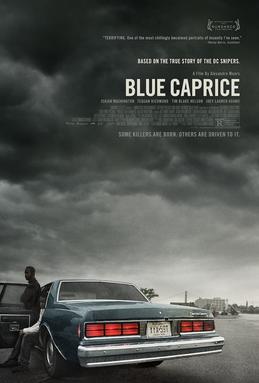
Blue Caprice is based on a true story.  In 2002, John Muhammad and Lee Malvo shot 27 people in Maryland, Virginia, and Washington, D.C., killing 17 of them.  The title of the film comes from the car that Muhammad and Malvo lived in during their shooting spree.  Significantly, throughout the film, John and Lee are referred to only by their first names. Though the film may have been inspired by their actual crimes, Blue Caprice never claims to be an exact recreation of what happened.  Instead, the film speculates about how John was able to turn a directionless teenager into a killer.

It makes for a chilling film.  Isaiah Washington plays John as being a chameleon, a man who is so empty on the inside that he’s become very good at fooling people into believing that he’s whatever they want him to be.  John is the type who can spend the morning plotting to overthrow the government, the afternoon trying to fool a school principal into telling him where his children are now living, and the evening grilling burgers and laughing with the neighbors.  The film leaves no doubt to John’s evil but it’s attitude towards Lee is more ambiguous.  Tequan Richmond captures the transformation of Lee from being a withdrawn teenager to a cold-blooded killer.  Was Lee capable of being a killer before he met John or was he transformed by the older man?  That’s the question that both the film and the audience struggles with.

Blue Caprice got good reviews when it played at the 2013 Sundance Film Festival, thought it was ultimately overshadowed by Fruitvale Station.  It’s a disturbing film and not an optimistic one, which is perhaps why, post-Sundance, it never received quite as much attention as it deserved.  It may not be a pleasant film to watch but it is one that definitely leaves an impression.

Previous Sundance Film Reviews:

  1. Blood Simple
  2. I Don’t Feel At Home In This World Anymore
  3. Circle of Power
  4. Old Enough

Cleaning Out The DVR: O (dir by Tim Blake Nelson)


(Lisa is currently in the process of cleaning out her DVR!  This could take a while.  She recorded the 2001 high school film O off of Cinemax on July 6th.)

Tell me if this sounds familiar.

O (Mekhi Phifer) is one of the only black students attending an exclusive high school in South Carolina.  Despite a past that involves petty crime and drugs, O appears to have his life on the right track.  As the captain of school’s basketball team, O is the most popular student at his school.  Everyone looks up to him.  Everyone wants to be him.  He’s even dating Desi (Julia Stiles), the very white daughter of the school’s very white headmaster (John Heard).  At a school assembly, Coach Duke Goulding (Martin Sheen) describes O as being like a son to him.  When O is awarded the MVP trophy, he shares it with his teammate, Michael Cassio (Andrew Keegan).

Watching all of this with seething jealousy is Hugo Gaumont (Josh Hartnett).  Hugo is a teammate of O’s.  In fact, he even thought that he was O’s best friend.  That was before O shared his award with Michael.  Making Hugo even more jealous is that he happens to be the son of the coach.  For every kind word that Duke has for O, he has a hundred petty criticisms for Hugo.  Whereas O has overcome drug addiction and is proclaimed as a hero for doing so, Hugo is secretly doing steroids, trying to do anything to improve himself as a player and hopefully win everyone’s love.

So, Hugo decides to get revenge.  Working with a nerdy outcast named Roger Calhoun (Elden Hansen), he manipulates O into thinking that Desi is cheating on him with Cassio.  He also tricks Cassio into getting into a fight with Roger, leading to Cassio getting suspended from the team.  To top it all off, Hugo gets O hooked on drugs, once again.  Finding himself consumed by a violent rage that he thought he had under control, O starts to obsess on determining whether or not Desi has been faithful to him…

If that sounds familiar, that’s because O is basically Othello, transported to modern times and involving privileged teenagers.  Even though the whole modernized Shakespeare thing has become a bit of a cliché, it actually works pretty well in O.  Hugo’s obsessive jealousy of the “cool kids” feels right at home in a high school setting and director Tim Blake Nelson and writer Brad Kaaya do a fairly good job of transporting Shakespeare’s Elizabethan melodrama to the early aughts.

(Actually, O was filmed in 1999 but it sat on the shelf for two years.  After a spate of school shootings, distributors were weary about releasing a film about high school students trying to destroy each other.)

Admittedly, O has its share of uneven moments.  Martin Sheen, playing the type of role that always seems to bring out his worst instincts as an actor, goes so overboard as the coach that he threatens to sink almost every scene in which he appears and Rain Phoenix is miscast as Hugo’s girlfriend.  Even Julia Stiles struggles a bit in the role of Desi.  However, both Mekhi Phifer and Josh Hartnett are perfectly cast as O and Hugo.  Phifer brings just the right amount of arrogant swagger to the role while Hartnett is a sociopathic marvel as Hugo.  Tim Blake Nelson’s direction is occasionally overwrought, relying a bit too heavily on a groan-inducing metaphor about taking flight and claiming the spotlight.  However, both Nelson and the film deserve some credit for not shying away from directly confronting and portraying the source material’s cultural and racial subtext.

O is hardly perfect but it is always watchable and, at its best, thought-provoking.

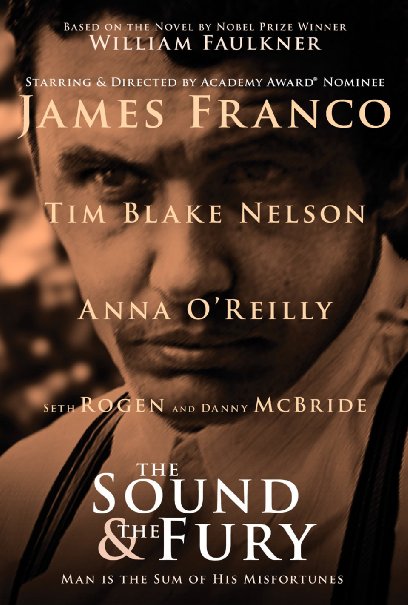
Cleaning Out the DVR Yet Again #37: The Sound and the Fury (dir by James Franco)


(Lisa recently discovered that she only has about 8 hours of space left on her DVR!  It turns out that she’s been recording movies from July and she just hasn’t gotten around to watching and reviewing them yet.  So, once again, Lisa is cleaning out her DVR!  She is going to try to watch and review 52 movies by the end of Thursday, December 8th!  Will she make it?  Keep checking the site to find out!)

the_sound_and_the_fury_2014_film

James Franco’s 2015 adaptation of William Faulkner’s classic novel, The Sound and The Fury, aired on Starz on November 2nd.

You know what?  Haters are going to hate but James Franco does more in an hour than most people do in a month.  Not only is James one of the most consistently interesting actors working today but he’s also a writer, a painter, a teacher, an activist, and a film director.

Indeed, it’s his work as a director that might be the most overlooked part of James’s prolific career.  Since making his directorial debut in 2006, with The Ape, James Franco has directed over 30 movies, television episodes, and short films.  As a director, James Franco has shown a talent for strong visuals and a willingness to take on difficult material.

For instance, can you imagine any other director who would have the guts to try to make a film out of The Sound and The Fury, the classic novel that may be the most unfilmable literary work this side of Finnegan’s Wake?

Told through the perspective of four related but very different characters, The Sound and The Fury details the fall of both the once mighty Compson family and the old South that the Compsons represent.  Benjy Compson is developmentally disabled and sees the world in a disjointed, nonlinear style.  Quinton Compson is fragile and sensitive and, while his section of the book starts in a fairly straight-forward enough manner, it quickly becomes nearly incoherent as Quinton’s mental state starts to deteriorate.  Jason Compson is cruel and evil but, because of his ruthless and self-centered personality, his section is the most straight-forward and the easiest to follow.  And finally, there’s Dilsey, the Compson family servant who is the only person to understand why the Compsons are in decline.  Faulkner utilized stream-of-consciousness throughout the entire novel, to such an extent that readers and critics are still debating just what exactly is happening and what Faulkner is actually saying.

In short, it takes courage to adapt a novel like The Sound and The Fury.  It takes even more courage when you’re an actor-turned-director who has his share of jealous haters.

Now, I should admit that James Franco was not the first director to attempt to make a film out of The Sound and The Fury.  In 1959, Martin Ritt made a version of the film, which reportedly did away with the nonlinear structure and centered the film around the straight-forward Jason.  (I haven’t seen the 1959 version.)  James Franco, on the other hand, not only adapts The Sound and The Fury but also adapts Faulkner’s style.

James Franco replicates the novel’s nonlinear structure and even takes on the role of Benjy himself.  It makes for a film that is occasionally frustrating and difficult to follow but which is also undeniably fascinating.  Filled with haunting images, James Franco’s The Sound and The Fury is a visual feast, one that perfectly captures the atmosphere of a decaying society.  The South, in this film, is trapped between the possibly imagined glories of the past and the harsh reality of the future.  There’s a dream-like intensity to the film.  It sticks with you.

As well, James Franco does an excellent job casting his film.  Tim Blake Nelson brings an enigmatic combination of grandeur and threat to the role of Mr. Compson and Jacob Loeb is haunting as the fragile Quentin.  Scott Haze dominates the film as the cruel Jason.  Though you never sympathize with Jason, you can understand how he became the man that he is.  Jason may not be a good man but, unlike the rest of the Compsons, you never doubt that he’s going to survive in one way or another.

James Franco took a big chance directing The Sound and The Fury and he succeeded.